

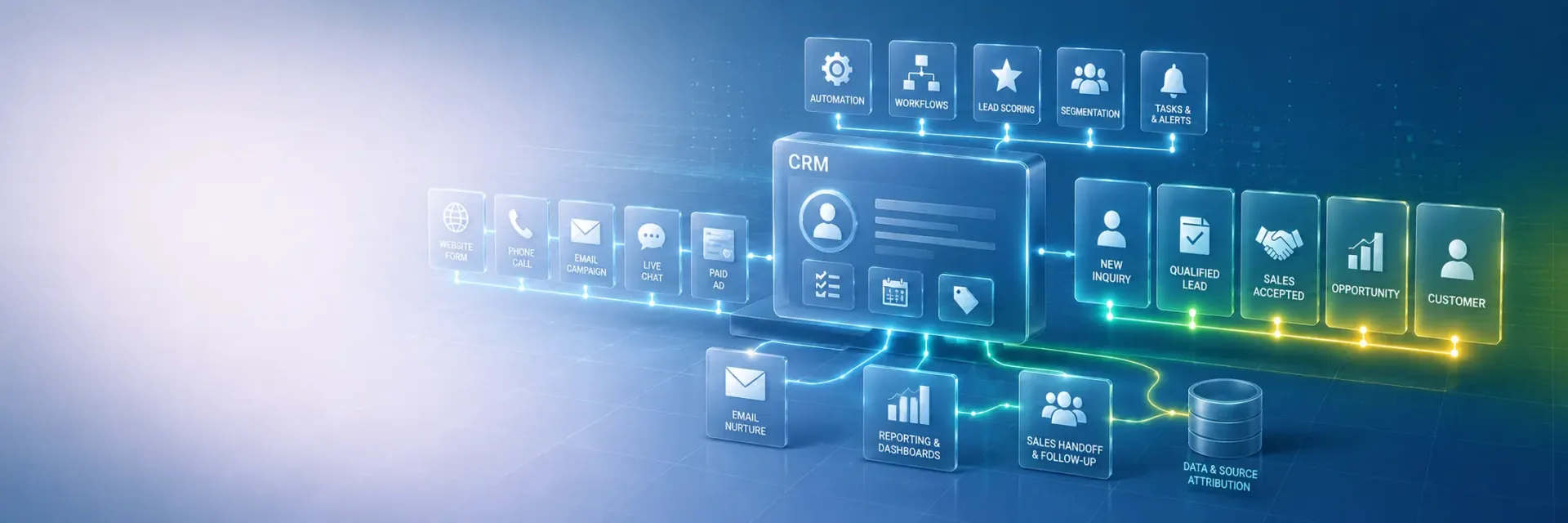
CRM and Lifecycle Growth System
A lead is not progress until someone owns the next step.
Fix the gap between interest and sales action.
CRM & Lifecycle is the growth-system layer that carries demand from the first captured signal through qualification, follow-up, Sales handoff and retention.
It connects email marketing, marketing automation, CRM operations and HubSpot while accounting for incomplete data, slow response, poor routing and disconnected ownership.
The outcome is a more dependable path from enquiry to qualified opportunity and ongoing customer value.
What this growth layer controls
This layer controls what happens after a person takes the first meaningful action.
It defines what data is captured, who owns the contact, how readiness is assessed, which follow-up is appropriate, how marketing and sales hand off responsibility, and how the outcome returns to reporting.

Signs this growth layer is broken
- New inquiries wait too long or receive the same response regardless of urgency.
- Marketing and sales use different definitions of a qualified contact.
- Contacts disappear between forms, inboxes, CRM queues, and individual spreadsheets.
- Automation continues after a person replies, opts out, buys, or becomes unsuitable.
- Leadership cannot see where suitable contacts stop progressing.
Capabilities in this growth layer
Related What We Fix pages
Relevant case study
Marketing-to-opportunity conversion improved 2.3 times within five months after lifecycle definitions, CRM handoffs, and measurement rules were corrected.
Diagnostic tool
Use it to estimate the cost of slow follow-up, weak qualification, and lost handoffs.
A conversion is the beginning of an operational process
Marketing platforms often treat a submitted form, booked call, download, purchase, or chat as the end of the process.
For the organization, it begins a new one.
Data must reach the correct system, retain its source and context, trigger the right response, receive an owner, and move through clearly defined stages.
When this process is weak, demand disappears after acquisition. Leads wait without contact. Duplicate records distort reporting. Sales or admissions teams lack context. Nurture sends the same message to everyone. Marketing cannot distinguish inquiries from accepted opportunities or customers.
The purpose of this layer is continuity: preserving intent, context, responsibility, and measurement after the first conversion.


How CRM and lifecycle work together
CRM provides the record and lifecycle structure. Automation applies rules to repetitive events.
Email delivers relevant communication.
HubSpot may provide the platform through which these functions operate.
The connection to upstream capabilities is equally important.
Website forms must capture the data required for routing.
Paid and organic sources must preserve campaign information.
Positioning and qualification rules must be reflected in forms and scoring.
Analytics must receive lifecycle outcomes.
Compliance requirements must shape consent, communication, access, and retention.
When these relationships are designed together, marketing can improve suitable inquiries and sales progress instead of raw response volume.
How BiViSee repairs broken follow-up
Map the real process
We document inquiry sources, record creation, qualification, ownership, response, later stages, disqualification, and reporting. The map includes exceptions and manual work, not only the intended process.
Define stages and responsibility
We establish customer-stage definitions, entry and exit criteria, ownership rules, response expectations, and the fields required to support them.
Design the data and automation model
Properties, integrations, workflows, lists, scoring, consent, and alerts are designed around the agreed process. Unnecessary complexity is removed before new automation is added.
Connect sales and customer feedback
Qualified, accepted, purchased, admitted, disqualified, and lost outcomes are made available to the teams and systems that need them. This creates a learning loop for targeting, content, conversion, and spend.
Govern and document
Naming, ownership, permissions, testing, monitoring, and change documentation reduce the risk of gradual CRM decay.
How success is measured
Depending on the business model, measures may include:
- Speed to first appropriate response
- Contact and connection rate
- Routing accuracy and unassigned-record rate
- Stage progression and time in stage
- Sales or admissions acceptance
- Nurture-assisted progression
- Reactivation and retention outcomes
- Source-data completeness
- Duplicate and invalid-record rate
- Pipeline or revenue by lifecycle source

Frequently asked questions
Do we need a new CRM?
Not necessarily. Many failures come from process, definitions, data, ownership, or configuration rather than the platform. Replacement is justified when the current system cannot support required work, data rules, connections, or staff use at a reasonable cost.
Should lead scoring be automated?
Only when the available information and later results are meaningful. Scoring should support prioritization, not create a false appearance of precision. It needs regular checks against accepted and rejected inquiries.
Can email automation replace sales follow-up?
No. Automation can support timing, education, reminders, and nurture. It should not replace human judgment in high-value, sensitive, or complex decisions.
Is HubSpot the strategy?
No. HubSpot is a platform. The strategy consists of audience, customer stages, ownership, data, communication, and measurement decisions implemented through the platform.
Further reading for this growth area
Use these guides when you need to examine one of the main decisions behind this part of the growth system.
How Nurture Sequences Support Follow-Up | Match each message to the contact’s current question and readiness.
Why HubSpot Rollouts Stall After Launch | Address adoption, ownership, and data quality after configuration.
CRM Data Decay | See how incomplete and outdated records weaken handoffs, automation, and reporting.
Lead Timing Gaps | Find delays between inquiry, qualification, routing, and follow-up.
Keep qualified intent moving after the conversion
BiViSee can help determine whether the problem is data capture, assignment, ownership, follow-up, email, platform configuration, or missing sales feedback.