
What You’ll Learn
CRM data decay mechanics are the recurring forces that make CRM records lose accuracy, context, and trust over time.
They include field decay, such as outdated emails, phone numbers, titles, and affiliations, plus context decay, such as obsolete deal notes, unclear buying authority, stale relationship status, or lost next steps.
CRM data decay is driven by update friction, weak incentives, manual delays, governance gaps, automation overrides, and business changes that happen faster than records are maintained.
Clean-ups may temporarily improve data, but decay returns unless teams reduce friction, assign ownership, preserve context, and govern updates continuously.
Key Takeaways
- CRM data decay is driven by systemic update friction and scaling complexity – not just individual neglect or outdated tools.
- Periodic data clean-ups temporarily improve data quality but fail to address underlying human and governance factors, allowing decay to return quickly.
- Trust in CRM collapses first through subtle behavioral shifts like shadow system usage, long before obvious errors surface in reports.
- Sustainable CRM reliability requires ongoing incentive structures and governance to reduce update friction and prevent both field and context rot.
Imagine betting your pipeline on data you know decays by the hour – yet most teams still do.
The uncomfortable truth: CRM data decay isn’t due to individual negligence or a bad tool.
It’s systemic, woven into the mechanics of every record, every process, and especially the human effort required to keep anything accurate at scale.
The biggest culprit isn’t time or technology – it’s the hidden update friction that slows (or stops) every attempt to keep things real.
That broader accountability logic is mapped in Marketing Automation & CRM.

Why CRM data decay is inevitable – and what lies behind it
It’s easy to blame stale pipeline data on infrequent audits or the occasional miss.
But the numbers paint a more sobering picture.
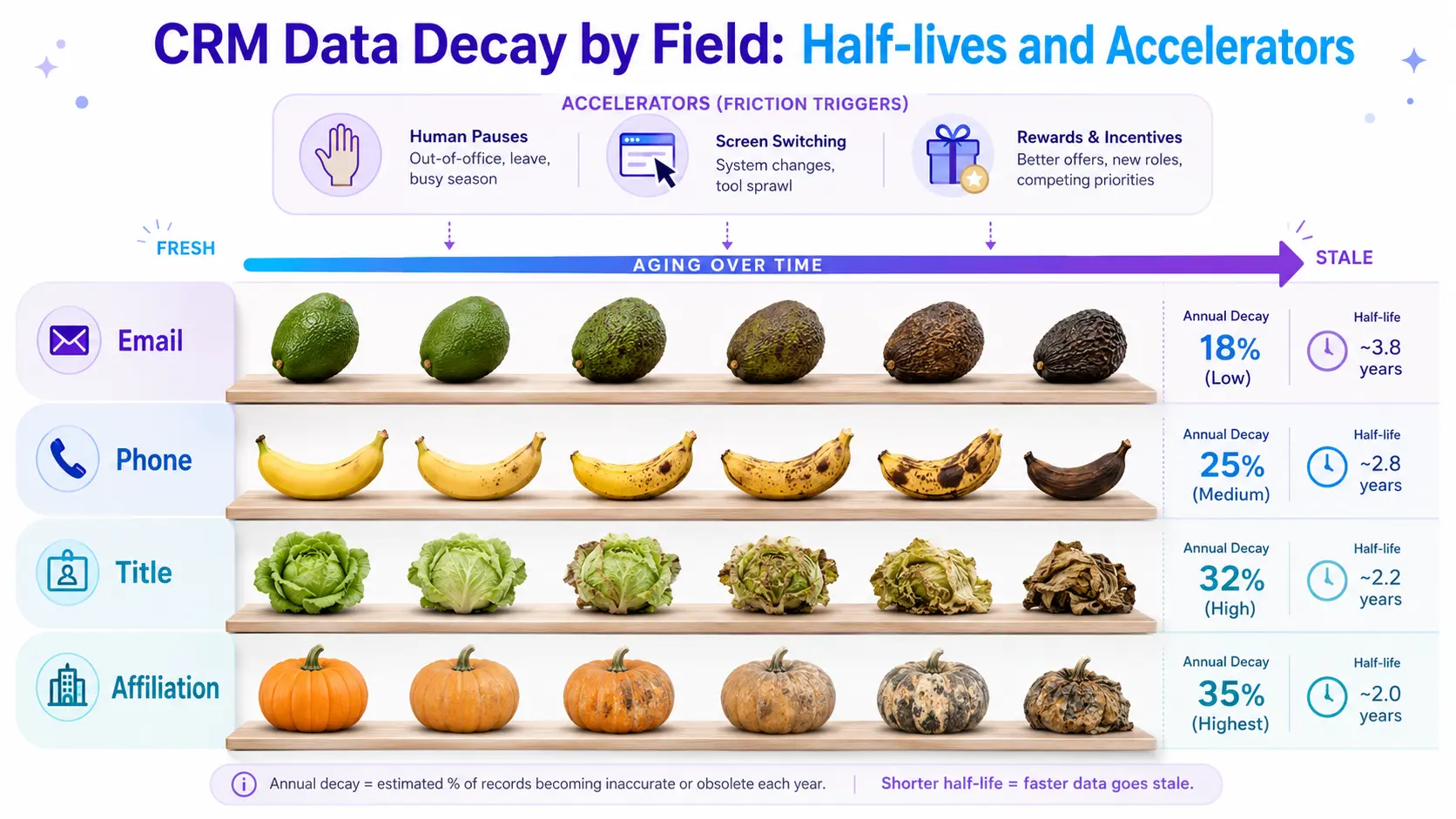
Email addresses decay at rates that often exceed 20 – 30% per year, as people switch domains, roles, or simply abandon old accounts.
Phone numbers lag not far behind, with frequent changes as employees switch devices, locations, or providers.
Titles – essential for segmentation and outreach – change in even less predictable bursts, with quarterly or annual org shifts leaving swaths of records instantly outdated.
And affiliation, the field many executives trust for targeting, can flip overnight in industries where talent poaching or M&A is routine.
The reality of CRM record deterioration by field
We’ve seen major SaaS companies run quarterly hygiene checks, only to expose double-digit error rates by the next quarter – despite best-in-class tooling.
One client found that by the time a lead reached sales, affiliation details were wrong on 12% of records, instantly derailing campaign intent and wasting rep cycles.
“Clean” at import doesn’t last: each data point faces its own unique half-life, shaped by business volatility and staff movement.
Every field is an aging asset.
And – like produce left on the shelf – some rot far faster than others.
CRM Field Decay Rates and Characteristics
| Signal Type | Description | Effect on CRM Use/Trust |
| Decrease in CRM Search Activity | Users search less in CRM | Indicates reduced reliance on CRM data |
| Reps Skip Pipeline Updates | Sales reps avoid updating deals/contacts | Leads to stale and inaccurate pipeline data |
| Sharp Drop in Opportunity Note Frequency | Fewer notes recorded during pipeline reviews | Forewarns teams reverting to shadow systems |
| Increasing Time Gaps Between Business Changes and CRM Updates | Updates lag behind real events | Indicates process strain and delays |
How human friction resets accuracy every day
So why doesn’t regular updating keep data current?
Because every CRM update requires human action, subject to delay, confusion, or outright avoidance.
Think about the last time a rep updated a phone number.
Was it after a call bounced?
After a deal closed?
Or not at all, because the friction of switching screens, navigating record details, and finding the right new info simply wasn’t worth the minute lost?
Key Causes of Human Friction in CRM Data Updates
- Delay in updating after data changes (e.g., phone number updates after bounced calls)
- Switching screens and navigating complex record details
- Lack of immediate reward or incentive for updating data
- Update resistance due to perceived low value of task
- Temporary boost in compliance during pipeline reviews fades quickly
- Small errors compound daily due to inconsistent updates
Real-world: We’ve watched teams with detailed update checklists.
Compliance peaked only during pipeline reviews – and faded within days.
Rewards rarely match the effort, so even well-meaning teams let small errors compound daily.
Human friction – tiny, repeated, invisible – becomes the silent engine of data integrity loss in CRM.
Attempting to fight this with more rules or reminders just piles on complexity.
If nobody’s rewarded for contribution, and systems aren’t designed for effortless updating, you face data decay not as an occasional problem – but as the resting state of your CRM.
CRM decay is the default, not the exception.
Every field, every day – pushing you toward truth erosion until update friction is solved.
The real question isn’t how fast your data rots, but what keeps your team from fixing it the moment it does.

Why clean‑ups don’t fix decay – why governance breakdown matters more
Think a quarterly CRM clean-up brings data back to life?
Most teams discover the mess returns faster than they can sweep.
The myth: periodic scrubbing buys you a reset.
The reality?
Without ongoing capture and update discipline, every “clean” CRM reverts to chaos – often before the reports even run.
The cleanup half‑life: why one‑time projects don’t restore trust
Every executive has authorized a massive CRM data clean-up – yet watched as faith in the numbers vanished again in months or weeks.
We’ve seen client after client celebrate clean audit trails, only to see drop-offs in activity, lead misallocations, and basic contact errors return with a vengeance.
Why?
Because a cleanup is a treatment, not a cure.
It doesn’t address the update friction that caused the rot in the first place.
Here’s the parallel: imagine draining a leaky boat and then rowing out, believing the problem is solved.
If the hull isn’t repaired, water rushes back in.
In CRM, unless systemic incentives, workflows, and real accountability are embedded, data integrity’s half-life is brutally short.
Attempts to restore trust by “wiping the slate” only highlight the lack of sustainable governance underneath.
So what keeps trust permanently out of reach?
Manual updates break down under pressure, reps avoid unvalued admin work, and without checks, errors multiply.
Reports look better for a cycle – then the rot accelerates, reinforcing skepticism and workarounds.
When the data isn’t governed, credibility decays faster than you can patch it.
When context rot outruns field corrections
You can patch a phone number or fix a title, but context – the backstory behind every field – red-lines faster, and quietly.
Relationship status, deal momentum, decision-maker shifts: these fade or mutate continuously, often without explicit signals or update triggers.
For one enterprise client, we tracked opportunity notes: seven days after a pipeline review, over a quarter had become obsolete or ambiguous, rapidly undermining forecast reliability.
The hidden danger?
Context loss breaks the chain of meaning, even as surface details look clean.
You may know the “who” but miss the “why” and “how” – the drivers that make data useable.
It’s like seeing the skeleton but not the nervous system.
Field-level corrections lull teams into a false sense of security; meanwhile, decision authority, internal objections, or next steps drift away under the surface, eroding foundation faster than surface repairs can keep up.
When decay grows, teams build shadow systems – that breakdown is detailed in CRM Shadow Systems.
Most CRM data decay is not a hygiene lapse.
It’s a governance system failure acting on two fronts: recurring field rot and catastrophic context loss.
Until leaders fix both, each clean-up becomes just another round on the treadmill.

How decay fractures pipeline trust and makes the CRM unreliable
The real risk in pipeline management isn’t a simple decimal error – it’s that outdated CRM data can quietly unhinge entire forecasts before anyone sees the break coming.
A single stale field isn’t a hiccup; it can reshape revenue projections and decision confidence across the board.
When stale records inflate forecasts and derail decisions
The biggest myth: only new pipeline matters.
In practice, most forecasts float on a foundation of old deals, contacts promoted out months ago, and companies that subtly shifted priorities.
Over 10 years in CRM consulting, we’ve seen how even a 10% invisibly stale record rate can tip quarterly projections completely off course – phantom deals linger, targets look hit on paper, but the bookings never land.
The illusion is maintained for weeks, sometimes a quarter, before the gap between expectation and reality snaps into full view.
Consequences of Stale CRM Records on Forecasts and Decisions
- Phantom deals inflate pipeline value leading to inaccurate revenue projections
- Obsolete or duplicate deals create false confidence in targets
- Delay in recognizing actual forecast shortfalls
- Resource misallocation as marketing and sales focus on dead leads
- Sales reps reluctant to shrink forecast due to fear of negative impact
- Slow decay outpaces visible fixes, undermining trust over time
Like a pilot trusting outdated weather data, revenue teams steer toward blue skies that don’t exist.
We’ve observed multiple organizations where more than a third of the pipeline value was built on deals that were either duplicates, obsolete, or tied to contacts no longer able to buy.
Why?
Update friction – nobody wants to be the first to shrink the forecast or kill ‘promising’ deals, so the rot persists just below the surface.
Ask yourself: if one column in your CRM could quietly undermine millions in forecasted revenue, would you spot it before the board does?
Hidden decay always outpaces visible fixes.
The slow drip of stale data sabotages resource allocation – marketing keeps fueling cold leads, sales spends cycles on dead ends, and leadership chases KPIs that have already expired.
Why representatives bypass systems when they stop trusting the CRM
It starts small: a sales rep knows the pipeline is padded, so they keep notes elsewhere.
Another skips CRM updates because “everyone knows it’s off”.
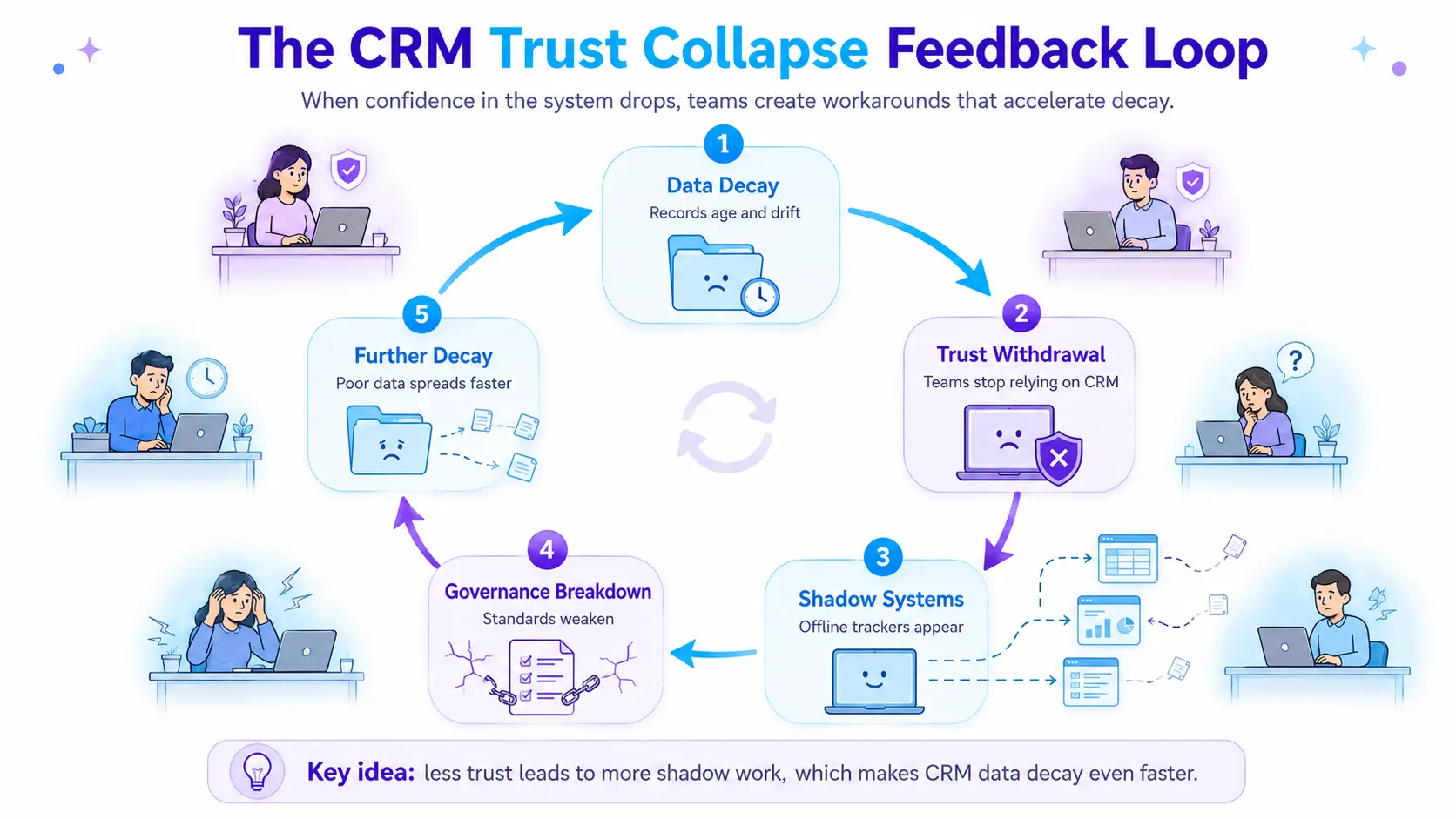
Before long, the feedback loop kicks in – less usage breeds less reliability, which breeds more shadow systems.
We’ve watched entire teams abandon formally mandated flows, building Google Sheets fortresses and private trackers just to protect themselves from bad data exposure.
One analogy: a GPS with a broken compass isn’t just ignored – it’s actively distrusted, and so are the people still defending its readings.
The same happens with CRMs as record decay intensifies: top players hoard truth outside the system, new hires distrust everything on day one, and managers waste hours reconciling fiction with reality.
Pipeline reviews devolve into debates over “which data is less wrong”, not how to win the deal.
The surprise is how quickly trust collapse escalates.
Within one bad quarter, we’ve seen CRM usage drop by half, Slack threads light up with workaround files, and decision-makers start to openly question reported metrics.
At this stage, the CRM doesn’t just lose value – it becomes a liability.
Reliable sales planning depends on fresh, trustworthy CRM data.
The moment decay goes unchecked, forecasts crumble, behavior shifts underground, and the entire system’s credibility is at risk – setting the stage for collapse unless root causes are addressed.

What leaders must look for next – diagnostic markers of truth erosion
Most leaders miss the warning signs – not because they aren’t visible, but because they don’t look like traditional “data problems”.
CRM decay rarely starts as a field going blank or a typo; it starts when your team quietly stops believing what they see.
The trust collapse doesn’t make noise, but it sets in motion a measurable chain reaction.
What gets your attention first: one rep quietly skipping pipeline updates, or a slow, silent drop in CRM search activity?
Key signals of decaying trust and data integrity
If you think bad data looks like an obviously broken email or wrong job title, you’re missing the root risk.
The real threat is behavioral: reps stop logging calls, managers double-check reports outside the system, high performers revert to spreadsheets.
Watch for these – subtle usage changes are often the first evidence of CRM data decay mechanics at work.
For example, over multiple client audits, we’ve seen that a sharp drop in opportunity note frequency is almost always followed, within weeks, by teams reverting to backchannel deal-tracking or skipping CRM updates altogether.
Diagnostic Markers of CRM Data Decay
| Field | Typical Annual Decay Rate | Decay Characteristics |
| Email Addresses | 20-30% | Change due to domain switches, role changes, account abandonment |
| Phone Numbers | Not specified but high | Frequent changes due to devices, locations, providers |
| Titles | Variable, quarterly or annual | Changes with organizational shifts |
| Affiliation | Can change overnight | Shifts due to talent poaching or M&A |
Another early marker: increasing time gaps between changes in the business and updates in the CRM.
If sales managers start chasing team members for basic field validation, your process is under strain.
Notice also when power users spend more time fixing data than finding value – at this point, your CRM has switched from a decision engine to a maintenance treadmill.
Ask yourself: is system login “compliance” consistent, or do people log in just to show presence and then operate elsewhere?
Behavior tells the truth faster than any field audit.
Dashboard usage wanes.
Internal Slack threads about “the real pipeline” spike.
Fields that matter suddenly populate only near quarter-end, when artificial consequences apply.
These aren’t hygiene lapses – they’re evidence of trust withdrawal, signaling the early phase of context rot in CRM systems.
How to assess decay’s role in CRM collapse without tool bias
Here’s where most executive reviews go sideways: They fixate on the tool or demand more scheduled clean-ups, hoping for a technical fix.
But evaluating CRM record deterioration through the lens of automation features or “one more field validation step” misses the real disease.
Collapse does not begin with system downtime – it starts with users quietly building private workarounds.
We recommend a different diagnostic path.
- First, look for pattern drift: which teams or roles are using shadow data sources as their primary reference, and how quickly does this switch spread?
Instead of focusing on form completion rates, examine the ratio of out-of-system updates (emails, calls, ad hoc trackers) to in-system captures.
If this ratio grows, data integrity loss in CRM is underway. - Second, resist bias toward the newest tool or integration.
No software can outpace context rot if the business process itself encourages delay or ambiguity.
In our own work, the fastest decay was always traceable to mismatched incentives (update friction CRM meeting zero practical reward for accuracy).
If leaders diagnose based only on tool dashboards, they risk missing the moment when credibility – the true foundation – starts to unwind. - Trust erosion never flashes a warning in big red letters.
The trick is to read the room, not just the reports.
Catch the early behavioral signals, and you can intervene before CRM trust collapse becomes irreversible.

Scientific context and sources
The sources below provide foundational context for how decision-making, attention, and performance dynamics evolve under scaling and constraint conditions.
- Data Accuracy and Decay in Information Systems
Data Quality: The Accuracy Dimension – Jack E. Olson – Morgan Kaufmann
Explores the technical and human factors contributing to data inaccuracy and decay, with specific emphasis on enterprise systems and CRM.
https://www.sciencedirect.com/book/9781558608917/data-quality - Behavioral Barriers to Data Maintenance
Data quality: Setting organizational policies – Veda C. Storey, Rajiv M. Dewan, Marshall L. Freimer – Decision Support Systems
Presents research on organizational incentives, responsibility gaps, and human factors that reinforce or undermine data maintenance across shared enterprise data processes.
https://www.sciencedirect.com/science/article/pii/S016792361200187X - Trust and Decision-Making Under Information Uncertainty
Trust and Distrust in Organizations: Emerging Perspectives, Enduring Questions – Roderick M. Kramer – Annual Review of Psychology
Analyzes how uncertainty, distrust, and institutional barriers affect trust formation and decision behavior inside organizations.
https://www.annualreviews.org/content/journals/10.1146/annurev.psych.50.1.569 - Performance Decline and Information Flow
The DeLone and McLean Model of Information Systems Success: A Ten-Year Update – William H. DeLone, Ephraim R. McLean – Journal of Management Information Systems
Examines how information quality, system quality, use, user satisfaction, and net benefits connect information-system performance to organizational outcomes.
https://www.jmis-web.org/articles/271 - Information System Decay Mechanisms
Minimizing the data quality problem of information systems: A process-based method – Qi Liu, Gengzhong Feng, Xi Zhao, Wenlong Wang – Decision Support Systems
Highlights how data quality problems are generated, propagated, and accumulated inside information systems, including process flow, resource allocation, and downstream decision risk.
https://www.sciencedirect.com/science/article/pii/S0167923620301366
Questions You Might Ponder
What causes CRM data decay mechanics to accelerate in large organizations?
When organizations scale, data points change more frequently, and update friction intensifies. Dispersed teams, shifting responsibilities, and increased record volume make it harder to maintain real-time accuracy. This results in faster CRM data decay unless explicit incentives and frictionless update workflows are embedded.
How does CRM data decay impact sales forecasting and revenue planning?
Stale CRM data inflates pipeline projections, leading to overestimated revenue, misallocated resources, and delayed recognition of shortfalls. Decaying records – especially those tied to contacts, deal status, or company affiliations – erode trust in the forecast’s validity, undermining executive and board-level decisions.
Why can’t periodic CRM clean-ups solve long-term data integrity issues?
Clean-up projects are temporary fixes that address visible errors but don’t resolve ongoing update friction. Without embedded incentives and daily discipline, inaccurate data returns rapidly as users revert to old behaviors. Sustainable integrity requires continuous governance, not one-off efforts.
What behavioral symptoms reveal early CRM data decay mechanics?
Early signs include declining user logins, reduced deal note updates, increased use of external tracking tools, and teams double-checking CRM outputs. These behavioral shifts signal withdrawal of trust and the emergence of shadow systems, often before field errors become obvious in audits.
How do context and field data decay differently in CRMs?
Field data (emails, phone numbers, titles) changes at measurable rates, but context (deal backstories, decision-maker mapping) erodes silently and quickly. Losing context can render technically ‘clean’ records functionally useless, undermining segmentation, outreach, and true opportunity qualification.