What You’ll Learn
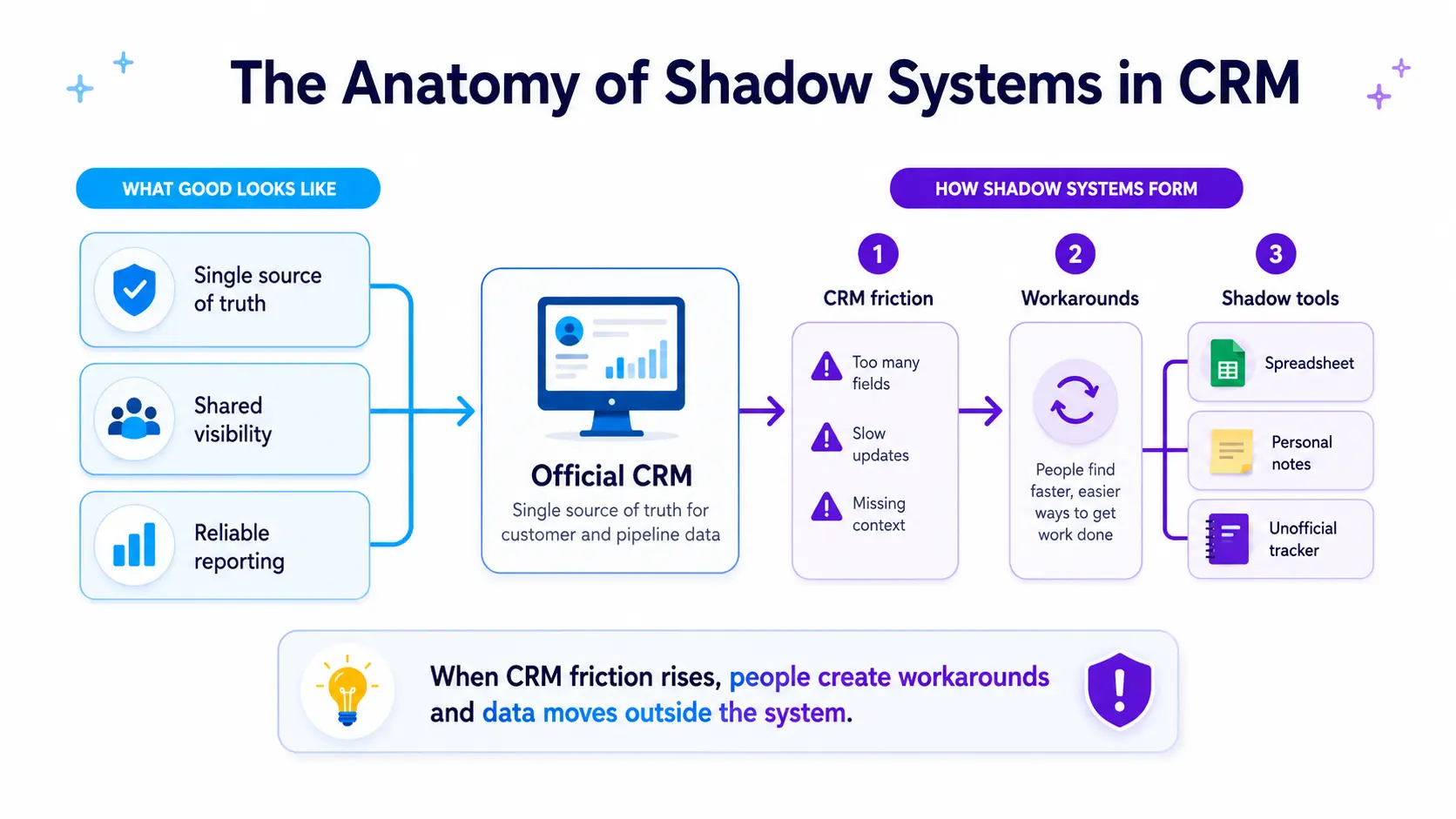
Shadow systems in CRM are unofficial tools, spreadsheets, notes, private trackers, or parallel workflows that teams use when they no longer trust the official CRM to reflect reality or support their work.
They often emerge as a practical response to friction, unclear ownership, slow workflows, excessive data entry, unreliable reports, or rigid processes.
Shadow systems may feel faster, but they fracture the shared source of truth by splitting pipeline data, forecasts, handoff notes, and customer context across hidden places.
Over time, they weaken governance, create reporting distrust, increase technical debt, blur accountability, and make business decisions depend on unofficial data instead of the CRM.
Key Takeaways
- Shadow systems in CRM arise as rational user responses to friction, inconsistency, or lost trust in official processes.
- Manual overrides and offline trackers accumulate, fragmenting data and undermining consensus across teams.
- Parallel sources of truth erode accountability, creating technical debt and complicating future system fixes.
- Addressing shadow systems requires structural fixes, restoring trust and ownership over processes rather than mere technical audits.
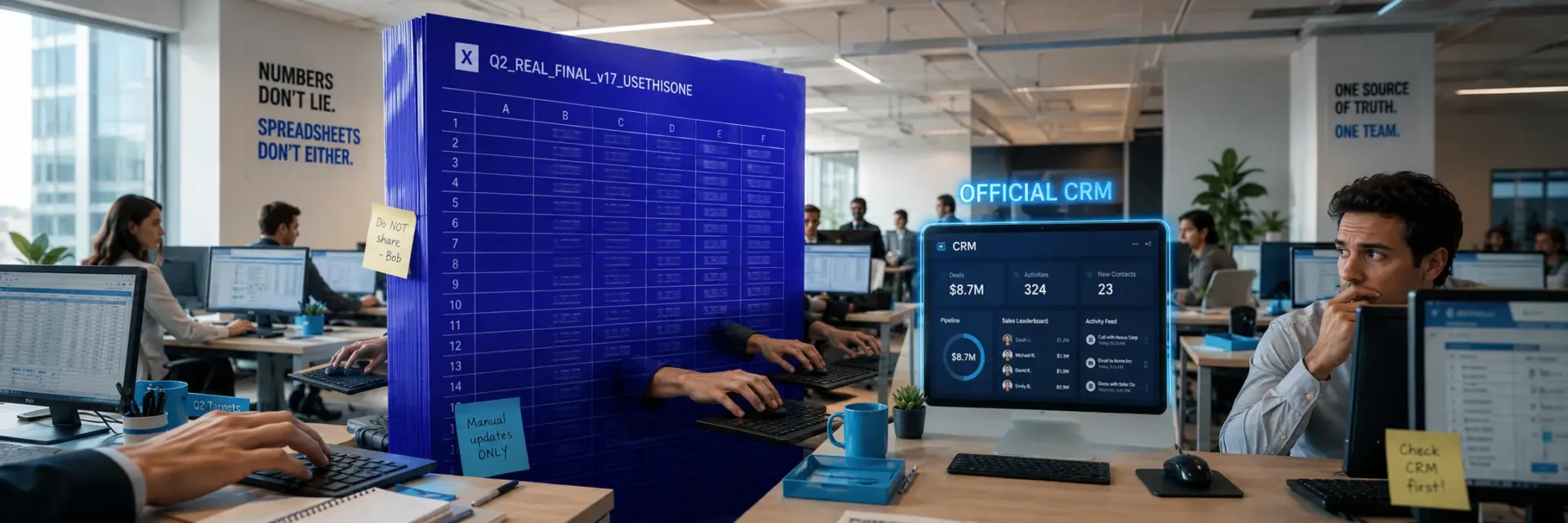
Most CRM failures start quietly – not with a data breach, but a spreadsheet.
The real tipping point happens when users trust an unofficial tracker over the company’s chosen system.
That’s not sabotage; it’s self-preservation.
If teams believe the CRM creates drag, they’ll build parallel truth nearly overnight, often without asking permission.
Why?
Because the path of least resistance wins every time – especially when revenue or customer outcomes are at stake.
That underlying pattern fits the broader landscape in Marketing Automation & CRM.

Why shadow systems become the trusted fallback
Ask any sales rep off the record, and you’ll hear it: the CRM sometimes feels like an obstacle course meant to slow them down, not speed them up.
We’ve watched high-performing sales reps abandon centralized tools, not because they “won’t follow process”, but because the CRM feels like trying to run a race in sand.
Data entry fields multiply, tactical workflows get buried under tabs, and simple deals turn into admin quizzes.
Inevitably, someone opens Excel “just for tracking this week” – and that file soon becomes the heartbeat of the team.
Key Reasons Shadow Systems Become Trusted Fallbacks
- CRM creates drag and administrative friction for users
- Users seek speed and certainty to keep pipelines moving
- Parallel truth emerges quickly without permission
- Managers trust unofficial trackers over official CRM data
- Shadow systems are a rational response to CRM shortcomings
The myth: users bypass CRM out of laziness.
Reality: they’re hacking toward speed and certainty – the two currencies that keep pipelines moving.
Shadow systems aren’t chosen; they emerge when CRM roadblocks pile up faster than IT can fix them.
The quickest sign this is happening?
When managers start trusting screenshots or side notes over the official report.
When CRM adds friction instead of clarity
If your CRM is supposed to be the map, but navigating it feels like using Google Maps with outdated streets, people create their own routes.
We’ve seen entire teams synchronize around the ‘real’ forecast sitting in a private doc, sidestepping the official pipeline altogether.
The trust collapse isn’t dramatic.
It’s accumulative, like a silent drip that eventually empties the tank.
Reasons Sales Reps Abandon CRM and Use Shadow Systems
| Consequence | Description | Resulting Risk |
| Technical Debt Multiplication | Patch solutions accumulate over time | Harder data cleanup and system integration |
| Erosion of CRM Trust | Users lose faith in official data | Decreased adoption and reliance on CRM |
| Missed Forecasts and Campaign Hits | Unreliable data leads to errors in forecasting | Revenue forecasting and campaign effectiveness suffer |
| Hidden Risk Exposure | Manual patches mask true data risk | Audit and compliance vulnerabilities |
| Expensive Cleanups | Large-scale reconciliation needed after delay | Six-figure remediation costs |
When control without trust outranks consistency
Here’s the uncomfortable truth: No amount of top-down governance can compensate for lost autonomy.
When people don’t feel true ownership of their numbers or process, consistency is the first casualty – and shadow systems quietly take over.
We’ve sat with sales ops directors who admit, “We run our own playbook because the global CRM rules never fit our deals”.
The result?
Manual overrides and off-platform notes become the true record of reality – even if they contradict what’s ‘official.’ When rules become rigid, teams see the CRM less as a partner and more as a bottleneck.
The illusion of uniformity evaporates because what’s entered for compliance rarely matches what’s used to make decisions.
Ask yourself: Would your teams risk missing quota just to maintain system consistency?
Rarely.
They’ll choose personal control over institutional alignment every time if trust is missing.
It’s like enforcing speed limits in a city with broken stoplights; everyone rewrites the rules to keep moving.
Shadow systems in CRM aren’t a user defect – they’re a rational, predictable response to gaps between what leadership values and what process delivers.
The longer the gap persists, the more the parallel truth becomes the de facto truth.
Every shadow spreadsheet and ad-hoc note is evidence: users don’t reject structure, they reject friction that slows results.
If you want to restore system trust, start by fixing the reasons people bolt.

How manual overrides fracture shared truth
Most leaders assume CRM data loses value because of one-off errors or occasional neglect.
In reality, it’s the quietly compounding manual “fixes” that create entirely divergent realities – where the information you see depends less on fact and more on which patchwork method someone trusted last.
The compounding cost of inconsistent records
A single duplicated contact or stale deal value might seem harmless, but these inconsistencies cascade.
Imagine two teams running forecasts off “the same” pipeline, yet each draws its numbers from subtly different exports.
What should have been one version of the truth instead fragments into personalized dashboards, siloed spreadsheets, and overwritten notes – each slightly out of sync.
The myth is that these are minor annoyances; the reality is they become the invisible wrecking ball for consensus planning.
We’ve watched companies book meetings with leads who already said no – because a manual update was missed.
One client’s QBR numbers diverged by 24% between finance and sales, traced back to an off-system tracker meant to “speed things up”.
Each fix in isolation looks like progress, but stack enough up and collective understanding collapses.
It’s like multiple surgeons each updating a patient chart on a sticky note: Who’s responsible when something’s missed?
Think about how fast small discrepancies spiral – especially when anyone with a little authority feels justified in “correcting” records without a shared process.
The problem rarely shows up in a dashboard alert.
It reveals itself when two execs present incompatible results from what should be a single source.
When ad‑hoc notes become de‑facto pipelines
Consider this scenario: over a few months, a single shared spreadsheet quietly becomes the real pipeline your team checks before every meeting.
Some teams, burned by a high-ceremony CRM field, quietly move their deal stages to a spreadsheet “just for this quarter”.
Six months later, that spreadsheet runs the meeting.
We’ve seen private Notion boards morph into quasi-CRMs, invisible to leadership.
In one extreme, a national sales team never adopted a pipeline reporting upgrade – not from malice, but because their own shared Google Sheet better reflected how they actually moved deals.
Manual overrides don’t just fracture the record; they spawn a parallel reality entirely outside formal governance.
What direction are your teams actually following: the official playbook, or the shadow system that feels safer and more accurate?
When private fixes turn into public practice, you haven’t just lost data integrity – you’ve lost the ability to recognize the true state of play.
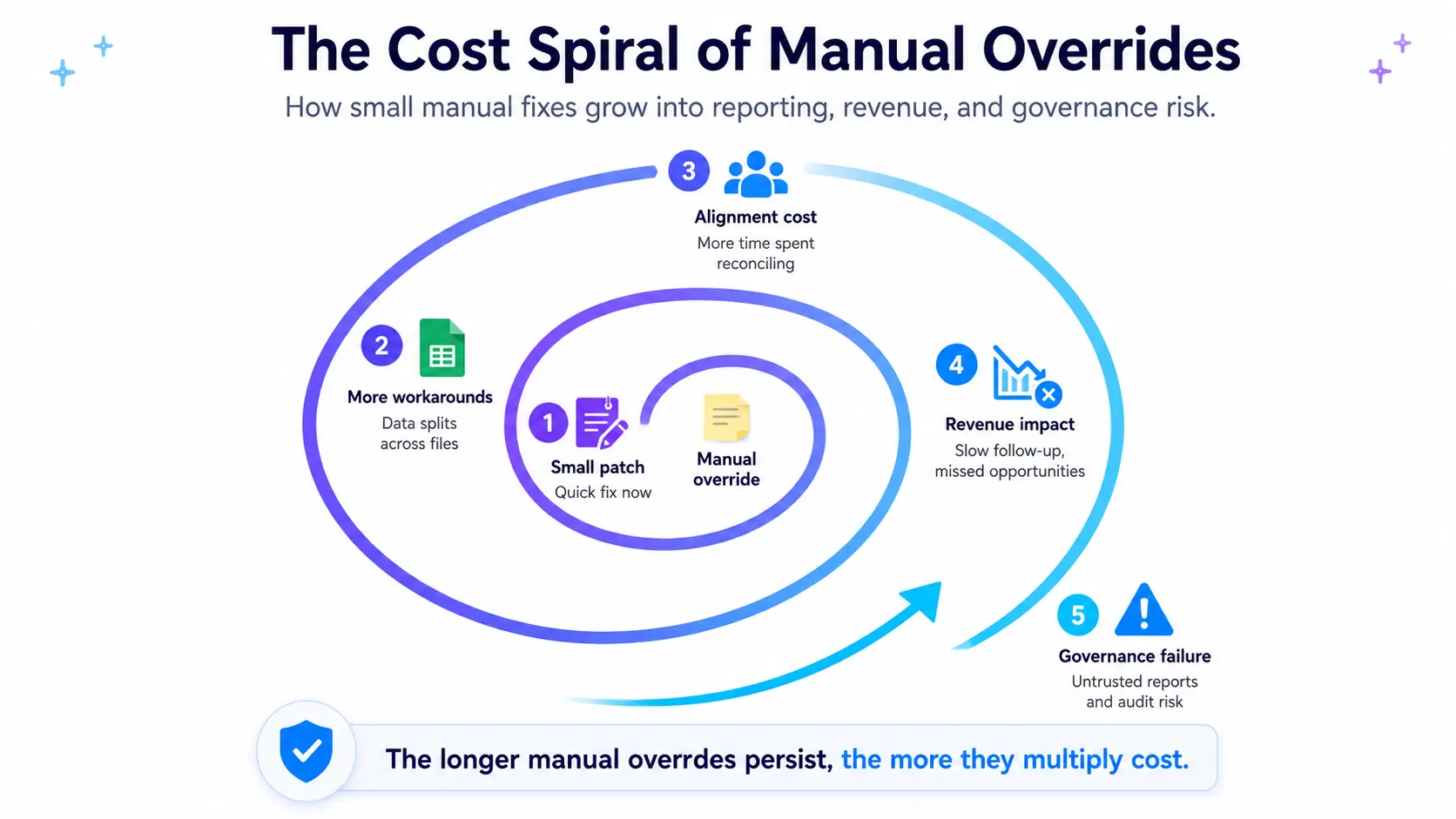
Every manual patch may start with good intentions – but their sum is entropy.
Left unchecked, these fractures create permanent space between what’s recorded and what’s real.
Fixing that gap starts by admitting you can’t manage what you don’t see.

What parallel truths cost your governance and outcomes
If you’re running your business with two truths – the one in your CRM and the one teams actually rely on – governance isn’t slipping; it’s missing.
Parallel tracking creates an invisible divide: decisions feel supported, but the foundation is crumbling beneath every handoff, forecast, and review.
Most leaders don’t see the fracture until it’s already shaped outcomes.
Lost accountability and fractured handoff logic
The myth says a single system means everyone’s on the same page.
The reality: when shadow systems in CRM take hold, ownership evaporates and responsibility gets diffused.
We’ve seen B2B teams where a deal dies, not at the hands of a competitor, but because a spreadsheet buried a critical update – nobody knew who owned what or when to act.
You can build as many processes as you want, but if your pipeline is interpreted differently in every tool, accountability vaporizes on contact.
Every time a spreadsheet replaces CRM, you trade transparency for speed, and clarity for improvisation.
Conversion rates dip, not because sales can’t close, but because leads get lost in the fog between official and unofficial records.
If you’re wondering why deals are stalling or handoffs are botched, ask which version of the pipeline your team trusts.
When the real communication happens through shadow spreadsheets, audit trails break and you lose the rhythm that drives outcomes.
It’s less like losing a playbook – more like each player invents their own rules in real time.
Deferred trust becomes compounding technical debt
Ignoring shadow systems is rolling a snowball downhill and betting it won’t grow.
That temporary spreadsheet “patch” doesn’t fade; it multiplies.
Over months, manual overrides and backdoor fixes stack up, making later integration or cleanup exponentially harder.
We’ve seen clients wrestle with six-figure cleanups after three quarters of letting ad-hoc data entry proceed unchecked – by then, patterns are ingrained, and data reconciliation is a project, not a fix.
Consequences of Ignoring Shadow Systems and Manual Overrides
| Reason | Description | Impact |
| Excessive Data Entry Fields | Multiple fields to fill slow down reps | Increases admin burden, reduces adoption |
| Tactical Workflows Buried | Workflows get lost under tabs | Delays deal progression |
| Simple Deals Become Admin Quizzes | Deal tracking feels complex and tedious | Drives reps to use alternative tools |
| Lack of Speed & Certainty | Official CRM feels slow and unreliable | Prompt emergence of shadow systems |
| Managers Distrust Official Reports | Trust shifts to unofficial trackers | Undermines CRM data credibility |
Think of technical debt here as erosion: slow, but relentless.
If trust in the CRM collapses, every delayed cleanup just thickens the sediment.
Before long, regaining a single source of truth means undoing not only bad data, but years of workarounds baked deep into daily routines.
Inaction carries a quantifiable cost – missed forecasts, botched campaigns, and risk exposure no audit will catch right away.
Shared truth is the foundation of performance.
Every parallel system chips away at that foundation – quietly at first, then all at once.
That parallel truth almost always becomes visible as reporting distrust – see Trust Collapse in CRM Reporting for how this pattern unfolds.

What business leaders can evaluate next
Every leader’s instinct is to audit the tools.
Most never realize it’s the behaviors that decide whether CRM survives – or quietly splits into shadow systems.
If your first move is cataloging features or inspecting logins, you’re missing where truth fractures: in how teams actually interact, circumvent, or override the system’s default logic.
Diagnosis checkpoints, not tool audits
Here’s the myth: technology upgrades restore CRM authority.
We’ve repeatedly seen companies overhaul platforms or buy plug-ins – and still end up with teams managing deal flows in personal folders or untracked spreadsheets.
Why?
Because tech audits catch tools, not workarounds.
The critical questions aren’t “What are people using?” but “Where does the shared reality break?” and “What manual processes surface when trust lags behind process?”
Critical Diagnosis Checkpoints for CRM Trust Issues
- Identify pipeline stages duplicated outside the CRM
- Determine who is patching gaps with private trackers
- Locate where real forecasts are adjusted offline
- Focus on human friction points instead of tool usage
- Recognize tolerated exceptions replacing governance
In practice, the most reliable diagnosis comes from mapping pain points where human friction blooms.
For example, which pipeline stages get duplicated outside CRM, who is patching gaps with private trackers, or where the ‘real’ forecast is quietly adjusted offline before every exec meeting.
The true sign of CRM decay isn’t lost licenses or stale accounts – it’s the spread of invisible, tolerated exceptions that quietly replace governance with habit.
If you picture your CRM as the company’s GPS, these checkpoints reveal the shortcuts no official route ever captures.
Ignore them, and you’ll never see when teams have already stopped trusting the signs.
When to route to structural capability fixes
Tool adoption is almost never the root; structural capability is.
When the same misalignments pop up across departments – like inconsistent handoffs, private deal lists, or serial spreadsheet rebuilding – it’s a red flag the underlying system design can’t support the behaviors your business needs.
At this stage, plugging leaks with new dashboards or minor rules is like patching a sinking boat with duct tape.
What separates successful CRM recoveries from endless reinvention is this: leaders who invest in reinforcing reporting trust, workflow mapping, and clear data ownership can actually retire shadow systems.
We’ve seen organizations halve manual overrides in under a quarter once leaders shift focus from feature policing to rebuilding shared confidence in process logic.
Evaluate not just if your CRM works, but if people want to – and do – rely on it, even under pressure.
If the answer feels uncertain, it’s the signal to escalate: diagnose at the level of structural trust, not last-mile feature lists.
A trusted CRM isn’t the absence of shadow systems – it’s a place where no one needs them.
The next move isn’t more technical fixes.
It’s restoring governance that earns real adoption, even when stakes are high.

Scientific context and sources
The sources below provide foundational context for how decision-making, attention, and performance dynamics evolve under scaling and constraint conditions.
- Shadow Systems and Information Systems Governance
Causing factors, outcomes, and governance of Shadow IT and business-managed IT: a systematic literature review – Stefan Klotz, Andreas Kopper, Markus Westner, and Susanne Strahringer – International Journal of Information Systems and Project Management
Explores how organizational shadow systems arise in response to rigid governance, highlighting risks to data quality and decision-making fidelity.
https://revistas.uminho.pt/index.php/ijispm/article/view/3802 - User Behavior and Decision-Making Under Friction
Simple Heuristics That Make Us Smart – Gerd Gigerenzer, Peter Todd, and The ABC Research Group – Oxford University Press
Examines how people consistently seek cognitive shortcuts and parallel processes when formal systems impede speed and certainty, paralleling shadow system emergence.
https://ideas.repec.org/b/oxp/obooks/9780195143812.html - Organizational Trust and System Adoption
Trust and Distrust in Organizations: Emerging Perspectives, Enduring Questions – Roderick Kramer & Karen Cook (eds.) – Russell Sage Foundation
Investigates how lost trust in centralized systems incentivizes the creation of workarounds and parallel records, undermining shared data truth.
https://www.russellsage.org/publications/book/trust-and-distrust-organizations - Data Quality Consequences in Collaborative Environments
Data Quality: Concepts, Methodologies and Techniques – Carlo Batini & Monica Scannapieco – Springer
Details how local manual overrides and ungoverned data entry lead to escalated inconsistency, impeding unified business logic and outcomes.
https://link.springer.com/book/10.1007/3-540-33173-5 - Technical Debt and Organizational Performance
Managing Technical Debt: Reducing Friction in Software Development – Philippe Kruchten, Robert Nord, Ipek Ozkaya – Addison-Wesley Professional
Outlines how ad-hoc fixes create long-term technical debt within enterprise systems, increasing operational costs and reducing agility.
https://www.sei.cmu.edu/library/managing-technical-debt-reducing-friction-in-software-development/
Questions You Might Ponder
Why do shadow systems in CRM emerge despite formal processes?
Shadow systems in CRM emerge when users perceive the official system as slow or cumbersome. They seek faster, more reliable solutions, building parallel trackers for immediate needs. This behavior stems from the gap between formal process and day-to-day performance requirements.
What risks do shadow systems in CRM introduce for data integrity?
Shadow systems in CRM undermine data integrity by creating fragmented, inconsistent records. When decisions rely on unofficial sources, errors, duplications, and missed updates increase, leading to unreliable forecasting and greater risks in customer management and sales accountability.
How do manual overrides in CRM processes affect business outcomes?
Manual overrides in CRM, such as offline spreadsheets or skipped data entry, cause information silos and workflow breakdowns. The cumulative impact is a loss of shared reality, making it difficult to create consensus or track true progress across teams, ultimately harming business efficiency.
Why might managers prefer shadow systems over official CRM data?
Managers may trust shadow systems over the official CRM when these parallel trackers align better with day-to-day results or feel easier to use. This preference signals a disconnect between system design and real business needs, compromising governance and true pipeline visibility.
What steps can leaders take to reduce the use of shadow systems in CRM?
Leaders should focus on aligning system workflows with user needs, reducing unnecessary friction, and fostering trust in the official CRM. Diagnosing points of friction and reinforcing accountability, not just auditing tools, is key to retiring shadow systems and restoring unified data governance.