
What You’ll Learn
CRM reporting distrust is the loss of confidence in CRM dashboards, pipeline reports, forecasts, or performance metrics when teams cannot clearly understand, verify, or own the numbers.
It usually comes from ambiguous definitions, changing filters, unclear inclusion criteria, conflicting dashboards, weak report ownership, or uncertainty about what a metric actually means.
CRM reporting distrust turns data from a decision tool into a debate trigger, causing leaders to request more validation instead of taking action.
When no team stands behind the report, forecasts become unstable, meetings shift into blame or interpretation, and decisions stall because no number feels safe enough to use.
Key Takeaways
- CRM reporting distrust is primarily caused by ambiguous context and unclear ownership, not technical errors.
- Ambiguity in data definitions and lack of ownership erodes executive confidence, driving debate over action.
- Forecasting and execution stall when teams can’t agree on data meaning, leading to missed opportunities.
- The true cost of CRM reporting distrust is organizational paralysis – decisions freeze while doubt multiplies.
Most CRM reports that stall teams aren’t wrong – they’re unclear.
Executives expect CRM numbers to be actionable, but when the meaning or intent behind those numbers is foggy, hesitation creeps in.
You’re not fighting outright errors; you’re fighting ambiguity that eats away at confidence – and that’s a far more slippery threat.

Why trusted reports feel unsafe to act on
A 99% accurate pipeline number means little if leaders can’t answer: what, exactly, does it include?
Did it count renewals or just new business?
Was that metric filtered differently this quarter?
The moment a report’s context gets murky, even the sharpest metric feels like a moving target.
We’ve watched leadership debates spiral over simple concepts like “qualified lead” because teams were operating on different mental models – invisible assumptions, never documented.
That’s the trap: well-intentioned data, but shifting definitions from team to team.
If a report’s purpose or criteria aren’t explicit, trust dissolves instantly.
How ambiguity in report context undermines decision confidence
The dominant failure mode is not technical but semantic: unclear context instantly downgrades even accurate CRM data into uncertainty.
The myth?
That accuracy alone drives confidence.
In reality, uncertainty about what a number really means is the fastest trigger for second-guessing.
It’s like reading a compass with no idea if north was recalibrated overnight.
Common Sources of Ambiguity in CRM Reports and Their Impact
| Ownership Status | Typical Scenario | Effect on Trust and Decision Making |
| Clear Ownership | Analyst or leader responsible for report accuracy | High trust, quicker decision making |
| Ambiguous Ownership | Multiple stakeholders unsure who owns report | Erodes trust, suspicion rises |
| No Ownership | No one claims responsibility for report | Trust collapses, decisions stall |
What meets the eye as a data issue is often a meaning issue.
Executives start asking, “Can I act on this, or am I being set up for surprise?” Every time that question lingers, motion slows.
When teams can’t confidently trace a number to a shared understanding, action gives way to posturing.
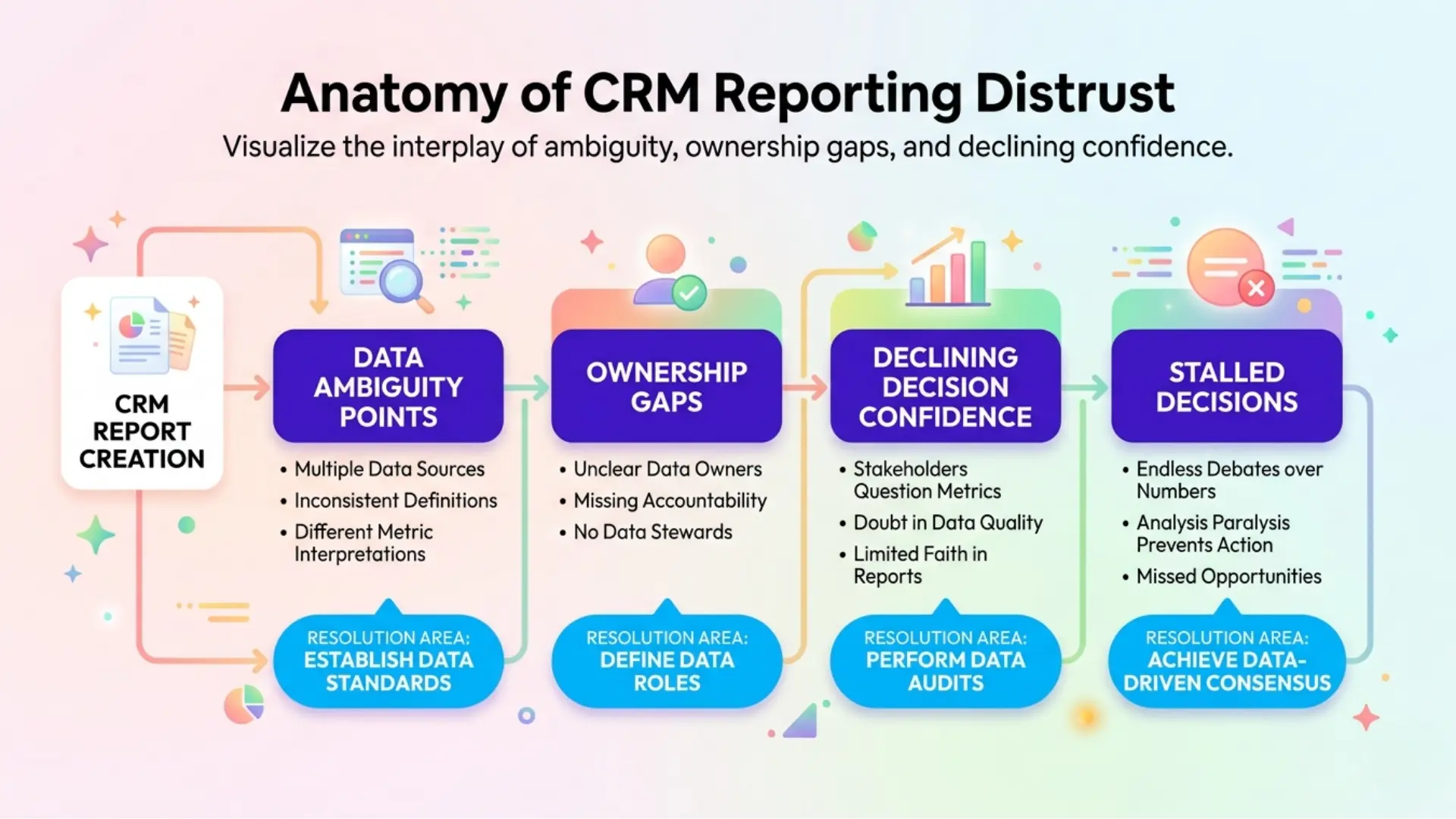
Ownership gaps: when no one stands behind the numbers
If you have to ask, “Who owns this report?” trust is already compromised.
We’ve seen high-stakes revenue tables where no analyst, marketer, or sales leader claims responsibility.
That gap does more harm than any technical flaw.
In our experience, leadership will endure small inaccuracies – but when no one can (or will) vouch for a number, faith erodes fast.
The result: every insight becomes a suspect; every action prompts a defensive check.
Effects of Ownership on CRM Reporting Trust
| Ambiguity Source | Description | Impact on Confidence |
| Undefined Inclusion Criteria | Unclear if metrics include renewals or only new business | Leads to misinterpretation of pipeline values |
| Changing Filters | Metrics filtered differently across periods | Causes inconsistent comparisons |
| Shifting Definitions | Varied mental models of terms like ‘qualified lead’ | Triggers debates and misaligned expectations |
The observable pattern: Without clear ownership, trust in reporting erodes regardless of technical quality.
Clients often come to us after months of stalled progress, only to admit, “We’re not sure who built the dashboard”.
When ownership is scattered or ambiguous, skepticism spreads: Was this number rolled up correctly?
Did someone adjust a filter last minute?
No answer, no trust.
One analogy: it’s like making strategic bets with chips no one will claim; the stakes become fake, so the game stops mattering.
Trust doesn’t die from error – it dies from neglect.
If nobody stands behind a metric, even the flashiest dashboard just sits there, gathering dust.
Ambiguity and ownership gaps break the chain between data and action.
When teams can’t decode what a report means – or who’s willing to defend it – decision inertia isn’t just likely, it’s automatic.
The next threat is behavioral: how distrust warps the very interaction with data itself.
That broader fragmentation in ownership fits the pattern outlined in Marketing Automation & CRM.

How distrust morphs reports into debate
It happens faster than most executives realize: the moment a CRM report sparks more questions than answers, decisions take a back seat.
Leaders who once demanded numbers start interrogating them instead – turning what should be clarity into a negotiation.
A single round of conflicting pipeline data, followed by another “quick fix”, and the room starts treating every metric as an opening statement, not a basis for action.
From data‑driven to data‑informed: leadership skepticism in motion
When CRM figures don’t line up two quarters in a row, executives don’t lean harder on the data – they start hedging.
We’ve seen leadership teams move from relying on clear metrics to second-guessing every trend line.
Instead of the numbers making decisions faster, every point becomes subject to reinterpretation: “Is this deal count real, or did ops shift the definition again?”
Key Signs of Leadership Skepticism in CRM Reporting
- Repeated discrepancies in pipeline data across reports
- Executives requesting source files or alternate data exports
- Multiple dashboards showing conflicting numbers
- Leadership hedging decisions instead of committing
- Increased emphasis on questioning definitions rather than outcomes
The myth is that more reporting builds confidence.
In practice, every added report with mismatched totals only raises suspicions.
One VP described it to us: “Every Monday, three dashboards say three different things – and then nobody wants to own the number”.
It’s like building a bridge where every engineer submits their own blueprints; nobody trusts the structure enough to cross first.
If you’re seeing executives spend meetings asking for source files or alternate exports, you’re already in the zone where data‑driven becomes data‑debated.
When meetings become blame sessions instead of decisions
Once suspicion sets in, meetings no longer push the business forward – they stall out in cycles of diagnosis and deflection.
Who entered this data?
Why did the win rate swing so much?
Instead of agreeing on “what’s true”, department heads start defending their own numbers and narratives.
We’ve observed teams spend over half their standing meetings tracking origin stories rather than driving actions.
It’s not just friction; it’s a loop.
One question sparks defensive maneuvering (“That’s not our fault, sales ops owns that metric”.), which spurs even more scrutiny.
Discussions get louder, outcomes get fewer, and the organization as a whole waits for someone – anyone – to call a number safe enough to move on.
When CRM reporting distrust takes over, the business stops acting on data and starts negotiating over it.
This inertia is rarely loud at first – it quietly turns leadership attention away from progress and toward perpetual re-litigating the facts.
If you see teams debating numbers more than next steps, reporting skepticism is already costing you momentum.

Why forecasting breaks when CRM truth collapses
Most teams hunt for the perfect forecast, but here’s the catch: once trust in CRM data slips, even the best-looking projection quietly unravels.
Numbers fill spreadsheets, presentations spark debate, but reality always outpaces a model built on shaky ground.
Forecasting doesn’t just get harder – it becomes theater, not strategy.
Forecast variance grows when CRM data loses authority
The easy myth?
That bad forecasts come from bad math.
The real culprit is uncertainty about the very building blocks.
We’ve seen clients pour weeks into refining models, only to realize their pipeline inputs change definitions quarter to quarter.
One global sales org burned through three monthly forecasts – each 30% off – because every team measured ‘qualified’ differently.
Suddenly, variance isn’t noise – it’s evidence that nobody agrees on the facts.
It feels like trying to predict the weather with a dozen thermometers, each stuck in its own microclimate.
Even with sophisticated dashboards and robust software, if each department tunes numbers for their story, the central projection dissolves into negotiation.
The question shifts from, “What will we hit?” to, “Whose version do we trust?” And when ‘truth’ is up for grabs, the forecast loses its weight.
Paralysis by prediction: when teams can’t commit to numbers
Leaders don’t fear being slightly wrong.
What freezes them is knowing every projection could be fiction.
The gut-check question – “Would you bet your bonus on this number?” – goes unanswered.
We’ve watched entire executive teams push back forecasts, not for lack of talent, but because nobody is willing to stand behind the data itself.
The longer this cycle spins, the harder it becomes to set targets, allocate budget, or launch an initiative with conviction.
Each cycle of review becomes one more round of second-guessing: chasing data provenance, validating definitions, re-running exports – anything to avoid making a call that feels built on sand.
It’s like running a race where every step forward triggers another look backward.
Eventually, teams would rather have no forecast than risk committing to a bad one.
When confidence in CRM numbers collapses, forecasting doesn’t just miss – it stalls.
Decisions drift.
Growth plans gather dust.

When no number feels safe, decisions stall
Most leaders believe the real risk is acting on bad CRM data.
The deeper threat?
Nobody acts at all.
When every number is suspect, analysis becomes a holding pattern – comfortable, endless, and quietly destructive to momentum.
Analysis paralysis: endless validation replaces execution
Imagine your team prepping for a board meeting: three versions of the same revenue slide, each with slightly different totals, each “double-checked” – but nobody confident enough to stake a decision on any of them.
It’s not debate; it’s limbo.
We’ve watched seasoned executives spend hours circling definitions, vetting exports, and requesting ‘one last’ data pull.
The meeting ends, objectives dangling, because no metric survives scrutiny without being sliced apart for flaws.
Why does this happen?
Once trust erodes, the job shifts from moving forward to eliminating risk.
It’s like trying to drive using three conflicting GPS routes – you end up parked, map in hand, engine idle.
The myth: more validation equals more certainty.
In reality, it multiplies doubt and turns execution into a mirage.
Every cycle spent proving numbers is a cycle stolen from changing them.
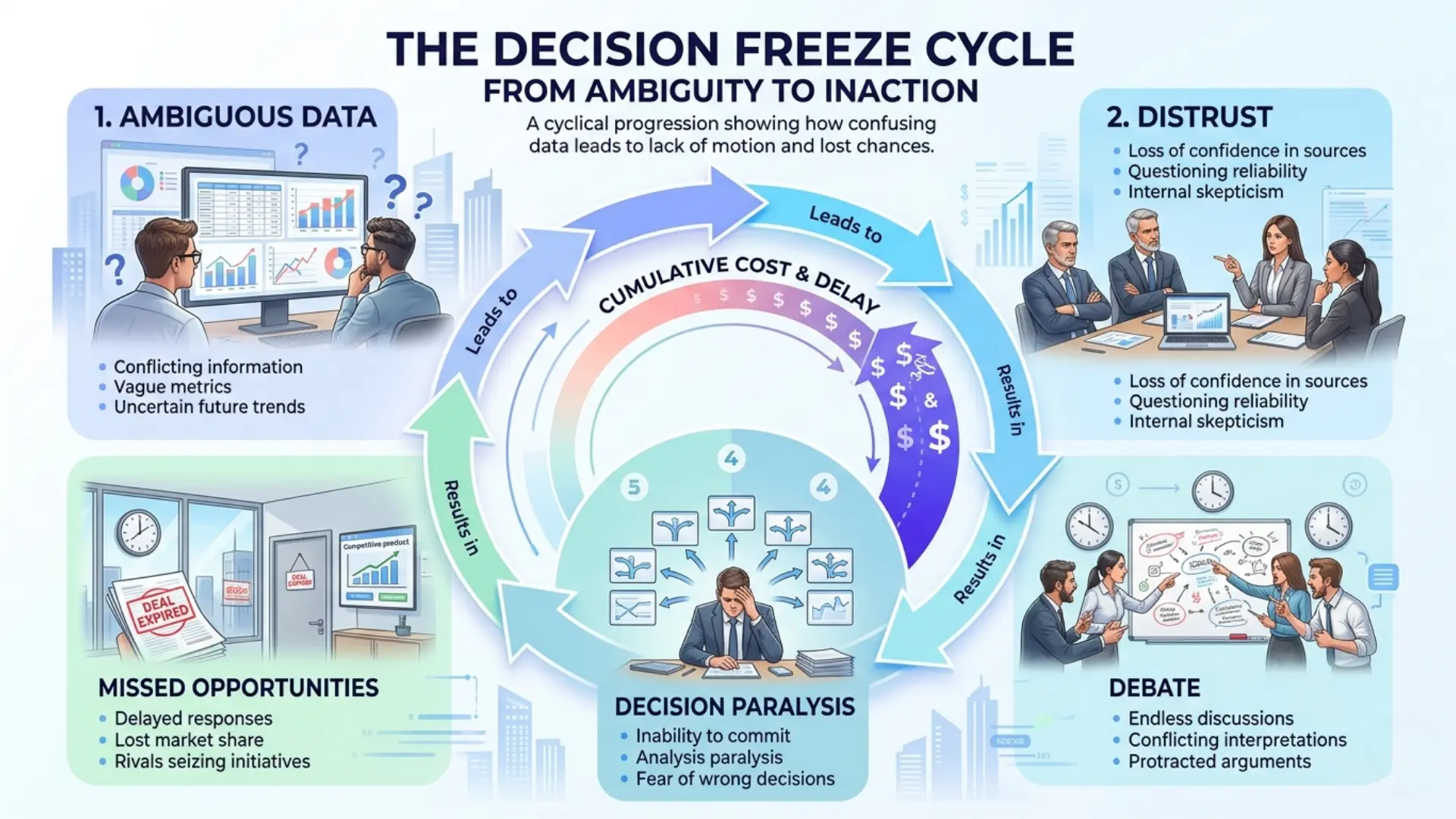
The cost of inaction: missed opportunities and accountability gaps
Every stalled decision has a price.
We’ve seen sales teams miss a critical market window, not due to slow work, but because leadership would rather ask for tighter proof than green-light a campaign.
Marketing plans pile up in drafts.
Opportunities pass while teams dig for one “bulletproof” metric instead of testing, learning, and adjusting.
The cost compounds: revenue targets slip, market share erodes, and accountability runs thin – because if no one trusts the data, no one can be held to outcomes.
Consequences of Decision Paralysis Due to CRM Reporting Distrust
- Missed critical market windows and timing
- Accumulation of unexecuted marketing plans
- Lost revenue opportunities from delayed actions
- Erosion of market share
- Reduced accountability for outcomes
- Cycle of justification replacing execution
What could have been a fast execution loop becomes a loop of justification.
How many deals are lost while teams debate definitions?
How much initiative evaporates when decisions feel radioactive?
When leaders can’t find a safe number, decisions freeze – and so does growth.
The biggest risk isn’t acting on imperfect data; it’s doing nothing while waiting for certainty that never comes.

Scientific context and sources
The sources below provide foundational context for how decision-making, attention, and performance dynamics evolve under scaling and constraint conditions.
- Data Quality and Decision Effectiveness
Beyond Accuracy: What Data Quality Means to Data Consumers – Wang, R.Y., & Strong, D.M. – Journal of Management Information Systems
Establishes how data quality dimensions beyond accuracy – including contextual, representational, and accessibility quality – affect whether users trust information enough to use it in decisions.
https://doi.org/10.1080/07421222.1996.11518099 - Definition Ambiguity and Cognitive Bias in Decision Making
Risk, Ambiguity, and the Savage Axioms – Ellsberg, D. – The Quarterly Journal of Economics
Seminal analysis of how ambiguity under uncertainty changes decision behavior, helping explain why unclear CRM definitions trigger hesitation, skepticism, and executive reluctance to act.
https://doi.org/10.2307/1884324 - Ownership and Accountability in Information Processes
Designing Data Governance – Khatri, V., & Brown, C.V. – Communications of the ACM
Explains how data governance depends on clear decision rights and accountability, directly supporting the article’s point that unclear report ownership weakens confidence and stalls action.
https://doi.org/10.1145/1629175.1629210 - Behavioral Impacts of Distrust in Analytics
Towards Business Intelligence Systems Success: Effects of Maturity and Culture on Analytical Decision Making – Popovič, A., Hackney, R., Coelho, P.S., & Jaklič, J. – Decision Support Systems
Shows how business intelligence maturity, information quality, and analytical decision-making culture affect the use of information for decisions, making it more relevant than the original mismatched link.
https://doi.org/10.1016/j.dss.2012.08.017 - Analysis Paralysis and Organizational Performance
The Concept of Information Overload: A Review of Literature from Organization Science, Accounting, Marketing, MIS, and Related Disciplines – Eppler, M.J., & Mengis, J. – The Information Society
Connects overload, ambiguity, information quality, decision delays, and “paralysis by analysis,” which fits the article’s argument that more validation can replace execution when trust collapses.
https://doi.org/10.1080/01972240490507974
Questions You Might Ponder
What causes CRM reporting distrust in executive teams?
CRM reporting distrust arises when report context, ownership, or definitions become ambiguous, eroding confidence in the data’s meaning. When leaders don’t understand what’s included in metrics or who stands behind reports, trust collapses and skepticism spreads, stalling actionable business decisions.
How does ambiguity in CRM reports impact decision-making speed?
Ambiguity in CRM reports slows decision-making by triggering second-guessing and debate. When it’s unclear what each number means, leaders hesitate to commit, shifting focus to clarifying definitions rather than progressing with decisions – ultimately reducing business agility and responsiveness.
Why is clear ownership important for CRM data trust?
Clear ownership ensures accountability for data accuracy, updates, and context. Without a responsible individual or team, skepticism grows – leaders question report integrity, and the likelihood of neglect or unchecked errors increases, resulting in decision inertia and loss of reporting credibility.
How does CRM reporting distrust affect forecasting accuracy?
CRM reporting distrust undermines forecasting accuracy because leaders cannot agree on inputs or trust projections. Inconsistent definitions and unowned numbers make every forecast debatable, causing organizations to delay targets, miss opportunities, and lose alignment on growth plans.
What are signs that CRM reporting distrust is stalling execution?
Key signs include frequent debates over report definitions, leaders requesting alternate data exports, lack of consensus on report owners, stalled or revisited forecasts, and meetings focused on data validation over action – all creating a cycle of justification instead of decisive execution.