Table of Contents
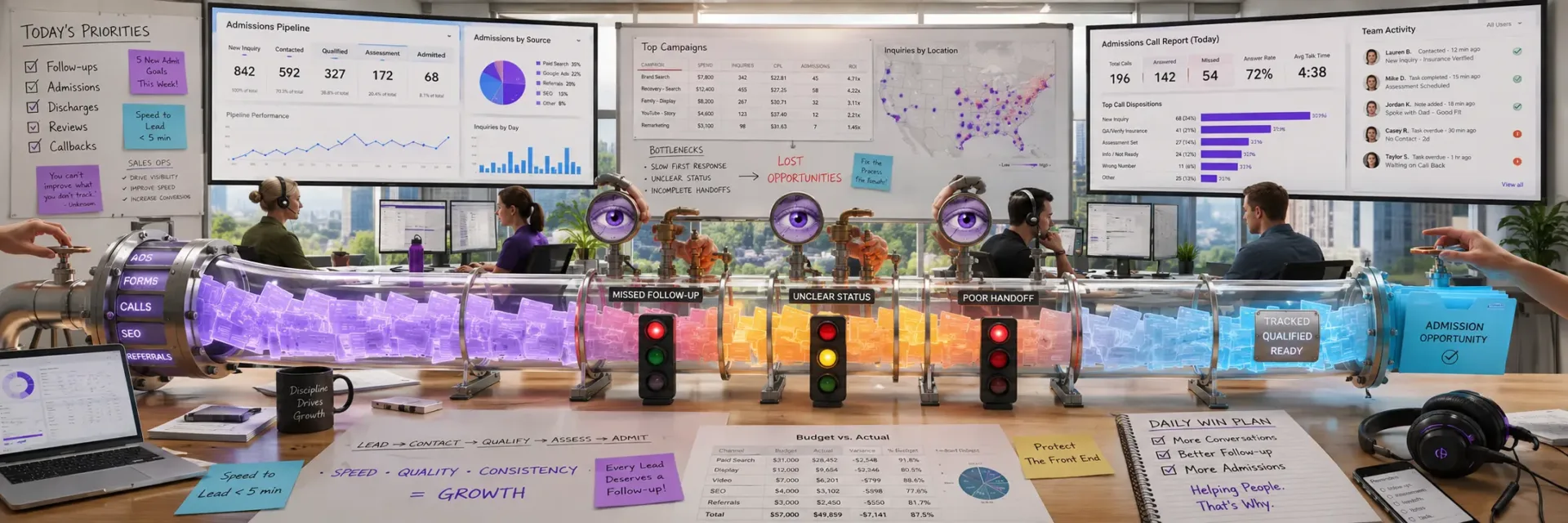
Tracking sales progress HubSpot is the process of using HubSpot CRM to see how inquiries, leads, and opportunities move from first contact to follow-up, qualification, pipeline stage, and final outcome.
In addiction treatment, this means tracking where each inquiry came from, how quickly the team responded, whether the contact was qualified, what follow-up happened, and where the admissions process slowed down.
HubSpot supports this through contact records, pipeline stages, tasks, reminders, dashboards, source tracking, and sales activity history.
The goal is not just reporting lead volume, but making sales progress visible so teams can reduce missed follow-ups, improve resource allocation, and manage qualified admissions opportunities more clearly.
Introduction: Enhancing Sales Tracking in Addiction Treatment with HubSpot
Sales tracking is not just a revenue report
Addiction treatment centers do not lose growth only because they lack demand.
They lose growth when the inquiry journey becomes hard to see.
A person may click an ad, visit a treatment page, call admissions, speak with a team member, involve a family member, delay the decision, then return days later.
If that journey is not tracked clearly, the team has to guess what happened.
That is where problems begin.
Follow-ups get missed.
Strong inquiries go cold.
Marketing channels look better or worse than they really are.
Leadership sees lead volume, but not true admissions quality.
In a competitive market, that is not a small operational issue.
It affects growth, occupancy, marketing spend, and patient acquisition.
This is why sales tracking matters in addiction treatment.
It gives the facility a clearer view of how inquiries move from first contact to admission readiness.
It also helps teams understand where the process slows down, which channels create serious conversations, and which follow-up steps need more control.
HubSpot, often used as a leading CRM and sales platform, can support this process by bringing sales, marketing, and admissions data into one more connected system.
The point is not to turn treatment admissions into a cold sales machine.
The point is to create visibility.
Because without visibility, decisions become opinion.
The critical role of sales tracking in addiction treatment
Sales tracking in addiction treatment is not only about counting admissions.
It is about understanding the full inquiry path.
Where did the person first come from?
What message did they respond to?
Did they call or fill out a form?
How fast did the team respond?
Was the inquiry qualified?
Did the person move forward?
If not, where did the process stop?
These questions matter because patient acquisition is rarely a straight line.
Some people are ready to speak immediately.
Some need time.
Some are family members trying to compare options.
Some are not a fit for the program.
Some need financial clarity before they can move forward.
If the facility only tracks top-level numbers, the real picture stays hidden.
A campaign may generate many leads but few qualified admissions conversations.
Another campaign may generate fewer inquiries but stronger intent.
One source may look expensive at first, but produce better-fit opportunities.
Another may look cheap, but waste admissions time.
Sales tracking helps separate activity from progress.
That is the difference leadership needs to see.
Data can also help sales and admissions teams improve their work.
McKinsey has written about how analytics can help sales teams understand opportunities more clearly and improve performance.
In addiction treatment, the same principle applies, but with more sensitivity and stricter operational control.
The facility does not need more data for the sake of data.
It needs the right data to make better decisions.
Leveraging HubSpot’s tools for effective sales tracking
HubSpot can help addiction treatment centers organize sales tracking in a more practical way.
The platform can connect contact records, inquiry sources, pipeline stages, call notes, tasks, follow-up reminders, email activity, forms, and reporting dashboards.
That matters because many facilities still manage parts of the journey across separate tools.
Website forms sit in one place.
Call notes sit somewhere else.
Ad data sits in Google Ads or Meta.
Email follow-up lives in inboxes.
Admissions updates live in spreadsheets or private notes.
That creates blind spots.
HubSpot’s CRM can give teams a more centralized view of each inquiry.
The admissions team can see the contact history.
Marketing can see which channels created the inquiry.
Managers can see whether follow-up is happening.
Leadership can see which sources move toward real admissions opportunities.
That is where HubSpot’s Sales Software becomes useful.
Not because the software is complex.
Because it helps the team manage simple but important actions with more consistency:
Who needs follow-up?
Which inquiry is stuck?
Which lead source created the contact?
Which stage is the opportunity in?
What happened in the last conversation?
What should happen next?
When this information is visible, the team can act faster and with more context.
That does not replace human judgment.
It supports it.
Real-life impact of HubSpot on addiction treatment sales
The real value of HubSpot shows up when the center stops guessing.
A treatment center may discover that one campaign creates high lead volume, but most inquiries are weak fit.
Another source may produce fewer contacts, but those contacts move faster through admissions.
A landing page may bring form submissions, but phone calls may create stronger opportunities.
These are not abstract insights.
They affect budget, staffing, follow-up, campaign strategy, and admissions planning.
HubSpot can also make handoffs cleaner.
If one staff member speaks with a family member, another staff member can see the notes, status, and next step.
If a follow-up is needed, the task is visible.
If an opportunity stalls, managers can review where and why.
That level of control matters in addiction treatment because timing is often critical.
A missed follow-up is not just a lost sales action.
It may be a missed chance to guide someone toward help at the moment they were willing to talk.
This is why sales tracking should not be treated as administrative reporting.
It is part of the growth system.
It helps the facility see what is working, what is leaking, and where the next improvement should happen.
Used properly, HubSpot gives addiction treatment centers a clearer way to manage the path from inquiry to admission.
Not by adding noise.
By making the right signals easier to see.
A related decision is covered in Mastering Addiction Treatment Center Patient Attraction with HubSpot, which explains the adjacent issue in more detail.

Begin with HubSpot today and witness the transformative impact on your addiction treatment center!
The Importance of Sales Tracking in Addiction Treatment
Sales tracking shows what lead volume cannot
Lead volume can look comforting.
It gives the team a number to report.
It makes campaigns feel active.
It suggests the market is responding.
But lead volume alone can hide the truth.
A treatment center can receive many inquiries and still struggle to turn those inquiries into qualified admissions conversations.
Another center can receive fewer inquiries but convert more of them because the source, message, follow-up, and admissions process are better aligned.
That is why sales tracking in addiction treatment matters.
It helps leadership understand what is actually happening between first inquiry and patient acquisition.
Without tracking, the team may only see the surface:
How many forms were submitted.
How many calls came in.
How many contacts entered the CRM.
How much was spent on ads.
Those numbers are useful, but incomplete.
Sales tracking goes deeper.
It shows whether inquiries were qualified, whether the admissions team followed up, whether the person moved forward, and where the process slowed down.
It also helps separate poor-fit activity from real opportunity.
That distinction matters because addiction treatment marketing is expensive, competitive, and sensitive.
A facility cannot afford to judge performance only by the number of people who raise their hand.
It needs to know which inquiries can realistically become admissions.
Understanding patient acquisition through sales tracking
Patient acquisition in addiction treatment is rarely clean.
A person may first search online.
A family member may call instead of the patient.
Someone may ask a question through a form and then disappear.
Another person may need multiple conversations before they are ready to take the next step.
Sales tracking helps make that journey visible.
By monitoring inquiry sources, conversion rates, call outcomes, pipeline stages, follow-up attempts, and patient demographics where appropriate, treatment centers can see which efforts are producing the right type of demand.
This gives the team a clearer view of patient acquisition.
For example, a center may find that paid search creates more urgent inquiries, while educational content supports families earlier in the decision process.
Or it may find that a campaign generates many leads, but most are not a good fit for the program.
That insight changes decision-making.
The team can adjust messaging, landing pages, channel investment, and follow-up workflows based on real behavior instead of opinion.
Sales tracking also helps identify weak points.
If many inquiries arrive but few become conversations, the issue may be response time or contact quality.
If many conversations happen but few move forward, the issue may be fit, cost, program clarity, or trust.
If many strong opportunities stall, the issue may be follow-up discipline or admissions workflow.
Each problem requires a different fix.
Without tracking, they all look like the same problem: “We need more leads”.
Most of the time, that is too simple.
Optimizing resource allocation with sales data
Treatment centers have limited resources.
Marketing budget is limited.
Admissions team capacity is limited.
Leadership attention is limited.
Clinical and operational resources are limited.
Sales tracking helps the facility decide where those resources should go.
If one channel produces high-quality opportunities, it may deserve more budget.
If another channel produces many weak inquiries, it may need better targeting, better messaging, or less spend.
If one admissions stage creates consistent delays, the team may need training, process changes, or stronger task management.
This is where sales data becomes a management tool.
It helps leaders allocate resources based on evidence, not pressure.
A center can use tracking data to decide:
Which campaigns deserve more investment.
Which channels need refinement.
Which referral sources are worth deeper relationship work.
Which follow-up gaps need operational attention.
Which team members need better workflow support.
Which stages of the pipeline need clearer ownership.
This kind of resource allocation becomes especially important when market conditions are tough.
Ad costs may rise.
Competition may increase.
Inquiry quality may shift.
Referral patterns may change.
If the center is not tracking the full journey, budget decisions become reactive.
Sales tracking gives leadership a better view of where money, time, and staff effort create the strongest return.
For broader resource allocation thinking, McKinsey & Company provides useful analysis across strategy, operations, and growth.
The principle is simple:
Spend more where the system creates qualified progress.
Fix or reduce what only creates activity.
Sales tracking helps teams set realistic goals
Many growth goals fail because they are not tied to process reality.
A center may set a target for more admissions without knowing how many qualified inquiries are required to reach that target.
It may increase ad spend without understanding the conversion rate from inquiry to admission.
It may ask admissions to move faster without seeing where the real delay occurs.
Sales tracking makes goals more practical.
If leadership knows the average conversion rate from inquiry to qualified opportunity, and from qualified opportunity to admission, it can plan more realistically.
It can also ask better questions:
How many qualified inquiries do we need this month?
Which channels can produce those inquiries?
What follow-up speed is required?
Where do we need to improve conversion?
What is the cost per qualified opportunity, not just cost per lead?
This helps the facility avoid growth planning based on hope.
It also makes performance discussions more precise.
Instead of blaming marketing, admissions, or market conditions in general, the team can inspect each stage of the journey and identify the real constraint.
That is the value of sales tracking.
It turns growth from a vague outcome into a visible process.
The goal is better control, not more reporting
Sales tracking should not become a reporting burden.
If the CRM becomes too complex, staff will avoid it.
If the team has to enter too much data manually, the data quality will decline.
If reports are too abstract, leadership will stop using them.
The system needs to stay practical.
Track the data that helps the center make better decisions.
Remove fields that do not influence action.
Keep pipeline stages clear.
Make follow-up ownership visible.
Connect marketing activity to admissions outcomes.
That is enough to start.
For addiction treatment centers, the value of sales tracking is not in having a perfect dashboard.
The value is in knowing what is working, what is leaking, and where the next improvement should happen.
That visibility can improve patient acquisition, budget decisions, admissions follow-up, and leadership planning.
It also reduces the habit of solving every growth problem by buying more leads.
Sometimes the bigger opportunity is not more demand.
It is better control over the demand already coming in.

Embrace HubSpot’s comprehensive analytics for deeper insights!
HubSpot’s Tools for Sales Tracking in Addiction Treatment
The CRM should show the truth of the admissions pipeline
A CRM is only useful if it shows what is really happening.
Not what the team hopes is happening.
Not what a spreadsheet suggests after the fact.
Not what a campaign dashboard implies from lead count.
The real question is simpler:
Where is each inquiry now, and what needs to happen next?
That is where HubSpot becomes practical for addiction treatment centers.
HubSpot’s CRM tools help teams capture, organize, and review the stages of the admissions journey.
Instead of relying on disconnected notes, inboxes, and platform reports, the center can manage contacts, tasks, pipeline stages, follow-up activity, and outcomes in one place.
This helps teams see the difference between:
A new inquiry.
A contacted inquiry.
A qualified admissions opportunity.
A stalled opportunity.
A poor-fit lead.
A completed admission.
That difference matters.
If all inquiries are treated the same, reporting becomes weak.
A form submission from someone casually researching is not equal to a high-intent call from a family member ready to speak.
A low-fit lead is not the same as a serious opportunity that needs fast follow-up.
HubSpot helps the team make those differences visible.
And once they are visible, they can be managed.
Pipeline tracking keeps the process from disappearing into notes
The admissions process has stages.
If those stages are not defined inside the CRM, the process often disappears into private notes, memory, or scattered conversations.
That creates risk.
A staff member may know what happened with a caller, but no one else does.
A manager may know that an inquiry is important, but there is no clear stage or next task.
Marketing may know the lead source, but not whether that inquiry was worth the spend.
HubSpot’s pipeline tools can help solve this.
A treatment center can build a pipeline that reflects its real admissions process.
For example:
- New inquiry.
- Contact attempted.
- Contact made.
- Fit reviewed.
- Financial discussion.
- Admission scheduled.
- Admitted.
- Not admitted.
- Follow-up needed.
The exact stages should match the center’s workflow.
The point is not to create a complicated sales board.
The point is to make progress visible.
HubSpot’s sales pipeline tracking features can help teams understand where each inquiry sits, who owns the next step, and where opportunities tend to stall.
This gives admissions managers a clearer view of daily work.
It also gives leadership a better way to judge performance over time.
If many inquiries get stuck at the same stage, the issue may not be marketing.
It may be process, staffing, pricing clarity, fit, call handling, or follow-up discipline.
Pipeline tracking helps reveal that.
Task management protects follow-up
In addiction treatment, timing matters.
A delayed response can change the outcome.
Someone may be ready to talk now.
A family member may be calling several centers in the same hour.
A potential patient may lose momentum if the next step is unclear.
That is why follow-up cannot depend only on memory.
HubSpot can create tasks, reminders, ownership rules, and internal notifications to help the team stay on top of next actions.
This is simple, but important.
A new form submission can trigger a task.
A missed call can require a callback.
A stalled opportunity can alert a manager.
A follow-up date can stay attached to the contact record.
A team member can see what was already done before making the next call.
This reduces one of the most common leaks in the admissions journey:
Good inquiries that do not receive consistent follow-up.
Task management does not replace care.
It supports it.
The admissions conversation still needs judgment, empathy, and clarity.
HubSpot simply helps make sure the right person follows up at the right time with the right context.
Dashboards turn activity into management insight
Dashboards are useful only when they help leaders make decisions.
A dashboard full of vanity metrics will not help an addiction treatment center improve admissions performance.
The important reports should connect activity to progress.
HubSpot dashboards can help leadership review:
New inquiries by source.
Contact rate.
Follow-up speed.
Pipeline stage movement.
Qualified opportunities.
Admissions outcomes.
Lost opportunity reasons.
Campaign performance by quality, not only volume.
This matters because marketing platforms often stop too early.
They can show impressions, clicks, forms, and calls.
But they do not always show whether those contacts became serious admissions opportunities.
HubSpot can help connect the front-end marketing picture with the back-end admissions picture.
That gives the team a better way to decide what to fix.
If lead volume is high but qualified opportunities are low, the issue may be targeting or message quality.
If qualified opportunities are strong but admissions are low, the issue may sit later in the process.
If follow-up speed is poor, the team may need operational changes before increasing ad spend.
Good dashboards do not just report performance.
They show where the constraint is.
Automation should remove admin work, not human judgment
HubSpot automation can help treatment centers work faster.
But it needs careful use.
In addiction treatment, automation should not make communication feel cold or careless.
The goal is not to push people through a generic sequence.
The goal is to reduce administrative burden and protect important follow-up steps.
Useful automation may include:
Lead routing.
Task creation.
Internal alerts.
Status updates.
Follow-up reminders.
Campaign attribution.
Basic nurture workflows.
Manager notifications for stalled opportunities.
This kind of automation gives staff more time for the conversations that need real attention.
It also helps protect consistency.
For example, every new inquiry can receive the same internal handling process, even if the actual human conversation is personalized.
Every stalled opportunity can be flagged.
Every source can be tracked in the same structure.
That makes reporting cleaner.
And clean reporting makes better decisions possible.
Contact records create continuity across the team
Addiction treatment inquiries often involve multiple conversations.
A person may speak with one team member first, then another.
A family member may call, then the potential patient may contact the facility later.
A follow-up may happen after several days.
A manager may need to review the case.
Without a shared record, context gets lost.
HubSpot contact records help preserve that context.
The team can see forms, emails, calls, notes, source data, lifecycle stage, tasks, and pipeline status in one place.
This creates continuity across the admissions team.
That continuity is practical.
It helps staff avoid asking people to repeat the same information.
It helps managers review quality.
It helps marketing understand what happened after the lead arrived.
It helps leadership see whether the process is working.
The more sensitive the journey, the more important continuity becomes.
But this also requires discipline.
Treatment centers should be careful about what information they store in the CRM.
HubSpot should support admissions and marketing operations, but sensitive clinical information needs clear controls and should remain in the correct healthcare systems when required.
The goal is not to store everything.
The goal is to store the right information in the right place.
HubSpot’s tools work best when they are designed around the facility
HubSpot is flexible.
That is useful, but it also creates risk.
A treatment center can build a clean, practical CRM.
It can also build a confusing one with too many fields, too many automations, and too many reports no one trusts.
The tool is not the strategy.
The strategy is the structure.
The best setup starts with the facility’s real admissions process, then builds HubSpot around it.
That means clear stages, clean source tracking, simple task rules, practical dashboards, and training that matches how the team works.
HubSpot’s sales tracking tools can help addiction treatment centers improve visibility, follow-up, reporting, and pipeline control.
But the value does not come from turning on features.
It comes from using those features to answer the questions that affect growth:
Which inquiries are moving?
Which ones are stuck?
Which channels produce quality?
Which follow-ups are late?
Which stages need attention?
Which decisions should change?
When HubSpot answers those questions clearly, it becomes more than a CRM.
It becomes a management system for admissions growth.
That matters because CRM systems in healthcare are not just back-office tools.
They can support better coordination, cleaner information flow, and stronger management visibility.
For broader context on digital systems and healthcare transformation, Healthcare IT News offers useful industry coverage and resources.

Improving Patient Outcomes through Effective Sales Tracking
Sales tracking should improve the patient journey, not just the dashboard
Sales tracking in addiction treatment should not stop at business reporting.
If the data only tells leadership how many inquiries came in, it is too shallow.
The more useful question is this:
What does the inquiry data reveal about the patient journey?
That matters because every inquiry contains signals.
Some are obvious.
Some are easy to miss.
A person may ask about cost before they ask about care.
A family member may revisit the same page several times before calling.
A caller may seem uncertain but still be highly serious.
A lead source may bring many contacts, but most may not match the program.
When these patterns are tracked properly, they can help the facility improve communication, follow-up, and the admissions experience.
This does not mean reducing patient care to a sales funnel.
It means using operational data to remove friction from the path into care.
Enhancing patient engagement with data-driven insights
Patient engagement starts before admission.
It starts when someone first searches, clicks, reads, calls, or fills out a form.
Sales tracking helps addiction treatment centers understand those early signals.
By looking at inquiries, feedback, interaction patterns, contact source, response time, follow-up activity, and stage movement, the team can see what people need before they are ready to commit.
This insight can improve communication.
For example, if many family members ask the same questions, the facility may need clearer family-focused content.
If many inquiries stall after the cost discussion, the team may need better financial guidance.
If a certain landing page creates confusion, the page needs to explain the next step more clearly.
The point is not just to collect data.
The point is to learn from it.
A treatment center can use those insights to make outreach more relevant and timely.
That may include better follow-up messaging, clearer admissions content, improved call scripts, stronger education resources, or more useful email sequences.
Engagement improves when people receive information that matches their real concerns.
It weakens when the facility sends generic messages that ignore what the person already did or asked.
Sales tracking helps prevent that mismatch.
Tailoring communication and follow-ups for improved retention
Follow-up is not just an admissions task.
It is part of the experience.
A person or family member may need more than one conversation before moving forward.
They may need reassurance, practical answers, or time to compare options.
If the facility follows up without context, the interaction can feel careless.
If the facility follows up with the right context, it can feel more organized and trustworthy.
Sales tracking helps make that possible.
When HubSpot captures the contact history, inquiry source, previous conversations, stage, and next task, the team can follow up with more precision.
That might mean:
A faster callback after a high-intent form.
A family-specific follow-up after a parent inquiry.
A practical next-step email after an admissions call.
A reminder task when someone asked to speak later.
A manager review when an opportunity stalls too long.
These details matter.
They help the team avoid treating every inquiry the same way.
Retention and continued engagement often depend on consistency.
If people feel lost between interactions, trust can drop.
If the team communicates clearly and remembers the context, the process feels more stable.
HubSpot can support that stability by keeping follow-up visible and organized.
Tailoring treatment programs and improving patient engagement with sales data
Sales data can also reveal patterns that help leadership refine programs and positioning.
For example, repeated inquiry themes may show that the market wants clearer information about privacy, family involvement, program length, cost, dual diagnosis support, executive treatment options, or aftercare.
That does not mean every program should change based on marketing data.
Clinical decisions must remain clinical.
But sales and admissions data can show how people understand the offer, where they hesitate, and what they believe they need.
That information can improve how the facility explains its programs.
It may also reveal gaps in the way services are packaged, presented, or supported across the patient journey.
For example:
If many qualified inquiries ask about aftercare, the center may need stronger aftercare communication.
If many families ask how to approach a loved one, the center may need better family education.
If many inquiries drop after a specific stage, the team should inspect what happens there.
If people misunderstand the program structure, the website and admissions process need clearer explanation.
Understanding the patient journey through sales data can also help teams craft more effective communication and follow-up strategies, leading to improved patient engagement and satisfaction.
For broader resources on patient engagement strategy, Patient Engagement HIT provides useful industry coverage and practical insights.
In addiction treatment, this matters because engagement is fragile.
A person may be ready one day and unreachable the next.
A family may need practical answers before they can act.
A poor handoff may create doubt.
A slow response may send someone elsewhere.
Effective sales tracking helps the team reduce these breakdowns.
It gives the facility a clearer way to understand what people need, how they move through the journey, and where support should improve.
Refining treatment programs with sales data
Sales and admissions data can help treatment centers make better decisions about how programs are presented, supported, and improved.
By understanding the preferences and needs shown in inquiry data, centers can make more informed decisions about program adjustments and service enhancements.
This could involve clearer program explanations, stronger family support materials, better aftercare communication, more practical financial guidance, or more precise messaging around treatment options.
The point is not to let marketing data override clinical judgment.
The point is to use sales data as a signal.
If people keep asking the same questions, something is unclear.
If many qualified inquiries hesitate at the same point, something needs review.
If certain concerns appear again and again, the facility should address them earlier in the journey.
Continuous refinement helps treatment centers align services, communication, and support with patient needs and market demand.
For broader information on substance use treatment, prevention, and behavioral health resources, The Substance Abuse and Mental Health Services Administration (SAMHSA) offers a wealth of information.
The result is not just better reporting.
It is a more organized, responsive, and patient-aware admissions process.

Use HubSpot’s data-driven approach to refine your patient engagement strategies!
Real-Life Examples: HubSpot’s Impact on Sales Tracking
Case studies are useful only when they reveal the system
Most case studies sound better than they are.
They show a result, but not the operating problem behind it.
They mention growth, but not the process that created it.
They say a tool helped, but not what the tool made visible.
For addiction treatment centers, the useful lesson is not “HubSpot improved sales tracking”.
The useful lesson is:
What did the center finally see after the CRM was implemented?
That is where the value sits.
When HubSpot is set up correctly, it can show where inquiries come from, how quickly staff respond, which opportunities move forward, where conversations stall, and which campaigns create qualified admissions conversations.
That visibility can change the way a facility manages growth.
Below are two practical examples that show how this works in different operating environments.
Case Study 1: Boosting patient acquisition in a small treatment center
Small treatment centers often compete against larger facilities with bigger budgets, stronger brand recognition, and more developed admissions teams.
That does not mean they cannot compete.
But it does mean they need sharper control.
A smaller addiction treatment center may not be able to waste budget on poor-fit leads.
It may not have extra staff capacity to chase every inquiry manually.
It may not have a large analytics team to connect marketing activity with admissions outcomes.
In this case, the center’s problem was not simply low demand.
The deeper problem was limited visibility.
The team had inquiries coming in, but it did not have a clear enough view of which sources were working, which contacts needed follow-up, and which messages were creating serious interest.
HubSpot changed the operating picture.
By using HubSpot’s CRM tools, the center could track patient interactions from the first inquiry through later follow-up.
Calls, forms, notes, source data, and next steps became easier to organize.
Instead of treating each inquiry as a separate event, the team could see the journey around that inquiry.
That mattered because many people do not convert after one interaction.
A family member may need more information.
A potential patient may need time.
A qualified inquiry may need a second conversation.
A poor-fit inquiry may need to be filtered out faster.
With better tracking, the center could respond with more context.
HubSpot’s analytics also helped the team review which marketing efforts were producing stronger engagement.
That allowed the center to adjust campaigns, improve messaging, and focus more attention on sources that produced better-fit inquiries.
The result was a stronger patient acquisition process.
Not because HubSpot magically created demand.
Because it helped the center stop managing demand blindly.
The lesson is practical:
Small facilities do not need a more complicated system.
They need a clearer one.
Case Study 2: Streamlining sales tracking in a large facility
Large treatment facilities have a different problem.
They may already have inquiry volume.
They may already have multiple campaigns running.
They may already have an admissions team in place.
But scale creates its own risk.
More leads can mean more confusion.
More staff can mean more handoff problems.
More campaigns can make attribution harder.
More reporting can create more disagreement if the data is not connected.
In this example, the large facility struggled to track and analyze sales progress across the full admissions journey.
The leadership team needed to understand how inquiries moved from first contact to admission.
The marketing team needed to know which campaigns were producing meaningful conversations.
The admissions team needed a cleaner view of follow-up and opportunity status.
HubSpot helped by bringing more structure to the process.
The facility could monitor each stage of the sales and admissions journey, from initial inquiry to final admission.
That gave the team a more detailed view of where opportunities were moving smoothly and where they were getting stuck.
This level of tracking created several benefits.
Marketing could compare campaign performance against real pipeline outcomes.
Admissions managers could see where follow-up needed attention.
Leadership could make better resource decisions.
The team could identify bottlenecks before they became bigger revenue problems.
One important result was the ability to connect marketing activity with sales progress.
That matters because a campaign can look strong at the top of the funnel while producing weak admissions outcomes.
Another campaign can look smaller but create better-fit opportunities.
Without CRM tracking, those differences are easy to miss.
HubSpot gave the facility a way to inspect that difference.
The facility also improved its ability to tailor communication around patient needs.
Better tracking created better context.
Better context made it easier to communicate with people and families in a more relevant way.
The lesson here is different from the small-center example.
Large facilities do not just need more lead volume.
They need pipeline control at scale.
Actionable insights and lessons learned
These examples point to the same core idea:
Sales tracking is not administration.
It is a management system.
For small centers, HubSpot can help make limited resources more effective.
The CRM can show which inquiries deserve attention, which campaigns produce real opportunity, and where follow-up is leaking.
For larger facilities, HubSpot can help manage complexity.
It can connect marketing, admissions, reporting, and pipeline visibility so leadership can see what is happening across the full journey.
The lessons are simple, but important:
Track quality, not just volume.
Define pipeline stages clearly.
Make follow-up ownership visible.
Connect marketing data to admissions outcomes.
Review where opportunities stall.
Use dashboards to guide decisions, not decorate reports.
The broader point is that HubSpot can adapt to different facility sizes and operating models.
A small center may use it to create basic control and focus.
A large facility may use it to manage scale, reporting, and cross-team coordination.
In both cases, the value comes from the same place:
HubSpot makes the journey easier to see.

Explore their stories and apply these real-life lessons to your sales strategy!
Implementing HubSpot for Sales Tracking in Your Facility
Implementation should start with the process, not the platform
HubSpot can improve sales tracking in an addiction treatment facility.
But only if the system is built around the way the facility actually works.
A weak implementation adds screens, fields, reminders, and dashboards without improving control.
Staff then avoid the CRM, managers lose trust in the data, and leadership still cannot see what is happening between first inquiry and admission.
A strong implementation does the opposite.
It makes the process easier to manage.
The goal is not to “install HubSpot”.
The goal is to create a reliable operating system for sales tracking, patient inquiry management, marketing visibility, and admissions follow-up.
That requires three things:
A clear setup plan.
Staff training that matches daily work.
Ongoing review and adjustment based on real data.
Without those pieces, HubSpot becomes another tool.
With them, it becomes part of how the facility manages growth.
Key steps for integrating HubSpot into sales and marketing processes
The first step is not technical.
It is operational.
Before building anything in HubSpot, the facility needs to define how the inquiry journey works today.
Where do inquiries come from?
Who receives them?
What happens after a form submission?
How are calls tracked?
When does an inquiry become qualified?
Which stages matter before admission?
Where does marketing need feedback from admissions?
Which outcomes should leadership see?
These questions should shape the CRM setup.
HubSpot should then be configured to match the facility’s real sales and admissions process.
That may include custom contact fields, deal stages, lead statuses, source tracking, task rules, reporting dashboards, and sales pipelines.
The sales pipeline should be clear enough to guide the team, but simple enough to use every day.
If the stages are too vague, reporting will not help.
If the stages are too complex, staff will stop updating them.
A practical pipeline might show:
New inquiry.
Contact attempted.
Contact made.
Fit reviewed.
Financial or payer discussion.
Admission pending.
Admitted.
Not admitted.
Follow-up needed.
The exact labels should match the facility’s workflow.
The next step is integration.
HubSpot should connect with the key systems that influence patient acquisition and reporting.
That may include the facility’s website, forms, email tools, social media platforms, call tracking, analytics, and ad platforms.
The purpose is not to connect every possible tool.
The purpose is to create one clearer view of the journey.
When data flows correctly, the team can see which marketing sources create inquiries, how those inquiries move through admissions, and which sources produce real opportunities instead of surface activity.
That is where HubSpot becomes useful.
It connects sales and marketing around the same facts.
Training staff for effective use of HubSpot tools
A CRM fails when people do not use it consistently.
That usually happens for one of three reasons:
The setup is too complicated.
The training is too generic.
The team does not understand why the data matters.
Staff training should focus on real workflows, not abstract software features.
Admissions staff need to know how to manage new inquiries, update contact records, log calls, assign tasks, move opportunities through stages, and record outcomes.
Marketing staff need to know how forms, campaigns, source tracking, landing pages, and reporting connect to the CRM.
Managers need to know how to review stuck opportunities, inspect data quality, monitor follow-up speed, and read dashboards.
Leadership needs to know which reports can guide decisions and which numbers are only early signals.
Training should cover:
How to enter data correctly.
How to track interactions with potential patients.
How to manage follow-up tasks.
How to update pipeline stages.
How to use analytics to understand campaign performance.
How to keep sensitive information controlled.
The point is not to make every staff member a HubSpot power user.
The point is to make daily use simple, consistent, and valuable.
Regular refresher sessions also matter because HubSpot changes over time.
New features, updated workflows, and improved reporting can help the facility, but only if staff understand how to use them.
For resources on staff training in CRM systems, HubSpot Academy provides educational materials and courses.
Training protects the quality of the system.
If staff skip fields, use stages differently, or keep notes outside the CRM, the reports become weaker.
Once the reports become weaker, leaders stop trusting the data.
That is why training is not a side task.
It is part of the sales tracking system.
Continuous monitoring and strategy adjustment based on HubSpot data
HubSpot is most useful when the data leads to action.
A dashboard that no one reviews is decoration.
A report that no one understands is noise.
A pipeline that no one updates is false confidence.
Treatment centers should review HubSpot data regularly to understand whether the sales and marketing system is working.
That review should include practical metrics:
Lead source.
Contact rate.
Follow-up speed.
Inquiry-to-qualified conversion.
Qualified opportunity-to-admission conversion.
Campaign performance.
Pipeline stage movement.
Patient engagement signals.
Lost opportunity reasons.
These numbers help the team see where the process needs adjustment.
If a campaign produces many inquiries but few qualified opportunities, the message or targeting may need work.
If many inquiries are qualified but do not move forward, the issue may sit in the admissions process, cost discussion, program clarity, or follow-up.
If opportunities stall in one stage, that stage needs review.
If response times are slow, the team may need workflow changes before increasing marketing spend.
This is the real value of continuous monitoring.
It keeps the facility from treating every growth problem as a lead volume problem.
Sometimes the solution is better targeting.
Sometimes it is clearer messaging.
Sometimes it is faster follow-up.
Sometimes it is a cleaner admissions process.
Sometimes it is better staff training.
Sometimes it is better reporting discipline.
HubSpot data helps leadership tell the difference.
Implementation should stay controlled and practical
Many CRM projects become too large too fast.
The team tries to build every workflow, field, dashboard, automation, and report before the system has proven itself in daily use.
That creates complexity.
A better approach is to start with the core journey first.
Capture inquiries cleanly.
Track sources accurately.
Define the pipeline.
Assign follow-up tasks.
Create a few useful dashboards.
Train staff on daily behavior.
Review the data.
Then improve the system step by step.
This keeps the CRM usable.
It also helps the facility avoid one of the biggest implementation risks: building a system that looks good in theory but fails in practice.
For addiction treatment centers, HubSpot should make sales tracking clearer, not heavier.
The implementation should help the team answer the questions that matter:
Which inquiries need attention now?
Which channels produce qualified opportunities?
Which follow-ups are late?
Where does the pipeline slow down?
Which campaigns deserve more budget?
Which process gaps need fixing?
When HubSpot answers those questions clearly, it becomes more than a CRM platform.
It becomes a practical management system for sales, marketing, and admissions growth.

Embrace HubSpot today for unparalleled results!
Conclusion: Embracing HubSpot for Enhanced Sales Management in Addiction Treatment
HubSpot gives sales tracking a clearer role
HubSpot CRM is not valuable because it gives addiction treatment centers more data.
Most facilities already have data.
The real issue is that the data often sits in different places, tells different stories, and fails to show what is happening between first inquiry and admission.
That is the gap HubSpot can help close.
When HubSpot is set up properly, it helps the team track the full sales and admissions journey with more control.
It can show where inquiries come from, how fast the team follows up, which contacts become qualified opportunities, where the process slows down, and which marketing channels produce real progress.
That changes the way leadership manages growth.
Instead of asking only how many leads came in, the team can ask better questions:
Which leads were qualified?
Which campaigns produced serious conversations?
Which follow-ups were missed?
Which stages created delays?
Which sources created admissions, not just activity?
Those questions matter because addiction treatment growth is not only a marketing problem.
It is a system problem.
Marketing, admissions, follow-up, reporting, and patient engagement all affect the outcome.
HubSpot helps connect those pieces.
Transformative benefits of HubSpot in sales tracking
The main benefit of HubSpot is visibility.
A treatment center can track each interaction from initial inquiry to admission readiness.
That gives the team a more detailed view of the patient journey and a stronger way to manage sales progress.
This visibility helps with several practical areas.
It helps admissions teams avoid missed follow-ups.
It helps marketing teams understand which channels create quality.
It helps managers see where opportunities stall.
It helps leadership allocate resources with more confidence.
That is why HubSpot’s role in sales tracking should be treated as operational, not just technical.
A CRM is not a dashboard for past activity.
It should be a live management system for what needs attention now.
For addiction treatment centers, this is especially important because timing and context matter.
A delayed callback can weaken trust.
An unclear handoff can confuse the person or family.
A poor-fit campaign can waste staff time.
A disconnected reporting system can push budget toward the wrong channel.
HubSpot can reduce these issues when the system is designed around the facility’s real admissions process.
For more insight into CRM systems and digital healthcare transformation, Healthcare IT News offers valuable resources.
Impact on patient acquisition and engagement
HubSpot’s impact does not stop at internal sales management.
It can also improve patient acquisition and engagement.
When a center can track patient interactions more clearly, it can refine how it communicates with people and families.
The team can see what someone has already done, what they asked, where they came from, and what follow-up happened.
That makes outreach more relevant.
A person who requested admissions information should not receive the same message as someone reading early education content.
A family member should not be handled the same way as a self-referral.
A qualified opportunity should not be left inside a generic follow-up process.
HubSpot helps the facility respond with more context.
That can improve engagement because the communication feels less random and more useful.
It can also support acquisition because the team can identify which channels, messages, and touchpoints bring people closer to a real admissions conversation.
The point is not to automate every interaction.
The point is to make sure people receive the right information at the right time, while the team keeps human judgment in control.
This tailored approach can improve the patient experience and support better outcomes, especially when sales tracking is used to reduce friction rather than create pressure.
A call to action for addiction treatment providers
Addiction treatment providers should not adopt HubSpot just because it is a known CRM.
They should adopt it when they are ready to manage sales tracking, marketing performance, and admissions follow-up with more discipline.
That means building the system around real operational questions:
Where do serious inquiries come from?
How quickly does the team respond?
Which stages create delay?
Which campaigns produce quality?
Which contacts need attention today?
Which reports does leadership trust?
HubSpot can help answer those questions, but only if the implementation is practical.
The pipeline must match the facility’s process.
The fields must be clear.
The dashboards must lead to decisions.
The team must be trained.
The data must be reviewed regularly.
The system must protect sensitive information.
When those pieces are in place, HubSpot becomes more than a software platform.
It becomes part of how the facility manages growth.
For treatment centers operating in competitive markets, that control can matter more than simply buying more leads.
More leads do not fix a weak process.
A clearer process helps the team get more value from the demand it already has.
That is the practical reason to embrace HubSpot for sales tracking in addiction treatment.
Not because it makes the admissions process less human.
Because it gives the human team a better system to work from.
A Call to Action for Addiction Treatment Providers
We strongly encourage addiction treatment providers to adopt HubSpot for their sales tracking needs.
Embracing this technology will not only streamline sales processes but also provide deeper insights into patient behavior and preferences.
By leveraging the power of HubSpot, treatment centers can make data-driven decisions that enhance both their operational efficiency and the quality of care provided to patients.
For further exploration or consultation on implementing HubSpot, please contact BiViSee for more information.

Questions You Might Ponder
How does HubSpot help in identifying the most effective marketing channels for addiction treatment centers?
HubSpot’s analytics tools allow addiction treatment centers to track the performance of various marketing channels. By analyzing metrics like lead source, click-through rates, and conversion rates, centers can identify which channels are most effective in attracting potential patients. This data helps in allocating marketing budgets more efficiently, focusing on channels that yield the best results, and adjusting or discontinuing underperforming campaigns. HubSpot’s detailed reporting makes it easier to understand the ROI of each marketing channel.
Can HubSpot integrate with other digital marketing tools used by addiction treatment centers?
Yes, HubSpot offers robust integration capabilities with a wide range of digital marketing tools. This includes social media platforms, email marketing services, content management systems, and more. These integrations allow for a seamless flow of data between HubSpot and other tools, enabling centers to have a comprehensive view of their marketing efforts. This interconnected system ensures that all marketing activities are aligned and that data from various sources can be analyzed collectively for better decision-making.
What role does HubSpot play in improving patient communication strategies?
HubSpot’s CRM system is instrumental in enhancing patient communication strategies. By tracking all interactions with potential patients, centers can personalize their communication based on the patient’s history, preferences, and needs. HubSpot allows for the automation of follow-up emails, personalized messaging, and targeted content delivery, ensuring that communication is relevant and timely. This personalized approach helps in building stronger relationships with potential patients, increasing the likelihood of their engagement with the treatment center.
How does sales tracking in HubSpot contribute to setting realistic business goals for addiction treatment centers?
Sales tracking in HubSpot provides addiction treatment centers with accurate and up-to-date data on their sales performance. This information is crucial for setting realistic business goals. By analyzing trends in patient inquiries, admissions, and conversion rates, centers can set achievable targets for patient acquisition and revenue. HubSpot’s data-driven insights help in forecasting future performance, allowing centers to set goals that are ambitious yet attainable, based on historical data and current market conditions.
Can HubSpot track the patient journey from initial contact to admission in addiction treatment centers?
Yes, HubSpot’s CRM system is designed to track the entire patient journey, from the first point of contact through to admission. It logs every interaction, including phone calls, emails, website visits, and social media engagements. This comprehensive tracking provides a detailed view of the patient’s journey, highlighting key touchpoints and opportunities for engagement. Understanding this journey helps treatment centers to refine their patient interaction strategies, ensuring that they provide the right support and information at each stage of the patient’s decision-making process.
Contact us and find out how we will optimize your addiction treatment center sales with HubSpot CRM.