Table of Contents
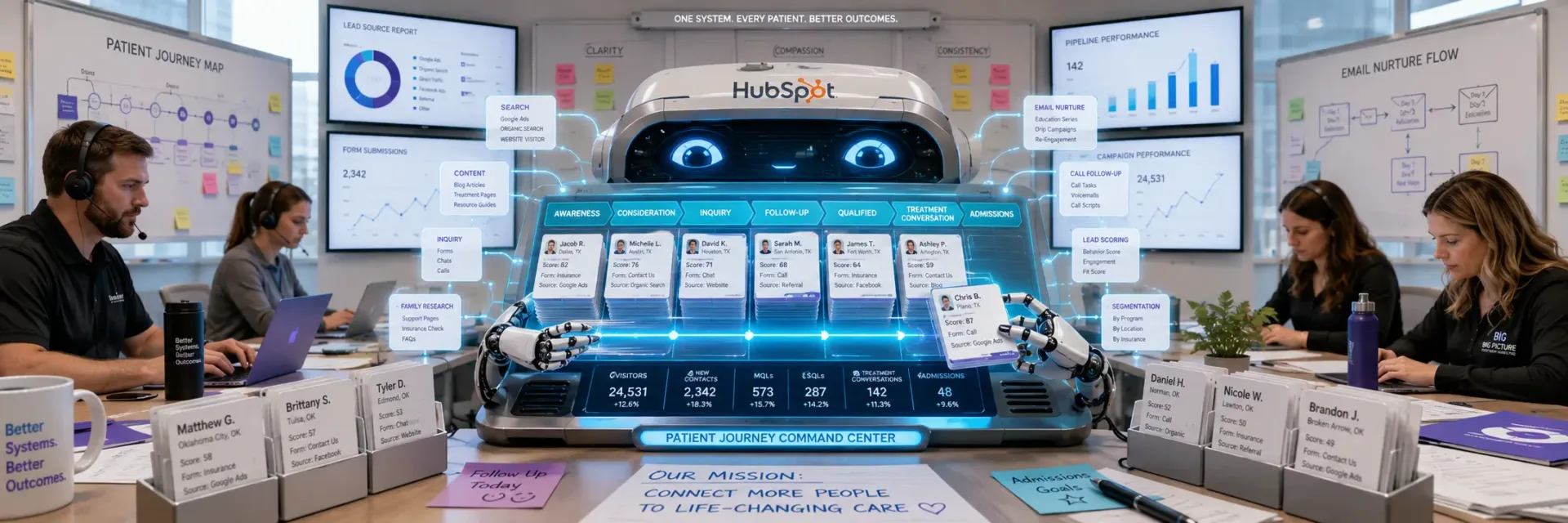
Attracting patients HubSpot means using HubSpot’s CRM, Marketing Hub, automation, email, forms, segmentation, analytics, and reporting tools to help addiction treatment centers guide people from first interest to a qualified treatment conversation.
In addiction treatment, this process connects website visits, content engagement, inquiries, calls, follow-ups, and patient journey stages in one system.
HubSpot helps centers personalize communication, track lead sources, nurture people who are not ready yet, support family and self-referral paths differently, and measure which campaigns create real admissions opportunities.
The goal is not more random leads, but a clearer, faster, more trusted path from search or inquiry to patient engagement.
Introduction: Revolutionizing Patient Attraction in Addiction Treatment with HubSpot
Patient attraction is not just a marketing problem
Addiction treatment centers do not need more random leads.
They need the right people to find them, understand them, trust them, and take the next step at the right moment.
That is much harder than it sounds.
A person looking for treatment may not be ready to speak.
A family member may be researching options quietly.
Someone may compare several centers before making contact.
Another person may call once, hesitate, and disappear if the follow-up feels slow or unclear.
This is why patient attraction in addiction treatment cannot rely only on ads, rankings, or website traffic.
Those channels matter.
But they are only the first layer.
The deeper issue is the journey after attention.
What happens after someone clicks?
What happens after they read a page?
What happens after they call?
What happens after they submit a form?
What happens when they are not ready yet, but may be ready soon?
Most treatment centers struggle because these moments are not connected.
Marketing sees traffic and leads.
Admissions sees calls and conversations.
Leadership sees admissions pressure.
The patient or family experiences the whole thing as one journey.
If that journey feels fragmented, trust weakens.
That is where HubSpot becomes useful.
HubSpot, a leading customer relationship management (CRM) platform, can help addiction treatment centers organize patient inquiries, track communication, manage follow-up, and understand how people move from first contact to admission readiness.
The goal is not to turn patient outreach into a cold sales machine.
The goal is to make the process clearer, faster, and more consistent.
Why HubSpot matters for addiction treatment centers
Addiction treatment is a high-trust decision.
People are not only choosing a service.
They are choosing who to speak to during a sensitive, often urgent situation.
Families are weighing safety, privacy, cost, program fit, credibility, and timing.
That means the center’s communication must be controlled.
Not scripted in a fake way.
Not automated without judgment.
Not generic.
Controlled means the right person gets the right follow-up with the right context.
HubSpot helps because it brings key parts of patient attraction into one system.
A treatment center can use it to manage contact records, track conversations, segment inquiries, monitor lead sources, automate internal tasks, and review campaign performance.
That matters because patient attraction does not end when a lead comes in.
A lead still needs to be understood.
A call still needs to be logged.
A follow-up still needs to happen.
A family member may need different information than the person seeking treatment.
A person who is researching may need a different path than someone ready to speak now.
Without a CRM, these differences often get lost in inboxes, spreadsheets, call notes, and disconnected platforms.
HubSpot can reduce that friction.
It helps treatment centers see who reached out, where they came from, what happened next, and which inquiries are moving toward real admissions conversations.
Patient outreach improves when the system is connected
Many addiction treatment centers already invest in patient attraction.
They run paid search.
They publish content.
They improve SEO.
They use landing pages.
They manage calls and forms.
They may send emails or follow-up messages.
The problem is not always lack of effort.
The problem is that the effort does not always connect.
A campaign may generate form submissions, but admissions may not know the full context.
A caller may speak with one person, then another team member may follow up without seeing the previous conversation.
Leadership may see lead volume, but not know whether those leads became qualified opportunities.
That creates poor decisions.
Marketing may scale the wrong channel.
Admissions may chase low-fit inquiries.
Leadership may misread performance.
Patients and families may feel the process is less organized than it should be.
HubSpot helps by connecting outreach, communication, and reporting.
Its tools can support email follow-up, form tracking, contact segmentation, pipeline management, reporting dashboards, and workflow automation.
Used well, these features help treatment centers build a more patient-centered attraction system.
That does not mean every message should be automated.
In addiction treatment, human judgment still matters most.
Automation should support the team by handling reminders, routing, internal alerts, basic follow-up structure, and reporting.
It should not replace thoughtful communication.
The real value is better patient acquisition control
HubSpot can help treatment centers attract more patients, but the bigger value is control.
Control over inquiry sources.
Control over follow-up timing.
Control over patient communication.
Control over lead quality.
Control over marketing performance.
Control over the journey from first touch to admission conversation.
This matters because patient acquisition becomes expensive when teams only optimize for volume.
More leads do not always mean more admissions.
More calls do not always mean better-fit patients.
More traffic does not always mean more trust.
The better question is:
Which marketing and follow-up system attracts the right people and helps them take the next step with less friction?
That is where HubSpot can become commercially useful.
It helps treatment centers understand which strategies produce meaningful engagement, which messages resonate, which sources create qualified inquiries, and where the process needs improvement.
Success stories across treatment centers often show the same pattern.
HubSpot does not create growth because the platform is popular.
It creates value when the facility uses it to organize the patient journey, improve follow-up, and make better decisions from cleaner data.
For addiction treatment centers, that is the practical opportunity.
Not more software.
A clearer system for attracting, engaging, and converting the right patients with more consistency.

Discover how to leverage HubSpot’s tools for your treatment center’s success.
Understanding the Addiction Treatment Patient Journey: A Key to Effective Patient Attraction
Patient attraction starts with understanding the journey
Addiction treatment decisions rarely happen in one step.
A person may first notice that something is wrong.
Then they search quietly.
Then they compare treatment options.
Then they hesitate.
Then they call, fill out a form, or ask a family member to contact a center.
That journey can move quickly, but it can also pause for days, weeks, or longer.
This is why patient attraction in addiction treatment depends on more than visibility.
Being found is important.
But being understood is what helps people take the next step.
A treatment center needs to know what people need at each stage of the journey.
Early on, they may need education.
During comparison, they may need proof and clarity.
When they are ready to speak, they need a simple next step.
After treatment, they may need continued communication and support.
When the journey is not understood, marketing becomes too broad.
Follow-up becomes too generic.
Admissions teams lose context.
Patients and families feel like they are being handled by a system that does not see their real situation.
That weakens trust.
A clearer patient journey helps treatment centers attract and retain patients more effectively because it connects communication, care, and timing.
Mapping the Patient Journey in Healthcare
The addiction treatment journey has several critical stages.
Each stage requires a different type of message, support, and follow-up.
The first stage is initial awareness.
This is when a person or family member begins to recognize the problem and look for information.
At this point, the treatment center needs to be visible where people search for answers.
That may include educational blog content, SEO, social media, paid search, and resources that explain treatment options in plain language.
The second stage is consideration.
Here, the person begins comparing options.
They may look at program types, location, privacy, reviews, cost, insurance, admissions timing, and credibility.
They are not just asking, “Can this center help?” They are asking, “Can I trust this center with something this personal?”
The third stage is decision-making.
This is where the first direct contact often happens.
Someone may call, submit a form, schedule a consultation, or ask a family member to speak on their behalf.
Response speed matters here.
So does clarity.
So does the ability to continue the conversation without making the person repeat everything again.
The fourth stage is treatment commencement.
Once someone moves toward admission, the process needs to feel organized.
Confusion around forms, scheduling, payment, or next steps can create friction at the exact moment when momentum matters.
The fifth stage is post-treatment follow-up and long-term care.
The journey does not end when treatment begins or even when the main program ends.
Follow-up care, aftercare communication, alumni engagement, and long-term recovery support can shape patient satisfaction and future referrals.
This is where utilizing tools like HubSpot’s CRM becomes practical.
HubSpot can help treatment providers track interactions, organize follow-ups, and personalize the treatment experience based on where someone is in the journey.
The value is not only operational.
It helps the center communicate with more relevance at the moments that matter most.
The main stages of the addiction treatment journey
The journey usually breaks into three broad phases.
- Initial awareness and consideration
The patient journey often begins when a person becomes aware of a substance use issue, or when a family member starts to look for help.
At this stage, treatment providers need to be present where people search for answers.
That can include clear educational articles, search-optimized service pages, social media content, and resources that explain what treatment involves.
The goal is not to overwhelm people with content.
The goal is to make the first steps less confusing. - Decision-making and treatment commencement
Once people understand their options, they move into comparison and decision-making.
This is where credibility, testimonials, program clarity, access to care, and admissions support become important.
People want to know whether the facility can help, whether the process is safe, and what happens next.
HubSpot’s CRM can help treatment providers track patient interactions and tailor communication around those signals.
If someone has already asked about cost, the next follow-up should not ignore that.
If a family member made the first contact, the communication should reflect that context.
This makes the decision process smoother.
It also helps the team avoid generic follow-up that feels disconnected from the person’s real concern. - Post-treatment follow-up and long-term care
Patient attraction does not stop at admission.
A center’s reputation is shaped by what happens after the first conversion.
Follow-up care and long-term recovery support influence satisfaction, retention, referrals, and trust.
Using HubSpot, treatment providers can organize follow-up emails, schedule check-ins, segment communication, and share useful recovery-related content.
This keeps the relationship active beyond the first treatment interaction.
It also helps the facility support people through a longer journey, not just a single point of contact.
Recognizing Patient Needs and Behaviors
Patient needs are not always obvious.
A person may ask about program length when they are really worried about leaving work.
A family member may ask about cost because they are afraid of making the wrong decision.
Someone may open several emails but avoid calling because they are not ready to speak yet.
Treatment centers need a way to read these signals.
CRM data can help.
By tracking patient inquiries, form submissions, email engagement, calls, website activity, and follow-up history, treatment centers can understand what people care about before they say it directly.
That insight supports better communication.
For example, if many people ask the same question before booking a call, that question should be answered earlier in the website journey.
If certain content gets strong engagement from families, the center may need more family-focused resources.
If many inquiries stall after the first conversation, the follow-up process may need review.
This is how patient attraction becomes more precise.
The center is not guessing what people need.
It is learning from behavior.
Why this journey view improves patient attraction
Patient attraction improves when the treatment center understands the person’s stage of readiness.
Someone in early awareness needs education.
Someone comparing options needs clarity and proof.
Someone ready to speak needs quick access.
Someone who has already spoken to admissions needs follow-up with context.
Someone after treatment needs continued support.
When every stage is treated the same, communication feels generic.
When every stage has a clear purpose, the journey becomes easier to manage.
HubSpot helps because it can connect the data behind these stages.
It can show who came in through which source, what they engaged with, what was discussed, and what should happen next.
That gives marketing, admissions, and leadership one clearer view of the journey.
For addiction treatment centers, that visibility matters.
It helps attract the right patients.
It helps reduce missed follow-ups.
It helps improve patient communication.
It helps build stronger long-term relationships.
And it makes patient attraction less dependent on guesswork.

Utilize HubSpot to enhance care and satisfaction at every stage.
Strategies for Attracting Patients in the Addiction Treatment Industry
Patient attraction needs more than visibility
Most addiction treatment centers know they need digital marketing.
That is not the hard part.
The hard part is knowing which marketing activity actually attracts the right patients, builds trust, and moves people toward a real conversation.
A center can rank in search results and still attract weak-fit inquiries.
It can publish content and still fail to answer the questions people actually have.
It can post on social media and still sound generic.
It can run campaigns and still lose people because follow-up feels disconnected.
Patient attraction works when marketing matches the person’s stage of need.
Someone in early research needs education.
Someone comparing facilities needs clarity and proof.
Someone ready to speak needs fast access.
Someone who already contacted the center needs follow-up with context.
That is why addiction treatment marketing needs a connected strategy.
Not random content.
Not generic ads.
Not “awareness” with no path to action.
A system that helps the right people understand why this center is relevant, credible, and worth contacting.
Digital Marketing Techniques in Addiction Treatment
Digital marketing plays a central role in attracting patients to addiction treatment services.
Search Engine Optimization, or SEO, helps treatment centers appear when people search for treatment options, program information, location-based care, and recovery-related questions.
But SEO should not only chase rankings.
It should help the right person find the right answer at the right stage.
Content marketing supports that goal.
Treatment centers can create articles, guides, videos, and resources that explain addiction, recovery, admissions, family support, treatment options, aftercare, cost questions, and what to expect before entering care.
Good content does more than fill a blog.
It lowers confusion.
People and families often search because they are uncertain.
They want to understand the process before they speak with someone.
Clear content helps them move from fear and comparison toward a more informed decision.
Social media can also support patient attraction, but it needs care.
The goal is not to turn sensitive treatment topics into shallow engagement posts.
The goal is to build a credible presence, share helpful information, and create a sense that the center understands the people it serves.
Regular posts, thoughtful education, community interaction, and platform-specific messaging can help increase awareness and engagement with people who may need support now or later.
Personalization and Targeted Campaigns in Addiction Treatment
Generic marketing is weak in addiction treatment.
People are not all entering the journey from the same place.
Some are searching for themselves.
Some are family members.
Some need urgent help.
Some are comparing programs.
Some want privacy.
Some want to understand cost.
Some are not ready to talk yet.
A strong patient attraction strategy treats those groups differently.
Personalization means using patient and inquiry data to create more relevant communication.
That may include segmented emails, tailored landing pages, family-specific resources, recovery education, or targeted campaigns based on expressed interests and behavior.
This does not mean using sensitive data carelessly.
It means understanding context.
A person who reads family intervention content should not receive the same follow-up as someone who requested an admissions call.
A person comparing treatment options should not receive the same message as someone who is ready to schedule a consultation.
Personalization improves marketing because it reduces mismatch.
The message fits the person’s concern more closely.
The next step feels more relevant.
The facility appears more organized and more aware of the real decision process.
That is how targeted campaigns become useful.
Not by chasing more people.
By speaking more clearly to the people who are already trying to decide.
Building Trust and Credibility in Addiction Treatment
Trust is the real conversion point.
A person may find the website through SEO.
They may read several pages.
They may check reviews.
They may compare programs.
They may look for signs that the center is legitimate, respectful, and capable.
If trust does not build, the inquiry does not happen.
In addiction treatment, credibility has to be earned across many touchpoints.
That includes clear educational materials, transparent program information, careful language, useful answers, visible expertise, responsible testimonials, and a professional online presence.
Positive reviews and testimonials can influence decision-making, but they must be handled with care.
They should support credibility without sounding exploitative or overly promotional.
The same applies to social proof on websites and social media platforms.
Providing accurate, helpful, and empathetic patient education also builds credibility.
It shows that the center understands the questions people ask before they are ready to speak.
Review platforms can also shape perception.
For broader context on online trust and review behavior, Trustpilot is one source treatment centers often consider when thinking about reputation signals.
The key point is simple:
People do not contact the center only because it is visible.
They contact it because the visible evidence feels trustworthy enough to act on.
Content marketing, SEO, and analytics need to work together
Patient attraction improves when content, SEO, and analytics are not treated as separate projects.
Content helps answer questions.
SEO helps people find those answers.
Analytics shows which answers lead to engagement and action.
When these pieces are connected, the treatment center can learn what actually works.
For example:
Which pages attract serious inquiries?
Which topics bring family members into the journey?
Which content helps people move from research to consultation?
Which campaigns create poor-fit traffic?
Which questions should be answered earlier?
HubSpot can support this because its inbound marketing tools help organize content, campaigns, lead capture, segmentation, and reporting in one system.
Effective content marketing becomes especially important here.
HubSpot’s inbound marketing tools can help addiction treatment providers create and distribute content that resonates with their target audience, from educational blog posts to social media campaigns.
For broader content strategy guidance, the Content Marketing Institute is a useful resource.
SEO also matters because many people begin their treatment research through search.
A center needs content that is visible, accurate, useful, and aligned with search intent.
Search intent means the real reason behind a query.
A person searching “how to help my son with addiction” needs a different answer than someone searching “private addiction treatment center near me”.
HubSpot analytics can then help the team see which campaigns, sources, and content types create meaningful engagement.
That feedback loop helps the facility refine strategy instead of guessing.
The strategy should attract the right patients, not just more patients
The purpose of patient attraction is not raw volume.
More traffic does not always mean more admissions.
More leads do not always mean better patient fit.
More campaigns do not always mean stronger growth.
The goal is to attract the right people and support them through the next step with less friction.
That requires a strategy built around:
Clear search visibility.
Useful educational content.
Trust-building proof.
Personalized communication.
Careful follow-up.
Clean analytics.
A connected CRM system.
When these parts work together, treatment centers can move beyond scattered marketing activity.
They can build a patient attraction system that is easier to measure, easier to improve, and more aligned with the sensitive nature of addiction treatment.

Leveraging HubSpot’s Tools for Patient Attraction
HubSpot’s CRM: Centralizing Patient Data for Personalized Addiction Treatment Communication
Patient attraction does not stop when someone becomes a contact.
That is where many treatment centers lose control.
A person may submit a form, call the admissions team, open an email, speak with one staff member, then return later through another channel.
If those interactions are not connected, the facility sees fragments instead of the full picture.
HubSpot’s CRM helps solve that problem.
HubSpot’s CRM centralizes clients data, making it easier for addiction treatment centers to organize patient inquiries, communication history, follow-up tasks, and engagement signals in one place.
That matters because communication in addiction treatment needs context.
A person asking about treatment for themselves is not the same as a parent calling for an adult child.
Someone ready to speak today is not the same as someone reading educational content quietly.
A person who already discussed cost should not receive a follow-up that ignores that conversation.
Without centralized data, these differences get lost.
With a cleaner CRM structure, the team can see what happened before and respond with more relevance.
This supports three practical outcomes.
- Personalized patient interactions
A unified contact record helps staff understand previous touchpoints, questions, concerns, and follow-up needs. That makes communication more useful and less generic. For broader coverage of healthcare technology and CRM systems in patient care, Healthcare IT News offers useful industry resources. - Efficient patient data management
HubSpot can help teams organize inquiries, notes, tasks, forms, contact status, and communication history. This reduces the risk of missed follow-ups and makes it easier for staff to work from the same information. - Stronger patient relationship building
People and families are more likely to trust a facility when communication feels organized. HubSpot helps staff respond with more context, which can make the experience feel more consistent and more human.
For a detailed understanding of HubSpot’s CRM capabilities, visit HubSpot’s CRM Features.
Inbound Marketing Tools: Tailoring Addiction Treatment Patient Attraction with HubSpot
Addiction treatment marketing cannot rely on broad awareness alone.
People are not all at the same stage.
Some are trying to understand what addiction treatment involves.
Some are comparing facilities.
Some are looking for help for a loved one.
Some are ready to speak now.
Some are still too uncertain to contact anyone.
HubSpot’s inbound marketing tools can help treatment centers build content and campaigns around those different stages.
That includes educational blog posts, landing pages, email campaigns, social media content, lead capture forms, and reporting.
The goal is not to publish more content for the sake of activity.
The goal is to create useful touchpoints that help the right person take the next step.
Effective content marketing is central here.
A treatment center can use content to answer the questions people already have:
What does treatment involve?
How do admissions work?
What should families know?
What happens after someone reaches out?
What makes one program different from another?
This kind of content helps reduce confusion.
It also helps the facility become visible in search and more credible during comparison.
HubSpot’s inbound tools can help organize and distribute that content across the journey.
For broader content strategy guidance, the Content Marketing Institute is a useful resource.
SEO and content visibility should support real patient intent
SEO in addiction treatment should not be treated as a ranking game.
Search visibility matters, but ranking for the wrong intent creates low-quality inquiries.
A person searching “how to talk to someone about addiction” needs a different page than someone searching “private addiction treatment center”. A family member looking for education needs different support than a person ready to schedule a call.
HubSpot can support SEO and content visibility by helping teams plan, publish, and analyze content around these different search intents.
The practical goal is to connect the right page to the right stage of the journey.
Educational content can support early awareness.
Program pages can support comparison.
Admissions pages can support decision-making.
Follow-up content can support ongoing engagement.
When content and CRM data work together, the facility can see which topics attract attention, which pages generate inquiries, and which content supports stronger patient engagement.
This makes marketing more precise.
The center is not only asking, “Did this page get traffic?”
It is asking, “Did this page help the right person move forward?”
HubSpot’s Marketing Hub connects campaigns, content, and data
Patient attraction becomes stronger when marketing activity is not scattered across disconnected tools.
HubSpot’s Marketing Hub can help treatment centers manage campaigns, content, landing pages, emails, forms, segmentation, and analytics in one connected system.
That makes it easier to see how each marketing activity supports the patient journey.
For example:
A blog post may create early awareness.
A landing page may convert a high-intent visitor.
An email may answer a common concern.
A form may capture an inquiry.
A CRM record may show whether the inquiry became a real admissions conversation.
This is where HubSpot becomes more useful than a simple marketing tool.
It connects activity to behavior.
That connection helps treatment centers refine campaigns based on what people actually do, not just what the team assumes they need.
To explore HubSpot’s Marketing Hub and its benefits for healthcare, visit HubSpot’s Marketing Hub.
Integrating Patient Data for Comprehensive Healthcare Marketing
Patient attraction improves when data from different touchpoints becomes usable.
A treatment center may have website data, call data, email data, ad data, form data, and CRM data.
If those sources stay separate, the team cannot see the full journey.
HubSpot’s integration capabilities help connect those signals.
This gives the facility a more complete view of how people engage before, during, and after inquiry.
It also helps the team understand patient needs, preferences, and concerns with more depth.
That broader view supports better marketing decisions.
Unified patient view
Integrated data helps the team understand how different touchpoints work together.
This can include website visits, forms, emails, calls, campaign sources, and follow-up history.
For broader research and analysis on technology sectors, including CRM integration in healthcare, Gartner offers strategic insights.
Customized marketing campaigns
When the team understands different patient segments, it can create more relevant campaigns.
A family-focused campaign should not sound like a self-referral campaign.
A ready-now admissions campaign should not sound like early education content.
Streamlined communication channels
Integrated systems reduce message mismatch.
The person should not receive one message from marketing and a disconnected message from admissions.
HubSpot helps align communication so the journey feels more consistent.
The real value is not the integration itself.
The value is what integration makes possible:
More relevant communication.
Better patient engagement.
Cleaner reporting.
Stronger follow-up.
More informed marketing decisions.
Used well, HubSpot helps addiction treatment centers move from scattered outreach to a more connected patient attraction system.

Begin streamlining your processes with HubSpot for better patient engagement.
Nurturing Leads into Loyal Patients with HubSpot
Lead nurturing is where patient attraction either compounds or leaks
A new inquiry is not the same as a new patient.
That is the gap many addiction treatment centers underestimate.
Someone may download a resource, open an email, submit a form, or call once.
That does not mean they are ready to choose a facility.
It means they have entered the journey.
What happens next matters.
If the follow-up is slow, generic, or disconnected, the inquiry can go cold.
If the communication is useful, timely, and relevant, the person or family may continue the conversation.
That is the role of lead nurturing.
In addiction treatment, lead nurturing should not mean pressuring people.
It should mean staying useful while someone moves from uncertainty to a clearer decision.
HubSpot can support this process with tools for email marketing, automated follow-ups, segmentation, CRM tracking, and analytics.
Used well, these tools help treatment centers stay connected with potential patients without losing the human tone that this industry requires.
The goal is not to “push” every inquiry.
The goal is to guide the right people toward the right next step with context and care.
Email Marketing and Automated Follow-ups
Email marketing can be useful in addiction treatment because many people are not ready to speak immediately.
They may need information first.
They may need time.
They may be comparing options.
They may be helping a family member.
They may want to understand what happens before they make contact again.
HubSpot’s email marketing tools can help treatment centers send personalized, informative, and timely messages to those people.
These emails might include recovery education, admissions guidance, appointment reminders, family resources, program updates, or next-step information.
The purpose is not to fill inboxes.
The purpose is to reduce confusion and keep the relationship active.
Automated follow-ups also help protect consistency.
If someone submits a form, the system can trigger an internal task or a follow-up sequence.
If someone has not responded, the team can receive a reminder.
If someone engages with specific content, they can receive information that better matches their concern.
This matters because trust is built through small moments.
A relevant follow-up can help.
A clear next step can help.
A reminder that does not feel robotic can help.
A message that reflects the person’s situation can help.
HubSpot can make these touchpoints easier to manage.
But automation needs restraint.
In addiction treatment, careless automation can make the process feel cold.
The better approach is to use automation for structure and timing, while keeping admissions judgment in control.
Data Analysis for Strategy Refinement
Lead nurturing improves when the team learns from real behavior.
HubSpot’s analytics tools can help treatment centers see how people respond to different messages, content, and follow-up paths.
That may include:
Which emails are opened.
Which links are clicked.
Which content gets attention.
Which follow-ups lead to conversations.
Which segments engage more strongly.
Which campaigns create weak or strong inquiries.
This data matters because lead nurturing should not be based only on guesswork.
If people consistently open emails about family support, that says something.
If cost-related content gets high engagement, that says something.
If a follow-up sequence gets ignored, that also says something.
The team can use those signals to refine the strategy.
For example, the facility may adjust email topics, change follow-up timing, improve landing page content, create stronger family resources, or simplify the path to an admissions conversation.
This is how nurturing becomes more effective over time.
Not because the system sends more messages.
Because the system helps the team understand which communication actually helps people move forward.
Personalizing Patient Communication
Personalization is not decoration.
It is not just using someone’s first name.
In addiction treatment, personalization means the communication reflects the person’s context.
A family member should not receive the same message as someone seeking treatment for themselves.
Someone who asked about admissions should not receive only broad educational content.
Someone still researching should not be pushed into a hard next step too early.
Someone who has already spoken to the team should not receive a message that ignores that conversation.
HubSpot’s CRM can support this by segmenting contacts based on inquiry type, source, behavior, stage, and previous interactions.
That allows treatment centers to tailor emails and follow-ups around real needs.
This approach shows that the facility is paying attention.
It also helps reduce friction.
When communication is more relevant, people do not have to work as hard to understand what to do next.
They receive information that fits their stage of the journey.
That can improve engagement, trust, and the likelihood of continuing the conversation.
Turning inquiries into long-term relationships
The strongest lead nurturing systems do not stop at the first conversion.
They continue supporting the relationship.
In addiction treatment, this can include post-inquiry education, treatment updates, recovery resources, aftercare communication, alumni engagement, referral communication, or family support content.
This continuous engagement helps keep the treatment center visible and useful.
It also reinforces the patient-provider relationship over time.
HubSpot helps by organizing communication history, segmenting audiences, scheduling messages, tracking engagement, and showing which content creates response.
Used well, this gives the treatment center a more consistent way to nurture people from early inquiry to deeper trust.
By leveraging these tools and strategies within HubSpot, addiction treatment providers can turn initial interest into stronger patient relationships.
Not through pressure.
Through clear, relevant, and consistent communication.

Master the art of lead nurturing with personalized communication using HubSpot.
Success Stories: Real-World Examples of HubSpot in Addiction Treatment
Success stories matter when they show the operating change
Most success stories in healthcare marketing are too vague.
They say a facility increased inquiries.
They say engagement improved.
They say admissions went up.
They say the tool made everything easier.
But executives need a clearer lesson.
What changed in the system?
In addiction treatment, HubSpot can affect patient attraction because it connects the work that is usually scattered: marketing activity, inquiry tracking, patient communication, follow-up, CRM data, and reporting.
That connection matters.
A treatment center may already have traffic.
It may already have leads.
It may already have an admissions team.
But if those parts do not work together, growth becomes difficult to manage.
The following examples show how HubSpot can help both small and large addiction treatment organizations improve patient attraction, engagement, and retention by making the journey easier to track and manage.
Small Addiction Treatment Center Success with HubSpot
Small addiction treatment centers often face a hard constraint.
They need to compete in a crowded market, but they do not always have the same budget, staffing, or brand recognition as larger providers.
That makes every inquiry more important.
In this example, a small treatment facility struggled with patient communication, data management, and retention.
The team had people reaching out, but the process was not structured enough.
Patient information was difficult to manage consistently.
Follow-up depended too much on manual effort.
Marketing results were hard to judge.
HubSpot changed the way the center managed those interactions.
The CRM gave the team one place to organize patient information, communication history, and follow-up activity.
This helped staff respond with more context and made the experience feel less fragmented for patients and families.
The center also used HubSpot’s email marketing tools to keep communication consistent.
That included treatment updates, motivational content, recovery-related guidance, and personalized follow-up messages.
These touchpoints helped keep patients engaged and connected to the facility’s support system.
The center then used HubSpot analytics to understand which outreach efforts were working.
This mattered because small facilities cannot afford to guess.
If one message, campaign, or follow-up path creates stronger response, the team needs to know.
If another creates activity but not meaningful engagement, the team needs to adjust.
The result was a noticeable increase in patient inquiries and stronger retention.
Not because HubSpot replaced the human side of care.
Because it helped the team manage that human side with better structure.
The lesson is simple:
Small centers do not need a bigger pile of disconnected tools.
They need a clearer system for attracting, understanding, and staying connected with the right patients.
Large Addiction Treatment Organization Success with HubSpot
Larger addiction treatment organizations have a different problem.
They may have more brand awareness, more campaigns, more staff, and more patient inquiries.
But scale creates complexity.
More leads can create more handoff problems.
More departments can create more data gaps.
More campaigns can make attribution harder.
More communication can make the patient experience less consistent.
In this example, a large addiction treatment organization used HubSpot to improve patient engagement and retention across a more complex operation.
Before HubSpot, the organization struggled to maintain a consistent view of patient interactions.
Patient data and communication activity were not always easy to connect.
This made it harder to understand patient behavior, coordinate outreach, and refine engagement strategies.
HubSpot’s CRM helped centralize patient data.
The organization could track interactions, segment contacts, manage follow-up, and review patient engagement across the journey.
This created a more complete view of how people moved from initial interest to continued relationship with the facility.
That visibility allowed the organization to personalize communication more effectively.
Different patient segments could receive content and follow-up based on their needs, behavior, and stage of readiness.
A person early in the journey could receive education.
A person closer to admission could receive clearer next-step guidance.
A past patient or family contact could receive longer-term support and engagement content.
The facility also used HubSpot to improve marketing analysis.
By reviewing engagement and performance data, the team could see which campaigns and communication paths worked best.
This helped them refine outreach, improve relevance, and strengthen retention.
The result was improved engagement and a stronger retention strategy.
The core lesson is different from the small-center case:
Large facilities do not only need more reach.
They need control across scale.
HubSpot helps when it gives leadership and teams a cleaner view of the patient journey, so communication stays relevant even as volume grows.
Actionable insights and lessons learned
These examples show that HubSpot can support addiction treatment centers at different stages of growth.
For a small facility, the value may come from better organization, cleaner follow-up, and more efficient use of limited resources.
For a larger organization, the value may come from scale, segmentation, reporting, and consistency across teams.
The common pattern is the same:
HubSpot works when it connects patient attraction to patient management.
That means the facility can see where inquiries come from, what people engage with, which follow-ups happen, which campaigns create stronger response, and where the patient journey needs improvement.
The most useful lessons are practical:
Track patient interactions from first touch onward.
Segment communication by need and readiness.
Use email carefully to support engagement, not pressure.
Review analytics to improve messaging and campaign focus.
Use CRM data to strengthen retention, not just acquisition.
Keep the system simple enough for staff to use every day.
For more case studies on HubSpot’s impact in various industries, HubSpot’s Customer Stories is an excellent resource.
The broader takeaway is that HubSpot does not create better patient attraction by itself.
It creates value when the facility uses it to reduce fragmentation, improve communication, and make decisions from clearer patient and marketing data.
A related decision is covered in Boost Your Sales Success, which explains the adjacent issue in more detail.

Learn from success stories and see how implementing HubSpot can benefit your facility.
Implementing HubSpot in Your Addiction Treatment Facility
Implementation should start with operational clarity
HubSpot can improve patient attraction and retention.
But only when it is implemented around the way the facility actually works.
A weak implementation adds tools, fields, workflows, and dashboards without improving the patient journey.
Staff then work around the system.
Marketing loses clean data.
Admissions loses context.
Leadership still cannot see which efforts are creating real progress.
A strong implementation does something different.
It makes the system easier to manage.
The goal is not to “add HubSpot”.
The goal is to connect patient attraction, communication, follow-up, and reporting so the facility can see what is happening and act with more precision.
That requires three things:
Clear alignment with facility goals.
Staff training that matches daily work.
Continuous review of data and strategy.
Without those pieces, HubSpot becomes another platform.
With them, it becomes part of the growth and patient engagement system.
Integration Steps: Aligning HubSpot with Addiction Treatment Goals
The first step is alignment.
Before building workflows or importing data, the facility needs to define what HubSpot is supposed to improve.
Is the priority more qualified inquiries?
Better follow-up?
Cleaner patient communication?
More accurate campaign reporting?
Stronger retention?
Better visibility into patient engagement?
A more connected admissions process?
These goals should shape the implementation.
HubSpot should then be configured around the facility’s real patient attraction and management process.
That may include CRM setup, contact fields, inquiry stages, patient segments, lead source tracking, marketing campaigns, forms, dashboards, and follow-up workflows.
The system should also connect with the tools the facility already uses.
This may include the website, email, social media platforms, call tracking, ad platforms, analytics tools, and other patient management systems where appropriate.
The point is not to connect every possible tool.
The point is to create a cleaner data flow.
When HubSpot is aligned correctly, the team can see who reached out, where they came from, what happened next, and which communication or campaign helped move them forward.
That improves patient communication.
It also improves marketing control.
For more insights into technology integration in healthcare, Healthcare Information and Management Systems Society (HIMSS) is a global advisor and thought leader supporting the transformation of the health ecosystem through information and technology.
Staff Training for Effective HubSpot Utilization
HubSpot works only if staff use it consistently.
This is where many implementations fail.
The system may be well built, but if the team does not know how to use it in daily work, the data quickly becomes unreliable.
Training should not be generic.
Admissions staff need to know how to manage inquiries, update contact records, log calls, create follow-up tasks, and move contacts through the right stages.
Marketing staff need to know how campaigns, forms, source tracking, content, email, and reporting connect to the CRM.
Managers need to know how to review stuck opportunities, inspect engagement data, and identify where the process is leaking.
Leadership needs to know which dashboards support decisions and which numbers are only early signals.
Training should cover:
How to manage patient interactions through the CRM.
How to create and execute marketing campaigns.
How to interpret analytics.
How to segment contacts correctly.
How to protect data quality.
How to keep communication consistent across the journey.
Refresher training also matters.
HubSpot updates its platform often.
Facility workflows also change.
Campaigns change.
Patient behavior changes.
Staff need periodic updates so the system does not drift away from daily reality.
For resources on staff training in CRM systems, Medical Group Management Association (MGMA) provides healthcare management resources and best practices that can support stronger CRM adoption.
Continuous Strategy Evaluation and Adaptation
Implementation does not end at launch.
That is when the real learning begins.
HubSpot’s analytics can help addiction treatment providers track campaign performance, patient engagement, inquiry quality, conversion paths, and follow-up activity.
This data should be reviewed regularly.
Not as a reporting habit.
As a decision system.
The team should ask:
Which campaigns attract the right patients?
Which messages create meaningful engagement?
Which inquiry sources produce weak-fit contacts?
Where do people stop responding?
Which follow-up workflows help?
Which patient segments need different communication?
Which parts of the journey still feel disconnected?
These questions help the facility adjust strategy based on evidence.
If one campaign produces many leads but few qualified conversations, the message or targeting may need to change.
If a content sequence supports stronger engagement, the facility may need more content around that topic.
If follow-up delays appear in the CRM, the issue may be operational, not marketing.
This is how HubSpot becomes useful over time.
It helps the facility refine patient attraction instead of guessing.
Implementation should stay practical
The risk with HubSpot is overbuilding.
A facility can create too many fields, too many lists, too many workflows, and too many dashboards.
The system may look impressive, but staff will avoid it if it feels heavy.
Start with the core journey.
Capture inquiries cleanly.
Track sources accurately.
Segment contacts by real needs.
Assign follow-up clearly.
Build useful dashboards.
Train staff on daily behavior.
Review the data.
Improve in stages.
This keeps the implementation usable.
It also helps leadership see whether the system is actually improving patient attraction and retention.
For addiction treatment centers, the best HubSpot setup is not the most complex one.
It is the one that makes the next step clearer for patients, staff, marketing teams, and leadership.

Start enhancing your patient engagement and marketing strategies now with HubSpot.
Conclusion: Revolutionizing Patient in Addiction Treatment with HubSpot
Patient attraction improves when the full journey is managed
Attracting patients in addiction treatment is not only about being visible.
Visibility matters, but it is not enough.
A treatment center also has to earn trust, answer real questions, respond quickly, follow up with context, and stay connected after the first interaction.
That is the harder part.
Many facilities already have pieces of the system in place.
They have a website, paid campaigns, SEO, content, email, phone calls, forms, and admissions conversations.
The problem is that these pieces often operate separately.
Marketing sees campaigns.
Admissions sees conversations.
Leadership sees pressure to increase patient volume.
Patients and families experience one connected journey.
If the internal system is fragmented, the external experience feels fragmented too.
HubSpot helps addiction treatment centers reduce that gap.
It gives providers a way to organize patient attraction, communication, follow-up, segmentation, and reporting in one more connected system.
The result is not just better software use.
The result is better control over the patient journey.
Embracing HubSpot for Enhanced Patient Engagement
HubSpot can help treatment providers improve patient engagement from the first touchpoint through ongoing communication.
That matters because engagement is not created by one message or one call.
It is created by continuity.
A person may first read an article.
Then they may visit a program page.
Then they may submit a form.
Then a family member may call.
Then the admissions team may need to follow up later.
If each step is managed in isolation, the team loses context.
HubSpot’s CRM and Marketing Hub help treatment centers manage that context.
The platform can support contact records, communication history, patient segments, email follow-up, task reminders, and performance reporting.
This allows providers to:
Personalize patient communication based on real needs and behavior.
Organize patient data more clearly.
Improve follow-up consistency.
Build stronger relationships with patients and families.
Review which engagement efforts actually work.
The point is not to automate the human side of care.
The point is to make human communication easier to manage.
When the team can see what happened before, it can respond with more relevance now.
That is how HubSpot supports stronger patient engagement.
Leveraging HubSpot for Competitive Advantage in Addiction Treatment
The addiction treatment market is competitive.
But standing out does not mean making louder claims.
It means becoming easier to trust.
A treatment center gains an advantage when its marketing, content, follow-up, and admissions process feel clear, credible, and consistent.
HubSpot can support that advantage by helping providers manage targeted digital marketing campaigns, organize patient data, analyze engagement, and improve outreach over time.
For example:
SEO can help the center appear when people search for treatment options.
Content marketing can answer the questions people ask before they contact admissions.
Email nurturing can support people who are not ready to speak yet.
CRM segmentation can help the team separate family inquiries, self-referrals, early research, and ready-now contacts.
Analytics can show which campaigns attract serious engagement, not just traffic.
This is where patient attraction becomes more precise.
The center stops treating every inquiry as the same type of lead.
It starts seeing different levels of intent, different concerns, and different paths toward action.
That creates a stronger competitive position.
Not because HubSpot makes the facility look more advanced.
Because it helps the facility communicate with more relevance and make better growth decisions.
Continuous Improvement with HubSpot Analytics
Patient attraction should not be managed by opinion alone.
The facility needs evidence.
HubSpot analytics can help treatment providers track how campaigns, content, emails, forms, and follow-up paths perform over time.
This can show:
Which campaigns generate qualified inquiries.
Which content creates meaningful engagement.
Which emails help people continue the conversation.
Which patient segments respond to different messages.
Where people drop off before taking action.
Which sources create volume but not quality.
This matters because addiction treatment marketing can become expensive fast.
If the center optimizes only for clicks, traffic, or raw leads, budget can move toward activity that does not produce the right outcomes.
HubSpot helps the team ask better questions.
Not just “Which campaign produced leads?”
But:
Which campaign attracted people who were a real fit?
Which follow-up sequence improved engagement?
Which content reduced confusion?
Which source helped people move toward an admissions conversation?
Which part of the journey still needs work?
That is how strategy improves.
The team reviews real behavior, adjusts communication, refines campaigns, and improves the journey step by step.
Continuous improvement is not about changing everything every week.
It is about using data to make the system clearer, more useful, and more effective over time.
Call to Action: Exploring HubSpot Solutions in Addiction Treatment
HubSpot presents a practical opportunity for addiction treatment providers that want to improve patient attraction and retention.
But the value does not come from simply adopting the platform.
It comes from implementing it around the facility’s real patient journey.
That means mapping the journey, structuring the CRM, connecting marketing and admissions data, segmenting contacts properly, training staff, and using analytics to improve decisions.
BiViSee can support this process by helping addiction treatment centers build HubSpot systems that connect marketing, patient engagement, follow-up, and reporting.
The goal is straightforward:
Attract the right patients.
Improve communication.
Reduce missed follow-ups.
Strengthen patient relationships.
Measure what is working.
Improve the system over time.
For addiction treatment providers, this is the practical reason to explore HubSpot.
Not as another tool.
As a clearer operating system for patient attraction, engagement, and long-term growth.

Questions You Might Ponder
How can HubSpot assist in targeting specific patient demographics in healthcare marketing?
HubSpot’s advanced segmentation tools enable healthcare providers to target specific patient demographics effectively. By analyzing patient data within the CRM, providers can identify key characteristics and preferences of different patient groups. This information allows for the creation of targeted marketing campaigns, such as personalized email communications or social media ads, that resonate with specific demographics. HubSpot’s analytics also provide insights into which strategies are most effective with each demographic, enabling providers to continuously refine their approach for maximum impact.
What role does HubSpot play in managing patient referrals and word-of-mouth marketing?
HubSpot can significantly enhance the management of patient referrals and word-of-mouth marketing. Its CRM system tracks patient interactions, including referrals, allowing healthcare providers to identify and reward loyal patients who refer others. Additionally, HubSpot’s email marketing tools can be used to encourage satisfied patients to share their positive experiences with friends and family, effectively boosting word-of-mouth marketing. Providers can also use HubSpot to create referral programs, track their success, and adjust strategies based on real-time feedback.
Can HubSpot integrate with other healthcare systems for a more cohesive patient management approach?
Yes, HubSpot can integrate with various healthcare systems to provide a more cohesive approach to patient management. This integration ensures that patient data is synchronized across platforms, providing a comprehensive view of each patient’s journey. Healthcare providers can leverage HubSpot’s API and various integration partners to connect with electronic health records (EHRs), appointment scheduling systems, and other healthcare management tools. This seamless integration enhances efficiency, reduces the likelihood of data silos, and improves the overall quality of patient care.
What are the best practices for healthcare providers to measure the ROI of their HubSpot marketing campaigns?
To measure the ROI of HubSpot marketing campaigns, healthcare providers should focus on key performance indicators (KPIs) that align with their specific goals. These may include patient acquisition costs, conversion rates, patient retention rates, and overall patient satisfaction. HubSpot’s analytics tools enable providers to track these KPIs in real-time, offering insights into the effectiveness of different marketing strategies. Additionally, comparing the cost of marketing campaigns against the revenue generated from new patients can provide a clear picture of ROI. Regularly reviewing and adjusting strategies based on these metrics is crucial for ongoing success and optimization of marketing efforts.
How can HubSpot facilitate the management of online patient reviews and their impact on attracting new patients?
HubSpot can be instrumental in managing online patient reviews, which are crucial for attracting new patients. The platform allows healthcare providers to monitor and respond to reviews across various channels. By integrating HubSpot with review platforms, providers can keep track of what patients are saying, respond promptly to feedback, and engage with their audience. Additionally, positive reviews can be showcased in email campaigns or on social media, using HubSpot’s marketing tools. This proactive management of reviews not only enhances online reputation but also builds trust with potential patients.
Contact us and find out how we will support your addiction treatment center sales in mastering patient attraction with HubSpot CRM.