
What You’ll Learn
Social media engagement versus demand is the difference between visible reactions and real buyer movement.
Engagement includes likes, shares, comments, views, and quick reactions that show content was noticed, but these signals do not prove purchase intent or business readiness.
Demand appears when engagement turns into meaningful buyer behavior, such as detailed questions, repeat interactions from target accounts, direct messages, content downloads, sales conversations, demo requests, or prospects connecting the message to their own problem.
The key distinction is that engagement measures attention, while demand measures movement toward a decision.
Strong social strategy filters vanity metrics from intent signals and tracks whether social activity creates commercial momentum.
Key Takeaways
- Social media engagement is often a surface-level signal that rarely reflects true commercial intent or buying readiness.
- Vanity metrics, such as likes and shares, can mislead teams into prioritizing visibility over business outcomes, distorting strategy.
- Signals such as recurring interactions, problem-centered questions, and context-rich commentary are stronger predictors of demand than raw engagement volume.
- Businesses should map engagement to intent-maturity models and prioritize metrics that indicate potential buyer movement to avoid the noise trap.
A spike in likes or a string of fire emojis can tempt any marketing team into assuming they’ve struck buyer gold.
But most social responses are just quick reactions – signs that content was noticed, not that someone is ready to act.
The difference between attention and actual purchase intent is where most strategies get quietly derailed.

When engagement doesn’t equal demand
It’s common to see a post rack up hundreds of interactions, but when the pipeline comes into focus, direct leads remain unchanged.
Why?
Social engagement acts like applause at a conference – loud, comforting, often meaningless for revenue.
One client saw their most “viral” LinkedIn post produce zero conversations from existing prospects.
The excitement stopped at the feed.
Why engagement is a surface-level signal, not a readiness indicator
Here’s the myth: that engagement equals intent.
In reality, most reactions measure social appetite, not readiness to buy.
This disconnect gets sharper in B2B, where a “like” from a decision-maker might signal approval, curiosity, or just the impulse of the moment.
How often does a viral thread leave the sales team empty-handed?
So, what’s the signal worth watching?
Comments that show deep reflection, questions about practical fit, repeat visits from the same company – these hint at shifting intent.
But even then, the step from interest to buying conversation is steeper than the metrics suggest.
Outside reactions may be bright, but real commercial intent happens beneath the surface, often invisible until specific signals emerge.
Commercial intent moves deeper, revealed only when the noise fades and genuine buyer signals surface.
If your problem is that social media gets attention but does not create business demand, the broader Social Media Marketing framework.
The risk?
Leaders who mistake applause for arrival end up steering their teams by noise, not revenue.
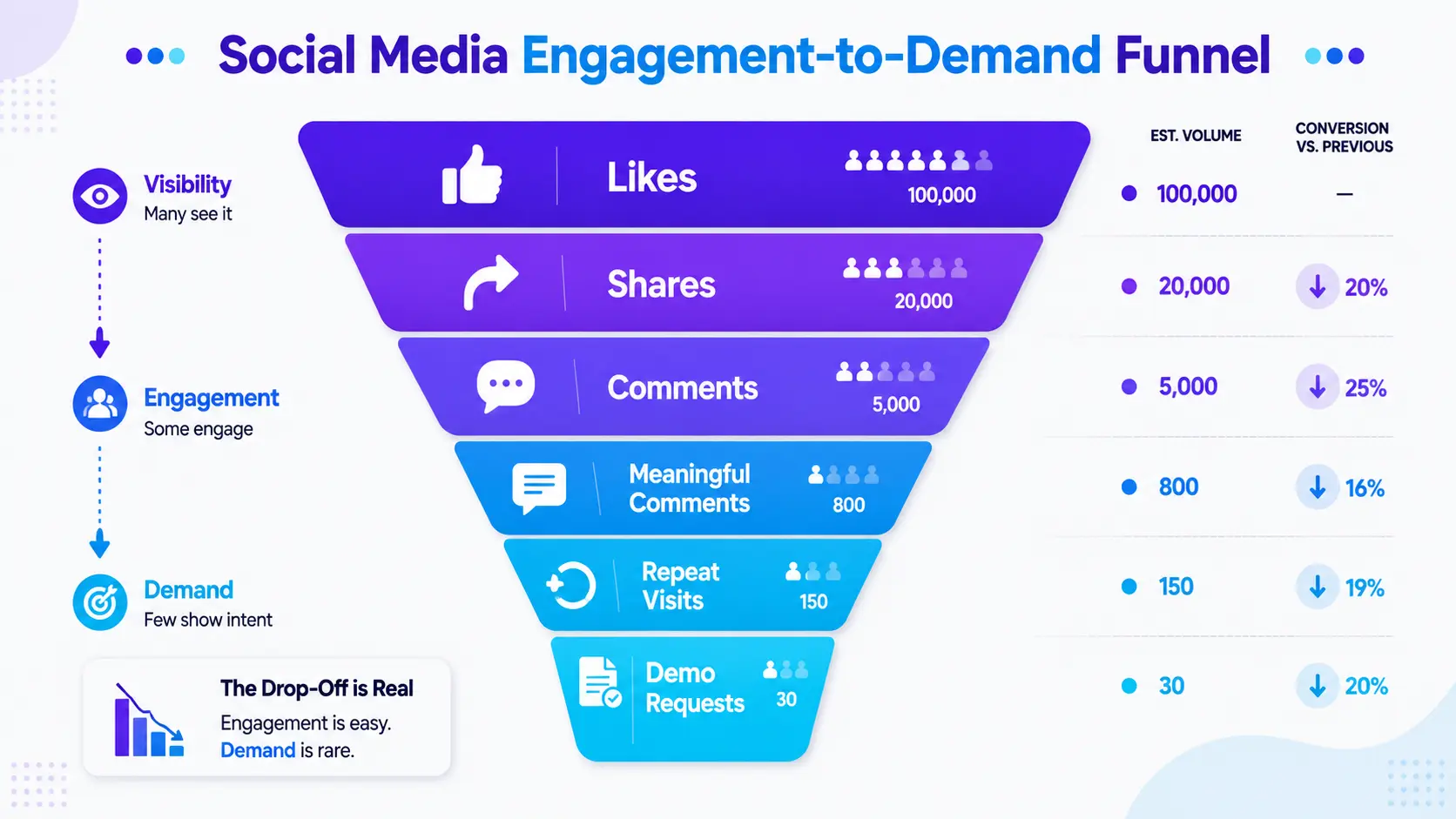
How platform metrics distort perception of performance
Scores of likes and impressions flood every analytics dashboard.
But, the most visible metrics tell a lopsided story.
Social platforms reward content that earns swift, easy reactions – short comments, quick taps, swipes.
Missing is any assurance that these bursts of activity correlate with real business outcomes.
Work with multiple brands has made one thing clear: platform algorithms are built to maximize user attention, not commercial results.
It’s not unusual to see a product announcement get outsized views when it rides a trending meme.
Yet those same posts rarely fill a pipeline or shift market positioning.
Here’s where the distortion creeps in.
As teams obsess over engagement curves and “velocity spikes”, they miss that algorithms reward performance tricks – posting at certain times, baiting low-effort replies, chasing novelty.
None of these moves the needle on trust or readiness.
If a CEO reviews last quarter’s report and sees high shares but no uptick in meetings booked, platform metrics have quietly won the narrative battle but lost the business war.
This is where confusion about social media engagement versus demand becomes expensive.
Are you measuring what matters, or just what moves fastest in the feed?
The reality?
Engagement as counted by platforms proves you’re visible.
It rarely proves you’re trusted.
Therefore, the key question isn’t “How do we drive more engagement?” but “Which signals genuinely predict intent – and which are digital noise?”
Once that line is drawn, entire playbooks shift.
But the next challenge is harder: distinguishing intent signals from the platform static that’s designed to distract.

What changes when engagement stops compounding into demand
Content teams often see big engagement numbers as momentum in motion.
But velocity on social platforms is a deceptive comfort.
Most of the time, a louder crowd means more friction when it comes time for buyers to move.
How indifferent audiences inflate engagement but dilute intent
Wider reach is supposed to mean wider opportunity.
But the wider the net, the more likely you’re accumulating reactions from people with zero intent to buy or influence the purchase cycle.
We’ve seen B2B posts break 10,000 likes overnight – yet trigger not a single meeting or request for proposal the next week.The silent inflation of vanity metrics creates an illusion of progress when the real business needle stays still.
Here’s where the disconnect gets sharper: as algorithms prioritize posts that provoke any reaction, content that’s polarizing, superficial, or simply entertaining can outperform insightful, decision-stage material.
The brand appears to win – while the sales pipeline remains unchanged.
That’s the hidden trap.
Indifferent audiences look impressive on a dashboard, but their attention is a mirage.
Every marketer faces this question: how much of your engagement is coming from audiences who will never act, no matter how persistent your follow-ups?
Engagement is not intent; it is just noise until filtered.
Focusing on engagement at scale can bring amplification, but at the cost of diluting actionable commercial signals.
It’s like pouring water into wine: the volume rises, but the potency falls.
So what’s actually moving when engagement metrics go up?
Possibly, nothing that counts for your revenue team.
Why premature selling undermines social trust momentum
In a well-known B2B campaign, a trusted brand watched audience energy evaporate after pivoting too soon from conversation to direct offer – the instant switch from relationship-building to hard pitch dissolved latent readiness into silence.
We’ve watched companies rush to drop gated offers or aggressive calls-to-action into high-engagement threads, only to see the energy evaporate.
The signal turns cold, and previously warm audiences go silent.
Think of social trust as a slow-building balance – every post, reply, and DM earning fractional credibility.
Push for action too early and the account is overdrawn; the audience feels sold, not seen.
It’s a bit like interrupting a first conversation to talk about marriage contracts – the reaction is never what you hope for.
So why does this happen?
Executives often mistake the speed of social engagement for the speed of buyer readiness.
The leap from recognition to action usually needs more time than your metrics suggest.
Trust is like friction: easy to increase in small increments, but hard to restore once broken.
Therefore, rushing the moment may get you a click, but it costs you the compound interest of real commercial relationships.
The trap is thinking that more reactions mean more readiness.
The sharper answer is that demand doesn’t take shape until intent outweighs indifference and social trust matures.
Next, the real question: how do you catch the signals that mark actual readiness beneath all the noise?

How to evaluate whether social engagement is actually contributing to business readiness
An impressive stack of comments on your latest post might look like momentum building.
But the reality is, surface buzz rarely translates to wallets opening.
The sharper question is this: what separates engagement that signals true buyer intent from engagement that’s just background noise?
The business risk isn’t just wasted attention – it’s mistaking applause for commercial interest.
The most expensive error in social strategy is letting vanity metrics steer the ship.
What indicators suggest readiness under the surface of engagement
Most teams chase metrics that platforms reward: likes, shares, rapid-fire reactions.
This is the comfort food of digital marketing – a quick dopamine hit with little staying power.
But the signals that matter almost always hide under the obvious.
Take meaningful comments.
Not just “Great post!” or a meme, but a question that points to a genuine business pain or a struggle with a line of your argument.
A prospect doesn’t challenge your idea unless they’re picturing it inside their own problem.
Repeat views from specific accounts – those matter more than one-off impressions.
If someone revisits your video or document several times week-over-week, they’re likely moving through an internal evaluation, not just browsing.
Identity resonance is the X-factor.
When a user explicitly ties your insight to their role, company, or pain (“We’ve struggled for months with this at [Company Name]”), you’re reading readiness – often long before they raise a hand publicly.
So where do most teams miss?
They see all engagement as a win.
But intent signals tend to show up in patterns: sequences of detailed questions, a user referencing your insight elsewhere, or the same name making regular, thoughtful contributions over time.
Not every click or emoji points to a deal in motion.
But if you spot depth, recurrence, and identity, you’re closer to demand than reach can ever get you.
The pitfall comes when marketing confuses volume with value.
One-off virality often brings empty calories, but steady, nuanced signals construct the bridge to revenue.
Key Indicators of Buyer Readiness Beneath Social Engagement
- Meaningful comments that demonstrate business pain or challenge arguments
- Repeat views or interactions from the same accounts over time
- Users explicitly linking insights to their company, role, or problems
- Sequences of detailed questions or thoughtful contributions
- References to your insights outside the original post or thread
When to shift from visibility metrics to intent-focused framing
Vanity metrics like aggregate likes or total impressions tell you how loud the message landed.
But the volume knob isn’t the business lever.
Growth comes from diagnosing which signals indicate progress in buyer readiness – moving from noise into actual momentum.
A simple diagnostic: Can your team trace any piece of engagement back to a tangible next step – such as a content download, a scheduled demo, or even just a private follow-up request?
If not, then the metric hasn’t broken out of noise status.
Another test: If you could never see likes or views again, which signals would you watch to know sales conversations are primed?
Once that question has an answer, the old metrics lose their grip.
Diagnostic Questions for Moving From Engagement to Intent
- Can any engagement be traced to a tangible next step (e.g., content download, demo request)?
- Which signals would you track if likes and views disappeared?
- Are you focusing on long-term buyer behavior patterns rather than short-term volume?
- Are you identifying which users moved closer to a purchasing decision?
- Have you distinguished noise from meaningful buyer signals in your metrics?
Think of engagement as weather.
It matters, but what counts is the climate – that long-term pattern of buyer behavior below the surface.
The shift happens when marketing teams stop optimizing for applause and start tracking for action.
Therefore, the question shifts from “How many reacted?” to “Who moved closer to a decision?”
That leaves one next implication: If business readiness hides beneath social noise, how do you surface those rare, actionable signals systematically – without drowning in the feed?

What to look at next – where to go deeper for mechanics and measurement
Every marketing team eventually hits a wall where engagement growth no longer answers the real business question.
But pumping more posts into the platform loop rarely shifts the numbers that matter.
The deeper issue isn’t simply “more activity” – it’s whether anyone is moving closer to a decision point at all.
Surface engagement will always be noisy.
The sharpest operators step back and ask: which signals actually show movement from attention to intent?
That is where most teams stall.
Assessing intent mechanics through dedicated intent-maturity models
Most organizations chase likes and shares as if all attention is created equal.
But raw engagement is just the outer shell – what’s happening under the surface tells a different story.
An intent-maturity model helps sort passive applause from progress along the real buying journey.
Think of intent like water temperature: a boiling pot signals readiness, while a still pond offers little promise.
The strongest models break engagement into tiers – fleeting glances (likes), active consideration (in-depth comments, repeated exposure), and finally real steps toward action (signals that connect to buyer context or decision).
Why does this matter?
Chasing volume hides the weak signals that actually matter for conversion.
We’ve seen teams mark campaign success on noise, only to find no one was ever close to buying.
Only once they mapped engagement back to maturity stages did the real levers appear.
Intent-Maturity Model Tiers of Social Engagement
| Platform | Typical Engagement Type | Industry Example | Engagement Signal Meaning |
| Limited surface signals, deeper lurking | B2B Enterprise SaaS | Few visible reactions but deeper buyer interest via direct messages or repeat visits | |
| TikTok | High volume of comments and reactions | Consumer/Food Brands | Massive visible engagement but often less direct buying intent |
| Likes and comments driven by entertainment and visuals | Consumer Brands | Lots of lightweight engagement, less indicative of purchase decisions |
So what signals deserve your full attention?
That’s the pivot point for sophisticated measurement.
The broader logic of intent maturity is developed further in Engagement to Intent Signals.
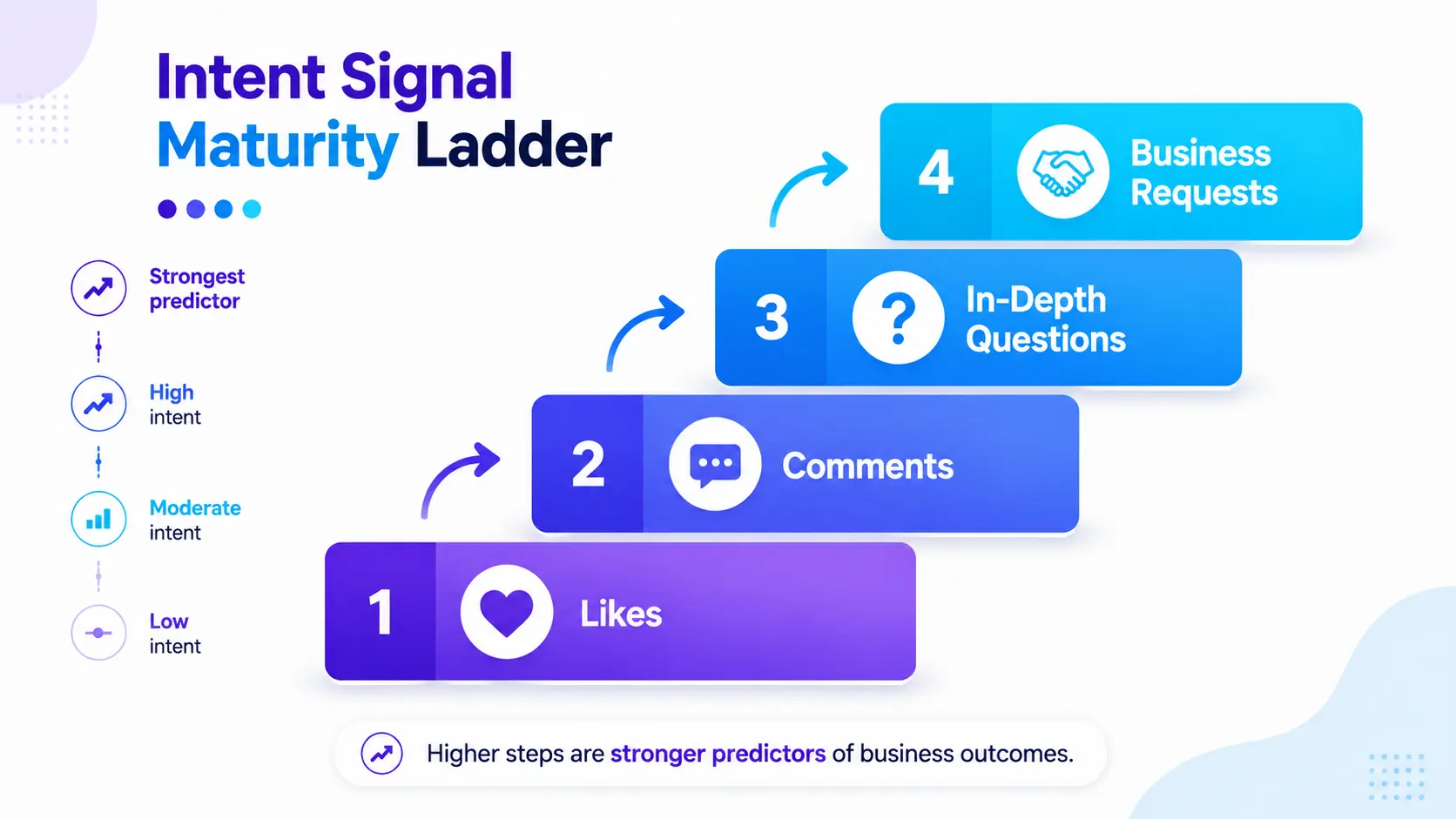
Exploring platform and industry overlays where social behavior shifts
Here’s the curveball: social engagement mechanics are not universal – they warp between platforms and can invert by industry.
What wins on LinkedIn may flop on Instagram.
B2B buyers leave fewer surface signals, but their lurking can mean more than a wave of lightweight likes in consumer markets.
A food brand can stir up massive comment threads over a new flavor on TikTok; an enterprise SaaS team may see only a DM from one target account after 1,000 views.
One looks bigger on dashboards.
But which is closer to demand?
Context redefines signal value every time.
This means intent models must fit the native behaviors of each platform and the buying patterns of each segment.
One-size-fits-all metrics erase useful meaning, fast.
That is where most measurement systems snap under pressure.
Variations in Social Engagement by Platform and Industry
| Engagement Tier | Description | Examples | Signal Strength for Buyer Intent |
| Fleeting Glances | Surface-level attention with minimal commitment | Likes, quick reactions, superficial shares | Low |
| Active Consideration | More thoughtful engagement showing reflection or recurring interest | In-depth comments, repeated content views | Medium |
| Real Steps Toward Action | Signals that connect to buyer context or decision | Detailed questions referencing business pain, identifying company or role, content downloads, meeting requests | High |
The next move is not adding more tools – it’s focusing your lens on the intent mechanics and overlaying them with the real-world context each platform and industry demands.
The numbers on your dashboard lose their meaning without this filter.
Once you recognize that engagement volume alone is a weak indicator, the challenge shifts: which signals, in which channels, truly map to commercial momentum?

Scientific context and sources
The sources below provide foundational context for how decision-making, attention, and performance dynamics evolve under scaling and constraint conditions.
- Attention, Engagement, and Activity on Social Network Sites
Do Facebook Likes Lead to Shares or Sales? Exploring the Empirical Links between Social Media Content, Brand Equity, Purchase Intention, and Engagement – Constantinos K. Coursaris, Wietske van Osch, Brigitte A. Balogh – 2016 49th Hawaii International Conference on System Sciences
Examines whether social media engagement connects to purchase intention and brand outcomes, making it useful for distinguishing surface engagement from commercial action.
https://doi.org/10.1109/HICSS.2016.444 - Social Signals, Trust, and Intent Signals in Digital Environments
The Value of Social Dynamics in Online Product Ratings Forums – Wendy W. Moe, Michael Trusov – Journal of Marketing Research
Shows how visible online ratings reflect both real customer experience and social influence, helping explain why observable social signals can differ from true individual intent.
https://doi.org/10.1509/jmkr.48.3.444 - Buyer Readiness and Decision Triggers in B2B Social Selling
The use of social media in sales: Individual and organizational antecedents, and the role of customer engagement in social media – Rodrigo Guesalaga – Industrial Marketing Management
Researches social media use in B2B sales and the role of customer engagement, supporting the point that social activity must be tied to sales process maturity rather than treated as demand by itself.
https://doi.org/10.1016/j.indmarman.2015.12.002 - Platform Algorithmic Biases and Business Outcomes
The effects of algorithmic content selection on user engagement with news on Twitter – Erwan Dujeancourt, Marcel Garz – The Information Society
Shows how algorithmic content selection can increase engagement metrics and favor already popular or more sensational content, supporting the point that platform metrics can be shaped by algorithmic incentives rather than business value.
https://doi.org/10.1080/01972243.2023.2230471
Questions You Might Ponder
Why doesn’t social media engagement always translate into business demand?
Social media engagement measures attention, not intent. Likes and shares often signal casual interest, not readiness to buy. Understanding the difference ensures marketers focus on signals that truly matter for driving demand, rather than getting distracted by vanity metrics.
A related decision is covered in Why Vanity Metrics in Social Media Mask Real Influence, which explains the adjacent issue in more detail.
What social engagement signals indicate real buyer intent?
Look for detailed comments reflecting business needs, repeated interactions by the same company, references to your content elsewhere, and clear role or pain-point mentions. These deeper signals suggest readiness to consider solutions, separating genuine prospects from indifferent audiences.
How do platform metrics mislead marketing strategies?
Platforms optimize for easy, rapid engagement – favoring content that draws clicks, likes, or comments – without tying these metrics to business outcomes. This creates the illusion of progress, distracting companies from pursuing meaningful actions that support sales or conversions.
What should businesses prioritize over likes and impressions when measuring social impact?
Instead of chasing aggregate likes or views, businesses should track signals linked to buyer progress – like content downloads, demo requests, or thoughtful engagement leading to sales conversations. These actions correlate more directly with commercial readiness and conversion potential.
How can marketing teams distinguish digital noise from true intent?
By using intent-maturity models that rank engagement depth and recurrence, teams can move beyond superficial reactions. Analyzing who engages, how often, and the context of interactions helps filter noise and focus on leads most likely to convert into revenue.