
What You’ll Learn
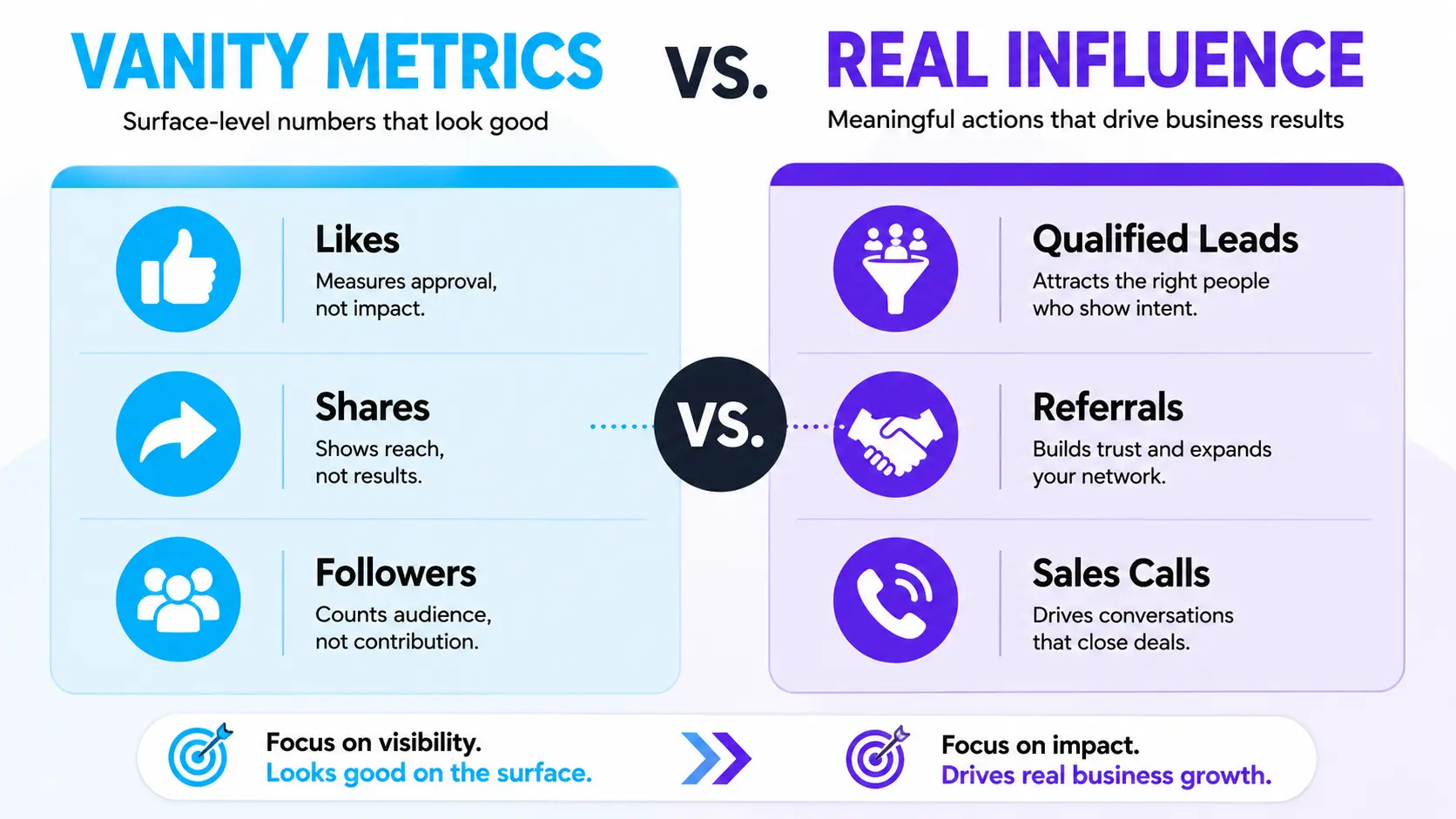
Vanity metrics in social media are easy-to-measure numbers such as likes, impressions, shares, followers, profile views, and engagement rates that can make social performance look strong without proving real business influence.
They often show visibility or surface attention, but they do not confirm trust, buyer intent, brand preference, referrals, qualified pipeline, or sales movement.
Vanity metrics become misleading when teams treat them as proof of demand instead of diagnostic signals.
Strong social media measurement uses these metrics as context, then checks deeper outcomes such as branded search, direct traffic, private sharing, sales conversations, buyer recall, and off-platform referrals.
Key Takeaways
- Vanity metrics in social media, such as likes and impressions, often obscure the absence of genuine business influence.
- True social media impact is frequently driven by private sharing and word-of-mouth, which are not captured by standard analytics.
- High engagement rates can signal interest but do not guarantee trust, brand preference, or sales conversion.
- Organizations must track off-platform signals and prioritize conceptual diagnosis over surface-level metrics to assess real influence.
Most executives see spikes in likes, followers, or impressions and assume brand momentum.
But profile views and engagement rates rarely signal real business movement.
The sharper truth: these numbers create false certainty while masking the absence of genuine influence.

What Are Vanity Metrics and Why Do They Mislead in Social Media?
On every major dashboard, vanity metrics – likes, impressions, shares, new followers – scatter across the top like confetti.
But the fact that something is easy to measure does not make it meaningful.
Social platforms push these numbers up front for a reason: they reward attention, not action.
It’s tempting to treat visible engagement as evidence of influence.
The myth is that high engagement automatically drives sales or trust.
We’ve watched major brands invest six figures to boost follower growth, only to see zero shift in qualified pipeline.
Surface metrics versus business impact
The reality is that surface-level social metrics almost always show reach, not persuasion.
Anyone can rack up impressions with a viral meme or giveaway, but surface metrics rarely trace back to high-quality sales calls, sustained inbound, or brand preference.
It’s like measuring real-world influence by counting how many people walk by your storefront, not how many actually come inside and buy.
The visible number becomes a substitute for the business result – and the signal gets lost in a sea of noise.
If your problem is that social media numbers exist but business impact is unclear, the broader logic is outlined in Social Media Marketing ](/capabilities/social-media-marketing/).
So where does real business impact actually come from?
That answer hides beneath the public engagement, in who acts, talks, and returns – not who simply taps like.
The platform never hands you that signal without extra work.
When visibility disguises emptiness
Some of the accounts with the flashiest growth charts and highest engagement rates suffer from an invisible problem: much of their following has no intent, authority, or relevance.
Visibility on its own doesn’t guarantee you’re visible to the right market.
We’ve seen B2B companies double their followers and still miss every major RFP in their space.
The audience was real, but the influence wasn’t showing up where it mattered.
So why does this happen?
Simple: algorithms reward content that triggers interaction, not content that builds trust or drives decisions.
An audience trained to click, scroll, and share will not always become buyers, partners, or advocates.
The gap between engagement and activation often widens as a company scales.
The dashboard lights up, but the pipeline stays flat.
That is where brands lose the thread.
The invisible cost is opportunity.
Building a huge following of passive spectators turns marketing into theater: crowded, loud, but powerless to move the outcome executives care about.
The quiet truth: Influence in social media is not measured by visible peaks, but by the silent signals of permission, trust, and recall – the parts most dashboards never show.
Therefore, the next step is learning to separate activity from actual traction, and rethinking what “winning” in social really looks like.

Why Your Social Media Influence Often Disappears Behind the Dashboard
A campaign can earn thousands of clicks, shares, even comments – each one mapped and celebrated in your dashboard.
But when revenue meetings roll around, those same dashboards suddenly stop telling the full story.
The numbers look impressive until you try to trace which ones actually moved a buyer to act.
Executives expect visible metrics to correspond to real influence.
But what if the conversations that actually matter happen where analytics can’t reach?
How dark social turns impact into direct traffic
Every brand chases visibility on public feeds.
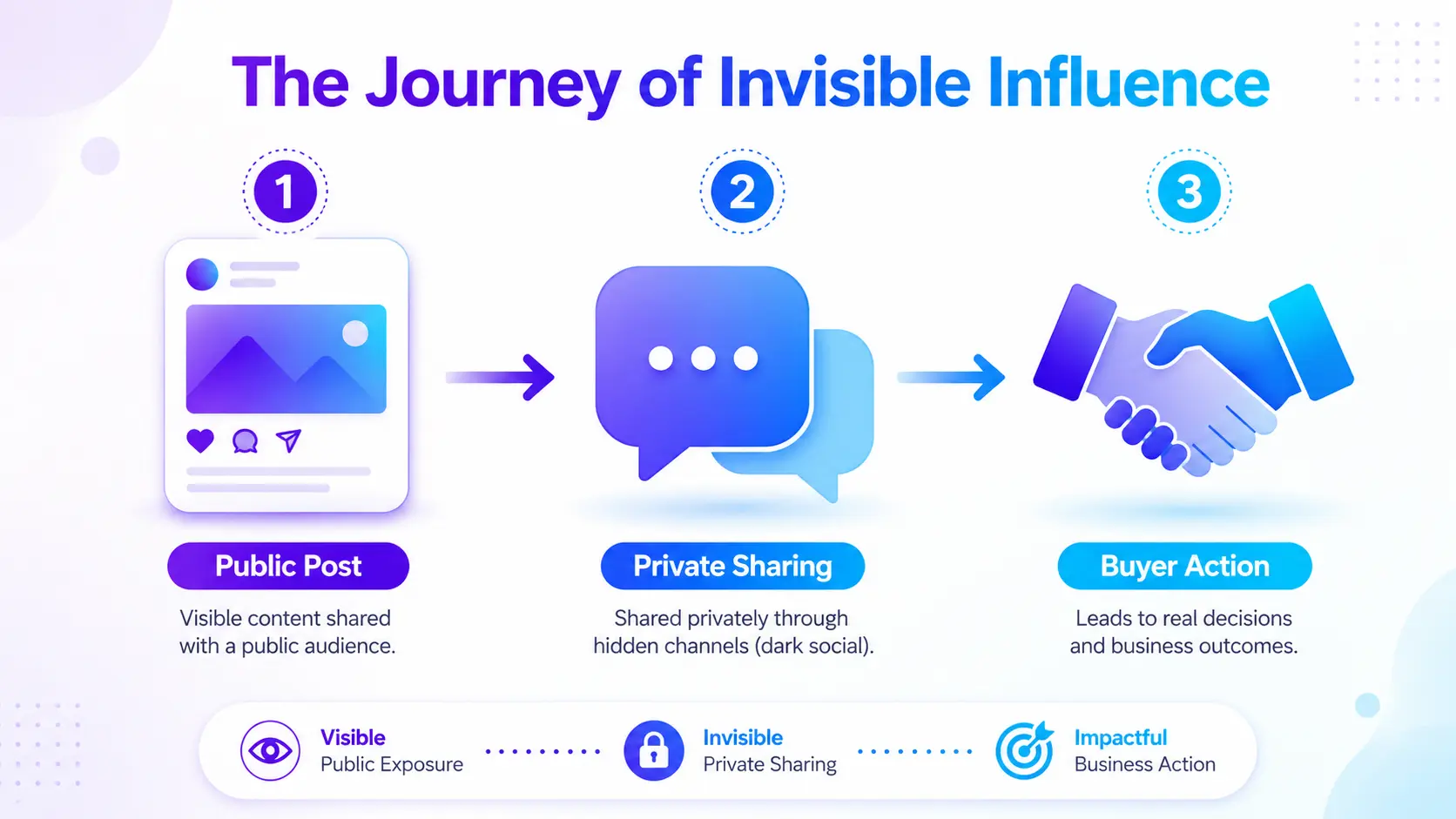
Yet the true lever of influence is often pulled in the shadows: private messages, encrypted group chats, or even screenshots sent over text.
This is “dark social” – all the ways content is shared beyond the line of sight of tracking pixels.
Key Characteristics of Dark Social Influence
- Content shared through private messages, encrypted chats, or texts invisible to tracking tools
- Spikes in direct traffic and branded searches without clear referral sources
- Buyer actions referencing content without public engagement traces
- Influence that bypasses standard social media analytics and attribution
- Acts as a hidden lever driving genuine business outcomes beyond visible metrics
In our work, it’s become routine to see spikes in direct traffic and branded search that can’t be mapped to any single campaign or platform touch.
A post might gain only modest likes, yet hours later, the website sees a jump in demo requests – seemingly out of nowhere.
Here’s the twist: prospects often arrive primed, referencing a post they saw but never engaged with.
The public metrics say “underperforming”.
The pipeline says otherwise.
If you’re wondering where the missing influence lives, it’s usually buried in these silent shares, forwarded Slack messages, or whispered recommendations.
The dashboard reports what’s convenient.
Buyers move through what’s invisible.
What escapes almost every attribution model?
Private influence that shows up as “direct” or “organic” traffic.
From impressions to search, referrals, and sales calls
Surface numbers stop at the edge of the platform, but influence doesn’t.
One executive recently told us that after a quiet post went live, their team fielded reference calls and LinkedIn searches days later.
No comment trail, no tag, nothing to measure – just clear aftershocks in pipeline conversation.
Social exposure acts like a primer: buyers see content, dismiss it, but then remember the brand weeks later while searching or asking peers.
The first contact rarely looks like action.
It often re-emerges in search, direct type-ins, or offline referrals, bypassing platform metrics.
Imagine your content as a spark in a dark room – most sparks fade, but some set off connections in spaces you can’t see.
That’s how genuine influence behaves: it’s non-linear, messy, and almost always undercounted.
It’s tempting to assume if it can’t be measured, it didn’t happen.
But most high-value influence escapes the report.
Therefore, if your team equates dashboard data with business movement, you’re missing the real lever for conversion.
Your social presence isn’t disappearing; it’s diffusing.
The next challenge: how do you design for social-assisted demand when the path can’t be traced post by post?

How to Think About Social-Assisted Demand, Not Just Metrics
Most marketing reports reach for engagement graphs first.
But a spike in activity almost never signals lasting influence.
The sharper edge: brands chasing social metrics may slip further from real demand, not closer.
Separating activity from real influence
It is easy to spot a leaderboard of impressions, shares, and trending posts.
But these signals often trick teams into thinking the business has new leverage – the bigger trap is believing that more activity equals more authority.
Here’s the myth: platform events create a direct pipeline to buyers.
In reality, rapid bursts of social engagement usually map to momentary curiosity or passive browsing, not acts of trust.
Distinguishing Social Media Activity from Real Influence
- High engagement can reflect curiosity, not trust or buying intent
- Real influence shows in new sales introductions and inbound partner requests
- Measurable impact includes off-platform buyer conversations and referrals
- Relying solely on surface metrics leads to false assumptions about pipeline growth
- True influence accumulates quietly and is often invisible on dashboards
We’ve seen B2B brands get caught equating weekly content bursts with pipeline growth, only to discover that none of the engagement came from decision-makers.
One post might reel in thousands of likes – yet not a single ICP (ideal customer profile) hand-raiser surfaces on calls or demo forms.
It’s like mistaking the noise outside a store for inside sales.
A client once celebrated a month of record comments and shares.
But the team missed a basic check: none of that volume tied back to a buying audience.
The sales cycle stayed flat.
In practice, most surface-level social metrics reward algorithms, not influence.
So what does real influence look like?
It’s measurable by the outcomes others rarely see: new sales intros, reference traffic, inbound partner requests, off-platform buyer conversations.
This is where most reporting goes silent – just as actual business shifts start to compound.
Trust, recognition and market memory as unseen momentum
Most teams measure what they see on the dashboard: impressions today, engagement this week, follower growth.
But trust and recognition build below the surface, stacking quietly with every consistent signal the brand puts into the market.
Real influence blooms in the gaps between metrics.
If your market sees proof of expertise – authority-level posts, visible customer wins, credible opinions – buyers start to file your brand away when stakes are high.
This is not about instant conversion.
It is about storing up credibility, ready to be spent when decision cycles open.
Think of repeated touchpoints as reputation “deposits” in the market’s memory.
The pattern is familiar: a prospect sees industry-relevant insights in their feed, skips past, yet remembers the name six weeks later during strategy planning.
These delayed effects rarely light up dashboards – yet they shape who gets invited to the table when deals form.
The best evidence?
Buyers referencing older posts, showing up through branded search, or mentioning your content in offline calls.
This market memory builds a moat others can’t see until it’s too late.
The real game isn’t just scoring another comment – it’s owning the space in buyers’ minds when the noise fades and decisions need to be made.
Here’s where most teams slip: they keep measuring what’s visible and miss the momentum that’s invisible.
The reporting habit must shift from counting to connecting.
But when should teams trust unseen signals over new activity?
There’s the tension waiting for sharper diagnosis.

What to Do Next: Navigate From Misleading Metrics to Conceptual Diagnosis
Most social media strategies stall at the reporting stage.
But more numbers on the dashboard rarely mean sharper clarity.
The deeper difference is whether leadership knows when to probe for what’s hidden, not just what’s counted.
When to explore dark social deeper
Executives scan campaign data and see a flat line where influence should be.
Still, referrals trickle in, prospects make oddly specific references, and website forms cite no clear source.
The disconnect grows: if the visible metrics are weak, what’s quietly working in the background?
Dark social is where the unexplained results hide.
Internal data from client reviews show a pattern – key leads arrive referencing content never tracked through existing dashboards.
It’s almost as if your most valuable social activity dissolves before attribution can catch it.
But the myth that “if it’s not measured, it didn’t happen” misguides leadership.
In practice, we see high-value introductions start from deep in private shares, group chats, or personal texts.
Surface-level social metrics vanish, yet real influence compounds in places standard tools will never reach.
Think of dark social like a backstage pass: You don’t get a ticket stub, but you still access the show.
The signal doesn’t show up in your scoreboard, but the business outcome is real.
So when executives notice patterns that the dashboard cannot explain – unusually warm inbound, referral language echoing recent campaigns, or cycles of direct traffic after big thought-leadership posts – that’s the cue to dive deeper into dark social diagnostics, not stop at what’s visible.
If you’re seeing cues that trackable metrics can’t support, it’s a sign: the attribution logic has a gap, and the real source of demand may be private, unmeasured conversation.
Is your team set up to diagnose what it can’t see?
When to explore vanity metrics in context
It’s easy to dismiss vanity metrics as pure fluff – likes, shares, or impressions that rarely map to sales.
Yet if you ignore them completely, you miss their utility as early signals of market resonance or fatigue.
The sharper executive play is knowing when these metrics reveal context, not truth.
Using Vanity Metrics as Diagnostic Signals
| Scenario | What Vanity Metrics Show | Recommended Action | Purpose |
| Spike in Engagement but Flat Demand | Increased likes/shares/impressions | Conduct deeper diagnosis beyond metrics | Identify if engagement reflects real trust or just noise |
| Sudden Drop in Vanity Metrics | Decrease in visible social activity | Check for market fatigue or content resonance | Understand if brand momentum is weakening |
| Consistent Metric Growth with No Pipeline Shift | Steady follower and engagement increase | Map metrics against downstream outcomes | Avoid optimizing for surface signals alone |
We see teams get fixated on chasing bigger surface-level numbers, hoping it will signal momentum.
But a deeper diagnosis reveals activity does not equal progress.
The practical lens: treat vanity metrics as warning lights, not the engine.
If engagement suddenly increases but actual demand stalls, that’s a dashboard hallucination, not growth.
The analogy is simple: surface metrics are the flashing lights on a console – they show where to look, not what’s actually moving under the hood.
If all signals spike after a campaign but business impact is flat, it’s time to question what those metrics are really telling you.
So, rather than default to tactical “lift” or content volume, executives should use spikes or dips in vanity metrics to isolate when it’s time for conceptual diagnosis.
Are these numbers hinting at real trust acceleration, or are they simply showing noise?
If your team has never mapped visible metrics against downstream outcomes, the risk is spending months optimizing the wrong signal.
The most actionable move is not to ignore vanity metrics, but to use them as triggers – a prompt to ask, what hides behind this spike, and what real behaviors are driving the silent conversion?
The costliest risk is not failing to measure, but failing to know what the measurement means.
Once this mental shift happens, the real challenge emerges: does your organization know where and how to drill deeper when the dashboard stops making sense?
That wider pattern of hidden social influence is further explored in Dark Social Influence.

Scientific context and sources
The sources below provide foundational context for how decision-making, attention, and performance dynamics evolve under scaling and constraint conditions.
- Social Media Metrics and Decision-Making
Social Media Metrics: How to Measure and Optimize Your Marketing Investment – Jim Sterne – Wiley
This book distinguishes between superficial social media metrics and business-relevant measurement, highlighting the risk of over-reliance on vanity metrics.
https://www.wiley.com/en-es/social-media-metrics-how-to-measure-and-optimize-your-marketing-investment-p-9780470622582 - The Limits of Online Engagement
Communicating Corporate Social Responsibility on Social Media: Strategies, Stakeholders, and Public Engagement on Corporate Facebook – Moonhee Cho, Lauren D. Furey, and Tiffany Mohr – Business and Professional Communication Quarterly
Peer-reviewed analysis showing that public engagement with social media content does not automatically equal deeper trust, business value, or meaningful stakeholder influence.
https://journals.sagepub.com/doi/10.1177/2329490616663708 - Dark Social and Attribution Challenges
Dark Social: The biggest missed opportunity in digital marketing – Ammarah Marjan, Charles Graham, Margaret Bruce, and Andrew Mitchell – Journal of Digital and Social Media Marketing
Peer-reviewed article explaining how private sharing and dark social traffic create attribution gaps, with social traffic often misclassified as direct traffic in analytics tools.
https://doi.org/10.69554/czwp6594 - Psychological Mechanisms in Social Signal Processing
Social Influence: Compliance and Conformity – Robert B. Cialdini and Noah J. Goldstein – Annual Review of Psychology
Explains how social cues and conformity mechanisms can influence behavior, supporting the point that visible social signals can shape perception without necessarily proving business impact.
https://www.annualreviews.org/doi/10.1146/annurev.psych.55.090902.142015
Questions You Might Ponder
What are vanity metrics in social media and why are they misleading?
Vanity metrics in social media – such as likes, followers, and impressions – are easy to track but rarely reflect true business impact. They often mislead decision-makers by creating an illusion of influence, while actual customer behavior and revenue movement may remain unchanged.
How do dark social channels affect social media influence tracking?
Dark social refers to private sharing channels like direct messages or group chats, which evade analytics tools. This hidden transmission of content frequently delivers higher-value impact – such as referrals or direct sales – than public metrics, yet is almost impossible to attribute precisely in dashboards.
Why don’t high engagement rates always translate to real business outcomes?
High engagement rates may stem from curiosity or entertainment value, not genuine buying intent. Actual business outcomes require trust and sustained attention, which are built through private or repeated interactions, not just visible clicks or shares on social media platforms.
What indicators suggest your audience is engaged but not influenced?
If your social content gains rapid likes, follows, or shares, but your qualified lead pipeline and inbound sales remain flat, your audience may be passively engaged without being influenced. True influence is reflected in trust-driven actions like referrals, direct inquiries, and repeat interactions.
How should companies evaluate the true impact of their social media presence?
To measure true impact, companies should look beyond vanity metrics and track downstream outcomes, such as brand search volume, direct site traffic, new customer referrals, and off-platform sales calls. Analyzing these indicators provides insight into whether content is truly shaping buyer decisions.