
What You’ll Learn
Dark social attribution is the measurement gap that happens when social media influence moves through private channels such as DMs, email, Slack, WhatsApp, group chats, screenshots, or copied links and then appears in analytics as direct, organic, or unattributed traffic.
It matters because buyers often share and discuss content privately before they search, visit, inquire, or buy.
Standard dashboards may miss the original social trigger, making social content look weaker than it is.
Strong dark social attribution does not chase perfect tracking; it looks for patterns such as direct traffic spikes, branded search growth, private referrals, and prospects referencing content that was never publicly engaged with.
Key Takeaways
- Dark social attribution reveals that much social-driven demand moves through unmeasurable private channels, escaping analytics classification.
- Relying on visible metrics alone often undervalues the true impact of social sharing and misleads marketing investment decisions.
- High-value buyers use private channels when deliberating, making “likes” and “impressions” a poor proxy for real intent or trust.
- Recognizing and adjusting for hidden influence patterns, rather than demanding perfect attribution, protects against strategic blind spots.
Most marketing teams track every visible click and engagement, assuming what can’t be measured isn’t moving the needle.
But a flood of influence moves in private – quietly, out of sight, and beyond the reach of analytics platforms.
The problem isn’t missing data, it’s a blind spot: the trust pathway is being built where you never see the footprints.
That measurement gap is mapped at a broader capability level in Social Media Marketing.

Why hidden sharing breaks your view of social trust
Email, DMs, workplace chats, group texts – these are where most links actually circulate when buyers are serious or stakeholders are weighing a decision.
Yet analytics software rarely tells you this story.
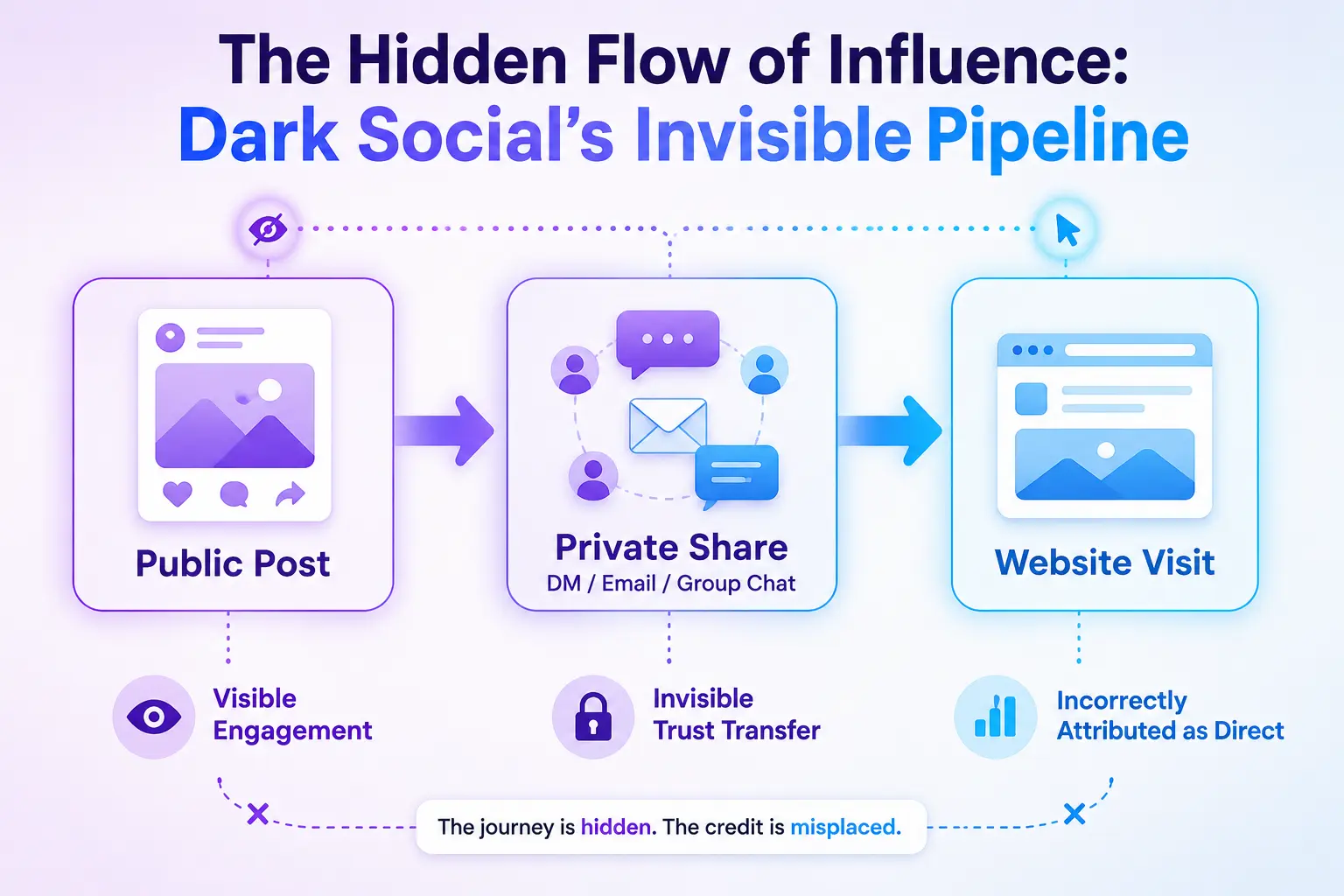
Instead, when someone copies a link from a social post and drops it into a Slack channel or a WhatsApp group, every subsequent click appears as “direct” or “no referrer”.
The original source fades instantly, lost before it ever hits your dashboard.
That’s the first trap: dashboards report that your brand’s site or article “just got a surge in direct visitors”, as if these users typed in your URL from memory.
But in reality, the trigger was a private share fueled by social capital – something you’ll never find by scrolling through visible metrics alone.
How private links get mis‑classified as direct traffic
When we audit client funnels, we often find that sharp spikes of so-called “direct” traffic match perfectly with new product launches or viral industry conversations on social.
Yet the attribution system gives zero credit to social-assisted demand, presenting an illusion of originless growth.
If you’ve been misreading these surges as “organic brand pull”, you may be missing the true engine: people sharing, recommending, and vetting your work out of the public eye.
So what does this misclassification really cost?
It amounts to a persistent attribution blind spot – guaranteeing you remain half-blind to how actual trust spreads.
Private sharing acts more like dark matter than a channel – unseen, powerful, shaping everything visible without ever making itself known in the data.
Common Dark Social Sources and Their Analytics Misclassification
| Pattern Observed | Example Scenario | Interpretation |
| Uptick in direct traffic to deep content | Spike after viral LinkedIn post | Private sharing via dark social channels |
| Branded search volume spike | After CEO posts shared by advocates | Delayed awareness from private shares |
| Increase in referrals from group chat domains | Referral traffic not marked as social | Dark social links circulating in chat groups |
Why hidden influence matters more than visible metrics
Most teams chase likes, shares, and impressions, treating them as the proof of brand traction.
Yet mission-critical buying moments happen when a link lands in a decision-maker’s inbox, not just on their timeline.
A copied URL debated in a deal-thread can outweigh 1,000 anonymous impressions in terms of pipeline movement.
Why Visible Metrics Fail to Capture True Social Influence
- Likes and impressions measure attention, not purchase intent.
- High-value buyers often engage privately rather than publicly.
- Critical buying moments happen in private channels like inboxes and group chats.
- Trust built in private sharing drives deal movement more than public interactions.
- Visible metrics may appear underwhelming despite strong pipeline impact.
The biggest myth: if you can’t see the social proof, it’s not building demand.
But real influence is what happens after someone trusts your content enough to share it with their inner circle, not what happens in front of the crowd.
The pathways buyers use are rarely tracked by standard UTM codes – they are carved out in the shadows, through personal networks, offline recommendations, and quiet validation loops.
Simple analogy: imagine measuring rainfall by counting how many drops you see hit your window.
You’d miss the river forming just beyond view – the water that matters for growth.
We’ve seen top-performing campaigns look underwhelming on the surface, only for clients to discover – weeks later – that new leads consistently reference content shared privately.
The visible footprint stays small; the impact multiplies underground.
How often does your reporting understate influence simply because the trust moved where your analytics couldn’t follow?
The repeatable insight: what isn’t counted still counts.
Trust built in private is often the kind that moves deals, wins advocates, and shapes long-term memory around your brand.
Therefore, the true influence of social is rarely found in public metrics – it slips through attribution, leaving most teams chasing shadows.
The challenge now isn’t measuring every hidden share; it’s recognizing where your view cuts off and learning to make decisions in the dark.
That opens a bigger question: what happens to your strategy when the most valuable signal can’t be measured at all?

When social influence vanishes in attribution systems
A spike in likes and impressions feels like momentum.
But even campaigns with jaw-dropping engagement can leave sales teams asking where the pipeline went.
The real move often happens where analytics go blind – when social influence slips through cracks no dashboard can track.
Why likes and impressions aren’t proof of demand
Most teams treat visible engagement as a proxy for interest.
It’s a comforting story: more reactions, more opportunity.
But here’s where the script breaks – likes and impressions measure attention, not intent.
We’ve seen clients invest heavily in posts “crushing it” publicly, only to find their inbound pipeline stuck on pause.
Engagement metrics reward the loudest activity, but high-value buyers rarely announce their curiosity for all to see.
A C-suite prospect isn’t going to “like” your post two weeks before calling your sales director.
Instead, their journey jumps between group chats, DMs, and screenshots shared quietly – making intent invisible to traditional measurement.
You might ask: so what triggers the real demand?
Often, the first sign shows up out of nowhere – a branded search surge, or a prospect referencing your content unprompted in a meeting.
This lagged effect means the moment of influence happened long before attribution systems light up.
Are visible metrics helping, or just blinding you to the true path?
How dark social fits into broader assisted demand
Picture social influence as a relay race, not a single sprint.
Public channels create awareness, but dark social – the private exchange of links and opinions – carries the baton toward actual interest.
In our work, the most effective campaigns plant trust early, letting private sharing mature leads in silence before they ever hit a tracked form or sales call.
Too many teams see dark social as an attribution failure instead of what it really is: the missing middle.
The myth is that every channel must be tracked start to finish.
But influence rarely moves in straight lines; it loops through invisible channels, then reappears with buyers who seem “brand new” to your CRM.
If you chase perfect attribution, you risk blaming social for the data gap, cutting budget from the very stage fueling search-driven demand.
Therefore, dark social isn’t the culprit – it’s often the silent carrier of trust between the moment a link is shared and the real decision point.
What slips below the surface in your attribution model may be doing the heavy lifting for later-stage demand.
The next move isn’t to force a perfect measurement, but to ask which missed signals your reporting is quietly erasing.

What risk are you taking by trusting dashboards alone
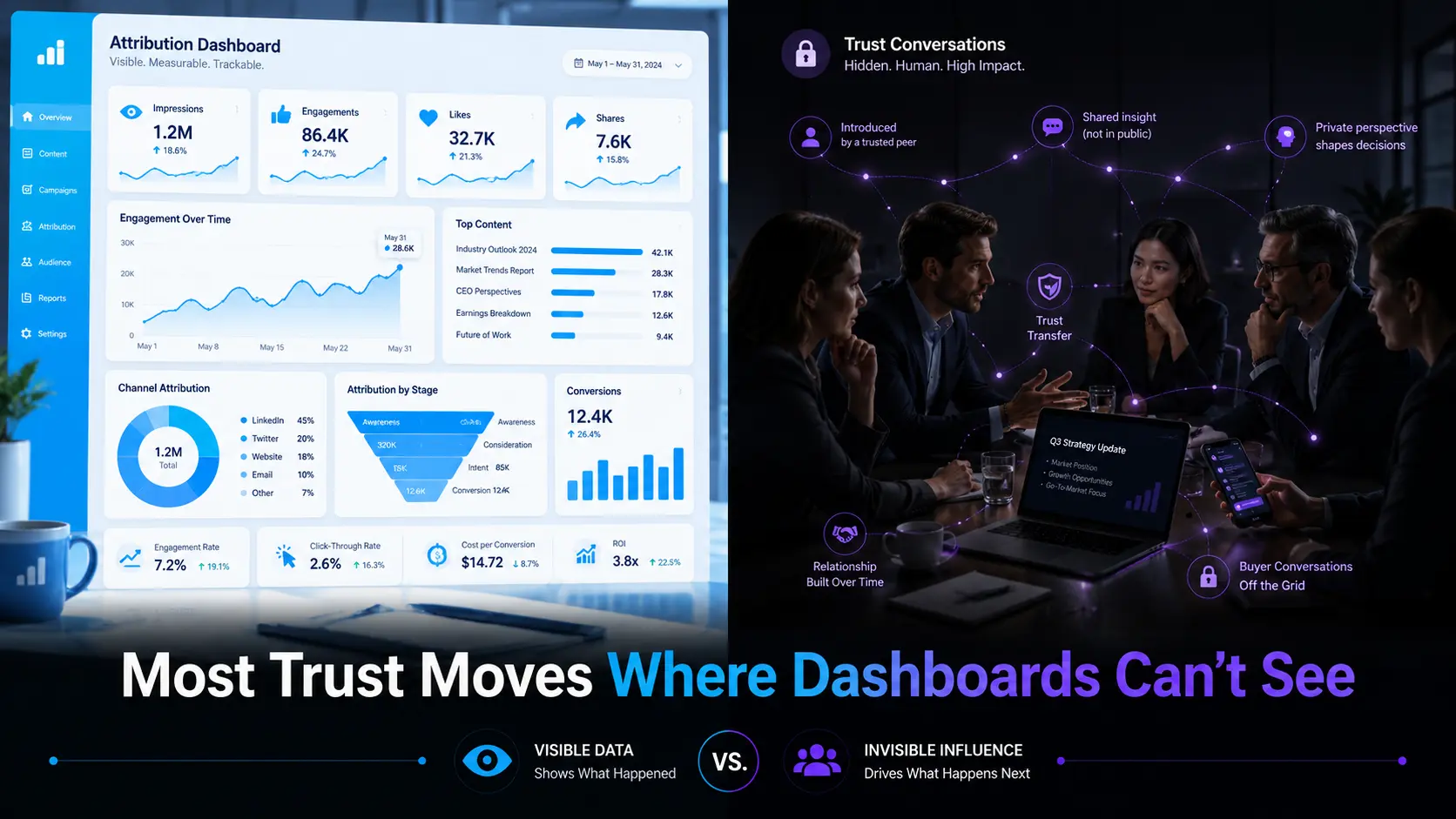
Most executives see a clean dashboard and think they’ve got a handle on social ROI.
But that clarity is the illusion.
The dangerous reality: the most powerful influence almost never leaves a public trace in your analytics.
It feels rational to steer investment based on tidy metrics.
Yet what counts is often what never shows up.
If you’re relying on dashboards for decision confidence, the risk isn’t just missing a few percent.
It’s misunderstanding where actual demand – and trust – originates.
The cost of underestimating trust‑based influence
The most serious risk with dark social attribution isn’t marginal.
It’s existential to your growth bets.
Teams often ignore private sharing, assuming that “if it mattered, it would be measured”.
But this is where market-shaping trust often gets built: a DM, a share in a Slack channel, a quick paste into a group chat.
None of these moments show up cleanly in your reports – but they move decision-makers closer to your solution.
Risks of Ignoring Dark Social Influence in Attribution
- Misinterpreting surges in direct traffic, missing private sharing origin.
- Undervaluing social as a driver of pipeline and deal progression.
- Cutting budgets on effective trust-building channels misclassified as non-existent.
- Overreliance on public engagement leading to false confidence in ROI.
- Failing to recognize and trace real conversations that build consensus.
One recurring pattern across client accounts: we’d spot spikes in direct traffic after a sharp LinkedIn post, only to learn weeks later those visitors had received the link in a private Slack discussion or WhatsApp thread.
No UTM.
No referrer.
Just a direct visit that seems organic.
The pipeline doesn’t connect back to the eye-catching post.
But behind the scenes, trust built in shadows carries more weight than any like or comment visible in your dashboard.
So what’s the hidden price?
Underestimating trust-based influence means pulling dollars from what works.
The fix isn’t pushing for more public engagement.
It’s tracing real conversations – the quiet consensus forming in private spaces, where buying committees actually move.
The myth says attribution tells you what’s moving the market.
The pattern says attribution tells you what’s obvious.
But deals rarely close in the open.
Think of missing trust signals as skipping chapters in a decision story.
You see the outcome, not the buildup.
Would you bet your next quarter on half a story?
Recognizing mis‑attribution patterns rather than chasing perfect data
There’s a persistent urge to force clarity out of chaos – to demand airtight attribution for every deal, every pipeline shift.
That urge is the root of wasted cycles and false confidence.
Instead, the better diagnostic is learning to recognize the signals that point to hidden social influence.
What does that look like in practice?
An uptick in “direct” traffic to deep content just after a viral social post.
Unexplained jumps in branded search after CEO content shared by advocates.
Or a sudden rise in referral volume from group chat domains that never show as social in your platform.
The signal isn’t perfect, but the pattern repeats: dark social drives demand, attribution mislabels it, teams misjudge what to fund.
Patterns Indicating Dark Social Influence in Attribution Data
| Source of Share | Typical Platform | How Analytics Classify Traffic |
| Outlook, Gmail | Direct / No Referrer | |
| DMs | LinkedIn, Twitter, Instagram | Direct / No Referrer |
| Workplace Chats | Slack, Microsoft Teams | Direct / No Referrer |
Trying to patch this with more tagging or demand-gen hacks is like fixing a cracked dam with stickers.
The signal remains stubbornly partial – but ignoring it doesn’t make the risk disappear.
The smarter play is to build reporting habits around patterns, not perfection.
Acknowledge that some influence is supposed to remain invisible.
Use that reality as a risk management tool, not a flaw in your stack.
Winning teams don’t chase perfect attribution.
They get sharp at reading the bias.
Therefore, dashboards are not a crystal ball – they’re a snapshot, shaped by what can be captured, not what actually moves buying teams.
The next challenge: if influence hides in dark social, how do you build a strategy that sees beyond the obvious trail?
That broader logic sets up Social-assisted Demand as the next factor in uncovering how social truly drives results.

Scientific context and sources
The sources below provide foundational context for how decision-making, attention, and performance dynamics evolve under scaling and constraint conditions.
- Digital Trace Data
Digital Trace Data in the Study of Public Opinion: An Indicator of Attention Toward Politics Rather Than Political Support – Andreas Jungherr, Harald Schoen, Oliver Posegga, Pascal Jürgens – Social Science Computer Review
This article examines the limits of using digital trace data as a proxy for real-world behavior and influence. It supports the article’s point that visible online signals often measure attention, not deeper intent or support.
https://journals.sagepub.com/doi/abs/10.1177/0894439316631043 - Private Social Influence
Social Features of Online Networks: The Strength of Intermediary Ties in Online Social Media – Przemyslaw A. Grabowicz, José J. Ramasco, Esteban Moro, Josep M. Pujol, Víctor M. Eguíluz – PLOS ONE
Explores how information moves through online networks via different tie types, including intermediary ties that connect groups. This supports the article’s point that influence often travels through network paths that are not obvious in surface metrics.
https://journals.plos.org/plosone/article?id=10.1371/journal.pone.0029358 - Attention vs. Influence
Tie Strength, Embeddedness, and Social Influence: A Large-Scale Networked Experiment – Sinan Aral, Dylan Walker – Management Science
Analyzes social influence in a large-scale networked experiment and helps distinguish observable engagement from actual behavioral influence. This fits the article’s claim that attention metrics do not equal true influence.
https://pubsonline.informs.org/doi/10.1287/mnsc.2014.1936 - Trust Formation in Digital Networks
The Value of Reputation on eBay: A Controlled Experiment – Paul Resnick, Richard Zeckhauser, John Swanson, Kate Lockwood – Experimental Economics
Explores how reputation signals affect trust and buying behavior in online markets. It supports the article’s argument that trust can shape decisions even when the underlying influence path is not directly visible in standard analytics.
https://link.springer.com/article/10.1007/s10683-006-4309-2 - Attribution Gaps in Digital Marketing
Toward a Digital Attribution Model: Measuring the Impact of Display Advertising on Online Consumer Behavior – Anindya Ghose, Vilma Todri – MIS Quarterly
Provides an academic framework for measuring online advertising impact across consumer behavior. It supports the article’s point that digital attribution is partial and can mislead decisions when systems only credit visible touchpoints.
https://papers.ssrn.com/sol3/papers.cfm?abstract_id=2638741
Questions You Might Ponder
What is dark social attribution and why does it matter for marketers?
Dark social attribution refers to the challenge of accurately tracking content shared through private channels such as email, DMs, and group chats. It matters because these untraceable shares often drive critical buyer decisions and trust-building that never appear in standard analytics.
How does private sharing affect website traffic metrics?
Private sharing can cause analytics platforms to misclassify visits as ‘direct’ or with ‘no referrer’. This inflates direct traffic numbers and hides the real source of influence, making social-driven demand seem invisible and underrepresented in dashboards.
Why are likes and impressions poor indicators of purchase intent?
Likes and impressions primarily measure surface-level attention rather than deeper trust or intent. High-value buyers frequently engage with content privately, meaning the absence of public interaction does not signal a lack of interest or impact on purchase decisions.
What risks do companies face by trusting only dashboard attribution?
Relying solely on visible dashboards can lead companies to undervalue or defund the channels actually driving demand. Overlooking dark social influence puts critical revenue and relationship-building at risk, as key trust signals remain unmeasured and ignored.
How can marketing teams recognize hidden social influence without perfect data?
Marketing teams can look for patterns such as unexplained direct traffic spikes following public posts or sudden branded search increases. Recognizing these trends helps teams better estimate the true value of hidden social influence, even without perfect attribution.