
What You’ll Learn
Social assisted demand is the hidden demand shaped by social media before a buyer takes a measurable action.
It happens when repeated social exposure builds memory, trust, preference, and problem awareness, even if the buyer does not click, like, comment, or convert immediately.
Social-assisted demand often appears later through branded search, direct traffic, private referrals, sales conversations, DMs, or prospects repeating language from earlier content.
Standard attribution can miss it because influence may travel through dark social, delayed recall, or offline discussion.
Strong social strategy treats social media as a trust and memory system that prepares buyers before conversion becomes visible.
Key Takeaways
- Social-assisted demand builds unseen influence long before direct conversions, shaping buyer intent through repeated social exposures and trust accumulation.
- Engagement metrics like likes or shares are often misleading; real business impact is revealed through brand recall, trust, and later action, not momentary attention.
- Standard attribution models often miss how social influence travels through dark social channels and memory, leading to underestimation of social’s true impact on demand.
- To maximize impact, organizations should treat social media as a long-term trust and memory system, tracking subtle signals beyond traditional dashboards.
Most teams assume that social media makes an impact only when they see direct conversions or spikes in leads.
But visibility isn’t always visible on the dashboard.
The real movement starts long before the measurable click – and gets missed by almost every attribution model in the market.
That broader pattern appears in Social Media Marketing.

What social‑assisted demand is and why it matters
Social‑assisted demand is the invisible pressure that social content builds: not by driving an immediate response, but by shaping what the market pays attention to, trusts, and stores in memory for later.
In many deals we’ve watched, the influence starts weeks – or even months – before anyone fills out a form.
The pattern is consistent: perception shifts long before the pipeline changes.
That raises a sharper question: How much demand was created before anyone could measure it?
Why ‘likes and views’ don’t equal business results
It’s easy to equate surging likes or viral moments with success, but the surface-level engagement is often a mirage: real business results are powered by unseen shifts, not public counters.
Here’s the myth: if the engagement rate rises, so will demand.
In practice, we’ve seen launch campaigns gather plenty of comments but zero effect on market awareness.
Key Points: Engagement vs Influence on Business Results
- High engagement (likes, comments) does not guarantee increased market awareness.
- Engagement metrics are vanity metrics if not tied to buyer memory and trust.
- Real influence is measured by how many buyers recall, trust, and act on content later.
- Following visible engagement without deeper signals can create illusions of momentum.
- Successful social media impact involves shaping perception long before measurable actions.
Public approval comforts teams, but it can distract from what matters – buyers rarely make choices based on like counts.
The sharp diagnostic: Engagement is not the same as influence.
The signal that matters is how many buyers remember, trust, and call back to your content weeks later – not how many double-tapped in the moment.
Vanity metrics might look impressive, but without a message that resonates, those numbers rarely translate into pipeline.
Too often, the chase for visible numbers creates the illusion of momentum while the real audience remains unmoved.
So, what does show actual movement?
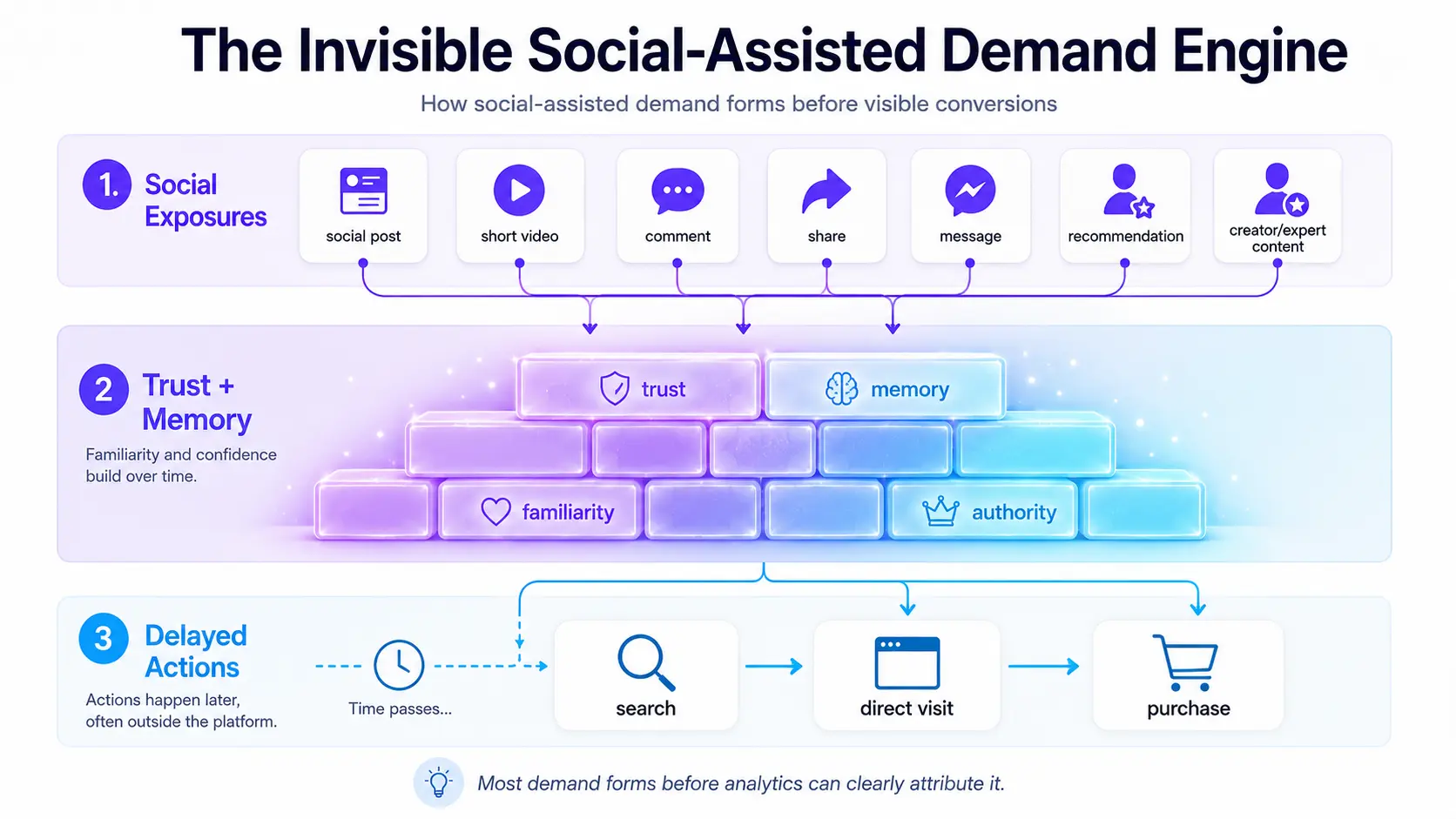
How social content plants seeds in customers’ minds before action
You usually won’t spot true influence when it first happens.
That low-engagement LinkedIn post you barely remember may quietly echo months later – in the language prospects use during sales calls.
Repeated exposure creates memory-layering.
One client saw a surge in brand search volume – not after a major campaign, but after a steady run of expert posts that were shared inside industry group chats.
The company’s logo became familiar before a single click came through.
The cumulative effect takes time to materialize.
The lesson: buyers start to recognize authority long before they’re ready to act.
This is the hidden compounding effect: Each touch stacks trust.
Each useful post builds recognition.
Over time, these small, unnoticed touches add up to a market that not only knows your name but instinctively prefers it.
But that setup work won’t show up as an immediate win.
Therefore, if your team waits for visible spikes before seeing value in social, you’re chasing the shadow, not the source.
The challenge next is seeing which parts of this invisible influence actually move the needle – and which are just noise.
That distinction will shape how you score social’s impact in the chapters ahead.

Why attribution dashboards often miss social’s real impact
Attribution feels scientific – every channel gets its numbers, and leaders trust the dashboard’s story.
But the real story barely fits those columns.
The sharpest teams know: not all influence leaves a visible trail.
Standard analytics reward what can be directly measured.
That gives a false sense of control.
The reality?
Social-assisted demand grows in the shadows, shaping decisions long before your CRM ever knows.
Dark social and hidden pathways that Analytics can’t see
Not all influence travels public highways.
Most of it cuts through alleys analytics can’t map – private DMs, WhatsApp groups, untrackable copy-pastes, side conversations, Slack threads.
It’s tempting to chase only what’s visible.
But we’ve seen multiple campaigns spark sudden surges in direct site traffic with no obvious referral source or campaign UTM in sight.
Users arrive after a week of social buzz, but Attribution logs their visit as “direct” – no window into the conversation that sent them there.
Ask yourself: when have you ever forwarded a LinkedIn post to a colleague via email or chat instead of clicking through?
That intent, that mental real estate – none of it shows up in the official traffic breakdown.
Here’s the myth – if Analytics can’t track a click, the channel didn’t move demand.
In truth, the most valuable signal might never generate a first-party data point.
The missing traffic, the mystery spike in brand search, the rise in demo requests after a community discussion – these are footprints of dark social doing what no dashboard captures.
Dark social is like word of mouth in new packaging.
It doesn’t seek credit.
It just moves people closer to action quietly – until a public moment triggers a measurable event.
That lag between social influence and action is where the revenue leak starts.
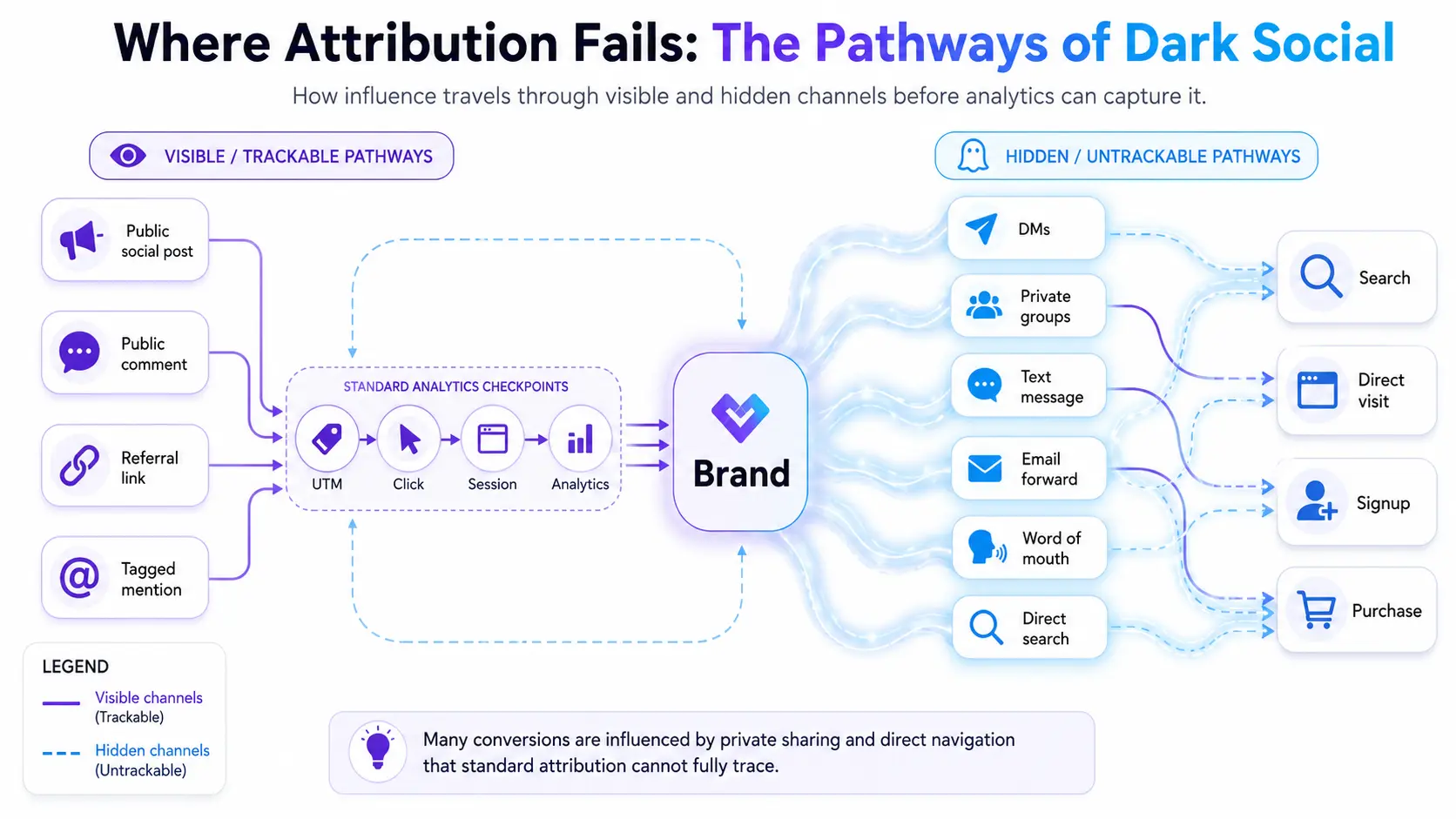
When social influence dissolves into direct, search, or referral channels
Influence rarely leaves its fingerprints in your UTM tags.
A user sees an expert’s post, thinks about it for days, searches your brand next week and signs up via the “direct” or “organic search” bucket.
That’s where classic attribution fails: it hands the gold medal to whichever channel got the last visible click.
We’ve seen brand search volume spike two days after a founder posts a controversial story.
We’ve heard from sales teams who first learn about growing demand when prospects start using language lifted straight from last month’s social content.
The impact isn’t linear – by the time the dashboard catches up, the shaping work is long done.
Can you really trust a dashboard that ignores every off-platform touchpoint and quiet backchannel influence?
Attribution dashboards freeze impact into a single moment, but demand is compounded elsewhere.
Therefore, if you only optimize for what Analytics reports, you’ll miss the leverage point – that crucial stage when awareness and trust quietly turn into intent.
The next challenge: recognizing the signals when influence hides in plain sight, not in your campaign ROI export.

What metrics can hint at social’s uncredited shaping of demand
Executives hunt for reliable marketing signals, mining dashboards for the surest proof of impact.
But the right metric often hides in plain sight.
The sharpest teams know: what matters most is almost never the number on top of the report.
Everyone wants simple conversion charts to connect social activity to outcomes.
Yet, the signals that reveal social-assisted demand rarely show up as a tidy, single metric.
The story runs underneath – where influence shapes action before anyone can measure it directly.
Brand search lift, direct traffic patterns, and recall signals
Leadership often expects a clear path: post on social, get more conversions, see the spike.
But the real influence emerges sideways.
You’ll notice certain patterns when social is working, even if the analytics can’t pin attribution down.
One repeatable signal: a surge in brand search volume.
When prospective customers see your message over and over, they don’t always click a post.
Often, they head straight to Google and type your brand.
That uptick?
It’s not luck.
It’s the echo of trust and memory built on social platforms.
But the visualization gets sharper: direct traffic also rises when social influence grows.
This isn’t a technical error or a tracking failure.
It’s the path customers take – connecting dots from your LinkedIn post or private Slack share straight to your website, skipping the visible referral trail entirely.
Think of it as learning a face in a crowded room: you may not remember the introduction, but when you finally need someone, you know exactly whom to look for.
Social content works the same way.
Memory comes first; measurable action follows days or weeks later.
That’s why single-post analysis so often fails.
The real story emerges when patterns repeat: an unexpected jump in branded queries, more direct landings on high-intent pages, or sudden audience recall in surveys and interviews.
So, is a rise in brand search the full answer?
It’s only one layer.
The deeper patterns, and the reasons people take action, often stay beneath the surface – until qualitative cues fill in the context.
Sales conversations, qualitative feedback, and referral language
Some of the sharpest evidence never touches the analytics dashboard.
It comes from the sales frontlines.
Teams we’ve worked with have heard lines like, “I keep seeing your CEO’s posts everywhere”, or “A peer sent me a guide from your LinkedIn”.
Those comments aren’t outliers – they’re proof that trust is built in quiet spaces before the deal ever starts.
But these signals are often written off as anecdotes.
That’s a mistake.
Language patterns in sales calls, DMs from prospects referencing posts, or stories repeated back to you reveal how deeply your message is spreading.
These fragments form a shadow map of influence – one you can’t buy with ad spend alone.
Real demand often emerges when customers start using your own words, citing your frameworks, or referencing that podcast clip shared last month.
Still, the absence of this referral language means something is breaking in the journey: either your content isn’t memorable, or your audience isn’t repeating what they see.
So what changes in strategy?
These soft signals demand structured listening.
Teams start closing the loop – not with more dashboards, but by analyzing what prospects actually say and where the language comes from.
That’s when the invisible hand of social becomes visible in your pipeline.
The missed metric isn’t a gap in reporting.
It’s a blind spot in the typical marketing mindset.
The next challenge: how do you treat social media not just as a content machine, but as a trust and memory engine that compounds even before you see the conversion?

When to treat social media as a strategic trust‑and-visibility system
Most companies chase social media for leads or pipeline acceleration.
But demand rarely walks in through the same door it entered.
The bigger, often ignored signal isn’t how many see you today – it’s how many remember you tomorrow and act on it elsewhere.
A paid ad can account for every click.
Social content moves beneath the surface, reshaping trust and recognition long before the actual conversion.
Therefore, social-assisted demand isn’t about harvesting demand on command – it’s about building mental availability that shows up in conversion paths nobody expected.
When your posting is visible but doesn’t compound or convert
Your posts rack up impressions and the brand logo appears everywhere – but revenue doesn’t budge.
That’s the setup where ‘visibility’ looks like progress, but nothing is stacking.
The audience sees, scrolls, and forgets.
Most teams double down: more content, higher frequency, even bolder creative.
But the plateau holds.
The common myth is that attention equals traction.
Reasons Why Visible Social Media Posting May Not Convert to Demand
| Issue | Description | Impact on Demand | Typical Team Response |
|---|---|---|---|
| Visibility without Memory | Audience sees content but does not retain or connect exposures | No measurable lift in brand recall, organic search, or referral traffic | Increase quantity and frequency of posts without changing messaging |
| Volume Over Consistency | Posting frequently but without cohesive message architecture | Traffic moves but market awareness and trust remain static | Doubling down on content volume aiming for impression counts |
| Lack of Message Relevance | Content does not create meaningful recall hooks or signatures | Each exposure is forgotten quickly, resetting effect daily | Focusing on distribution and algorithmic boosts rather than message quality |
Here’s the breakdown: visibility only compounds when each exposure builds on the last – like stacking bricks into a wall.
But if the market doesn’t connect those touches or assign memory, it’s as if each brick gets set, then knocked down overnight.
The effect resets.
We’ve seen clients regularly hit six-figure impression counts for months, only to find zero lift in organic search, zero flagged mentions in sales calls, and no change in referral traffic.
The numbers moved, but the market did not.
So the question becomes: Why aren’t those visible moments stacking up into measurable demand?
Sometimes it’s a mismatch – posting for visibility, but ignoring what creates recall.
Other times, teams over-index on volume, viewing each post as a lottery ticket, not realizing consistency and message architecture matter more than pure reach.
If a brand wants to avoid this dead zone, the fix isn’t just more distribution.
It’s crafting memory hooks and content signatures that make every exposure harder to forget – even when the dashboard is quiet.
Therefore, compounding only happens when the market attaches meaning to the message, not when an algorithm promotes it for 10 seconds.
Demand is shaped in the gaps between posts, not just during the spike.
The wall builds when repetition and relevance meet memory.
When engagement looks healthy but demand isn’t emerging
Likes, shares, replies – on the surface, the signs point to traction.
Yet the sales team doesn’t see new prospects citing your work.
Pipeline sits idle.
The trap is taking engagement as proof of demand, but that traffic may be nothing more than a crowd applauding from the stands, not buyers stepping onto the field.
A sharp diagnostic is asking: Are the same accounts appearing in both your social interactions and sales conversations?
Or are you seeing the right numbers from the wrong people?
One client ran multi-touch attribution and found their biggest ‘fans’ on social hadn’t visited the website in months.
Conversely, new leads said they’d “seen us everywhere” but couldn’t remember a specific post.
That is the value of social-assisted demand – its real work often goes uncredited.
So where does the system break down?
Sometimes engaging content optimizes for the platform, not true buyer movement.
Teams fall for vanity metrics, assuming that high engagement means latent demand.
But social influence doesn’t always create instant conversion; often, it builds dormant trust that later unfreezes in direct search, brand mentions, or word-of-mouth referrals.
Therefore, when engagement separates from demand, review what you’re building: attention or memory, applause or authority.
Demand moves when engagement becomes memorable enough to survive the scroll and prompt outside action.
Social media as a strategic trust-and-visibility system means playing the long game – not for the echo in your notifications, but for the echo in your market’s decisions.
The next chapter is not about impressing the feed.
It’s about translating memory and trust into persistent business edge: why does the market trust some brands after a single post while others fade, no matter how visible?
That shift from attribution certainty to decision confidence is where social media measurement must evolve next.

Scientific context and sources
The sources below provide foundational context for how decision-making, attention, and performance dynamics evolve under scaling and constraint conditions.
- The subtle shaping of demand through social and network effects
The Social Amplification of Risk: A Conceptual Framework – Roger E. Kasperson, Ortwin Renn, Paul Slovic, et al. – Risk Analysis
Explains how signals move through psychological, social, cultural, media, and interpersonal channels, shaping perception and behavior beyond the original trigger. This is related to how social media can shape trust, attention, and intent before measurable action appears. The original resource title and authors were not accurate. The current link should be replaced with the correct Wiley DOI page.
https://onlinelibrary.wiley.com/doi/10.1111/j.1539-6924.1988.tb01168.x - Latent decision triggers and memory in business contexts
Cognitive and neural principles of a memory bias on preferential choices – Peter M. Kraemer, Regina A. Weilbächer, Tehilla Mechera-Ostrovsky & Sebastian Gluth – Current Research in Neurobiology
Grounds how memory influences later preferences and value-based decisions. This fits the article’s point that repeated social exposure can create delayed shifts in buyer intent before a click, search, or conversion happens. The original ScienceDirect link appears to lead to a different article, so it should be replaced.
https://pmc.ncbi.nlm.nih.gov/articles/PMC9846459/ - The limits of digital attribution
The Path to Purchase and Attribution Modeling: Introduction to Special Section – P.K. Kannan, Werner Reinartz & Peter C. Verhoef – International Journal of Research in Marketing
A strong fit for the article’s claims about multi-touch journeys, attribution limits, channel spillover, and the difficulty of assigning credit to hidden or delayed influence. The original Now Publishers link leads to a different publication, so it should not be used.
https://research.rug.nl/en/publications/the-path-to-purchase-and-attribution-modeling-introduction-to-spe/ - Awareness, trust, and the long tail of influence
Understanding Customer Experience Throughout the Customer Journey – Katherine N. Lemon & Peter C. Verhoef – Journal of Marketing
Explains how customer experience develops across many touchpoints, channels, and moments over time. This is more relevant to the article than the original sharing-economy/photo-trust source because the article is about social-assisted demand, repeated exposure, delayed recall, and non-linear buyer journeys.
https://journals.sagepub.com/doi/10.1509/jm.15.0420 - The mechanics of invisible persuasion
Digital Marketing: A Framework, Review and Research Agenda – P.K. Kannan & Hongshuang “Alice” Li – International Journal of Research in Marketing
Explains digital marketing through touchpoints, customer behavior, digital interaction, and broader marketing system effects. This is a safer and more directly related source than the original “Hidden Persuaders” reference, which I could not verify reliably from the provided citation.
https://papers.ssrn.com/sol3/papers.cfm?abstract_id=3000712
Questions You Might Ponder
What is social-assisted demand and why is it critical for modern marketing?
Social-assisted demand is the invisible influence created by social content that builds trust, awareness, and future intent before direct conversions are measured. It impacts business outcomes by shaping buyer memory and preferences, making it critical to recognize and leverage for sustainable growth.
How does social media shape customer decisions before they act?
Social media subtly shapes decisions through repeated exposures, memory layering, and word-of-mouth. Even without immediate clicks, content can build recognition and trust, causing potential buyers to recall the brand or message when the time to act arrives, often bypassing visible attribution.
Why do traditional attribution dashboards struggle to measure social-assisted demand?
Attribution dashboards typically only track direct, measurable actions such as clicks or form fills. They miss off-platform sharing, private messages, and word-of-mouth – all key routes of social-assisted demand – resulting in overlooked influence that actually drives future demand and pipeline growth.
What are hidden signals of social-assisted demand beyond likes and shares?
Hidden signals include increased brand search volume, unexplained surges in direct website traffic, and recurring references to social content in sales conversations. These indicators reflect true market movement that engagement metrics alone cannot capture, highlighting trust and memory over visible clicks.
How can companies evolve social media strategy to harness social-assisted demand?
Firms can optimize by focusing not just on content frequency or engagement but on building recall, authority, and trust. Strategies should prioritize memory hooks and monitor qualitative feedback, ensuring social efforts become a compounding trust-and-visibility engine rather than chasing superficial metrics.