
What You’ll Learn
Social media impact measurement is the process of evaluating how social activity influences business outcomes beyond visible metrics such as likes, impressions, shares, or last-click conversions.
It measures not only direct clicks, but also hidden and delayed effects such as branded search lift, direct traffic growth, private sharing, buyer recall, sales conversations, referral language, and prospects repeating campaign ideas.
Social media impact is often undercounted because influence moves through dark social, memory, word of mouth, and assisted demand before a buyer converts.
Strong measurement treats platform metrics as clues, then validates them against trust, recognition, pipeline quality, and commercial movement over time.
Key Takeaways
- Last-click attribution and vanity metrics systematically undercount social media’s real business value by ignoring indirect influence and hidden pathways.
- Private sharing and “dark social” channels drive referrals and demand untraceable by standard analytics, making alternative signals essential.
- Tracking branded search lift, direct visits, and qualitative sales feedback gives stronger confidence in social’s impact amid incomplete data.
- Focusing only on immediate conversions risks starving future growth, while true measurement requires both context and patience.
Every exec has watched a well-planned campaign return disappointing numbers in their reporting dashboard.
But there’s a deeper flaw at play – numbers like last-click conversions and high social reach keep persuading teams they’re seeing the whole impact.
The sharper truth?
Attribution simplifies influence, and in doing so, quietly erases much of the value social media creates.
That broader dynamic is mapped out in Social Media Marketing.

Why one attribution number often misses social media’s real business influence
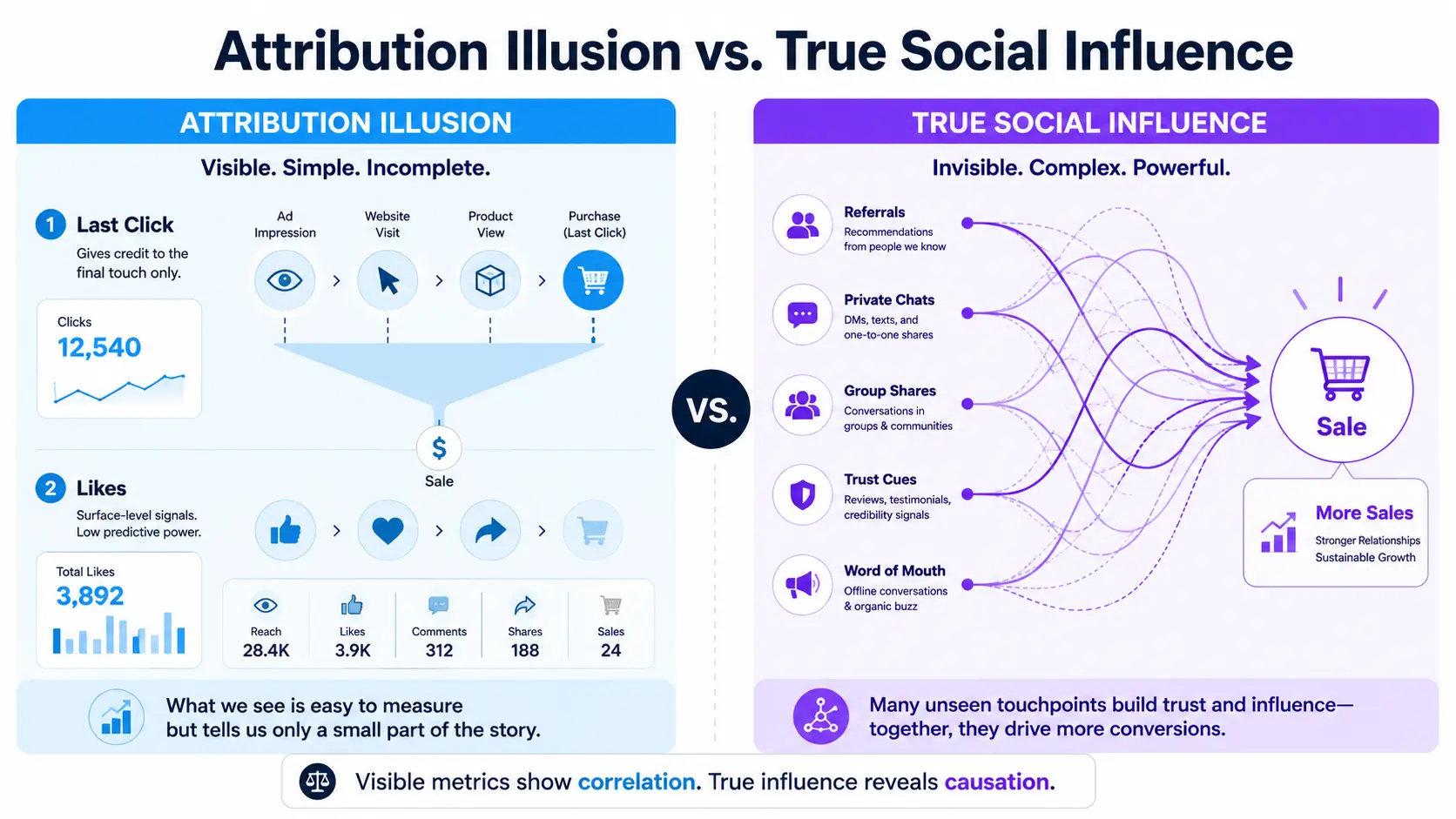
Think of last-click attribution as a spotlight – bright, but blinding to the shadows where most social influence lives.
It shines only on the final click before a sale or lead, marking that moment as the hero.
But social doesn’t work like search or direct response.
Social platforms plant seeds: a comment months ago, a share in a private group, a post that prompted a silent check-in with your brand.
How last-click attribution and vanity metrics distort performance
Vanity metrics, like follower growth or casual likes, don’t catch what matters either.
They offer comfort but not certainty.
We’ve watched high-engagement posts drive little measurable business, while lightly-liked insights sparked DMs and referrals that eventually landed major deals.
The myth that surface numbers always predict bottom-line results is persistent – and expensive.
Comparison of Last-Click Attribution vs Vanity Metrics
| Aspect | Last-Click Attribution | Vanity Metrics | Impact on Performance Measurement |
|---|---|---|---|
| Definition | Attributes conversion credit to final click before sale | Metrics like follower growth, likes, engagement volume | Oversimplifies and misses broader social impact |
| Focus | Final transaction/action | Surface-level engagement signals | Ignores earlier or indirect social touchpoints |
| Visibility | Shows only last interaction | Visible on platform dashboards | Blinds teams to hidden/dark social influence |
| Business consequence | Misattributes value; underfunds trust-building campaigns | Provides comfort but not predictive of revenue | Leads to erroneous budget and strategy decisions |
What’s visible on your social dashboard is the tip, not the iceberg.
Doubling down on what’s easy to count leads teams to misjudge platform value and cut the wrong investment lines.
But the business consequence is sharper.
When leadership ties budgets to last-click wins, campaigns that build trust or brand recall quietly lose funding.
What gets measured well doesn’t always drive the next wave of growth.
So how do teams avoid being fooled by the dashboard?
That tension sits at the heart of social strategy – and pushes us to look for what slips past the numbers.
Why private sharing and dark social hide real influence
Most of your brand’s social influence never shows up in a Google Analytics report.
But it’s not lost – it’s moving in places attribution cannot follow.
Direct messages, Slack shares, WhatsApp groups, silent copy-paste links: these are “dark social” channels.
They don’t pass a referral tag or a visible clickstream.
This ‘dark social influence’ is a blind spot that most social media impact measurement models miss, yet it can drive outsized business results.
Examples and Impacts of Dark Social Channels
- Direct messages on platforms like WhatsApp or Slack sharing brand content
- Private group shares and untracked URL copy-pasting
- Silent offline conversations referencing social posts
- Internal executive forums or meetings citing social content
- Invisible referrals that lead to unexpected sales or leads
The actual journey looks nothing like the funnel chart.
Someone finds a post through a friend’s DM, talks about it at lunch, or clicks a bare URL shared in a private channel.
No attribution model will connect the dots.
That’s where the real signal begins.
Business decision-makers often assume that what isn’t trackable isn’t scalable.
But in practice, we’ve seen deals that “came out of nowhere” – in reality, they started with a screenshot in a private executive forum or a mention in an internal meeting.
One analogy: attribution acts like a security camera pointed at your front entrance, while most qualified buyers are slipping in through side doors you cannot see.
This is why executive teams who only chase visible traffic miss the slow build of trust – the compounding effect of repeated, unlogged touches across channels.
How much influence are you missing?
If your reports show a drip but sales keeps quoting social posts back at you, you’re seeing dark social at work.
Vanity metric platforms will not warn you.
Therefore, risk hides where influence grows strongest.
The attribution blind spot means strategic risk: ceding ground to competitors who measure by market movement, not just platform logs.
Tracking what you can see is only half the game.
The rest lives in invisible signals, indirect conversations, and brand recall.
The next move is discovering which signals are worth your confidence – even without perfect data.

What alternative signals build measurement confidence when data is incomplete
Marketing teams hunt for direct proof that social media moves business results.
But when the trail goes cold in the analytics, most assume the signal just doesn’t exist.
The reality: decision confidence is built on threads of influence – receipts that rarely show up in neat columns, but can be woven from overlooked clues.
What if the missing value wasn’t lost, only misfiled?
Tracking brand memory through branded search and direct traffic lift
Clicks and likes might disappear in a sea of noise, but the moment a potential buyer types your brand into Google after a social impression, you have a clue that outlives the feed.
Many brands chase platform-specific metrics, yet overlook this delayed recall effect.
We’ve seen client teams chase high engagement on Instagram, only to stall on immediate traffic.
But two weeks later, branded searches spike – and direct-visit sessions rise, sometimes with zero spend on search.
The uplift wasn’t from a clever paid campaign; it began with a scroll, a share, or a mention.
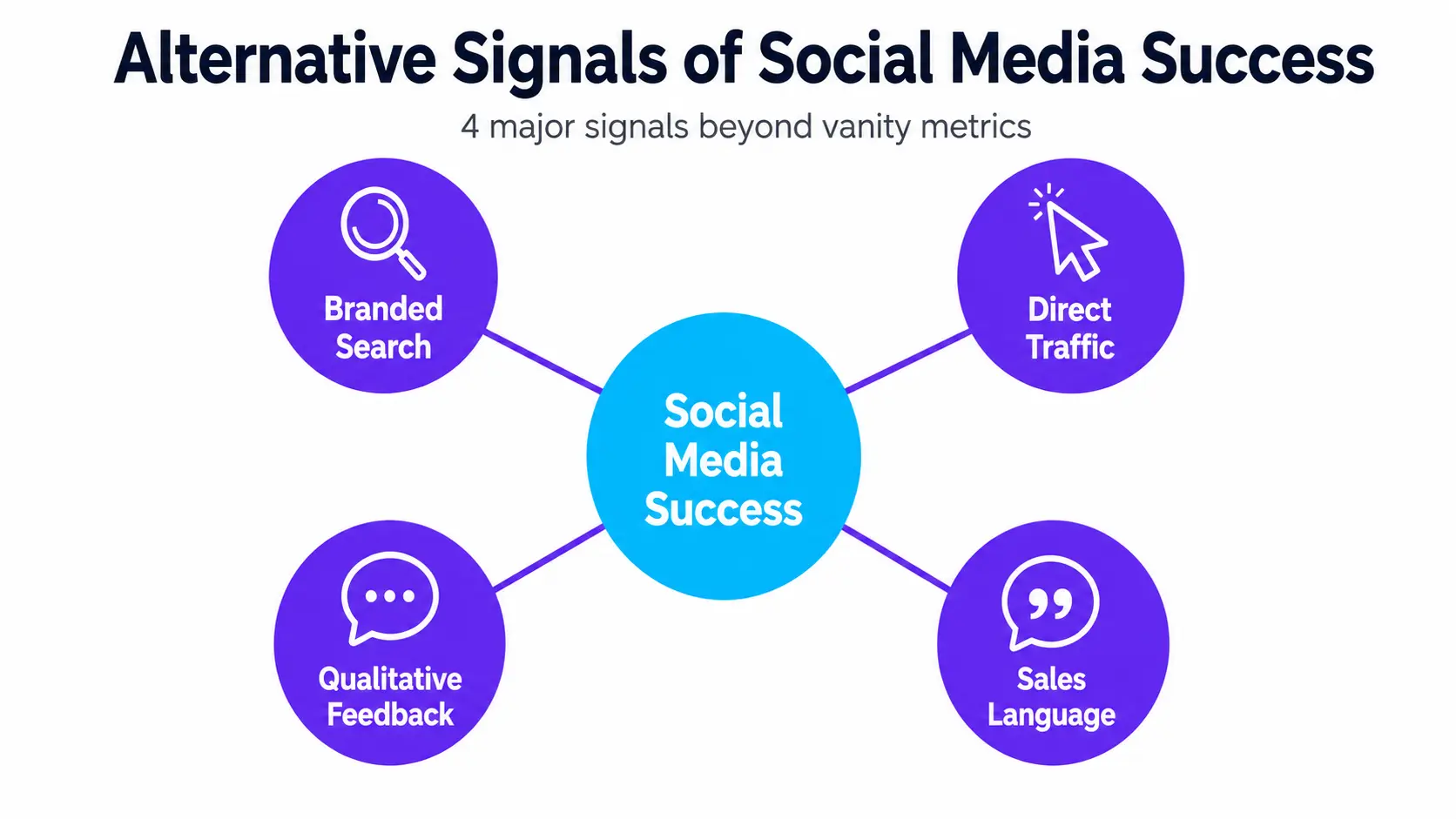
A practical signal: a consistent uptick in branded search volume or direct traffic after social pushes – without matching paid campaigns – often points to social media’s hidden pull.
Sales teams sometimes notice “random” surges in inbound leads, though the spike usually lags the campaign.
While most teams believe only what’s directly attributed to social counts, the payoff comes when they track these second-order signals over time, not just month-end vanity metrics.
If visibility drives memory and memory drives inbound intent, where would your next budget dollar go?
Using qualitative feedback and sales language as indirect impact evidence
Some of the sharpest signals aren’t numbers at all.
Listen to what buyers say on discovery calls, in email threads, or in intake forms.
“I saw your post on LinkedIn. Someone in my network sent me your article”.
These are the breadcrumbs analytics can’t reconstruct, but sales teams hear them weekly.
In one client’s funnel review, nearly a quarter of closed-won deals referenced a social touch – none linked by last-touch attribution.
It’s not always the volume of mentions, but the quality: specific recall, thematic alignment, even snippets of campaign language mirrored back by prospects.
You’ll know your social assisted demand lands when your own copy comes back in someone else’s words.
Types of Qualitative Feedback Signaling Social Media Impact
- Buyer mentions of social posts during discovery calls
- References to brand content in email conversations
- Leads quoting campaign language or themes
- Sales team observations of social-driven discussions
- Tracking lead intake forms citing social as influence
A simple diagnostic is to track how often new leads cite social content or share language unique to brand campaigns – especially when it surfaces in conversations before click signals appear in your CRM.
Why does narrative evidence matter?
Data without context leads to tactical errors.
But when narrative and number agree – even weakly – confidence grows stronger than any dashboard alone.
Business moves slower than dashboards suggest, and the evidence is always partial.
Yet the teams that piece together influence from brand memory and buyer words win the measurement game others quit in frustration.
The single-source signal never arrives.
Success depends on your ability to make decisions amid uncertainty.

What undercounts social media’s role when teams judge only immediate conversions
When a viral post triggers a conversion spike, most teams rush to credit the last visible click.
But this short-term focus misses a harder truth: social media’s business impact often forms invisibly, as trust and awareness compound for months before any sign of intent appears.
The dashboard shows wins or losses.
But what it misses is how trust and intent pool quietly below the surface, only surfacing long after the initial touch.
That’s why performance can appear flat, even when the groundwork for a surge has already been laid.
How engagement compounds over time but remains invisible in reports
Engagement is treated like a tap: turn it on, and conversions should flow.
But that’s a myth – engagement acts more like steady rainfall before a flood.
Each like, share, or DM isn’t an instant sale but a subtle deposit into brand memory.
We’ve watched brands run high-frequency social for quarters without clear conversion spikes, only to see sales climb unexpectedly months later.
The correlation isn’t immediate – the buyer’s sense of familiarity and trust builds by increments, and most reporting windows snap shut long before the purchase catch-up begins.
That lag means the compounding effect of sustained interaction goes undetected, particularly on platforms where ‘dark social’ – private shares, direct messages, and untracked group chats – quietly amplifies reach.
The impact is real, but most analytics tools are blind to these hidden referrals.
Are teams missing the very signals that drive future demand?
This trust compounding is like investing in a relationship.
You won’t see instant payback, but withdrawals – when they arrive – are often bigger than a single post’s performance would predict.
Therefore, when reports dismiss social’s value for lack of short-term ROI, they undercount the patience dividend that follows consistent audience engagement.
How assisted demand reshapes conversion paths long before lead makes contact
Attribution models crave clean, final actions – form fills, purchases, demo requests.
But most decision journeys meander: research starts on LinkedIn, a product gets mentioned in a Slack group, and a buyer only converts after multiple rounds of passive exposure.
Assisted demand is the silent negotiator – warming up prospects on channels attribution ignores.
In our experience, buyers reference social impressions weeks after their first touchpoint, many unable to pinpoint which tweet or post tipped them from awareness to intent.
So the conversion path isn’t a straight shot from click to close; it’s a relay race, with social platforms handing off influence to search, email, and sales touchpoints that finally capture the credit.
It’s easy to undervalue a channel that rarely finishes the race but consistently sets up the win.
That’s the hidden cost of judging solely by immediate conversion.
Therefore, the impact of social is bigger than the sum of visible conversions – it multiplies demand quietly upstream.
When teams widen their measurement lens, they start to see how missed credit upstream robs them of growth downstream.
But if every payoff takes months to mature, how do you keep leadership confident in investments that don’t convert on command?
That’s the puzzle the next section takes apart.

When to trust social metrics and when to qualify them with broader signals
Leaders often stare down big social numbers and think more equals better.
But volume hides a mess of weak signals in plain sight.
Not every share, like, or comment holds the same value for decision-stage influence.
Assessing engagement quality vs quantity when influence matters
Surface-level engagement is easy to misread – a flood of likes after a viral moment might look like real gain.
However, business movement usually happens in the quieter, less-visible interactions: thoughtful comments, shares into Slack groups, and direct outreach to sales.
The myth that maximum engagement guarantees maximum intent quietly erodes marketing confidence month after month.
That’s where most teams get trapped.
They celebrate numbers, then wonder why pipeline velocity stalls.
In client reviews, we’ve seen leadership teams anchor to spikes in post interactions while missing the uptick in branded search or the shift in conversation tone on sales calls.
The tell: engagement that moves downstream is rarely the one that dazzles your dashboard.
Here’s a way to break the illusion.
Treat social attention like a busy tradeshow floor.
Fifteen people might walk by your booth.
Only one asks a tough question that signals true buying intent.
Most just browse.
Quantity creates noise – quality signals tell you who cares, who acts, and who remembers.
So, what does it mean for measurement?
Teams need to separate publicly visible metrics from signals that forecast real business movement.
Are those lively comments coming from your target accounts, or from bots and competitors?
Does a spike in social shares lead to more direct leads, or is it just another round of recycled content?
The expensive mistake is chasing applause instead of action.
Teams that optimize for deeper, context-driven engagement – versus just viral attraction – are the ones who see social become a true demand engine over time.
Balancing platform data with context: market, regulation, and message fit
Standard social metrics rarely travel well across different business environments.
It’s tempting to treat a strong metric from one campaign as a template, but market context changes the signal.
Regulation tightens privacy; market maturity shifts what engagement looks like; even small message changes can swing audience behavior without warning.
Platform reports never factor in channel saturation or regulatory drift.
We’ve watched companies celebrate a conversion spike right before a market-wide crackdown kneecapped that channel’s future potential.
Every number needs a context check – or teams risk drawing the wrong conclusions from the right data.
Think of metrics like weather reports: a 70°F sunny forecast means different things on a beach than on a mountaintop.
An engagement rate that looks solid in SaaS might signal severe underperformance in a consumer launch, or vice versa.
Therefore, measurement confidence grows by factoring in three core context layers: who your market actually is, which rules distort what’s visible (think GDPR limiting social retargeting), and how well your value story fits current buyer needs.
So what changes for executive judgment?
Trust platform numbers only when you can see their limits in your context.
Qualify every metric – ask if it still means what you think when regulations shift, buyers adapt, or new players bend the rules.
Measurement confidence is not about certainty; it’s about reading signals with your business blinders off.
In the end, social media metrics never settle the argument alone.
The sharpest executives rely on them as clues – then pressure-test them against what’s changing outside the dashboard.
The real question becomes: what will you miss if you don’t?

Scientific context and sources
The sources below provide foundational context for how decision-making, attention, and performance dynamics evolve under scaling and constraint conditions.
- Attribution Models in Marketing
Beyond the Last Touch: Attribution in Online Advertising – Ron Berman – Marketing Science
Explains why last-touch attribution can misallocate credit in online advertising and why better attribution logic is needed when multiple touchpoints influence conversion. This validates the article’s critique of last-click over-simplification in measuring social media impact.
https://pubsonline.informs.org/doi/10.1287/mksc.2018.1104 - The Measurement of Social Media Influence
Social Data: Biases, Methodological Pitfalls, and Ethical Boundaries – Alexandra Olteanu, Carlos Castillo, Fernando Diaz, Emre Kıcıman – Frontiers in Big Data
Explains why social media data can be biased, incomplete, and methodologically risky. This supports the article’s point that visible platform metrics should not be treated as complete proof of social media influence.
https://pmc.ncbi.nlm.nih.gov/articles/PMC7931947/ - Dark Social and Hidden Channels
Multi-Channel Attribution: The Blind Spot of Online Advertising – Vibhanshu Abhishek, Stylianos Despotakis, R. Ravi – SSRN Working Paper
Analyzes blind spots in assigning credit across digital campaign components and explains why attribution can miss influence outside the final visible conversion path. This supports the article’s claim that hidden or indirect channels can be undercounted by standard analytics.
https://papers.ssrn.com/sol3/papers.cfm?abstract_id=2959778 - Assisted Conversions and Brand Touchpoints
Television Advertising and Online Word-of-Mouth: An Empirical Investigation of Social TV Activity – Beth L. Fossen, David A. Schweidel – Marketing Science
Shows how advertising exposure and online word-of-mouth interact across channels. This supports the article’s claim that social influence can seed memory, conversation, and demand before a conversion is directly attributed.
https://pubsonline.informs.org/doi/10.1287/mksc.2016.1002
Questions You Might Ponder
How does social media impact measurement differ from traditional attribution models?
Social media impact measurement considers indirect, multi-touch, and untracked interactions, unlike traditional models focused on last-click or direct conversions. This captures hidden influence, such as brand recall and trust-building, giving a fuller picture of social’s business effect.
What role do dark social channels play in business outcomes?
Dark social channels – like private DMs, internal shares, and untagged links – drive referrals and shape buying decisions that standard analytics miss. Recognizing their influence enables marketers to uncover overlooked value and refine measurement strategies for improved accuracy.
Why are vanity metrics misleading for social media impact measurement?
Vanity metrics, such as likes or follower counts, capture surface-level engagement without proving business value. These metrics can mask weak demand signals, making teams overestimate success, while ignoring deeper, conversion-driving interactions that influence sales.
What alternative signals help validate social media’s real impact on business?
Alternative signals include branded search volume lift, direct traffic increases, inbound sales language echoing campaign themes, and qualitative buyer feedback. Tracking these reinforces confidence in social’s upstream influence, even when attribution fails to connect conversions directly.
How can executives prevent underinvesting in high-impact social media strategies?
Executives should weigh both quantitative metrics and qualitative signals, factoring in context and delayed effects. Investing in broader, trust-building social efforts – despite weak immediate attribution – protects long-term pipeline growth and outpaces competitors focused on easy-to-measure wins.