
What You’ll Learn
Social intent maturity is the stage of buyer readiness shown by how a person or account moves from passive social attention to commercial action.
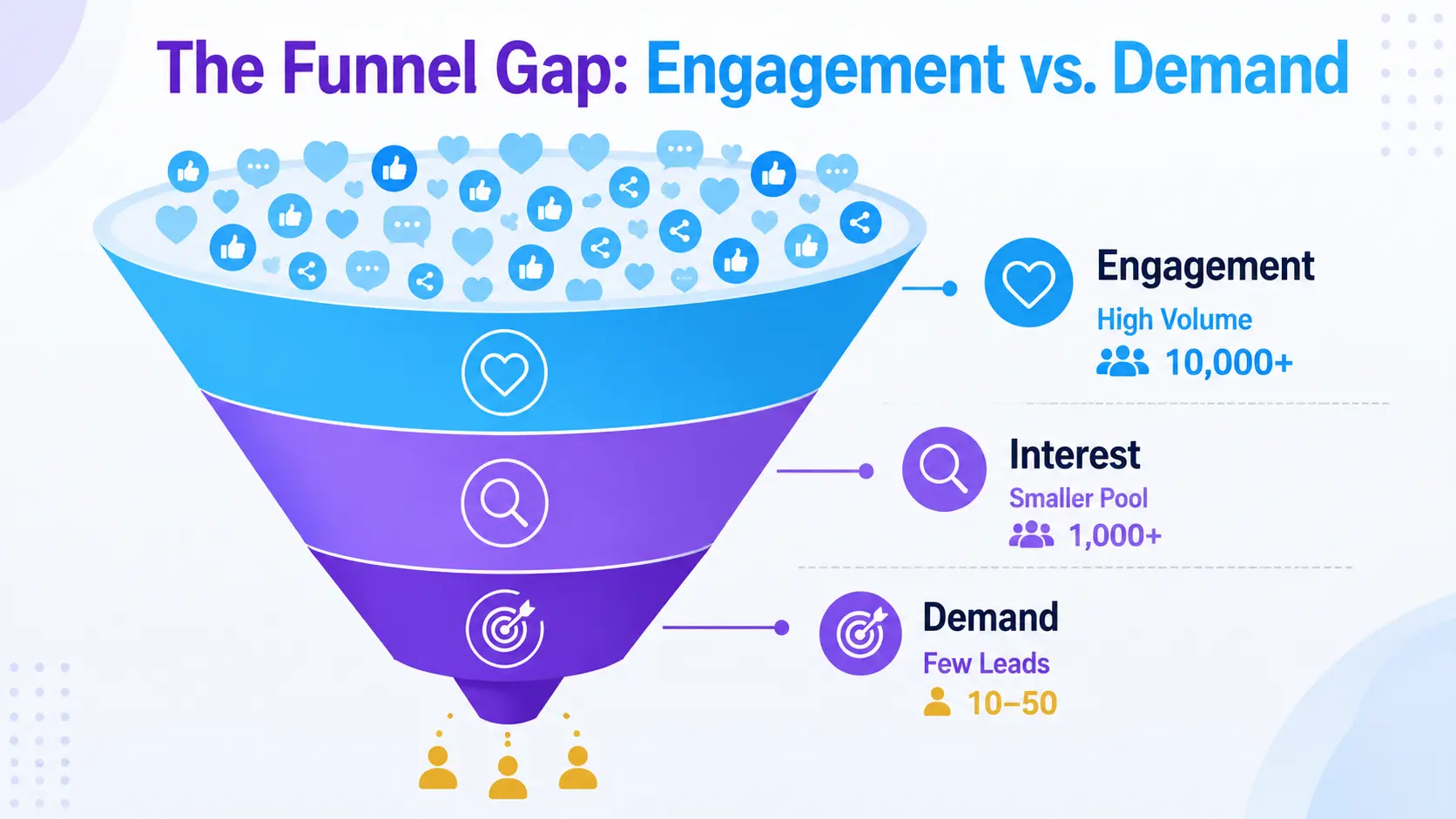
Early signals include views, likes, repeat exposure, and silent consumption, which may show awareness but not buying intent.
Mature intent appears when the audience connects the content to a real problem through detailed questions, direct messages, repeat visits, content downloads, sales conversations, or requests for help.
Social intent maturity helps teams separate surface engagement from demand by tracking whether trust, memory, and readiness are increasing over time instead of assuming that visible reactions will become leads.
Key Takeaways
- Social media engagement metrics like likes and shares rarely indicate real buyer intent or pipeline progress.
- Trust and demand accumulate beneath the surface, as silent influence is more predictive than visible reactions.
- Novelty-driven posts may spark engagement but fail to convert; strategic content should nurture authority and memory among buyers.
- Effective measurement requires focusing on intent signals and long-cycle attribution, not just immediate visible interactions.
Everyone wants to see social numbers rise – likes, comments, shares.
But high engagement rarely tracks with high sales.
Last quarter, one client’s post went viral and not a single lead moved forward.
Digital applause signals visibility, not real demand.

What Does “Engagement Doesn’t Equal Demand” Really Mean
It’s tempting to read every like as a sign your message is landing.
The myth?
More hearts, more business.
Yet on the client side, we’ve lost count of viral posts that never moved the pipeline.
A like is simple recognition, not a buyer’s handshake.
Think of it this way: catching a glance at a billboard and slowing down to stare are two different things.
Social engagement is the glance.
Demand starts building only when someone stops and recognizes their own need inside your message.
But engagement metrics trick marketers into chasing attention instead of buyer readiness.
A one-click reaction doesn’t require the audience to care about their problem – or even realize they have one.
That’s the leak: lots of on-platform buzz, but no growth in the CRM.
Why a like isn’t a sign of buying intent
So what’s actually signaled?
Awareness – sometimes interest – rarely intent.
The signal is weak until matched with clear evidence of progression: questions, requests, or an action that moves prospects down the funnel.
Engagement metrics skip that nuance.
Reasons Likes Don’t Indicate Buying Intent
- Likes signal visibility, not buyer’s readiness or intent.
- Engagement is a surface-level reaction needing no problem recognition.
- High social applause rarely converts directly to pipeline growth.
- Many viral posts yield attention but fail to generate leads.
- True demand requires deeper actions like questions or requests.
The broader dynamic of social media as a trust-building, not just transactional, system is mapped in Social Media Marketing.
How silent influence builds trust before visible interaction
Not every lead leaves a public footprint.
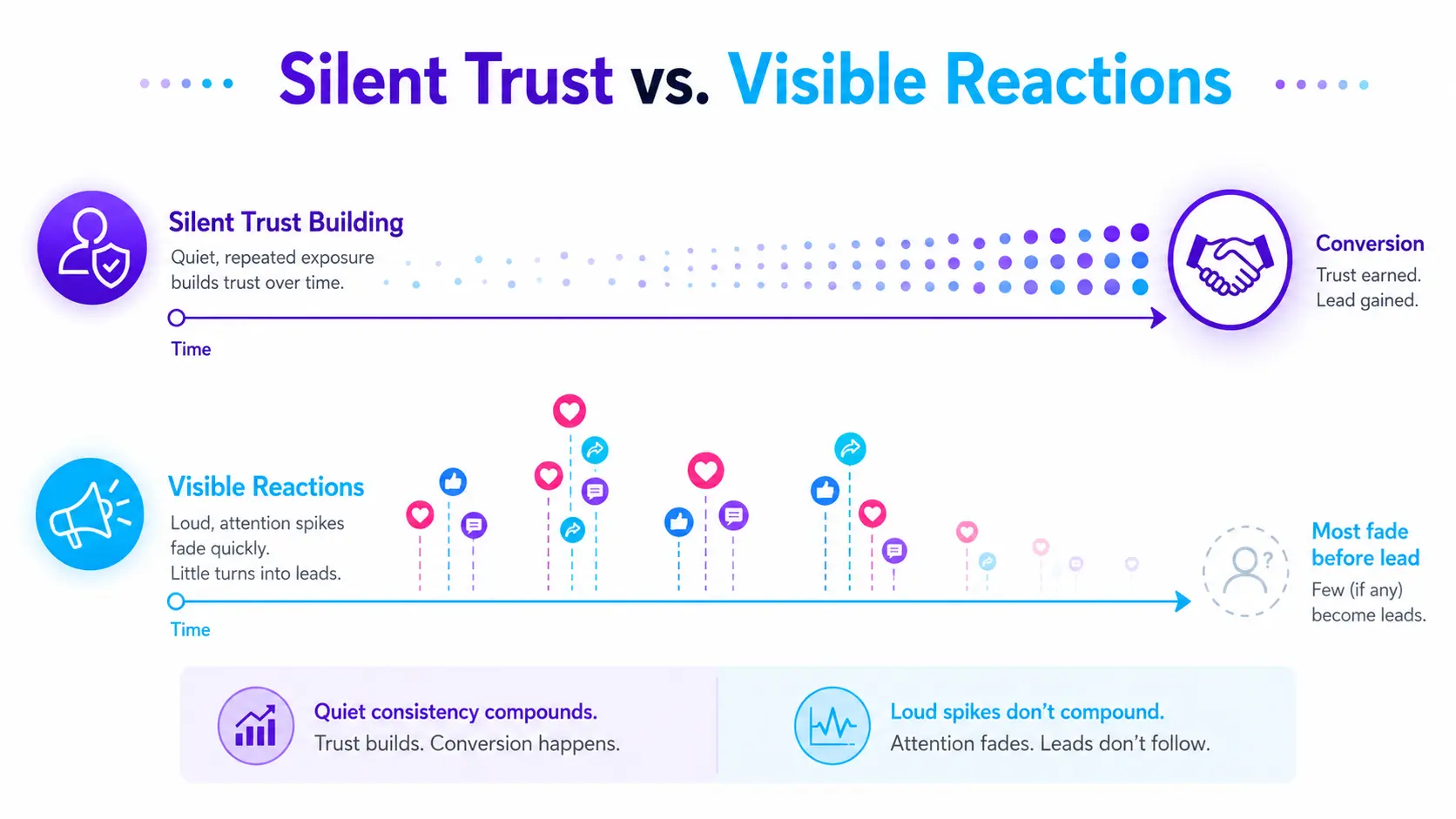
In fact, the biggest commercial gains often come from people watching quietly – consuming weeks of content without clicking, then converting fast and in full when it matters.
We see it often: major buyers show up out of nowhere, ready to talk business, referencing posts they never reacted to.
Their trust builds in silence.
The value isn’t in vanity signals but in building mental availability – the subtle effect where repeated exposure stacks up influence far in advance of action.
Here’s the analogy: social presence works less like a storefront window, more like planting seeds.
There’s a lag between first exposure and real demand – what looks like empty ground can be prime territory beneath the surface.
But a focus on surface metrics blinds teams to the invisible majority.
Influence compounds beneath the feed, out of sight and out of reach of engagement dashboards.
Therefore, the smarter play is building consistency and authority – even when engagement is silent – so trust is there when the audience finally moves.
The gap between what’s measured and what matters is widest right here.
Once you see it, the old obsession with quick reactions falls away.
The more interesting question: What shifts when you model for trust before chasing intent?

What Makes Engagement Misleading as a Success Measure
It looks like a surge of likes should mean your strategy is working.
But those spikes rarely signal what decision-makers need most.
The real risk: engagement numbers can become a distraction, pulling teams away from the substance that actually moves demand.
When reactions reward novelty over relevance
A headline that disrupts, a meme that stirs a stir, a bold graphic – these rack up likes faster than any expert analysis ever will.
But novelty is cheap fuel.
Authority is slow-burn.
Teams often chase posts that “go viral” for the dopamine rush of public attention.
But we’ve seen firsthand with clients: the content that triggers instant engagement tends to flatten out before it ever builds buyer trust.
A quick win in clicks creates the illusion of progress, until a quarter later, pipeline growth is nowhere to be found.
That’s the heartbreak most marketers face: the posts that blow up rarely stick with the people who actually buy.
Sensational hooks draw a crowd, but authority-building content is what keeps strategic buyers in your orbit.
Authority isn’t measured by applause, it’s measured by memory.
How many engagement metrics tell you who will remember your solution in a month?
None.
That’s the blind spot analytics dashboards still don’t solve.
When audiences engage but don’t progress
Not all engagement comes from your buyers – or even from people with any buying intent at all.
Posts get shared, pushed out by the algorithm, and suddenly you’re pulling in reactions from employees, competitors, bots, and people outside your market.
It feels like momentum.
But momentum with the wrong crowd is a dead end.
This is the trap: vanity metrics swell, but pipeline sits still.
We’ve worked with brands whose social reach doubled, yet top-funnel leads fell flat.
Why?
Their audience was clapping, not converting; participating, not progressing.
Sometimes, intent maturity (how ready someone is to buy) just isn’t there yet.
So what does move the needle?
It’s the handful of signals that show audiences are shifting from curiosity to active evaluation – not more likes, but more questions that dig into outcomes and readiness.
The difference between buzz and progress is subtle, but the costs aren’t: confusing attention with intent leads to wasted hope and slow quarters.
The audience’s energy may be real, but the substance underneath is missing.
Types of Engagement and Impact on Demand
| Measurement Model | Focus Area | Strength | Limitation |
| Vanity Metrics | Likes, Comments, Shares | Easy to track, shows awareness | Does not reflect buyer intent or pipeline impact |
| Last-Touch Attribution | Last interaction before sale | Simple link to conversion | Misses early exposure and trust-building phase |
| Multi-Touch / Mental Availability | Tracking repeated exposures and brand recall | Captures brand influence over time | Requires advanced analytics and longer-term data |
| Content-Influenced Sales Conversations | Tracking sales queries linked to content interactions | Directly ties engagement to pipeline movement | May lag behind initial engagement spikes |
Engagement metrics show you who is awake.
They don’t tell you who will act.
Which leads directly to the real work: mapping intent maturity – not noise – so teams know when demand is quietly building beneath the surface.

How Social Intent Maturity Shapes Readiness and Timing
There’s a difference between catching someone’s eye and making them care.
But most social strategies chase immediate response like all attention is equal.
The sharper reality: readiness – real buying potential – has its own timing, and social intent matures slowly even when content looks like it’s landing.
Early vs decision-stage attention in social channels
Many brands treat social as a pipeline where buyers flow straight from swipe to sales call.
Yet, most interactions happen far upstream.
People skimming LinkedIn or scrolling Instagram might pause, react, or even comment – while their actual interest sits months from any purchase.
But here’s the myth: that early attention means active intent.
In practice, social channels work more like a billboard outside a city – seen by everyone, acted on by few.
When we’ve tracked campaign outcomes for B2B clients, the silent majority consuming posts will outsize the vocal minority by 10x, but only a sliver move forward that week.
The attention is real.
The intent is latent.
Therefore, marketing that tries to push buyers too soon often produces friction, not momentum.
What signals should leaders look for instead of surface-level clicks or likes?
Look for signals of “mental availability”: repeated exposures, increasing dwell time, or subtle trend mentions even in casual conversations.
These are faint, but they map to early-stage recall – the kind that quietly accumulates until a problem triggers action.
When we shifted analytics for a SaaS client from engagement rates to content-influenced sales conversations, we found peaks often lagged discovery by weeks.
The glitz of immediate replies hid the real pipeline movement.
That’s where the true strategic gap lives.
Social doesn’t fail just because people aren’t conversion-ready – timing is the real filter.
Why delayed demand is normal – not failure
If demand doesn’t show up fast after a campaign, leaders often feel something’s broken.
But buying cycles rarely match post frequency.
The delay is built in: trust and need have to sync up before action takes root.
Most audiences aren’t ready to solve a problem the first time they see your message.
Instead, belief and familiarity build through repeated exposures – a mental snowball slowly gaining weight.
This is why “attention before intent” is the rule, not the flaw, on social.
Imagine watching water boil: most of the energy goes invisibly into warming up – then, when the shift comes, it happens fast.
Social demand follows the same pattern: quiet accumulation before a visible jump.
Therefore, a pause between spikes in engagement and tangible sales is not a warning sign, but a natural part of how influence before interaction works.
The brands that win are those that stay present during the silent phase, building trust and recognition so that when intent matures, they are top of mind.
Most teams break strategy in the wait.
But the companies that understand where intent truly lives – under the numbers – spot buying signals that don’t show up on a dashboard.
The real test is what happens after the engagement fades: does memory persist, and does interest turn into a next step?
So if demand is slow to surface, the sharper question becomes: how do you tell whether your content is quietly working – or quietly being forgotten?

What Could Be Going Wrong in Your Social Strategy
You can push out a thousand posts and fill your feed with movement.
But activity rarely translates into commercial growth on its own.
The sharper reality: most brands misread their own signals and end up mistaking noise for real progress.
The dashboard might show rising engagement.
Yet pipeline stays flat.
When visibility compounds into nothing
Most teams believe more eyes equal more opportunity, so they focus on volume – reach, impressions, followers.
But mass visibility without positioning is like shining a flashlight in daylight: the attention scatters and fades before anyone remembers the source.
Here’s what actually happens.
The market registers your presence, but without a clear message or defined position, your brand becomes more wallpaper than landmark.
We’ve seen clients rack up millions of impressions across platforms, only to discover in interviews that not one qualified buyer could explain what the company actually does.
That tension is easy to miss.
It’s tempting to connect the dots between output and impact.
But in real campaigns, disconnected content recycles attention but fails to anchor memory.
Think of an ad campaign built around clever visuals but lacking a clear offer or point of view.
It may spark a wave of likes – but six months later, not one tieback to pipeline.
Common Pitfalls of Focusing on Visibility Alone
- More eyes don’t guarantee remembered or qualified brand impact.
- High impressions can turn a brand into background noise without clear messaging.
- Disconnected content fails to anchor buyer memory or interest.
- Momentum driven by visibility alone leads to zero pipeline growth.
- Without distinct positioning, competitors may gain the advantage.
If you can’t articulate your distinct promise each time someone sees your brand, you’re subsidizing your competitors’ differentiated stories.
That’s the hidden risk: momentum without memory.
Are you trading mental availability for meaningless activity?
When engagement happens among the wrong audience
The easiest mistake for a growing brand is reading applause from fans as interest from buyers.
The line blurs quickly: someone in an adjacent industry shares a post, comments stack up – but none of them match your ICP, and few will ever take a sales call.
We’ve watched B2B marketing teams celebrate strong engagement, only to realize the majority came from peers, job-seekers, or partners, not potential customers.
It’s seductive to chase what’s popular within your extended network.
But this cycle rewards content optimized for noise, not for revenue movement.
It helps to picture a crowded conference – your booth may attract plenty of passersby, but if they’re not in-market, your follow-up list is just longer, not better.
This is the trap in using engagement as a proxy for progress.
Not all interest has the same commercial value.
Ask yourself: when did your engagement last trigger a qualified conversation?
Therefore, the issue isn’t just how many engage – it’s who is moved to take a step closer to buying.
If reactions skew toward the wrong segment, your demand signal is dimmed at the source.
The result?
You can spend months optimizing posts for reach or applause, yet watch pipeline stall.
The fix isn’t more content or louder messaging – it’s rerouting strategy around buyer signals, not crowd noise.
Until you can decode who actually matters in your engagement metrics, every strategy tweak risks amplifying the wrong signal.
The next challenge: how do you rebuild your social approach so that even low-key reactions drive real commercial momentum?
Before social can convert, it often must make the company safer to trust and the audience more ready to move.
That logic continues in Social Trust and Readiness Signals.

What Leaders Should Consider Next
Growth stalls when you chase the wrong signals.
But the real trap isn’t just about misreading likes or follows.
The bigger risk is letting engagement distract from the moves that actually create commercial demand.
Most leadership teams stare at rising social numbers, expecting a magic threshold where activity finally converts to pipeline.
Yet, that inflection point rarely appears – no matter how long you watch.
What changes the outcome isn’t waiting; it’s better decision framing.
So where should attention shift when social metrics stop answering the right questions?
When to explore measurement and attribution models
It’s easy to assume you understand which activities drive results – until the pipeline goes cold.
But correlation between engagement and revenue is usually weaker than it looks in analytics dashboards.
The source of the problem often hides in the discrepancy between attention before intent (lots of impressions, little buyer movement) and true demand signal.
The common myth says: if you can see reactions, you can map them to value.
In reality, even your most viral posts may generate zero sales impact if the audience isn’t commercially primed or tracked across the funnel.
A like is not a breadcrumb you can follow to ROI.
Think of engagement metrics like a city’s noise level – loud doesn’t mean anyone is heading to your store.
What does move the needle?
Attribution models that account for mental availability (how often your brand comes to mind in buying moments) instead of just visible interaction.
When you start mapping how demand matures over multiple cycles – sometimes months of quiet warming before any click – new patterns emerge.
The silent buyer is often more valuable than the loudest fan.
So when do leaders need to invest in better measurement?
The cue is not just flatlining engagement, but lagging conversion against steady social buzz.
If “awareness” and “pipeline” are diverging month after month, it’s time to recalibrate your models.
This means pushing beyond last-touch and vanity metrics, building in diagnostics that trace influence before interaction even surfaces.
Measurement Approaches for Social Engagement Impact
| Engagement Source | Description | Effect on Pipeline | Buyer Intent Level |
| Potential Buyers | Target audience with buying intent engaging with content | Leads move forward in pipeline | High |
| Employees/Partners | Internal or related audiences reacting or sharing content | No direct impact on pipeline | Low |
| Competitors/Bots | Non-buying entities engaging | Artificial inflation of metrics, no pipeline growth | None |
| General Public/Curious Users | Broad audience engaging without buying intent | No progression to sales | Minimal/None |
The gap between what you track and what matters will get wider as platforms change their data windows and buyer paths stretch out.
The fix is to measure the unseen – memory, preference, and decision readiness – not just direct response.
That’s when your measurement actually matches commercial reality.
When readiness framing indicates a need for trust-building content models
There’s a strong urge to double down on tactics when results stall.
But more content, more posts, or bigger paid bursts rarely fix the underlying issue if the audience isn’t ready to buy.
Trust earns demand; repetition earns recall.
Most strategies skip straight to action, missing the stage where belief forms long before deals close.
How do you know it’s time to shift?
Watch for these signals: repeated engagement from familiar handles with no movement down the funnel, long decision cycles, or a mismatch in story resonance versus sales traction.
The more often you see silent spectators lurking but not signing, the clearer the message – your content is winning attention, but not yet trust.
It’s like warming up an audience in a cold room; until belief in your authority and relevance spreads, action won’t happen – even if everyone claps along.
Real trust-building content addresses invisible objections, creates shared mental shortcuts, and stays memorable when decisions actually happen.
This is the move from “activity” to “strategic positioning”.
The tactical comfort zone is tempting; the strategic path feels slow.
But only the latter compounds into profit.
Therefore, when engagement keeps rising but sales remain flat, your next step is not to post more but to rethink whose belief you’re shaping and how long demand is actually maturing below the surface.
Converting attention to profit demands a new calibration of what “impact” means in social.
That change starts once leaders stop chasing instant wins and begin asking: which signals tell me trust is deepening, not just that noise is spreading?
Once that shift happens, the next question is sharper: which positioning models actually accelerate readiness across intent stages – so demand stops just echoing and finally arrives?

Scientific context and sources
The sources below provide foundational context for how decision-making, attention, and performance dynamics evolve under scaling and constraint conditions.
- Audience engagement dynamics
Social Media Engagement: A Model of Antecedents and Relational Outcomes – Laurence Dessart – Journal of Marketing Management
This source explains social media engagement as a multi-dimensional construct with affective, cognitive, and behavioral layers. It is relevant because the article argues that visible reactions like likes and comments are not enough to prove commercial demand.
https://www.tandfonline.com/doi/abs/10.1080/0267257X.2017.1302975 - Trust and influence formation
What Do We Mean When We Talk about Trust in Social Media? A Systematic Review – Yixuan Zhang, Joseph D. Gaggiano, Nutchanon Yongsatianchot, Nurul M. Suhaimi, Miso Kim, Yifan Sun, Jacqueline Griffin, Andrea G. Parker – CHI Conference on Human Factors in Computing Systems
This source reviews how trust in social media is defined, measured, and formed. It fits the article’s point that trust often develops before visible buying behavior appears.
https://dl.acm.org/doi/10.1145/3544548.3581019 - Marketing effectiveness metrics
Measuring Marketing: 110+ Key Metrics Every Marketer Needs – John A. Davis – WileyDavis explains how marketers should evaluate performance across different metric types. This fits the article’s argument that surface metrics, such as engagement, can mislead decision-makers when they are not tied to business outcomes.
https://onlinelibrary.wiley.com/doi/book/10.1002/9781119199205 - Sales funnel attribution models
Attributing Conversions in a Multichannel Online Marketing Environment: An Empirical Model and a Field Experiment – Hongshuang (Alice) Li, P.K. Kannan – Journal of Marketing Research
This source explains how to attribute conversions across multiple digital touchpoints. It is directly relevant to the article’s claim that early social interactions often do not predict demand unless they are mapped through a proper attribution model.
https://journals.sagepub.com/doi/abs/10.1509/jmr.13.0050
Questions You Might Ponder
What is the difference between social media engagement and demand?
Social media engagement reflects visible actions like likes, comments, or shares, but demand relates to underlying buyer intent and action. High engagement may indicate awareness, while genuine demand requires indicators such as direct inquiries or sales conversions.
Why don’t high engagement metrics always lead to more sales?
High engagement metrics often track attention or interest, not readiness to buy. Audiences may like or comment without intending to purchase, resulting in impressive engagement numbers but little to no movement in actual sales pipeline.
How can brands measure true buyer intent on social media?
Brands should look for deeper signals like direct questions, content downloads, or requests for information – actions that show active evaluation. Shifting focus from vanity metrics to intent indicators helps align social strategy with commercial goals.
Why is trust more important than quick engagement in building demand?
Trust accumulates quietly through repeated exposure and consistent messaging, creating mental availability for buyers. Quick engagement may drive short-term attention but does not guarantee long-term loyalty or readiness to buy when the need arises.
How can marketers avoid being misled by social media engagement metrics?
Marketers can avoid misinterpretation by tracking intent-based actions and attributing results over longer buying cycles. They should integrate measurement models that map influence and memory, not just click or like counts, to ensure alignment with revenue outcomes.