
What You’ll Learn
Social media trust before conversion is the process of building buyer confidence through repeated exposure, credible proof, and peer validation before asking for a sale, demo, or direct action.
Social engagement can show attention, but trust forms more slowly as buyers see consistent ideas, relevant expertise, customer evidence, and respected people validating the brand.
Conversion becomes more likely only after the audience recognizes its problem, sees the brand as credible, and feels safe enough to engage.
Pushing CTAs too early can weaken trust, lower lead quality, and make buyers feel sold to before they are ready.
Strong social strategy treats trust as the bridge between attention and demand.
Key Takeaways
- Social media engagement (likes, comments) signals attention but does not predict buying intent or sales pipeline development.
- True commercial demand emerges from problem recognition and credible social proof, not from viral posts or vanity metrics.
- Trust accumulation on social channels is slow and compounding, often invisible until it results in qualified buyer outreach or conversions.
- Premature selling or CTAs undermine trust, reducing lead quality and making long-term pipeline growth harder to sustain.
A LinkedIn post might rack up hundreds of reactions overnight.
But a wave of likes doesn’t mean buying intent is building under the surface.
The sharper truth: engagement signals rarely reveal if an audience actually recognizes its own problem, let alone plans to solve it.

Why engagement often fails to create demand
Most teams chase social media engagement thinking every comment signals warming interest.
But in the real world, most likes measure awareness or momentary agreement – not commercial urgency.
Social media is full of people tapping “like” on insights that feel good, not on solutions they intend to buy.
We see this mistake everywhere: sales teams celebrate viral posts, only to find their pipeline stuck at “nice to have” conversations.
The engagement feels promising at first.
But it’s the digital version of applause – everyone claps, but almost no one asks about price.
That broader failure mode is mapped in Social Media Marketing.
How likes and comments fall short of buying readiness
Think of social engagement like applause at a conference – not every clap leads to a closed deal.
The crowd may love the topic, but walk out unchanged.
So where does real buyer energy start?
Not in the engagement tab, but in the hidden funnel where an internal pain point turns into a need.
Reasons Why Social Media Engagement Does Not Indicate Buying Readiness
- Likes measure awareness or momentary agreement, not commercial urgency
- Engagement signals resemble applause without price inquiry
- Comments mostly reflect curiosity, not decision-stage interest
- Social signals are cheap currency without genuine triggers for action
- High engagement often results in ‘nice to have’ rather than ‘need to have’ conversations
Buying readiness shows up as questions about implementation, pricing, use cases, or direct outreach – not as another volley of high-fives under a witty one-liner.
The rude awakening: social engagement is cheap currency unless it’s paired with a genuine trigger for action.
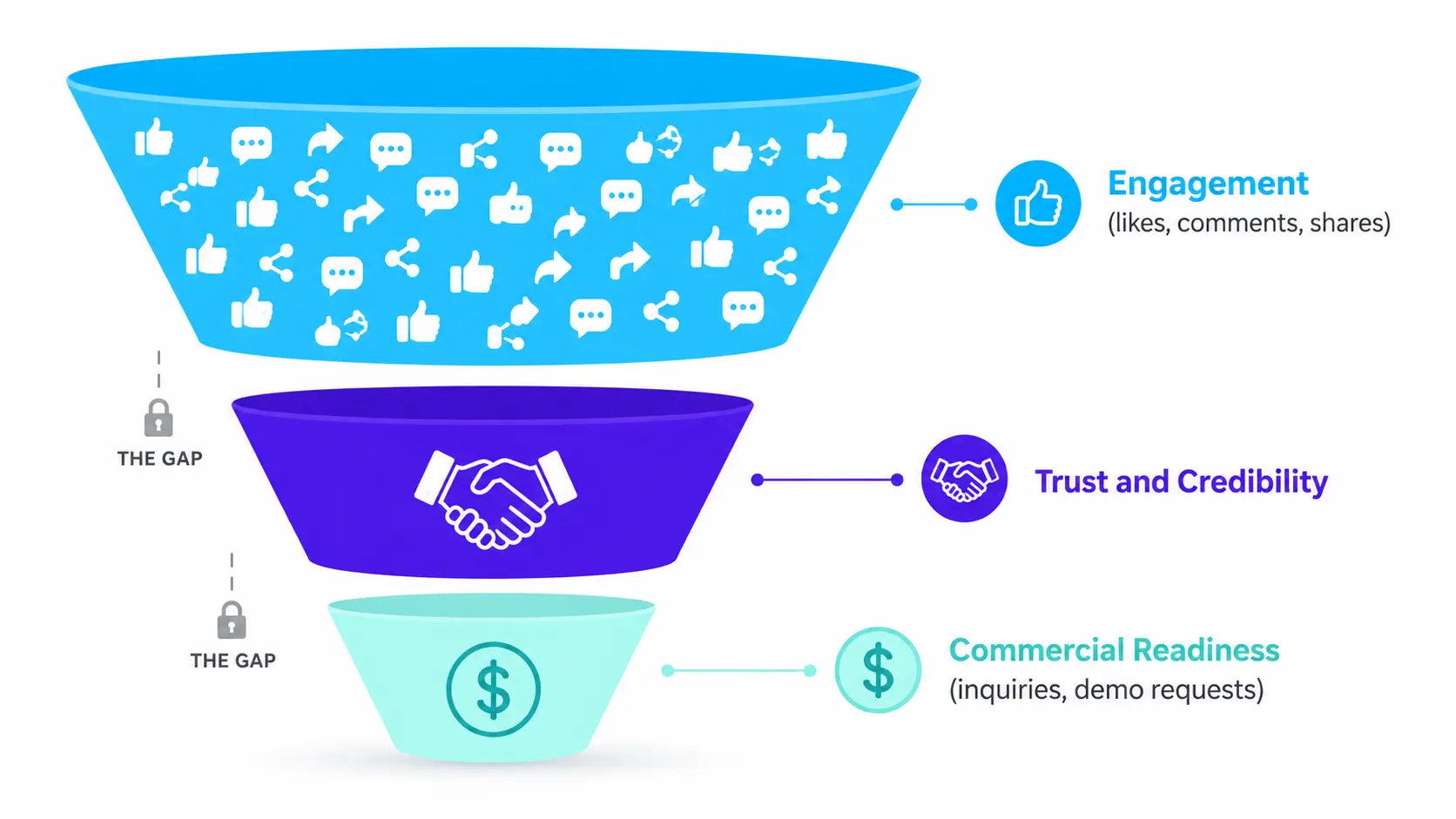
When early attention masks a lack of demand maturity
A viral post can trick even experienced marketers.
Peaks in impressions and shares seem like market validation.
Yet, more often than not, they hide the market’s true status: awareness is up, but intent lags far behind.
This gap often blindsides executives.
Campaigns run hot for weeks, dashboards light up green, but deeper pipeline analysis reveals stalled demand.
The market may notice, but it isn’t yet ready to move.
That’s the hidden cost: attention without problem ownership leads to a forecast built on sand.
We’ve worked with B2B brands who saw engagement spike after a high-profile share.
But their sales teams heard the same objections: “Interesting, but not a priority”.
The real indicator wasn’t the likes; it was the slow drip of qualified inquiries weeks later, once the message finally landed with buyers who had active need.
What creates this optimism trap?
Early engagement speaks to curiosity and surface resonance, not decision-stage urgency.
It’s a mirage that tempts teams to ramp budget or push CTAs prematurely – but the demand signal isn’t real yet.
That’s the commercial risk: chasing the energy of early attention often means missing the quiet, slower signals of readiness.
Moving from engagement to demand requires watching not just the reactions, but the shift in buyer conversations – are people just talking, or are they actually moving?
The first signal is not the conversion.
It’s the point when the chatter shifts from “good idea” to “show me how”.
Once that gap is clear, the next strategic challenge emerges: how to turn trust, not just attention, into real demand.

How social media builds trust before conversion
Picture a founder watching a steady stream of likes but never a booking.
The missing link isn’t more reach – it’s how trust slowly compounds beneath the surface, often long before a prospect realizes they’re ready to buy.
Trust as a slow asset, not a quick traffic boost
It’s easy to treat social channels like digital billboards, measuring success by clicks and spikes in web traffic.
But traffic chases are shallow – brands see numbers rise and still miss quota.
The myth is that social media’s main value is instant lead flow.
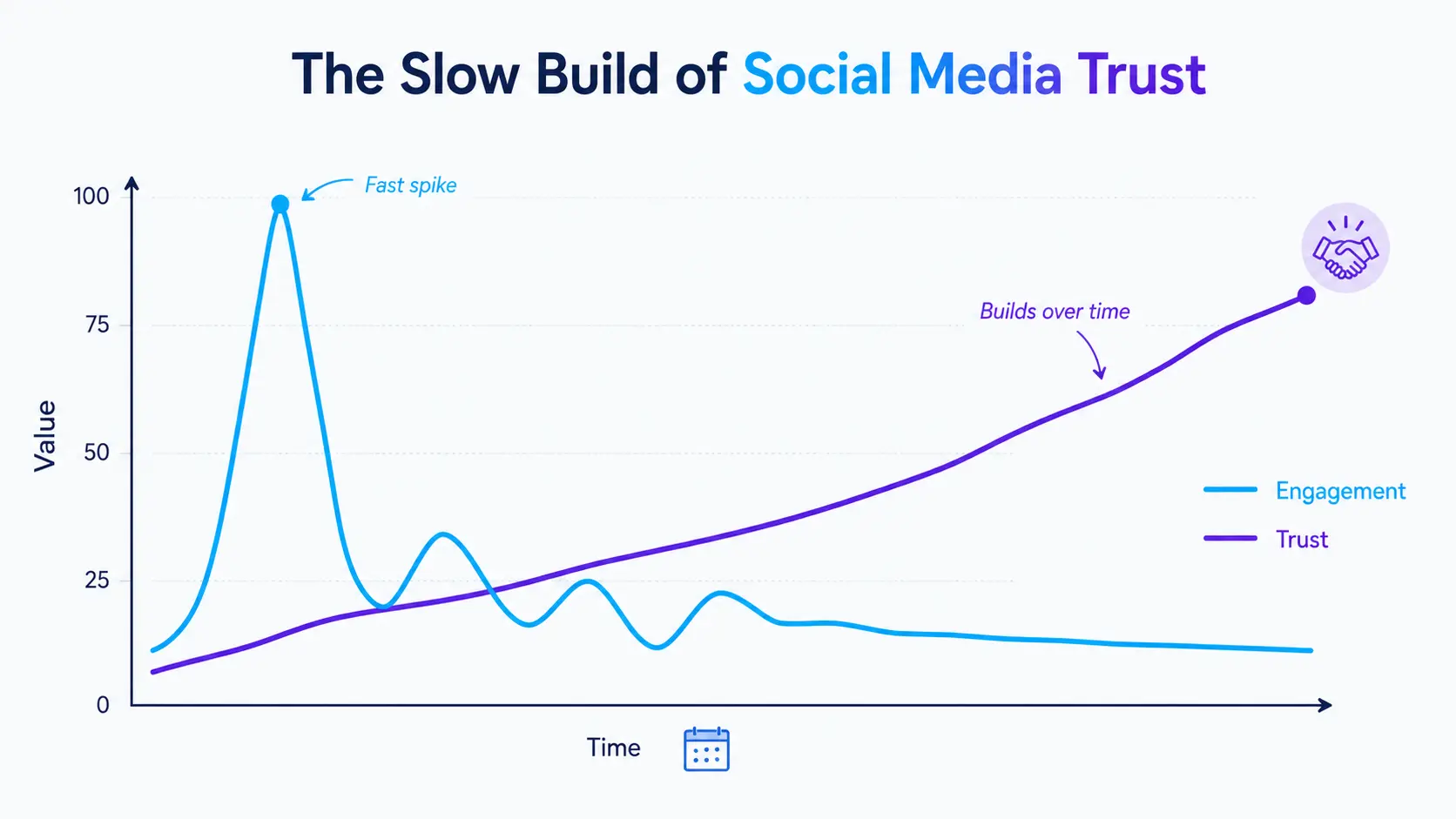
Here’s the real mechanism: trust builds by repetition, not reach.
Teams that prize followers or viral engagement often miss the fact that steady, predictable exposure is working on a different clock.
Consider how many times you have to see a name in your feed before you’re willing to believe a claim, let alone click to learn more.
For most buyers, it’s not a single post – it’s the slow drip of credibility over weeks or even months.
It’s the difference between pouring water on hard ground and waiting for it to seep in.
Fast metrics dry up; trust sinks deep and lasts.
That’s why some campaigns look flat until – suddenly – later conversions show up linked to earlier, forgotten exposures.
The mistake we see too often with clients: pushing to accelerate demand ignores how trust quietly compounds.
Quick bursts deliver attention but rarely shift perception.
The channel is not a pipeline; it’s more like soil where trust must take root before anything grows.
This trust channel narrative reflects what some call the ‘hidden funnel social media’ process: progress happens before intent is visible.
What survives is not the flash of a viral post, but the slow consensus that forms below the surface.
Therefore, measuring only early clicks or follower jumps will miss the business transformation happening out of sight.
The invisible trust funnel: from awareness to readiness
Most reporting on social performance focuses on the top of funnel – reach, reactions, visits.
But the pipeline executives care about moves in steps most dashboards never capture: from vague awareness to actual readiness to buy.
Think about the silent phase after a prospect follows your page but before direct outreach or signup.
In that period, every feed appearance, mention, and peer endorsement acts as a trust deposit, long before they visit a landing page.
The funnel is invisible – but real – shifting someone from “I know this brand exists” to “I trust them enough to engage”.
We’ve seen this in practice: a senior buyer goes inactive after a comment exchange, only to return weeks later referencing a steady stream of posts.
The decision wasn’t sparked by the first exposure, but by the sum total – a feeling that the brand is legitimate, safe, and relevant.
What’s happening here?
The prospect crosses multiple silent thresholds: initial contact, growing credibility, internal risk check.
Each stage is powered less by offers and more by consistent social proof.
This is where the “hidden funnel social media” conversation gets real: trust-building social exposure turns cold connections into warm permission, moving them closer to commercial intent without a hard sell.
The ultimate shift is this: trust on social media is a lagging indicator that predicts future conversion, not just present attention.
Therefore, the smart move is to invest in trust earlier – then, watch as conversions begin to echo back from months of credibility, not fleeting surges of noise.
The problem isn’t that trust is invisible.
The danger is trying to shortcut what only compounding exposure can achieve – leaving one question: which trust signals are strong enough to predict real conversion, and which are just social wallpaper?

Which trust signals actually influence later conversion
You might scan a crowded comment thread and assume momentum equals buying.
But strong social proof before conversion – visible trust signals, not just attention – carries the real influence.
Social proof thresholds that trigger credibility
It’s easy to think that any bump in followers or reactions should drive results.
But almost every client we’ve advised in growth-stage SaaS has watched viral content produce zero pipeline.
The myth: credibility grows in a straight line as the numbers rise.
The sharp reality is that social proof acts more like a switch than a dial.
For most buyers, trust becomes actionable only past certain visible thresholds – think 1,000+ meaningful followers, regular engagement from recognized accounts, or a short but impactful burst of positive comments from relevant players.
Below these markers, busy decision-makers write the page off as “not for people like me”.
That’s why faint signals – sporadic likes from low-reputation profiles or a comment thread full of colleagues – rarely move the needle.
The difference is visible in the quality and network of those participating.
So what turns a social channel from invisible to credible?
It’s rarely the raw count.
It’s whether enough influential or peer voices back the message in public.
Social Proof Thresholds Influencing Buyer Credibility
| Threshold | Description | Impact on Credibility |
| 1,000+ meaningful followers | Minimum follower count considered credible by buyers | Triggers actionable trust |
| Regular engagement from recognized accounts | Consistent interactions from influential or relevant profiles | Enhances peer validation and trust |
| Short burst of positive comments from relevant players | Concentrated positive feedback from key industry voices | Acts as a switch to increase credibility |
| Sporadic likes from low-reputation profiles | Infrequent interactions from general or non-expert users | Minimal impact, often ignored |
| Comment threads full of colleagues | Engagement mainly by internal or non-peer users | Low influence on external buyer trust |
The analogy is simple: showing up at a networking event is one thing, but getting introduced by someone respected in the room changes how others listen.
Therefore, the best signal is not universal approval, but visible trust from the right group.
The fix is to focus less on the vanity of broad engagement and more on the composition of your visible supporters.
One grounded rule: a small group of credible advocates out-powers a large pool of generic followers – every time.
Peer validation vs brand claims in pre-purchase decisions
Brand-led success stories land flat if buyers treat them as just another pitch.
The myth here: articulate messaging and beautiful graphics win trust.
But when buyers approach a high-ticket or risk-sensitive offer, what actually matters is seeing real people – ideally, similar to themselves – vouch for outcomes.
This is where peer validation outguns even the sharpest brand copy.
User-generated content, third-party recommendations, detailed testimonials, or even screenshots of customer results act as shortcuts for commercial confidence.
The hidden funnel starts here: as soon as buyers see someone like them report a credible result, cognitive friction drops.
Suddenly, it feels safe to move from interest to intent.
That is the moment the market stops hesitating.
Why does this gap go unnoticed by so many marketing teams?
Social proof is easy to fake, but hard to manufacture at scale.
Buyers are trained to tune out polished claims but still pause when a peer weighs in.
The diagnostic test: if your evidence would look trustworthy coming from a competitor – or as a quoted client comment without your logo attached – it’s strong.
Therefore, the conversion path accelerates only when the balance of proof shifts away from the brand’s voice and toward the market’s own words.
The risk is clinging too tightly to brand-led content, missing that the next sale may rest not on what you say, but on who is willing to say it for you.
The issue is not whether trust signals are visible – it’s whether they are credible enough to convert skepticism into action.
Once that lens is locked, the tougher problem emerges: how do you source, surface, and amplify the signals that matter before your next campaign goes live?

When pushing for demand too early undermines trust
Many teams push hard for conversions the moment a post goes live.
But treating every share, comment, or click as an excuse to shove an offer creates a friction point that’s not obvious at first.
The sharper risk is that early selling feels less like confidence and more like desperation.
The risk of premature selling pressure
The temptation makes sense: a bump in engagement looks like a signal to strike.
Yet most executive buyers aren’t looking for a vendor that hustles the loudest – they’re quietly judging which brands seem confident enough to let trust mature.
Push a CTA too soon, and the signal flips: what seemed like warm market interest begins to erode, replaced by hesitation.
This isn’t theory.
We’ve watched brands move from dozens of inbound leads per week to radio silence after cranking up the urgency in messaging.
Instead of nudging prospects toward readiness, they inadvertently trained the audience to expect a hard sell – before trust could settle in.
One insurance client swapped value content for gated demos after a viral LinkedIn post.
The visible engagement doubled, but lead quality cratered.
The pattern is simple: buyers feel ambushed, not persuaded.
So when does a call-to-action switch from building momentum to breaking it?
That’s the hidden trap – there’s no visible dashboard metric for trust erosion.
It seeps in as a slow drop in positive replies, increasing skepticism, and the market becoming harder to warm up later.
The quietest damage happens early, long before pipeline reports reveal the leak.
Risks of Premature Selling Pressure in Social Media Marketing
- Early CTAs create friction and appear desperate rather than confident
- Pushy messaging leads to audience hesitation and trust erosion
- Visible engagement doubles but lead quality may drop sharply
- Increased skepticism leads to a harder-to-warm audience later
- No direct dashboard metric shows trust erosion – damage is gradual
- The market rewards patience and understanding over immediate sales pressure
The market often trusts patience more than the perfect pitch.
The commercial payoff starts when the audience feels understood – not pursued.
That timing calculus is explored in depth in Why Social Media Engagement Often Fails to Create Demand.
What’s missing when visibility doesn’t compound
Repeated exposure is supposed to build momentum, not fatigue.
But when brands scramble to connect every impression to an immediate outcome, the momentum collapses.
The mistake?
Mistaking visibility for resonance and platform activity for real trust-building.
Teams often ask, “Why aren’t our numbers compounding after successful posts?” The reality hides in three blind spots: platform misalignment, message mismatch, and mismeasurement.
First, not every platform supports early-stage trust.
A B2B SaaS brand pushing trials on Instagram may gain views, but the channel context rewards casual interaction, not decision-stage action.
Next, a consistent message is wasted if it’s targeted at the wrong readiness tier – speaking conversion when the audience is barely problem-aware is like pouring water into a bucket full of holes.
Third, mismeasurement leads teams to double down on what looks visible, not what delivers compounding value.
A spike in engagement tricks the dashboard into optimism, but if next-quarter meetings or testimonials aren’t growing, something fundamental isn’t working.
It’s like turning up the volume on a speaker that’s playing to an empty room: loud, but pointless.
So what shifts when teams get this right?
Instead of chasing quick wins, they design for repeated exposure without overplaying the CTA.
Social media becomes a sequence – not a one-off event – where trust compounds invisibly until the moment the market is finally ready to buy.
The gap is rarely about reach – it’s about timing and patience.
Once that’s clear, the real challenge emerges: how do you measure trust-building and readiness before the market raises its hand?

Scientific context and sources
The sources below provide foundational context for how decision-making, attention, and performance dynamics evolve under scaling and constraint conditions.
- Social Signal Interpretation in Digital Environments
A 61-million-person experiment in social influence and political mobilization – Bond, R.M., Fariss, C.J., Jones, J.J., Kramer, A.D.I., Marlow, C., Settle, J.E., & Fowler, J.H. – Nature
This study shows how online social signals and peer cues can influence online expression, information-seeking, and real-world behavior.
https://www.nature.com/articles/nature11421 - Trust Development in Computer-Mediated Interaction
Reputation Systems – Resnick, P., Zeckhauser, R., Friedman, E., & Kuwabara, K. – Communications of the ACM
The paper explains how online reputation systems help users assess trust when direct personal knowledge is limited.
https://doi.org/10.1145/355112.355122 - Peer Effects and Credibility in Social Media
The Role of Social Networks in Information Diffusion – Bakshy, E., Rosenn, I., Marlow, C., & Adamic, L. – Proceedings of the 21st International Conference on World Wide Web
The study examines how peer exposure and social network structure affect information diffusion in online environments.
https://doi.org/10.1145/2187836.2187907 - Behavioral Decision Science: From Attention to Action
Dual-Process Theories in Social Psychology – Chaiken, S., & Trope, Y. (Eds.) – The Guilford Press
This academic book explains how people process social information through different cognitive routes, which supports the distinction between surface attention and deeper decision triggers.
https://www.guilford.com/books/Dual-Process-Theories-in-Social-Psychology/Chaiken-Trope/9781572304215 - Measuring the Impact of Social Proof
Reviews, Reputation, and Revenue: The Case of Yelp.com – Luca, M. – Harvard Business School Working Paper
This study estimates how visible online reviews and ratings affect restaurant demand and revenue, making it a better fit for social proof and buyer behavior.
https://www.hbs.edu/ris/download.aspx?name=12-016.pdf
Questions You Might Ponder
Does high social media engagement always mean users are ready to buy?
No, high engagement on social posts typically signals awareness or mild interest, not actual buying intent. Genuine demand is reflected by direct inquiries, implementation questions, or pipeline activity, not just likes or shares. That gap between attention and readiness also explains Why Calls to Action Fail on Engagement-Heavy Social Posts: a visible reaction can arrive long before the audience has enough trust or intent to accept a stronger next step.
How does trust on social media influence later purchase decisions?
Trust builds gradually through consistent, credible exposure – such as peer endorsements or repeated brand interactions. This slow trust accumulation eventually lowers buyer risk perceptions and increases readiness to convert, making trust a key precondition for purchase.
What are credible social proof signals buyers look for online?
Buyers look for validation from respected peers, industry influencers, or detailed third-party testimonials that match their own experiences. The presence of engaged, credible voices in a brand’s online community can trigger rapid increases in perceived trust and conversion readiness.
Why is pushing CTAs too early on social channels risky for brands?
Premature calls to action can erode trust, making brands appear desperate rather than confident. When audiences sense selling pressure before trust is established, their skepticism rises and engagement quality drops – often hurting long-term pipeline results.
How can brands measure trust-building on social platforms effectively?
Rather than relying solely on engagement counts, brands should track changes in the types of inbound inquiries, increases in peer-led discussion, and the frequency of unsolicited endorsements. These signals suggest shifts in deeper market readiness and real trust development.