
What You’ll Learn
Expert visibility in social media is the practice of making a company’s real subject matter experts visible through named posts, opinions, explanations, replies, and public judgment.
It builds trust faster than anonymous brand content because buyers can evaluate the person behind the message: their reasoning, consistency, expertise, tone, and accountability.
Expert visibility works when the market starts recognizing specific people, not just the company logo, as credible sources on a problem or category.
Its strongest signals include follow-up questions, expert-name searches, citations, qualified inbound interest, and buyers referencing an expert’s ideas in conversations.
Key Takeaways
- Trust accelerates when companies make expert judgment visible, not just brand messaging.
- Consistent visibility from named experts compounds both recognition and authority over time.
- Anonymous brand posts fail to build lasting credibility or drive meaningful demand.
- Search engines and AI increasingly reward content tied to verifiable, public-facing experts.
Most companies invest in growing their brand’s presence on social platforms to win trust.
But brand logos and feed-friendly messages usually blend into the noise.
It’s the visible expertise of real people – front and center – that triggers real belief shifts and action.
If your problem is that the company has expertise but the market cannot see the people behind it, start with the Social Media Marketing framework.

What Expert Visibility Means – and Why It Changes Trust Dynamics
Hidden behind the logo, expertise loses almost all its leverage.
When expertise steps out of the shadow and becomes visibly human, it redefines how organizations build authority.
Suddenly, the process of building trust shifts – from abstract branding to tangible proof of judgment.
How visible judgment demonstrates credibility where logo messaging cannot
Brand accounts can repeat slogans and share whitepaper links every week, but audiences rarely remember them.
The real impact comes when someone shows their thinking in public – judgment, nuance, even the willingness to stake their name on what’s right.
That’s not just noise.
It’s the start of trust.
It’s common to see B2B pages packed with polished templates: “Thought leadership”, “key takeaways”, and safe advice under a corporate banner.
But try asking a room full of buyers who actually wrote any of those.
Most won’t recall a single name.
Here’s the myth: repeating the brand voice eventually builds belief.
But faceless messages don’t feel risky, so they’re easy to ignore.
When subject matter experts explain *how* they think – and show where they stand – readers process the signal differently.
Snap judgments get replaced by real attention.
One skeptical CMO told us, “I trust people I see reasoning through tough calls, not brands posting consensus statements”.
It’s like the difference between watching a chef cook in front of you and seeing their restaurant run a generic TV ad.
One makes the process – and skill – unmissable.
The other just claims it exists.
Comparison of Brand Posts vs. Expert-Led Visibility
| Criteria | Description | Impact on Trust and Discovery |
| Branded Search Queries | Are specific expert names triggering search, not just company name? | Indicates recognition and authority beyond social platforms |
| AI and Knowledge Panel Citations | Are experts cited in AI-driven answers and search snippets? | Shows verifiable expertise rewarded by algorithms |
| Traffic Quality | Are expert content clicks leading to qualified pipeline or just web visits? | Measures conversion of visibility into business results |
| Cross-Channel Recognition | Does expert presence pass from social to organic search? | Essential for compounding and lasting trust signals |
Where does that get you at the business level?
Trust built on a visible, named expert is portable.
That credibility extends to the brand, accelerates decision velocity, and often attracts demand before a sales rep reaches out.
The weak signal often looks like a win: high brand impressions, low actual authority.
The fix starts when your experts become visible – judgment first, logo second.
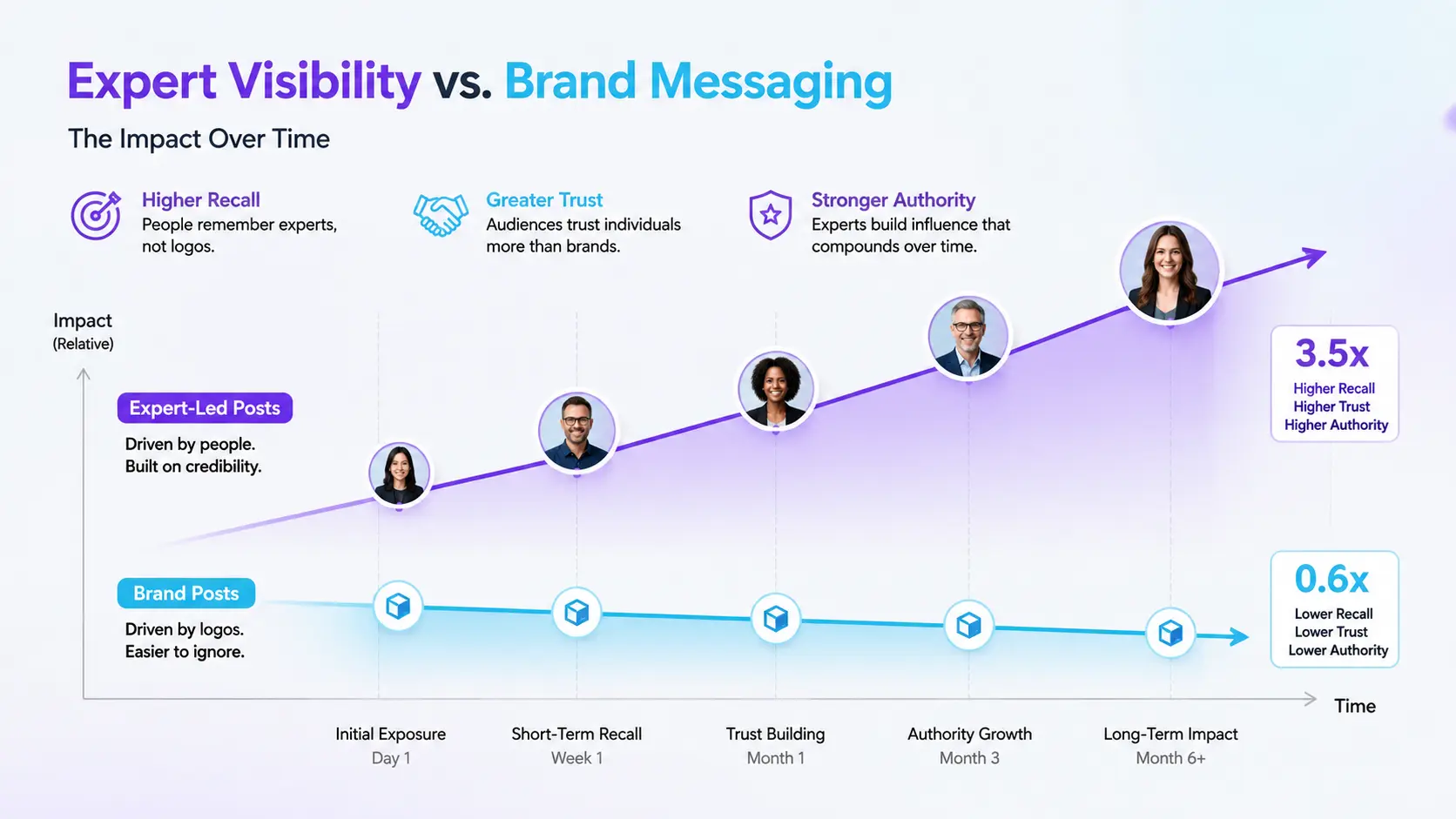
Why consistent visibility, not frequency, shapes trust over time
Many teams obsess over post frequency – more content, more slots, more reminders – but audiences forget what flashes by.
What leaves a mark is seeing the same expert surface again and again, always reinforcing what they’re known for.
Being visible isn’t about showing up every day with a new tip.
It’s about compounding recognition: “That’s the cybersecurity lead who challenged the industry’s top myth”, or “That’s the analyst whose predictions land more often than not”.
Most teams get distracted by reach numbers, but recognition compounds only with strategic consistency.
We’ve seen clients post daily from company handles to chase algorithms – but the only moments that actually moved pipeline were sparked by a recognizable expert weighing in at the right moment.
Frequency without a repeatable expert signal turns your content into wallpaper.
There’s a reason microinfluencers in B2B circles drive trust faster: you remember them by name and judgment, not volume.
Key Takeaways on Building Trust Through Consistent Expert Visibility
- Trust grows when audiences repeatedly recognize the same expert over time.
- Posting frequency alone does not build lasting trust or recognition.
- Expert voices create memorable signals that stand out from brand noise.
- Microinfluencers gain trust by being recognizable, not by high volume.
- Compounding visibility turns passive observers into advocates.
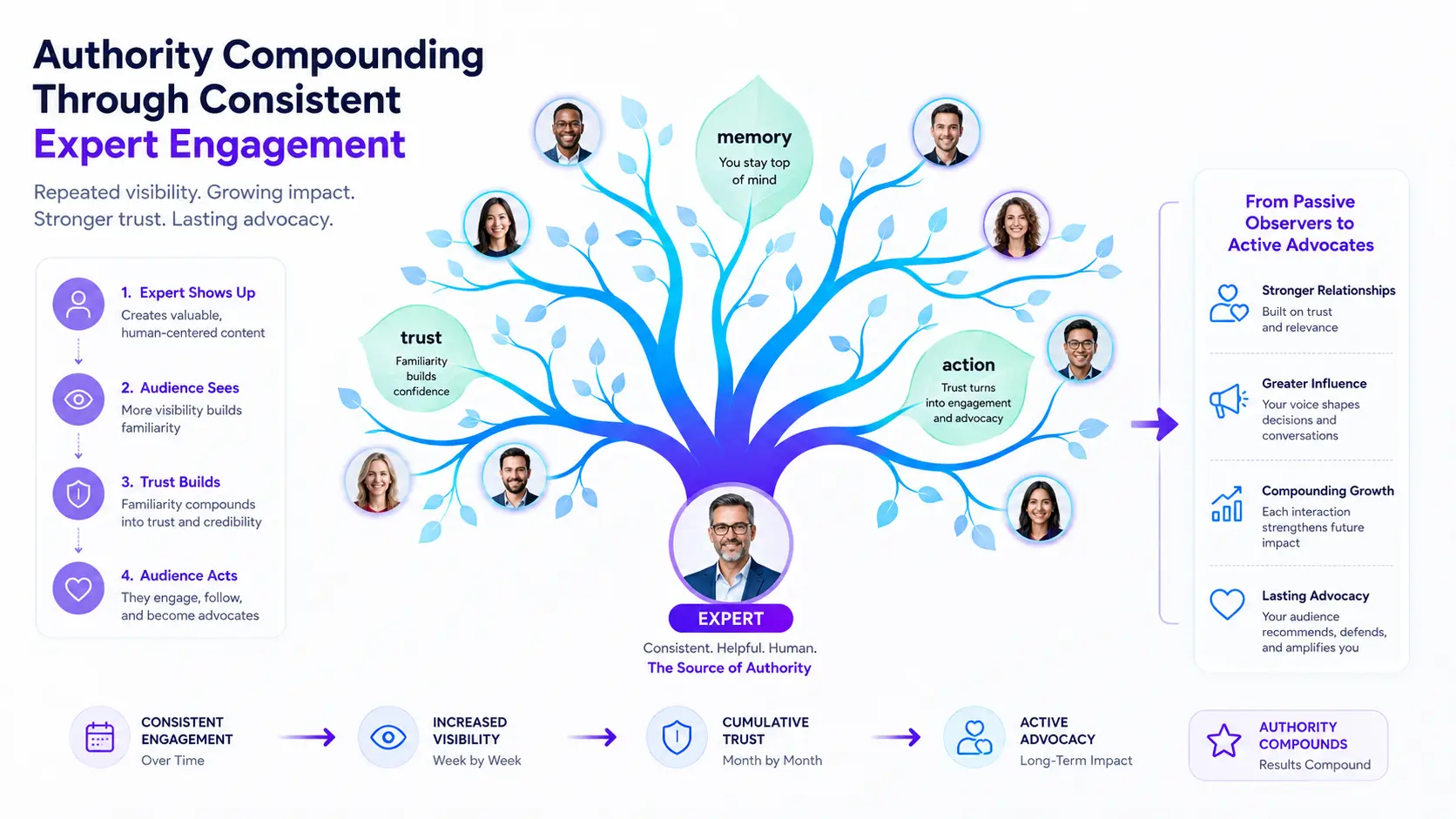
Does the audience recall your people, or just the logo?
Social trust grows each time viewers see a trusted name – not just another company message.
Over time, compounding visibility turns passive observers into actual advocates.
But when you chase frequency alone, your expert voices drown in the same feed as every faceless brand.
Consistent, recognizable expertise plants the seed for exponential trust growth.
But the real test comes when buyers look past your brand’s posts and ask: who inside the company is worth listening to?

What Goes Wrong When Expertise Stays Hidden Inside the Brand
Most brands assume that team expertise is working in the background to fuel growth.
But the reality is, when that expertise stays invisible inside generic company posts, the effects barely register.
The belief that a faceless brand voice can carry authority on social media seems harmless – until the numbers prove otherwise.
When posts don’t compound: lack of personal voice reduces memorability
Imagine you’re evaluating two LinkedIn posts: one from a faceless brand, another from a named expert explaining a recent decision.
The first earns likes but fades from memory.
The second, with its personal signature, stays with the reader – anchored in context and judgment.
It’s like trying to recall a crowd announcement in a train station – sound is present, but there’s no reason to remember who said it or why it matters.
We’ve seen this with client campaigns that stuck to corporate templates: the metrics started high, but recall tests weeks later landed near zero.
Without a personal voice, brand content blends into a fog of sameness.
But more sameness only compounds the problem over time.
Recognition decays, and so does any hope of compounding authority.
One mini-insight: memorability is anchored in visible judgment, not just message repetition.
If the team’s experts never step outside the company logo, every post starts at square one – no cumulative effect, no signal that builds on past attention.
The audience sees activity, not a face they learn to remember.
So why should they trust or recall you over anyone else in their feed?
When engagement doesn’t become demand: mistrust in anonymous statements
Light activity on posts creates a quiet illusion of traction.
But beneath surface engagement – likes, shares, impressions – there’s a breakdown: the leap from attention to trust never happens when messaging feels anonymous.
Relying on faceless statements lets doubt creep in.
Audiences interpret anonymous content as opinion, not expertise.
We’ve seen B2B brands hit a ceiling where plenty of social engagement never translated into inbound leads or authority standing.
The missing link?
Proof that a real, accountable expert stands behind the claim.
Here’s a practical tell: if your comments fill with polite agreement but no one asks a follow-up or seeks direct contact, you’re operating in the engagement gap.
Think of brand social like an unmanned booth at a tradeshow – it collects visitors, but it doesn’t create real conversations.
Replacing the face with a logo is the quickest way to kill signal strength.
Low memorability and weak trust signals don’t just slow growth – they remove any shot at demand compounding.
Therefore, the path forward isn’t just posting more often; it’s making your expertise visible before the scroll.
Common Pitfalls and Warning Signs of Faceless Brand Messaging
- High post activity but low follow-up questions or direct contacts.
- Surface engagement without deeper conversations or trust.
- Posts are seen as opinion, not accountable expertise.
- Content blends into ‘wallpaper’ without a personal voice.
- Engagement does not translate into inbound leads or authority.
When expertise stays behind the curtain, the illusion of brand activity can cover deeper issues.
The next question is sharper: what real signals can prove expert-led visibility is winning over your market – not just filling up the feed?

How Expert-Led Visibility Feeds Broader Social and Search Trust Signals
Most brands chase channel growth, hoping more social presence will boost their trust footprint.
But social reach alone doesn’t earn recognition past the scroll.
The real accelerant is the visible fingerprint of a human expert – one that quietly primes trust far outside the original platform.
Visibility triggers familiarity bias – even before someone searches
Every executive notices a name popping up in their feed, even when they’re not looking for it.
But it’s not the repetition that imprints; it’s the pattern of recognizable expertise attached to each interaction.
This is not about flooding the timeline.
Public expert judgment plants a subconscious bookmark, so that when the same voice resurfaces during a buying or search moment, it feels familiar – almost endorsed by previous exposure.
We’ve seen client teams underestimate this silent advantage.
After months of steady expert-led posting – without chasing viral volume – their leads mention, “I kept seeing your head of product explain things, so I checked your site”.
No campaign tracking picks up that cause-and-effect directly.
The signal is simple: consistent expert presence shortens the path to trust when it finally matters.
So what changes when a buyer sees an expert’s commentary before ever typing your brand into Google?
The recognition curve goes vertical.
That’s why microinfluencers in B2B corners outperform household brand accounts – they build micro-familiarity, not just broadcast impressions.
Most brands push frequency, thinking enough repetition equals authority.
But frequency alone is noise if there’s no human anchor.
Brands become wallpaper; experts become benchmarks.
Trust is a pattern match, not a volume game.
That is the line most companies miss.
Search and AI systems reward verifiable human sources more than generic brand data
When search engines and AI tools sift the web, they now track for something sharper than keywords or corporate claims: attributable expertise.
A named, visible authority leaves a signature – proof of origin, unique phrasing, clear provenance.
Anonymous brand posts melt into the algorithmic background, while posts tied to expert judgment surface in search snippets and AI citations.
Unlike traditional influencers who may have a broader following but lighter subject authority, expert visibility focuses on verifiable credibility.
Key Opinion Leaders (KOLs) or subject matter experts earn trust not because they attract attention, but because their proven expertise is distinct from personality-driven influence.
This distinction is crucial – especially in B2B, where buyers rely more on peer judgment than on mass popularity.
Here’s where the rules have flipped.
You can have libraries of brand content, but without visible expert voices, the material lacks what search and AI evaluators look for: authenticity, traceable perspective, and proof of real experience.
Practitioners detailing a process, risk, or decision on social leave a breadcrumb trail search engines pick up – moving from generic visibility to subject matter expert credibility.
We watched one SaaS client’s organic and AI-sourced mentions leap after their CTO began answering open technical questions under her own name.
The brand’s owned content sat static, but the human layer started appearing in AI outputs and search features almost overnight.
Isn’t this just thought leadership with a new label?
That’s the myth.
The new game is verifiability: only sources that can be traced to real experts are promoted, cited, and indexed as decision assets.
The analog here is simple: generic brand posts are like unsigned paintings in a gallery – technically present, but no one can verify their value.
Expert-stamped content, in contrast, comes with provenance – making it more likely to be displayed, referenced, and sought out.
Authority is not what you claim about your brand; it’s what third-parties can verify back to a named expert.
Therefore, the question shifts: how many of your visible assets could be traced to real human judgment if an algorithm – or a buyer – looked for the source tomorrow?
The brands that win search and trust in AI are not louder – they’re more attributable.
As this edge becomes table stakes, the next leap is measuring whether your expert voices show up where buyers actually decide.
A related decision is covered in When Founder Visibility Drives Social Trust, which explains the adjacent issue in more detail.

How to Evaluate Whether Expert Voices Are Working for Your Social Strategy
Most brands watch social numbers climb and assume expert voices are quietly driving the results.
But vanity stats can camouflage whether real credibility is compounding in public.
The sharper question: can you prove your experts are the reason trust flows back to the business – or are their efforts dissolving into the brand blur?
Are users recognizing and seeking specific people – not just the company?
Teams often interpret upticks in brand mentions as evidence of expert impact.
But those signals may simply reflect generic activity – followers seeing more posts, not remembering the people behind them.
The hardest proof isn’t likes or impressions – it’s whether buyers and market voices attach solutions, insights, or authority to actual names.
What does this look like in the wild?
When we’ve assessed expert visibility for clients, a reliable marker is the appearance of individual team members in LinkedIn search autocomplete or industry group discussions – unprompted, organic, and paired with real topics, not just job titles.
That’s the difference between someone seeking “your company” and searching for “Lisa, the compliance lead who made sense of that new regulation”.
But those moments don’t appear on a dashboard.
They show up as calendar invites to the right people, quotes in media, or personal inbound requests that never route through generic marketing forms.
It’s the real-world echo that someone stands out as a problem-solver, not a corporate mouthpiece.
So why does this signal matter?
Buyers remember experts who help them think differently, not the brand that floods their feed.
Once your team’s names trigger conversations – or even light curiosity in search – it signals your credibility is becoming portable, and less dependent on paid reach or brand spend.
Half the battle is diagnosing whether personal visibility sticks.
Ask: Does the market quote, tag, or cite your people after the campaign ends?
Or does recognition vanish as soon as spend drops?
Is social visibility translating into higher trust in SEO and discovery?
A surge in social engagement feels validating.
But unless those expert touchpoints carry over into higher authority in organic and search – trust is siloed, not compounding.
We’ve watched this play out: a subject matter expert earns steady interactions on LinkedIn, but when the same topics are searched in Google, another brand or competitor’s name fills the snippet.
The real test isn’t whether your experts have fans; it’s whether their visibility moves the needle in discovery channels that drive buying decisions.
Look for leading signals: – Are specific expert names driving branded search queries, not just the company name? – Do your experts show up as cited sources in AI-driven answers or knowledge panels? – Are clicks on their content leading to a measurable lift in qualified pipeline – not just web traffic?
The consequence is direct: Experts who surface in both search and AI are treated as trusted sources, giving the business an unfair advantage in zero-click environments.
But if no user signals or citations exist beyond the platform, credibility evaporates outside the social bubble.
Key Evaluation Criteria for Expert Visibility Impact
| Aspect | Brand Posts | Expert-Led Visibility |
| Memorability | Low – faceless, easy to ignore | High – personal voice and judgment |
| Trust Signal | Weak – generic and anonymous | Strong – shows thinking and accountability |
| Audience Reaction | Passive – impressions but low engagement | Active – prompts follow-up and recognition |
| Portability | Tied to brand only | Credibility extends beyond brand |
True expert visibility isn’t about short bursts of engagement – it’s about becoming the person buyers or algorithms seek out for answers.
That leaves a sharper, final challenge: How do you distinguish between surface-level influence and real, compounding authority?
When expertise becomes visible across more people, employee advocacy becomes a distribution and trust layer.
That broader logic appears in Employee Advocacy.

Scientific context and sources
The sources below provide foundational context for how decision-making, attention, and performance dynamics evolve under scaling and constraint conditions.
- Social Trust & Authority Development
Cascading Behavior in Networks – David Easley & Jon Kleinberg – Networks, Crowds, and Markets: Reasoning about a Highly Connected World
This book chapter explains how behavior, adoption, and influence spread through social networks. It supports the article’s argument that visible signals from people inside a network can shape trust, attention, and adoption more effectively than abstract brand messaging.
https://www.cs.cornell.edu/home/kleinber/networks-book/networks-book-ch19.pdf - Online Influence of Individual Versus Corporate Sources
Who Says What to Whom on Twitter – Shaomei Wu, Jake M. Hofman, Winter A. Mason, Duncan J. Watts – Proceedings of the 20th International Conference on World Wide Web
This paper analyzes how different types of Twitter users produce and receive attention, including elite and media-like accounts. It supports the article’s broader point that visible, identifiable sources shape how information spreads across social platforms.
https://dl.acm.org/doi/10.1145/1963405.1963504 - Source Credibility and Message Processing
The Effects of Source Credibility in the Presence or Absence of Prior Attitudes: Implications for the Design of Persuasive Communication Campaigns – G. Tarcan Kumkale, Dolores Albarracín, Paul J. Seignourel – Journal of Applied Social Psychology
This study examines how source credibility affects persuasion, especially when people lack strong prior attitudes or knowledge. It supports the article’s argument that credible, identifiable sources can influence belief formation more strongly than anonymous or low-credibility messages.
https://onlinelibrary.wiley.com/doi/abs/10.1111/j.1559-1816.2010.00620.x - Human Signals and Information Retrieval Evaluation
Human-Computer Interaction View on Information Retrieval Evaluation – Tiziana Catarci & Stephen Kimani – Information Retrieval Meets Information Visualization
This chapter explains why information retrieval evaluation needs to account for human users, interaction, and usability, not only system-level metrics. It supports the article’s broader point that human judgment and user-centered signals matter in how information systems are evaluated and trusted.
https://link.springer.com/chapter/10.1007/978-3-642-36415-0_3
Questions You Might Ponder
Why is expert visibility in social media more effective than brand posts?
Expert visibility in social media leverages human judgment, creating authentic trust and recall. Named experts provide nuanced insight and accountability, which signals real credibility – unlike faceless brand posts that often blend into background noise and are easily forgotten.
How does consistent expert visibility influence audience trust over time?
Consistent expert visibility creates familiarity and credibility by repeatedly presenting the same expert as a reliable source. This recognition builds trust and authority, whereas frequent but unfocused posts from a brand account fail to leave a lasting impression.
What happens when company expertise remains hidden behind the logo?
When expertise is only presented as brand messaging, audiences perceive the content as generic and less trustworthy. This lack of personal voice reduces memorability, engagement, and ultimately undermines the authority and demand that comes from visible, accountable individuals.
Do search engines and AI give preference to content from identifiable experts?
Yes, current search and AI systems increasingly value content tied to verifiable human sources. Attributable expertise boosts visibility in search results and AI snippets, while anonymous brand posts lack the authenticity and trust required for top placement.
How can brands measure if expert-led social strategies are delivering real authority?
Brands should monitor whether specific team members are mentioned in search, cited in third-party content, or directly sought after by buyers. Indicators include expert-driven branded searches, inbound requests, and the appearance of individuals in citations or AI summaries.