
What You’ll Learn
Founder led social media trust signal is the credibility created when a visible founder or leader publicly connects their voice, judgment, expertise, and accountability to a company’s message.
Unlike a faceless brand page, founder-led content gives buyers a human signal they can evaluate through tone, consistency, replies, opinions, and visible behavior over time.
This signal can build trust faster because people assess risk through recognizable humans, not only logos or polished claims.
It works best when the founder reinforces the company’s expertise, answers real questions, and transfers personal credibility into brand authority without becoming the only source of trust.
Key Takeaways
- Founder-led social media trust signals create deeper buyer trust and higher engagement than faceless brand content.
- Algorithms and buyer psychology both favor visible human leadership over polished brand messages for recall and conversion.
- Overusing founder presence risks credibility; leadership visibility should shift to team, expert, and brand overlays as organizations scale.
- The most effective social trust strategies recognize when to transition from founder-centric to multi-layered credibility mechanics, aligning trust with business objectives.
A company page can push content, rack up impressions, and even buy reach.
But what it can’t do is create a founder-led social media trust signal – the crucial trigger that makes people care who stands behind the message.
The classic brand profile – with slick visuals, polished taglines, and an unbroken wall of logos – creates a strange paradox: more professional, yet less trusted.

Why an invisible company page fails to build durable trust
The myth that buyers judge brands on “polish” misses how people actually vet risk.
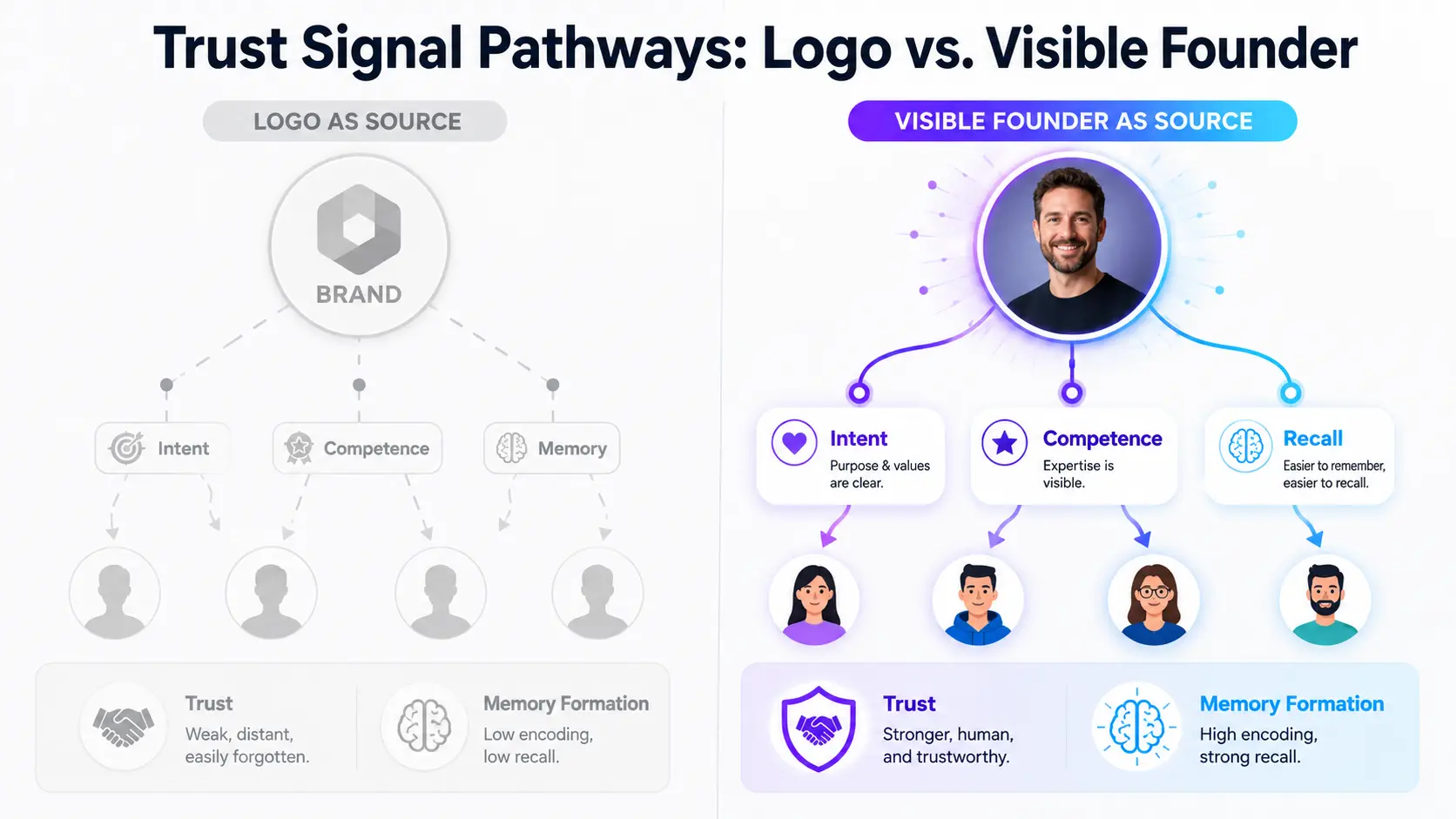
They don’t just want polish; they look for clues of intent, competence, and accountability – signals that only a real person emits.
Brands assume the logo earns enough credibility.
Yet when buyers can’t spot the mind behind the message, a sense of distance creeps in.
Here’s what actually happens: buyers scan company updates in their feeds, but their brains register almost nothing.
The logo is just an object – flat, safe, and forgettable.
It’s like scanning street signs instead of shaking someone’s hand.
Anonymity carries no cost in signage; it creates a hard ceiling in trust.
What buyers unconsciously miss when they see only a logo
Think about the last time you considered a new vendor from LinkedIn or Twitter.
Did you hunt for someone to attach to the brand’s claims?
Did you look for a founder’s voice, a reputation to research, a track record of personal commentary?
This is not just a habit – it’s survival logic.
People shortcut trust through human judgment, not corporate identity.
Buyers are wired to read eyes, scan tone, and notice how someone reacts under pressure.
These micro-signals don’t translate through a logo.
The diagnosis is simple: the logo hides the very thing buyers use to de-risk the purchase.
So why do so many companies still hide behind the brand page?
That’s where the quiet breakdown starts.
If your problem is that the company has expertise but the market cannot see the people behind it, start with the Social Media Marketing framework.
How faceless content dissolves memory and recognition
Logos may carry recognition at scale, but when it comes to recall and trust, they break down fast.
You can post a hundred company updates, but most buyers won’t remember a single line.
The facelessness doesn’t just lower recall – it actively erases it.
Here’s the analogy: a logo without a human is like a storefront window with curtains drawn.
You know a brand exists, but you learn nothing about the people inside.
That’s why buyers scroll past even well-produced company content without it leaving a mark.
There’s no story, no emotion, no anchor to memory.
We’ve seen inside client analytics: posts signed off by founders get three to seven times the comments compared to identical brand posts.
The reason is not just reach – it’s memorability.
Stories, confessions, or hard opinions from leaders imprint.
A logo never does.
Faceless content – no matter how polished – gets lost in the feed fog.
But a founder’s post, or even a simple team photo with a direct comment, sits in memory long after, creating familiarity that accumulates with each exposure.
Therefore, the invisible company page doesn’t just fail to build trust – it fails to even enter the consideration set.
The first problem isn’t lack of traffic; it’s lack of trace.
The deeper question: if buyers can’t remember the brand, how do you become their decision default later?

Why platforms reward human voices over brand channels
Algorithms owe nothing to a brand logo.
But mention a founder’s name, and the feed reacts before the reader even decides why.
The common assumption: distribution is fair game for all – company or leader, paid or organic.
The actual rule is harsher.
Platforms quietly load the dice for people with faces, not brands with slogans.
A brand’s post may sit in a feed with perfect timing, yet the same content – shared by a founder – triggers 10x more ripple and recall.
Why does the platform behave this way?
The answer isn’t in the code; it’s in how signals compound around perceived human risk and authenticity.
The surface logic says any update can go viral, but the buried rule is that brands are on the platform’s slow lane unless they borrow human trust.
The reach multiplier personal profiles unlock
Most executives expect their company page to be their voice of record.
But LinkedIn, X/Twitter, and even Facebook have a different agenda: they privilege engagement that looks like conversation, not broadcast.
As a result, founder-led social media trust signals become the catalyst – not the byproduct – of reach.
A founder’s post becomes its own algorithmic accelerant.
Platforms detect higher dwell time, more comment threads, and instant re-shares from genuine connections.
But a brand page’s post, even with similar CTA or creative, runs into rate limits – throttled reach, queued for secondary scans, rarely making it off the home feed.
One client moved a thought leadership series from their brand page to their CEO’s profile; overnight, the average impressions tripled with no added promotion.
There’s no direct pay-to-play workaround for this multiplier.
The bias is structural.
This is not about follower count.
Most brand pages hold more total followers than an individual leader, but algorithms discount them by default.
Why?
Trust travels faster peer-to-peer, not brand-to-buyer.
People react to another human taking responsibility for a statement, but rarely to a logo repeating company copy.
The repeatable insight: Feed algorithms major on risk, not just engagement.
They bet on the reputational stake of a real person, not the polish of a designed page.
What’s the actual business effect?
Company narratives, even if bold, get buried until a living voice steps forward.
Quietly, the audience signals they are waiting for a human to endorse – and expose – the brand message.
How engagement signaling amplifies founder authority
A founder’s public interaction is more than surface-level dialog.
Every like, comment, and reply creates a trust trail – a visible behavioral trust signal social media platforms index deeply.
But with a brand page, that authenticity layer is missing; responses feel scripted, stakes are low, and the algorithm can tell the difference.
Every time a founder responds to a comment or even corrects a critic, it triggers a second layer of feed attention.
Interactivity generates additional notifications for both first- and second-degree connections, compounding social proof.
It’s the digital version of a crowd gathering as soon as someone takes a stand on the street corner.
Silence from a leader, meanwhile, creates a vacuum – even with scheduled posts humming in the background.
Here’s a simple analogy: A founder engaging on social is like meeting the chef at a restaurant’s front door.
You’re more likely to remember the meal and refer friends, not just rate the food.
Company pages can’t recreate that personal handshake, no matter how witty the content.
But there’s another edge.
Authentic engagement from a leader creates a virtuous cycle: increased inbound attention on one post raises the starting visibility for the next.
Over time, this compounds – founder authority, once established, acts as a magnet for both platform distribution and market attention.
That is the advantage algorithms keep granting to visible leaders.
Therefore, the real question isn’t whether a company page should exist; it’s how much founder-led content can be leveraged before reach plateaus or trust starts diffusing – a tension the next chapter will push further.

How human credibility transforms into company authority
Most teams expect that boosting a company’s image starts with more brand content.
But real-world buyer decisions are shaped first by the humans they notice, not the logos they scroll by.
What makes trust attach to a founder – and then move to the company – remains the silent power in any channel, yet it’s often misunderstood and misused.
Behavioral trust mechanisms behind founder visibility
Executives think that authority comes from publishing expertise or simply being present online.
However, audiences make rapid, invisible calculations about whose face, voice, and actions feel authentic – as if deciding whether to trust someone at a high-stakes meeting, not a digital campaign.
The candidate isn’t a logo; it’s a person whose track record, tone, and pattern of showing up can be quietly verified by everyone watching.
But the real trigger is built on what psychologists label “parasocial trust”.
People relate to visible leaders as if they know them, even without meeting.
That single leap – engaging with a founder over a faceless page – instantly raises baseline credibility.
One client’s founder posted visibly during a key launch, answering hard questions in real time, and inbound leads referenced trust in the person more than any feature sheet.
They perceived risk as lower, not from better design or better claims, but from seeing an accountable, responsive human.
This is where many brands miss – they pour resources into design or messaging, but fail to let buyers connect with the humans who will stand behind outcomes when the stakes are real.
Just as investors back founders before products, buyers seek relational proof before company promises.
What signals don’t show up?
Accountability, authenticity, and tone that matches intent.
A founder’s public record – what they comment on, how they take feedback, whether they admit mistakes – acts like a rolling reference check buyers can passively watch.
If that pattern holds, a quiet transfer happens: the founder’s credibility fills the company’s authority gap.
So the trust signal is not just visibility, but visible pattern over time.
Key Behavioral Trust Mechanisms Behind Founder Visibility
- Visible leaders emit signals of intent, competence, and accountability.
- Audiences form parasocial trust, relating to founders as if personally known.
- Founders’ public records act as rolling reference checks.
- Authenticity is built through tone, pattern of presence, and responsiveness.
- Trust transfers from personal reputation to company authority over time.
- Showing vulnerabilities and failures earns conviction, not just polish.
A static logo can’t promise you’ll get a straight answer.
A founder showing their thinking, or illustrating failures as well as wins, leaves a different residue: earned conviction.
That’s the shift most brand campaigns never achieve.
So the real test isn’t how polished a post looks, but how much of a reputation the team is willing to risk, in public, on behalf of their brand.
How visible leadership shortens the decision journey
The decision cycle for B2B buyers is built on eliminating perceived risk at each step.
Yet when founders appear repeatedly in a prospect’s feed – sharing insight, fielding tough questions – buyers leapfrog many of the usual hurdles.
The effect?
The trust signal doesn’t pass through a sequence of staged proofs; it compounds as social capital.
One executive recounted fielding inbound requests that referenced things he’d written months earlier – proof that the memory of a founder persists longer than any single campaign.
Even more, when founders step forward, sales cycles tighten.
We routinely saw prospects reach out after a founder’s deep-dive commentary, skipping demo requests and moving straight to qualification.
These are not accidents: personal visibility operates as a silent accelerator, compressing what would be weeks of proof-seeking into a handful of digital interactions.
But the biggest myth is that more posts mean more trust.
Passive presence is not the same as active credibility.
It’s participation – real interaction with the market – that creates momentum.
If founder-led social media trust signal is working, you’ll notice the lag between first impression and buyer engagement shrinks.
Buyers stop asking, “Who’s really behind this?” and start asking better questions, faster – about value, fit, and impact.
The badge of authority transfers only when leadership stays visible, not just present.
Company authority, therefore, is not built on volume of visibility, but on the depth and character of the leader’s imprint.
The handoff from personal credibility to organizational trust is fragile.
The next edge: knowing where the founder’s impact slows – and what must step in before trust breaks.

When founder visibility isn’t enough – and what to compare next
A founder’s face can animate even the driest brand story into something buyers notice.
But direct visibility is not a universal fix.
The hard truth: in certain growth stages and market structures, social feeds full of founder posts quietly start losing their grip where a well-crafted brand message should take the lead.
Scenarios where brand content supports funnel stages better
Most execs flip the founder visibility switch and expect the entire funnel to glow brighter.
But different parts of the funnel have different requirements – and there are clear points where human credibility loses ground to brand structure.
Consider awareness campaigns targeting new markets with no prior context.
A founder’s story won’t reach enough diverse audiences to seed a scalable pipeline at top-of-funnel.
Branded content – deployed across the right paid and organic placements – sets broader reach parameters.
It hands the microphone back to the company when the goal is tight message control, mass-market impressions, or “SKU dump” content that simply can’t be made personal at scale.
Founder Visibility vs Brand Content Effectiveness Across Funnel Stages
| Risk/Warning Sign | Description | Potential Impact | Recommended Action |
| Overexposure | Founder posts become repetitive noise in feeds | Audience tunes out, engagement drops | Reduce frequency, diversify voices |
| Mismatch with Execution | Founder vision outpaces product/support delivery | Credibility gap, audience distrusts claims | Align messaging with operational realities |
| Backlash in Sensitive Verticals | Founder opinions trigger negative reactions | Reputational damage, lost opportunities | Tailor content carefully to target markets |
| Personality Overshadows Offer | Attention focuses on founder not product | Diluted decision signals, confused buyers | Balance personal and brand messaging |
Some teams stumble here: they try to drag a founder’s personal style across low-awareness display, retargeting, or catalog-led social ads for complex or sizable product lines.
The result is confusion – a buyer might remember a charismatic founder, but not associate them with the breadth or capability of the offer.
That’s the blind spot: a personal voice carries further in trust-building, but not always in breadth or category recall.
So when context shifts – from relationship-building to sheer informational coverage – the founder’s role drops back.
The handoff is subtle but critical: brand-led content supports memory, compliance, and scale where personal reach simply cannot stretch.
That’s the operational crossover point most teams miss.
When founder visibility erodes credibility instead of scaling it
There’s a flip side that rarely gets discussed.
Rampant founder posts can eventually work against their own authority.
A founder trying to cover all company comms becomes noise in the feed, risking overexposure and loss of credibility.
Think of a stage speaker who never leaves the spotlight – eventually, even their best lines get tuned out.
We’ve seen high-growth teams lose months when a founder’s comments become mismatched with scaled execution.
For example, the founder’s vision may outpace what product and support teams can deliver, or their opinions trigger backlash in more sensitive verticals.
The market reads this as inflation – or worse, as inconsistency.
Instead of trust transfer, the audience starts seeing red flags: is the brand just one person’s charisma, or does it stand for something durable?
Risks and Warning Signs of Overusing Founder Visibility
| Funnel Stage | Founder Visibility Effectiveness | Brand Content Effectiveness | Key Considerations |
| Top-of-Funnel Awareness | Low – reaches limited diverse audiences | High – enables broad mass-market impressions | Brand content supports reach, tight message control, and scale |
| Middle Funnel Relationship-Building | High – builds trust and personal connection | Medium – supports memory and compliance | Founder visibility creates credibility; brand content reinforces |
| Decision/Conversion Stage | High – shortens sales cycle by reducing perceived risk | Low – less personal impact | Active founder presence compresses qualification steps |
| Scaled SKU or Catalog Marketing | Low – personal voice doesn’t scale well | High – manages wide product offerings effectively | Brand content crucial for consistency and coverage |
One practical test: If a founder’s content routinely attracts more attention for the personality than the offer, risk is compounding instead of value.
This pattern often creeps in when executive presence crosses into influencer territory – posts become performative, and the signal for decision-stage buyers gets drowned out by style over substance.
Therefore, the challenge is not just maximizing founder-led social media trust signals – it’s knowing when those signals saturate, backfire, or need reinforcement from composure, breadth, or structure.
The sharpest strategy recognizes the swaps: when to dial down the founder’s face, when to ramp up the brand, and which channels or stages call for a hybrid.
But most teams want a playbook – when that fails, the next move is learning how to route visibility across leader, expert, and brand overlays that don’t break trust along the way.

What to do next: how this informs your social strategy architecture
Most teams want a blueprint for converting founder-led social media trust into predictable business results.
But the map keeps shifting just when they think they see the path.
The repeat playbook stalls if you treat visibility as a static asset, not a dynamic engine.
Social trust scales – until the context changes beneath you.
The next step isn’t dropping your current approach.
It’s figuring out when to double down, when to layer in other voices, and when to pass the spotlight entirely.
What to explore in leadership visibility mechanics next
It’s tempting to assume “founder presence” is the whole play.
But a single voice, no matter how compelling, eventually meets natural limits.
What fuels early compound growth can plateau as audiences crave diversity and proof beyond the visionary.
So, what layer comes next?
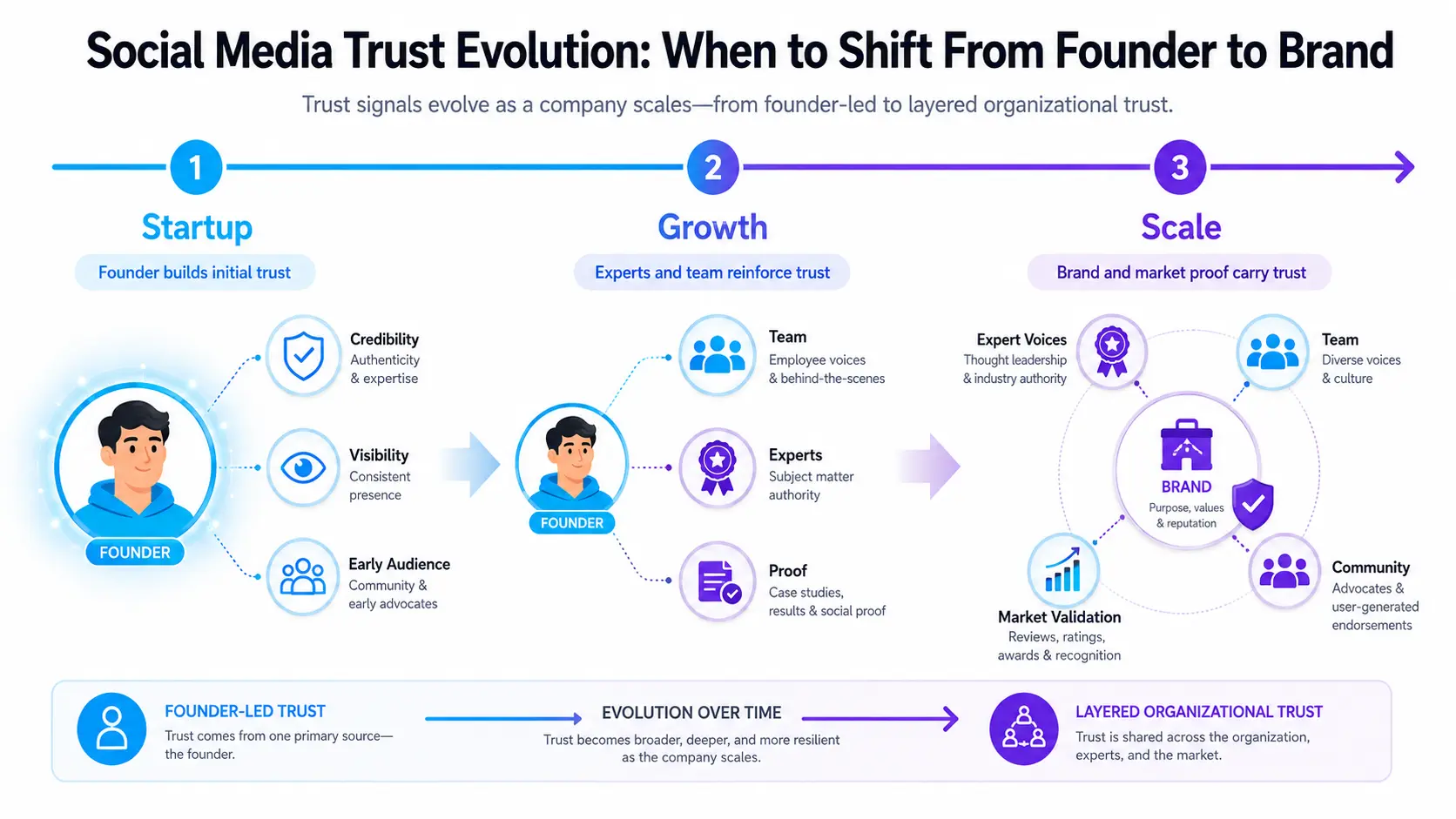
Some companies expand the frame with expert overlays – bringing in technical leads or specialist team members whose own reputations carry weight.
Others amplify rising voices by investing in employee advocacy, letting team members share real operational stories that move the behavioral trust signal through every buyer touchpoint.
There’s also the industry echo effect.
Getting recognized by respected players or earning mentions from outside authorities gives your message long legs, especially in ecosystems where buyers check credibility across multiple channels.
Think of this as trust triangulation: founder authority sets the signal, expert and employee content ground it, and industry validation widens the moat.
The founder doesn’t vanish.
But sustainable trust now compounds through a lattice of visible humans, not just a single figurehead.
Is your current social presence building that web – or just propping up one pillar?
That broader pattern is explored in expert-led social media trust mechanics.
When to call in related capabilities instead
Founder-led trust is powerful, but it’s not a skeleton key.
There are moments when the business objective shifts and the tactics need to mature.
A few scenarios stand out:
- Your category requires mass consistency or rapid scale across SKUs. At this stage, brand positioning and systematic content marketing outperform episodic personal posts. Controlled message architecture takes priority over founder improvisation.
- Your audience prefers video, demos, or visual proof over written persona-driven content. Video strategy and branded formats can extend reach and credibility when leader-driven updates can’t surface all value props quickly.
- You’re running concurrent campaigns across regions, products, or segments. Coordinated content and brand channels create stability, while founder visibility becomes one layer among many, not the core.
Diagnosing when to shift is itself a signal of sophistication.
The mistake isn’t over-investing in founder visibility – it’s clinging to it after its diminishing return has set in.
Scenarios When Founder Visibility Alone Is Insufficient
- Mass consistency or rapid scale across multiple SKUs requires brand positioning and systematic content marketing.
- Audiences preferring video, demos, or visual proof benefit from video strategy and branded formats.
- Concurrent campaigns across regions, products, or segments need coordinated content and brand channels.
- Overreliance on founder visibility past diminishing returns risks eroding trust.
- Mixing expert-led, employee advocacy, and industry validation content broadens trust signals.
- Recognize when to dial down founder presence and amplify other voices in the ecosystem.
Personal authority can move a market, but the mature strategy knows when to route trust through a broader suite of assets.
The next strategic leap asks: which visibility mechanic best compounds trust at this stage of your funnel, and how will you sense it’s time to swap gears?

Scientific context and sources
The sources below provide foundational context for how decision-making, attention, and performance dynamics evolve under scaling and constraint conditions.
- Trust Formation in Online Social Networks
First impressions matter: evaluating the importance of online reputation in social networking sites for initial trust in virtual work partners – Hugo Martinelli Watanuki & Renato de Oliveira Moraes – Information Technology & People
This paper examines how public profile information, self-disclosure, and online reputation influence initial trust formation in social networking contexts.
https://repositorio.usp.br/directbitstream/c025b7ba-d8b0-4531-9854-074012e7b327/First%2Bimpressions%2Bmatter%2Bevaluating%2Bthe%2Bimportance%2Bof%2Bonline%2Breputation%2Bin%2Bsocial%2Bnetworking%2Bsites%2Bfor%2Binitial%2Btrust%2Bin%2Bvirtual%2Bwork%2Bpartners..pdf - Human Factors in Brand Engagement
Brands Are Human on Social Media: The Effectiveness of Human Tone-of-Voice on Consumer Engagement and Purchase Intentions Through Social Presence – Hyun Ju Jeong, Deborah S. Chung, & Jihye Kim – International Journal of Communication
This paper shows that a human tone of voice on social media can make consumers perceive brands as more socially present. It also finds that human tone of voice can increase intention to engage with the brand, and that engagement intention can increase purchase intention. This supports the point that humanized brand communication can create stronger engagement than distant corporate communication.
https://ijoc.org/index.php/ijoc/article/view/19269 - Authenticity, Credibility, and Social Media Communication
I tweet honestly, I tweet passionately: Twitter users, context collapse, and the imagined audience – Alice E. Marwick & danah boyd – New Media & Society
This paper explains how authenticity, audience awareness, and self-presentation work in social media environments.
https://journals.sagepub.com/doi/10.1177/1461444810365313 - Attention and Memory in Social Information Processing
Social Attention and the Brain – Jeffrey T. Klein, Stephen V. Shepherd, & Michael L. Platt – Current Biology
This paper explains why social attention is biologically important and why human social signals carry special weight.
https://pubmed.ncbi.nlm.nih.gov/19889376/
Questions You Might Ponder
Why do founder-led social media trust signals outperform branded content?
Founder-led trust signals outperform because buyers instinctively seek human accountability, intent, and competence – cues that a logo cannot transmit. Personal engagement fosters authentic connections, making buyers more likely to remember and trust the message, which leads to higher engagement and better recall.
How does visibility of company leadership impact the sales cycle?
Visible leadership shortens sales cycles by directly addressing buyer risk. When founders are repeatedly seen engaging authentically online, prospects move faster to qualification, skipping lengthy trust-building processes and referencing the founder’s actions as a reason for their confidence.
What risks are associated with overusing founder visibility in social channels?
Overuse of founder visibility can lead to overexposure, loss of credibility, or brand confusion. If a founder becomes the main face, buyers may question the organization’s depth or reliability, and feed fatigue may set in, diminishing overall trust and engagement with the message.
At what stage should brands shift from founder-led to broader social strategies?
Brands should introduce broader strategies when scaling, reaching new markets, or seeking consistency across diverse or product-heavy campaigns. When founder-led influence plateaus, layering in expert voices, employee advocacy, and industry validation better supports memory, compliance, and overall market reach.
How do algorithms reward human versus company page content?
Algorithms prioritize content from personal profiles over company pages because human interactions trigger longer dwell times, more comments, and a greater sense of authenticity. This leads to compounded engagement and reach, while brand channels are algorithmically throttled unless amplified by visible people.