
What You’ll Learn
Employee advocacy as trust system is the structured use of visible, voluntary employee voices to build brand credibility through human proof, not just to increase content reach.
It works when employees share relevant ideas, experiences, expertise, and peer-level perspectives in their own voice, so audiences receive the message as credible insider judgment rather than scripted brand promotion.
Strong employee advocacy transfers personal credibility into brand trust, expands organic visibility through real networks, and supports awareness, referrals, and demand.
It fails when participation is forced, templated, or measured only by share counts instead of trust signals, conversations, and buyer movement.
Key Takeaways
- Employee advocacy strengthens brand trust only when rooted in authentic, voluntary participation by visible staff – not through forced, scripted sharing.
- Personal credibility, not content volume, is the multiplier for long-term trust and reach in employee advocacy as a trust system.
- Forcing participation or relying on uniform messaging harms credibility, stifles engagement, and can damage both employee and brand reputation.
- Sustainable advocacy programs prioritize opt-in visibility and align content with employees’ professional identities, fueling business impact and retention.
Most leaders see employee advocacy as a way to stretch their brand’s digital footprint.
But repurposing staff as content amplifiers is the easiest – and least effective – move.
The sharper reality: real advocacy is a living trust signal, not a distribution hack.

Why employee advocacy isn’t just branded reach
People trust people more than they trust brands.
But ask most teams to explain why, and the answers sound shallow – “it feels authentic”, or, “faces beat logos”.
The deeper dynamic: audiences subconsciously score information higher if it comes from a real insider, not a corporate channel.
When an employee shares insight or experience in their own words, every word feels earned, not assigned.
But here’s where most programs fail: when the message reads like it’s been handed down from headquarters, the very act of broadcasting kills believability.
That’s the problem with template-driven employee advocacy – a sea of near-identical LinkedIn posts is the digital equivalent of a paid crowd.
The effect?
Recipients sense the script.
Engagement drops.
The person’s network starts filtering out the brand, and worse, the employee’s own capital takes a hit.
That broader visibility logic connects directly to how Social Media Marketing operates as a trust system.
How human credibility multiplies brand visibility
Seen up close, the real engine isn’t just message reach – it’s credibility transfer.
We’ve watched smart teams use employees’ professional stories to drive recall and trust in ways polished brand pages never could.
Advocacy wins when it feels like a peer recommending a tool, not a rep reading from a guidebook.
Here’s the analogy: brand posts are billboards on the side of a highway.
Employee advocacy, done right, is a warm introduction at a dinner party.
One shouts at traffic; the other invites a conversation.
So why do so many still fixate on “getting everyone to share” as the goal?
That’s the quiet trap.
Human credibility is scarce.
Forced amplification burns it.
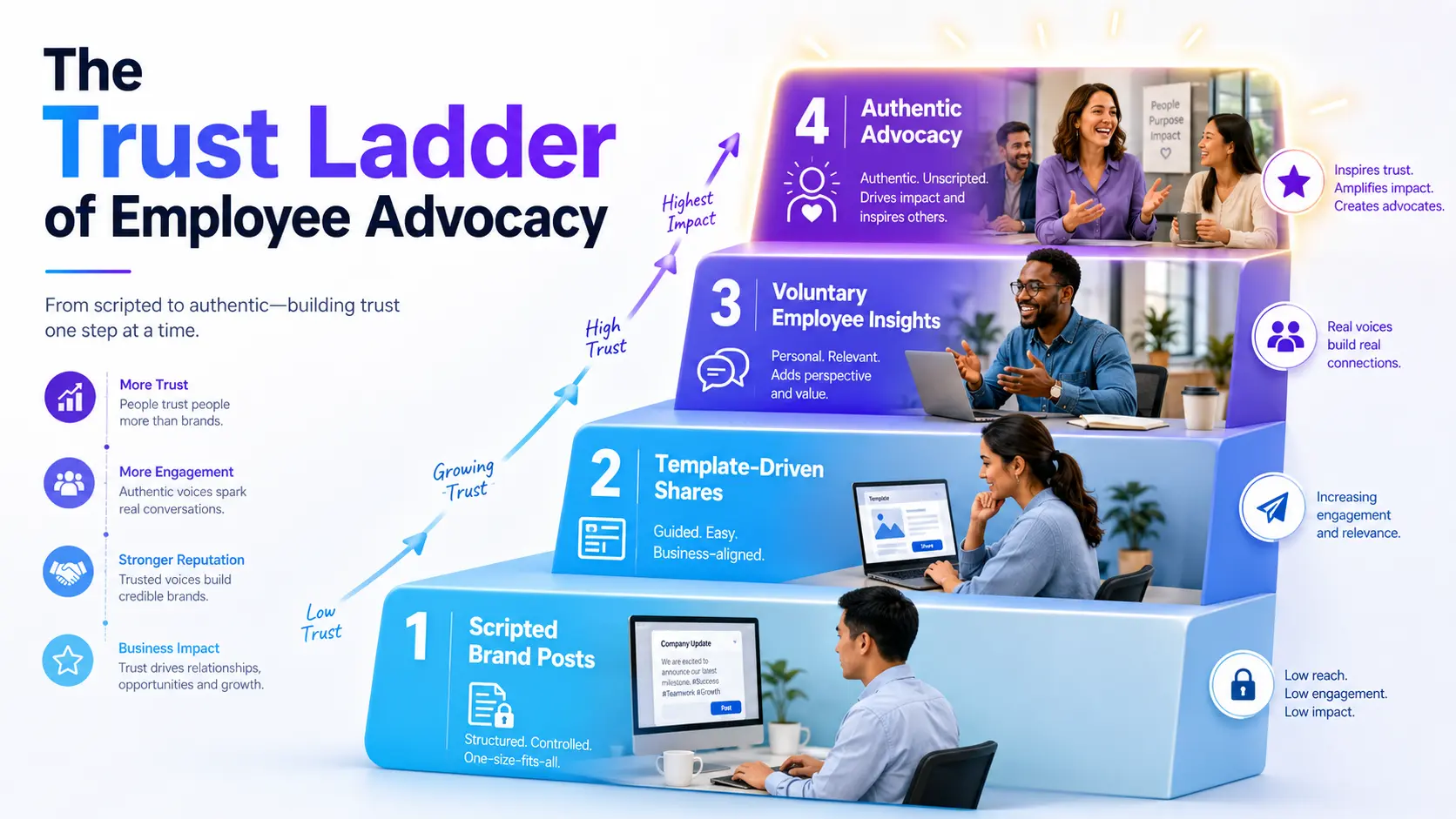
Why organic reach from people compounds, and brand posts don’t
Brand content lives inside an algorithmic box.
But personal accounts enjoy a different status in most social feeds – more visibility, more interaction, higher trust.
When an individual shares something that sparks attention, that signal jumps across networks.
Each person acts as a hub, not a transmission tower.
Most brand pages plateau.
Contrarily, employees who post with real perspective can trigger second-degree reach: colleagues, clients, industry peers, even weak-tie connections.
The algorithm favors these unforced posts, rewarding originality and authentic interaction.
The result?
A compounding effect where credibility accelerates visibility, not the other way around.
Is it riskier?
Yes.
Not every employee post lands the way the brand hopes.
But the tradeoff is real: only voluntary, genuine advocacy unlocks distributed trust signals at scale.
The myth that more volume from more accounts means more impact blinds many teams.
Instead, it’s the interplay of trustworthiness and personal network edges that actually moves the number.
Reach is easy to buy.
Organic trust is not.
The shift is subtle but transformative: seeing advocacy as a trust system reframes every decision about how visibility flows.
But if trust is the asset, mechanical sharing doesn’t grow it – it squanders it.
That leaves one uncomfortable truth: what passes for advocacy in most organizations is just brand noise in disguise.
The next challenge is even sharper: what breaks when advocacy is forced instead of earned?

When advocacy becomes harmful – why forced sharing fails trust
Most leaders install advocacy tools expecting an instant lift in branded visibility.
But flooding feeds with company-approved posts does not create trust – it usually drains it.
The sharp reality is that a forced program can quietly push your company into a credibility deficit before anyone spots the warning signs.
The authenticity paradox: why scripted posts backfire
Executives often believe that giving employees perfectly-crafted messages will scale reach without risk.
However, when authentic voice disappears, audiences sense it immediately.
Scripted advocacy reads like an echo chamber, not a network of real people.
That is the catch: the more brand voice filters through personal profiles, the lower the trust signal drops – sometimes below what a brand page achieves alone.
Key Reasons Scripted Employee Advocacy Fails
- Loss of authentic voice makes audiences immediately skeptical
- Scripted posts read like echo chambers rather than genuine conversations
- Engagement rates flatline or decline due to perceived inauthenticity
- Employees sound disconnected from real-world dialogue
- Advocacy turns invisible, resembling note cards rather than discussions
- Audiences amplify human credibility, not compliance
We’ve seen the pattern play out: Employees reluctantly copy-paste messaging, but engagement rates flatline or even shrink.
The market recognizes the script.
Instead of multiplying credibility, these posts leave both the employee and the brand sounding disconnected from real conversation.
Why does it fail so predictably?
People come to social channels expecting genuine signals – real stories, unique insights, unfiltered language.
When that disappears, the advocacy channel turns invisible.
It’s like handing everyone in a meeting the same note card and calling it a discussion.
So, what does last?
The marker is clear: audiences amplify human credibility, not compliance.
The quickest way to break social media trust mechanisms is to turn your people into repeaters rather than participants.
Your workforce’s structure can block advocacy
Many advocacy efforts stall before launch – not from lack of enthusiasm, but from friction: who has access, who feels pressure, and who can share with actual relevance.
In practice, only a slice of the team has both the incentive and the network to shape a conversation.
But programs routinely ignore this, expecting uniform output across all roles.
Deskless teams struggle the most.
If employees don’t live in email or are rarely at a computer, every extra click or login creates a barrier.
A sales rep on the road or a shift worker in the field is unlikely to broadcast canned messages, even with the best encouragement.
The result?
Advocacy becomes a filter for privilege and tech access rather than a bridge to distributed trust signals.
That is where the equity gap opens.
Teams closest to the customer often have the least structural support to participate – so their authentic, relevant voices go unheard while the noise of forced amplification grows.
Therefore, the path to genuine social trust is blocked as soon as participation becomes a box to tick instead of a meaningful choice.
Many programs look equal on the surface, but real advocacy stays stuck in organizational bottlenecks that social platforms quietly penalize.
Workforce Structure Impact on Employee Advocacy
| Workforce Segment | Common Barriers | Effect on Advocacy | Resulting Trust/Visibility Impact |
| Deskless Teams | Limited email/computer access; extra clicks/logins | Low participation; difficulties broadcasting messages | Advocacy favors privileged/tech-accessible employees; equity gap in voice |
| Sales Reps on the Road | Time constraints; limited platform access | Reluctance to post forced or canned messages | Reduced authentic advocacy; lower distributed trust signals |
| Shift Workers in Field | Limited tech access; cultural/organizational friction | Minimal involvement in advocacy activities | Missed opportunities for relevant, credible signals |
| Corporate Office Employees | Generally higher access and incentive | More likely to participate in advocacy | Centralized voice but risks uniform messaging if forced |
Forced advocacy does more than stall growth.
It can signal to the market that your brand values conformity over credibility.
Once those signals land, the cost to recover trust climbs fast.
The next chapter digs into how advocacy becomes a real bridge – only once participation is built on voluntary, relevant human visibility.

What makes advocacy a lasting trust bridge, not a campaign stunt
Some brands treat advocacy like a campaign: run a push, spike visibility, then repeat.
These spikes rarely turn into long-term trust.
The insight: trust that stays is built gradually, as employees show up over time – not when activity is manufactured and then drops off.
The real question is simple – what makes advocacy endure while other efforts fade as noise?
Voluntary visibility and personal relevance win long‑term
Most companies roll out advocacy as a program.
Yet, what sticks isn’t enrollment – it’s willingness.
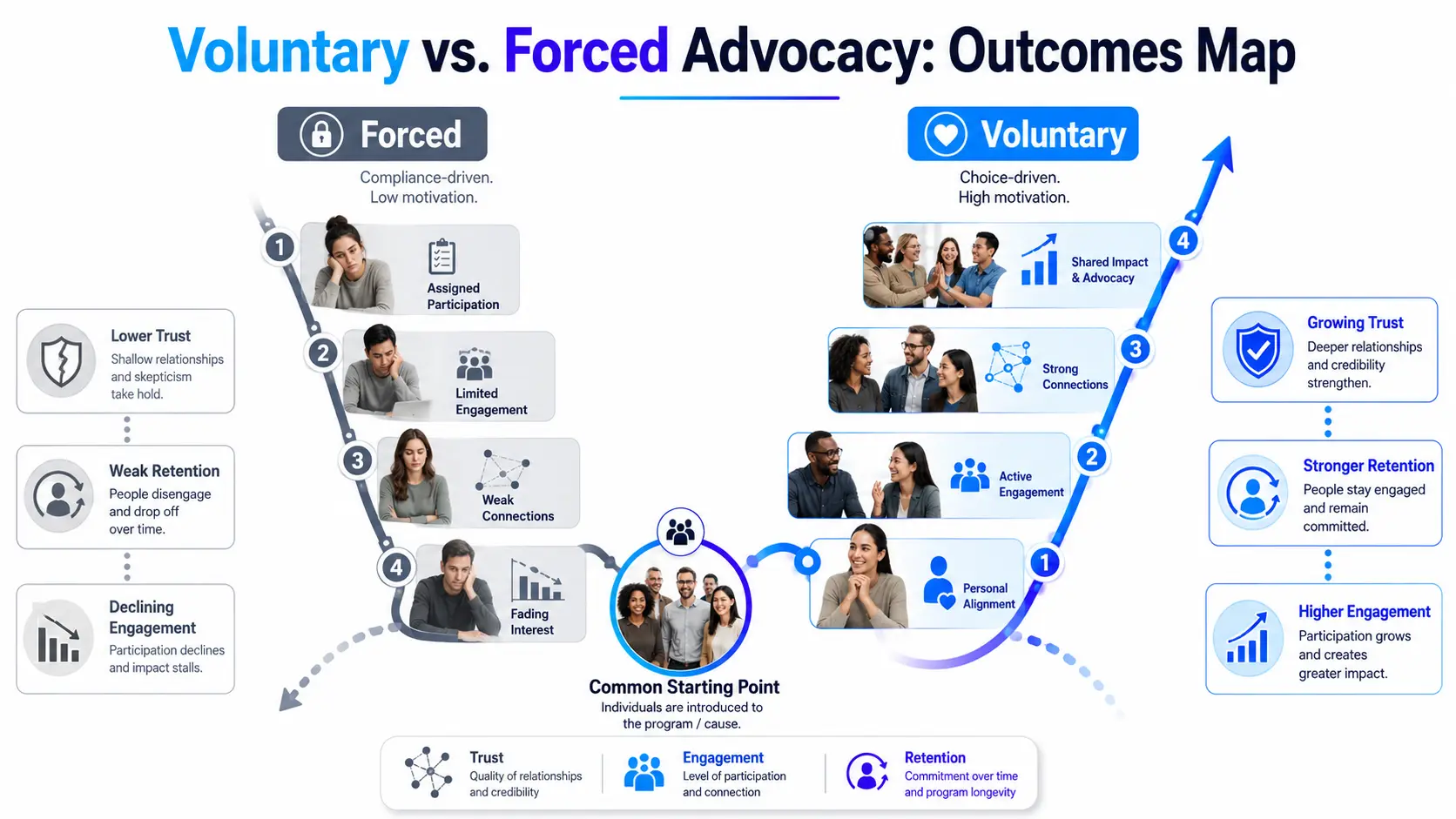
When visibility is voluntary, people choose what connects.
But when visibility is scheduled or assigned, participation dips faster than analytics dashboards can refresh.
Principles for Sustainable Employee Advocacy
- Visibility must be voluntary to maintain participation
- Employees choose content that personally connects with them
- Forced sharing leads to self-censorship and disengagement
- Advocacy systems that allow filtering or reinterpretation outperform canned content dumps
- Opt-in and relevance protect against program fatigue
- Personal connection to professional identity supports retention
We’ve watched teams fill the launch event, then struggle to sustain more than a handful of authentic posts a month.
Why?
Forced sharing makes people self-censor or disengage.
The myth is that company direction can make advocacy scale.
In practice, opt-in is the only predictor of sustained use – especially when sharing connects to something personally meaningful, not just to a brand campaign slot.
One line that reframes it: participation is not about reach – it’s about resonance.
Advocacy systems that let employees filter or reinterpret messages outperform those that dump canned content into inboxes.
Think of it like choosing your route home: people stick with paths they recognize, not the ones imposed by outside GPS.
That instinct for self-direction multiplies retention.
But what if your structure fights this tendency?
Coercive mechanics, leaderboards, or automated reminders drive short-term output and long-term fatigue.
Therefore, opt-in and relevance aren’t just best practices – they are the last safeguards against advocacy becoming just another source of noise.
Linking visibility to employee identity supports retention
Most advocacy launches focus on what the brand gains: increased distribution, new social impressions, or traffic spikes.
But campaigns fade, and so do participation rates – unless advocacy connects to the employee’s own identity and ambition.
We’ve seen the difference when sharing aligns with someone’s own role or professional story.
Organic advocacy – where someone posts to strengthen their own reputation, not only to help the company – accelerates both trust and staying power.
If employees can use advocacy to build or reinforce their own expertise in public, their motivation outlasts any leaderboard or incentive.
Here’s the edge: when advocacy becomes a tool for career progress or peer status, visibility is sustainable and self-fueling.
But when it’s only about boosting the brand’s metrics, participation dries up exactly when you need it most.
It’s no accident: sustainable advocacy grows at the intersection of business benefit and personal gain.
Therefore, the trust bridge is not paved by policy or marketing strategy – it’s stabilized by giving employees a reason to care, publicly and personally.
That is the lever that turns one-off campaigns into durable, distributed trust systems.
But if advocacy relies on human motivation, what does that reveal about which employees are actually ready – and which structures amplify or smother that signal?

What senior leaders should evaluate before relying on employee advocacy
Most executives measure employee advocacy success by how far brand content travels.
But program reach tells you almost nothing about business impact.
The sharper move is to question whether advocacy will generate the right outcomes – or quietly transfer risk.
Employee-driven visibility sounds like a universal win.
Yet that only holds true if the design matches what your business actually needs.
Otherwise, the program silently erodes trust or stalls after launch.
Is your goal demand or awareness?
Match advocacy design accordingly
The assumption is that every advocacy push should maximize exposure.
But what works for awareness can easily miss the mark for real demand.
A campaign that puts your name in more feeds rarely drives qualified buyers to act – unless your program structure acknowledges this upfront.
In practical terms, if the outcome is pure awareness (think: new market entry or perception shift), then low-barrier sharing and broad prompts may do enough.
But aiming to accelerate demand – actual pipeline, referrals, or intent signals – requires advocacy that feels as much like peer endorsement as it does information.
One insight: teams who treat advocates as market connectors, not just mouthpieces, tend to build the strongest business cases.
They build programs with layered asks: some employees simply reshare, while others stage deeper conversations or facilitate intros for high-potential leads.
The trick is knowing the difference and designing ladders for both.
So, how do you diagnose fit?
If an advocacy initiative rarely drives engagement among non-employees, it’s almost always a distribution stunt – not a growth engine.
The risk: you scale noise, rather than interest.
Are your KPIs just measuring share counts, or can you actually see downstream buyer motion?
Are you solving for trust gaps, not just distribution?
Here’s the trap: chasing broader reach without reinforcing credibility leaves a brand more exposed, not safer.
Social media algorithms now favor signals from real people – but the value is not in mere amplification.
It’s in the trust level they bring.
If your audience already knows your brand exists but hesitates to act, more posts by employees won’t solve it.
The issue likely hides in trust friction – unanswered doubts, credibility gaps, or the sense that “this looks staged”.
Amplification without authenticity decays fast.
A practical test: if advocacy posts look and sound like every other marketing message, your real trust signals get lost.
This is the difference between distributed trust signals and synthetic distribution.
The former drives conversations and referrals; the latter gets skipped.
The smartest organizations map their trust gaps before they touch distribution models.
Sometimes the fix is equipping specialists to answer real objections in their voice.
Sometimes it’s helping employees connect their expertise to buyer pain points – no scripts required.
The myth is that broader distribution builds social capital.
In reality, social capital comes from networked credibility, not frequency.
Reach only multiplies results when credibility moves with it.
Are you designing for that transfer – or just trying to fill more feeds?
The issue isn’t whether people see your brand through their peers.
It’s what those peers are willing to vouch for, and why.
If that dynamic is weak, every additional impression adds risk, not value.
The next question: what qualifies as a real trust signal – and who truly owns it inside your business?
That wider trust-to-brand connection becomes even clearer in Linking Employee Visibility to Brand Positioning.

Scientific context and sources
The sources below provide foundational context for how decision-making, attention, and performance dynamics evolve under scaling and constraint conditions.
- Social Networks and Trust
Kinds of Third-Party Effects on Trust – Ronald S. Burt – Rationality and Society
Explains how third parties shape trust and distrust inside social structures, supporting the article’s point that trust travels through people and network relationships, not only through direct brand messages.
https://doi.org/10.1177/1043463195007003003 - Organizational Behavior and Advocacy Effects
Enhancing Employee Advocacy on Social Media: The Value of Internal Relationship Management Approach – Yeunjae Lee, Katie Haejung Kim – Corporate Communications: An International Journal
Analyzes employee advocacy on social media and shows why internal relationship quality matters for credible employee participation. This fits the article’s point about authentic advocacy being stronger than forced amplification.
https://doi.org/10.1108/CCIJ-05-2020-0088 - Credibility in Digital Communication
Separating Fact From Fiction: An Examination of Deceptive Self-Presentation in Online Dating Profiles – Catalina L. Toma, Jeffrey T. Hancock, Nicole B. Ellison – Personality and Social Psychology Bulletin
Investigates deceptive self-presentation online. This supports the article’s point that audiences assess authenticity and credibility in digital communication, even when the context is not corporate advocacy.
https://doi.org/10.1177/0146167208318067 - Employee Motivation and Participation Systems
Self-Determination Theory and the Facilitation of Intrinsic Motivation, Social Development, and Well-Being – Richard M. Ryan, Edward L. Deci – American Psychologist
Keep this source. It is real and the DOI is correct. It supports the article’s argument that voluntary participation works better than controlled or coerced participation.
https://doi.org/10.1037/0003-066X.55.1.68 - Network Effects in Information Diffusion
The Structure and Function of Complex Networks – M. E. J. Newman – SIAM Review
Keep this source. It is real and the DOI is correct. It supports the article’s network logic: individual nodes can multiply reach, diffusion, and influence across connected systems.
https://doi.org/10.1137/S003614450342480
Questions You Might Ponder
What is employee advocacy as a trust system?
Employee advocacy as a trust system means empowering employees to voluntarily share brand-related insights as credible insiders. Unlike standard amplification, this approach leverages personal trust and lived experience, resulting in higher credibility, deeper engagement, and durable brand reputation rather than just broader reach.
How does authentic employee advocacy differ from scripted brand messaging?
Authentic employee advocacy relies on staff sharing personal perspectives and genuine experiences, making content more believable and relatable. Scripted messaging, by contrast, feels corporate and forced, leading to lower engagement, skepticism, and diminished trust signals both for employees and the brand.
Why do forced employee advocacy programs often backfire?
Forced employee advocacy programs backfire because they undermine authenticity by pressuring staff to share standard messages. This erodes credibility, reduces engagement, and can cause employees to disengage or self-censor, ultimately damaging both internal morale and external perception.
Why is voluntary participation crucial in employee advocacy as a trust system?
Voluntary participation ensures that employees only share content aligned with their professional identities and interests. This personal relevance fosters sustained engagement, amplifies trust signals in networks, and avoids program fatigue or resistance often seen with mandatory or automated advocacy efforts.
What should leaders evaluate before launching an employee advocacy program?
Leaders should assess whether advocacy will drive desired business outcomes, like awareness or demand, and understand existing trust gaps in target audiences. Programs must be tailored to organizational context, support voluntary and relevant sharing, and avoid metrics that prioritize volume over genuine trust signals.