
What You’ll Learn
Personal brand vs company brand in social media marketing is the strategic choice between building trust through visible people or through corporate channels. A personal brand creates faster trust because buyers can judge a real person’s expertise, conviction, tone, and accountability.
A company brand creates scale, consistency, and long-term institutional memory, but often feels less human when used alone.
The strongest social strategy does not treat them as opposites.
It uses personal visibility from founders, experts, and operators to create trust, then transfers that trust into company assets, positioning, content, and sales systems so credibility survives beyond one person.
Key Takeaways
- Personal-led visibility outperforms company accounts by providing real judgment signals, enabling audiences to form deeper trust through perceived intent and conviction.
- Metrics show individual accounts generate significantly higher engagement and trust than faceless brand channels, leading to business outcomes.
- Overdependence on a single visible leader risks brand dilution and trust loss; scalable strategies must deliberately transfer trust from person to platform.
- Strategic mapping of visibility, targeted handoffs, and codified expertise ensure organizations compound trust instead of losing it during scaling and transition.
Most companies assume social media trust is a branding problem solved by louder logos and glossy campaigns.
But brand visibility without a visible person feels frictionless – and forgettable.
The sharper truth is that trust accelerates only when people can judge the mind behind the message, not just the message itself.
That deeper logic sits within Social Media Marketing, which maps how trust and authority depend on both personal and company brand visibility.

Why personal-led visibility matters more than company-only social media
Anyone can post a clever update from a company handle.
But when a visible person steps into the feed, everything shifts.
Suddenly there’s a mind, a stake, a real name betting on the insight.
This isn’t about personality; it’s about perceived skin in the game.
Here’s the myth: Logos prove legitimacy, people create risk.
In practice, the opposite is true.
The visible individual signals intent and exposure – there’s something to lose, and that’s where judgment begins.
It’s like being at a conference where you can either speak to the banner at the entrance or the strategist behind the booth.
One can answer questions, double-down on a claim, and absorb blame or praise.
The other just stands there, unmoved by market reaction.
How people build judgment signals that brands can’t
Judgment forms where observers spot real conviction, not where policies edit out edge.
So, a founder, product owner, or expert brings context – past stances, response patterns, even mistakes.
That trail lets buyers, partners, and fence-sitters build a working model of trust, doubt, and future intent.
But this judgment loop stalls with a faceless brand.
Logos resist vulnerability and leave the audience scanning for the actual decision-maker.
The effect: Social memory attaches to people who show their take, not to statements signed off by a committee.
How fast does this turn into value?
It’s visible in feed behavior.
Buyers pause for a human face or a distinctive “I believe” claim, but tap away from sanitized consensus.
Therefore, personal-led visibility remains the most direct path to trust and attention in personal brand vs company brand in social media marketing, even before the product demo or cold call.
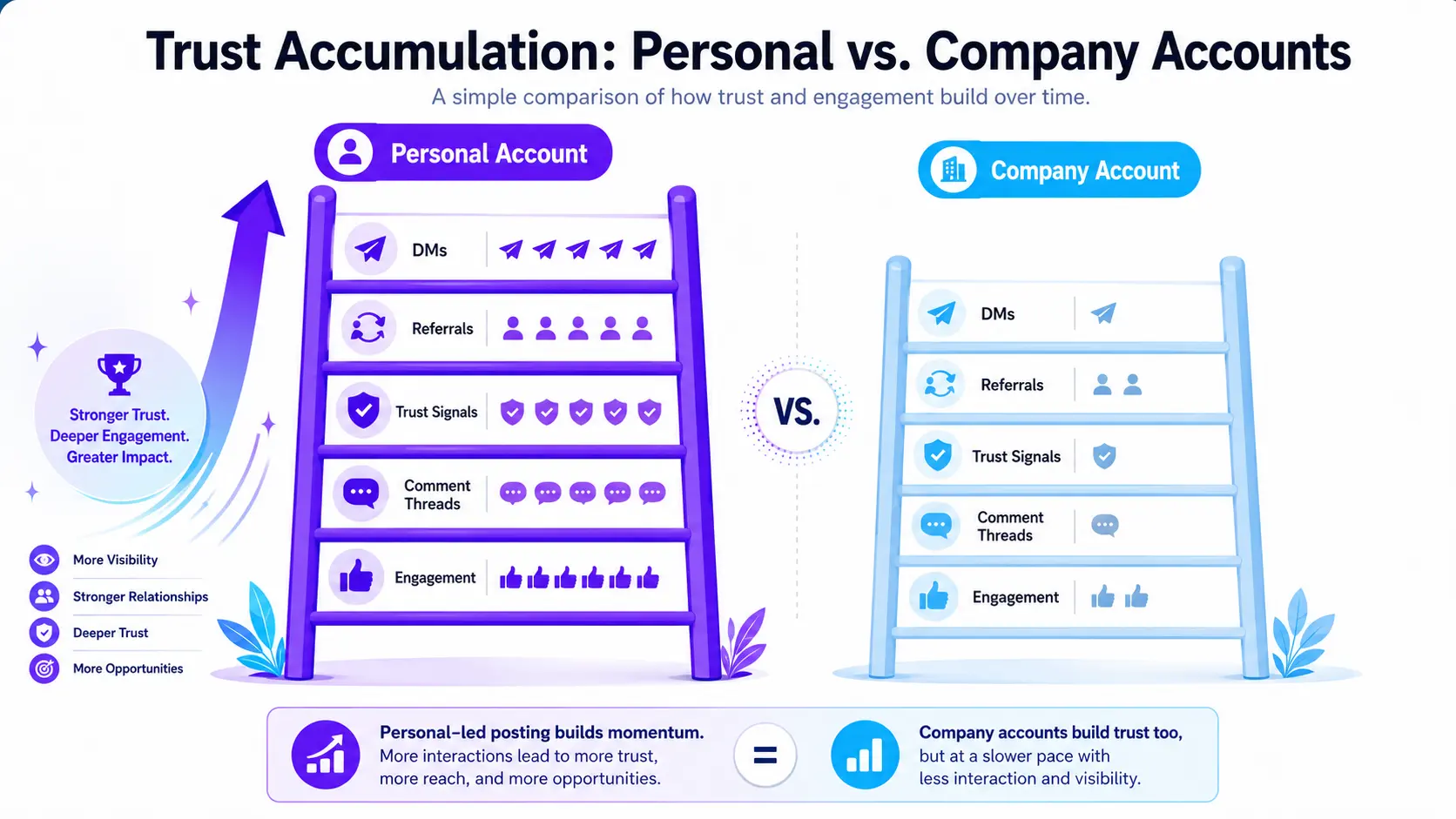
Engagement and confidence metrics behind personal brand trust
It isn’t only perception that shifts with human presence on social – it’s measurable business performance, confirmed by industry surveys and campaign analysis.
Over hundreds of campaigns, the simple pattern emerges: individual-led posts generate up to eight times the engagement of company-only updates.
That’s not a rounding error; it’s the difference between being scrolled past and remembered.
The myth to break: Company channels feel safer, so they generate steadier results.
Yet data shows audiences respond to perceived risk and real voice – 76% of surveyed buyers say they trust information from people over brands in a decision context.
That level of confidence turns attention into action.
One practitioner observation: when coaching clients to run parallel campaigns, personal profiles often drive not just higher engagement, but longer threads of direct replies, questions, and shares – organic conversion signals that company content rarely triggers.
Where does this leave brand strategy?
Relying solely on corporate voice looks efficient on paper, but the trust economy rewards the first credible person, not the first brand.
Therefore, teams that activate their experts, founders, or visible operators turn every post into a diagnostic: Do people react, interact, and re-circulate, or does the message vanish on impact?
Comparison of Personal-Led Posts vs Company-Only Posts Engagement and Trust Metrics
| Growth Stage | Key Characteristics | Risks | Recommended Actions |
| Early Stage | Founder or senior specialist leads; drives engagement and dialogue | Over-dependence on one individual | Amplify personal brand visibility to jumpstart trust |
| Scaling Stage | Declining engagement on company posts; reliance on founder for traffic spikes | Bottleneck and engagement plateau | Weave personal credibility into scalable company assets |
| Mature Stage | Multiple voices echo conviction and values; shared trust across team | Founder dependence limits long-term growth | Deliberate transfer of trust from individual to platform |
The signal is clear: trust builds where there’s visible judgment, not just an approved message.
But that raises the next, messier question – why do company accounts so often fail to compound this effect, even with scale and polish?

What stops company pages from becoming trusted social voices
Company pages spend heavily on slick content calendars and brand-approved language.
But the bigger the budget, the less each post seems to matter.
The counter-intuitive reality: most company pages are engineered for risk reduction, not trust creation, and the result isn’t security – it’s invisibility.
Sanitized language, risk filters, and emotional distance
A company account’s content may read smooth, but it rarely provokes a reaction worth remembering.
Most executives assume risk controls make the brand appear stable.
But mutual familiarity – inside jokes, quick reactions, even mistakes – tend to vanish after policy teams step in.
The result is content that’s correct, but forgettable.
This isn’t just a drop in engagement; these are company page visibility limitations built directly into how companies communicate on social channels.
We’ve watched posts enter review loops that dilute both voice and intent.
It’s common for original insights to be watered down until “safe” equates to “bland”.
The missing ingredient is presence: does anyone really feel another mind is behind the post, or do buyers see compliance at work?
This is where the cost starts to compound.
Polished language may avoid controversy, but it also drifts into generic business noise.
Would you remember one more LinkedIn post about company values or innovation?
Most audiences wouldn’t, either.
The difference is as stark as speaking with a neighbor versus watching a safety demo: both may say the right words, but only one can earn your interest when trust is scarce.
Lack of compound attention without human anchors
Even viral company posts rarely produce new conversations or visible loyalty.
The biggest reason?
No clear person stands behind the message – so no memory gets attached.
Company brand visibility leads to surface attention, but little that sticks past the scroll.
We’ve seen teams mistake reach for retention.
A surge in impressions looks promising, until you discover repeat comments, DMs, and referrals gather around individual contributors.
If there isn’t an identifiable source – someone who stakes reputation – engagement flattens quickly.
This creates a cycle of diminishing returns.
Company accounts can generate presence, but seldom gravity.
Who does the buyer imagine answering if they reply with a tough question?
If there’s no obvious face or voice, dialogue never compounds, and conversion remains improbable.
What starts as a safe, consistent feed winds up as background noise – the kind buyers skim but never invite into deeper discussions.
Careful risk management strips pattern, story, and memory from company pages.
Therefore, the longer a brand stays faceless, the less likely it is to become a trusted participant in a market conversation.
The harder truth lands next: can a visible person fix what a sanitized logo can’t, or is something deeper required?

When visible people should amplify versus replace the company brand
Some organizations sprint to human-led visibility in year one, thinking a magnetic individual can shortcut any market barrier.
But leaning on personal brand too long often leaves companies exposed at the very moment they try to scale.
The sharper decision isn’t whether to let star talent lead on social – it’s how and when to deliberately pass the trust baton from person to platform without breaking momentum.
Sequencing visibility across growth stages
Companies crave explosive traction, especially in markets where attention feels scarce.
It’s common to watch founders or senior specialists become luminaires – driving most engagement, sparking dialogue, even setting the public tone.
But there’s a catch: what starts as an advantage can quietly become a bottleneck.
At early growth stages, buyer trust is accelerated by seeing a real human’s reasoning, priorities, and mistakes.
Decision-makers want a sense of who is behind the screen.
That edge drives the personal brand vs company brand in social media marketing dilemma: a founder-led marketing trust value outpaces anything a cold logo can produce.
But founders can’t – and shouldn’t – try to scale themselves forever.
Visibility Sequencing Across Growth Stages
| Metric | Personal-Led Posts | Company-Only Posts | Notes |
| Engagement Rate | Up to 8x higher | Baseline | Individual-led posts generate significantly more engagement |
| Trust Level | 76% of buyers trust people over brands | Less trusted | Survey shows buyers trust info from people in decisions |
| Organic Conversion Signals | More direct replies, questions, shares | Rarely triggers | Personal profiles drive longer interactive threads |
When a new client asks if they should put all social efforts through one magnetic voice, the answer depends on two signals: concentration risk and transferability of trust.
You can picture the early phase as a relay race, where the founder carries the baton fast out of the gate.
But if the company’s hand stays glued to that baton, the race stalls before the finish line.
So, which signal tells you it’s time to shift gears?
Watch for declining engagement on company posts, dependency on one individual for traffic spikes, and lack of repeatable demand from new faces.
The highest leverage is in sequencing: amplify the individual early, then weave their credibility into something transferrable by design – not by accident.
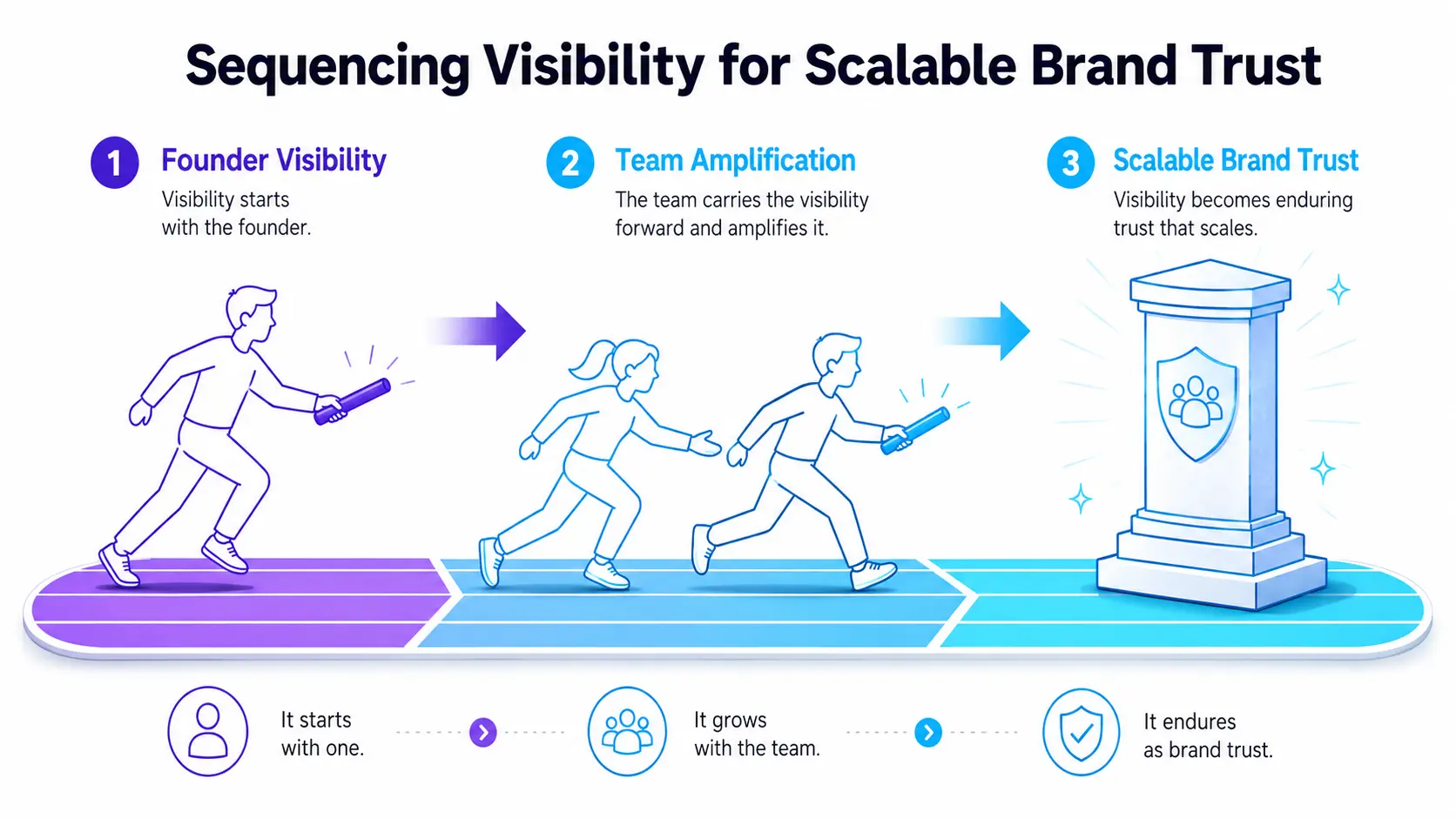
Balancing founder visibility with brand scalability
Most teams hear ‘founder dependency’ and instantly picture PR nightmares if their CEO leaves.
The reality bites long before that.
The deeper risk is letting personal presence eclipse the company’s long-term social memory.
If clients, recruits, and partners see the brand as an empty shell unless a famous face appears, growth capacity hits a hard cap.
Here’s the overlooked switch: hybrid models work best.
Picture a founder as a trust carrier – not a permanent stand-in, but an energy source that jumpstarts attention while architecting repeatable story formats, cultural cues, and content themes others can carry forward.
This requires process.
We’ve watched brands document founder-led narratives, then systematically repurpose them into company asset libraries – think: playbooks, approved themes, even voice principles.
Teams who succeed treat the transition like training a muscle.
They run controlled experiments where posts from both the company and visible leaders echo the same conviction, values, and priorities, but delivered through multiple hands.
Why does this matter commercially?
Founder-driven attention wins credibility and engagement at speed, but unchecked, it breeds pressure to repeat a single play forever.
Therefore, the only scalable version is one where human presence social brand trust moves from individual to group, and finally – selective, deliberate company signatures.
Most companies think amplification is enough.
The smart ones plan for transference.
The real test comes when the founder steps off stage.
If the company account echoes only static branding, trust evaporates almost overnight.
But if years of visible expert thinking have been worked into the brand voice itself, the trust economy personal brand effect doesn’t disappear – it compounds in company memory.
So the right move isn’t amplifying or replacing – it’s sequencing, then deliberately bridging conviction from person to platform.
The next question: what models and process controls keep that bridge strong without risking dilution or loss of authenticity?

Risks you must manage when leaning on personal visibility
A magnetic founder can carry a brand straight through locked doors.
But when the whole strategy sits on one visible individual, the pressure shifts from scaling trust to surviving the next handoff.
The risk isn’t that the personal approach fails – it’s that it fails silently, right when growth looks strongest.
Not all trust is created equal.
Some sticks to the person, not to the company.
That is where the risk multiplies.
Dependency fragility and founder departure risk
A founder’s viral post can send inbound leads surging, but every company that leans exclusively on one face faces the same hidden risk: if that person departs, slows down, or shifts focus, trust can evaporate nearly overnight.
We’ve watched teams celebrate spikes only to spend months patching leaks as attention vanishes.
The signal: distribution drops, DMs slow, and referrals edge to zero.
This isn’t just a loss of reach.
It’s a break in the transfer of trust from personal to company.
Without anchoring personal credibility inside core systems – sales ops, customer success, product feedback loops – the audience’s confidence doesn’t stick.
It floats with the person.
Clients often assume a successor or a shared team page can fill the void, only to see engagement collapse.
So what fixes the foundation?
Treat the personal brand as an on-ramp, not the highway.
The path to durability is weaving individual perspective into company operations before the risk window opens.
What survives a founder’s exit is the muscle memory, not the emoji.
That’s where most organizations misdiagnose strength for resilience.
Visibility misalignment and brand dilution
The visible expert draws a crowd.
But when their posts start to drift – opinion, commentary, even a joke pulling in a different direction – company memory splinters.
Personal brand momentum becomes brand dilution.
Suddenly, the audience knows what the person stands for but forgets what the company delivers.
This misalignment rarely shows up in dashboards.
It appears sideways: new prospects credit the founder, not the firm.
Partners want a meeting with the individual, not the sales team.
Over time, competing narratives form, and a single viral misstep can set positioning back quarters.
Imagine running a campaign where every product signal is on-brand – until the most visible team member signals otherwise in a personal post.
Trust fractures at the edge, not the center.
So the quiet challenge isn’t expert presence, it’s strategic coherence.
The difference between compounding trust and leaking it is predictable alignment – not just more noise.
We’ve seen stronger commercial retention where expert-led content cross-references core positioning, even subtly.
That’s the anchor that holds when storms hit.
The cost of leaning hard on personal visibility isn’t paid in reach – it’s paid in memory and resilience.
Companies building on borrowed trust must decide: will the brand own the narrative before the signal moves on?
The next section moves from audit to action – where strategic handoffs decide whether trust is multiplied or lost.

What to do next: strengthen social media as a human-trust system
Every executive sees the gravity shift: more business is won (or lost) in a DM or comment thread than through the official company feed.
But the mistake is thinking a few thought-leader posts or polished brand campaigns can flip that switch overnight.
What actually moves the needle is a disciplined audit – where attention, trust, and engagement really reside – not where the org logo shows up the most.
Map your visibility gaps across people and channels
Most brand leaders think if everyone on the team shares company posts, visibility gaps close themselves.
But gaps persist where no single person is visible enough, not just where logos are absent.
The sharper reality: buyers track humans.
They remember who delivered a perspective, who showed up across their feed, who had a point-of-view when it mattered.
Teams that treat social as a leaderboard – tracking which people are actually accruing trust, which channels hold repeat attention, and which voices drive real questions – see the pattern fast.
Sometimes a niche expert with a small following creates outsized deal flow, while a well-funded company account becomes white noise.
One analogy: high-trust social presence is less like a broadcast tower and more like a web of spotlights.
Some areas are bright, some remain dark, and every shadow hides a missed opportunity.
So where do you start?
Make a people-first inventory: who is visible on your core channels, who gets replies from target buyers, and who drives off-platform conversations?
When we have run these gap maps for clients, the black holes always appear – department heads with zero public signal, founders only active on one channel, or experts whose personal brand has stalled.
That’s where future churn sneaks in, even if the funnel looks full today.
Prepare handoffs into targeted deeper assets
Visibility without depth creates fleeting attention, not trust.
But attention compounds when a noticed person routes it to a deeper asset – like a relevant explainer, a buyer diagnostic, or a specialist’s original framework.
Hands-off, the pathway splinters: audience forgets, interest dissolves, intent drops.
Directing attention from public social moments into high-value assets – owned explainers, events, or expert guides – lets buyers compound their trust privately.
We’ve seen founder DMs spike demo requests, but conversions only jump when a recipient lands on a real resource, not just a LinkedIn profile.
The practical move: build obvious next steps into every visible touchpoint.
Not as a pitch, but as a route – “If this speaks to your industry, check this breakdown”, or “Our lead strategist just unpacked this topic in detail here”.
So, the commercial upside isn’t just more impressions.
It’s the ability to direct signal-rich attention into assets that work hardest for the business – while limiting drop-off at every stage.
The gap isn’t in how much content is shipped or which posts go viral.
The unanswered question is which individual’s presence creates a steady, ownable route from surface-level curiosity to commercial trust.
That’s where the real compounding starts – and the next decision isn’t about volume, but about mapping your organization’s actual trust pathways.

Scientific context and sources
The sources below provide foundational context for how decision-making, attention, and performance dynamics evolve under scaling and constraint conditions.
- Social credibility and trust on digital platforms
What Do We Mean When We Talk about Trust in Social Media? A Systematic Review – Yixuan Zhang, Joseph D. Gaggiano, Nutchanon Yongsatianchot, Nurul M. Suhaimi, Miso Kim, Yifan Sun, Jacqueline Griffin, Andrea G. Parker – arXiv
This systematic review explains how trust in social media is defined, measured, and shaped by platform, user, and content cues. It supports the article’s point that credibility on social platforms depends on visible signals, source cues, and user interpretation, not only on brand-level presence.
https://arxiv.org/abs/2302.03671 - Impression formation and personalization
Impression Formation in Cyberspace: Online Expectations and Offline Experiences in Text-based Virtual Communities – David Jacobson – Journal of Computer-Mediated Communication
This paper explains how people form impressions online when face-to-face cues are limited. It supports the article’s point that visible individual signals, names, language, and interaction patterns can shape credibility more strongly than abstract or faceless communication.
https://academic.oup.com/jcmc/article/5/1/JCMC511/4584195 - Organizational risk and visibility
Testing the Linkages Among the Organization-Public Relationship and Attitude and Behavioral Intentions – Eyun-Jung Ki, Linda Childers Hon – Journal of Public Relations Research
This article examines how organization-public relationship perceptions connect to attitudes and behavioral intentions. It supports the article’s point that trust, commitment, and relationship quality shape whether audiences move beyond passive awareness into supportive behavior.
https://www.tandfonline.com/doi/abs/10.1080/10627260709336593 - Personal branding and influence
Putting the Person Back in Person-Brands: Understanding and Managing the Two-Bodied Brand – Susan Fournier, Giana M. Eckhardt – Journal of Marketing Research
This article explains how person-brands create value through human qualities, while also creating risk through inconsistency, social embeddedness, and dependence on the individual. It supports the article’s argument that personal visibility can build trust faster than company-only branding, but must be managed carefully.
https://doi.org/10.1177/0022243719830654 - How social proof and authority shape trust
Social Influence: Compliance and Conformity – Robert B. Cialdini, Noah J. Goldstein – Annual Review of Psychology
This canonical review explains how authority, social norms, compliance, and conformity influence perception and behavior. It supports the article’s point that trust is shaped by social signals and perceived authority, not only by formal organizational messaging.
https://www.annualreviews.org/doi/full/10.1146/annurev.psych.55.090902.142015
Questions You Might Ponder
Why do personal brands build trust faster than company brands on social media?
Personal brands build trust faster because audiences can assess real intent, personality, and conviction. Individuals display vulnerability, direct engagement, and accountability – key signals that logos and sanitized company accounts often lack – leading to deeper, faster audience trust and recall.
What are the main risks of relying on a single visible person for brand growth?
The primary risks include founder dependency, which can cause a loss of momentum or trust if the individual leaves or shifts focus, and misalignment with company values, which can dilute brand memory and hinder scalable long-term growth strategies.
How can companies transition from a personal-led to a scalable brand-led strategy?
Effective transition requires sequencing: amplifying visible experts early, codifying their voice and insights into company playbooks, then systematically handing off narrative control to company assets – balancing human credibility with scalable brand structure.
Do metrics show differences in engagement between personal and company social posts?
Yes. Research and campaign data consistently show personal-led posts generate significantly higher engagement – up to eight times more – than company-only posts, with more direct comments, shares, and thread depth, leading to increased buyer action and loyalty.
What practical steps help companies compound trust on social media over time?
Map visible people and their engagement, identify channel gaps, direct attention from visible individuals into deeper company assets, and orchestrate planned transitions of trust – ensuring continuity, measurable impact, and resilience against personnel changes.