Table of Contents
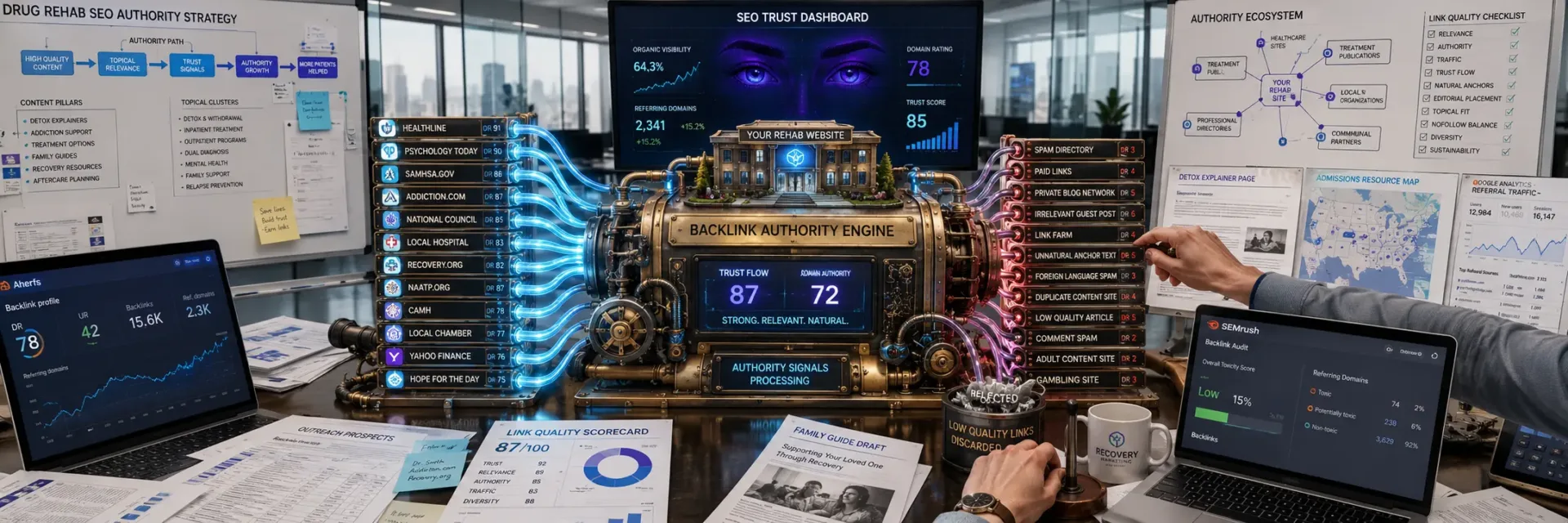
Backlinks for drug rehab are external links from other websites to a drug rehab center’s website that act as trust and authority signals for search engines and users.
Strong backlinks usually come from credible, relevant sources such as healthcare sites, recovery resources, local organizations, professional directories, community partners, educational content hubs, or addiction treatment publications.
For drug rehab SEO, backlink quality matters more than quantity because addiction treatment is a sensitive, high-trust category.
Effective backlinks support rankings, referral traffic, credibility, and visibility for treatment, detox, admissions, family support, and location pages while helping search engines see the rehab center as a trusted resource.
Introduction
Backlinks are not just an SEO checkbox for drug rehab centers.
They are trust signals.
In addiction treatment, trust decides whether people stay on the page, compare your center, and take the next step.
A family member may be searching under pressure.
A person struggling with substance use may be looking for help privately.
Search engines also need signals that your website is credible enough to rank for sensitive treatment-related searches.
That is where backlinks matter.
A backlink is a link from another website to yours.
When a relevant and trusted site links to your rehab center, it tells search engines that your content has value.
The stronger and more relevant those links are, the more they can support your search visibility.
For drug rehab websites, this matters because SEO is already competitive.
Many centers target the same treatment, detox, and location-based searches.
A clear content strategy helps, but content alone may not be enough.
Your site also needs authority.
That is why backlinks are a core part of SEO for drug rehab marketing.
Significance of SEO in Drug Rehab Marketing
SEO helps drug rehab centers appear when people search for treatment options, addiction support, detox services, and rehab programs.
This matters because many people search before they call.
They may compare centers, read reviews, check locations, review treatment types, and look for signs that a center feels safe and credible.
Strong SEO can help your center:
- Appear for relevant treatment searches
- Reach people actively looking for help
- Support trust before the first call
- Bring more qualified organic traffic
- Reduce overreliance on paid media
- Make important treatment pages easier to find
But rankings do not come from content alone.
Search engines also look at signals from outside your website.
Backlinks are one of those signals.
The Role of Backlinks in SEO Success
Backlinks can help search engines understand whether your website deserves more trust.
A link from a credible health resource, local organization, recovery-related site, or relevant publication can carry more value than a random link from an unrelated website.
For drug rehab centers, link quality matters more than link count.
A large number of weak links can create risk.
A smaller number of relevant, credible links can support stronger search performance.
Good backlinks can help your rehab website:
- Improve authority
- Support higher rankings
- Bring referral traffic
- Build credibility
- Strengthen important treatment pages
- Compete for harder keywords
But backlinks need to be earned carefully.
Addiction treatment is a sensitive field.
Aggressive link tactics, spam directories, and low-quality guest posts can damage trust instead of building it.
Building Strong Backlinks
A strong backlink strategy starts with useful content.
Other websites need a real reason to link to you.
That reason may be a treatment guide, clinical explanation, local resource, family support article, original insight, or clear answer to a common admissions question.
Useful backlink methods include:
- Publishing helpful treatment resources
- Creating content for families and decision-makers
- Building local partnerships
- Contributing expert articles to relevant websites
- Sharing original insights or data
- Earning mentions from recovery-related organizations
- Creating resources that referral partners can use
The goal is not to collect links from anywhere.
The goal is to earn links that make sense for your center, your audience, and your SEO strategy.
Backlinks can help drug rehab websites build authority, improve search visibility, and reach more people who are already looking for treatment support.
Used correctly, they become part of a larger growth system: better content, stronger trust, higher visibility, and more qualified admissions conversations.

Start building strong backlinks today.
Understanding Backlinks
Backlinks are links from other websites to your website.
Simple idea.
Serious impact.
For a drug rehab center, backlinks can affect how search engines judge your site’s authority.
They can also send referral traffic from places people already trust, such as recovery resources, local partners, health websites, professional directories, or media mentions.
But backlinks are not equal.
A link from a trusted, relevant health or recovery website can support your SEO.
A link from a spam-heavy or unrelated site can create risk.
In addiction treatment, this matters more than usual because the topic is sensitive.
Search engines look for trust.
People look for trust.
Your backlink profile should support both.
Definition and Explanation of Backlinks
A backlink is a hyperlink from one website to another.
If another site links to your drug rehab website, that link can act as a signal that your content is useful or credible.
There are two broad types to understand:
- Internal backlinks: Links between pages on your own website.
- External backlinks: Links from other websites to your website.
Both matter, but they do different jobs.
Internal links help visitors and search engines move through your site.
For example, a blog post about detox can link to your detox program page, admissions page, or residential treatment page.
External backlinks help build authority outside your own site.
For example, a local community organization, clinical resource, or recovery publication may link to one of your educational guides.
The external link carries more weight as an outside signal because it comes from another website.
Importance of Backlinks in SEO
Search engines use backlinks as trust signals.
A website with strong, relevant backlinks can be easier to rank because other credible sites are pointing to it.
For drug rehab centers, backlinks can support several SEO goals:
- Better search rankings: Relevant backlinks can help your pages compete for treatment, detox, and location-based searches.
- More organic visibility: Stronger rankings can make your center easier to find when people search for rehab options.
- Referral traffic: Links from trusted websites can send visitors directly to your site.
- Higher authority: Credible links can help your website become a stronger source in the addiction treatment space.
- More trust before contact: If people find you through a reliable source, the first trust barrier is lower.
The key is relevance.
A backlink from a recovery-related, health-related, local, clinical, or educational source is usually more useful than a random link from a weak directory.
How Backlinks Influence Search Engine Rankings
Search engines do not treat every backlink the same way.
They look at the quality, context, and relevance of the linking page.
Three factors matter most.
Quality over quantity
A few strong links can be more useful than many weak links.
A backlink from a respected health website, recovery resource, or local organization can carry more value than dozens of links from unrelated sites.
Weak links can also create risk if they look manipulative or spam-heavy.
Relevance matters
A link from a site connected to addiction treatment, mental health, healthcare, local services, or family support is more relevant than a link from a random business blog.
Relevance helps search engines understand why your website deserves attention for rehab-related searches.
Anchor text matters
Anchor text is the clickable text used in a link.
For example, if another website links to your page using the words “residential addiction treatment”, that gives search engines context about the linked page.
But anchor text should look natural.
Too many keyword-heavy anchors can look artificial.
A healthy backlink profile usually includes a mix of branded anchors, page titles, natural phrases, and relevant terms.
Techniques for Building Strong Backlinks
Strong backlinks usually come from strong reasons to link.
That means your website needs assets worth referencing.
Useful backlink-building methods include:
Content creation
Create resources that other websites would reasonably cite.
Examples include:
- Family guides
- Treatment explainers
- Detox education pages
- Local addiction support resources
- Rehab comparison guides
- Aftercare and relapse prevention resources
- FAQ pages that answer real admissions questions
The better the resource, the easier it is to earn relevant links.
Guest posting
Write expert articles for relevant websites.
This can work when the article is useful, accurate, and placed on a credible site.
It should not look like a link scheme.
For rehab centers, guest content should focus on education, treatment clarity, family support, recovery resources, or local community needs.
Social media distribution
Social media links may not carry the same SEO weight as editorial backlinks, but they can help more people discover your content.
More visibility can lead to natural mentions, shares, and links from other websites.
Community participation
Forums, Q&A sites, and professional discussions can create referral opportunities when used carefully.
The goal is to answer questions well, not drop links everywhere.
A link should be added only when it genuinely helps the reader.
What Rehab Centers Should Avoid
Backlink building can harm SEO when it becomes aggressive.
Avoid:
- Paid link schemes
- Spam directories
- Irrelevant guest posts
- Automated link building
- Private blog networks
- Overused keyword anchor text
- Links from low-quality sites
- Fake recovery resources created only for SEO
Addiction treatment is a trust-heavy category.
A backlink strategy that looks manipulative can weaken the brand and create search risk.
The Practical Standard
A good backlink should pass a simple test:
Would this link make sense to a real person?
If the answer is yes, the link may support trust and SEO.
If the answer is no, it is probably noise or risk.
For drug rehab centers, backlink strategy should focus on credible relationships, useful resources, relevant sites, and clean authority growth.
That is how backlinks support search visibility without damaging trust.

Begin by building strong backlinks.
Techniques for Building Strong Backlinks
Strong backlinks do not come from random outreach.
They come from content and relationships that make sense.
For a drug rehab center, that means your site needs resources worth referencing.
A weak article with a link request will not build authority.
A useful guide, a clear clinical explanation, or a local recovery resource has a better chance of earning links from sites people already trust.
The standard is simple: Would another credible website have a real reason to link to this page?
If not, the backlink strategy needs better assets.
Creating High-Quality Content That Attracts Backlinks
Content earns links when it helps another site support its own readers.
For rehab centers, that usually means content that explains treatment clearly, answers family concerns, or gives practical context around addiction recovery.
Useful linkable content can include:
Informative articles
Write articles that explain drug rehab topics in clear, accurate language.
Good topics may include detox, residential treatment, dual diagnosis care, relapse prevention, family involvement, admissions, privacy, and aftercare.
The article should answer real questions.
It should not read like a sales page.
How-to guides
Step-by-step guides can attract links because they are easy to reference.
Examples include:
- How to talk to a loved one about treatment
- How the rehab admissions process works
- How to prepare for residential treatment
- How families can support recovery after treatment
- How to compare rehab options safely
These pages can support search traffic and also become resources that other sites can cite.
Case studies
Case studies can show how treatment, family support, clinical care, or aftercare planning works in practice.
For addiction treatment, case studies must protect privacy.
They should avoid identifiable personal details unless consent is clear and documented.
The point is not to sensationalize outcomes.
The point is to explain process, care, and decision points in a way that builds trust.
Publishing useful content gives other websites a stronger reason to link to your pages.
A strong off-page strategy starts with assets that are beneficial to link to your pages.
Guest Posting and Collaborating with Industry-Related Websites
Guest posting can still work, but only when it is selective.
A generic guest post on a weak site does little.
A useful article on a relevant health, recovery, family support, community, or professional site can help your center earn a cleaner backlink and reach a more relevant audience.
Use guest posting carefully.
Identify reputable sites
Look for websites connected to addiction recovery, mental health, healthcare, local community support, family education, or professional services.
Check whether the site has real readers, clear editorial standards, and a clean backlink profile.
Avoid sites that publish any guest post for a fee.
Write posts that fit the audience
A guest post should serve the host site’s readers.
Good topics may include:
- How families can recognize treatment readiness
- What to know before choosing a rehab center
- How aftercare supports long-term recovery
- How dual diagnosis affects treatment planning
- How employers can support workers seeking treatment
The link back to your site should feel natural and useful.
Build real relationships
One guest post is useful.
A relationship is better.
Build connections with site owners, clinicians, local organizations, community partners, and recovery educators.
Those relationships can lead to future content, referrals, interviews, citations, and more relevant backlinks.
Using Social Media to Promote Content and Gain Backlinks
Social media links alone usually do not carry the same SEO value as editorial backlinks.
But social media can still help backlink growth.
It puts your content in front of people who may cite it later: clinicians, local groups, journalists, bloggers, referral partners, alumni communities, and family support organizations.
Share regularly
Post useful resources, guides, articles, and case studies on platforms such as Facebook, X, and LinkedIn.
Do not post only promotional content.
Share pages that answer real questions and can help people understand treatment options.
Engage with followers
Respond to comments.
Join relevant discussions.
Share useful context without turning every interaction into a sales pitch.
The more useful the content is, the more likely people are to save it, share it, or reference it from another website.
Collaborate with relevant voices
Partner with credible people or organizations in the addiction treatment, recovery, mental health, family support, or local community space.
The goal is not influencer hype.
The goal is responsible distribution through people and groups your audience already trusts.
Engaging in Community Forums and Q&A Sites for Backlink Opportunities
Forums and Q&A sites can create referral traffic and occasional backlink opportunities.
But this has to be handled carefully.
Drug rehab is a sensitive topic.
Dropping links into discussions can look exploitative and may damage trust.
The better approach is to answer questions clearly, then link only when the page adds real value.
Find relevant communities
Look for places where people ask real questions about addiction, recovery, family support, treatment options, or local help.
These may include Reddit, Quora, recovery forums, local groups, and professional discussion spaces.
Provide useful answers
Answer the question directly.
Avoid vague claims.
Avoid pushing your center.
Explain the issue, give practical context, and point people to safer next steps.
Add a link only when it expands the answer.
Be consistent
One answer will not build authority.
Regular, responsible participation can build reputation over time.
It can also help your team understand the questions people ask before they contact treatment providers.
That insight can feed your content strategy.
What Makes Backlink Building Work
Backlink building works when it feels earned.
A strong rehab website gives other sites a reason to cite it.
It publishes useful resources, builds relevant relationships, shares content responsibly, and participates in communities without exploiting vulnerable people.
That is how backlinks support SEO without creating brand or compliance risk.
The goal is not more links at any cost.
The goal is better authority from better sources.

Focus on creating valuable content.
Specific Strategies for Drug Rehab Websites
Drug rehab websites need a careful backlink strategy.
This is not a category where you should chase links from anywhere that accepts them.
The site is dealing with sensitive decisions, private concerns, and high competition in search.
A strong backlink should make sense in context.
It should come from a relevant source.
It should support trust.
It should point to content that genuinely helps the reader.
That is the standard.
Strategies Built for Drug Rehab Websites
1. Create valuable content
Backlinks start with content worth linking to.
For rehab centers, that usually means content that answers real treatment, recovery, family, and admissions questions.
Useful content types include:
- Blog posts that explain the rehab process in plain language
- Guides for families comparing treatment options
- Pages about detox, residential care, dual diagnosis, and aftercare
- Privacy and admissions explainers
- Recovery planning resources
- Infographics that explain data, treatment steps, or recovery timelines
- Case-based resources that protect privacy and avoid personal identification
The content should be useful enough that another website could reference it without needing to sell your center.
That is what makes it linkable.
2. Use outreach with a clear reason
Outreach works when the message gives the recipient a real reason to care.
Do not send generic backlink requests.
Instead, contact relevant websites, organizations, bloggers, clinicians, referral partners, and community groups when you have a useful resource that fits their audience.
Good outreach should explain:
- Why the resource is relevant
- Who it helps
- What problem it answers
- Where it could fit on their website
- Why linking to it would help their readers
Personalized outreach works better than mass outreach because rehab content needs context and trust.
3. Use social media to build visibility
Social media can help get useful content in front of people who may later reference it.
This can include clinicians, family support groups, recovery advocates, local organizations, journalists, and other content publishers.
Share content that answers real questions.
Examples:
- How families can prepare for a treatment conversation
- What happens during admissions
- How detox connects to residential care
- What privacy means during treatment
- How aftercare planning works
The goal is not to collect social links.
The goal is to increase reach so the right people discover and cite your content.
4. Guest post only on credible sites
Guest posting can help, but only when the site is relevant and credible.
For drug rehab websites, guest posts should focus on education, recovery support, family guidance, treatment planning, or local community needs.
Avoid websites that publish thin guest posts from any industry.
A good guest post opportunity should meet a few standards:
- The site has a real audience
- The topic fits addiction treatment, health, recovery, families, or local support
- The editor cares about quality
- The link fits naturally
- The content helps the host site’s readers
Guest posting should build trust, not just links.
5. Participate in online communities carefully
Online communities can create useful visibility, but they require restraint.
Addiction treatment discussions are personal.
Link dropping can feel exploitative.
Use communities like Reddit and Quora only when you can answer questions responsibly.
A good community answer should:
- Answer the question directly
- Avoid promotional language
- Give practical context
- Encourage safe next steps
- Link only when the resource adds real value
Community participation can also show you what people ask before contacting a rehab center.
Those questions can guide better content.
6. Collaborate with related websites
Collaboration can create better backlinks than cold outreach.
Relevant partners may include:
- Recovery communities
- Mental health blogs
- Local health organizations
- Family support groups
- Addiction education sites
- Professional associations
- Community service organizations
- Other non-competing treatment resources
Useful collaboration formats include:
- Joint webinars
- Co-authored articles
- Expert interviews
- Local resource pages
- Recovery education guides
- Family support content
These links tend to be stronger because they come from real relationships and useful shared content.
What Makes These Strategies Work
The strongest backlinks for drug rehab websites usually come from three things:
- Useful content
- Relevant relationships
- Clean context
A backlink from a trusted recovery resource is better than a link from a random business site.
A link to a helpful guide is better than a link forced into a thin article.
A natural mention from a partner is better than a mass-produced guest post.
For rehab centers, backlink building should support authority without creating risk.
That means fewer weak links, more relevant sources, and content that deserves to be referenced.
A related decision is covered in Boost Your Rankings, which explains the adjacent issue in more detail.

Start by creating valuable content and engaging in outreach.
Measuring and Analyzing Backlink Success
Backlink work should not be judged by link count alone.
A rehab center can gain dozens of links and still see no useful business impact.
Some links bring authority.
Some bring referral traffic.
Some support rankings.
Some create risk.
Some add nothing.
That is why backlink success needs to be measured with the same discipline as paid media, SEO content, and conversion work.
The real question is not: How many backlinks did we get?
The better question is: Which backlinks improved visibility, trust, traffic quality, and admissions opportunities?
Tools and Metrics to Track the Effectiveness of Backlinks
Several tools and metrics can help you monitor backlink performance.
Use them to understand both SEO value and business value.
- Google Analytics
Google Analytics helps you see how backlink traffic behaves after people reach your site.
It gives comprehensive data on traffic sources, landing pages, engagement, and conversions.
For rehab centers, pay close attention to:
- Referral traffic – See which external websites are sending visitors to your site.
- Conversion rates – Track whether referral visitors call, submit a form, start a chat, or visit admissions pages.
- Engagement quality – Review time on page, pages per session, and key page visits.
- Lead paths – Check whether backlink visitors move from educational content to treatment or contact pages.
A backlink is more useful when it brings people who engage and take meaningful action.
- Ahrefs
Ahrefs is useful for backlink profile analysis.
It helps you review:
- Backlink profile – See the number, source, and quality of sites linking to you.
- Domain Rating – Estimate the strength of domains linking to your website.
- Lost links – Find links that disappeared and may need follow-up.
- Competitor links – See where competing rehab centers are earning authority.
- Anchor text – Review the clickable text used in links pointing to your site.
For drug rehab websites, Ahrefs can help you separate useful links from weak or risky ones.
- Moz
Moz offers tools for tracking and analyzing backlinks along with other SEO signals.
Useful areas include:
- Link Explorer – Review the strength and relevance of links pointing to your website.
- Spam Score – Identify links that may be risky or low quality.
- Domain Authority – Estimate the authority of linking domains.
- Link growth – Track whether your backlink profile is improving over time.
Moz can be especially useful for spotting patterns in link quality, not just link volume.
- SEMrush
SEMrush includes backlink analysis, backlink audits, and competitor comparison.
Use it to review:
- Backlink audit – Find toxic or suspicious links that may create SEO risk.
- Competitor analysis – Compare your link profile with other treatment centers.
- Referring domains – See which websites are linking to you.
- Authority signals – Review whether new backlinks are helping or weakening your profile.
- Link gaps – Find relevant websites that link to competitors but not to you.
This is useful when you need to decide where outreach should go next.
How to Analyze Data and Refine Backlink Strategies for Better Results
Backlink data should lead to action.
The goal is not to build a longer report.
The goal is to improve the quality, relevance, and impact of your link profile.
- Evaluate backlink quality
Focus on quality before quantity.
A strong backlink usually comes from a site that is relevant, trusted, and connected to health, recovery, addiction treatment, local community work, family support, or professional services.
Review:
- Domain authority – Higher-authority sites can pass more SEO value.
- Relevance – A link from a related website is usually more useful than a random link.
- Placement – A link inside useful content is stronger than a link buried in a low-value directory.
- Context – The link should make sense in the sentence and on the page.
- Anchor text – The clickable text should look natural, not manipulative.
For rehab centers, relevance and trust matter more than raw link volume.
- Monitor referral traffic
A backlink can support SEO even if it sends little traffic.
But referral traffic still matters.
Check which links are sending real visitors.
Then check what those visitors do.
Ask:
- Do they stay on the site?
- Do they visit treatment pages?
- Do they click admissions pages?
- Do they call or submit forms?
- Do they come from relevant locations?
- Do they match your ideal inquiry profile?
If a link sends qualified visitors, look for more partnerships or placements like it.
- Track ranking movement
Backlinks can support rankings over time.
Monitor whether important pages improve after gaining relevant links.
Focus on pages tied to business value, such as:
- Treatment pages
- Detox pages
- Dual diagnosis pages
- Location pages
- Admissions pages
- Family support pages
- Private care pages
Do not expect every backlink to create an immediate ranking jump.
Look for broader patterns across keyword groups and landing pages.
- Identify and manage toxic links
Toxic links are links from spammy, irrelevant, or low-quality websites.
They can create SEO risk, especially if your backlink profile looks manipulated.
Review:
- Toxic link score – Use backlink tools to flag suspicious links.
- Spam-heavy domains – Watch for sites with no real audience or unrelated content.
- Unnatural anchor text – Look for repeated exact-match keyword anchors.
- Sudden link spikes – Investigate unusual backlink growth.
- Disavow process – Use Google’s disavow tool only when harmful links are serious and cannot be removed.
Do not panic over every weak link.
Most websites attract some low-quality links.
Focus on patterns that create real risk.
- Refine outreach and content strategy
Use backlink data to improve your next actions.
If a family guide earns quality links, create more family-focused resources.
If a local resource page gets links from community sites, expand local content.
If a treatment explainer earns links from health or recovery websites, build more content in that format.
Review:
- Successful campaigns – Repeat the outreach and content types that earned relevant backlinks.
- Content optimization – Improve pages that attract links but do not convert.
- Missed opportunities – Find competitor links you can realistically pursue.
- Relationship sources – Prioritize partners and publishers that send useful traffic or authority.
- Page-level impact – Send new links to pages that matter for admissions, not only blog posts.
What Backlink Success Should Look Like
A healthy backlink strategy should show progress in several areas:
- More links from relevant websites
- Fewer risky or irrelevant links
- Better authority for important pages
- More referral traffic from trusted sources
- Stronger rankings for treatment and location keywords
- More visitors moving from linked content to admissions pages
- Better visibility against direct competitors
For drug rehab centers, backlink success is not about chasing the largest possible backlink profile.
It is about building authority that search engines can trust and people can understand.
When measurement is done well, backlinks stop being a vague SEO activity.
They become a controlled part of the growth system: content earns links, links build authority, authority supports rankings, rankings bring qualified visitors, and the website moves those visitors toward a real admissions conversation.

Start by evaluating the quality of your existing backlinks.
Conclusion
Backlinks can raise search visibility, but only when they come from the right places.
For drug rehab centers, the standard has to be higher than “we got a link”.
A useful backlink should come from a credible, relevant source.
It should point to content that helps the reader.
It should make sense in the context where it appears.
It should support trust, not create doubt.
That is the difference between authority and noise.
Recap of the Importance of Backlinks
Backlinks help search engines decide whether your website deserves more trust.
When respected websites link to your rehab content, they send a signal that your page is worth referencing.
That can support stronger rankings, better organic visibility, and more referral traffic from people who are already reading trusted sources.
The strongest backlink profiles usually have a few traits:
- Links from relevant health, recovery, clinical, local, or educational websites
- Natural anchor text that does not look forced
- Links placed inside useful content, not buried on weak pages
- A steady pattern of authority growth
- Few spam-heavy or unrelated links
- Clear connection between linked pages and real user needs
For addiction treatment, backlink quality matters more than quantity.
A small number of strong links can do more than a large number of weak ones.
Key Benefits of Building Strong Backlinks
Better website visibility
Strong backlinks can help important pages rank higher in search results.
This can make your rehab center easier to find for treatment, detox, family support, and location-based searches.
Higher credibility
Links from trusted websites can support your center’s authority.
This matters because people comparing treatment options are looking for signs that your center is reliable before they contact admissions.
Stronger SEO performance
Backlinks remain one of the major off-page SEO signals.
When combined with clear content, technical SEO, and strong page structure, they can help your website compete for harder keywords.
More qualified traffic
A relevant backlink can send visitors who already have interest in addiction treatment, recovery support, or related services.
That traffic can be more useful than random traffic because the context is stronger.
More support for key pages
Backlinks can help treatment pages, admissions pages, detox pages, local pages, and resource guides gain authority.
That helps search engines understand which pages deserve more attention.
Encouragement to Implement Backlink Strategies
A backlink strategy should start with the assets your center already has – or needs to build.
Do not begin with outreach.
Begin with content worth referencing.
A practical plan may look like this:
- Create useful resources
Build pages that help families, patients, referral sources, and local organizations understand treatment better.
Examples include:
- Family guides
- Detox explainers
- Residential treatment pages
- Dual diagnosis resources
- Admissions process pages
- Aftercare planning guides
- Local recovery resource pages
- Review current backlinks
Use tools such as Google Analytics, Ahrefs, Moz, or SEMrush to review your existing backlink profile.
Look for strong links, weak links, lost links, risky links, and pages that already attract references.
- Improve linkable pages
If a page already earns links, make it better.
Add clearer structure, stronger answers, better internal links, more useful FAQs, and a stronger next step.
- Build relevant relationships
Reach out to recovery organizations, local partners, health websites, professional groups, and educational publishers when your resource could help their readers.
Avoid generic link requests.
- Use guest content carefully
Contribute articles only to credible websites where the topic fits.
The article should educate, not exist only to place a link.
- Share content responsibly
Use social channels, community spaces, and partner networks to put useful resources in front of people who may reference them later.
Avoid link dropping in sensitive discussions.
The Practical Standard
A good backlink should pass four checks:
- Is the source relevant?
- Is the website credible?
- Does the link help the reader?
- Would the link still make sense without SEO as the goal?
If the answer is yes, the link can support trust and search authority.
If the answer is no, it may be a risk or a waste of time.
For drug rehab centers, backlink building is not about collecting as many links as possible.
It is about earning the right links from the right sources to support the right pages.
That is how backlinks become part of a stronger growth system: useful content earns authority, authority supports rankings, rankings bring better visitors, and better visitors create more qualified admissions conversations.

Questions You Might Ponder
Why are backlinks important for SEO in drug rehab marketing?
Backlinks are important for SEO in drug rehab marketing because they signal to search engines that your website is trustworthy and authoritative. High-quality backlinks from reputable sites can significantly improve your search engine rankings, making your site more visible to potential clients. This increased visibility helps attract more organic traffic, which can lead to higher conversion rates and more clients for your rehab center.
What are the best strategies for building strong backlinks?
The best strategies for building strong backlinks include creating high-quality content, engaging in guest posting, utilizing social media, and participating in community forums and Q and A sites. High-quality content attracts natural backlinks from other websites. Guest posting on reputable sites helps gain exposure and backlinks. Social media promotion increases content visibility, and participating in online communities allows you to share your expertise and gain valuable backlinks.
How can social media help in gaining backlinks for a drug rehab website?
Social media can help gain backlinks by increasing the visibility of your content. When you share valuable articles, guides, and case studies on platforms like Facebook, Twitter, and LinkedIn, it reaches a wider audience. Engaging with followers and influencers can lead to more shares and links back to your site. Social media acts as a platform to showcase your content, encouraging others to link to it from their websites.
What tools can be used to track the effectiveness of backlinks?
Tools to track the effectiveness of backlinks include Google Analytics, Ahrefs, Moz, and SEMrush. Google Analytics helps track referral traffic and conversion rates from backlinks. Ahrefs provides detailed reports on backlink profiles and domain ratings. Moz offers tools for link strength and spam score analysis. SEMrush provides backlink audits and competitor analysis. These tools help monitor and evaluate backlink performance, guiding strategy improvements.
How do backlinks influence search engine rankings?
Backlinks influence search engine rankings by acting as endorsements for your site’s content. Search engines view backlinks from reputable and relevant sites as signals of quality and trustworthiness. High-quality backlinks can improve your domain authority and boost your site’s position in search results. The relevance and quality of the backlinks, as well as the anchor text used, all play a role in determining their impact on rankings.
What are the benefits of engaging in guest posting for drug rehab websites?
Guest posting benefits drug rehab websites by increasing their exposure and gaining high-quality backlinks. Writing articles for reputable industry-related websites helps reach a broader audience and build credibility. Including natural backlinks to your site in these posts drives referral traffic and boosts SEO. Guest posting also fosters relationships with other site owners, opening opportunities for future collaborations and backlink opportunities.
How can you evaluate the quality of backlinks?
You can evaluate the quality of backlinks by considering the domain authority of the linking site, the relevance of the content, and the context of the backlink. High domain authority sites provide more value. Backlinks from relevant sites in the same industry or niche are more beneficial. Additionally, the anchor text used and the placement of the link within the content can impact its quality and effectiveness.
What are the risks of having toxic backlinks, and how can they be managed?
Toxic backlinks can harm your SEO by lowering your site’s credibility and rankings. These links often come from spammy or low-quality sites. To manage toxic backlinks, regularly review your backlink profile using tools like Ahrefs or SEMrush. Identify and disavow harmful links through Google’s Disavow Tool. This process helps ensure that search engines ignore these toxic links, protecting your site’s SEO performance.
How can participating in community forums and Q and A sites benefit drug rehab websites?
Participating in community forums and Qu0026amp;A sites benefits drug rehab websites by allowing you to share your expertise and gain valuable backlinks. Providing helpful answers and linking back to relevant content on your site increases your site’s visibility and authority. Active participation builds your reputation in the industry, attracts traffic, and enhances SEO through quality backlinks from engaged community members.
What is the role of anchor text in backlinks, and why is it important?
Anchor text is the clickable text in a hyperlink that leads to your site. It is important because it provides context to search engines about the content of the linked page. Relevant keywords in anchor text can enhance your SEO efforts by signaling to search engines the relevance and topic of your page. Effective use of anchor text helps improve search engine rankings and drives targeted traffic to your site.
How will you start building strong backlinks for your website? Enhance your SEO success today.