
What You’ll Learn
Why content fails across social platforms is the strategic mismatch that happens when a brand uses the same message, format, proof, or tone in channels that reward different trust signals.
Content that works on LinkedIn may fail on Instagram, TikTok, X, or Facebook because each platform shapes how people notice, judge, and believe a brand.
Failure often comes from copy-paste posting, recycled visuals, weak message-platform fit, and tracking reach or likes instead of demand cues such as DMs, questions, shares with colleagues, site visits, or sales conversations.
Strong social strategy adapts the core idea to each platform’s native behavior, not just its image size or caption length.
Key Takeaways
- Identical content fails across platforms because each social network rewards different trust signals, styles, and proof types.
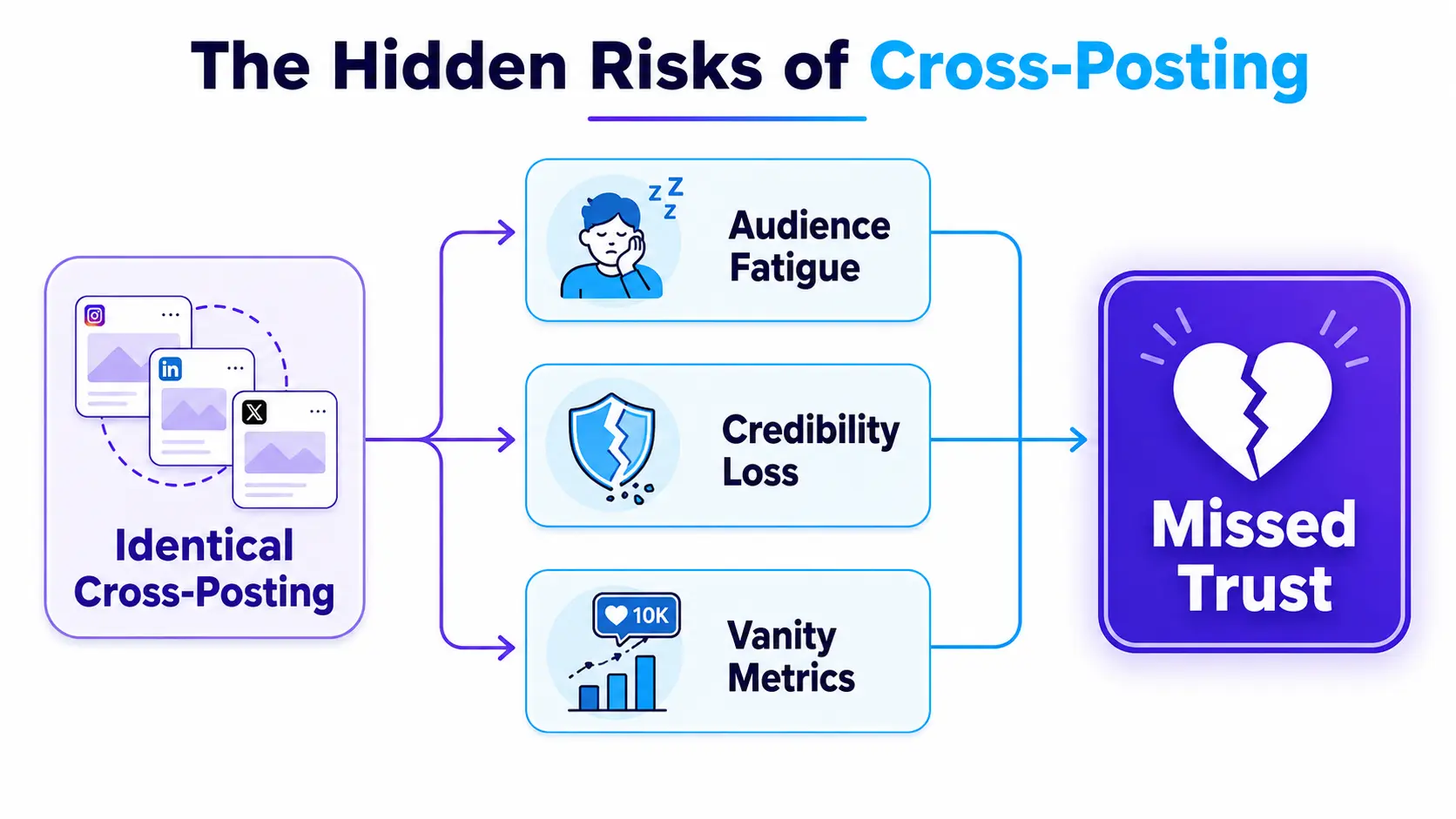
- Cross-posting without adaptation risks damaging brand credibility, leading to audience fatigue and disengagement.
- True platform adaptation requires aligning messaging with distinct behavioral and cultural logics, not just surface changes.
- Measuring trust and demand requires tracking buyer actions and sentiment, not relying on vanity engagement metrics.
A post that impresses on LinkedIn can feel invisible or even off-key on Instagram.
But most brands believe pushing a single message everywhere will multiply trust and demand.
The jarring truth?
Copy-paste messaging rarely lands in more than one place – what works on one network is often a flat note on another.

Why identical posts fail to build trust or demand on different platforms
Each social platform is its own environment – a digital city with unique norms for how people notice, judge, and remember brands.
But it’s easy to forget this when the analytics promise easy reach with one upload.
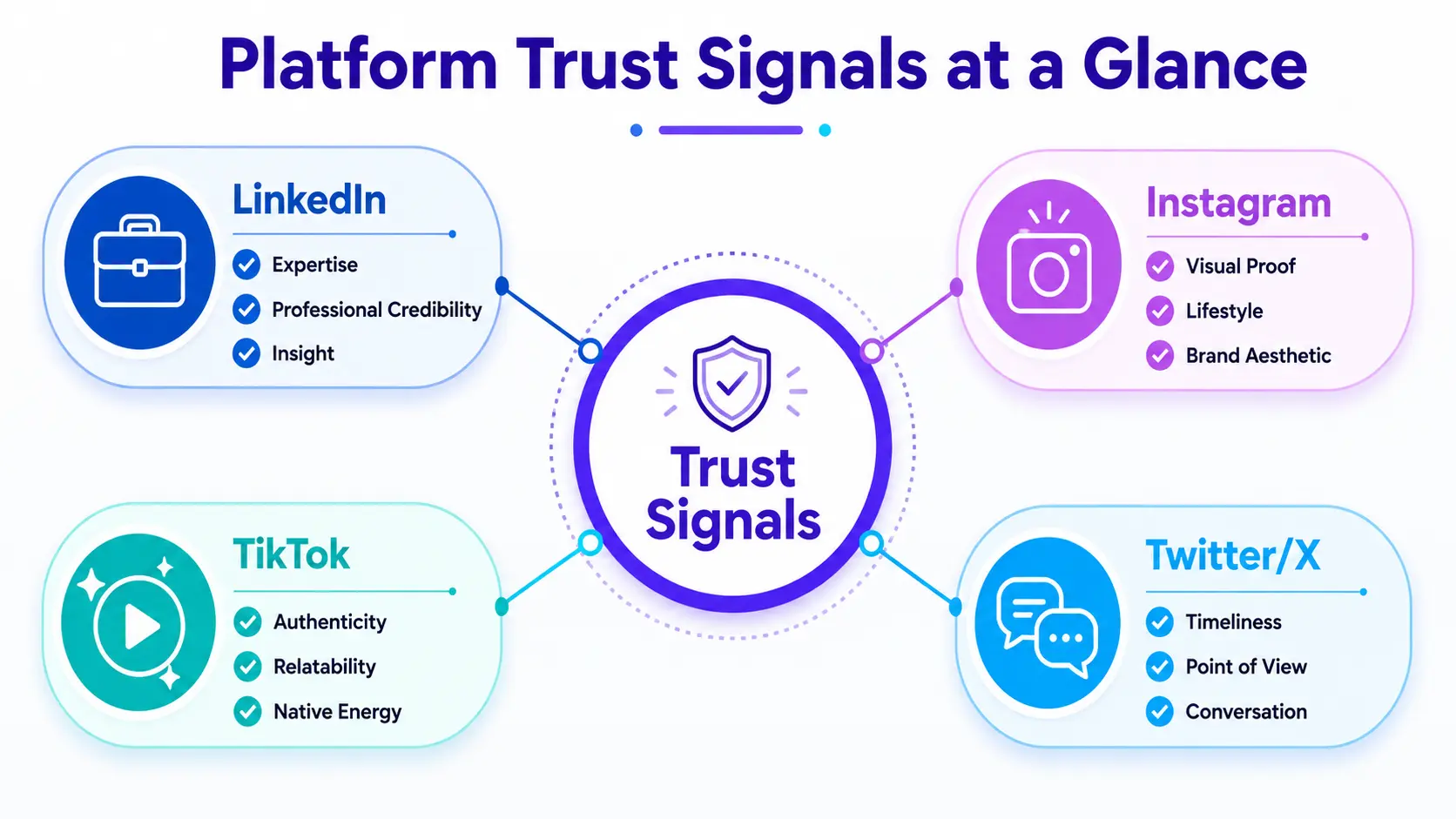
Expertise may signal status on LinkedIn, but on TikTok, it’s the style and context that earns attention first.
How platform environments shape attention, proof, and brand recognition
Proof doesn’t translate neatly, either.
Sharing a stat-packed case study on Twitter can look like overkill, while the same post might build instant authority on LinkedIn.
We’ve seen brands lose traction by recycling “thought leadership” posts into video-first feeds – content meant to demonstrate depth often reads as stiff or unfamiliar.
What’s labeled clever on one platform can be ignored – or misinterpreted – elsewhere.
Comparison of Platform Trust Signals and Content Expectations
| Metric Type | Description | What it Signals | Example | Resulting Action |
| Impressions | Number of times content is seen | Potential reach without engagement | 500 likes on Twitter without site visits | May lead to overconfidence |
| Engagements | Likes, shares, comments | Surface-level interaction | User likes or shares a post | Good but not definitive |
| Demand Cues | Direct inquiries or DMs | Active buyer interest | Prospect requests pricing info | Strong signal of trust and demand |
| Audience Behavior | Actions post-impression | Trust formation or dismissal | Shares with colleagues or initiates conversation | Indicates content effectiveness |
Here’s the uncomfortable analogy: treating YouTube, Facebook, and LinkedIn as identical is like expecting the same suit to work for every job interview, regardless of role or company culture.
It’s not just about being present – it’s about speaking the right trust language under each roof.
So why do most executives gloss over this mismatch?
Blind spots appear when channel mechanics mask what actually builds recognition.
The same case study post can spark DMs from buyers on one network but draw silence or mockery on another.
That wider logic is outlined in Social Media Marketing.
That’s where the leak in cross-platform trust starts.
The audience decides which signals feel native, and what looks like proof on paper may look like puffery in the feed.
On Instagram specifically, trust signals are visual: consistency of style, environmental cues, and repeated glimpses into people or place create credibility much faster than text-heavy claims.
Familiarity and aesthetics work together to transfer recognition into trust, turning a casual viewer into a follower because they see what feels real and repeated over time.
When repurposing message dilutes credibility instead of reinforcing it
Repurposing sounds efficient – until recycled visuals and scripts wear thin.
The myth is that repetition builds authority.
In reality, repeated posts can instead flag a lack of effort, or worse, signal a brand that doesn’t understand its audience’s platform habits.
Here’s what happens in practice: After two or three “recycled” posts, audience attention shifts from the message to the mismatch.
Suddenly, what once looked like strategic omnipresence looks careless and robotic.
We’ve seen brands suffer drop-offs not from algorithm changes, but from viewers tuning out what they recognize as repeat content.
That is how fatigue overtakes reach.
Credibility suffers its own silent death when content feels out of place.
A leadership quote that stirs engagement on LinkedIn can look out of sync – or even insincere – on TikTok, where the expectation is authenticity, not polish.
On Instagram, trust depends on what can be seen at a glance: polished grid layouts, recurring faces, and behind-the-scenes visuals demonstrate not just presence but credibility and intent.
If a brand defaults to generic graphics or wordy posts, the audience interprets it as tone-deaf or inconsistent with the visual proof the platform rewards.
Does this mean you can’t reuse ideas?
Hardly.
But the rule is simple: a message must mutate to survive.
If a brand treats all platforms as identical, it teaches audiences to ignore its voice everywhere.
Common Pitfalls of Repurposing Identical Social Media Content
- Repeated posts signal lack of effort and audience misunderstanding.
- Audience shifts attention from message to mismatch after 2-3 recycled posts.
- Content fatigue reduces reach and engagement over time.
- Out-of-place content undermines authenticity, especially on platforms like TikTok.
- Generic visuals on Instagram lead to perceived inconsistency and tone-deafness.
- Uniform messaging across platforms trains audiences to ignore the brand’s voice.
The quiet failure: familiarity breeds disregard, not trust, when every touchpoint feels recycled.
The hard fix isn’t just better copy or more compelling visuals.
It starts by grasping that every platform has its own native grammar – a way of signaling value that unlocks trust or kills it outright.
But if the message can be native everywhere, the next strategic question isn’t what to post – it’s how to measure if trust is actually being built.

When cross-posting adds reach – but hides strategic risk
More posts in more feeds looks like growth.
But visibility is not the same as trust.
The sharp reality is that cross-posting often amplifies brand fragility instead of authority, quietly increasing strategy risk when it appears to solve for scale.
Why relying on a single platform can leave visibility – and credibility – fragile
It’s tempting to treat one high-output platform as a safe harbor: acquire followers on LinkedIn, publish heavily, and accept that other channels are just noise.
But dependency on a single environment sets a trap that’s hard to see from the inside.
We’ve watched leaders build outsized presence on one network, believing loyal engagement means the market is theirs.
But the shift comes fast when an algorithm change, policy tweak, or even a competitor’s viral moment tilts attention elsewhere.
That one crowded feed can evaporate attention and credibility overnight – the same way a stock portfolio crashes without diversification.
Here’s the diagnostic most teams miss: stability is fake if audience access depends entirely on an external rule set.
Even at peak visibility, you’re exposed.
Therefore, every additional channel is more than just a new distribution lane – it’s partial insurance on the brand’s ability to be seen and believed, regardless of platform turbulence.
Growth is rarely lost all at once.
It degrades, post by post, while dashboards still promise reach.
Instagram’s visual-first environment magnifies this effect: an audience that once responded to company updates may drift if the visual story isn’t clear and compelling.
Without continual visual cues – team faces, client proof, environmental consistency – followers lose the subtle familiar signals that convert attention to trust.
Why undifferentiated content invites audience fatigue or skepticism
Sending cloned posts everywhere feels efficient – one message, broad awareness.
But the audience response tells a different story.
Repetition across feeds dulls the message faster than most teams expect.
Attention begins to slip when users notice identical phrasing or recycled visuals, especially across LinkedIn, X, and Instagram.
The effect isn’t just blindness – it’s subtle erosion of trust.
For Instagram, visual sameness is especially costly – the platform’s culture rewards original, behind-the-scenes glimpses, real environments, and signals of ongoing activity.
Feed repetition or mismatched aesthetics quietly tells followers the company doesn’t get them or isn’t truly present.
Why?
People expect content to match the native tone and rhythm of each platform.
When it doesn’t, the message lands out of context, creating a sense of inattention or even inauthenticity.
A quick analogy: Imagine hearing the same elevator pitch – word for word – in every business, social, and creative setting you visit, regardless of the room.
This is even more stark on Instagram, where each scroll is a test of visual context and recognition – audiences decide in seconds if the environment feels real, familiar, and credible, or if it’s just noise.
It grows stale, and soon you start doubting if the speaker really understands who they’re talking to.
That is when fatigue turns to skepticism.
Instead of expanding trust through repeated presence, the brand starts to feel less real, less attentive, and – ironically – less trustworthy.
Therefore, the risk is deeper than low engagement.
The consequence is emotional distance.
Signs and Consequences of Undifferentiated Social Content
- Users notice identical phrasing or visuals, causing message dulling.
- Visual sameness conflicts with platforms rewarding originality (e.g., Instagram).
- Inattention or inauthenticity perception grows when content mismatches platform tone.
- Repeated content triggers fatigue turning into skepticism.
- Audience doubts speaker’s understanding of the platform’s culture.
- Emotional distance grows despite apparent reach or engagement numbers.
The warning sign is not reach dropping; it’s the shift in how the market receives – and resists – the message.
The next question is whether platform adaptation can truly shift trust, or if it’s just window dressing for much bigger strategic gaps.

How to spot when platform adaptation isn’t just tactical but strategic
Most brands tweak captions or crop pictures and call it platform adaptation.
But true adaptation shifts not just surface details but the buyer’s interpretation of your offer.
The surprise: minor cosmetic changes often create the illusion of progress – while the real strategic signal lives elsewhere.
The visible effort isn’t what decides if the adaptation works.
The underlying question: is your content moving the business toward deeper trust and action, or is it just blending in?
Assessing whether your social media is shaping trust or just earning impressions
Every social channel reports numbers – likes, reach, shares – that look like solid traction at first glance.
But these metrics can mask what matters: if your audience is signaling actual trust or only giving you routine attention.
Views do not equal interest, and interest does not always create demand.
A pattern we’ve seen: a B2B post performs “well” on Twitter with 500 likes but drives no site visits, while the same concept on LinkedIn prompts a direct response from prospects.
Why does this difference happen?
Vanity signals – surface-level engagement – inflate confidence, but demand cues reveal business movement: DMs for more info, requests for pricing, downstream meeting requests.
The channel’s environment decides what the metric means.
Indicators of Trust vs. Vanity Metrics on Social Platforms
| Platform | Primary Trust Signals | Content Style | Audience Expectation | Example Impact |
| Expertise & case studies | Text-heavy, professional | Authority and status | Data-driven posts build authority | |
| Visual consistency & familiarity | Visual-first, polished or behind-the-scenes | Authenticity via aesthetics | Repetitive visuals build trust | |
| TikTok | Style & context | Video-first, casual, authentic | Immediacy and personality | Polished leadership quotes can seem insincere |
| Twitter (X) | Concise proof & stats | Brief, stat-focused | Quick information bursts | Stat-packed posts may look overkill |
Here’s the simplest diagnostic: track not just total impressions but what happens next.
Do people ask questions, share with colleagues, or start skeptical debates?
Or do they scroll, tap, and move on without a trace?
One signals trust is forming.
The other is a false positive.
That’s how impressions can become a vanity drug that feeds activity dashboards but fails to change the buyer’s mind.
The commercial consequence: teams fixate on what is easy to count, leaving the business blind to what actually pays off.
Recognizing when a platform’s logic changes your message’s meaning
The same idea is not received the same way everywhere.
On Instagram, a product photo with a witty tagline may read as casual lifestyle branding.
On LinkedIn, it might get ignored or seem oddly informal – while a data-driven headline on LinkedIn may feel dry or out of place on TikTok.
For credibility on Instagram, visuals often need to show repeated activity, people at work, or real outcomes – a static or infrequent feed undermines the sense of social proof the channel is designed to amplify.
The platform’s logic is built to elevate those who appear visually invested and consistent.
Myth: Repurposing is as simple as resizing or rewording.
But small shifts in format often miss that each platform frames meaning with its own internal logic: TikTok rewards immediacy and personality, while LinkedIn sorts for expertise signals and credibility cues.
When you overlook these boundaries, even strong ideas lose weight – or worse, confuse the audience.
We’ve watched posts spark debate in one feed but drop with zero pulse in another.
The message didn’t weaken – it just hit a parallel universe with different rules.
It’s like dropping a foreign coin into a vending machine: it looks like money, but the mechanism rejects it.
So where does this leave the executive?
Cosmetic adaptation keeps content looking busy, but the real work is shifting the message’s core to match the trust signals and logic of each environment.
Adaptation isn’t a box to tick.
It’s the difference between noise and influence.
Once you spot this, the next problem emerges: how do you know if your social efforts are shaping new buyer beliefs – or simply playing the metrics game?

What to do next: scaling insight without jumping to tactics
When Instagram’s visual trust logic shifts to even shorter-form, speed-driven attention, new adaptation problems emerge.
That broader transition appears in How Short-Form Shifts Social Trust.
Most leaders want answers to platform failure fast – but clarity erodes when teams rush straight to channel tweaks.
Yet, moving from diagnosis to tactics too soon is what traps brands in the cycle of reactivity and surface fixes.
The sharper move is to pause at the strategic fork: should you dig deeper into platform behavior, or refine your core messaging before the next campaign?
When to explore platform‑behavior mechanisms vs when to refine your core message
The simplest decision filter isn’t what most use.
Teams often chase platform “hacks” – timing, hashtags, formats – but neglect to ask if the base message even fits the way that platform organizes attention and trust.
But the message-platform fit is the control variable: sometimes the right content underperforms, not from lack of value, but because the platform’s logic scrambles its meaning.
So where do you look first?
If content wins trust and demand in one place but dies in another, it’s likely a platform behavior issue.
For example, we’ve watched financial insights spark engagement on LinkedIn, only to vanish on TikTok – not from content quality, but from platform preferences for visual versus textual proof.
That’s not a superficial problem; it changes what counts as credibility and even what gets remembered by the audience.
But when a post falls flat everywhere, or only picks up empty likes, the message itself demands scrutiny.
Sometimes it isn’t the feed’s flow blocking you, it’s a message with fuzzy signals or mismatched purpose – trying to talk demand when the market only wants awareness, or vice versa.
Here’s the repeatable insight: Message and mechanism either work together or not at all.
The hardest part?
These failures rarely look dramatic at first glance; it’s the persistent undercurrent of slow growth and indistinct authority that signals a strategy problem, not an operational miss.
Is your challenge hiding in the system, or in the sentence?
How to determine if your challenge is social media or another capability’s gap
Surface data often blames the wrong culprit.
Teams point at missed impressions or low shares as a social media issue.
Yet, in real audits, we see problems spiraling out from upstream blind spots: weak brand clarity, unproved value propositions, or broken paid-to-organic handoff.
Think of your social feeds as a storefront window: they reflect the best and worst of every supporting capability.
When content repeatedly fails across platforms, don’t just chase channel fixes.
The breakdown may live in the message, brand posture, or even an analytics feedback loop missing signal.
A warning sign: when every platform feels like an uphill battle, start searching behind the feed – into the architecture of content, brand systems, video integration, or even your measurement model.
Sometimes, what looks like a social collapse is the echo of a broader business gap.
Therefore, before racing to optimize what’s visible, evaluate what’s invisible: signal clarity, trust formation, and capability fit.
Only then can social strategy escape the cycle of recurrence – and drive decisions into the next layer of impact.
The question that follows isn’t just “what’s the tactic?” – it’s “which problem actually owns the outcome next?”

Scientific context and sources
The sources below provide foundational context for how decision-making, attention, and performance dynamics evolve under scaling and constraint conditions.
- Social Media Platform Differences
I tweet honestly, I tweet passionately: Twitter users, context collapse, and the imagined audience – Alice E. Marwick, danah boyd – New Media & Society
Explores how social media collapses different audiences into one communication context, making platform norms and audience expectations central to trust and participation.
https://journals.sagepub.com/doi/10.1177/1461444810365313 - Audience Adaptation and Message Personalization
Audience Segmentation and Climate Change Communication – Matthew C. Nisbet, Ezra M. Markowitz – Oxford Research Encyclopedia of Climate Science
Explains how segmentation, targeting, and tailoring help persuasive messages fit different audience groups instead of treating all audiences as one uniform mass.
https://academic.oup.com/edited-volume/61804/chapter/546637883 - Social Proof and Trust Dynamics
What Do We Mean When We Talk about Trust in Social Media? A Systematic Review – Yixuan Zhang, Joseph D. Gaggiano, Nutchanon Yongsatianchot, Nurul M. Suhaimi, Miso Kim, Yifan Sun, Jacqueline Griffin, Andrea G. Parker – CHI Conference on Human Factors in Computing Systems
Reviews how trust in social media is defined, measured, and shaped by context, platform design, content, users, and social signals.
https://dl.acm.org/doi/10.1145/3544548.3581019 - Platform-Specific Content Engagement
Platform or Content Strategy? Exploring Engagement With Brand Posts on Different Social Media Platforms – Zheng Shen – SAGE Open
Compares brand post engagement across platforms and supports the article’s claim that the same content can perform differently depending on the platform’s engagement logic.
https://journals.sagepub.com/doi/10.1177/21582440231219096
Questions You Might Ponder
Why does content fail across social platforms even when it succeeds on one?
Content fails across platforms because each social network has unique norms, trust signals, and audience expectations. What resonates on LinkedIn may fall flat on TikTok or Instagram, making one-size-fits-all messaging less effective and even damaging to credibility.
How can brands adapt content for different social media platforms?
Brands should study the “native grammar” of each platform, tailoring content formatting, visuals, and tone to match audience expectations. Adaptation should go beyond surface tweaks and align message delivery with the underlying behavioral logic of each platform.
What are the risks of cross-posting identical messages on all channels?
Cross-posting identical messages risks audience fatigue, reduced engagement, and a loss of authenticity. Over time, followers may perceive the brand as inattentive or inauthentic, leading to diminished trust and a higher likelihood of being ignored or unfollowed.
How do you know if your social media strategy builds trust and demand?
Effective measurement goes past impressions or likes to track downstream actions such as DMs, referrals, or business inquiries. Trust-building content triggers engagement that signals buyer interest or conversation, not just surface-level metrics.
What’s the difference between platform adaptation and superficial changes?
Platform adaptation means aligning your message to match each platform’s unique values and trust signals, not just changing image sizes or captions. Superficial tweaks may create the illusion of progress, but only true adaptation influences buyer perception and drives meaningful results.