
What You’ll Learn
Short form attention versus trust is the gap between fast visibility and lasting brand belief.
Short-form platforms win attention through quick videos, low-friction mobile feeds, and variable-reward scrolling, but those same mechanics often weaken memory, depth, and authority.
Views, likes, and watch time can show that people noticed content, but they do not prove that people remembered the brand, trusted its expertise, or moved closer to buying.
Short-form works best as an entry point into a broader demand system, where attention is routed to deeper assets such as explainers, case studies, landing pages, webinars, or sales conversations that build trust over time.
Key Takeaways
- Short-form platforms win instant attention through variable-reward feeds and low-friction mobile formats, but this often sacrifices long-term trust and authority.
- High attention metrics do not guarantee business impact; most short-form engagement is fleeting and fails to drive lasting recall or buyer intent.
- Relying solely on short-form performance risks algorithmic backlash, trust erosion, and regulatory scrutiny, undermining sustainable growth.
- The most effective systems route short-form attention into deeper content assets that reinforce brand value, recognition, and trust over time.
Most executives believe the battle is won once an ad, post, or video captures the viewer’s first glance.
But the real machinery of platforms like TikTok doesn’t just grab attention – it hijacks it by design.
Variable reward feeds create micro-surprises with every swipe, conditioning users to chase the next dopamine hit, not to remember the last one.
That broader system logic is charted in Social Media Marketing.

Why short‑form formats grab attention instantly
The algorithm’s unpredictability acts like a slot machine, making each scroll feel urgent and new.
But here’s the myth: more novelty means more value.
In practice, chasing unpredictability often means users forget what they just saw.
We’ve seen audience retention graphs that spike at the opening three seconds, then nosedive by ten – users are primed to react, not to recall.
How variable‑reward feeds hook users within seconds
Why does the brain fall for it?
Every swipe triggers a fast feedback loop: sometimes a great clip, often pure filler.
That uncertainty is the juice keeping thumbs moving.
The analogy is simple: imagine opening a gift box, never knowing if there’s a reward or just packing paper – eventually you open dozens in rapid succession, addicted to the possibility, not the outcome.
But this system trades depth for speed.
So the same unpredictability that builds massive reach also makes authority vanish.
Viewers stay in the loop seeking novelty, rarely pausing to process or connect an idea to a brand.
If virality is the spark, then trust is the slow burn these feeds rarely give time to start burning.
Key Mechanisms of Variable-Reward Feeds
- Micro-surprises with every swipe create dopamine hits
- Algorithm unpredictability mimics slot machine effect
- Users chase novelty rather than recall content
- Fast feedback loop of good clip vs filler maintains engagement
- System trades depth for speed, limiting lasting authority
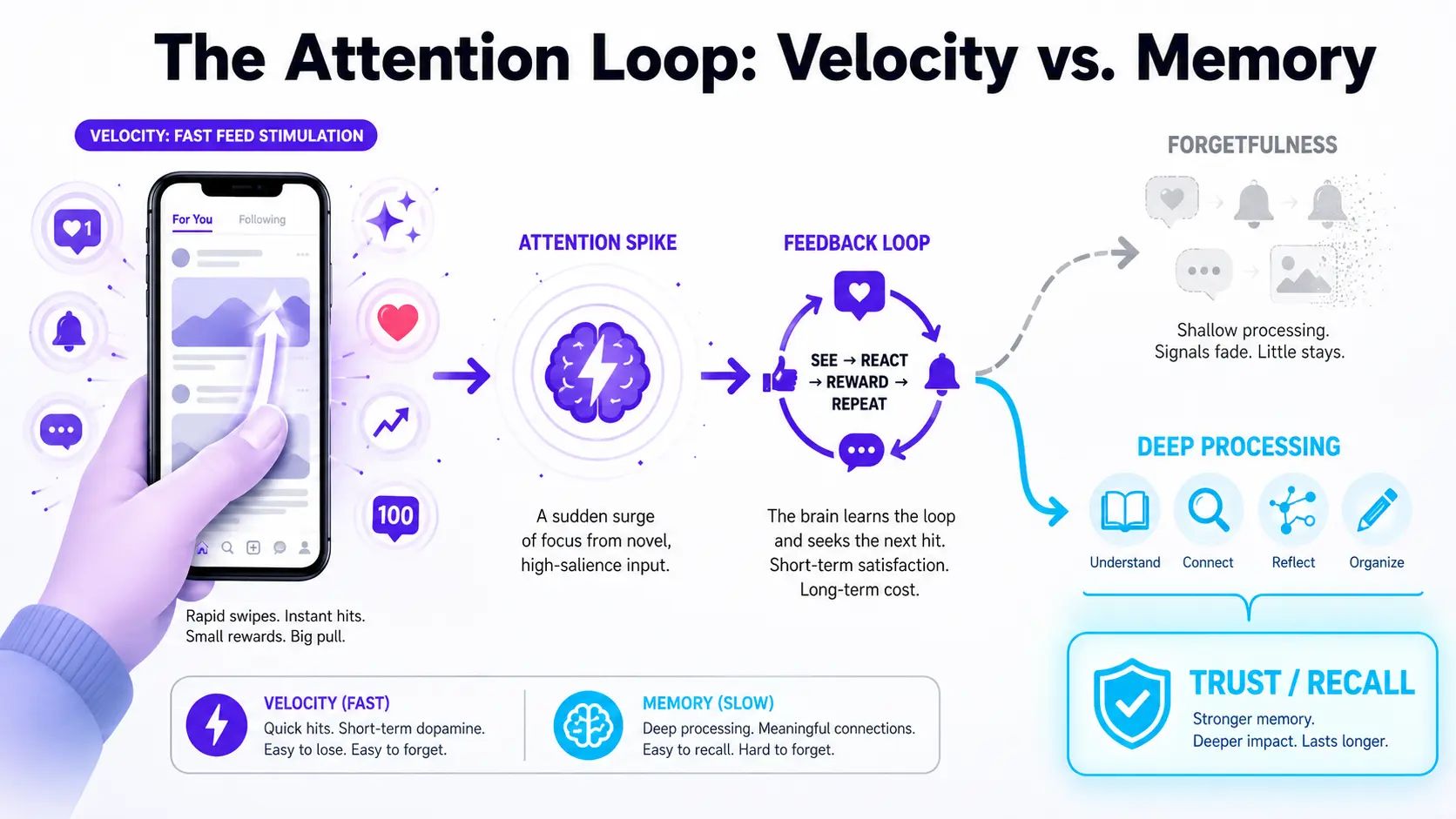
Mobile‑first, low‑commitment formats reduce friction for consumption
Tapping through a vertical feed asks almost nothing of the audience: hold a device, use one finger, move in seconds.
But lower friction has a hidden cost – and almost no executive calls it out until attention metrics stall.
Short‑form video turns mobile devices into frictionless delivery pipelines.
Entry costs are invisible: you don’t have to search, subscribe, or even think.
But if anyone can enter, no one stands out.
When every video is the same height and moves at the same speed, differentiation blurs into the noise.
That’s why habitual consumption is not loyalty.
In real campaigns, we’ve watched brands hit millions of views – only to get forgotten by the very audience they reached hours earlier.
The easiest path to eyeballs is often the hardest path to memory.
That is the transfer most teams miss.
So, while short‑form dominates instant discovery and feeds the attention economy, it quietly sidesteps the conditions that allow trust or demand to build.
The next question isn’t just how to get seen, but how to be remembered – if attention is nearly free, what actually earns authority?

Why attention doesn’t equate to authority or demand
The flood of likes, views, and instant reactions on short‑form platforms can look like a signal that brands have their audience locked in.
But fast-moving feeds often reward what is compelling for a moment, not what stands the test of memory or influences choice.
There’s a catch: attention grabs are not the same as business impact.
Attention lacks resonance unless connected to trust signals
It’s easy to confuse rapid-fire engagement with true market traction.
But many of those engagements stop at surface-level curiosity.
What the data hides: attention, in isolation, feels impressive but rarely pushes the needle on recognition or reliable influence.
One persistent myth is that brand discovery equals buyer readiness.
In years of working on short‑form strategies, it’s clear that even viral moments rarely leave a lasting mark unless layered with signals that validate authority – testimonials, visible expertise, or social proof that outlasts the swipe.
The difference shows in repeated purchase intent.
Brands with spikes in short‑form views see little change in inbound demand until trust cues bridge the gap.
There’s an analogy that fits: attention is like a billboard flashing past on the highway.
It may startle the senses, but unless the message ties back to something memorable, the impact fades by the next mile.
So what changes when recognition, not just reach, becomes the measure?
Trust doesn’t form the instant someone sees your content.
It forms when attention finds reinforcement – messages repeated, authority visible, value proven.
The more fleeting the interaction, the less likely it is to convert into recall or demand.
Short‑form content risks weak memory and fast forgetfulness
The swipe economy rewards brevity, but that same speed carries a hidden cost: most viewers can’t remember what they watched minutes later.
Teams often realize – too late – that their content has become noise in the feed, memorable to the algorithm but not to a thinking buyer.
Why does this happen?
Short‑form video capitalizes on cognitive shortcuts.
The brain burns through clips without encoding brands or messages, especially when each new post erases the last.
Many executives measure campaign success by the spike on their dashboard, missing that cognitive residue – actual recall – is barely present.
Here’s the repeatable insight: what’s easy to watch is easy to forget.
That is the trap.
This cognitive effect shapes commercial outcomes.
Quick hits of attention rarely contribute to authority or preference.
Therefore, campaigns built strictly for virality run cold when it’s time for a buyer to make a decision.
The lesson is clear: views alone cannot replace signals that plant a brand’s value in the customer’s mind.
But if attention is cheap, building recognition and trust will always be the more expensive – and profitable – game.
Brands letting short-form attention masquerade as market demand face a cascade of new risks – many invisible until growth stalls.

What risks emerge when brands treat attention as success
Short‑form metrics light up dashboards faster than any other channel.
But those numbers often hide silent damage underneath.
The sharper risk is that chasing spikes in attention can backfire – damaging platform standing, eroding trust, and undermining the very growth brands mean to drive.
Risks of Treating Short-Form Attention as Success
| Risk Category | Description | Cause | Consequence |
| Platform Trust Crises | Algorithimic punishment and reduced reach | Clicky patterns, recycled viral formats, misleading jump-cuts | Drop in reach and distribution, regulatory scrutiny |
| Regulatory & Compliance Risks | Flags brand as risky actor, damages ROI & brand safety | Surge in low-quality or manipulative content | Loss of audience trust and business costs |
| Mental & Cognitive Side-Effects | Eroded recall, weakened trust, user disengagement | Overexposure to rapid, snackable micro-content | Lower campaign effectiveness, creator burnout |
Platform trust crises and algorithmic backlash
Executives might assume that as long as content racks up views, wins will follow.
Yet the very engines behind TikTok attention economy can punish brands that push for numbers at all costs.
Once algorithms sense engineered, clicky patterns – recycled viral formats, overblown hooks, or misleading jump-cuts – they quietly reduce reach, sometimes without warning.
The line between smart optimization and trust erosion is thinner than most teams think.
It’s like playing chess against a shifting opponent: brands adapt to algorithmic quirks, but platforms adapt faster.
A familiar scenario from client work – one company scaled micro-videos aggressively, leaning into trending audio and rapid-fire edits.
For a week, the surge was real.
The next, their average reach cratered, shadowed by what looked like a small tweak in the system.
The same rules that reward novelty will penalize perceived manipulation.
But algorithmic punishment isn’t the only consequence.
Platforms also face external pressure: surges in low-quality or manipulative content invite regulatory scrutiny, flagging brands as risky actors in both user and compliance eyes.
As skepticism rises, both distribution and audience trust drop.
The gold rush for attention becomes a liability.
These regulatory and compliance risks can quickly shift from visibility issues to real business costs, cutting into ROI and long-term brand safety.
So what signal really matters?
It’s not just the spike, but how content survives the platform’s changing tests.
The quiet insider truth: attention that smells artificial creates a drag inside the system, and recovery is rarely as simple as waiting for trends to shift.
Mental and cognitive side‑effects of short‑form dependency
Brands think daily output keeps them top-of-mind.
But high-volume short‑form rarely gives buyers the anchors they need to remember or believe.
The more a brand trains its audience to expect snackable, disconnected bursts, the less likely users are to retain messages or connect those moments to genuine authority.
The analogy is simple: imagine a room with dozens of flashing lights – each bright for a second, none leaving an imprint.
When everything is urgent, nothing sticks.
We’ve watched companies flood feeds with relentless micro-content, only to find brand recall actually falling in post-campaign tracking.
Memory fades as quickly as the next scroll.
But there’s a deeper risk most boards ignore.
Overexposure to nudge-driven, variable-reward environments wears down both creators and audiences.
Teams burn out chasing ever-shorter trends; buyers tire, disengage, and learn to filter out the noise.
Attention economy risks turn into lower effectiveness, not just wasted spend.
Therefore, optimizing for attention alone misses the hidden damage: eroded trust, weaker recall, and declining long-term engagement.
The battle isn’t won by flashing brightest – success demands knowing exactly where short‑form slots into the broader system.
Deciding whether attention is fueling trust – or just generating more noise – requires hard business framing and a sharper look at lasting value.

How to assess when short‑form attention fits into a broader demand system
Most brands chase short‑form attention as if every spike in views signals new market demand.
But a rush of eyeballs without a pathway to trust turns high visibility into shallow value.
The real win is knowing when attention is only the invitation, not the whole event.
When short‑form should feed deeper content or authority assets
Short‑form video lures buyers in a heartbeat, but it rarely holds them.
High-performing campaigns often look valuable in TikTok analytics, yet stall at the first sign of a real decision.
But not every viral moment is designed to move a market.
The strongest signal is what happens next: does the click, comment, or share pull buyers into something they remember?
It’s a common misstep – treating the platform as both the starting line and the finish.
We’ve watched campaigns rack up millions of views, only to find the downstream landing pages see less than a 1% conversion or scroll depth beyond the header.
That gap exposes the real friction.
If 95% of your viewers never get past the surface, attention is performing as a billboard – not as a bridge.
The line is clear: short‑form works best as an entry point when you can answer two questions – did the content make the right people curious, and did it route them into deeper experiences where trust and authority are built?
If not, every bump in views is just surface heat.
That’s where purpose‑built authority assets come in: podcasts, in‑depth explainers, interactive demos, or solution breakdowns – each offering room for buyers to slow down and process.
So is your short‑form content acting as a tentpole or just a flare?
If your next step after a viral short is a dead end (or worse, a generic sales push), your system leaks potential.
Authority assets should catch and compound initial curiosity, not let it evaporate.
It’s striking how hard this is to get right, even for skilled teams.
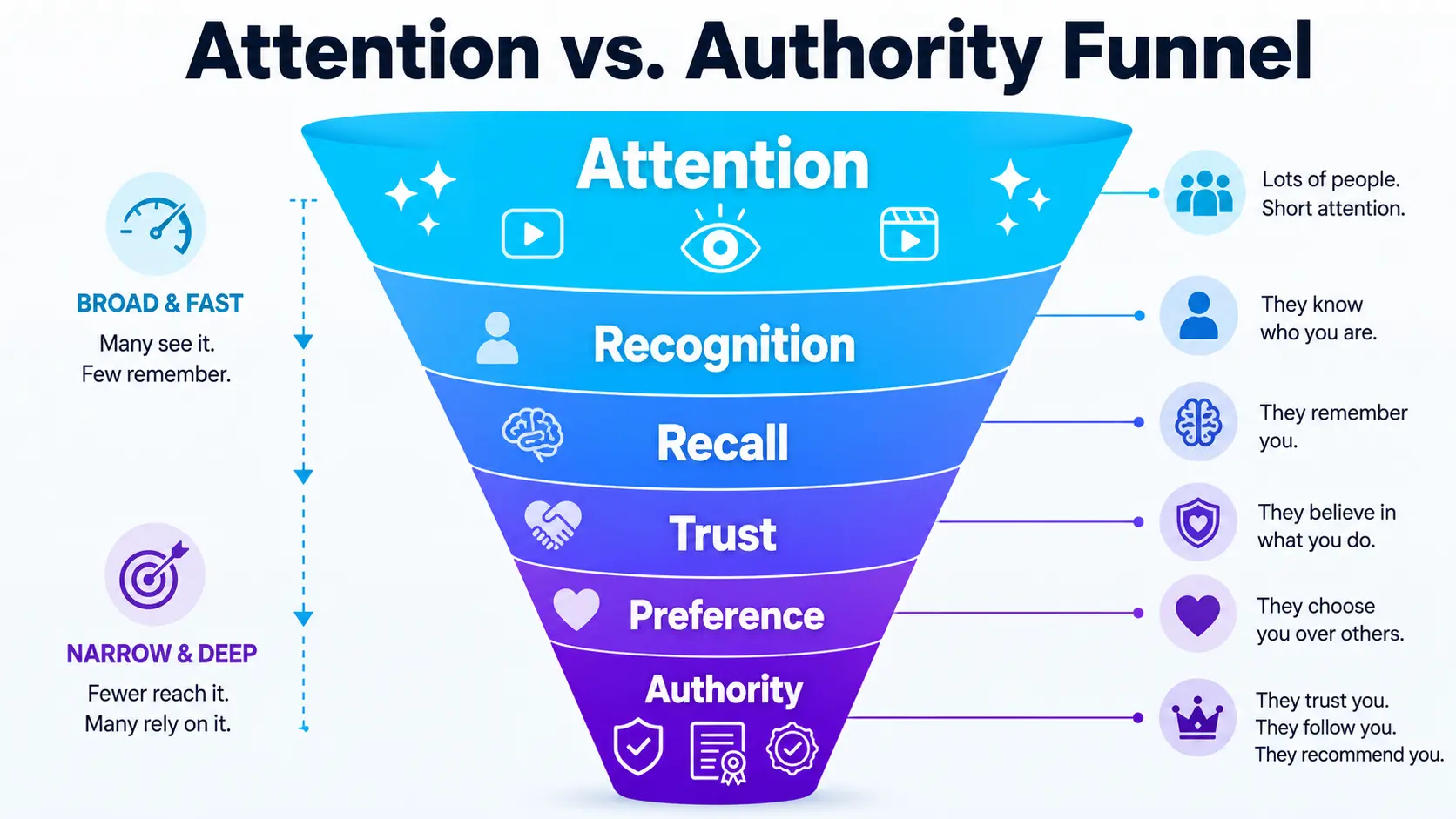
How to measure attention-to-trust conversion in a capability system
The metric that matters is not how many people stopped to watch, but how many remember it a week later – or show any sign they trust what they saw.
Traditional dashboards reward instant feedback: views, likes, shares.
But those say little about whether the audience converted attention into belief, recognition, or intent.
Metrics to Assess Attention-to-Trust Conversion
- Branded search upticks indicating recognition
- Repeat direct visits to content or assets
- References to brand language or frameworks in sales conversations
- Internal circulation of educational or authority materials
- Unprompted recall or memory tests post-campaign
- Growth in branded keyword usage beyond viral peaks
A sharper lens looks for signals further down the funnel: branded search upticks, repeat direct visits, references to your language or frameworks in sales conversations, or audience members circulating your assets internally.
One client barely moved their follower count but saw 3x more requests for executive briefings after a series of short‑form explainers linked to a research vault.
That’s attention compounding into demand.
Here’s the test: can you draw a line – however imperfect – between your spike in platform visibility and an uptick in meaningful outcomes?
Memory tests (unprompted recall in later interactions), branded keyword growth, or even anecdotal buyer references are stronger indicators than viral peaks.
If attention cannot be traced to trust, it becomes a cost center masked as momentum.
It’s like letting water hit hot asphalt: there’s a sizzle, then it disappears.
The durable asset is what sticks after the noise fades.
That wider tradeoff is clearer when you compare what happens when attention needs more depth – YouTube behaves less like a feed and more like an authority environment. YouTube as authority environment shows how platform structure changes trust formation.
The platform hands you the moment; your system turns it into momentum.
The next move: decide which signals deserve further investment, and which attention spikes are safe to ignore.

Scientific context and sources
The sources below provide foundational context for how decision-making, attention, and performance dynamics evolve under scaling and constraint conditions.
- Behavioral economics of decision loops
Thinking, Fast and Slow – Daniel Kahneman – Farrar, Straus and Giroux
Provides the cognitive framework behind fast, intuitive reactions and slower, more deliberate processing. This supports the article’s distinction between instant short-form attention and deeper trust-building.
https://us.macmillan.com/books/9780374533557/thinkingfastandslow/ - Algorithmic unpredictability and user engagement
The Relevance of Algorithms – Tarleton Gillespie – in Media Technologies: Essays on Communication, Materiality, and Society
Explains how algorithms shape what users see, what becomes relevant, and how platforms structure public attention. This fits the article’s argument about algorithmic volatility, visibility, and platform-controlled attention.
https://doi.org/10.7551/mitpress/9780262525374.003.0009 - Attention in digital environments
A Review of Evidence on the Role of Digital Technology in Shaping Attention and Cognitive Control in Children – Maria Vedechkina, Francesca Borgonovi – Frontiers in Psychology
Reviews how digital technology can affect attention and cognitive control. This supports the article’s point that fast digital formats can capture attention without necessarily producing deep processing or durable memory.
https://www.frontiersin.org/journals/psychology/articles/10.3389/fpsyg.2021.611155/full - Social proof and trust formation
Social Influence and the Collective Dynamics of Opinion Formation – Mehdi Moussaïd, Juliane E. Kämmer, Pantelis P. Analytis, Hansjörg Neth – PLOS ONE
Explains how peer influence, expert confidence, and majority signals shape opinion formation. This supports the article’s point that visible authority, testimonials, and social proof help turn short attention into stronger trust.
https://journals.plos.org/plosone/article?id=10.1371/journal.pone.0078433 - Commercial outcomes of media recall
The Mediating Role of Brand Recall and Brand Attitude in Influencing Purchase Intention in Advergames – Azaze-Azizi Abdul Adis, Hyung Jun Kim – Asia Marketing Journal
Connects brand recall and brand attitude to purchase intention in an interactive digital media setting. This supports the article’s claim that attention only matters commercially when it turns into recall, preference, and intent.
https://amj.kma.re.kr/journal/vol15/iss3/7/
Questions You Might Ponder
Why do short-form platforms capture user attention so quickly?
Short-form platforms use variable-reward algorithms and mobile-first design to create instant gratification. This lowers entry friction and delivers unpredictable content, making users chase novelty, not memory – resulting in high engagement but little lasting recall or connection.
How does short-form attention differ from real brand trust?
Short-form attention is rapid and surface-level, gained through curiosity or quick entertainment. Trust requires reinforcement: repeated authority signals, testimonials, or expertise that survive beyond the swipe. Without these, high attention rarely translates to business impact or customer loyalty.
What are the risks of relying solely on short-form metrics for brand success?
Focusing heavily on short-form metrics like views or likes can hide deeper issues, such as eroding trust, algorithmic penalties, and regulatory scrutiny. Brands may see short spikes in visibility but suffer weaker recall, disengaged audiences, and diminished long-term growth.
How can brands turn short-form attention into sustainable demand?
Brands must use short-form as an entry point, linking it to authority assets – podcasts, deep dives, or explainers – that build trust and recognition. Connecting initial attention to deeper content increases the chance that curiosity converts into loyalty, preference, or demand.
What are the best signals that short-form content is building real authority?
Key signals include: upticks in branded search, repeat visits to deep assets, reference to brand language in sales calls, post-campaign recall tests, and increased branded keyword usage. These indicators show attention is fueling trust, not just fleeting visibility.