
What You’ll Learn
YouTube builds authority differently because it combines sustained attention, search intent, long-form explanation, and durable discovery in one platform.
Unlike feed-first social platforms that reward quick reactions and short-lived visibility, YouTube lets viewers spend more time with structured arguments, tutorials, demonstrations, and expert reasoning.
This deeper attention helps audiences connect a person, brand, or idea with credible expertise.
YouTube videos can also keep ranking, resurfacing, and generating trust through search, recommendations, transcripts, chapters, and AI-readable semantic structure long after publication.
As a result, YouTube authority compounds through depth, relevance, and repeated discovery, not only through immediate reach or engagement.
Key Takeaways
- YouTube builds authority differently by fostering deep viewer attention, enabling trusted, memorable associations with expertise.
- Long-form content outperforms feed-first clips for executive and B2B audiences because it supports thorough reasoning and recurrent references.
- YouTube’s blend of intent-driven search and persistent recommendations causes authority and views to compound long after publication.
- AI and search algorithms reward semantically structured, comprehensive YouTube videos, driving higher algorithmic and human trust.
Long-form video on YouTube seems like a slow play compared to the constant churn of short clips in your feed.
But a fast-moving feed rarely leaves a mark worth remembering.
Authority isn’t built in fragments – it lives where buyers can stop, listen, and process a line of thinking without being dragged to the next distraction.
That underlying distinction is part of the broader model in Social Media Marketing.

Why YouTube’s Depth‑Driven Environment Builds Lasting Trust
Here’s the myth: More impressions mean more belief.
Yet when exposure happens in five-second snippets, the mind doesn’t link faces to ideas or recall insights later.
True memory sticks when a viewer spends minutes – sometimes hours – engaged in a structured argument, story, or demonstration.
It’s the difference between catching phrases in passing and reading an entire chapter.
The brain codes deep attention into lasting associations: this expert, this viewpoint, this proof.
Comparison of YouTube Long-Form Videos vs. Feed-First Short Clips
| Feature | YouTube Long-Form Content | Feed-First Short Clips |
| Content Structure | Layered transcripts, timestamps, and semantic chapters | Minimal or no structured information |
| AI Interpretation | Generates knowledge graphs and semantic relevance | Limited to shallow keyword signals |
| Algorithmic Trust | Built on depth, coherence, and completeness | Based on immediacy and volume |
| Human Audience Impact | Engages learners and builds expertise perception | Captures quick attention but low retention |
| Longevity | Content ranks and surfaces over long periods | Content quickly loses visibility after initial spike |
One sharp insight we’ve noticed: A single 10-minute video on YouTube, built around a clear narrative, gets referenced back by decision-makers weeks later.
It’s as if it held a chapter in their thinking, while 20 micro-clips got washed out by the scroll.
How sustained attention strengthens authority signals
What makes this possible isn’t just content length – it’s attention depth.
When an executive fully absorbs a nuanced walkthrough, the authority signal amplifies.
But fast feeds?
They default to surface impressions, not recall.
Therefore, if your growth play relies on being “top of mind” in critical buying moments, depth-first platforms win by default.
The platform’s very design helps the message cut through the digital noise.
Benefits of Sustained Attention on YouTube for Authority Building
- Enables viewers to fully process structured arguments and narratives.
- Links faces to ideas, enhancing memory and recall.
- Creates lasting mental associations with expertise.
- Promotes reference back by decision-makers even weeks later.
- Amplifies authority signals through deep engagement.
So is your authority built for memory – or for fleeting reach?
When explanation beats speed for leadership positioning
Speed wins the click, not the conviction.
Feed-first content forces brevity.
But concise rarely persuades.
Executives looking for partners, tools, or ideas aren’t swayed by clever hooks alone.
They seek logic, nuance, and the comfort of seeing the real expertise play out over time.
We’ve seen this repeatedly: The brand that invests in a detailed, well-structured YouTube explainer becomes the market reference – even months later.
A sharp analogy: Fast clips act like digital billboards – seen, but seldom built into trust.
A long-form breakdown is the lunch meeting where trust actually grows.
That’s where long-form video changes the game.
You get space to show process, admit doubt, reason through counterpoints, and build credibility line by line.
The effect?
Your prospects have more than a “sound bite” to remember – they have a textured narrative to cite in meetings.
Here’s the repeatable insight: Explanation outlasts exposure.
It’s not about fighting for seconds of attention; it’s about earning the right to shape what the audience believes is possible.
Yet, the authority signal isn’t permanent.
The next friction: How can you make sure your message keeps compounding – rather than fading – after the first surge of views?

How YouTube Combines Search Intent with Social Discovery
It’s easy to see YouTube as just another social platform – powered by algorithms and obsessed with engagement.
But the engine behind YouTube’s influence runs on two fuels, not one.
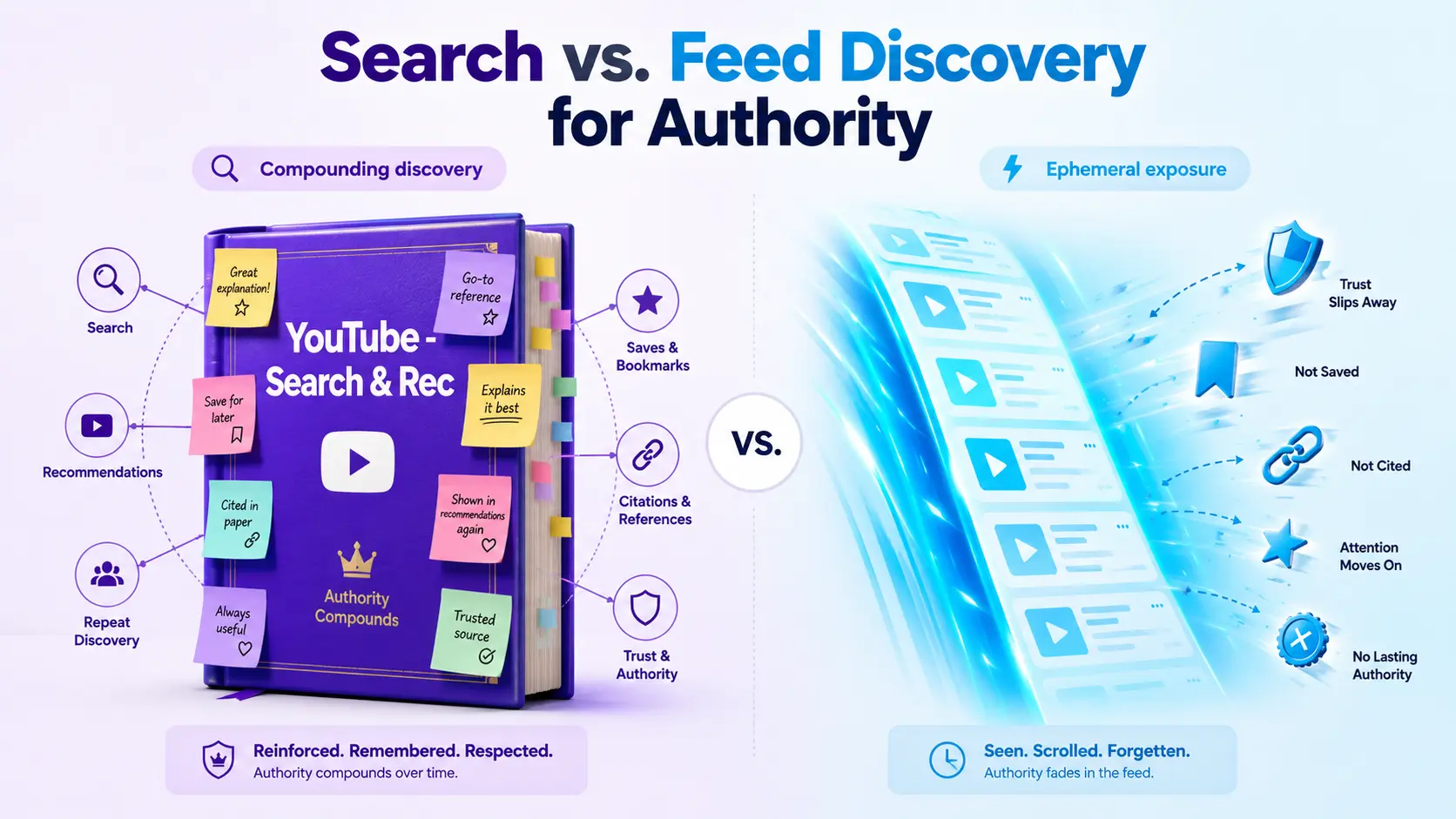
Most social networks only give you momentum if you win the feed lottery.
On YouTube, discovery isn’t a coin toss; it’s a system that doubles authority with every search and every recommendation.
When algorithmic discovery enhances trust, not just reach
Social algorithms typically reward what’s novel and fast.
But the quick dopamine hit of a trending TikTok doesn’t stick in the mind – or drive confident business decisions.
Authority, in contrast, demands visibility that doesn’t evaporate when the scroll ends.
Here’s where YouTube sets itself apart.
Algorithmic recommendations on YouTube are not simply matching the next video for a burst of engagement.
They surface content to users who are already signaling interest – through past searches, subscriptions, and viewing depth.
When a viewer lands on a recommended YouTube video about enterprise software, they’re rarely seeing it at random.
The underlying architecture quietly screens for relevance, recency, and session-level signals.
That’s a different kind of trust-builder.
Think of it as the difference between a billboard on a highway and a curated library.
One interrupts; the other invites return visits.
Clients often expect the YouTube algorithm to behave like TikTok’s: flash attention, then gone.
But those who treat recommendations as a credibility ladder – not a lucky draw – see videos viewed and re-viewed by increasingly ready buyers.
This is why authority on YouTube compounds.
Once your video enters the right recommendation graph, it persists – not for hours, but indefinitely.
But more attention is not useful unless the audience believes what they’re seeing should influence their next step.
That’s the part most teams miss: reach only creates opportunity when the algorithm sends your depth to the right eyes.
Why YouTube’s search architecture anchors demand formation
Every executive has felt the difference between being found and being pushed.
Search signals on YouTube are buyer intent on display.
When viewers start with a search, they reveal problems, goals, and readiness without ever filling out a form.
YouTube’s search isn’t isolated from its social layer – it’s fused.
A strong search footprint means appearing for buyers who start by questioning, then slowly deepening their evaluation.
The moment your long-form video meets a high-intent query, you earn more than a view – you become part of that buyer’s decision set.
Unlike feed platforms, where your message disappears with the next swipe, YouTube lets a single asset surface again and again across dozens of intent stages.
We’ve seen client content become an industry reference, not through sheer output, but through tactical search positioning – so that discovery is layered, returned-to, and trusted, not just seen once.
What changes for the business?
Authority is no longer a temporary win.
It becomes embedded in the search-discovery cycle, supporting demand even as trends shift elsewhere.
Therefore, the psychology of decision gravity works in your favor: the more your content shows up in both intent and browse, the more buyers move from passive viewing to confident action.
But the real unlock isn’t just in visibility – it’s in how YouTube content remains reachable for weeks, months, or years.
That opens a new question: when does today’s asset become tomorrow’s authority magnet, compounding results long after its initial launch?

How YouTube’s Content Retains Value and Compounds Over Time
Three weeks after a YouTube launch, a client checks their analytics: the views have doubled, mostly from people searching for nuanced answers days after the episode first aired.
Old videos, now months deep, still draw buyers with intent – not accidental scrollers.
Unlike social spikes that vanish overnight, this pattern shows how YouTube content lives longer, works harder, and quietly amplifies authority while competitors’ posts fade.
Why views and trust accumulate post‑publication
Every feed-first platform trains creators to chase the next post as if yesterday’s work is ancient history.
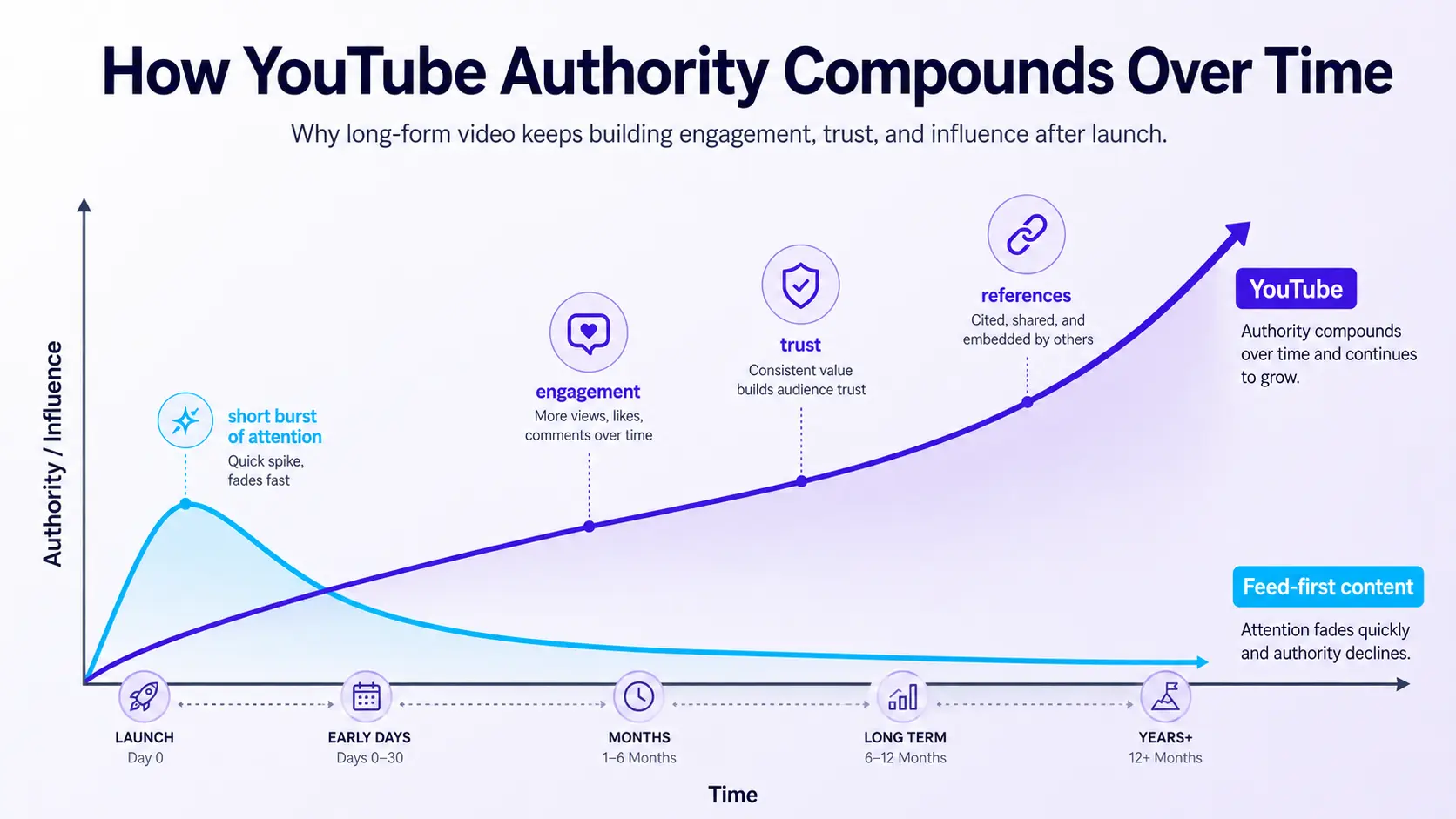
But on YouTube, the first surge is only a fraction of the total reach.
We’ve watched client videos pull in 60% of their lifetime views *after* the first month.
The myth is that only fresh videos matter.
In reality, YouTube trains the algorithm – and the audience – to rediscover and re-rank content based on ongoing relevance, not just newness.
Key Insights on Post-Publication View and Trust Growth on YouTube
- 60% of lifetime views happen after the first month.
- Content is rediscovered and surfaced based on ongoing relevance.
- Steady re-exposure builds compound authority over time.
- Algorithm favors content with robust engagement metrics.
- Videos act as durable assets, not one-off content events.
What does this mean in practice?
A single in-depth video sometimes gets surfaced by search queries and recommendations weeks or months after its debut.
Trust doesn’t just spike during launch week; it snowballs each time new viewers land and stay for longer sessions.
This steady re-exposure forges the kind of authority that’s hard to copy fast.
So what’s the mechanism?
It’s as if each view leaves a fingerprint that signals authority.
The more robust the engagement – watch time, comments, keyword matches – the stronger the algorithm’s incentive to resurface that content.
But here’s where most teams miss the leverage: the value isn’t in the one-off win; it’s in the accumulation – views and trust both rising with every new encounter.
That’s how a well-made video becomes a compound asset, not just a content event.
When one video yields returns over months, not just days
Companies used to TikTok or feed-first platforms expect results in hours.
But on YouTube, we’ve seen video assets yield demand – leads, sign-ups, brand searches – months after launch, sometimes with bigger weekly results in month three than week one.
The initial peak is only half the story.
Think of it like planting a perennial garden, not tossing wildflower seeds.
The feed forgets.
YouTube’s algorithm circles back, resurfacing the strongest material whenever demand or context shifts.
Campaigns that treat YouTube as a cycle of “launch and leave” get left behind by those who treat videos as evergreen assets – each gaining algorithmic favor and trust as their history grows.
Here’s the key: the impact isn’t limited to visibility.
Authority compounds too.
Each revisit, each late-stage discovery, layers familiarity and proof that speed-based platforms can’t touch.
Therefore, the biggest advantage is not immediate reach, but durable demand gravity.
Retention and recurring impact turn the authority flywheel.
But the next question signals a bigger opportunity: what happens when content is built for both human trust and machine interpretation, in parallel?

Why Long‑Form YouTube Is an Authority Machine in the AI Era
Most brands still treat YouTube like just another social platform.
But AI doesn’t see YouTube as feeds and likes – it sees signals of expertise rich enough to be read, parsed, and elevated.
How YouTube Long-Form Content vs. Feed-First Clips Influence AI and Algorithmic Trust
| Aspect | YouTube Long-Form Videos | Feed-First Short Clips |
| Content Length | Long, typically 10+ minutes | Very short, usually seconds |
| Attention Depth | Sustained attention, allowing for complex narratives | Fragmented attention, quick impressions |
| Authority Signal | Strong due to deep engagement and recall | Weak, surface-level impressions |
| Memory Impact | Lasting memory and references later by decision-makers | Easily forgotten due to fleeting exposure |
| Effect on Buyer Decisions | Shapes nuanced evaluation and trust | Mostly generates awareness without persuasion |
What defines authority now is not who goes viral, but who builds the clearest map for machines trained to recognize substance over style.
How AI systems read depth as expertise
Video is not just for people – AI watches too.
Long-form YouTube content, with its layered transcripts and structured chapters, generates a footprint dense enough to convert raw footage into knowledge graphs that machines can interpret.
But the common myth is that length or runtime alone does the work.
In reality, it’s the depth and semantic order – how concepts are explained, questions answered, and arguments built – that gives AI a reason to mark a creator as an expert in a topic.
In client projects, we’ve seen how transcripts with clear technical language and topic hierarchies become almost like instruction manuals for AI models mapping vertical expertise.
So what actually gets picked up?
Unlike a sixty-second short clip, a comprehensive walk-through or tutorial video offers dense, timestamped explanations, credible referential language, and even natural signposting.
If AI is scanning to answer, “Who knows this, and can they prove it?” – it’s looking for this trail of cognitive evidence.
A sharp analogy: working with YouTube long-form is like writing a chaptered guidebook, while feed-first clips resemble sticky notes.
Machines and search models both need structure to trust the source.
The sharper your concepts connect, the more durable your authority in the knowledge graph.
Not every executive recognizes it yet, but discovery models now reward videos that deliver depth and treat viewers not as distracted browsers, but as learners.
The transcript isn’t an afterthought – it’s the backbone.
But what tells the machine to push one expert over another, especially when both have strong engagement?
That cue lives in the semantic wiring beneath the surface.
When semantic structure outperforms speed in algorithmic trust
AI-driven ranking systems don’t just measure attention; they evaluate coherence, depth, and reliability of content structure compared to feed performance.
Many creators believe more posts and higher frequency drive visibility, especially after seeing quick wins on TikTok or Instagram Reels.
But algorithmic trust is increasingly rooted in context.
If your content connects concepts, demonstrates stepwise logic, and provides complete answers, it becomes algorithmically trustworthy – meaning it gets surfaced as a genuine authority, not just an attention blip.
Across several enterprise rollouts, we’ve seen that a single long-form YouTube video, with intentional semantic headings and thorough explanations, gets indexed more predictably by large language models and search-based surfacing tools.
When video chapters match natural question structures and the transcript reads like a guided resource, AI systems assign higher topical reliability – even if the total views do not match viral short-form numbers.
Here’s the commercial edge: feed-first platforms reward immediacy and volume, but AI-native search rewards substance and structure.
Which format will shape the next generation of buyer research?
The gap grows wider as AI seeks not just signals, but reasons to trust who’s teaching.
Authority is shifting from the flash of quick engagement to the quiet certainty of semantic pattern.
The next leap: how brands optimize videos not just for humans, but so machines can see depth as intent and intent as expertise.

Scientific context and sources
The sources below provide foundational context for how decision-making, attention, and performance dynamics evolve under scaling and constraint conditions.
- Sustained attention and memory formation
Sustained Attention and Spatial Attention Distinctly Influence Long-term Memory Encoding – Megan T. deBettencourt, Stephanie D. Williams, Edward K. Vogel, Edward Awh – Journal of Cognitive Neuroscience
Explores how sustained attention and spatial attention affect long-term memory encoding, supporting the article’s claim that deeper attention can build more durable associations.
https://pubmed.ncbi.nlm.nih.gov/34496022/ - Effects of structured argument on trust
Group Polarization and Computer-Mediated Communication: Effects of Communication Cues, Social Presence, and Anonymity – Choon-Ling Sia, Bernard C. Y. Tan, Kwok-Kee Wei – Information Systems Research
Analyzes how mediated communication conditions affect persuasive argumentation and belief formation, which is relevant to the article’s point about structured long-form content creating authority.
https://doi.org/10.1287/isre.13.1.70.92 - Algorithmic recommendations and content persistence
Want to be on the top? Algorithmic power and the threat of invisibility on Facebook – Taina Bucher – New Media & Society
Examines how platform algorithms shape visibility and invisibility, supporting the article’s discussion of algorithmic surfacing and authority compounding.
https://doi.org/10.1177/1461444812440159 - AI and semantic structure in search
Semantic Search on Text and Knowledge Bases – Hannah Bast, Björn Buchhold, Elmar Haussmann – Foundations and Trends in Information Retrieval
Covers semantic search, query meaning, knowledge bases, NLP, ranking, indexing, and inference, making it a strong fit for the article’s claim that structured content helps machines interpret expertise.
https://www.nowpublishers.com/article/Details/INR-032
Questions You Might Ponder
How does YouTube build authority differently from short-form social feeds?
YouTube builds authority differently by enabling deep, sustained engagement – viewers can process full arguments, fostering lasting trust and memory links. This contrasts with feed-first platforms, where fleeting impressions rarely form strong expertise associations. As a result, YouTube creators are more likely to be remembered as credible sources.
Why do long-form YouTube videos outperform short clips in B2B decisions?
Long-form YouTube videos provide the narrative space for thorough explanation, logic, and demonstrations, which meet executive needs for nuanced evaluation. Short clips may grab quick attention but rarely influence purchase decisions. Detailed content is referenced and trusted throughout extended B2B buying cycles.
What is the impact of YouTube’s recommendation algorithm on content longevity?
YouTube’s recommendation algorithm surfaces relevant content based on user intent and prior engagement – not just trending topics. This persistent exposure means valuable, in-depth videos remain discoverable and influential long after initial publication, compounding their authority over time.
How does YouTube search signal buyer intent compared to other platforms?
YouTube search queries reflect specific problems, goals, and purchase readiness. Unlike passive scrolling on feed-first apps, YouTube searchers are actively seeking solutions, making high-quality, targeted videos more likely to attract decision-ready viewers and generate real business outcomes.
Why does AI prefer long-form, semantically structured YouTube content?
AI and search algorithms evaluate depth, coherence, and conceptual order. Long-form YouTube content provides dense transcripts and topic hierarchies, making it easier for AI systems to recognize expertise. In contrast, scattered feed content lacks the context and structure required for strong algorithmic trust.