
What You’ll Learn
Trend chasing weak social authority describes how brands lose trust, recall, and differentiation when they prioritize viral formats over a clear point of view. It happens when social content copies trending memes, sounds, hooks, or commentary without reinforcing the brand’s own expertise, values, or market position.
Trend-driven posts may increase views, shares, or short-term engagement, but they often fail to create qualified demand because audiences remember the trend, not the brand.
Strong social authority comes from consistent, value-driven content that builds durable recognition, while trend chasing turns the brand into an echo of the feed instead of a source buyers trust.
Key Takeaways
- Trend chasing weak social authority by prioritizing visibility over substance, resulting in poor recall and trust erosion.
- Viral trends rarely generate qualified leads or business growth because they lack lasting value and differentiation.
- Mimicry of trending formats dilutes brand distinctiveness, leading to commoditization and loss of pricing power.
- Consistent, value-focused messaging compounds trust and recall, outperforming fleeting trend-driven tactics over time.
Most leaders celebrate viral posts as proof of brand momentum.
But momentary spikes in views rarely translate to demand, trust, or actual business growth.
The sharper risk: chasing visibility without substance converts your authority into noise – leaving brands exposed, forgettable, and priced out of their own market.

Why trend‑driven visibility fails to build authority
Chasing visibility has a magnetic pull – metric dashboards light up and teams feel validated when content racks up shares.
But the mismatch hits fast: the same post that draws millions of impressions often produces no clear lift in qualified leads or repeat buyers.
The dopamine spike fools the room, yet the sales pipeline stays cold.
The myth: more eyeballs mean more credibility and buying intent.
The truth is grimmer.
Most viral social content achieves reach at the cost of context.
Viewers swipe, laugh, or share, but rarely recall which brand was behind the moment.
The authority signal vanishes the moment the trend does.
That broader system is outlined in Social Media Marketing.
Why millions of views rarely convert into business outcomes
We have watched brands bring us posts that reached audiences in the millions, but not one inbound qualified lead resulted.
The “big win” ended in a Slack thread, not on the P&L.
So why does this disconnect persist?
Trend-driven formats speak to what’s fleeting – timelines, algorithms, and passing jokes.
But authority isn’t built in the feed; it’s built in memory.
If your audience forgets you right after the scroll, that is the missed signal.
Here’s the analogy: viral trend posts are fireworks – brilliant in the moment, gone in seconds.
Durable authority is a lighthouse – always visible, even when the noise fades.
Which one helps a buyer find you in high-stakes decisions?
Yet, how many leaders still equate “went viral” with success?
That’s the repeatable trap.
Therefore, the first question isn’t, “Did we go viral?” It’s, “Did our visibility earn us durable trust, preference, and recall when it counts?”
Comparison of Viral Trend Content vs. Durable Authority Content
| Criteria | Key Question | Implication |
| Authenticity | Does this trend reflect our true expertise and values? | If no, the brand voice is diluted and forgettable |
| Uniqueness | Would the content read as something only we could create? | If no, the brand looks like a follower, reducing trust |
| Business Impact | Does the trend content generate qualified leads and recall? | If no, effort is wasted on short-term spikes |
| Opportunity Cost | What are we not creating instead while chasing this trend? | Possibly losing time to build durable authority and trust |
| Long-term Value | Will this trend support or subtract from brand authority? | Misaligned trends erode authority and pricing power |
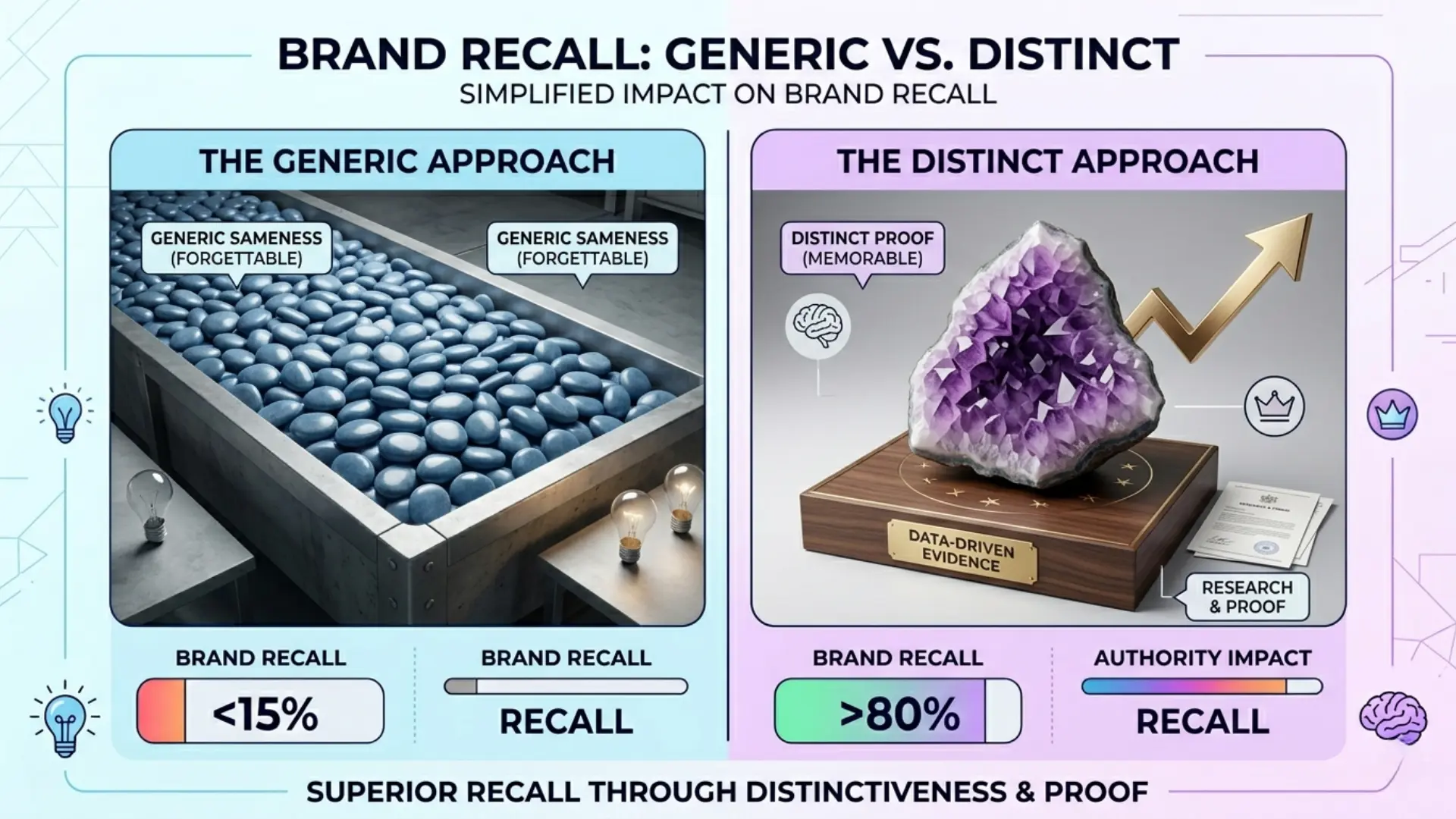
How mimicry dilutes differentiation and erodes trust
Most teams fall for the shortcut: see a trend, copy the format, aim for fast relevance.
But when every brand copies the same meme, dance, or commentary, audience eyes glaze over.
The result isn’t authority – it’s invisibility masquerading as participation.
Here, the myth bites deeper.
“Being where the audience is” is safe advice until every player speaks in one borrowed tone.
Trust fractures as soon as the buyer senses the brand doesn’t know its own mind.
That’s when prospects start viewing your company like a commodity, swappable with every other logo on their feed.
We’ve seen companies burn months building processes to chase trends – only to realize the calibration drifted.
The original point of view faded until nothing separated their profile from the pack.
One founder told us bluntly: “Our marketing started sounding like everyone else, and so did our pipeline”.
Why does copied content weaken authority so fast?
Mimicry signals you’re following – not leading – so the “real” originators claim the spotlight.
Buyers spot borrowed signals instantly.
That’s when brand recall dissolves and price pressure follows.
Consequences of Trend Mimicry in Social Media
- Audience disengagement due to repetitive, borrowed formats
- Loss of distinct brand voice leading to commoditization
- Fractured trust as buyers view the brand as a follower
- Dilution of core proposition and pricing power
- Authority lost to original trend creators
- Pipeline impact: fewer qualified leads and sales

Think of authority as a company’s signature.
The more you imitate, the blurrier the signature becomes.
How can buyers trust what’s not distinct?
Therefore, trend imitation doesn’t just miss new business – it leaks value from your core proposition.
The smart move isn’t to swear off digital formats, but to ask: Are we leading the conversation, or just echoing noise?
Trend-fueled bursts deliver neither trust nor recall – setting up the deeper question: what does it take to make brand authority compound over time?

What makes content compound audience trust over time
What actually earns audience recall isn’t being seen everywhere – it’s building a repeatable pattern in both substance and timing.
Most brands chase attention, believing that audience recall comes from being seen as much as possible.
But what people remember is not how often a brand appears, but the steady pattern and substance of its message.
Memorability grows from consistency, not velocity.
Why consistent, value‑driven content builds memorability
A flood of content grabs eyes, but a reliable signal wins brain space.
Brands often mimic each new trend, convinced it triggers recognition.
Yet, scattered bursts blend together and evaporate fast – like flashes in a storm, bright but quickly forgotten.
Here’s the myth: volume equals recall.
But after working with teams across B2B and D2C, we’ve seen the opposite hold.
The brands that win loyalty repeat their core message until it becomes shorthand in the market – think how a single phrase or approach, hammered home, triggers instant recognition.
What about those companies with a different campaign every month?
They get glances, not memory.
Patterns beat moments every time.
Consistency hands the audience a reference point.
When someone can predict what a brand will say – and knows it matters – they start to rely on it subconsciously.
Ask yourself: if you disappeared for three months, would your audience notice – or would another account fill the gap with the same trending sound and format?
Value-driven content is the anchor.
Trend-driven content is driftwood.
How trust compounds long‑term while trends fade fast
Trust rarely forms in a single hit.
Instead, it’s built the way interest grows on a savings account: small actions, repeated, turning into something much larger over time.
Each value-driven post builds on the last, forming reputation through repetition.
Copycat trend use can spike reach for a day, but it leaves no residue.
We’ve seen pages with millions of views and no recall when it counts – prospects can’t even name the brand later.
But one brand with a clear, persistent point of view dominates the shortlist when buyers need solutions months down the road.
That’s not coincidence.
Why does authority content outlast trends?
Trend formats are the sugar hit – brief, forgettable, common to everyone.
But a stance or perspective, reinforced week after week, becomes part of how the audience orients in their category.
Even platforms reward this: the algorithm pushes what people look for again and again.
So the real compounding effect is subtle but unstoppable.
Steady, value-rich presence cements trust long after the latest fad has vanished from the feed.
But that raises a sharper issue: if trust accrues quietly over time, how do you know when it’s working – and when you risk stalling growth by chasing after the next viral hook?

How to evaluate whether a trend aligns with your strategic identity
Most brands frame trend decisions as quick wins for visibility.
But not every trend is a bridge to authority.
The sharper move is asking which trends actually reinforce what you want to be known for – and which ones quietly subtract from it.
Trend Evaluation Criteria and Opportunity Costs
| Aspect | Viral Trend Content | Durable Authority Content |
| Audience Impact | Momentary spikes in views, shares, and impressions | Consistent recall, trust, and preference over time |
| Business Outcome | Often no lift in qualified leads or sales | Drives inbound leads and pipeline growth |
| Brand Recall | Audience quickly forgets the brand behind the content | Memorability built by repeatable patterns and substance |
| Authority Signal | Disappears as trend fades | Grows and compounds steadily over time |
| Risk | Converts authority into noise and commoditized presence | Builds durable trust and differentiation |
Does this trend naturally reflect our expertise and values?
Surface buzz makes decisions feel urgent.
But copying a viral format rarely answers a tougher question: does this trend let your brand’s real point of view show through, or are you just wearing someone else’s costume for a day?
When we review campaigns with clients, we often start here: if the trend format vanished tomorrow, would your expertise and values still be clear in what’s left?
More often than not, the answer is no.
Most trending formats reward the safest, least distinct version of a brand’s voice – not the one that builds recall or invites trust over time.
It works like a filter.
The best test is not whether your team can ride a wave, but whether the final result reads as something only your company could have made.
A trend that fits your authentic expertise makes your signal stronger.
The rest, no matter how tempting, dilute the brand until no one can remember what makes you different.
That’s the pivot most teams miss.
Trend chasing for its own sake turns your presence into background noise.
What’s the opportunity cost compared to authority building content?
Every campaign has a cost beyond the time it eats – the lost chance to shape authority instead.
It’s not just about what you post; it’s what you’re *not* making while chasing the latest quick-hit format.
If you pour a week into a meme or a borrowed hashtag, that’s a week not spent deepening your audience’s trust or clarifying your expertise.
This becomes painfully clear in monthly reviews: the team celebrates spikes in shares, but struggles to point to lasting business impact.
Activity fills the content calendar, but the signal gets weaker.
Is one more fleeting hit really better than a piece that grows in value every time it’s seen or referenced?
Trend chasing is like playing the social lottery – high risk, quick adrenaline, but rarely compoundable.
Authority comes from building decision assets, not renting attention.
So the sharper lens is not whether you *can* ride the trend, but what you give up when you do.
This is how weak social authority starts: by trading away compounding trust for a short burst of relevance.
A trend may promise reach, but only alignment grows durable authority.
The next question: how do you adapt trend formats to serve your voice instead of erasing it?

Where trend use belongs in a social media system built for trust
Teams often slot trends straight into their content calendars, thinking every viral format gives them an audience edge.
But putting trends at the core of a social strategy quietly sets a trap.
The moment your presence depends on borrowed flavor, the brand voice is no longer yours.
The common play is to treat every trend as a highway to exposure.
But speed without steering is not control.
True authority makes the format serve the message – not the other way around.
How to repurpose formats without losing your voice
It’s easy to mistake adaptation for imitation.
Adopting popular structures can show agility, but mimicking the tone, visuals, or scripts of a trend leaves your perspective invisible.
The difference is subtle but critical.
Companies with staying power use trends as containers, not templates.
Think of a trend format like a stage.
The set may be familiar, but the script must be your own.
We’ve seen brands lift ideas from trending sounds or memes, but only those adding a distinctive take spark real recognition.
When every video looks like the last viral clip, people forget who said what.
But when a team injects their viewpoint into an expected format – challenging the premise or bringing unique angles – the audience starts to anticipate substance, not just style.
So, when does adaptation stop short of imitation?
The litmus test: if you strip away the trend, does anything about the content sound unmistakably like your brand?
If not, the risk is commoditized presence – easy to copy, easier to forget.
Guidelines for Adapting Trend Formats Without Losing Brand Voice
- Treat trend formats as containers, not templates
- Inject unique insights, commentary, or humor into trends
- Ensure content still sounds unmistakably like your brand
- Avoid imitating tone, visuals, or scripts exactly
- Use trends to amplify your point of view, not replace it
- Measure impact beyond likes – focus on conversations and leads
One client tried replicating a viral Q&A trend word-for-word, hoping for spillover success.
The result?
A spike in likes, but no lift in actual conversations or sales.
Once the trend faded, so did any memory of the posts.
Compare that to their own “unsolved myth” series – structured like a familiar reaction video, but anchored in expert commentary and trademark humor.
Months later, those clips still drive new inbound leads.
Audiences remembered the approach, not just the format.
This is where the value tips: Adapt trend formats as a wrapper for your perspective, never as a replacement for it.
That’s the lever most companies miss.
When to route to deeper understanding of social positioning
Repurposing the packaging only works if you know where your authority sits.
So, when does leveraging a trend signal time for a shift in strategy?
The first sign: if all that remains after the trend passes is a faint echo of other voices, not your own.
Ask this: Are you using trends to amplify a point of view – or to hide the absence of one?
If the brand disappears without trending content holding it up, it’s a cue to go deeper.
The fix is rarely more trend surfing; it’s clarifying what only your team can say boldly.
Borrowed momentum can start a conversation, but trust compounds where originality meets relevance.
That is where deep social positioning takes over: anchoring authority in themes, values, and framing only you can own.
Therefore, the strategic use of trends is not about chasing every wave – it’s about knowing when to step off the board and double down on the undercurrents that drive real, lasting trust.
The question then sharpens: what signals tell you your voice is distinct enough, even when the trend cycle ends?
That missing foundation is deeper social positioning, developed further in Point of View in Social Media Marketing.

Scientific context and sources
The sources below provide foundational context for how decision-making, attention, and performance dynamics evolve under scaling and constraint conditions.
- Attention Economy and Social Media
The Attention Economy and the Net – Michael H. Goldhaber – First Monday
This paper outlines how attention, not simply reach or views, becomes a central currency of digital presence. It supports the article’s argument that visibility from trend chasing does not automatically build social authority.
https://firstmonday.org/ojs/index.php/fm/article/view/519/440 - Authority Building and Signal Theory
Advertising as a Signal – Richard E. Kihlstrom and Michael H. Riordan – Journal of Political Economy
This paper explains how advertising can work as a market signal. It supports the argument that authority depends on credible, costly, and consistent signals – not borrowed trend formats.
https://www.journals.uchicago.edu/doi/abs/10.1086/261235 - Memorability through Consistency
Habitual Prospective Memory and Aging: Remembering Intentions and Forgetting Actions – Gilles O. Einstein, Mark A. McDaniel, Rebekah E. Smith, Pat Shaw – Psychological Science
This study examines habitual prospective memory, showing how repeated tasks and contexts shape remembering. It is relevant to the article’s point that consistent patterns are easier to remember than scattered, trend-driven bursts.
https://profiles.wustl.edu/en/publications/habitual-prospective-memory-and-aging-remembering-intentions-and-/ - Commoditization and Differentiation
How Brands Grow: What Marketers Don’t Know – Byron Sharp – Oxford University Press
This book explains evidence-based brand growth, especially mental availability and repeated brand cues. It supports the article’s argument that brands need memorable, repeatable assets instead of content that blends into category noise.
https://global.oup.com/academic/product/how-brands-grow-9780195573565 - Decision Assets in Content Strategy
Building Strong Brands – David A. Aaker – Free Press
A foundational book on brand identity, brand systems, and long-term brand assets. It supports the article’s case for building durable authority assets instead of chasing short-lived relevance.
https://www.simonandschuster.com/books/Building-Strong-Brands/David-A-Aaker/9780029001516
Questions You Might Ponder
Why doesn’t viral content usually lead to lasting business results?
Viral content often generates high visibility but lacks context and substance, causing audiences to quickly forget the brand behind the trend. This fleeting attention fails to build authority or drive meaningful engagement, resulting in minimal impact on business outcomes or long-term loyalty.
How does trend chasing weak social authority for brands?
Trend chasing weak social authority because it signals imitation rather than originality, making brands appear as followers. This erodes differentiation, dilutes trust, and causes audiences to view the brand as generic – reducing its relevance and authority in high-stakes buying decisions.
What is the opportunity cost of focusing on trends instead of authority-building content?
Prioritizing trends consumes valuable time and resources that could be invested in creating authoritative, value-driven content. This trade-off often means missing opportunities to reinforce brand expertise, deepen audience trust, and develop compounding market recall.
How can consistent, value-driven content improve brand memorability?
Consistent, value-driven content fosters brand recall by creating recognizable patterns and reinforcing a durable brand point of view. This repetition helps audiences subconsciously associate expertise and trust with the brand – leading to stronger long-term loyalty and increased preference.
When should brands use trends as part of their social media system?
Brands should only use trends when they can adapt these formats to reinforce their unique expertise and voice. If trend participation does not serve the brand’s strategic identity, it risks turning authority into noise. The key is to make trends a wrapper for original perspectives, not a replacement.