
What You’ll Learn
Social media point of view is the set of beliefs, boundaries, and distinct explanations that shape what a brand consistently says, rejects, and proves on social channels. It is not a tagline, tone, opinion, or viral hook.
A strong social media point of view makes content recognizable because the audience can see what the brand believes, what it notices, what it challenges, and how it explains the market differently from competitors.
It builds trust and demand by turning scattered posts into a consistent market stance that people can remember, quote, and associate with the brand across platforms.
Key Takeaways
- A distinct social media point of view creates lasting brand recognition and trust, outperforming fleeting viral tactics.
- Consistency in beliefs, boundaries, and differentiated content compounds long-term authority and market loyalty.
- Generic, undifferentiated posting leads to forgettability and weakened demand, regardless of engagement metrics.
- Adapting your social media point of view to each platform and industry context is essential for relevance and defensibility.
Most social media strategies obsess over reach and viral tricks.
But brands that chase popularity often disappear into the noise.
The real signal that cuts through isn’t what goes viral – it’s a point of view so distinct, even a quick scroll imprints your name in the mind of your market.
That broader model is outlined in Social Media Marketing.

What is a social media point of view – and why it matters for recognition
A brand’s social media point of view isn’t the style of a post or the energy of a voice – it’s the set of beliefs, boundaries, and stances that shape which ideas earn daylight on your feed.
But here’s the myth: many assume a POV is just an “opinion” or a catchy tagline.
That’s surface level.
The value runs deeper.
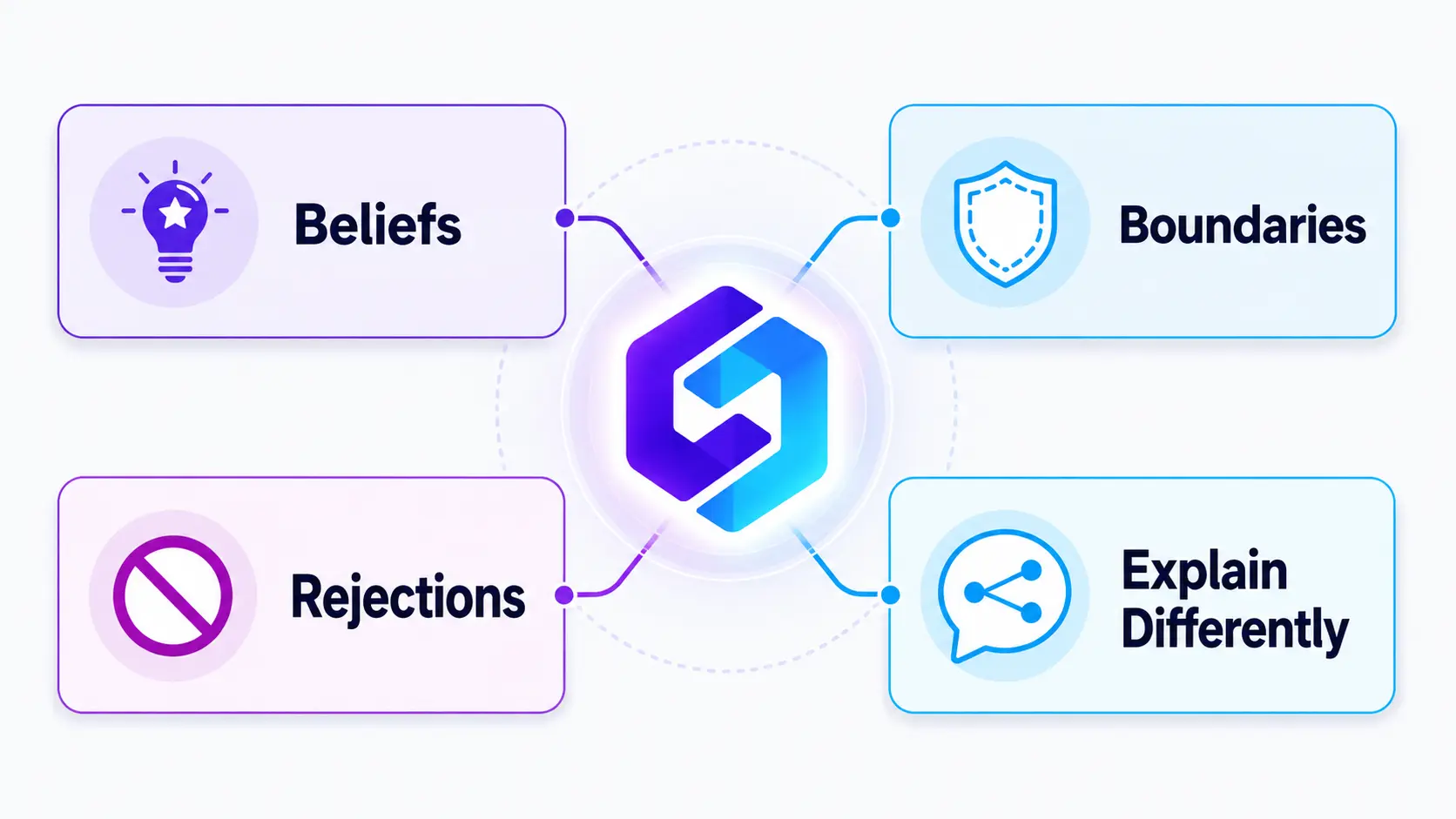
It emerges from four core pillars: what you believe, what you notice, what you reject, and what you explain differently than everyone else.
How a clear point of view creates belief, boundaries, and market stance
What you believe forms a spine for every message.
It could be as direct as “transparency outperforms showmanship in B2B”.
But the subtler signals – what you choose to dismiss, or which blind spots you surface – matter just as much.
That’s where boundaries appear.
For example, we’ve seen teams hit a wall sharing generic “tips” that feel safe for everyone but memorable for no one.
The content collects likes and goes nowhere.
But let them reject a common myth, or challenge a dead industry process, and suddenly the audience leans in.
Every strong POV is more than a list of talking points.
It’s a strategic filter.
Think of POV as a lens – the kind that brings the edges of the picture into sharp focus but blocks out the background blur.
Without that lens, posts become pixel noise: visible, but waiting to be scrolled past and forgotten.
Core Pillars of a Social Media Point of View
| Platform | Audience & Behavior | Content Style/Format |
| Professional, in-depth audience | Long text posts, detailed analysis | |
| Visual, casual, story-driven audience | Short videos, Stories, images | |
| X (formerly Twitter) | Fast-paced, witty, brief interactions | Short text updates, quick engagement |
| TikTok | Younger, trend-focused audience | Short, entertaining videos |
Here’s a simple repeatable insight: the line between trust and indifference is marked by boundaries your content is willing to defend publicly.
When you show what you won’t support – what breaks your process, contradicts your worldview, or wastes your buyer’s attention – your stance becomes sharper than your slogans.
Is it ever risky?
The risk of standing for nothing is far greater than the risk of losing those who disagree.
The content loses its audience long before anyone debates your ideas.
Why recognition trumps novelty: the compounding value of consistent POV
Most brands treat novelty as the key to social media success.
One fresh format, a viral meme, a stunt – then chase the next trend.
But recognition, not novelty, changes the game.
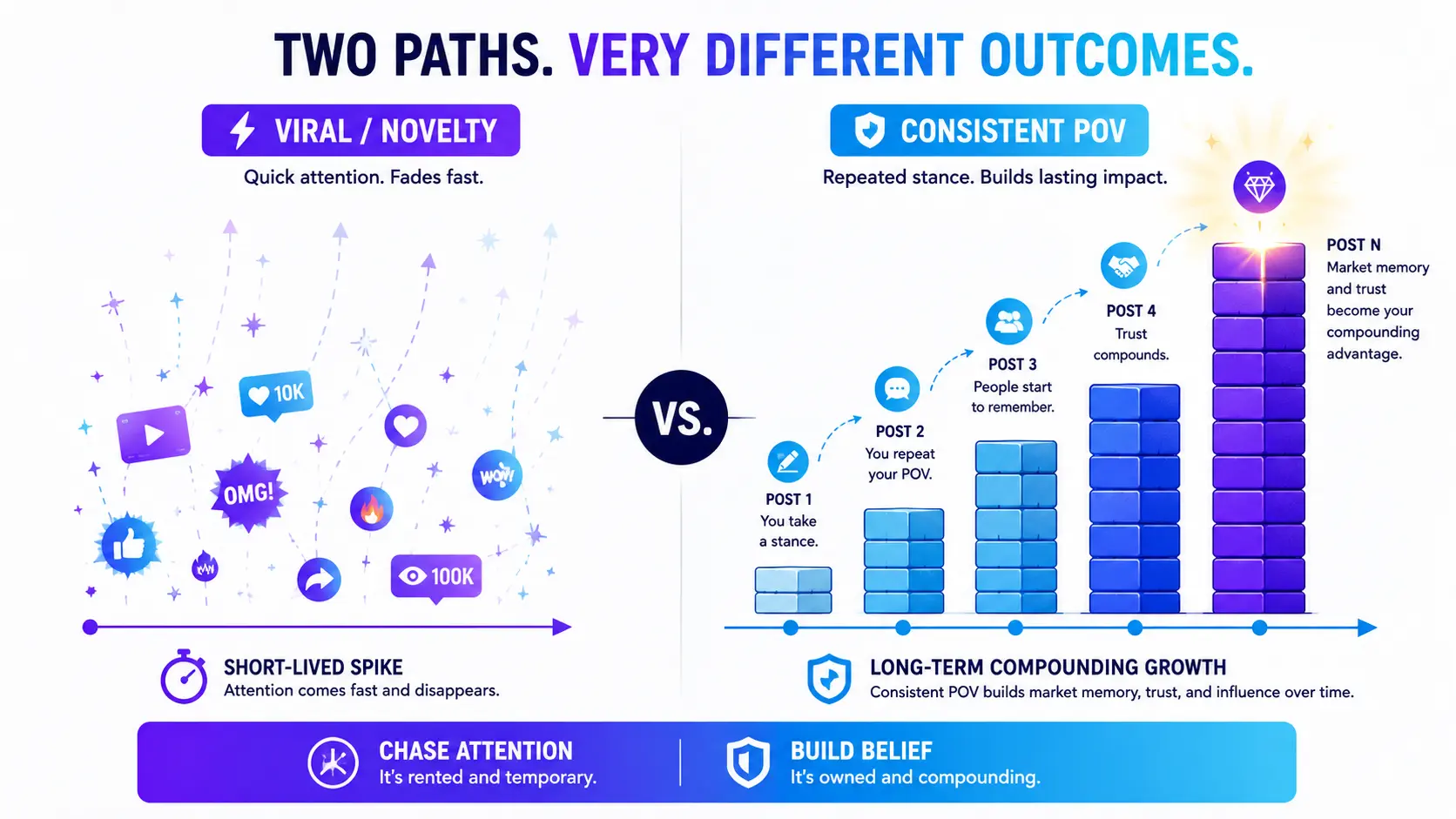
The posts your market remembers are the ones that echo your POV again and again, not the ones that flash and fade.
When your content is shaped by a consistent POV, every piece acts like an extra brick in the wall of market memory.
Think about the brands you trust: you don’t remember their hottest takes, you remember the stance that shows up week after week, shaped by the same filter.
That’s the part competitors can’t clone.
Relying only on novelty is like throwing confetti – colorful, instantly everywhere, then swept away in minutes.
Strong POV is the architectural foundation: visible, solid, and impossible to mistake for someone else’s.
But how does this trust compound?
Over time, your market starts predicting the unique angle only you bring.
Audience mindset shifts from “what will they post?” to “what will they say about this?” – and that’s where authority grows in social channels.
It’s not repetition for repetition’s sake; it’s the compounding signal of who you help, what you fight for, and how you explain the market in a way nobody else quite does.
Therefore, the payoff isn’t just “more engagement” – it’s market memory and trust that drive demand long after the viral moments fade.
The next challenge: how do you know if your content is missing this compounding effect?

When social media posting feels aimless: diagnosing missing point of view
A packed social calendar can make a team feel active, even accomplished.
But activity without direction is the root of most content regret.
The uncomfortable truth: if your posts don’t create an echo in memory or lead anyone forward, you’re broadcasting into a silent room.
Most social teams mistake steady output for proof of progress.
Their content engine keeps running, but the fuel for relevance – clarity of point of view – is missing.
The risk isn’t just wasted time.
It’s that even strong brands become forgettable.
Posting content that doesn’t compound or drive demand
A common blind spot for executives is confusing a flurry of impressions or likes with real brand momentum.
But content without a discernible point of view has no spine.
Each post stands alone, dissolving as quickly as it appears.
Engagement is fleeting; demand doesn’t build.
One client once described this as “paddling in circles” – lots of motion, no real travel.
Here’s the analogy: imagine pouring water onto dry sand.
Each drop vanishes instantly, leaving no mark.
That’s what generic posting does to your presence – no memory, no compounding benefit.
Without a social media point of view, content doesn’t stack; it scatters.
Common Pitfalls of Content Missing a Strong Point of View
- Mistaking steady output for real progress
- Publishing generic tips that accumulate no memory
- Sharing lightweight opinions with no backbone
- Creating content that stands alone without reinforcing brand stance
- Confusing impressions or likes with lasting brand momentum
- Competing against your own previous posts instead of reinforcing them
The practitioner trap?
Teams publish helpful tips, day-of-week themes, or lightweight opinions, but nothing ties back to what they believe or what sets them apart.
The result is surface-level agreement, not lasting conviction.
It feels busy, yet nothing accumulates.
The missed outcome isn’t merely a lack of sales – it’s the evaporation of demand creation itself.
Without consistency of stance, every new post competes against your last instead of reinforcing it.
So what shows up instead of growth?
A performance plateau, where moving the metrics means starting over each month.
Engagement without differentiation: when everything sounds the same
Sometimes, a brand manages to attract likes or shares, but the content reads as if it could belong to any competitor in the space.
There’s no narrative thread, no signature voice, just a recycled playbook.
This is where the absence of an intentional point of view shows its full cost.
Executives may notice “engagement” on dashboards, yet the comments rarely mention the brand itself – or worse, readers can’t recall who posted what last week.
Posting without a stance leaves you exposed to sameness.
The buyer shrugs and moves on.
One telltale sign: scrolling your feed feels like reading a never-ending press release, with only names swapped out.
Without a unique social media point of view, you risk becoming a ghostwriter for your own competitors.
Safe content blends in.
Only a distinct social media point of view shapes lasting preference.
Therefore, when differentiation falls away, so does trust.
The risk goes beyond low reach; it becomes irrelevance at the buyer’s decision point.
The next step: expose how to evaluate where your own content sits on the stance-recognition spectrum – and confront the silent signals that your market is tuning you out.

How to evaluate if your social presence needs a stronger point of view
Most organizations assume their brand has a clear stance – after all, the mission and tagline are spelled out.
But memorability in social media rarely comes from what you say about yourself.
The sharper signal is hidden in the gaps: when your content goes live, do buyers instantly feel what you stand for – or could every post belong to anyone in your sector?
A distinct social media point of view acts like a hidden watermark.
But if that imprint fades, so does message recall and market demand.
The fixation on constant output quietly blinds teams to this signal loss.
Instead of rethinking the shape of their presence, leaders double down on speed or uniformity and wonder why recognition slips.
Does our content reflect what we believe, notice, and reject consistently?
It’s easy to assume consistency means on-brand visuals and language.
However, belief and boundary in social media are built through recurring cues: what you believe, spotlight, and refuse.
Most content reviews default to campaign metrics and scheduled posts.
But does the team ask which boundaries are non-negotiable – or which trends your brand simply won’t chase?
Surface-level sameness is rarely an accident; it’s usually a byproduct of missing belief and boundary in social media content.
In work with B2B and B2C brands, we’ve seen executive teams surprised by how fast their feed drifts from meaning to noise.
One insight: when new contributors have no cues on what to refuse or defend, groupthink fills every slot with “safe” ideas.
Diverse voices are valuable, but without a defined point of view, debate turns into compromise, not conviction.
Analogy: A strong point of view is like a border on a map – without it, you only recognize cities by their size, not by what defines them.
Teams mistake regular posting for steady positioning.
But belief and rejection – what you won’t do, not just what you will – are where differentiation lives.
Therefore, if your audit finds little evidence of these boundaries, it isn’t just a content gap.
It’s a demand problem waiting to unfold.
Are platforms treated differently or flattened under identical messages?
It’s tempting to standardize messaging across platforms for efficiency.
But each channel rewards a particular language, rhythm, and depth.
The risk: if your point of view isn’t adapted for each audience, your social presence becomes generic everywhere.
Here’s a diagnostic: compare your messaging on LinkedIn, Instagram, and X.
Does each channel reflect an adjusted belief structure – or do they read like copy-and-paste jobs with trivial formatting changes?
The myth is that message consistency means duplication.
In reality, rigorous point of view in social content means knowing which beliefs deserve foregrounding per platform – and which expressions undermine that stance.
The cost of flattening your point of view isn’t just inefficiency; it’s near-total invisibility.
From our client experience, the highest trust and engagement come from brands that flex their stance without fracturing it.
One B2B SaaS team saw their recognition leap when their technical voice was calibrated for LinkedIn depth but distilled for Twitter wit.
The underlying beliefs never shifted, but the signals matched the room.
Therefore, if your audit finds platform content indistinguishable except for hashtags or length, you’re not leveraging your belief system – you’re diluting it.
The question isn’t how to post faster, but how to let stance drive platform fit.
The reality: social media differentiation comes from working your point of view into each audience’s context, not forcing context to fit your workflow.
Now the challenge deepens – what does a robust, consistent point of view empower, and where do the limits appear if it’s confused with controversy or personality?

What a strong social POV changes – and what it doesn’t
Most leaders hope a distinctive social media point of view pushes their brand into the spotlight.
But a strong POV rarely generates instant buzz or controversy.
The sharper payoff is quieter: it makes every post recognizable, trusted, and compounding – even when the topic isn’t new.
Why POV isn’t controversy, personality, or clickbait
Stake your claim: clarity in social content isn’t about sparking arguments or showing off personality quirks.
But too many teams fall into the trap of equating “strong POV” with baiting outrage, chasing viral trends, or making their CEO the story.
The myth is simple but sticky – if you’re not stirring the pot, you must be blending in.
This is where most social strategies quietly fail.
Controversy attracts fast glances, not trust.
Overly personal tone confuses the brand message with the messenger.
And clickbait, by design, burns attention as quickly as it earns it – leaving little to build on when the dust settles.
Misconceptions About What Constitutes Strong Social Media POV
- Strong POV is not about sparking arguments or outrage
- It’s not about making the CEO or personality the central story
- Avoids clickbait that burns attention quickly
- Draws authority from certainty about core beliefs
- Focuses on clarity and recognizability over momentary attention
- Holds a view that survives editing, translation, and time
There’s a clearer way: a social media point of view draws its authority from certainty about what matters, not from courting risk.
The difference is felt in how your audience recalls you, not just how they react for a moment.
Imagine social content as a clean blueprint; the lines matter more than the colors splashed around them.
If your POV is only visible when you raise your voice, you don’t actually have one – the crowd does.
So, what’s the decision rule here?
Brand stance is what survives editing, translation, and time.
Personality, controversy, and cheap hooks fade.
The discipline is in holding a view that makes every post both recognizable and defensible – no matter who’s behind the keyboard.
What a consistent POV enables: visibility, trust, and demand shaping
Consistency in point of view is the difference between noise and memory.
But it’s not about repetition for its own sake.
When clients keep their social content shaped by a steady stance – what they believe, what they reject, what they see others miss – patterns start forming in the market’s mind.
Someone with no previous contact can see one post and name the brand, even before the logo loads.
Here’s a practical insight from the trenches: we’ve found that buyers return to brands whose stance helps them decide what to value or ignore, not to the ones with flashiest headlines.
Familiarity in boundaries earns attention far longer than novelty.
The quiet miracle is trust – earned not through perfection, but through reliable lines drawn in the sand.
Is novelty ever the goal?
Rarely.
Recognition is what compounds.
Each expression of a distinctive POV acts as a memory anchor.
Controversy doesn’t – its spikes are forgotten as quickly as they appear.
That’s the hidden engine behind real authority growth: when your market recognizes your content style without the watermark, you own a slice of mental real estate the noisy players never do.
So what changes next?
With strong POV discipline, visibility turns sticky and trust survives market turbulence.
But the tougher question remains: which beliefs deserve to be center stage on each channel – and when must they be adapted?

Next steps: when to go deeper via platform or industry-specific POV spokes
Maintaining a strong social media point of view can look straightforward at the brand level.
But translating that stance across each platform – or adapting it in highly regulated fields – reveals hidden cracks.
Most teams assume the core message will automatically fit everywhere.
In reality, channel and industry friction quietly limits both recognition and reach.
Platform adjustments: when POV needs recalibration for different channels
It’s tempting to simply recycle your strongest message across every social channel.
But channels shape behavior as much as content does – what cuts through on LinkedIn may land flat on TikTok, and what works on X might go ignored on Instagram.
That’s where rigid POVs can turn brittle.
A senior executive sharing a bold opinion in a text post might spark engagement on X, but a two-minute video saying the same thing could feel rehearsed on Instagram Stories or irrelevant on Facebook.
Each environment has its own social gravity.
The point of view needs calibration, not dilution; otherwise, attempts at consistency become a source of friction rather than trust.
Adapting Social Media Point of View by Platform
| Pillar | Description | Example |
| What you believe | The foundational convictions shaping every message | “Transparency outperforms showmanship in B2B” |
| What you notice | The subtler signals or blind spots your content highlights | Spotlighting inefficiencies others ignore |
| What you reject | Boundaries set by dismissing common myths or unsafe topics | Rejecting generic ‘tips’ that feel safe but are forgettable |
| What you explain differently | Offering unique explanations or perspectives distinct from others | Challenging dead industry processes with new interpretation |
Here’s one way to frame it: every platform is like a new room at the conference.
Your stance must stay visible, but the way you state your belief, reject common wisdom, or explain a principle needs to flex for the specific audience dynamic and medium.
That’s the trap – over-indexing on sameness signals a lack of presence, while radical reinvention signals absence of core standpoint.
Miss the fit, and the risk isn’t just lower engagement.
You invite behavioral backlash or even shadow bans when the tone, format, or position break channel norms.
Teams with deep experience know when a post reads as brave on one platform but comes off as reckless on another.
How do you recognize where adaptation is required without eroding the beliefs that make your brand memorable?
That’s the operational question most content calendars skip.
Therefore, before scaling or specializing your content, audit how your social media point of view shows up both in message and modality on each channel.
If you see blandness or controversy out of context, that’s your signal to dig into platform-specific spokes – or risk your distinctiveness evaporating under algorithmic pressure.
Industry overlays: when regulated or niche fields change POV rules
Crafting a distinctive social media point of view in a regulated or niche field is a strategic double-bind.
The boundaries are set not just by your brand but by external rules, codes, or even cultural expectations that override generic differentiation tactics.
The myth is that all industries can stand out with the same levers.
But in sectors like healthcare, finance, or legal, publishing what you reject or believe gets filtered through compliance, risk, and sometimes literal law.
We’ve seen even experienced teams trip here – a punchy stance that wins SaaS followers might trigger legal review or client loss in insurance.
The tension isn’t theoretical: even what counts as “explaining differently” is circumscribed by policy or regulation.
Without adapting POV to these overlays, you risk one of two quiet failures: draining your positioning until it’s bland – or crossing a boundary that invites fines, bans, or legal action.
Ironically, the safest path is not to flatten your voice, but to sharpen clarity about which beliefs are publicly defensible within domain guardrails.
In these cases, the decision shifts from “how bold can we sound” to “where can we claim authority without raising red flags?”
Therefore, if your audience or industry comes with special boundaries, next steps are not just about content tactics – they require building mini-strategies (industry overlays) that balance trust-building against operational risk.
This is how a sharp point of view stays both distinct and defensible, no matter how narrow the path.
A strong core stance is only the start – the next move is adapting, not diluting, your POV for each context.
That opens the door to tailored strategy guides: when does your brand need a platform-specific playbook, and when does sector complexity demand a new kind of stance entirely?
A point of view becomes credible only when the company can support it with proof.
The logic for building proof is explored in Proof in Social Media Marketing.

Scientific context and sources
The sources below provide foundational context for how decision-making, attention, and performance dynamics evolve under scaling and constraint conditions.
- Social identity in branding
Social Identity and Self-Categorization Processes in Organizational Contexts – Michael A. Hogg, Deborah J. Terry – Academy of Management Review
Explores how social identity and self-categorization shape organizational behavior, group boundaries, and shared meaning – useful as a theoretical base for brand point of view and market recognition.
https://journals.aom.org/doi/10.5465/AMR.2000.2791606 - Consistency and trust in brand communication
Brand Authenticity Leads to Perceived Value and Brand Trust – Asuncion Hernandez-Fernandez, Mathieu Collin Lewis – European Journal of Management and Business Economics
Examines how authenticity, including consistency and continuity, supports perceived value and brand trust – directly relevant to the business value of a sustained, clear brand stance.
https://doi.org/10.1108/EJMBE-10-2017-0027 - Memory and attention in digital communication
Novelty and Collective Attention – Fang Wu, Bernardo A. Huberman – Proceedings of the National Academy of Sciences
Shows how attention to online items rises and fades over time, supporting the article’s argument that novelty alone is weak and that lasting recognition needs repeated, recognizable signals.
https://www.pnas.org/doi/10.1073/pnas.0704916104 - Theory of organizational boundaries and differentiation
Social Innovation: Blurring Boundaries to Reconfigure Markets – Alex Nicholls, Alex Murdock – Palgrave Macmillan
Explores how organizations and markets are shaped by blurred and reconfigured boundaries – relevant to the article’s point that beliefs, rejections, and boundaries help define a distinct market role.
https://link.springer.com/book/10.1057/9780230367098 - Avoiding sameness and voice dilution in digital strategy
A Framework for Categorizing Social Media Posts – Wondwesen Tafesse – Cogent Business & Management
Provides a structured way to classify brand posts by message strategy, which helps explain why brands should avoid copy-paste posting and adapt content by platform and context.
https://www.tandfonline.com/doi/full/10.1080/23311975.2017.1284390
Questions You Might Ponder
What is a social media point of view and why is it important?
A social media point of view refers to the clear, distinctive beliefs and boundaries that guide a brand’s content. It’s crucial because it creates recognition, trust, and lasting market memory, helping brands stand out from competitors and avoid generic or forgettable messaging.
How can a consistent social media point of view affect brand trust?
A consistent social media point of view reassures audiences by signaling reliability and clarity. When brands take recognizable stances instead of simply following trends, consumers develop trust and are more likely to remember and engage with the brand over time.
What are common mistakes brands make with their social media point of view?
Common mistakes include posting generic tips, chasing viral trends without a stance, duplicating content across platforms, and confusing activity with meaningful engagement. These errors lead to bland, forgettable content that fails to drive demand or market preference.
How should brands adapt their social media point of view for different platforms?
Brands should tailor their point of view for each platform by adjusting message style, tone, and depth while maintaining core beliefs. For example, technical depth on LinkedIn, concise wit on X (Twitter), and more visual approaches on Instagram each reinforce brand recognition within audience expectations.
What risks do brands face without a strong social media point of view?
Brands lacking a strong social media point of view become indistinguishable from competitors, struggle to build buyer trust, and fail to create demand. Without clear boundaries, posts scatter attention, reduce long-term recognition, and can dilute the brand’s authority in key markets.