
What You’ll Learn
Proof led social media content is social content that builds trust by anchoring claims in concrete evidence, not just opinions, trends, or polished advice.
It uses specific data, real examples, observed patterns, trade-offs, outcomes, lived experience, or demonstrated judgment to show why a message should be believed. Proof-led content is harder to copy because the evidence comes from what the brand has actually seen, tested, changed, or achieved.
It helps audiences remember who made the claim, understand the reasoning behind it, and treat the brand as a credible source.
Strong proof-led social content turns posts into trust assets that support recognition, authority, and demand over time.
Key Takeaways
- Proof-led social media content breaks through the noise by anchoring claims with concrete data, real examples, and lived experience, directly increasing trust and credibility.
- Generic, opinion-only posts blur together and get forgotten quickly, even when they generate surface-level engagement.
- Specific evidence transforms advice into memorable reference points, making your content difficult to replicate and easier for audiences to recall and act upon.
- Continually integrating proof compounds your brand’s authority and reputation, creating lasting differentiation and long-term commercial advantage.
Everyone fighting for attention on social media eventually tries to say something useful.
But useful alone is rarely enough.
Even sharp advice blends into the feed when it sounds like an echo – generic, familiar, quickly scrolled past.

Why simple claims fail to matter – and what proof changes
The sameness starts before you notice.
Open any business feed and you’ll see a parade of lookalike assertions: “Focus on the customer”, “Execution beats ideas”, “Content is king”.
The intent is there, but every assertion wears the same anonymous uniform.
It’s assembly-line content – each post safe, polished, and instantly forgettable.
This flattening effect happens when creators focus on surface value and presentation but skip the one layer that actually differentiates: proof.
Without concrete evidence, data, or lived experience, even valid insights feel like wallpaper.
That is where the trust gap quietly widens.
The problem with bland content: why useful posts become invisible
Most brands try to fix this with more activity – posting more often, using trending formats, or adding sharper graphics.
But frequency and polish can’t disguise the fact that an echo, repeated louder or more often, is still an echo.
Opinions are cheap and easily guessed.
Evidence is scarce and sticky – not just more content, but the kind that buyers can’t easily dismiss or replicate.
That distinction is central to social media marketing as a system.
The most common myth?
That being “helpful” is enough to stand out.
In reality, feeds are filled with helpful advice no one remembers.
The feed turns invisible when no one can remember who said what – or why it mattered to begin with.
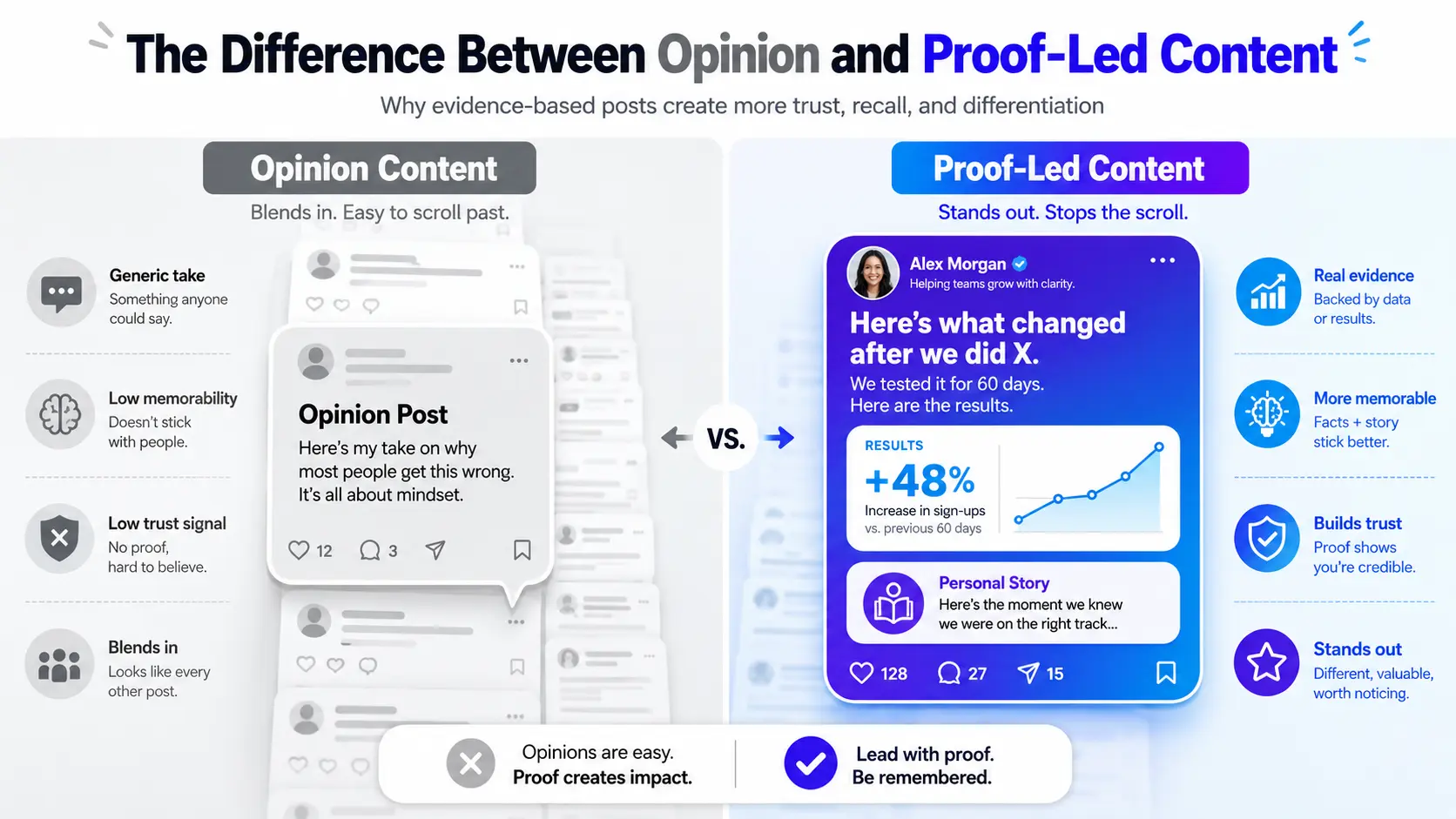
What proof adds: credibility, memorability, and demand
Inject a real example, a number, or a personal outcome into a point, and the difference is immediate.
The post gains weight.
Where most bravado-filled posts dissolve on contact, evidence gives your words friction.
It’s like switching from static on a radio to a signal you can’t ignore.
Proof rewires the buyer’s brain.
Instead of asking, “Does this sound right?” they now ask, “Where did they get that?” Specific data or lived judgment transforms your voice from just another opinion to a source worth watching.
For example, a statement like “We reduced churn by 17% in a six-month span, but only after removing three popular features” has staying power – precisely because it is hard for others to fake or repost without substance.
Proof increases memorability on social media by linking claims to felt experience.
The audience may not remember the slogan, but they will remember who showed their work.
That is what moves a brand from forgettable to trusted.
It becomes a reference point, not background noise.
Think of proof as the watermark hidden in the image – subtle, hard to copy, instantly noticed by the trained eye.
Even when competitors try to mimic your advice, the absence of real evidence is glaring.
Here’s the repeatable insight: opinions can be shared, proof gets remembered.
So what changes first?
The content that shapes decisions becomes the content that brought something no one else was willing – or able – to prove.
The question now isn’t just what to say next, but how to anchor every claim with substance that travels further than the feed itself.

What makes proof more believable than opinion in social media
A polished opinion can gather likes, comments, and shares on social media.
But if you strip away the branding, most opinions eventually blur together.
The sharper truth?
Proof-led content doesn’t just persuade – it survives the swipe and carves a competitive edge that’s nearly impossible to copy.
Evidence that counts: specific data, patterns, trade‑offs, observed judgment
Most teams assume that evidence means rattling off a big number or pasting in a chart.
Yet, not all proof is created equal.
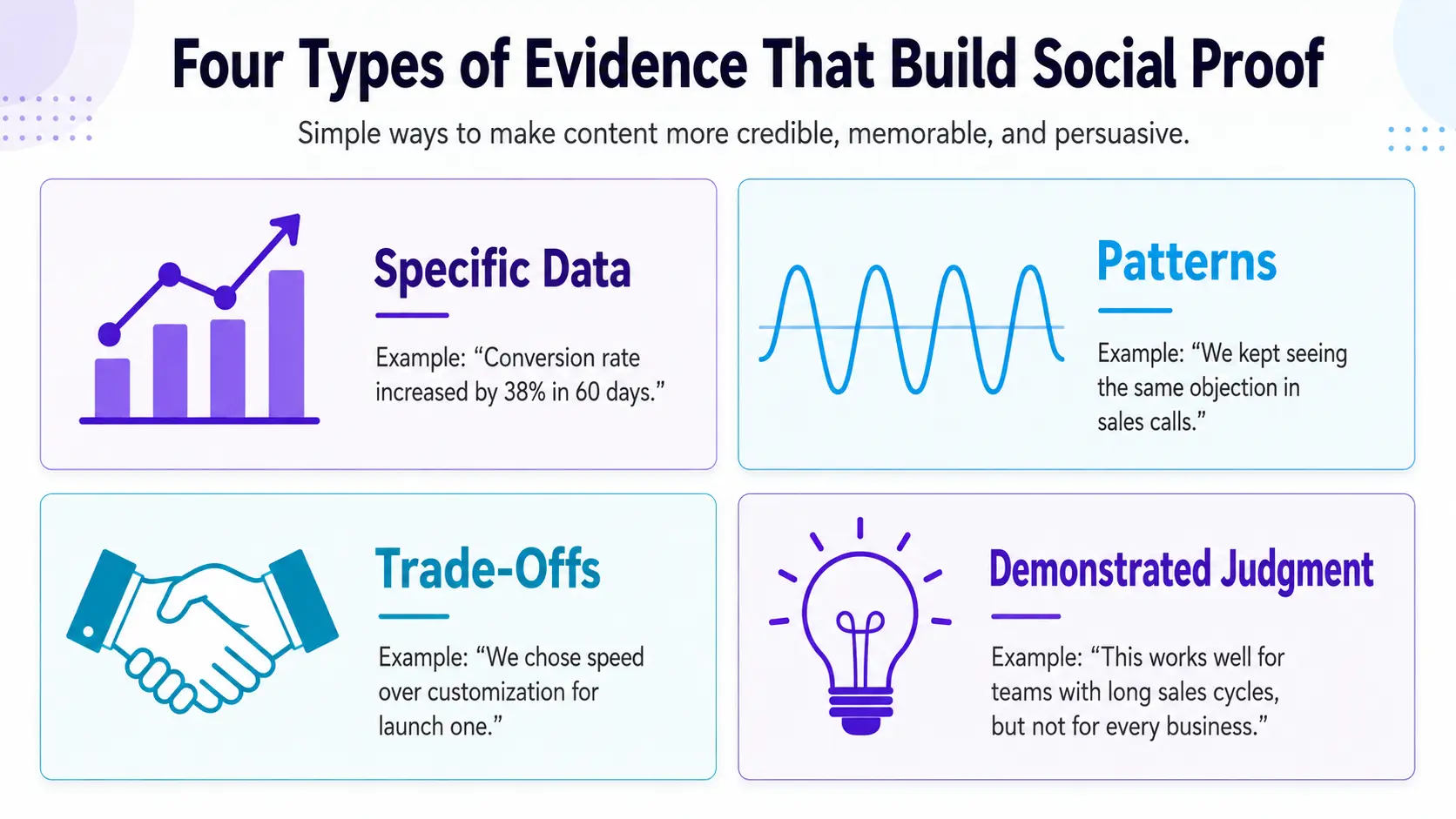
In reality, the types of evidence that shift perception fall into four buckets: specific data, patterns you’ve observed, meaningful trade-offs, and demonstrated judgment shaped by direct experience.
Types of Evidence That Build Proof-Led Social Media Content
| Type of Evidence | Description | Example Provided |
| Specific Data | Concrete numbers or statistics that cannot be easily faked. | “Across 40 campaigns last quarter, offers above $500 led to a 70% higher .”click-to-lead rate…” |
| Patterns Observed | Recurring trends or behaviors noticed across multiple instances. | Noted that conversion rates flattened past a certain price point ($2,000). |
| Meaningful Trade-offs | Clear explanation of decisions and their impact, showing the cost-benefit balance. | “We chose fewer content formats, which cut reach by a third but doubled referral leads.” |
| Observed Judgment | Insights and calls shaped by direct experience and professional discretion. | Demonstrated live buyer conversations and decision-making. |
A generic claim (“We drive results for clients”) can be copied by anyone with a keyboard.
But when you state, “Across 40 campaigns last quarter, offers above $500 led to a 70% higher click-to-lead rate, but conversion rates flattened past $2,000”, you’re now operating with a signal nobody else owns.
That specificity can’t be faked – someone guessing at your results will miss the nuances in the pattern.
Seen in practice, this move works like a watermark.
A point of view tagged with visible proof becomes native to your brand.
When our team publishes breakdowns citing real buyer conversations or live dashboard screenshots, engagement is only part of the outcome; we see those posts turning into reference points inside Slack groups and sales calls months later.
So why do these signals work so much harder than opinion or surface-level tips?
Saying, “X works better than Y”, without supporting context puts the reader back at square one.
But showing the trade-off – “We chose fewer content formats, which cut reach by a third but doubled referral leads” – gives the audience an actual decision lens.
That gap between advice and demonstrated judgement is the difference between passing traffic and real trust.
You can spot the content missing this layer by how easily it could be reworded by competitors.
If a scraper could replicate it by swapping brand names, evidence is thin.
But with genuine proof, even borrowed phrasing can’t reproduce the credibility.
Why proof signals ownership of insight, not just format adherence
There’s a myth that adding metrics or storytelling instantly upgrades a generic post into a proof-led one.
But proof isn’t a matter of style or formula.
It reveals original ownership: the author has actually seen, tested, or risked something others haven’t.
Just as a chef’s fingerprint is in their signature dish – not just in following a recipe – proof roots a social point of view in lived experience.
This isn’t about dumping private spreadsheets or sensitive data.
It’s about framing insight so nobody else can legit claim it as their own, even if the topic is trending.
This effect shows up the moment your posts spark debate or get cited by skeptics trying to poke holes.
Copycats may mimic your phrasing, but they stumble where your proof makes the point sticky: demonstrated trade-offs, patterns only you noticed, calls shaped by real consequences.
That’s where a post jumps the fence from clever commentary to intellectual property.
So what happens commercially?
Posts with visible proof become trust assets.
They seed recall far beyond their like count.
They survive trend cycles, even when the format becomes widespread.
That’s why proof-led content creates demand that opinion alone simply can’t achieve.
The core insight: Any marketer can borrow a trending hook, but only proof anchors authority.
The next challenge – how do you know if your current social presence is proof-led, or just polished opinion dressed as leadership?

How to evaluate whether your social content lacks proof and impact
A polished feed can fool even the sharpest marketers into thinking their strategy is sound.
Yet a steady stream of engagement often masks a deeper problem: posts that get noticed but never remembered.
The trap isn’t in the writing or the design.
It’s in the substance that survives the scroll – proof or lack of it.
Teams obsessed with frequency and style will wonder why their message never sticks.
But structural sameness in social content is easy to spot when you know the right signals.
If last month’s posts blur together or your best-performing thread doesn’t drive a single follow-up, you’re not just missing reach – you’re missing influence.
Signs your posts sound generic despite polish
A well-constructed carousel or a punchy text post will often draw quick likes.
But run a simple test: if you strip away your logo, would the advice belong to anyone?
Generic posts hide inside high engagement – comments full of agreement, but rarely any reference to specifics or next steps.
Sales-marketing teams often tell us, “People say they loved that tip, but no one quotes it back on sales calls”.
Signs Your Social Media Posts Sound Generic Despite High Engagement
- Advice could belong to anyone if stripped of branding or logo.
- High engagement with comments mostly agreeing, but no specifics or next steps.
- Audience and sales-marketing teams don’t recall quotes on sales calls.
- Repetition of format without insights, with audience echoing headlines but not details.
- Competitors easily replicating points, causing the brand to blend into the feed.
- More engagement than referral, more likes than shares, and more agreement than application.
That is the silent failure: high surface validation, low downstream recall.
The strongest signal of generic content is repetition of format over insight.
If most responses echo back your headline (not the details), or new followers cannot describe what makes your perspective unique, proof is missing.
Even worse, when competitors echo your points a week later and audiences can’t tell the difference, you’ve blended into the feed.
Are you seeing more engagement than referral, more likes than shares, more agreement than application?
That’s where impact is leaking.
Questions to test your content’s credibility and ownership
Ask: If you disappeared tomorrow, would anyone miss how you express your ideas, or could another brand replace your posts without loss?
Does each thread show a decision, a trade-off, or a detail that only your team would notice?
Where in your last five posts did you show a number, a process, or a trade cost others ignore?
The difference is not subtle: content that owns a true insight anchors memory.
Teams we’ve worked with often win buyer attention simply by stating, “Here’s how we changed course when the usual playbook failed”.
A simple analogy: social feeds are like crowded train stations.
The loudest voices get noticed for a moment, but the ones who hand you a map – something you couldn’t find elsewhere – get remembered.
What in your content is actually hard to copy?
Key Questions to Evaluate Credibility and Ownership of Social Media Content
- If you disappeared tomorrow, would anyone miss how you express your ideas?
- Could another brand replace your posts without loss?
- Does each thread show a decision, trade-off, or detail unique to your team?
- Where in your last five posts did you show a number, process, or trade cost others ignore?
Proof-led differentiation doesn’t just change the style or structure of your content.
It flips the script on what audiences recall, discuss, and seek out.
Therefore, your evaluation isn’t about how often you post – it’s about how unmistakable your signal becomes when evidence enters the frame.
Spotting the leak is step one.
But now the sharper edge appears: how does proof not only fuel recall, but transform visibility into reputation over time?

Next steps: when proof‑led distinction becomes your growth advantage
Most brands believe standing out on social media is mainly about timing, creativity, or channel mastery.
But channel shifts and style changes almost always get copied in weeks.
The sharper edge often isn’t the trick, but the trust your posts create over time.
That is where proof‑led content quietly pulls ahead.
How proof compounds visibility into reputation
Attention can be bought, hacked, or borrowed – but reputation accumulates.
Proof is the difference.
Anyone can say “we increase revenue” or “our approach works”.
However, when a feed is built from grounded evidence – real outcomes, observable trade-offs, clear judgment – that content starts being remembered for what actually happened, not just what was claimed.
There’s a simple analogy: picture social feeds as fast-moving rivers.
Most advice posts are driftwood – visible, floating, but quickly swept downstream.
Proof‑based posts are river markers.
They anchor memory, so viewers know exactly where that insight comes from and return to it when conditions change.
We’ve seen countless polished profiles slip into oblivion over time, even as engagement metrics briefly spike.
But the brands that keep showing specific, repeatable results begin to shift perception.
Their posts don’t just pass through the feed – they alter the reputation landscape, one proof-point at a time.
The hard truth for content strategists: trend-chasing delivers spikes, not layers.
Trust is built by stacking credible signals relentlessly, until competitors can’t just imitate format – they have to compete with your record.
And that’s much harder.
So what happens next when your feed becomes the benchmark, not just another stream of claims?
Where to go from here when proof becomes your signal
The goal isn’t just to win the daily slot in the feed.
It’s to create a system where every post becomes a small piece of capital – something that accumulates, references itself, and resists erosion.
When proof becomes your signal, you’re no longer competing for a quick glance.
You’re setting the bar for what evidence looks like in your market.
A sharp executive will notice: each new post, study, or documentary thread adds weight to every prior claim.
This creates a compounding loop.
Instead of starting from zero each quarter, your reputation is now a reservoir that makes future claims more believable.
But here’s the step most never reach – proof-led distinction isn’t just an add-on.
It becomes the decision filter for your entire content system.
What stories merit exposing?
Which insights earn screen time?
Which data points are strong enough to trust?
Earning that position flips the pressure.
Instead of scrambling to keep up with trends, you control the frame.
The next win will come from building proof as an operating principle – not just an occasional campaign move.
The path forward is clear: when proof becomes your default, the only question left is how deep that reservoir should run.
What systems, processes, or signals can keep compounding your authority while others keep chasing the latest format?

Scientific context and sources
The sources below provide foundational context for how decision-making, attention, and performance dynamics evolve under scaling and constraint conditions.
- Decision-making and attention in complex environments
Selection and Transmission Processes for Information in the Emerging Media Environment – Joseph N. Cappella, Emily K. Vraga, Leticia Bode, et al. – Media Psychology
Explains how information with strong attention-getting properties and stronger memory value is more likely to be selected and transmitted in modern media environments, supporting the article’s argument for specific, proof-led content.
https://pmc.ncbi.nlm.nih.gov/articles/PMC4504694/ - Trust, evidence and credibility
Trust and Credibility in Web-Based Health Information: A Review and Agenda for Future Research – Laura Sbaffi, Jennifer Rowley – Journal of Medical Internet Research
Reviews empirical research on how people assess credibility and trustworthiness in web-based information, supporting the article’s point that evidence, source quality, and transparency shape trust.
https://www.jmir.org/2017/6/e218/ - The power of narratives and empirical specifics
Storytelling and Evidence-Based Policy: Lessons from the Grey Literature – Brett Davidson – Palgrave Communications / Nature
Shows how storytelling can help evidence travel into policy and decision contexts when used strategically, supporting the article’s point that proof becomes more memorable when attached to concrete stories and real examples.
https://www.nature.com/articles/palcomms201793 - Behavioral economics and decision heuristics in real-world information selection
Nudge: Improving Decisions About Health, Wealth, and Happiness – Richard H. Thaler, Cass R. Sunstein – Yale University Press
A landmark behavioral economics text explaining how choice architecture and cues shape decisions in complex environments, supporting the article’s argument that proof-based signals affect perception, recall, and action.
https://yalebooks.yale.edu/book/9780300262285/nudge/ - Signal theory and strategic communication
How to Make Sense of Weak Signals – Paul J. H. Schoemaker, George S. Day – MIT Sloan Management Review
Explains how weak signals can be detected, interpreted, and turned into useful strategic insight, supporting the article’s argument that specific proof-points can create durable differentiation in noisy media environments.
https://hbsp.harvard.edu/product/SMR317-PDF-ENG
Questions You Might Ponder
Why does proof-led social media content increase trust more than opinion pieces?
Proof-led social media content is rooted in concrete evidence, real outcomes, and unique data, providing audiences with verifiable support for claims. This transparency builds trust, as followers can differentiate between generic advice and substantiated expertise, leading to stronger credibility and long-term loyalty.
How does adding data or real examples make social posts more memorable?
Integrating specific data or firsthand examples transforms a post from a generic opinion into a distinct, sticky insight. Audiences are more likely to recall and trust content linked to factual evidence or lived experience, making your brand’s advice stand out in crowded feeds and sales conversations.
What are the key indicators that my social content lacks proof-led differentiation?
Telltale signs include content that could be attributed to any competitor, high engagement but little referral, audience members failing to quote specifics, and competitors easily replicating your messaging. If your advice is easily swapped or forgotten, proof-led elements are likely missing.
Can proof-led content impact commercial outcomes beyond engagement metrics?
Yes. Proof-led content establishes your brand as a credible authority, increasing recall during purchasing decisions and in sales interactions. This sustained trust leads prospects to reference your expertise, compounding brand reputation and turning engagement into qualified pipeline activity or direct business outcomes.
What types of evidence work best for building proof-led content?
Effective evidence includes specific, non-generic data, repeatable patterns or trends observed across cases, visible trade-offs with real consequences, and demonstrated judgment based on direct, lived experience. Each adds a layer of authenticity and makes your content less likely to be imitated yet more likely to be sought out.