
What You’ll Learn
Social media memory decay is the loss of brand recall that happens when social posts get attention but fail to become remembered ideas.
It occurs because feeds move quickly, posts disappear fast, and audiences rarely retain isolated messages after the scroll.
High impressions, likes, or posting frequency do not prevent memory decay if the content lacks repeated themes, clear proof, and a consistent point of view.
A brand reduces social media memory decay by repeating a small set of core ideas over time, linking them to visible proof, and measuring whether buyers can recall what the brand stands for without being prompted.
Key Takeaways
- Social media memory decay prevents fleeting posts from accumulating into lasting brand authority and trust.
- Repeated, coherent messaging – rather than isolated content bursts – is essential in creating durable brand recognition.
- Platform dynamics and information overload accelerate the disappearance of brand messages from both feeds and audience memory.
- True social authority is signaled by unprompted audience recall, not by frequency or transient engagement metrics.
Most executives track social reach and likes as if they reveal brand power.
But mass attention rarely survives past the day a post lands.
The real threat is not quiet social channels; it’s authority that dissolves the second your post drops out of sight.
If your problem is that social activity exists but authority does not compound, start with the Social Media Marketing framework.

Why social media memory decay undermines authority
Every social feed feels busy, especially during campaign pushes.
But momentary visibility creates an illusion: if enough people see the brand, recognition and trust will naturally follow.
The market doesn’t reward hope.
How fleeting attention fails to build recognition
The myth is that exposure equals memory.
In practice, “visibility” on social platforms often means a split-second scroll, a forgotten logo, maybe a name half-recognized if it surfaces again in the same week.
We’ve seen high-activity brands rack up millions of impressions, only to discover that even warm audiences stumble over basic product recall a month later.
If attention is sand in a clenched fist, it slips away the tighter you squeeze.
So what’s happening?
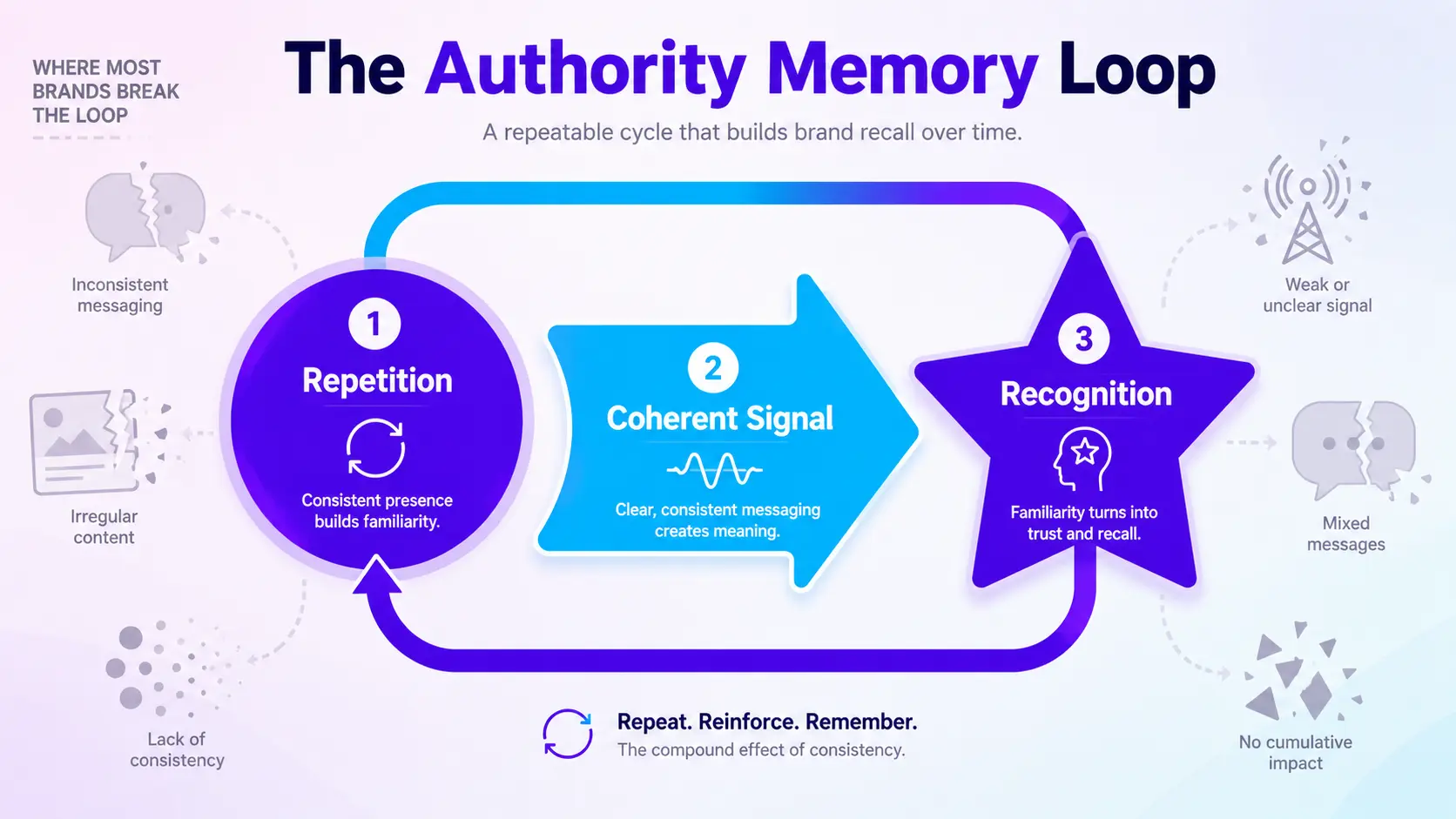
Recognition is built by pattern, not by spike.
Buyers form memories by encountering the same core idea through repeat, coherent signals – not isolated bursts of content.
When your social presence is an assembly of disconnected updates, users may recognize the profile photo but forget what your brand actually stands for.
This is where attention turns into vapor instead of lasting equity.
Often, impressions pass by without sticking; the real problem is the gap between being seen and being recalled.
If authority is your goal, that gap is fatal.
The clue: If your followers hesitate to summarize in one sentence what you do or why you matter, your brand is suffering from social media memory decay – not a posting gap, but a strategic shortfall that bleeds opportunity with every feed refresh.
Reasons Fleeting Social Media Attention Fails to Build Recognition
- Social visibility often means brief, forgotten exposure rather than meaningful recall.
- Recognition requires repeated, coherent signals – not isolated bursts of content.
- Disconnected posts result in users forgetting what the brand stands for.
- The gap between being seen and being recalled undermines authority.
- Authority suffers when followers can’t summarize the brand’s value clearly.
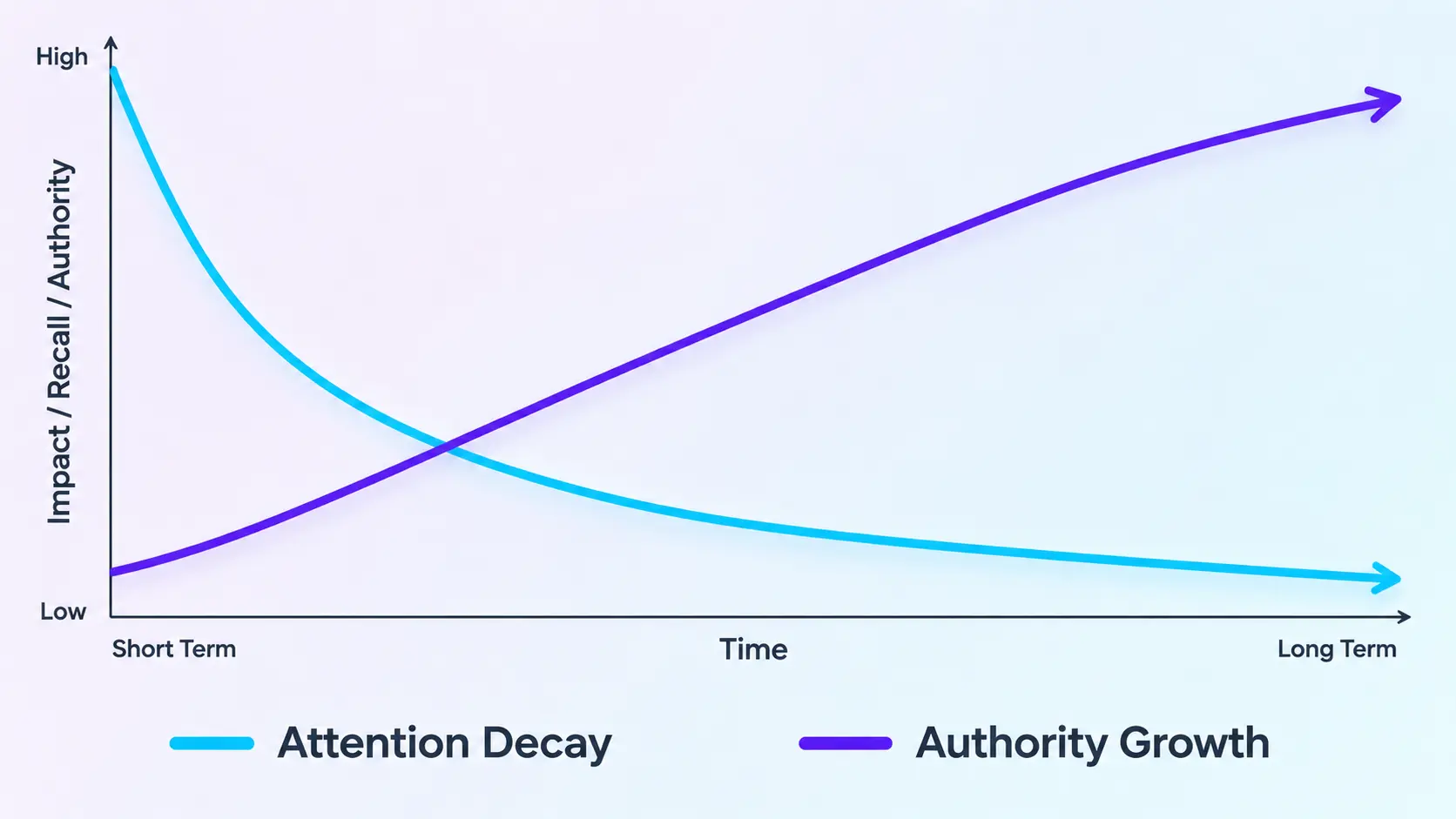
How platform dynamics accelerate feed decay
Most social teams feel pressure to keep calendars full and the algorithm happy.
But every platform is engineered for churn, not accumulation.
As soon as a post slides past its peak hours, the algorithm deprioritizes it and users’ attention shifts elsewhere.
Social content isn’t built to linger mentally; it’s programmed to make space for what comes next.
That’s the part most teams miss: timing and format tweaks can’t reverse a feed’s natural decay curve.
Even evergreen content – those carefully “timeless” social posts – vanish from both the feed and user recall faster than brands predict.
We’ve seen long-form threads and viral videos spike, then disappear from market memory as if they’d never been posted at all.
The average user’s timeline is a conveyor belt, not a museum.
New ideas push the old offstage, sometimes within hours.
Therefore, authority cannot depend on post-by-post performance.
The real cost isn’t in missed impressions, but in never accumulating enough shared memory to drive preference or command trust at the next decision point.
Most visibility metrics stop at attention captured.
But building authority means measuring attention converted into recognition and trust over time.
Once you see social media memory decay as a strategic liability, not just a posting challenge, the question shifts: how do you build the kind of recall that resists the platform’s built-in forgetfulness?
Each layer of memory loss is compounded by how your content is structured – and that’s where the deeper problem begins.

What prevents your content from becoming a remembered idea
Every executive can recount a time when a standout post grabbed attention for a day, only to vanish from any meaningful recall.
But bursts of visibility don’t stack into memory.
The unexpected threat is that content designed for engagement often fails to leave a trace in the market’s collective mind.
Most teams operate under a misleading assumption: if the Analytics dashboard shows views and interactions, the message must be working.
The numbers look healthy on the surface.
Yet, revisit that same audience next quarter, and you’ll find that the substance of the message is already gone.
Why isolated posts don’t accumulate meaning
It’s tempting to treat every post as a new swing at grabbing recognition.
But scattershot social activity is like tossing single pebbles into a river – each makes a ripple, but none change the current.
The myth: frequency drives retention.
In reality, repetition on a core idea is the only way to move a concept from novelty into lasting market memory.
We’ve seen campaigns flood feeds with new messages each week, hoping one will stick.
The result is brief surges of engagement, followed by familiar silence.
The real market memory – what buyers actually recall when making decisions – is built when themes return predictably, getting sharper each time.
Without recurring signals, even the most creative campaign will fade before trust takes root.
So why do most brands cling to isolated posting?
The daily pressure to “ship content” feels like progress.
But attention without pattern recognition never crosses into reputation.
That’s the silent cost beneath every vanity metric spike.
One simple rule: if your core message can’t be repeated back by your audience inside three months, then your content is noise, not memory.
Effect of Posting Patterns on Brand Memory
| Indicator | Description | Impact on Brand Authority |
| Engagement lift without inbound trust increase | More likes or shares but no rise in referral quality, repeat mentions, or expert tags | Surface-level activity with no deepening brand trust |
| Audience surveys show name recognition but no core message recall | People recognize the brand name but cannot summarize what it does or offers | Shows poor message retention despite visibility |
| Follower growth outpaces brand recall | Social attention spikes but direct search queries or leads remain flat | Reflects lack of meaningful memory despite audience size |
| Market repeats competitors’ ideas, not your brand’s | Proof points get reposted but are not linked back to your brand | Signals failure to build unique remembered authority |
Why formats don’t fix missing strategic memory
The scramble for novelty often takes a different turn – teams switch formats, chasing higher algorithmic reach.
But swapping video for carousels is like repainting a sign nobody remembers reading.
The logic: change the wrapper, the message will stick.
The reality: form only works if substance remains consistent.
Clients will ask: “Should our thought leadership use more shorts, threads, or infographics?” The better question: “Is our audience able to recount what we stand for, regardless of format?” Format choice matters for reach, but memory is a function of repetition and cohesion, not just packaging.
What’s often overlooked is the trap of mistaking platform optimization for strategy.
Platform trends shift, but durable authority is format-agnostic.
If the message morphs every week, memory never forms – no matter the medium.
So the focus is not on picking the new viral medium, but on deciding what you want remembered – and building every asset to reinforce that singular memory.
The overlooked truth: Authority begins when the market can anticipate your message before you post it.
This is what most competitors never achieve.
But even clear repetition and strong messages can still fail if they don’t connect across posts.
That opens a sharper dilemma: what actually binds scattered content into a single, remembered idea?
Understanding these blocks sets up the next crucial step: how to spot invisible memory gaps in your current social activity.

How to identify when your social activity is invisible memory-wise
Executives see engagement graphs spike after each post.
But those signals feel more valuable than they are.
The sharpest loss isn’t missing reach – it’s content that draws eyes for a moment and is instantly forgotten by the market.
Attention, by itself, creates momentum on dashboards but leaves no trace in actual buyer memory.
Each week, we speak with teams surprised their share-of-voice leads to zero increase in inbound queries or spontaneous mentions – even as impressions set records.
This disconnect hides in plain sight: teams celebrate numbers that signal only exposure, not stored recognition.
The tough question: how do you spot when all that activity is quietly building nothing that lasts?
Key indicators that attention isn’t translating to trust
A post trending in the feed is not the same as a post staying in the market’s mind.
The first symptom: lift in engagement with no lasting increase in inbound trust (measured as referral quality, repeat mentions, or unsolicited expert tags).
Another red flag – audience surveys reveal name recognition but blank looks around your core message or offer.
Teams often think higher like or follower counts signal progress, but this is surface-level velocity with zero depth.
In a recent client audit, we mapped follower growth timelines against direct search queries for the brand.
The surprise?
Surges in social attention and actual brand recall barely moved together.
Social channels felt busy – yet months later, the leads showed no memory of any content specifics, just vague brand familiarity at best.
So, what does true impact look like?
Buyers not only remember you but recall what makes you different – often repeating your language back.
Until that signal shows up, it’s all noise, not authority.
Here’s the repeatable insight: buyers trust what outlasts the scroll, not what trends for a day. Key Indicators of Social Media Memory Decay
| Posting Pattern | Description | Effect on Brand Memory |
| Scattershot / Different Messages Each Post | Posting isolated, unrelated content frequently | Brief engagement surges but no lasting memory formation |
| Repetition on Core Ideas | Consistent messaging on a few key themes repeated over time | Builds lasting recognition and trust |
| High Frequency without Coherence | Many posts scheduled but no connecting narrative | Creates noise and shallow brand connection |
| Coherent Content with Proof | Repeated core messages supported by testimonials and outcomes | Drives memory retention and credibility |
When consistency masks absence of meaning
It’s easy to confuse regular posting with building brand memory.
But consistency can create the illusion of momentum – teams locked into weekly content calendars start to believe activity itself is a growth engine.
We’ve seen it first hand: leaders point to their streak of daily posts as evidence of authority, yet not one line or key idea gets repeated by the market a month later.
Imagine a drip irrigation system that runs every day but never penetrates the roots – the garden stays wet but nothing grows deep.
Social output works the same way: constant moisture without real absorption means shallow brand connection.
This is where most teams slip – in chasing cadence, the content becomes background noise.
Buyers remember the rhythm but forget the message.
Recognition without recall doesn’t close deals.
Therefore, the real signal isn’t frequency or feed activity.
It’s whether your ideas survive beyond the platform echo and reappear unprompted in buyer conversations.
If nothing from your last ten posts is shaping how the market talks, you’ve built activity – without memory.
The fix starts with recognizing this gap before adding another post to the pile.

What to consider next: building memory before execution
Plans for growth often stall out at the content calendar.
But more posts – even on the right schedule – fail to shift how your brand sits in the market’s mind.
The real risk is mistaking activity for actual authority build.
So, what changes before execution can actually give your social strategy a memory advantage?
When to dig into repetition, proof, and expert visibility
Content cadence is easy to inspect – miss a week and the gap is obvious on the dashboard.
Yet, recognition is not a product of hitting every slot.
The myth is that consistent posting creates constant recall.
In reality, what gets repeated with proof becomes residue in market memory; what’s scattered, no matter how frequent, disappears.
I’ve seen teams fill every slot for months and still hear “I didn’t know you did that” from the exact buyers they target.
The pattern was always the same: no throughline, just a string of unconnected claims.
Proof – testimonials, visuals, specific outcomes – was used as filler, not as drumbeat.
That is when repetition without reinforcement fails.
So, how do you know it’s time to shift?
Look for these signals: your audience remembers ideas from others, but not you; your credibility always resets every pitch; your proof points get reposted, but nobody associates them with your brand.
That’s the sign the market memory is pointing away.
It’s like telling a story but changing the plot every chapter.
The listener can’t stitch the lesson, so the message drains away after each telling.
The tension isn’t about volume.
It’s about stacking memory through repetition and visible expertise, tethered by real-world proof.
Therefore, the focus turns to how belief accumulates, not how often you post.
Signs It’s Time to Focus on Repetition, Proof, and Expert Visibility
- Audience remembers competitors’ ideas but not yours.
- Credibility resets with every new pitch attempt.
- Proof points are shared but not associated with your brand.
- Your core message fails to stick beyond immediate impressions.
- Lack of a consistent narrative prevents message retention.
Why you need a memory‑shaping social system, not a calendar
A posting calendar feels like structure.
But it only answers when and maybe what – never how the message compounds in audience memory.
The underlying trap is tactical progress masking strategic emptiness.
Formatting posts for reach, shifting hashtags, or chasing trends are all surface moves if there’s no plan for durable visibility.
Building a memory-shaping system is different.
It starts with designing for singular ideas that echo – not just into feeds, but into mental shortcuts buyers use to make decisions.
This means mapping your core offerings to belief-based proof, sequencing stories, and repeating resonance points until recognition tips.
One client rebuilt their approach by assigning every post to a core pillar – each pillar mapped to a buyer confusion or competitor misdirection.
Proof cycles were baked in.
Instead of chasing each week’s algorithmic flavor, they measured what itself became quotable, or repeated by outsiders.
Suddenly, recall lasted past the campaign – and referral leads began opening with “We keep seeing you as the expert on X”.
So what actually makes the difference?
It isn’t having more planned posts.
It’s building a system where each message amplifies the last, carries proof, and clarifies reputation as it goes.
Therefore, it’s time to rethink the starting point before launching another post.
The question isn’t what’s next on the calendar – but what repetition and recognition structures your market memory actually needs.
That opens the gate to hands-on strategies for embedding authority instead of just producing more noise.
If memory is the problem, repetition is not optional – but repetition only works when it creates recognition.
That logic is outlined in Repetition, Recognition, and Social Authority.

Scientific context and sources
The sources below provide foundational context for how decision-making, attention, and performance dynamics evolve under scaling and constraint conditions.
- Decision Fatigue and Memory Decay
Making Choices Impairs Subsequent Self-Control: A Limited-Resource Account of Decision Making, Self-Regulation, and Active Initiative – Vohs, K.D., Baumeister, R.F., Schmeichel, B.J., Twenge, J.M., Nelson, N.M., Tice, D.M. – Journal of Personality and Social Psychology
This research demonstrates that repeated decision-making depletes cognitive resources, supporting the argument that continuous low-commitment choices can reduce mental capacity available for memory formation and evaluation.
https://doi.org/10.1037/0022-3514.94.5.883 - The Effect of Information Overload on Recall
The Concept of Information Overload: A Review of Literature from Organization Science, Accounting, Marketing, MIS, and Related Disciplines – Eppler, M.J., Mengis, J. – The Information Society
This review explains how excessive information impairs processing, comprehension, and decision quality, supporting the argument that constant information streams weaken durable memory formation.
https://doi.org/10.1080/01972240490507974 - Recognition over Activity in Authority Building
How Brands Grow: What Marketers Don’t Know – Byron Sharp – Oxford University Press
This evidence-based marketing work demonstrates that brand growth depends on building and refreshing memory structures over time rather than generating isolated bursts of activity, directly supporting the argument that authority comes from recognition rather than volume.
https://global.oup.com/academic/product/how-brands-grow-9780195573565 - Memory, Repetition, and Attention in Messaging
Attitudinal Effects of Mere Exposure – Robert B. Zajonc – Journal of Personality and Social Psychology
This classic study demonstrates that repeated exposure increases familiarity and positive evaluation, supporting the argument that repeated core messages build recognition and trust more effectively than isolated content.
https://doi.org/10.1037/h0025848 - System Thinking in Organizational Performance
Thinking in Systems: A Primer – Donella H. Meadows – Chelsea Green Publishing
This influential systems-thinking book explains how consistent, repeatable structures create compounding effects over time, supporting the argument that authority grows from systems rather than sporadic activity.
https://www.chelseagreen.com/product/thinking-in-systems/
Questions You Might Ponder
What is social media memory decay and how does it impact brand authority?
Social media memory decay refers to the rapid fading of brand messages and recognition after fleeting visibility on social platforms. This decay undermines brand authority, as short-lived exposure rarely translates into lasting trust or reputation in the minds of decision-makers.
Why don’t social media impressions lead to stronger customer recall?
Social media impressions are typically brief and disconnected, causing users to quickly forget the message. Without repeated, coherent signals, audiences may recognize a brand momentarily but fail to recall its core value, weakening future purchase intent and authority.
How can brands overcome fleeting attention to build lasting recognition?
Brands can combat fleeting attention by focusing on repetition of key messages, building thematic consistency, and reinforcing core ideas across content formats. This pattern-driven approach helps audiences form durable associations, strengthening brand recall amid constant feed churn.
How do platform algorithms contribute to content memory loss?
Platform algorithms prioritize newness and engagement velocity, causing past posts to quickly disappear from both feeds and user recall. This engineered churn ensures that only messages continuously resurfaced through strategic repetition become memorable and influential.
What are key indicators that a brand’s social activity isn’t building authority?
Key signals include: upticks in branded search, repeat visits to deep assets, reference to brand language in sales calls, post-campaign recall tests, and increased branded keyword usage. These indicators show attention is fueling trust, not just fleeting visibility.