
What You’ll Learn
Social content sameness is the condition where a brand’s social posts look, sound, and argue like everyone else’s content, making them easy to ignore and hard to remember.
It happens when posts rely on safe claims, trend copying, polished templates, generic tips, or consensus language instead of a clear point of view, proof, and distinct market position.
Social content sameness can still generate likes or impressions, but it weakens recall, trust, and demand because buyers cannot connect the message to a specific brand.
Strong social content breaks sameness by showing what the brand believes, proves, and defends differently.
Key Takeaways
- Social content sameness causes posts to be easily forgotten and undermines brand differentiation.
- Polished, consensus-driven content delivers weak recall compared to proof-based, viewpoint-driven messaging.
- Trend copying inflates engagement but fails to generate trust or real demand due to lack of unique positioning.
- Distinctiveness, not volume or polish, drives lasting market authority, recall, and meaningful conversation.
Most teams think generic social content is a production issue – something a sharper copy edit or fresher template can fix.
But even well-polished posts drown in the scroll.
The surprise is that quality alone isn’t what makes social content memorable or differentiating.
What actually decides if your content commands recall isn’t flawlessness, it’s distinctiveness.
And that’s where sameness creeps in quietly: the posts look right, sound reasonable, but buyers forget them by lunch.
If your problem is that social content exists but the market does not remember it, start with the Social Media Marketing framework.

When social posts blend in, not stand out
You can have every phrase dialed in, get your visuals approved, and match the colors to the brand guide.
Yet, almost all of it fades from memory.
Here’s the myth: that accuracy, clarity, and polish are the tickets to recall.
They aren’t.
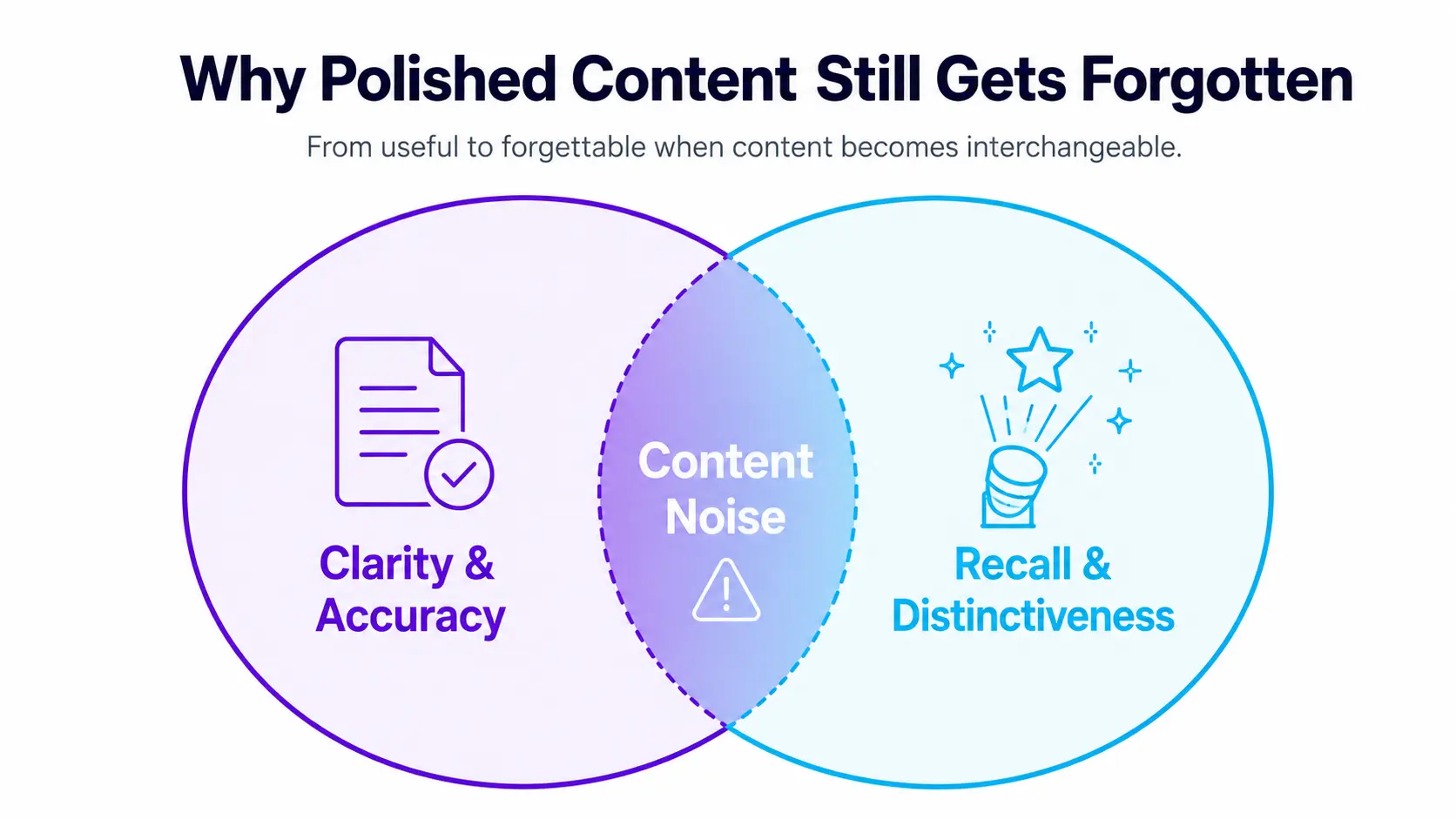
Safe, correct content becomes background noise when it fails to draw a boundary – what’s for you, what’s against you, where you stand.
Why clear basics still feel forgettable
We’ve seen brands produce hundreds of posts that scored high on readability scores but never on top-of-mind surveys.
The pattern is simple: if your content can be swapped with any competitor’s, it’s functionally interchangeable.
That’s the definition of social media sameness.
Think of it like the elevator music of LinkedIn – pleasant, never offensive, instantly forgotten.
Even high-performing posts – on paper – can slip into this trap if there’s no visible edge.
But what about all those posts with tidy stats, helpful lists, and popular inspirational lines?
Here’s the open loop: why don’t they stick?
It turns out, social content with no boundaries rarely creates strong recall, no matter how flawless the formatting.
Without a clear point of view, your content is just noise in a crowded feed.
Therefore, the most important recall driver isn’t polish – it’s permission to be remembered, which comes from the content’s edges, not its smoothness.
Reasons Why Polished Social Content Is Forgettable
- Accuracy and clarity alone don’t ensure recall.
- Content can be functionally interchangeable with competitors.
- Safe, correct content becomes background noise.
- Lack of clear boundaries causes content to blend in.
- Absence of a clear point of view makes posts forgettable.
How sameness hides strategic choices
It’s easy to think blending in stems from weak production, but the real issue is deeper: content becomes generic when there’s no true ownership of a view.
The standard playbook says copy the leader, follow the trend, adjust with the season.
But every time a team chooses “what works for everyone”, the brand’s perspective blurs into the background.
There’s a diagnostic question we use with clients: if you remove the logo, could this post come from any other brand in your space?
If the answer’s yes, you’ve written for consensus, not ownership.
Strategic choices are supposed to create friction – without that, your signal is silent.
This is the profit leak most executives miss.
Interchangeable content might drive baseline engagement, but it’s invisible when it’s time for a buying decision.
Buyers don’t seek the loudest echo – they want the authority that draws a line and is willing to stand by it.
So what’s the repeatable insight?
Content only breaks out of sameness when it visibly claims a unique stance – even if that means pushing against trend logic.
The real risk isn’t low-quality posts.
It’s producing endless content that nobody remembers, nobody can quote, and nobody could mistake for yours.
That’s the starting point – but the next section opens the higher-stakes tension: what happens to demand creation when popularity outweighs ownership?
When content lacks a clear point of view, teams often chase trends to create visibility.
That pattern is explored in Trend Visibility vs Authority.

Why popularity without ownership hurts demand creation
A spike in likes or shares might look like momentum is building.
But reach built on recycled trends almost never triggers real market movement.
The sharper problem?
Popularity built without a unique stamp quietly starves demand, even as reports tell a winning story.
The illusion of engagement from trend copying
Trend copying seems like a shortcut to relevance.
Scroll through most feeds and the sameness jumps out: familiar graphics, borrowed phrases, copycat hooks.
When brands chase what’s already working elsewhere, the numbers look safe – engagement ticks up, impressions swell, surface metrics hum.
But here is where the damage hides.
Trend-based social media sameness lulls teams into mistaking borrowed visibility for actual trust.
It’s the digital equivalent of wearing another company’s uniform: you might get invited in, but no one remembers your name afterward.
Real observation: we’ve seen B2B tech brands lift share and comment counts by jumping on trending topics.
Yet when sales teams later ask prospects what stuck, the answer is a blank.
Recall is weak even after heavy promotional pushes.
Warning Signs of Trend Copying in Social Content
- Use of familiar graphics and borrowed phrases.
- High engagement metrics without lasting recall.
- Content feels like ‘wearing another company’s uniform.’
- Sales teams report weak brand recall post-promotion.
- Popularity doesn’t translate to new demand.
If your brand feels interchangeable, even high engagement won’t convert to new demand.
That’s the hinge most teams miss.
More activity, less attribution.
Low-friction growth always cuts out the friction that would have made you memorable.
Proof over polish for memorable messaging
Polished, generic social content gives a sense of completeness – but leaves buyers unmoved.
Distinct messaging is not about being slick; it’s about offering proof that earns belief.
Proof-led social content uses tangible evidence – specific outcomes, clear reasoning, real stakes.
When a post grounds its claim in something unique to your business or customer’s world, it survives beyond the scroll.
For example, one SaaS client swapped vague trend spins for concrete before-and-after snapshots of user results.
The engagement didn’t jump overnight, but retention and referral rates quietly climbed.
Proof creates structural content differentiation that no format tweak or design flourish can replicate.
Why does this matter for demand creation?
Polish attracts a glance, but only proof earns a second look – and the second look is what plants a buyer’s next question.
That is the irritant that forms a pearl: the curiosity gap that reliable demand needs.
Generic social content can steal the show for a moment, but it won’t win the market’s memory or overcome weak recall social posts.
Therefore, as you chase reach, the tougher call becomes: do you want to be visible, or do you want to be believed?
The next logic break is just as sharp.
If proving your stance matters more than riding the next wave, what does that mean for how teams evaluate which messages deserve to be amplified?

When sounding safe becomes strategic failure
Most teams trust that avoiding controversy protects brand reputation across social channels.
But safety rarely makes a message memorable.
Worse – the pursuit of consensus can turn a once-distinctive voice into background noise, robbing the brand of any edge in a crowded market.
A familiar comfort zone tempts every executive: Let’s keep it professional, let’s avoid risk, let’s trust the AI to generate something everyone can agree on.
Yet that very impulse is the starting point of content invisibility.
The cost of consensus messaging
It’s easy to spot posts crafted for broad approval.
They flatter both sides of every question, dodge direct claims, and sound “on-brand” but not on-mission.
But as generative models drive AI homogenization and prompt-driven output floods feeds with clean, neutral phrasing, the problem compounds: posts start to blur into one another, each as interchangeable as the next.
What gets missed is the hidden price: Every time language gets sanded down for broad accessibility, the brand’s unique fingerprint fades.
At BiViSee, we’ve watched clients push out months of high-volume content using model-driven templates, only to find audience recall and engagement slide – even as consistency improves on paper.
Imagine a brand voice as a color in a gray-scale palette.
The more you dilute hue for general liking, the closer you get to total invisibility.
That’s not just about aesthetics; it’s about competitive positioning.
The moment you sound safely neutral, a thousand rivals sound exactly the same.
Worse, being forgettable is not a static risk.
The longer consensus language is the norm, the less likely buyers are to connect any post with your brand’s actual expertise.
That’s how the cycle of weak recall and zero authority begins.
So why does consensus messaging still seduce smart brands?
What bold conviction gains (and costs)
Strong stances draw sharp boundaries: for every audience ready to follow, there’s another ready to turn away.
That polarization keeps content from drifting into anonymity, but it brings a new anxiety – what if a bold point of view limits potential market?
Yet the blunt truth from our own advisory work: posts with a visible, provable belief consistently drive stronger follow-on conversations, even when they ruffle feathers.
When a CMO sees a post that won’t be mistaken for “just another brand update”, it’s usually the one that makes a specific claim others avoid.
It only takes one sharp line to make a post distinct.
We’ve seen a single, conviction-driven sentence trigger more DMs and demo requests than weeks of carefully balanced content.
The effect compounds: bolder messaging creates a magnet for the right client, even as it filters out the imitative competition.
But the gain isn’t without cost.
There will be false alarms – negative comments, unsubscribes, and moments when leadership fears visibility became vulnerability.
Is the risk justified?
Ask which hurts more in the long run: temporary discomfort from a strong stance, or permanent irrelevance from blending in.
Think of it as the difference between a spotlight and a ceiling light – one draws attention and memory, the other simply fills the room with bland illumination.
Comparison of Bold Conviction vs. Safe Consensus Messaging
| Question / Indicator | Proof-Led Content | Generic / Consensus Content |
| Logo removed, post still distinctive? | Yes – unique proof and story visible | No – interchangeable claims |
| Presence of specific evidence? | Concrete outcomes, unique processes | Vague claims, generic bullet points |
| Message structure | Clear boundaries, narrative, inside perspective | Flat, unclear architecture |
| Ability to divide market? | Yes – shows evidence of difference | No – blurs into feed with others’ content |
Sounding safe offers comfort, but not traction.
The next edge comes from re-examining which ideas, boundaries, and evidence actually define authority versus just fill the feed.

What to evaluate next to break out of content sameness
Most brands crank out content with the belief that consistency is their edge.
But consistent output alone is often the fastest route to becoming invisible.
The harsh truth?
Volume multiplies sameness when you’re scaling the wrong signal.
Executives see the warning signs: high-frequency posts, steady engagement metrics, but soft audience memory and weak conversion from social.
Yet, the usual fixes – new templates, bolder graphics, snappier CTAs – never shift core perception.
That’s because sameness isn’t cosmetic.
It’s a structural and strategic problem buried under activity.
Does your content prove what you believe?
It’s easy to think that stating a belief is enough to differentiate.
But audiences can detect when content broadcasts values without proof.
A clear message with no receipts lands as interchangeable as the next brand’s – sharp wording, generic outcome.
The acid test?
Ask: If your logo vanished, would any post still make sense only for your team?
I’ve seen brands post conviction statements – “we lead the market in X” – followed by generic bullet points found in any competitor’s feed.
The pattern repeats: confident claim, little evidence, no story.
But here’s a sharper diagnostic: does your content show unmistakable proof that you operate differently, or does it repeat the same claims in safer packaging?
Proof-Led Content Diagnostic Checklist
| Aspect | Bold Conviction Messaging | Safe Consensus Messaging |
| Visibility | Draws sharp boundaries, attracts attention | Blends into background, neutral |
| Audience Response | Polarizes; attracts followers and repels some | Pleasant to all but forgettable |
| Memory and Recall | Distinct, memorable, encourages follow-on conversations | Invisible, weak recall |
| Risks | Negative comments, unsubscribes, leadership anxiety | Permanent irrelevance, lack of traction |
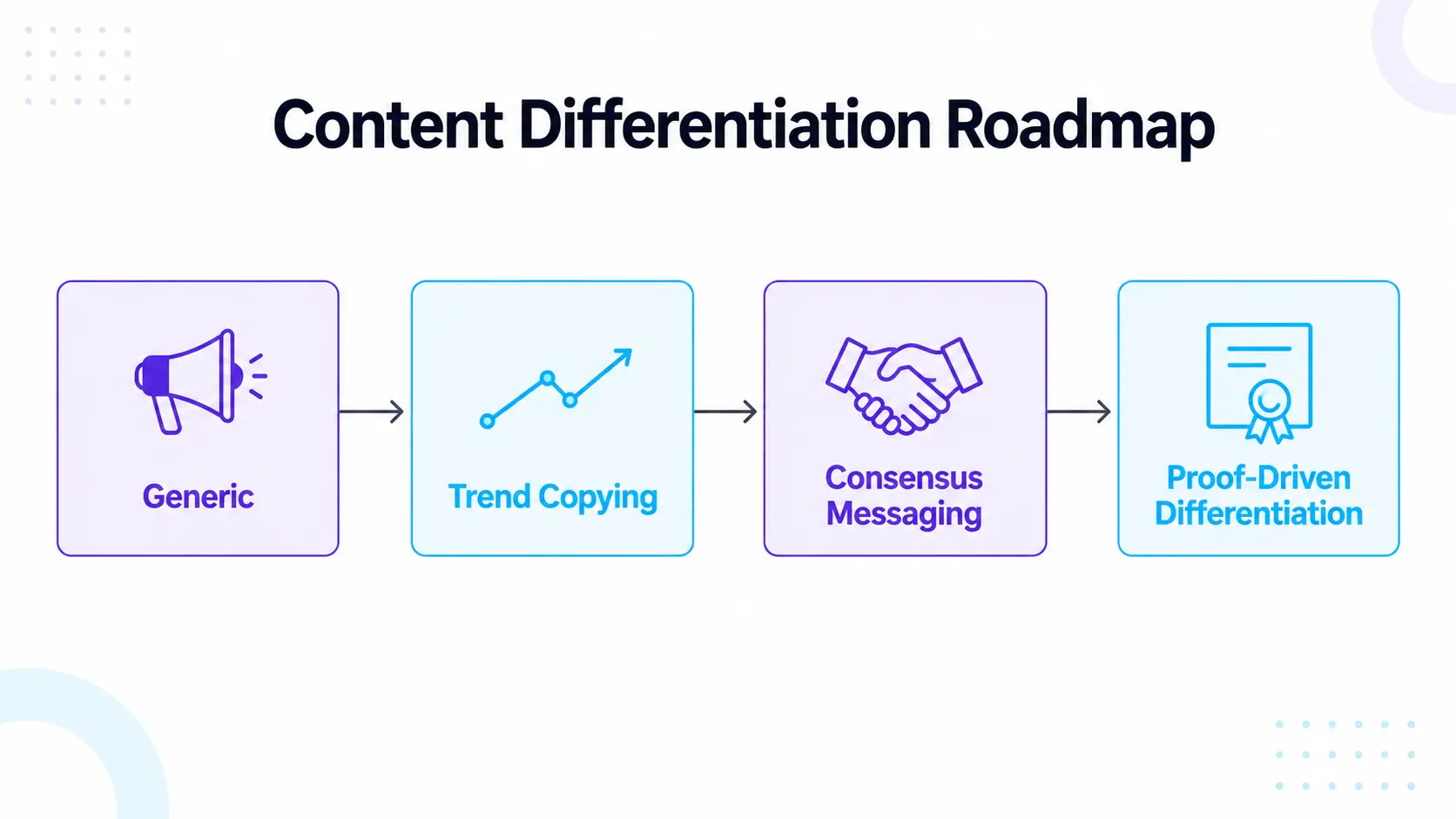
Proof-led content isn’t just adding a data point – it’s structuring the message around something only you can stand behind.
For example, describing a process shift that cut response time in half, or naming the step your competitors avoid.
The difference is clear: proof sets boundaries, while generic claims blur into the feed.
So, the next time your team reviews a calendar packed with social posts, ask which message could be read as anyone’s and which actually divides your market by showing evidence of difference.
The posts that survive this test are the first signals of breakout authority.
Where does content need structure, not more polish?
Most teams pour effort into making posts look perfect – crisp designs, airtight grammar, high-production video.
But the core failure mode is rarely polish.
It’s the absence of a structural angle that gives the content shape, memory, and an edge.
Think of structure as the invisible scaffolding: a defined point of view, a recurring proof pattern, a narrative with sequential logic, an inside perspective the audience can’t find anywhere else.
When content lands flat, the common temptation is to refine the edges, not the architecture.
I’ve watched brands invest weeks in creative reviews, iterating on visuals or clever copy, only to see the new posts fall into the same weak recall bucket.
The breakthrough never follows better aesthetics – it comes when leadership insists on a standard: every post must demonstrate what only this brand can defend or deliver.
That’s the structural break from sameness.
So before tweaking another headline, step back.
Which layer needs reinforcement – the visual polish, or the skeleton that actually sets you apart?
Structural content differentiation is rarely obvious from inside the campaign.
But once you spot it, you’ll see that nearly all social content failure starts before production.
The trap isn’t posting too little or too bland.
The real trap is investing resources in signal amplification when the signal itself still fits inside anyone’s box.
The proper next move?
Diagnose the boundary line between what any brand could claim and what your message can prove – then let structure drive content, not the other way around.
Better structure gives memory.
But it also raises a sharper question: Once you set those boundaries, are you ready to defend them when the market pushes back?

Scientific context and sources
The sources below provide foundational context for how decision-making, attention, and performance dynamics evolve under scaling and constraint conditions.
- Distinctiveness Theory in Social Judgment and Memory
Distinctiveness and the salience of social category memberships: Is there an automatic perceptual bias towards novelty? – Penelope Oakes – European Journal of Social Psychology
Explains how distinctiveness and novelty increase salience in social perception, supporting the article’s point that content must create clear boundaries to be remembered.
https://onlinelibrary.wiley.com/doi/abs/10.1002/ejsp.2420160403 - Effects of Information Overload on Consumer Decision-Making
Information Load and Consumer Decision Making – Naresh K. Malhotra – Journal of Consumer Research
Shows that consumers have limited capacity to process information, which supports the argument that similar, excessive content weakens recall and decision quality.
https://www.jstor.org/stable/2489029 - Role of Diagnostic and Distinctiveness in Brand Recall
A Model of Brand Awareness and Brand Attitude Advertising Strategies – Larry Percy, John R. Rossiter – Psychology & Marketing
Explains brand awareness strategy and the distinction between brand recognition and brand recall, making it relevant to the article’s argument about memorable, non-generic positioning.
https://onlinelibrary.wiley.com/doi/abs/10.1002/mar.4220090402 - Authority and Expertise Signal Processing in Digital Environments
Social media and credibility indicators: The effect of influence cues – Xialing Lin, Patric R. Spence – Computers in Human Behavior
Examines how authority, identity, and bandwagon cues shape perceived credibility in social media environments, supporting the article’s point about visible authority signals.
https://www.semanticscholar.org/paper/Social-media-and-credibility-indicators%3A-The-effect-Lin-Spence/34123f1b6b8ef9412de2cc2ee4cb66ef645f4997 - Effect of Emotional Framing on Content Memory
Feeling and Thinking: Preferences Need No Inferences – Robert B. Zajonc – American Psychologist
A classic paper on affect and preference formation. It supports the article’s point that emotionally clear and conviction-led messaging can influence attention and memory more strongly than neutral consensus language.
https://doi.org/10.1037/0003-066X.35.2.151
Questions You Might Ponder
What is social content sameness and why is it a concern for brands?
Social content sameness occurs when posts from different brands are so similar they become indistinguishable. This reduces brand recall, weakens authority, and lowers conversion by making messages forgettable in crowded feeds.
How can brands create distinctive social content?
Brands can achieve distinctiveness by taking clear, proof-backed stances, revealing authentic perspectives, and using tangible evidence instead of generic claims. This approach ensures their messages are remembered and recognized.
Why doesn’t highly polished social content always perform better?
While polish increases surface appeal, it doesn’t guarantee recall or belief. Content lacking unique viewpoints or evidence fades into background noise, making it less likely to influence buying decisions or foster loyalty.
What are the risks of chasing social media trends for engagement?
Copying trends may boost engagement metrics temporarily but creates content that blends with competitors. This borrowed relevance fails to build trust or trigger demand, leaving brands unmemorable at critical buying moments.
How does consensus messaging lower brand authority?
Consensus messaging strips content of boldness and viewpoint, prioritizing neutrality over uniqueness. This dilution makes it hard for audiences to link posts to brand expertise, eroding long-term competitive positioning and signal strength.