
What You’ll Learn
LinkedIn B2B social environment is the professional social context where visibility, trust, and business value are shaped by people, expertise, and relevance rather than by company page activity alone.
LinkedIn works differently from broader social platforms because users judge content through professional credibility, job context, peer networks, and business relevance.
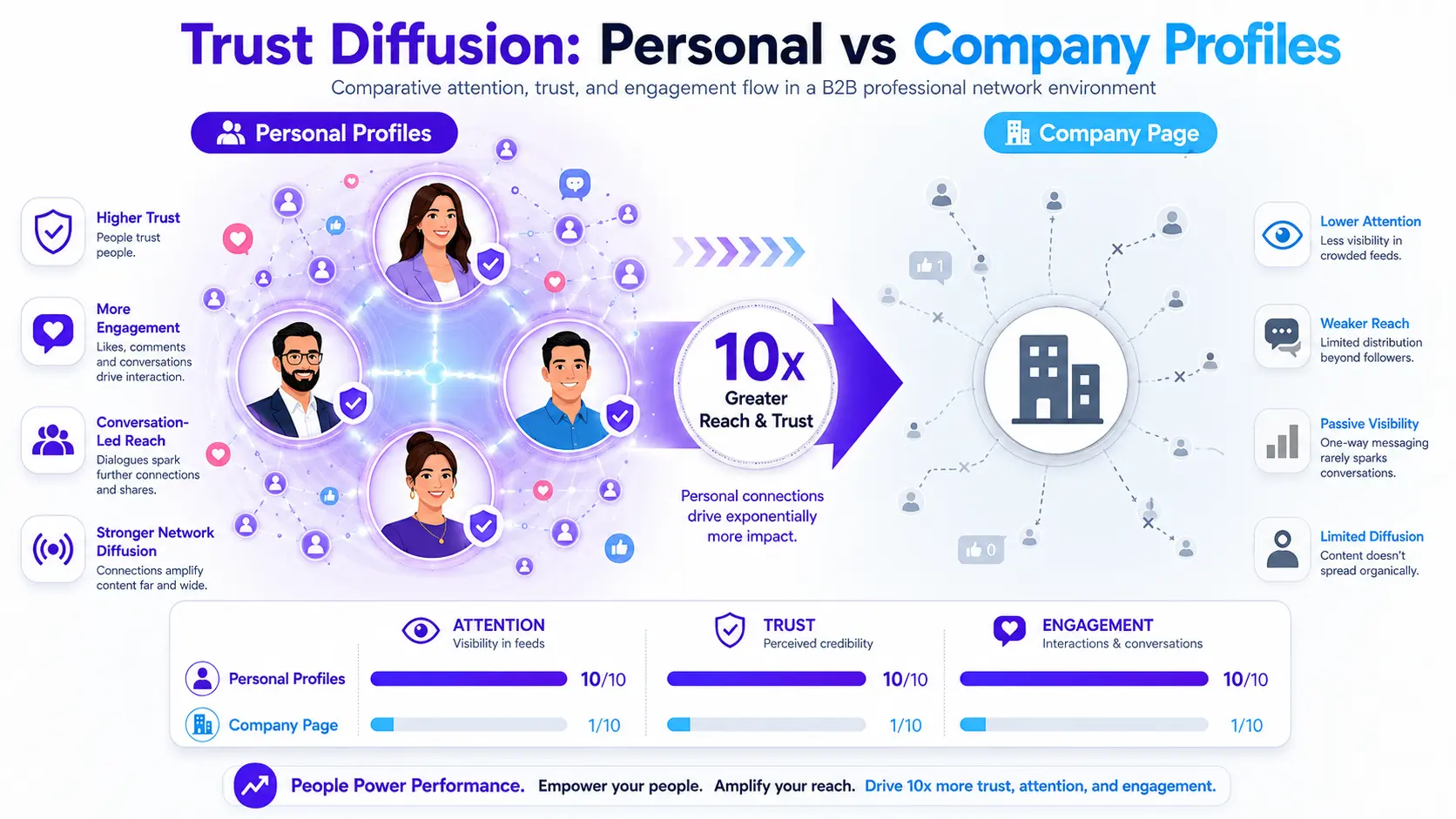
Personal profiles often outperform company pages because buyers respond more to named experts, leaders, and specialists than to logos.
In this environment, strong signals include dwell time, thoughtful comments, saves, direct messages, buyer-specific engagement, and conversations that move into deeper marketing or sales systems.
Key Takeaways
- Personal profiles dominate B2B visibility on LinkedIn by building professional trust and driving meaningful engagement, far outpacing company pages.
- LinkedIn’s algorithm rewards quality signals like dwell time and direct professional relevance over raw engagement numbers, making substantive content key.
- Generic posting and engagement metrics alone do not translate into compounded trust or pipeline value without specificity and evidence of buyer resonance.
- True LinkedIn B2B compounding requires readiness in credibility, clear team positioning, and timely routing of signals into broader marketing systems.
On LinkedIn, most brands expect that their official company page is the best way to reach decision-makers.
But the real engine for exposure is not the logo or the brand – it’s the faces behind it.
The sharp contrast: personal profiles dominate attention, while company pages often stall, no matter the follower count.
The structural reason is trust.
Executives scroll past company posts that look scripted, but pause on updates from peers and specialists.
In our work, we have seen posts from an individual with 2,500 connections outpace a company with 50,000 followers by a factor of ten.
The personal introduction, the direct voice, the implied expertise – these elements trigger a reaction that company messaging rarely earns.

How LinkedIn’s ecosystem shapes professional trust and visibility
Here’s the myth that slows down many teams: building brand awareness requires only pumping consistent content from the company page.
But LinkedIn’s audience mechanics put networks first and brand badges second.
When a leader shares an experience, the network senses skin in the game.
That’s when trust compounds.
What drives this gap?
Personal profiles spark conversation, draw mentions, and move into private messages – the true visibility engine.
Company page content may reach a feed, but it often exits before earning attention.
It’s the difference between arriving as an outsider and being invited inside.
Why personal profiles consistently outperform company pages for visibility
The repeatable insight: On LinkedIn, authority is portable, but trust is personal.
So, which matters more: reach or resonance?
The answer is visible in your own feed.
Relevance lands harder when the messenger is a person, not a corporate entity.
That’s why brands seeking B2B trust should leverage internal voices, not just official handles.
That broader social media logic is outlined in Social Media Marketing.
Comparison of LinkedIn Personal Profiles vs Company Pages for B2B Visibility
| Condition | Recommended Action | Reasoning |
| Organic content attracts right buyer engagement | Consider paid amplification | Paid spend multiplies what already works |
| Organic signals weak or absent despite effort | Invest in deeper expertise (strategic repositioning, coaching) | Amplification without substance wastes budget |
| High engagement but no buyer pipeline or recognition | Evaluate credibility and message clarity | Engagement alone doesn’t guarantee outcomes |
| Before investing heavily in posting | Assess team capacity and message clarity | Foundation is necessary for compounding value |
| After organic signals stack up | Scale through paid and advanced content systems | Signals indicate readiness for efficient investment |
How algorithm signals prioritize engagement quality over volume
Conventional wisdom insists that more likes, comments, or shares equal more visibility.
Yet, this misses the real game.
LinkedIn’s platform does not reward pure activity – it rewards intent signals hidden in reader behavior.
The quiet driver is dwell time: how long someone actually stays with a post, not whether they click or clap.
High dwell time acts as a vote of trust.
When users slow down, engage with the substance, or save a post, LinkedIn’s algorithm takes notice.
We have seen niche content – sometimes with fewer than 50 reactions – push far past broad, viral-style posts when readers stick around.
It’s a signal that audience specificity wins over surface-level popularity.
Here’s where the comparison to other social platforms fails.
On LinkedIn, semantic matching – the alignment between content themes and professional interests – pushes content further with the right users.
The platform uses profile data, previous interactions, and job titles to serve content not just widely, but to the connections most likely to act.
That’s why generic engagement does not deliver commercial outcomes.
Key Engagement Signals LinkedIn Prioritizes
- Dwell time: how long someone stays with a post
- Substantive engagement such as saves or thoughtful comments
- Semantic matching of content to professional interests and job titles
- Relevance over broad viral popularity
- Avoidance of generic likes lacking real business intent
Think of it this way: a LinkedIn post is less like a billboard and more like a professional roundtable.
If the discussion is rich, people stay.
If it’s vague, buyers move on fast.
That’s the silent filter most marketers overlook.
So what changes when quality wins over quantity?
Content strategy must favor sharp, situation-aware posts that speak directly to pain points, not just status updates that chase numbers.
The net result: trust and visibility climb together, but only when engagement signals reflect real business attention – not empty clicks.
The issue is not reach for its own sake.
The issue is whether that reach shapes buyer perception in a context of trust.
Once that’s clear, the logic of LinkedIn shifts: the path to visibility starts with credibility and ends with the quality of connection, not the raw height of the metrics scoreboard.
Next, we need to look at why even active posting can fail to compound – revealing another layer few teams see coming.

When content fails to compound – or why posting isn’t enough
Everyone knows LinkedIn rewards visibility with reach and recognition.
But the metric most teams chase – post volume – can quietly cap both.
What slips by is how the wrong kind of activity makes noise while leaving trust and demand unfinished.
Why generic posts leave trust and demand unfinished
It’s easy to think that consistent posting is building a professional audience.
But consistency, stripped of sharp substance, has a habit of fading into the background.
A common B2B mistake: publishing broad, safe updates that could apply to any company in the sector.
The assumption is that more eyes will see the message, but generic content gets sifted out by LinkedIn’s algorithm long before it lands with decision-makers.
The analogy is simple – shouting into a crowded conference hall.
The louder and less specific the message, the faster it blends into the noise.
We’ve seen campaigns where dozens of broad posts drove short spikes in impressions, only to stall out at the next deal stage.
Here’s what actually happens: LinkedIn’s platform behavior is tuned to reward specificity and substance.
Signals like content engagement, relevance to a niche interest, or depth of response aren’t just vanity – they’re active modifiers of who sees and who remembers a post.
Posts without clear, actionable, or opinionated takeaways rarely create memorable touch points or follow-on discussion.
The real cost isn’t only lost likes, but wasted mental shelf space in the very buyers you want to influence tomorrow.
So why do generic posts keep getting scheduled?
It’s faster to fill a calendar than to craft a viewpoint.
But without specificity, trust stalls and demand never fully forms.
The result: lots of activity, little compounding business value.
Why engagement doesn’t always translate into pipeline or recognition
A post might rack up impressive likes, but B2B teams often face the hard surprise: that attention doesn’t always turn into meetings, pipeline, or recognition from buyers who matter most.
There are plenty of posts that rack up applause – but the audience turns out to be peers, not prospects.
We’ve reviewed dashboards where top-performing posts by engagement led to zero meetings or pipeline.
At first glance, this looks like a data problem.
But watch what happens when engagement goes shallow: recognition layers thin out fast, and real buyer trust never cements.
What LinkedIn’s B2B social environment teaches is simple – it’s the depth, not just the volume, of recognition that signals a channel will compound value over time.
Shallow likes aren’t building real business momentum.
Attention from the right titles and functions is what actually moves the needle.
How do you spot the difference?
If engagement is high but follow-ups, connections, or deal activity run flat, the platform is reflecting activity not commercial impact.
That’s where the compounding engine breaks down.
Consistent activity feels productive – but unless trust and demand finish the loop, posting becomes just another motion.
The sharper opportunity lies past raw engagement, in building momentum with buyers who remember, return, and reach out.
Which raises the harder question: what signals show when content is starting to compound for real business outcomes?

How LinkedIn’s logic differs from other platforms – reframe assumptions
Every B2B team knows social channels matter for reach and attention.
But treating LinkedIn like just another slot in the content scheduler is a trap.
The logic that wins on LinkedIn quietly breaks in places like Twitter or Facebook – and the difference is bigger than most expect.
Why adaptation – not replication – is required across platforms
The instinct to copy-paste a “winning” post from LinkedIn into another network makes sense at a glance.
Yet, the moment you move content across platforms without rewiring intent, the results flatten.
There’s a reason high-performing LinkedIn players rarely become high-performing anywhere else by default.
Here’s where the gap gets real: platform behavior in B2B social media is determined not just by algorithms, but by the unspoken rules of each environment.
On LinkedIn, visibility follows professional trust and context cues; on other platforms, entertainment value or topical resonance often dominate.
You can rack up vanity likes on X or Facebook, but those signals do not transfer business intent or create decisive buyer trust formation on LinkedIn.
How many B2B teams have run campaigns with identical assets everywhere, only to see engagement spike on consumer channels and stall on LinkedIn?
That mismatch isn’t a fluke.
It’s a sign that specification trumps duplication – for the simple reason that LinkedIn’s audience is primed for different signals.
Content specificity on LinkedIn engagement means speaking directly to expertise, challenges, and outcomes – not trendjacking for likes.
Think of LinkedIn as less of a public square and more like a boardroom with glass walls.
Everything gets audited for professional credibility – even in the comments.
This audit mechanism is unique to the LinkedIn B2B social environment, and it explains why simple replication fails.
The language, tone, and even subject matter that drive results on Instagram or X often come across as shallow or off-mark in a LinkedIn feed.
That leads to a stark choice: teams can copy and get diluted, or adapt and tap into intent.
The difference is not subtle – the adaptation is the lever for compounding visibility and trust.
That wider behavioral logic operates differently in Instagram’s B2B visibility environment.
But if adaptation wins, when should LinkedIn performance become a feeder for deeper marketing systems?
Before LinkedIn can serve as just a channel, it must become a signal source for the systems that actually drive growth.
When LinkedIn should feed other marketing systems consciousness
Some teams chase LinkedIn visibility as an end goal.
But visibility is not value – not until it connects with a broader system.
The bigger opportunity is to treat each LinkedIn signal – whether it’s high dwell time impact, meaningful debate, or repeated shares – not as finished outcomes, but as raw material to drive smarter content, stronger brands, or sharper demand models elsewhere.
Here’s where intent-aware leaders create leverage: when posts consistently spark professional conversations or draw inbound questions, those indicators reveal what the market truly cares about.
Instead of spinning out new content for its own sake, high-performing teams let LinkedIn content compounding inform brand messaging, long-form pieces, or conversion hooks on owned platforms.
Consider this: engagement on LinkedIn shows which ideas survive the trust audit and convert passive scrollers into active prospects.
But the next move is rarely to stay there.
The sharpest teams use LinkedIn as a sensing function for platform behavior in B2B social media – feeding signals into email, events, nurture tracks, or even product stories.
That way, what thrives on LinkedIn seeds larger systems that move buyers closer to decision.
Does this mean every viral post deserves a landing page or campaign pivot?
Not always.
The key filter is whether the LinkedIn attention reflects buyer seriousness, not just algorithmic luck.
When commercial signals converge – real dialogue, peer endorsement, topic depth – that’s when LinkedIn activity should consciously route into deeper marketing execution.
The risk is to treat LinkedIn performance as the finish line.
The upside is to recognize when it’s simply the starting gun for a more durable growth engine.
The next question becomes: how do you judge internal readiness to make LinkedIn a true B2B visibility lever?

What to consider before choosing LinkedIn as your B2B visibility lever
Most leadership teams assume that posting content on LinkedIn is an immediate win for brand visibility.
But a decision to commit resources isn’t just about picking the right channel.
The real risk is investing before your foundation – credibility, team firepower, and clarity of message – is ready for long-term compounding.
How to assess existing credibility, team capacity, and message clarity
It’s easy to believe that a few high-performing team members can pull an entire company’s perception upward on LinkedIn.
However, professional trust on LinkedIn rarely survives on lone-wolf efforts or one-off campaigns.
Companies with sporadic profiles and muddy positioning typically find that even frequent posting results in almost no meaningful visibility outside their own network.
The check isn’t whether you have a few posts with decent engagement.
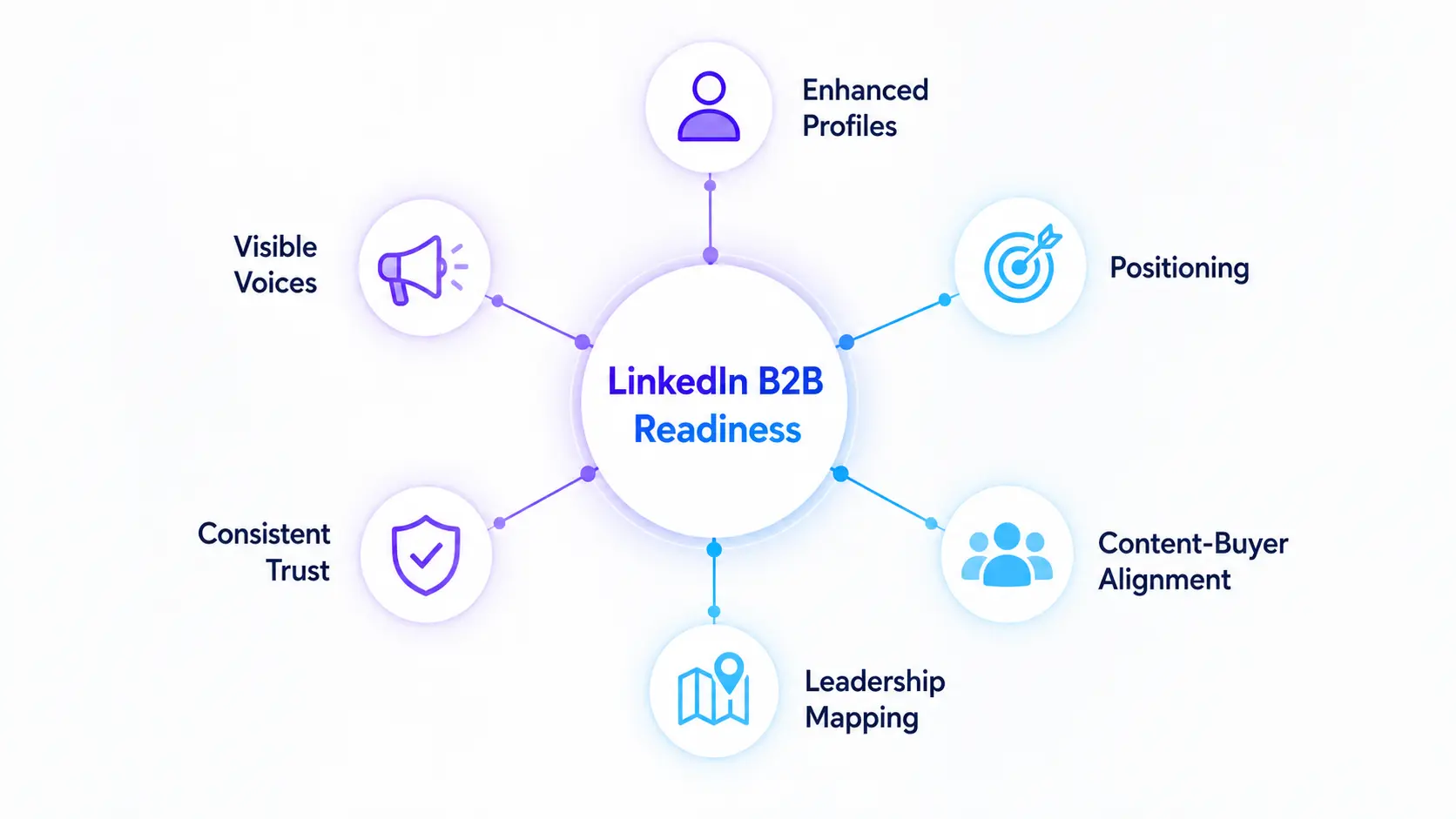
The reality check is simpler: Does your team already have visible, credible, and consistent voices in the LinkedIn B2B social environment?
Or is every profile little more than a digital resume?
Readiness Criteria for LinkedIn B2B Visibility Success
- Visible, credible, and consistent voices within the team
- Profiles reflecting more than just digital resumes
- Clear and focused positioning aligned to core buyers
- Alignment between content themes and targeted buyer interests
- Mapping leadership reach and direct buyer access
- Consistent content that builds durable professional trust
We’ve watched capable teams with solid offline reputation struggle online because their thought leadership is scattershot and internally focused.
In contrast, the companies that build durable attention invest early in aligning their people’s profiles, sharpening their positioning, and enforcing one clear theme per core buyer.
The analogy is like showing up at a conference with no name tag, no context, and nothing to say beyond generic greetings.
People might nod, but they won’t remember you – and they definitely won’t follow up.
Presence is not performance.
So what do you test?
Map your leadership’s current reach and direct buyer access on LinkedIn.
Audit whether your position, content, and capacity step up to match the intent of the buyers you want.
The gap shows you where the compounding will fail before it starts.
The sharpest lens: consistent credibility, operational readiness, and message clarity form the ground floor.
Therefore, any move to push harder on LinkedIn without these isn’t an investment – it’s a bet the market will never cash in.
When to route to deeper expertise or paid amplification
There’s a common urge to solve slow LinkedIn growth by outsourcing or boosting posts with paid spend.
But – this often papers over deeper weaknesses, not real constraints.
When teams push dollars into posts before organic signals work, the result is artificially inflated reach but no trust, and certainly no pipeline.
This is the moment to ask: is the bottleneck really reach – or is it that your expertise and message haven’t yet crossed the buyer’s credibility threshold?
Paid amplification only compounds what already works; it cannot manufacture substance or team reputation from scratch.
LinkedIn B2B Visibility Readiness and Investment Decision Framework
| Aspect | Personal Profiles | Company Pages |
| Primary driver of visibility | Faces and personal connections | Brand logo and official messaging |
| Trust factor | High due to personal voice and implied expertise | Low due to scripted appearance |
| Typical engagement pattern | Sparks conversation, mentions, private messages | Often reaches feed but loses attention quickly |
| Impact example | Post with 2,500 connections outperforms | Post with 50,000 followers underperforms |
| Role in network | Authority is portable, trust is personal | Brand badge secondary to network |
A decision-stage signpost is whether your organic content already attracts the right comments, connections, or direct outreach from target buyers.
If these signals are weak or absent – even with consistent effort – the next investment isn’t tactical amplification.
The decision is to route to deeper expertise for strategic repositioning, executive coaching, or narrative reframing.
Conversely, when organic signals stack – when key buyers start to engage unprompted, when your team fields real inbound interest – that’s when paid and advanced content systems start to return on cost.
More activity before this point burns budget and morale.
This diagnostic is sharper than it sounds: LinkedIn only multiplies what’s already true.
Therefore, clarity on your internal reality prevents wasted moves and opens the door to compounding, not just presence.
The constraint is rarely the platform, but how you set the stage before you press “post”.
The question that remains: when the readiness test is clear, what does the actual path to breakthrough performance look like on LinkedIn?

Scientific context and sources
The sources below provide foundational context for how decision-making, attention, and performance dynamics evolve under scaling and constraint conditions.
- Social Influence and Trust in Professional Networks
Social Influence and the Collective Dynamics of Opinion Formation – Mehdi Moussaïd, Juliane E. Kämmer, Pantelis P. Analytis, Hansjörg Neth – PLOS ONE
This research explains how social influence shapes opinion formation through peer signals, confidence, and group dynamics, which supports the article’s point that trust spreads more strongly through people and networks than through static company pages.
https://journals.plos.org/plosone/article?id=10.1371/journal.pone.0078433 - Company Reputation and Personal Branding
Reputation and Its Risks – Robert G. Eccles, Scott C. Newquist, Roland Schatz – Harvard Business Review
Discusses how reputation depends on trust, stakeholder perception, and the gap between expectations and reality, closely tying into B2B environments where individual voices can strengthen or weaken company reputation.
https://hbr.org/2007/02/reputation-and-its-risks - Algorithmic Impact and Engagement Quality
Understanding dwell time to improve LinkedIn feed ranking – Siddharth Dangi – LinkedIn Engineering
Explains how LinkedIn uses dwell time and feed behavior to improve ranking quality, directly supporting the article’s point that LinkedIn rewards meaningful attention, not only likes or surface engagement.
https://www.linkedin.com/blog/engineering/feed/understanding-feed-dwell-time - Organizational Visibility and Attention Scarcity
The attention economy and the Net – Michael H. Goldhaber – First Monday
Explores how visibility and attention become scarce resources in digital environments, which supports the article’s argument about professional content competing for attention under information overload.
https://firstmonday.org/ojs/index.php/fm/article/view/519
Questions You Might Ponder
Why do personal profiles outperform company pages in the LinkedIn B2B social environment?
Personal profiles garner greater trust and engagement because they represent real expertise and direct experiences. Decision-makers are more likely to interact with and trust posts from individuals, which fuels visibility and compounding business value over company-branded messaging.
What algorithm signals matter most for LinkedIn B2B content performance?
LinkedIn prioritizes dwell time, substantive engagement (like saves and thoughtful comments), and semantic relevance to professional roles. Posts that earn higher dwell times and direct professional interactions are amplified, as these actions indicate genuine business attention.
How does LinkedIn B2B posting success differ from other social platforms?
Unlike platforms such as Facebook or X, LinkedIn rewards credibility, professional specificity, and trust signals over viral entertainment value. Posts must align with business interests and buyer needs, not just pursue broad engagement, making content adaptation critical for success.
Why doesn’t high engagement always translate into B2B pipeline growth on LinkedIn?
High engagement such as likes may come from peers or non-target audiences. True pipeline impacts arise from qualified engagement – comments, shares, and conversations with decision-makers who are potential buyers – and not just surface-level metrics.
When should LinkedIn signals be integrated into broader B2B marketing systems?
Once organic LinkedIn activity repeatedly drives actionable interest from target buyers, those insights should be used to refine marketing strategies, messaging, and content across owned channels, events, and nurturing programs for sharper, outcome-driven growth.