
What You’ll Learn
Paid media platform volatility is the normal instability in PPC and paid social performance caused by changing auctions, competitor bids, automation learning phases, budget shifts, audience recalibration, attribution changes, and signal quality problems.
It can create sudden swings in CPC, CPM, CPA, ROAS, lead volume, or conversion rates even when campaigns have not been mismanaged.
Paid media volatility is not always chaos or failure; many short-term fluctuations are structural because advertisers operate inside rented platforms with moving rules and opaque algorithms.
The key is knowing whether a change is temporary turbulence or a deeper issue caused by broken tracking, degraded conversion data, sustained negative trends, or automation drift.
Key Takeaways
- Paid media platform volatility is a structural feature, not an operational failure, driven by auction dynamics, competition, and automation recalibration.
- Algorithmic learning phases and feedback loops cause performance swings, especially after any change to creative, audience, or budget settings.
- Most performance turbulence is temporary, but persistent drops, compounded errors, or broken tracking require diagnostics and deeper intervention.
- Control over volatility comes from optimizing signal quality and knowing when to act versus riding out routine platform-instigated swings.
Most teams mistake sudden drops or spikes in paid media performance as evidence of faulty strategy – or someone’s oversight.
The truth: platform volatility is baked into the system, not a sign of internal failure.
The belief that paid channels should deliver smooth, predictable returns is a myth that quietly drains budgets and morale.
Why?
Because you’re operating on “rented ground”, where the rules, competitions, and signals change without warning – yet the urge to overreact is almost impossible to resist.
That wider pattern is explored in PPC & Paid Media.

What paid media platform volatility really is – and why it isn’t chaos
Imagine running a sprint, only to find your lane width, the starting pistol’s timing, and even your competition recalibrated every hour – by someone else.
This is how ad auctions work behind the scenes.
When a new competitor floods your audience with bigger bids or a major spender suddenly pauses, your cost per click or lead can double before lunch with no change on your end.
One executive client panicked over a 30% CPM spike overnight – until we mapped back to a retail holiday driving seven new bidders into their segments.
Nothing broke; the race just got harder.
How auction dynamics and competition shifts drive unowned fluctuations
The biggest myth?
That “manual control” or constant tweaks tame volatility.
In reality, the moment you push your budget or change creative, you’re re-entering a moving auction.
Sometimes, shifting one small variable triggers outsized cost swings – simply because you’ve landed on the radar of a new, better-funded competitor, or the algorithm recalibrates the auction floor.
Auction volatility means you’re sharing the stage with invisible rivals, and their moves are as important as your own.
Causes of Auction Dynamics Driving Paid Media Volatility
| Threshold | Description | Guidance |
| Budget Size | Daily spend swings as % of total budget | Intervene if daily swings exceed 20% for multiple days; micro-budgets show wide fluctuations but rarely need panic unless persistent |
| Data Volume | Number of conversions or impressions | Only act if anomalies persist after meaningful volume (hundreds of conversions, not dozens) |
| Time Window | Duration of observed volatility | Look for sustained changes across 3 to 5 business days; single-day or weekend swings usually platform turbulence |
Volatility is not synonymous with chaos.
It’s a structural feature of paid media platforms, driven by forces outside any one advertiser’s grasp.
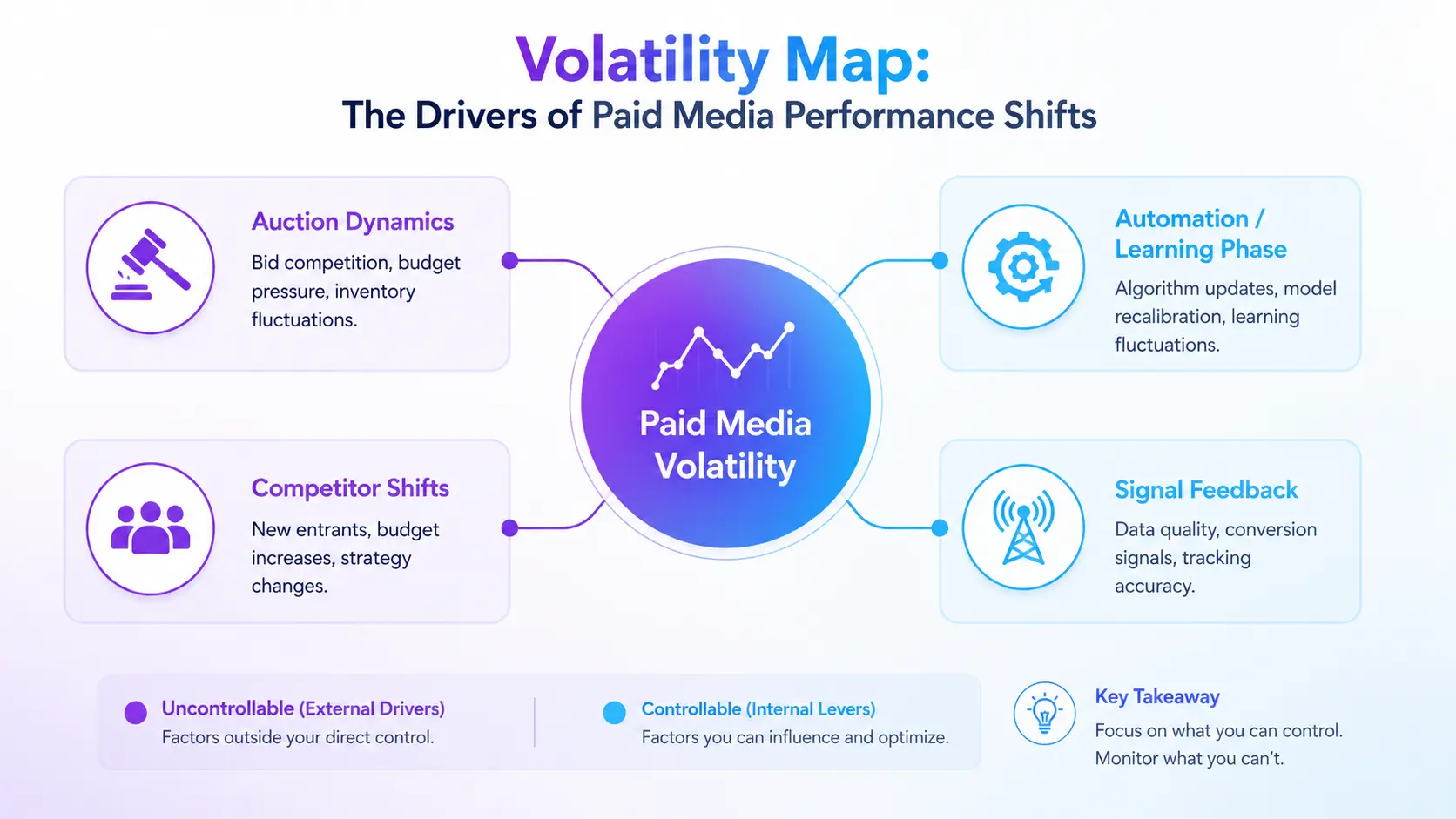
Why automation learning phases make stability temporary, not guaranteed
Key Characteristics of Automation Learning Phase Volatility
- Machine learning self-tunes and destabilizes campaign performance with each new data input or setting change.
- Minor campaign updates can wipe prior optimizations and amplify small adjustments into major swings.
- Steady state is fragile; every shift risks turbulence as the algorithm recalibrates.
- Expect volatility as design – react calmly and distinguish learning phase noise from controllable issues.
What happens when you trust the platform’s machine learning to “find efficiency” – but every time you update, performance whiplashes?
Paid media automation isn’t a fixed system; it’s a self-tuning engine designed to destabilize in pursuit of new data.
The learning phase doesn’t promise gradual improvement.
It delivers volatility by design.
We’ve watched platforms erase six weeks of optimization overnight because a minor campaign setting changed – wiping the old behavioral history.
What looks like erratic delivery is the algorithm resetting its expectations after reading a new signal, often amplifying small adjustments into major swings.
The accepted wisdom is that the machine irons out instability with enough data.
Not quite: learning phase instability means your “steady state” is always one shift away from turbulence.
Think of automation like a fly-by-wire jet: inputs keep it airborne, but sudden gusts or tiny control nudges create unpredictable oscillations.
When automation controls the auction throttle, expecting calm is fantasy.
The right move often isn’t to react, but to understand whether you’re seeing turbulence baked into the system – or a controllable loss of signal (an open loop explored next). Volatility on these platforms isn’t a symptom of incompetence.
It’s a consequence of the invisible rules, moving targets, and automation recalibration.
Smart teams learn to read these shifts not as chaos, but as part of the system’s DNA – so reaction is measured, not panicked.

When signal degradation is the hidden culprit behind performance swings
Most executives assume the problem is messaging, budget, or media placement when paid performance swings wildly.
But the deeper culprit often lurks in something almost invisible: broken feedback loops between your conversion events and the platforms optimizing your spend.
Counterintuitively, the more you spend, the greater the payoff – and the risk – from tiny distortions here.
If your reporting machinery slips, even by a little, optimizations turn into miscalculations fast.
How incomplete or delayed conversion data misaligns optimization behavior
Imagine piloting a race car with a lagging speedometer – by the time you react to a warning, you’re already behind.
The same happens in paid channels when conversion data drips in late or not at all.
Platforms then misjudge which users to target, swinging your cost per acquisition or ROAS away from plan.
We’ve seen client accounts bleed thousands per week, not from creative fatigue but because post-iOS conversion signals collapsed without warning.
If you’ve noticed sudden spikes in CAC after an analytics fix, that’s the system groping in the dark rather than precision-tuning.
It’s a myth that the platforms “just know” who to find next; their learning loops are only as sharp as your inputs.
Starved of real business outcomes or receiving incomplete events (common with server-side tracking setups), the algorithms start optimizing for clicks or time-on-site, not revenue.
The silent drift is often missed until results plunge.
Why attribution models can mask real declines or amplify noise
Attribution exists to explain performance swings, yet it often does the opposite: creates fog.
Short-window models can amplify minor shifts, making ordinary performance noise look catastrophic.
Alternatively, last-click or default settings hide decays in upper-funnel effectiveness until it’s too late to course-correct.
Here’s the analogy: assessing campaign health with only partial vitals.
If your attribution model overweights a single channel or event, you see dramatic improvement (or collapse) that never happened in reality.
We’ve watched teams celebrate a “surge” in paid sign-ups that were actually spillover organic – attribution inflation at play.
And when signals weaken, platforms start guessing, injecting volatility into even well-run campaigns.
Which numbers are trustworthy?
Only those repeatedly mapped back to verified business outcomes, not proxies.
Signal loss rarely presents as a flashing error.
It creeps up, distorting every optimization until the algorithm is solving for something irrelevant.
The clarity: examine your signal chain before blaming strategy.
If the right data isn’t driving the system, volatility is not just probable – it’s automatic.

What makes volatility feel unpredictable – and which fluctuations deserve action
You’ve seen it: a calm week, then abrupt numbers that defy explanation – profits wobble, alarms sound, and the dashboard looks foreign.
But these sharp shifts usually don’t signal a broken strategy.
They mark how the platform’s internal machinery surfaces in your results, often in patterns that startle even seasoned operators.
The challenge isn’t avoiding turbulence, it’s learning to read whether it’s routine or an early sign of deeper trouble.
How to recognize normal turbulence versus structural collapse
Signs of Normal Turbulence vs Structural Collapse
- Normal turbulence involves temporary cost-per-acquisition swings and short-term volume dips that revert without intervention.
- Structural collapse is characterized by prolonged spend drops, free-falling conversion rates, or broken tracking blocking optimization.
- Accumulating failures across time, geographic areas, or channels often indicate systemic collapse rather than isolated volatility.
- Short-term swings lasting days are often platform-driven noise; persistent negative trends require deeper investigation.
Think of paid media like flying commercial: some turbulence is routine, expected, and engineered into the system.
Platforms frequently reshape auction logic, recalibrate machine learning, and shuffle audience pools.
When a campaign’s cost per acquisition jumps for two days, or creative fatigue sets in after a sharp spike, these are textbook turbulence – not structural damage.
We’ve seen six-figure campaigns swing 15% up or down for days, only to revert without intervention.
One client’s lead volume cratered on a Wednesday, spiked back by Friday.
The culprit?
Platform-wide auction volatility – unrelated to creative or bid changes.
In contrast, structural collapse usually drags on: spend plummets for a week, conversion rates free-fall, or tracking breaks lock out optimization entirely.
Ask yourself: is this a blip with historical precedent, or a novel pattern with no quick rebound?
Here’s the myth: any sudden shift is a crisis to fix.
In reality, real systemic breakdowns announce themselves with accumulating failures – across time, geos, or channels – not just isolated wobbles.
Short-term swings often resolve naturally; system failures do not.
Like a seasoned pilot, you need to know when to ride out normal bumps versus initiate an emergency landing.
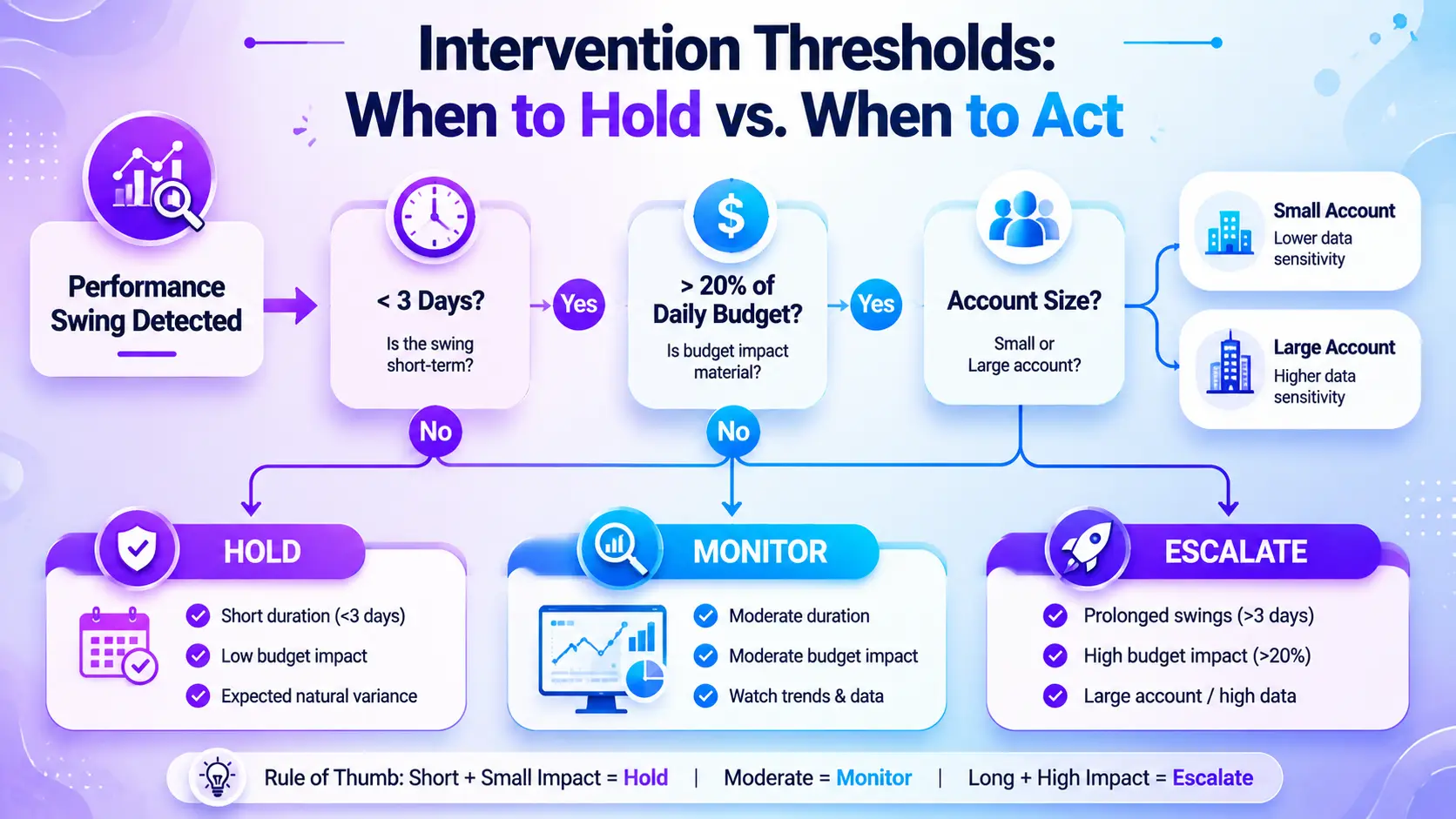
What thresholds (budget, data volume, stability) matter before you intervene
Thresholds for Intervention in Paid Media Volatility
| Cause | Description | Impact on Performance |
| New Competitor Bids | Sudden entrant floods audience with higher bids | Cost per click or lead can double without account changes |
| Major Competitor Pauses | Large spender stops bidding temporarily | Cost per impression (CPM) and auction floor adjust, causing price shifts |
| Algorithm Recalibration | Platform resets auction mechanics or floor | Triggers outsized cost swings from small campaign changes |
If volatility always triggered intervention, you’d spend more energy chasing phantoms than preventing loss.
So, which thresholds actually warrant action?
Start here:
- Budget size: If daily swings exceed 20% of total spend for multiple days, risk compounds quickly.
Micro-budgets may show wilder fluctuations, but meaningful accounts rarely justify panic unless deviation is persistent. - Data volume: Variance in small datasets (low impressions, low conversions) is natural and masks true trends.
Only take action if anomalies persist after meaningful volume – think hundreds of conversions, not dozens. - Time window: Look for sustained changes across at least three to five business days.
Single-day or weekend swings are usually platform turbulence, not decay.
We’ve advised clients to hold tight after seeing cost-per-acquisition spike by 30% in a single day – only for numbers to normalize by week’s end.
Most paid campaigns need time to reveal structural change.
The urge to intervene prematurely is like oversteering a car on a loose gravel road: you may aggravate a minor skid into a real spin-out.
If instability breaches these thresholds, or you observe repeated adverse patterns without natural correction, escalate your diagnostics.
Otherwise, measured patience is often safer – and more profitable – than reflexive action.
Volatility doesn’t always signal disaster.
The executives who distinguish turbulence from collapse – and calibrate response – protect both budget and sanity.

Why feeling out of control is normal – and what control you still retain
Let’s state the uncomfortable truth: If you feel your paid media performance is a black box, you’re not alone – and you’re not failing.
That “out of control” sensation isn’t a symptom of inexperience.
It’s the price of playing on platforms where algorithms make the real decisions, and where most levers are out of your reach.
How rented optimization systems limit your visibility – but still respond to strong signals
Most executives expect a direct connection from budget to outcome, like turning a dial and hearing the volume change.
With platforms driven by automation, that connection twists: you provide inputs, but the algorithm determines what happens next.
This shift often feels like driving with a frosted windshield – you grip the wheel, but the view ahead is blurred by design.
Here’s the myth to bury: No optimization stack, no matter how sophisticated, gives you full transparency or control.
Every paid media team we’ve advised – Fortune 50 included – has hit the same wall: platform auctions operate as closed rooms.
You send in your bid, your creative, your data, but the algorithm sorts, scores, and delivers with its own logic.
Direct platform interfaces show you what the system allows.
They rarely reveal why specific campaign swings happen, or how data signals are weighted in real time.
But this isn’t pure chaos.
Platform algorithms still respond consistently to strong, clean signals – clear conversion data, unified audiences, and distinct creative themes.
For one client, a simple feed cleanup (purging outdated audience segments) restored nearly 20% of lost ROAS in less than two weeks, even as costs fluctuated.
Well-structured inputs tend to cut through the noise and anchor algorithm behavior.
In a sense, you’re steering the ship with beacons – not a map.
Anyone expecting total clarity from these “rented” systems misunderstands their bargain: you get scalable reach, but your grip on the wheel is intentionally loose.
Why does this matter?
Because if you’re waiting for perfect visibility, you’ll never move.
Volatility can’t be eliminated, but impactful signals still change outcomes.
Are your strongest data routes open?
Is your creative feeding the machine, or stuck in last year’s rut?
These levers matter more than chasing platform transparency.
When to escalate diagnostics into deeper signal or automation layers
There’s a telltale difference between random fluctuation and true system drift.
Spotty performance following a new campaign structure?
That’s typical turbulence.
But when core metrics crumble and minor levers deliver nothing – despite stable spend and audience – platform “opacity” becomes a warning sign, not just a nuisance.
In our experience, two triggers demand escalation: when lagging feedback or erratic behavior persists beyond a week, or when conversion data suddenly fails to influence delivery.
One retail client watched top-of-funnel CPAs triple with no creative changes and healthy budgets.
The real problem?
A subtle tracking outage cut their signal strength, so the algorithm started optimizing blindly.
No amount of bid tweaks helped; the fix required rebuilding their data pipeline, not shuffling platform settings.
Think of performance diagnostics as an x-ray versus surface inspection.
If basic campaign hygiene doesn’t close the gap, it’s time to go deeper – into signal loss, data pipeline health, or even external auction changes.
And if you’re forced to escalate, don’t linger debating settings you can’t see.
Move swiftly to check for broken feedback signals or automation breakdowns.
Feeling out of control is standard; letting it paralyze you is optional.
Strong signals and decisive escalation are still yours to command – regardless of how the platform clouds the dashboard.
When platforms change, signal quality decides how your model reacts – that logic runs deeper in Signal Degradation & Attribution Volatility.

Scientific context and sources
The sources below describe the economic and marketing science foundations behind diminishing returns in advertising and marketing spend. They provide empirical and theoretical context for the mechanisms discussed above, including concave response curves, advertising elasticity, and the relationship between spend intensity and marginal performance.
- Decision-Making Under Uncertainty
Judgment Under Uncertainty: Heuristics and Biases – Amos Tversky & Daniel Kahneman – Cambridge University Press
This book explores how individuals and organizations respond to unexpected shifts and volatility, providing a cognitive science framework for understanding reactions to paid media instability.
https://www.cambridge.org/9780521284141 - Marketplace Dynamics and Auction Theory
Internet Advertising and the Generalized Second Price Auction: Selling Billions of Dollars Worth of Keywords – Benjamin Edelman, Michael Ostrovsky, Michael Schwarz – American Economic Review
A foundational paper explaining how auction dynamics and competitive shifts create unpredictable price and placement outcomes, reinforcing the platform volatility concept.
https://www.aeaweb.org/articles?id=10.1257/aer.97.1.242 - Algorithmic Systems and Feedback Loops
Fairness and Abstraction in Sociotechnical Systems – Sam Corbett-Davies, Sharad Goel, Sandra González-Bailón, Sorelle A. Friedler, Hanna Wallach, Suresh Venkatasubramanian – ACM Conference on Fairness, Accountability, and Transparency
This research examines how algorithmic systems behave within complex feedback environments, showing how optimization systems can amplify instability when signals are incomplete, delayed, or structurally biased – directly relevant to automated paid media platforms.
https://dl.acm.org/doi/10.1145/3287560.3287598 - Signal Loss and Attribution in Digital Media
Beyond the Last Touch: Attribution in Online Advertising – Ron Berman – Marketing Science
This research examines how attribution models attempt to assign conversion credit across fragmented customer journeys, while highlighting the structural limitations caused by incomplete visibility, cross-channel signal loss, and imperfect causal inference – directly relevant to distorted PPC performance interpretation.
https://www.nowpublishers.com/article/Details/MKT-059 - Scale, Complexity, and Organizational Response
Complexity and Organizational Reality: Uncertainty and the Need to Rethink Management After the Collapse of Investment Capitalism – Ralph D. Stacey – Routledge
This book examines how organizations behave under volatile, nonlinear systems where interventions can create unintended consequences, supporting the argument against reactive decision-making in unstable performance environments.
https://www.routledge.com/Complexity-and-Organizational-Reality-Uncertainty-and-the-Need-to-Rethink-Management-after-the-Collapse-of-Investment-Capitalism/Stacey/p/book/9780415556477
Questions You Might Ponder
What causes sudden shifts in paid media platform performance?
Sudden performance shifts are mostly due to auction dynamics, competitor actions, and automated recalibrations by the platform’s algorithm. These factors operate outside your control, so even unchanged campaigns can see rapid cost or volume swings driven by external system shifts.
How does signal degradation impact campaign outcomes?
Signal degradation occurs when conversion data is late or incomplete, making algorithms optimize blindly or for incorrect outcomes. This can lead to wasted ad spend, higher acquisition costs, and ROAS declines because the platform’s learning loop is cutting off real business feedback.
What’s the difference between turbulence and structural collapse in paid media?
Turbulence refers to temporary swings in key metrics (like cost-per-acquisition) that quickly revert, while structural collapse involves prolonged, compounding drops across multiple areas due to deeper issues such as tracking failures or strategic misalignment, requiring urgent intervention.
When should you actually intervene during a period of paid media volatility?
Only intervene if volatility lasts more than three to five days, the swing is over 20% of daily budget, or negative trends persist at scale. Small, short-term swings typically self-correct; overreacting can worsen outcomes by amplifying algorithmic instability or misreading platform feedback.
How much control do advertisers really have over paid media platform volatility?
While advertisers can optimize inputs like creative, audience, and conversion signals, ultimate performance is governed by platform algorithms – essentially a “rented” system with limited transparency. Strong data and well-structured campaigns regain some influence, but full control isn’t possible.