What You’ll Learn
PPC signal loss is the degradation, delay, or disappearance of conversion data that paid media platforms use to optimize campaigns.
It happens when tracking breaks, attribution coverage shrinks, consent rules block events, conversion logs lag, duplicate postbacks distort credit, or key business outcomes stop flowing back to Google Ads, Meta, or other PPC systems.
When signal loss occurs, campaigns may keep running but optimization shifts toward whatever proxy data remains, such as clicks, form starts, or low-value micro-conversions.
This can create false reports, budget misallocation, volatile CPA or ROAS, and performance changes that look like campaign problems but are actually measurement failures.
Key Takeaways
- PPC signal loss quietly shifts platform optimization toward available, but often misleading, metrics – independent of campaign changes.
- Automation amplifies volatility when data quality drops, making performance swings more severe and less predictable.
- Attribution and measurement gaps can misallocate budget, inflate apparent lower-funnel wins, and distort perceived ROI.
- Reliable PPC optimization depends on robust, consistent data flow – signal stability must be prioritized alongside creative and budget controls.
Most executives assume stable campaigns mean stable results.
The uncomfortable truth is your PPC platforms can quietly shift strategy – even when creative, bids, and targeting don’t change – simply because the signals feeding their models degrade or go missing.

Why PPC systems shift behavior when signals degrade
Imagine a GPS that starts dropping satellites mid-trip.
Your route still “updates”, but the destination gets blurry, sometimes leading you in the opposite direction.
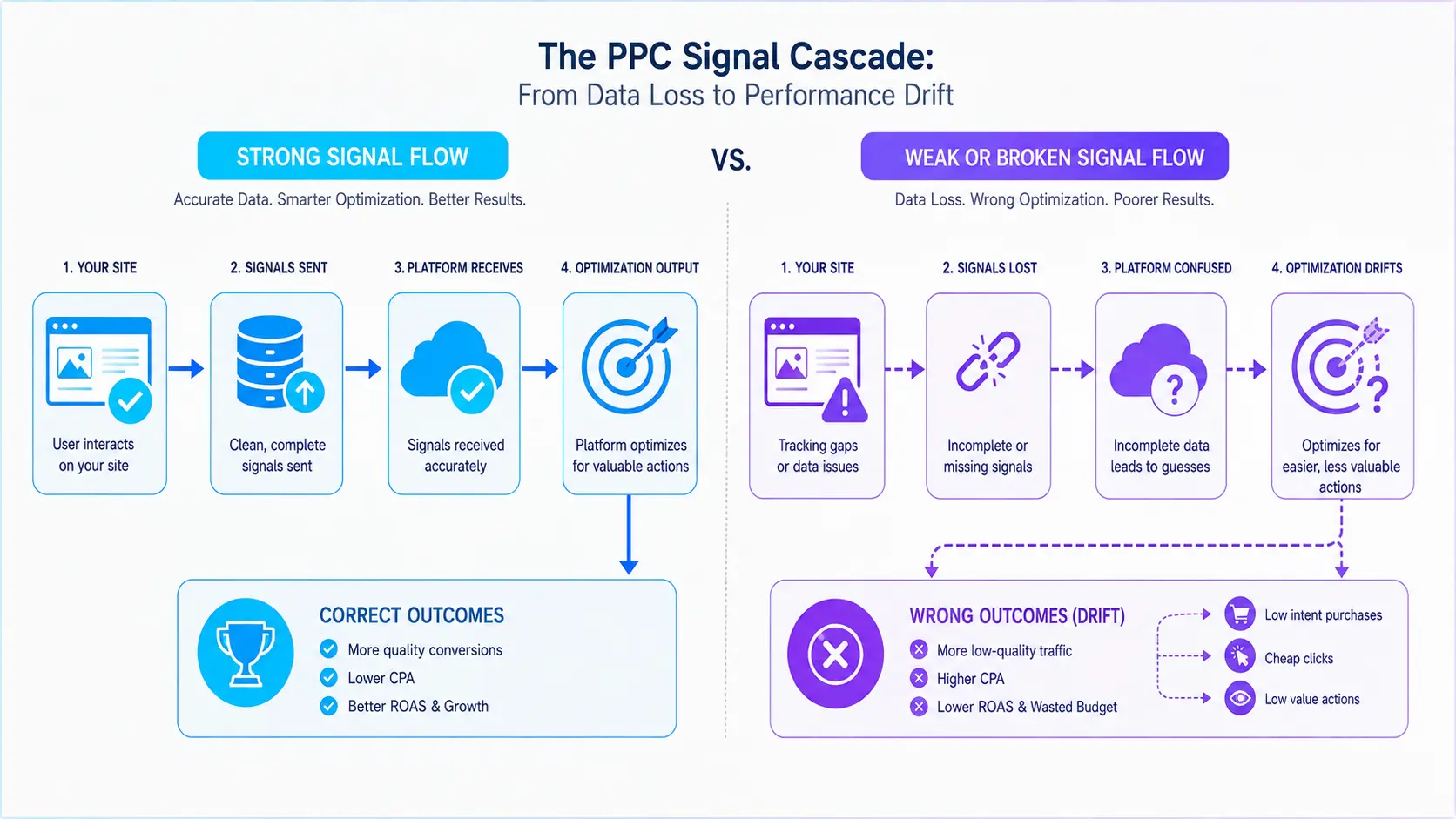
PPC systems thrive on clear conversion feedback; when that feedback gets noisy or incomplete, platforms still optimize – they just chase the wrong outcome.
The wider implications show up throughout PPC & Paid Media.
How missing or noisy conversion feedback makes platforms chase the wrong goal
Here’s the myth: “As long as the campaign structure is solid, the platform will seek the right outcome”.
But when we work with brands after a martech stack change or a privacy update, we repeatedly see performance drift that tracks directly to conversion signal degradation, not campaign tweaks.
Impact of Conversion Signal Issues on PPC Optimization
| Signal Problem | Cause | Impact on PPC Reporting | Example |
| Attribution coverage erosion | Tracking updates or site changes | Upper-funnel stages missing from reports | Upper/middle journey stages stop sending data |
| Conversion gaps | Tracking code errors or consent changes | Sudden unexplained conversion drops | 18% drop traced to pixel firing delay |
| Tracking delays | Attribution windows change or logging lag | Conversion counts delayed, mislead optimization | Delayed conversions cause algorithms to chase ghosts |
Some of the best machine learning doesn’t fail by turning off – it fails by misfiring.
For instance, if half your leads go untracked after a tag breaks, the algorithm often “learns” to seek patterns that create the wrong kind of conversions.
In one client audit, an ecommerce platform started optimizing for clicks rather than revenue due to dropped purchase signals – ad spend visually shifted toward high-traffic, low-intent audiences, all while campaign settings stayed untouched.
Ask yourself: Is your top cost driver measured cleanly, or are you getting a Doppler-distorted version of intent?
Platforms don’t know the difference; they respond to the loudest, fastest signal available.
A single week’s tracking error can reroute months of optimization, all beneath the surface.
The analogy: a chef following a recipe, but half the ingredients’ labels are missing.
The meal still comes out, but nutrition and taste become a gamble.
Here’s what’s repeatable: “PPC algorithms don’t go offline when signals degrade – they go off-course”.
Why automation amplifies volatility when data quality drops
Automation promises stability, but when data quality slips, volatility ramps up.
We’ve seen first-hand that increasing reliance on automated bidding and dynamic budgets makes outcome swings sharper, not softer, during episodes of signal noise in PPC.
These shifts have only accelerated with industry-wide changes like cookie deprecation and Apple’s ATT.
When learning instability enters – the optimization engine keeps updating based on whatever signals come through, whether those are robust, delayed, or simply wrong.
Platform volatility increases, and small data disturbances start cascading into major cost-per-action jumps or sudden channel switches.
Have you wondered why ROAS breaks out of its range despite identical budgets and ads?
That’s typically attribution gaps and data loss, not hidden auction factors.
The repeatable pattern: automation acts like a self-driving car with foggy sensors – it doesn’t slow down, it just steers harder in the wrong direction.
At scale, signal-driven drift multiplies unpredictability, making last week’s performance less useful as a predictor.
If results seem to shift for no reason, this is usually not conspiracy; it’s PPC’s invisible response to signal loss.
What feels stable from the marketer’s chair is algorithmic chaos under the hood.
Clear measurement is not a technical luxury – it’s the engine that keeps platforms learning in your favor.
Lose that, and optimization breaks before campaigns do.

How attribution gaps and measurement drift change decision‑making perception
Common Attribution and Measurement Issues in PPC
- Lower-funnel wins appear stronger due to missing upper-funnel signals
- Double-counting conversions due to duplicate credit assignments
- Device gaps break conversion continuity across mobile and desktop
- Misaligned credit causes budget shifts based on flawed data
- Measurement drift creates a distorted view like a funhouse mirror
An unexpected surge in lower-funnel efficiency often means you’re missing half the story, not twice as effective.
Silent losses in upper-funnel conversion signals can make it look like performance is up – right as growth stalls.
Most teams assume their PPC results reflect actual business outcomes.
In reality, signal loss quietly rewires attribution, warping every report and distorting every optimization decision.
When attribution fails, lower‑funnel looks stronger and upper‑funnel disappears
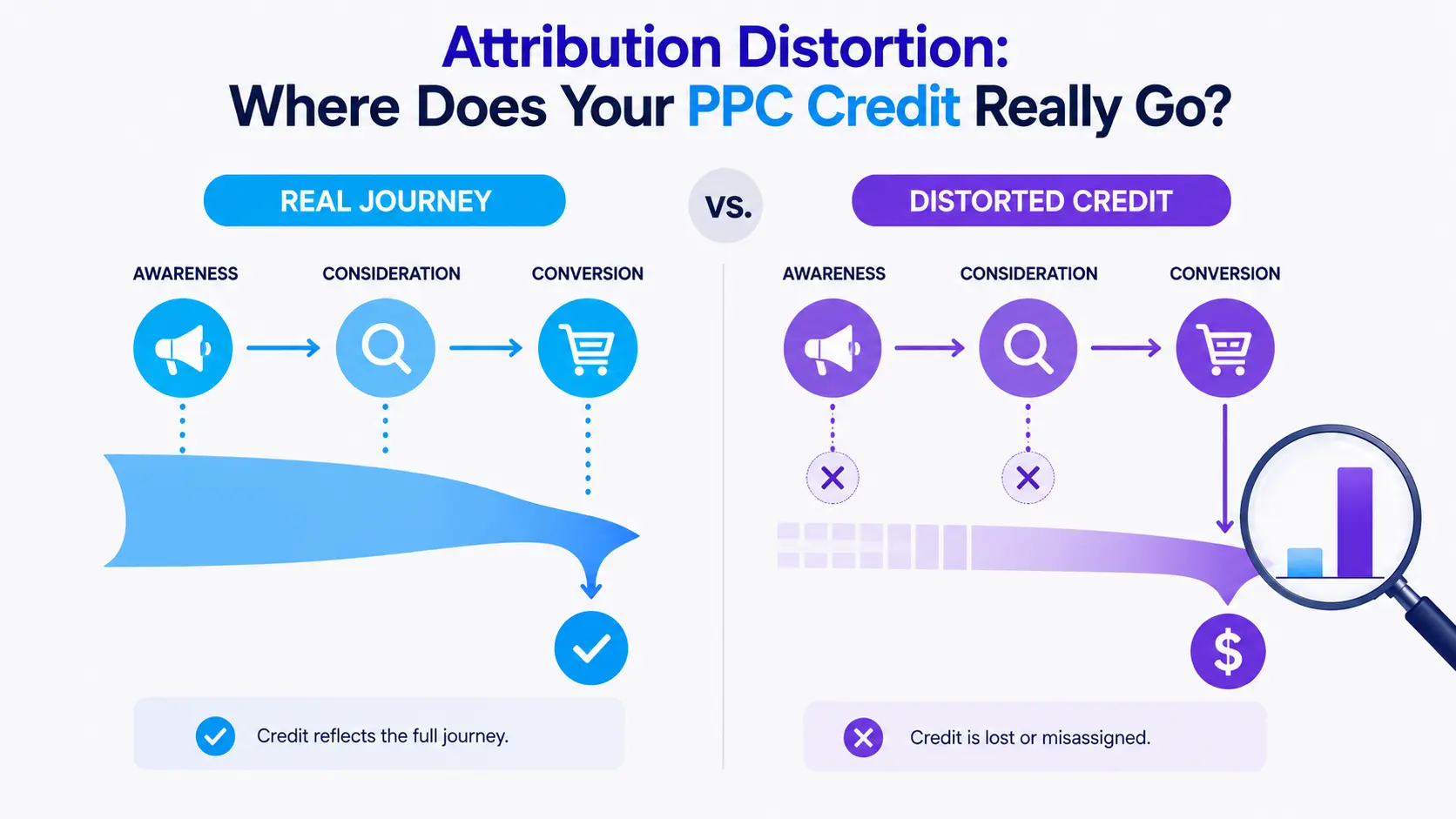
Picture this: you invest in both awareness and retargeting, but reporting starts showing all wins in retargeting campaigns.
What’s actually happening?
Upper-funnel touchpoints (like video views or first website visits) lose trackable attribution as signals degrade.
Only the clean, last-click transactions remain visible.
Algorithms and dashboards start crediting bottom-funnel activity for deals it didn’t create.
It’s like only judging a relay team by the last runner – ignoring who handed them the baton in the first place.
We’ve watched B2B clients double down on high-retargeting ROAS just as overall pipeline velocity sputtered.
They were chasing a stronger-looking lower-funnel, not realizing upper-funnel value was cut from the data entirely.
Question: are your budget increases reinforcing actual influence, or just echoing what’s easy to measure?
Double‑counting, device gaps, and misaligned credit skew budget shifts
If one device loses conversion tracking or two platforms both claim the same conversion, every reported “win” becomes a little less real.
Double-counting happens when multiple vendors or channels assign credit for a single sale – pushing attribution totals over 100%.
Device gaps crop up as users bounce between mobile and desktop, breaking the thread of continuity so campaigns on each device get partial or unearned credit.
One SaaS team we worked with spent 30% more on branded search after attribution logic was changed, only to discover that a tracking update had sent duplicate postbacks to two platforms.
Budget shifts followed the false signal, not true incremental growth.
Ask yourself: how much of your reported ROI growth is an artifact of measurement, not market strategy?
Measurement drift and attribution noise are less like reading through a fogged window and more like a funhouse mirror – magnifying some effects, erasing others.
The real risk: chasing a growth pattern that only exists inside broken reporting.
The true story surfaces only when you inspect how and where your signals fail.
If PPC reports feel out of sync with actual business impact, it’s usually not your strategy that’s broken – it’s the measurement reality you’re betting on.

Why losing signal doesn’t mean running ads wrong – it reflects partial platform control
Most teams blame their in-house choices the minute PPC performance starts to slip.
But here’s the secret: even flawless campaign setups can’t fill gaps the platform can’t see.
When you lose conversion signals, the system doesn’t just “pause” – it quietly rewires what it chases, regardless of your intent.
Platforms rent your data; loss of signal shifts what they optimize
Think of PPC automation as leasing the latest AI co-pilot – it only drives straight if you feed it clean data.
The moment your conversion signals get patchy, platforms like Google Ads or Meta shift gears.
The algorithm still optimizes, but the goalpost moves without warning.
Suddenly, impressions and clicks may rise while qualified leads vanish – because optimization now targets whatever feedback survives, not true business outcomes.
One client watched a sudden spike in micro-conversions – form starts, not completions – right after a tracking update.
The platform simply maximized the only metric it could see.
Executives often believe such surges mean campaign tactics improved.
In reality, automation just redefined “success” due to signal loss.
The myth is that campaign configuration owns all the risk.
In truth, you’re renting the platform’s automation and priorities shift every time your data contracts or changes shape.
The optimization engine, stripped of granular conversions, may chase noisy proxies or amplify unprofitable segments.
If signal loss can sway the manager’s steering that much, what else is it quietly changing?
Signal volatility forces reactive cycles; stability is a strategic choice
Here’s what most leaders miss: instability isn’t random.
Platforms react instantly to input drops – meaning one small tracking failure can spiral into weeks of wasted budget as the system reorients around new (and less valuable) signals.
Teams get pulled into whiplash cycles, adjusting creative or budgets to compensate for what’s actually measurement drift, not market change.
Through dozens of audits, we found that the most expensive error isn’t “bad campaigns”.
It’s letting signal volatility dictate strategy instead of engineering consistency into how the system reads business outcomes.
Think of measurement as the foundation: every crack multiplies downstream costs.
The analogy is a chef with fluctuating ingredients – one missing spice, and the entire flavor profile shifts.
Misreading reporting “wins” or “losses” under signal drift risks mistaking supply for talent.
So when performance flips without a campaign change, don’t self-blame.
Partial control is the default.
The only way to regain leverage is to treat signal stability as a board-level priority – not an afterthought.
Signal loss doesn’t reveal poor campaigns.
It exposes how little of the optimization game you truly control – and why consistent, engineered data is the most valuable asset you can own.

What to inspect next when PPC reports misbehave under signal uncertainty
Key Diagnostic Steps to Address PPC Signal Loss
- Check attribution coverage for signal gaps after updates
- Identify conversion tracking gaps or errors quietly reducing data
- Monitor tracking delays causing lagged conversion reporting
- Compare platform data against media mix modeling (MMM)
- Run holdout tests to validate campaign impact
- Use first-party data layers like CRM logs to verify PPC wins
- Triangulate insights from multiple independent benchmarks
Executives often mistake unusual dips or spikes in PPC performance as market shifts or creative fatigue – but most reporting swings are measurement mirages, not reality.
Here’s what most teams miss: your paid traffic data isn’t just wrong when tracked conversions disappear; it quietly distorts every decision the second signals get patchy.
The real risk?
Making budget calls based on shadows, not substance.
Check signal surface: attribution coverage, conversion gaps, and tracking delays
Common Signal Issues Affecting PPC Data Accuracy
| Signal Issue | Effect on Platform Behavior | Example Scenario | Resulting Optimization Focus |
| Half leads untracked due to broken tag | Algorithm learns wrong conversion patterns | Ecommerce platform optimizes for clicks not revenue | Shift to high-traffic, low-intent audiences |
| Dropped purchase signals | Platform chases immediate visible signals | Spending shifts without campaign changes | Maximize easier but less valuable micro-conversions |
| Noisy or incomplete conversion feedback | Optimization chases wrong outcome | Tracking errors reroute months of optimization | Algorithm steers based on distorted intent signals |
When attribution coverage, conversion tracking, or data timeliness break down, the numbers driving campaign decisions become unreliable.
That’s how PPC signal loss quietly poisons decision-making.
First, attribution coverage often erodes without warning – especially after tracking updates or site changes.
One CMO we advised was shocked to learn her upper-funnel campaigns weren’t missing budget but missing signals; the middle and top journey stages simply stopped sending back data, making the performance look artificially bottom-heavy.
Conversion gaps aren’t always visible in dashboards.
Even minor tracking code errors or privacy-related consent changes can drop key signals.
In one retail client’s account, a sudden 18% drop in reported conversions was traced to a single pixel firing delay triggered by a site speed plugin update.
It never showed as an error – just as a quiet performance ‘decline.’
Tracking delays create their own optical illusion: traffic is real, but conversion counts trickle in hours (or days) later, making optimization algorithms chase ghosts.
When you see sudden shifts, ask: have attribution windows changed?
Do conversion logs lag behind ad clicks?
If the answers are unclear, your reports aren’t showing the true picture.
Compare against independent benchmarks: MMM, holdout tests, first‑party data layers
It’s easy to obsess over granular campaign metrics, but they’re only a single pane of glass.
The disciplined teams pressure-test platform numbers against three independent sources – always in this order: media mix modeling (MMM), holdout testing, and first-party data sets.
MMM exposes aggregate trends over time, revealing if revenue and conversions on the books track with platform uplift or if they drift apart.
One ecommerce client saw ROAS look steady in Google Ads – even as cashflow numbers faltered.
MMM flagged this disconnect weeks before dashboards did.
Holdout tests (pausing spend in controlled segments) are the litmus test for causality.
If a supposedly “hero” campaign gets paused and zero change happens in sales or leads, you’ve surfaced an attribution gap.
In our experience, real-world holdouts often show that up to 30% of reported PPC conversions would have occurred organically.
Finally, first-party data measurement (think CRM logs, post-purchase surveys, email signups) anchors all other numbers.
If pipeline, order logs, or sales team closeout rates diverge from PPC-reported wins, trust your own ledgers – not the platform.
The fastest way to separate signal noise in PPC from actual revenue performance is to triangulate these independent measurements.
Don’t settle for just a second opinion – demand three.
Measurement drift can masquerade as performance volatility.
The teams that treat diagnostics as routine, not rescue, avoid the worst errors – because clarity beats panic every time.
When signals weaken, automation becomes a bigger risk: for the underlying mechanics, see Automation Trade-offs.

Scientific context and sources
The sources below describe the economic and marketing science foundations behind diminishing returns in advertising and marketing spend. They provide empirical and theoretical context for the mechanisms discussed above, including concave response curves, advertising elasticity, and the relationship between spend intensity and marginal performance.
- Algorithmic Decision-Making in Advertising
Understanding Programmatic Creative: The Role of AI – Gordon Chen, Trevor Collins, Doug MacAulay, Jonathan Y. Schroeder – Journal of Advertising
This peer-reviewed article examines how AI and machine learning systems underpin programmatic advertising decision-making, including automated optimization based on dynamic data inputs, making it directly relevant to how degraded signals can affect campaign performance even when structural settings remain unchanged.
https://www.tandfonline.com/doi/full/10.1080/00913367.2019.1654421 - Attribution and Measurement Bias
Beyond the Last Touch: Attribution in Online Advertising – Ron Berman – Marketing Science
This peer-reviewed paper examines how attribution models can systematically distort campaign value when customer journeys span multiple touchpoints and measurement visibility is incomplete, directly relevant to PPC measurement drift and optimization bias.
https://pubsonline.informs.org/doi/10.1287/mksc.2018.1104 - Behavioral Effects of Signal Uncertainty
Judgment Under Uncertainty: Heuristics and Biases – Daniel Kahneman, Paul Slovic, Amos Tversky – Cambridge University Press
This foundational academic work explains how decision-makers behave when information is incomplete, noisy, or uncertain, providing a strong theoretical parallel to human overreaction and optimization errors under degraded performance signals.
https://www.cambridge.org/core/books/judgment-under-uncertainty/6F9E814794E08EC43D426E480A4B412C - Automation and Systemic Volatility
About automated bidding – Google Ads Help (Official Documentation)
Official Google documentation explains how Smart Bidding relies on auction-time contextual signals and conversion data to make automated optimization decisions, making it directly relevant to understanding how signal volatility can amplify PPC performance swings.
https://support.google.com/google-ads/answer/2979071?hl=en - First-Party Data and Measurement Reliability
Measuring Marketing: 103 Key Metrics Every Marketer Needs – John A. Davis – SAGE Publications
This academic reference explains structured measurement frameworks and emphasizes the importance of reliable, independently governed data inputs when evaluating marketing performance, making it relevant to diagnosing attribution gaps and performance reporting drift.
https://www.researchgate.net/publication/260107517_Measuring_Marketing_103_Key_Metrics_Every_Marketer_Needs
Questions You Might Ponder
How does PPC signal loss lead to distorted campaign outcomes?
When PPC platforms lose critical conversion signals, their algorithms optimize for the most available – though potentially irrelevant – outcomes. This can lead to performance drift where ad spend is redirected toward high-traffic, low-intent actions, disconnecting reported results from true business goals.
What are early warning signs of conversion tracking degradation in PPC?
Early indicators include sudden drops in reported conversions without correlating traffic loss, unexpected shifts in ROAS, or a surge in metrics like clicks or form starts rather than completions. If upper-funnel metrics vanish or attribution seems heavily last-click, signal loss may be occurring.
Why do automated bidding strategies amplify volatility during data gaps?
Automated bidding relies heavily on consistent, high-quality signals for optimization. When signal quality drops, these systems don’t slow down but rather adjust to suboptimal proxies. This results in unpredictable swings in CPA, sudden budget reallocations, and less reliable performance forecasting.
How can attribution gaps impact paid media budget allocation?
Attribution gaps – caused by device handoffs, signal delays, or platform mismatch – often lead teams to over-invest in lower-funnel campaigns that still show clean data. This can mask real upper-funnel contribution, causing organizations to misallocate budgets based on incomplete or duplicated conversion credit.
What actionable steps can reduce PPC measurement drift?
To combat measurement drift, consistently audit attribution coverage, verify tracking across all devices, compare platform data with internal CRM or sales logs, and use holdout testing. Triangulating data sources helps ensure reporting accuracy and prevents decisions based on distorted PPC performance.