
What You’ll Learn
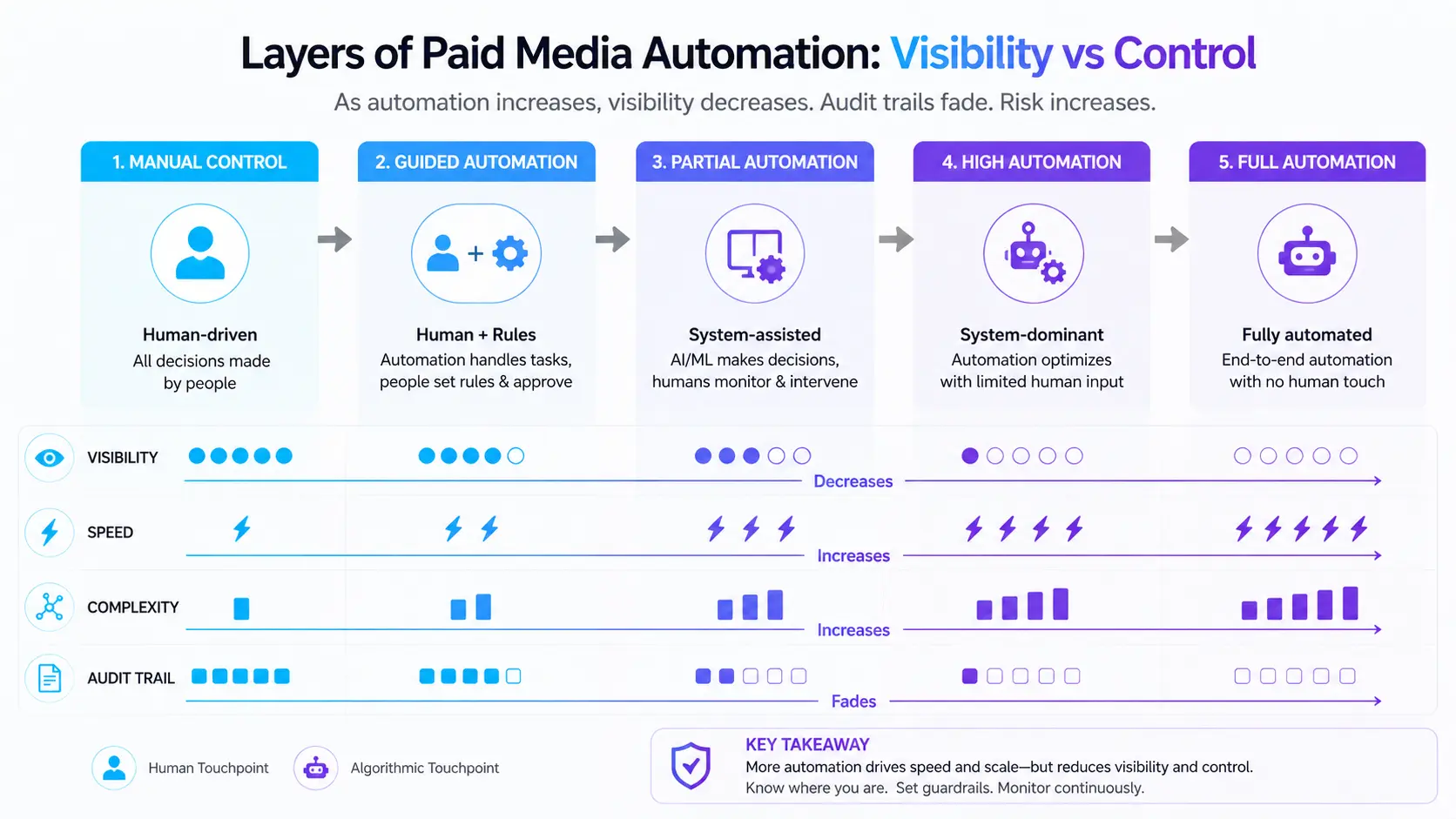
Paid media automation transparency trade off is the loss of visibility, auditability, and causal clarity that happens when PPC and paid social campaigns rely more heavily on automated bidding, targeting, placement, budget allocation, and optimization systems.
Automation can improve speed and scale, but it also makes it harder to see why performance changed, which signals drove decisions, where budget moved, or whether the platform optimized for real business value.
The trade-off becomes risky when degraded signals, opaque algorithms, platform-centric objectives, or model drift create results that look efficient but cannot be explained or governed.
Strong oversight uses guardrails, audits, data triangulation, and human review to keep automation accountable.
Key Takeaways
- Increased automation in paid media often reduces transparency, making it harder to audit and understand what drives campaign outcomes.
- Speed and data opacity in automated systems heighten the risk of automation bias and silent performance drift, potentially harming business goals.
- Most platforms optimize for their own objectives, not necessarily business value, which makes ongoing human governance essential.
- Effective oversight – via clear constraints, audits, and triangulation – ensures automation supports, rather than undermines, profitable brand growth.
Most teams think more automation equals more efficiency.
Almost no one talks about what you lose: the ability to see *why* results happen.
Many digital advertisers report declining trust in automated campaign reporting, citing difficulty auditing outcomes as the main concern.
The single biggest trade-off in scaling paid media automation isn’t the obvious one (less hands-on control); it’s that each algorithmic leap clouds causal clarity – transforming campaign performance into a “just trust the model” proposition.
That wider dynamic is outlined in PPC & Paid Media.

Why increasing automation erodes visibility into paid media decisions
Imagine watching a slot machine spin at triple speed – wins and losses flash by, but try asking which symbol, sequence, or timing actually mattered.
That’s what it feels like when algorithmic bidding cycles outrun human observation.
In practice, the faster the engine, the harder it becomes to pin down *why* performance jumps or tanks.
How optimization speed hides the reason behind results
There’s a myth that faster optimization always means smarter outcomes.
The reality: when decisions trigger hundreds of micro-adjustments in milliseconds (shifting budgets, swapping audiences, toggling placements), the path from input to output is fogged.
One client saw their ROAS surge for three days, only to realize the “lift” came from short-term retargeting overlaps the system exploited – something invisible until we reverse-engineered placements.
This is not just inconvenient; it’s a risk.
If you can’t audit the cause, you can’t repeat or correct the effect.
Fast, opaque automation can lead to automation bias: assuming machine-selected results are inherently optimal, when in fact, you’re driving a car with blacked-out windows.
Why Optimization Speed Obscures Cause and Effect
- Algorithmic bidding cycles operate faster than human observation.
- Hundreds of micro-adjustments happen within milliseconds.
- Short-term performance spikes may be due to unseen factors like retargeting overlaps.
- Opaque automation risks automation bias and loss of repeatability.
- Lack of auditability prevents correction of unintended outcomes.
When signal degradation amplifies opacity in automated systems
Speed is only half the opacity equation.
The other half is loss of data fidelity – when signals the system relies on degrade due to privacy shifts or broken tracking.
Many organizations overlook that automation thrives on dense, accurate signals, but when consent rates drop or cookies disappear, the system improvises with weaker data.
That broader technical break is the focus of [signal integrity diagnostics](#-placeholder-link-to-signal-diagnostics-spoke).
We’ve watched as algorithmic decisioning becomes almost inscrutable: it starts inferring patterns from noise, making “best guesses” about which audiences convert.
In one campaign, after a tracking pixel stopped firing on iOS, the platform’s automation rerouted spend based on modeled conversions.
Attribution logic turned into a hall of mirrors – one where neither we nor the client could confirm what moved the needle.
The less reliable your signals, the more your automation operates as a black box – and the harder it is to diagnose, predict, or govern.
Would you trust a GPS that stopped updating its location halfway to the destination?
Visibility and scale are on a seesaw.
Every turn toward greater automation in paid media increases speed and reach, but almost always at the expense of knowing what’s truly happening.
That’s the trade-off leaders must confront before handing over the keys.

What automation controls – and what remains outside its grasp
Most advertisers assume automation is fighting for their outcomes.
But nearly every adtech platform is actually prioritizing its own optimization goals – maximizing short-term performance metrics, not long-term business value.
This difference isn’t trivial: it quietly determines if you’re scaling profitable growth or just padding a platform’s success report.
Automation Control vs Human Governance in Paid Media
| Failure Pattern | Characteristics | Consequences | Example |
| Fragile learning periods | High sensitivity to changes, instability during early phase | Sudden cost spikes, unpredictable performance | Changing headline resets algorithm learning causing cost spikes |
| Sudden cost shifts | Rapid performance changes without clear signals | High volatility in CPA and ROI | Competitor bidding changes causing 60% cost spike |
| Drift at scale | Slow degradation in signal quality and targeting accuracy | Silent budget leakage, reduced lead quality | 10% monthly CPA creep due to model drift |
| Hidden inefficiencies | Invisible budget leaks via irrelevant placements | Wasted spend, poor ROI | Automation spending on low-value placements unnoticed |
Platform‑centric objectives vs business‑aligned outcomes
Automation in PPC doesn’t discriminate between what grows your business and what completes a platform’s definition of “success”.
Think about it – platforms tune their algorithms for click-through rates, impression quality, or engagement.
But are those the KPIs you answer to at the next board meeting?
We’ve worked with SaaS brands that saw record-breaking ‘conversions’ – until they traced most back to trial users with zero expansion potential.
Human oversight discovered the gap, but the automation had already spent 60% of the quarter’s budget on low-value actions.
Here’s a myth that derails even seasoned teams: “If we set the right event or value as our campaign goal, automation will put our interests first”.
In reality, algorithms optimize for what they can measure and scale.
Anything outside that loop – quality, LTV, revenue, brand fit – becomes an afterthought, or worse, invisible.
It’s the difference between hitting cruise control on a straight road versus navigating a mountain pass: hands-off feels great until the definition of a safe route dramatically changes.
At what point does chasing platform-defined efficiency drift from business growth?
Where control must stay human: governance, safety, and strategic constraints
Not every lever can – or should – be handed to the machines.
The allure of automation in paid media is efficiency, but every new layer strips out nuance that humans consider second nature: brand reputation, audience integrity, and compliance risk.
In practical terms, we’ve seen campaigns flagged for sudden spikes in questionable placements – kids’ apps, polarizing content, international traffic not in scope.
It wasn’t malice; it was automation optimizing for volume and CPM at the expense of context.
Without a human auditing placements weekly, one client found their carefully crafted B2B brand showing up – on page five of a mobile game review site in Hungary.
Can automation monitor regulatory changes, subtle audience shifts, or nuanced brand safety signals?
Not reliably.
Human intervention is the last barrier against automation bias in paid media – a source of accountability that algorithms can’t replicate.
Think of automation as the world’s fastest driver and the strategist as the one who sets the route and applies the brakes when the scenery changes.
Governance, pacing, and compliance should never be outsourced to a black box.
Bottom line: automation excels at what it can see and measure, but leaves blind spots where business value and brand trust live.
Scaling profitably starts with knowing which reins to keep in your hands.

How automation failure patterns differ – and what that signals
What if your next ad campaign hits target CPA for weeks – then doubles overnight and never recovers?
Most leaders blame a single setting or bad creative.
In reality, the automation’s invisible fault lines are often set long before results shift.
Distinct failure patterns in paid media automation don’t just signal a minor hiccup – they warn you which levers you’ve really given up and which risks multiply as you scale.
Common Patterns of Automation Failure in Paid Media
| Aspect | Automation Control | Human Oversight | Impact |
| Optimization Goals | Maximizes platform metrics like CTR and engagement | Focuses on business KPIs like LTV, revenue, brand fit | Misalignment can waste budget on low-value actions |
| Transparency | Opaque decisioning, limited auditability | Monitors placements, brand safety, compliance | Prevents brand reputation and regulatory risks |
| Scope of Control | Automates bidding, placement, audience targeting | Sets governance, pacing, strategic constraints | Balances efficiency with accountability |
| Risk Management | Prone to bias and error from degraded signals | Evaluates shifts in audience, compliance, and market | Catches errors automation misses |
Fragile learning periods and sudden cost shifts
The moment an automated campaign launches, it’s hungry for signal – but most miss how precarious those early days are.
One surprising truth: a tweak as small as changing headline copy can completely reset an algorithm’s learning, sending costs sky-high without warning.
We’ve seen clients drop a new offer mid-test, only to watch the platform redistribute budget with zero regard for past winners – sometimes burning a week’s spend in 36 hours.
The myth is that automation “protects” you against volatility.
The reality: instability is built-in during learning phases.
Unlike a seasoned account manager, algorithms don’t know when they’re out of their depth.
They rely on patterns, not judgment.
In one case, a platform’s ‘smart learning’ drove acquisition cost down for a week, then spiked it by 60% after a competitor changed bidding strategy – without any clear signals available to the human eye.
Tightly-coupled automation can make minor market movements feel like earthquakes in your metrics.
If learning periods are like balancing on a tightrope, over-correcting in either direction means you fall – fast.
Drift, budget leakage, and hidden inefficiencies at scale
It’s easy to spot a blowout.
But slow leaks are costlier.
Over weeks, even well-trained automation can drift off target as signal quality degrades or competitive dynamics shift.
You may see stable volume but imperceptibly lower quality leads.
One luxury service advertiser, for instance, relied on automated lead scoring and watched CPA creep up by 10% monthly.
It wasn’t sudden – it was silent, caused by model drift that no dashboard flagged.
Automation in PPC reduces control, especially over time.
Model drift in ad optimization isn’t obvious: it hides in the difference between headline conversions and true post-funnel outcomes.
Dependency risk compounds because every “invisible” correction stacks up.
Before you notice, a campaign that looked healthy based on platform metrics is leaking budget via irrelevant placements or redundant auction entries.
Ask yourself: when was the last time your automation flagged a problem before your finance team did?
Systems tuned for platform-centric objectives often miss business value misalignment entirely.
Failure in paid media automation is less about catastrophic mistakes – and more about whether you can spot the difference between a speed bump and an unguarded cliff. Automation failure isn’t a single threat.
The true risk is not seeing how invisible changes – fast or slow – reshape your performance.
The sharper your awareness of these distinct failure modes, the less likely your next campaign becomes another anonymous casualty of the black-box trade-off.

What to expect from automation – and where human oversight adds strategic clarity
Most executives install more automation expecting less risk, when the real leverage comes from smarter boundaries – not more buttons to push.
The uncomfortable truth is that what you automate defines where you surrender perspective.
Few realize that the best-performing teams spend less time “optimizing” campaigns and more time shaping the lines automation can’t cross.
If it feels like the system is running itself, ask: Who set the guardrails – and what’s outside them?
Shifting from manual tweaks to strategic constraints
Automation in PPC doesn’t replace human judgment – but it punishes wasted attention.
Obsess over bid adjustments and you’ll always lag behind algorithmic speed.
One client grew ROI by 38% in three months – after we eliminated daily manual changes and forced the platform to work inside sharply defined rules for spend, segment, and creative mix.
The difference?
Instead of reacting to every fluctuation, we defined the only outcomes that mattered for the business and coded those expectations into the system’s structure.
Think of it like a dam: You can’t control every drop of water, but you decide where the river flows.
Micro-managing levers gives an illusion of control, but lasting results come from framing the constraints the machine must respect.
Which boundaries have you set that would make the algorithm painful to violate?
Where has “helpfulness” from automation nudged you away from core objectives instead of toward them?
Designing oversight systems that catch drift before damage occurs
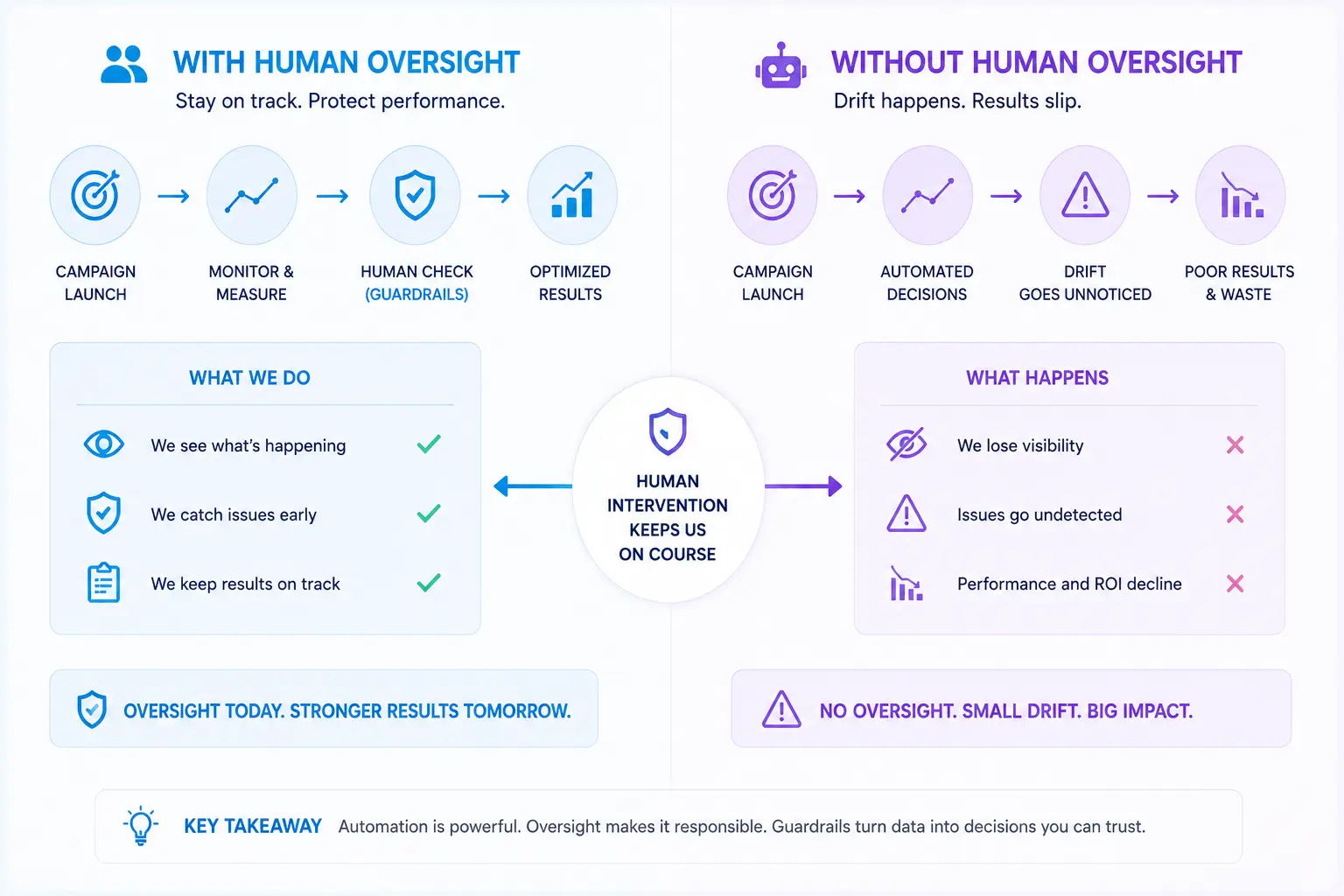
Automation bias isn’t just about letting the system run – it’s about believing performance is stable when, in reality, drift can erode results quietly.
We’ve seen accounts where cost efficiency held for quarters, then degraded by 27% almost overnight.
The triggers?
Small changes in traffic quality and undetected signal loss, all invisible to dashboards until revenue trended south.
Key Components of Effective Automation Oversight Systems
- Cross-source triangulation to verify data consistency.
- Recurring manual audits of campaign results and placements.
- Deliberate friction points requiring human review of anomalies.
- Logging and alerting mechanisms to flag unusual patterns.
- Clear guardrails and strategic constraints coded into automation.
Instead of chasing anomalies after they hit, high-performing teams build early warning systems: cross-source triangulation, recurring audits, and deliberate friction points where human eyes are required to review results that don’t match intent.
If automation is the autopilot, governance is the black box recorder – logging, alerting, and surfacing patterns that demand human judgment before losses compound.
You can’t eliminate every risk of black-box adtech automation, but you set the odds by designing the system for interference before failure strikes.
The clarity and profit come from this discipline – not from the illusion that more automation equals less attention.
Executives who shift from reaction to system governance don’t just survive the next wave of automation dependence – they make the trade-off work for them.

Scientific context and sources
The sources below describe the economic and marketing science foundations behind diminishing returns in advertising and marketing spend. They provide empirical and theoretical context for the mechanisms discussed above, including concave response curves, advertising elasticity, and the relationship between spend intensity and marginal performance.
- Automation Transparency and Human-Machine Teaming
The ethics of algorithms: Mapping the debate – Mittelstadt, B.D., Allo, P., Taddeo, M., Wachter, S., Floridi, L. – Big Data & Society
This peer-reviewed paper examines opacity, accountability, transparency, and ethical risks in algorithmic decision-making systems, directly relevant to understanding auditability and control limitations in paid media automation environments.
https://journals.sagepub.com/doi/10.1177/2053951716679679 - Cognitive Overload and Decision Quality
A model for types and levels of human interaction with automation – Parasuraman, R., Sheridan, T.B., Wickens, C.D. – IEEE Transactions on Systems, Man, and Cybernetics
This foundational research explains how increasing automation changes human oversight quality, introduces automation bias risks, and reduces effective human intervention under complex decision conditions – directly relevant to adtech automation governance.
https://pubmed.ncbi.nlm.nih.gov/11760769/ - Performance Drift in Machine Learning Systems
Learning under Concept Drift: A Review – Jie Lu, Anjin Liu, Fan Dong, Feng Gu, Joao Gama, Guangquan Zhang – IEEE Transactions on Knowledge and Data Engineering
This peer-reviewed survey examines how machine learning systems degrade when underlying data conditions change over time, covering drift detection, model adaptation, and monitoring frameworks – directly relevant to understanding silent performance deterioration in automated optimization systems.
https://arxiv.org/abs/2004.05785 - Platform Objective Alignment and Business Outcomes
Measuring the Business Value of Recommender Systems – Dietmar Jannach, Michael Jugovac – IEEE Data Engineering Bulletin
This research examines how platform optimization metrics and true business outcomes can diverge, highlighting the gap between algorithmically optimized system performance and actual commercial value creation – directly relevant to paid media platforms optimizing toward proxy objectives rather than advertiser business goals.
https://arxiv.org/abs/1908.08328
Questions You Might Ponder
How does automation in paid media reduce campaign transparency?
Paid media automation reduces transparency by obscuring the logic behind decisions. Algorithms make rapid, micro-level changes faster than humans can audit, causing marketers to lose visibility into what actually drives performance changes, which can lead to trust and accountability issues. That loss of transparency becomes harder to diagnose when the platform itself changes, which is why Why Paid Media Performance Suddenly Shifts: Understanding Platform Volatility maps the external changes that can move results without an obvious account-level cause.
What risks are associated with relying on opaque adtech algorithms?
Opaque adtech algorithms introduce risks such as automation bias, unintended budget leakage, and missed detection of poor placements or low-value actions. Without clear audit trails, it becomes difficult to identify and correct undesirable outcomes, endangering both brand safety and ROI.
Why do signal integrity and data quality matter for automated campaigns?
Signal integrity and data quality are crucial because automation systems depend on dense, reliable input to optimize campaigns. As data fidelity degrades – due to privacy restrictions or broken tracking – the system starts inferring from noise, amplifying misalignments and making results unpredictable.
How can human oversight improve paid media automation outcomes?
Human oversight in paid media automation establishes necessary guardrails, regularly audits campaign results, and ensures alignment with business objectives. This limits automation bias, catches drift early, and provides strategic interventions that pure automation typically misses, protecting both brand value and profitability.
What are the signs of automation-related performance drift in PPC campaigns?
Signs include gradual increases in cost per acquisition, changes in lead quality, unexplained shifts in placement or audience, and discrepancies between platform metrics and true business outcomes. These issues often go undetected until manual review connects the dots, highlighting the need for structured oversight.