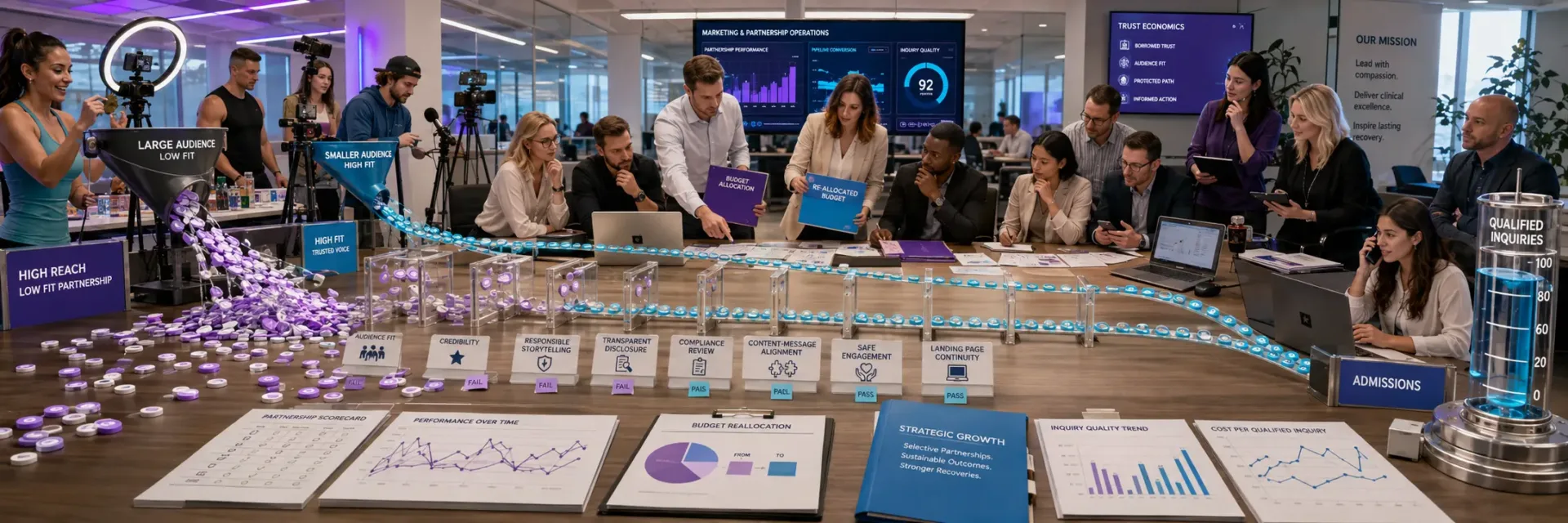
Table of Contents
Drug rehab influencer partnerships are ethical collaborations between addiction treatment centers and trusted creators, advocates, clinicians, recovery voices, or mental health influencers who can share educational, supportive, and compliant content with relevant audiences.
In drug rehab advertising, strong influencer partnerships focus on authenticity, audience trust, responsible storytelling, recovery education, and clear disclosure of the relationship.
They may include personal narratives, live Q&A sessions, social media campaigns, webinars, testimonials, or resource promotion.
The goal is to expand reach, reduce stigma, build credibility, and guide people toward informed treatment conversations without exploiting vulnerability, making misleading claims, or violating healthcare advertising and privacy standards.
Influencer partnerships can help drug rehab centers reach people who may not respond to traditional ads.
But reach alone is not the real opportunity.
The sharper value is borrowed trust – the trust an audience already has in a credible voice before the treatment center ever enters the conversation.
That trust must be handled carefully.

Introduction: Unlocking New Avenues in Drug Rehab Advertising Through Influencer Partnerships
Addiction treatment is not a normal consumer category.
The audience may include people in crisis, families under pressure, loved ones looking for answers, or individuals who are not ready to ask for help openly.
A careless influencer campaign can feel exploitative fast.
A thoughtful one can reduce stigma, make education easier to access, and guide people toward a safer next step.
This is where drug rehab advertising needs a stricter standard.
The goal is not to use influencers to make treatment look trendy.
The goal is to work with trusted voices who can share responsible, useful, and transparent content.
That may include recovery advocates, mental health educators, clinicians, family support voices, alumni with consent, or creators who have built trust around wellness and recovery topics.
The right partnership can help a rehab center reach people earlier in the decision process.
The wrong partnership can damage trust before the audience even visits the website.
That is the central issue.
Influencer marketing in addiction treatment should not start with “Who has the biggest following?”
It should start with “Who can speak to this audience responsibly, and what should this content help the audience understand?”
Harnessing the Power of Authentic Connections
Authenticity is the main reason influencer partnerships can work in drug rehab advertising.
People often trust a familiar voice more than a brand message.
But authenticity does not mean unfiltered content, dramatic storytelling, or personal exposure without limits.
In this space, authentic means credible, careful, and relevant.
A creator may have a personal recovery story.
A clinician may explain addiction and treatment in plain language.
A family advocate may help loved ones understand what support can look like.
A mental health influencer may reduce shame by speaking openly about seeking help.
Each voice can create connection in a different way.
The strongest influencer content usually does one of three things:
- Helps people understand addiction or recovery more clearly.
- Reduces fear around asking for help.
- Points people toward credible resources or next steps.
That is more useful than broad inspiration.
For example, a vague post saying “Recovery is possible” may create hope, but it may not help the reader act.
A more useful post explains what a first call with a rehab center may involve, how families can prepare for a conversation, or why asking for help does not mean someone has failed.
Specific content creates safer movement.
Influencers can also help reach people who are not searching directly.
Someone may not type “rehab center near me” into Google yet, but they may follow recovery, wellness, mental health, or family support content.
A trusted creator can place helpful information into that person’s existing feed.
But the creator’s trust is fragile.
If the content feels like a hard sell, the audience may reject it.
If the influencer makes claims that sound too strong, the campaign may create compliance and credibility risk.
If the partnership is not disclosed, trust can break.
Therefore, every authentic connection needs boundaries:
| Authenticity Factor | What It Should Do | What To Avoid |
| Lived experience | Help people feel less alone | Turning private pain into a sales hook |
| Professional insight | Explain treatment topics clearly | Making broad or unsupported claims |
| Audience trust | Create a safer path to learning | Using trust to pressure vulnerable people |
| Storytelling | Make the message relatable | Implying one outcome applies to everyone |
| Disclosure | Make the partnership transparent | Hiding paid or sponsored relationships |
This is the difference between influence and exploitation.
A rehab center should not use trust as a shortcut. It should use trust as a responsibility.
Strategic Selection of Influencers
The right influencer is not always the person with the largest audience.
In drug rehab influencer partnerships, audience fit and credibility matter more than follower count.
A smaller creator with a trusted recovery audience may be more valuable than a large lifestyle influencer with weak relevance.
A clinician with modest reach may create stronger trust than a celebrity voice that feels disconnected from addiction treatment.
A family-focused advocate may reach decision-influencing loved ones better than a broad wellness page.
The selection process should begin with the audience.
Who is the rehab center trying to reach?
- People actively considering treatment
- Parents of young adults
- Spouses or partners
- Adult children of people with addiction
- Alumni and recovery communities
- Mental health audiences
- Referral partners
- Professionals seeking credible resources
Each audience may need a different influencer type.
For example, families may respond well to a creator who explains boundaries, support, and communication.
People in early recovery may respond better to a recovery advocate or peer voice.
Professionals may trust clinician-led education more than personal storytelling.
That is why influencer selection should be based on relevance, trust, and responsibility.
A useful influencer screening table can look like this:
| Selection Criteria | What To Check | Why It Matters |
| Audience fit | Does the audience match the rehab center’s target group? | Reach only matters if it reaches the right people |
| Content history | Has the influencer discussed recovery, mental health, or related topics responsibly? | Past content signals future risk |
| Engagement quality | Are comments thoughtful, relevant, and safe? | Trust shows in interaction quality |
| Credibility | Does the influencer have lived, professional, or community authority? | Sensitive topics need trusted voices |
| Brand alignment | Does the voice match the center’s tone and values? | Misalignment can damage trust |
| Compliance readiness | Can the influencer follow disclosure and claim rules? | Reduces legal and reputational risk |
| Platform fit | Is the audience active on the chosen platform? | Different platforms support different content types |
This protects the campaign from a common mistake: choosing visibility over fit.
A high follower count can hide weak trust.
A large audience can also increase risk if the message is wrong.
In addiction treatment, the cost of a poor match is higher because the audience may be vulnerable and the content may touch health-related decisions.
The better decision rule is simple.
Choose the influencer who can help the right audience understand the right next step with the least trust risk.
Content That Resonates
Influencer content works best when it answers real doubts.
In drug rehab advertising, those doubts are often practical and emotional at the same time.
A person may wonder, “Will I be judged?”
A parent may wonder, “What should I do first?”
A spouse may wonder, “How do I know if treatment is needed?”
Someone in recovery may wonder, “What support exists after treatment?”
Content should meet those questions directly.
Strong influencer content can include:
- Plain-language addiction education
- Myths and misconceptions about treatment
- Family support guidance
- First-step explainers
- Recovery stories with consent
- Live Q&A sessions
- Webinar promotion
- Resource sharing
- Mental health and stigma education
- Alumni or community support content
The best content does not try to close the decision in one post.
It helps the audience move one step forward.
That may mean reading a guide, watching a webinar, visiting a treatment page, saving a resource, or contacting the center.
The next step should match the person’s readiness.
A strong content plan can connect influencer posts with deeper assets on the rehab center’s website.
For example, an influencer may discuss how families can start a hard conversation, then link to a family guide or resource page.
A clinician may explain what treatment assessment means, then link to an admissions explainer.
A recovery advocate may discuss support after treatment, then link to alumni or continuing care content.
This connects influencer partnerships with content marketing.
The influencer creates the trust-based entry point.
The website provides the deeper explanation.
The follow-up path guides the user toward a useful next step.
That sequence matters.
If the influencer content sends people to a weak landing page, trust leaks.
If the page does not match the post, the user feels misled.
If the call to action is too aggressive, the campaign may lose the audience.
A practical content alignment table can help:
| Influencer Content Type | Audience Need | Best Follow-Up Asset |
| Personal recovery reflection | Hope and relatability | Success story page or recovery resource |
| Family support post | Guidance for loved ones | Family guide, webinar, or FAQ |
| Clinician-led explainer | Clear education | Treatment page or admissions explainer |
| Live Q&A | Direct questions and trust-building | Replay page, resource list, contact option |
| Social campaign | Awareness and stigma reduction | Blog post or educational hub |
| Webinar promotion | Deeper learning | Registration page and email follow-up |
The strongest influencer content does not stand alone.
It becomes the first step in a wider trust path.
Leveraging Multiple Platforms
Influencer partnerships can run across Instagram, YouTube, TikTok, LinkedIn, podcasts, blogs, newsletters, webinars, forums, and recovery-focused communities.
But platform choice should not follow trends.
It should follow audience behavior and content purpose.
Different platforms support different levels of depth.
Short-form video can create awareness.
YouTube can explain complex topics.
Podcasts can build trust through longer conversations.
Instagram can support visual education and story-based content.
LinkedIn can reach professional and referral audiences.
Webinars can create structured learning.
Email newsletters can support ongoing contact.
The platform should match the message.
A sensitive recovery story may not belong in a short, highly compressed format unless it is handled with care.
A clinician explaining treatment steps may need more time than a short clip allows.
A family education topic may work better as a webinar, article, or live session.
That is why platform planning should start with the content goal:
| Platform | Best Use | Watchout |
| Awareness, short education, community trust | Avoid shallow recovery content | |
| YouTube | Longer explainers, interviews, webinars | Needs clear structure and moderation |
| TikTok | Short stigma-reduction and education clips | High risk of oversimplification |
| Professional trust and referral education | Less suited for personal crisis messaging | |
| Podcasts | Deep conversations and credibility building | Harder to track direct response |
| Email newsletters | Follow-up and ongoing education | Requires consent and relevance |
| Webinars | Family education and live Q&A | Needs strong follow-up path |
| Forums or niche communities | Targeted recovery discussions | Requires strong moderation and rules |
A diversified platform strategy can help a rehab center reach different audience groups without forcing one format to do everything.
But more platforms also mean more review work.
Each platform has different norms, risks, and content limits.
The same message may need different treatment across channels.
A webinar clip can become a short post, but the short post must keep the meaning intact.
A podcast quote can become a graphic, but it should not remove necessary context.
That is where many campaigns create risk.
They cut a careful message into a catchy fragment and lose the nuance.
For drug rehab influencer partnerships, nuance is part of trust.
The content should stay clear, careful, and useful even when repurposed.
Ethics and Compliance
Ethics and compliance are not a final review step.
They should shape the partnership before the first post is drafted.
Drug rehab advertising sits in a sensitive category.
The audience may be vulnerable.
The topic may involve health, privacy, family crisis, treatment decisions, and recovery outcomes.
That means influencer content must be held to a higher standard than ordinary lifestyle promotion.
Three rules matter most: disclose, protect, and avoid misleading claims.
Disclosure means the audience should know when there is a paid, sponsored, or formal relationship.
Protection means personal health information and private stories must not be exposed without proper consent.
Avoiding misleading claims means content should not promise outcomes, exaggerate treatment success, or imply that one person’s experience applies to everyone.
This is not only legal risk. It is trust risk.
A campaign that hides the partnership can damage both the influencer and the rehab center.
A campaign that uses personal stories carelessly can feel exploitative.
A campaign that makes broad outcome claims can mislead people who are already under stress.
A compliance review should cover:
| Review Area | Question To Ask | Risk Controlled |
| Disclosure | Is the partnership clearly stated? | Hidden sponsorship or deceptive promotion |
| Consent | Has the person agreed to share their story? | Privacy violations and trust damage |
| Claim accuracy | Are all treatment claims careful and supportable? | Misleading or exaggerated messaging |
| Outcome language | Does the content avoid guarantees? | Unsafe recovery promises |
| Sensitive details | Are private details removed unless needed and approved? | Overexposure and reputational harm |
| CTA language | Does the next step guide without pressure? | Exploiting vulnerability |
| Platform policy | Does the content fit platform rules? | Account or campaign issues |
Influencers should receive clear content guidelines before the campaign starts.
These guidelines should explain words to avoid, claims to avoid, disclosure expectations, story rules, and approval steps.
That does not mean the content must feel scripted.
It means the influencer has a safe frame to work inside.
A good partnership gives the influencer room to speak in their own voice while protecting the audience, the center, and the integrity of the message.
Measuring Success
Influencer campaign measurement should go beyond likes and follower growth.
Those metrics can show attention, but they do not prove trust, inquiry quality, or business impact.
In drug rehab advertising, the stronger question is: did the partnership help the right people take a safer, more informed next step?
That step may be a website visit, guide download, webinar registration, phone click, form submission, email signup, or direct inquiry.
It may also be deeper engagement with educational content before a person is ready to contact the center.
Measurement should match the campaign goal.
If the goal is awareness, reach and impressions matter.
If the goal is education, video completion, saves, comments, and clicks to resources matter.
If the goal is inquiry, call clicks, form submissions, landing page conversion rate, and lead quality matter.
A practical measurement table can look like this:
| Campaign Goal | Useful KPIs | What To Avoid |
| Awareness | Reach, impressions, audience growth | Treating reach as proof of trust |
| Education | Saves, shares, video watch time, resource clicks | Measuring only likes |
| Community engagement | Comments, live questions, webinar attendance | Rewarding unsafe disclosure |
| Website traffic | Referral visits, landing page behavior | Ignoring page quality |
| Lead generation | Call clicks, forms, consultation requests | Counting low-fit inquiries as wins |
| Trust building | Return visits, email signups, admissions mentions | Expecting instant conversion from every post |
| Content quality | Audience response, comment relevance, compliance review | Prioritizing drama over accuracy |
Attribution will not always be perfect.
A person may see an influencer post, visit the website later, read several pages, talk with family, and contact the center days or weeks afterward.
Therefore, the center should combine platform data, website analytics, CRM notes, call tracking, and admissions feedback when possible.
Admissions feedback is especially useful.
If callers mention a webinar, creator, story, or post, that is a trust signal.
If leads from a campaign are confused, low-fit, or expecting something the center does not provide, the message may need revision.
The campaign should be optimized around quality, not just volume.
The strongest influencer partnerships do not simply amplify reach.
They help the right audience understand recovery support with more trust and less friction.
Once that is clear, the next step is more selective: choosing the influencers who can carry that responsibility without damaging the message.

Let’s collaborate to create meaningful connections and drive impactful change.
Identifying the Right Influencers
The right influencer for a drug rehab campaign is not always the person with the largest audience.
But many centers still begin selection with follower count, reach, or platform popularity.
That is the wrong starting point.
The better starting point is risk-adjusted trust.
In addiction treatment marketing, an influencer does not only carry attention.
They carry tone, credibility, audience expectations, and reputational risk.
If the person is poorly matched, the campaign can feel opportunistic, even if the reach is high.
A good influencer should help the audience understand recovery, support, treatment, or next steps more clearly.
They should not make the topic feel like a trend, performance, or sales push.
That means selection must be slower and more deliberate.
Define Your Target Audience
Influencer selection should begin with the audience the rehab center needs to reach.
A campaign for people actively considering treatment is different from a campaign for parents, spouses, alumni, mental health audiences, or referral partners.
Each audience has different fears.
A person seeking treatment may need reassurance about the first call.
A parent may need guidance on what to do next.
A spouse may need help understanding boundaries.
A professional referral partner may need credibility, process clarity, and program fit.
Therefore, one influencer cannot serve every audience equally well.
A useful audience map can look like this:
| Target Audience | Main Concern | Influencer Type That May Fit |
| Person seeking help | Fear, shame, uncertainty, first step | Recovery advocate, mental health creator, clinician educator |
| Parent or family member | How to help without making things worse | Family support voice, therapist, recovery educator |
| Alumni or recovery community | Long-term support and connection | Peer support voice, recovery community leader |
| Professionals and referral partners | Credibility and process clarity | Clinician, industry expert, healthcare educator |
| Mental health audience | Stigma and related emotional barriers | Mental health advocate or licensed professional |
| General awareness audience | Understanding addiction and recovery | Educator, wellness creator, public health voice |
This prevents broad targeting.
A broad campaign may get attention, but attention from the wrong audience has limited value.
It may also produce low-fit inquiries, vague engagement, or unsafe comment threads.
The best influencer campaigns are built around a clear user question:
- “What does this person need to understand before they take the next step?”
- “Who does this person already trust?”
- “What kind of voice can explain the topic safely?”
- “What action should this content support?”
These questions make the campaign sharper.
They also protect the brand from choosing creators who are popular but misaligned.
Look for Relevance and Authenticity
Relevance means the influencer’s content already connects to addiction recovery, mental health, family support, wellness, clinical education, or related themes.
Authenticity means the audience believes the influencer has a real reason to speak on the topic.
Both are needed.
A creator may be authentic in their own niche but irrelevant to treatment decisions.
Another may be relevant to healthcare but speak in a way that feels cold or disconnected.
The best fit usually combines topic alignment, audience trust, and responsible communication.
Drug rehab influencer partnerships should avoid forced matches.
A generic lifestyle influencer promoting a rehab center may create reach, but the audience may question the connection.
A recovery advocate, therapist, mental health educator, or family support creator may carry less total reach but more trust.
That trust is the asset.
Relevance can be reviewed through past content.
Look at what the influencer has posted over time.
Have they discussed addiction, recovery, therapy, mental health, family conflict, trauma, or support responsibly?
Do they use careful language?
Do they avoid shame and sensationalism?
Do they understand the difference between personal experience and general advice?
Authenticity can be reviewed through audience response.
Do comments show real trust?
Do people ask thoughtful questions?
Does the influencer respond with care?
Or is the account built mainly on attention, controversy, and emotional reaction?
This is where selection becomes practical.
| Review Area | Strong Signal | Weak Signal |
| Topic fit | Regular, responsible content on recovery or mental health | Sudden interest only after sponsorship |
| Tone | Clear, supportive, careful language | Dramatic, shame-based, or sensational language |
| Audience trust | Thoughtful comments and real questions | Low-quality reactions or unrelated engagement |
| Story use | Consent-based and respectful sharing | Overexposed private details |
| Brand fit | Values align with treatment support and education | Content style conflicts with rehab center tone |
| Risk profile | History of responsible communication | Past misinformation or controversy |
A rehab center should also check whether the influencer’s audience is likely to see the content as credible.
If the audience trusts the influencer for entertainment, fashion, or lifestyle topics, a sudden treatment-related message may feel out of place.
Relevance keeps the message believable.
Authenticity keeps the audience open to it.
Evaluate Their Engagement Rates
Engagement rate can help judge whether an influencer’s audience is active.
But in drug rehab advertising, raw engagement can be misleading.
A high engagement rate does not always mean high trust.
Some accounts generate comments through controversy, emotional pressure, or polarizing content.
That kind of engagement may not be suitable for addiction treatment marketing.
The center should review the quality of engagement, not only the number.
Useful engagement looks like:
- People asking real questions
- Comments that match the topic
- Audience members sharing thoughtful reactions
- Saves and shares on educational posts
- Respectful discussion
- Repeat interaction from the same community
- Low levels of spam or unrelated comments
Weak engagement looks like:
- Generic comments
- Bot-like responses
- Off-topic reactions
- Arguments and hostile discussion
- Engagement driven by drama
- Large reach with little meaningful response
The comment section is often more useful than the follower number.
It shows how the audience behaves when sensitive topics are discussed.
For rehab centers, this matters.
A campaign may bring new people into the brand’s ecosystem, but it may also bring unsafe conversations, stigma, or misinformation if the influencer’s audience is not well matched.
A practical review should include:
| Engagement Metric | What It Can Show | What To Check Before Trusting It |
| Likes | Basic content reaction | Whether likes come from relevant audience members |
| Comments | Conversation strength | Whether comments are thoughtful and safe |
| Shares | Perceived usefulness | Whether content is educational or just emotional |
| Saves | Long-term value | Whether posts help people return to resources |
| Video watch time | Depth of attention | Whether people stay for the real message |
| Link clicks | Movement to next step | Whether traffic is qualified |
| Webinar questions | Active learning | Whether questions match the campaign goal |
For influencer partnerships, engagement should be matched to the campaign type.
If the goal is education, saves, shares, comments, and video completion may matter.
If the goal is trust-building, return visits and audience questions may matter.
If the goal is inquiry, link clicks, call clicks, forms, and admissions feedback matter.
Do not reward the wrong signal.
A dramatic post may get comments, but it may not send the right people to credible support.
A calmer educational post may get fewer reactions but create better website visits or webinar registrations.
That is the tradeoff many campaigns miss.
Consider the Platform
Platform choice should follow audience behavior, topic depth, and risk level.
It should not follow trends.
Instagram, YouTube, TikTok, LinkedIn, podcasts, newsletters, webinars, forums, and recovery communities all support different types of content.
The same influencer may be strong on one platform and weak on another.
A short-form platform can help reduce stigma or share one simple idea.
But it may not be the right place for a complex treatment explanation.
A podcast can build deeper trust, but it may be harder to connect to direct response.
A webinar can support family education, but it needs a clear follow-up path.
LinkedIn may work for referral relationships and professional trust, but may not fit personal recovery messaging.
The platform should serve the message.
| Platform | Best Fit | Main Risk |
| Visual education, short stories, community trust | Oversimplified recovery content | |
| TikTok | Short awareness and stigma reduction | Sensitive topics may become too compressed |
| YouTube | Longer explainers, interviews, webinars | Requires stronger structure and content quality |
| Podcasts | Deeper conversations and credibility | Harder attribution and longer production cycle |
| Professional trust and referral education | Less suitable for personal crisis messaging | |
| Newsletters | Ongoing education and resource sharing | Requires audience consent and relevance |
| Webinars | Family education, Q&A, expert content | Needs moderation and follow-up |
| Forums or recovery groups | Niche community discussion | Requires rules and careful moderation |
For rehab centers, platform choice should also account for privacy.
People may avoid public engagement with addiction-related content even when they find it useful.
That means likes and comments may understate impact.
A person may watch, save, click, or visit privately without public interaction.
This is especially important on platforms where engagement is visible to others.
Therefore, the campaign should offer low-friction, private next steps.
A link to a guide, article, webinar, or contact page may be better than asking people to comment publicly about sensitive experiences.
Public engagement is not always the goal.
Safe movement is.
Assess Their Content Quality
Content quality is not only about production value.
A high-quality video can still carry a poor message.
A simple post can still create trust if it is clear, accurate, and responsible.
For drug rehab influencer partnerships, content quality has four layers:
- Accuracy: the content avoids misinformation and unsupported claims.
- Clarity: the audience understands the point quickly.
- Sensitivity: the content respects the vulnerability of the topic.
- Direction: the content gives a useful next step.
All four matter.
A rehab center should review the influencer’s past content before agreeing to a partnership.
Look at captions, videos, comments, stories, live sessions, and any health-related posts.
The goal is to see whether the influencer can handle sensitive topics without exaggeration.
Weak content may include:
- Claims that recovery has one simple cause or solution
- Treatment promises that sound guaranteed
- Shame-based language
- Personal stories used for shock value
- Advice that sounds clinical without proper qualification
- Heavy emotional framing without practical help
- Calls to action that pressure vulnerable people
Strong content usually does the opposite.
It uses plain language.
It explains limits.
It avoids guarantees.
It gives people a clear next step.
It treats recovery as serious, personal, and complex without making the message hard to understand.
A content quality checklist can help:
| Quality Factor | Strong Content Should Do |
| Accuracy | Avoid unsupported treatment claims |
| Clarity | Explain one main idea per post or segment |
| Tone | Stay respectful and non-shaming |
| Story handling | Use consent and avoid unnecessary private details |
| CTA | Guide people to resources or direct contact without pressure |
| Fit | Match the rehab center’s brand and care model |
| Review readiness | Allow content review before publication |
This review should happen before contracts or campaign planning.
If the influencer’s content style creates risk, editing one sponsored post may not solve the deeper issue.
The audience already expects a certain tone from that influencer.
If that tone conflicts with addiction treatment standards, the partnership may not be safe.
Content quality is not polish.
It is judgment made visible.
Verify Their Credibility
Credibility is the final filter.
In healthcare-adjacent marketing, credibility cannot be assumed from popularity.
A credible influencer may have lived experience, professional background, community leadership, clinical education, advocacy history, or a long record of responsible content.
But the center must verify the basis of that credibility.
This does not mean every influencer must be a clinician.
It means the campaign should be honest about who the influencer is and what authority they have.
A recovery advocate can share personal experience.
A clinician can explain treatment concepts.
A family educator can speak to loved ones.
A peer support voice can discuss community and connection. Each role can be valuable, but each role has limits.
Those limits should be clear.
An influencer with lived experience should not be framed as a clinical authority unless they are qualified.
A clinician should not share patient details without proper consent.
A creator should not make claims about outcomes that the center cannot support.
Credibility checks may include:
| Credibility Area | What To Review |
| Background | What gives the influencer authority on this topic? |
| Content history | Have they shared responsible content over time? |
| Audience trust | Do followers treat them as a serious voice? |
| Claim discipline | Do they avoid broad promises and medical overreach? |
| Disclosure behavior | Do they clearly label paid partnerships? |
| Reputation | Are there major conflicts, controversies, or misinformation risks? |
| Collaboration fit | Can they follow review, compliance, and brand guidelines? |
This step protects the center before the campaign goes live.
Credibility also affects conversions.
A trusted influencer may drive fewer clicks but better-quality engagement.
A poorly matched influencer may create traffic that does not understand the offer, does not fit the program, or expects something the center does not provide.
That creates waste.
The right influencer helps the audience understand the right next step before they click.
That improves the chance that traffic becomes useful, not just visible.
Drug rehab influencer partnerships should be selected with the same seriousness as any other trust channel.
The question is not “Who can amplify us?”
The question is “Who can responsibly carry this message to the people who need it?”
Once that selection is clear, the next challenge is building the partnership strategy itself – what the influencer should create, how the campaign should run, and how the center should protect trust through every touchpoint.

Partner with us to spread hope and awareness through influential storytelling.
Strategies for Influencer Partnerships
Influencer partnerships in drug rehab advertising need more than creator selection.
But many campaigns stop once the influencer is chosen.
They assume the right person will naturally create the right message.
That is risky.
The partnership needs a clear content role, review process, disclosure standard, landing path, and measurement plan.
Without that structure, even a credible influencer can send the audience into a weak or confusing experience.
The strategy should protect three things at once: audience trust, campaign performance, and compliance.
Creating Authentic Content
Authentic content does not mean the influencer says whatever they want without review.
In addiction treatment, authentic content means the message feels human, useful, and true to the influencer’s voice while staying accurate and responsible.
That balance is important.
If the content is too scripted, the audience may reject it.
If it is too loose, the message may create risk.
The center should give influencers a clear framework, not a word-for-word script unless the situation requires it.
A useful content brief should define:
- The audience
- The topic
- The main message
- Claims to avoid
- Required disclosure language
- Approved resources
- CTA options
- Review and approval process
- Privacy and consent rules
This gives the creator room to speak naturally without drifting into unsafe claims.
The best influencer content often starts with one clear user concern.
For example:
| Audience Concern | Influencer Content Angle |
| “I am afraid to call.” | Explain what a first conversation may look like |
| “I do not know how to help my loved one.” | Share family support guidance |
| “I feel ashamed.” | Normalize asking for help without minimizing the issue |
| “I do not understand treatment options.” | Explain common treatment pathways in plain language |
| “I am not ready to talk yet.” | Share a resource, guide, or educational page |
This keeps the content useful.
Personal stories can work well, but only when handled with care.
A recovery-related story should never be used as shock content.
It should not reveal details that are not needed.
It should not imply that one person’s outcome will happen for everyone.
A better story structure is simple:
- What the person was unsure about
- What helped them understand the next step
- What support looked like
- What someone in a similar situation can do next
This creates hope without overpromising.
Educational content can be just as powerful as personal content.
A clinician, mental health educator, or recovery advocate can explain treatment myths, family support, stigma, aftercare, or what happens before admission.
This type of content can help people who are not ready for a direct conversation.
The goal is not to force urgency.
The goal is to make the next step feel safer and clearer.
Co-Branding Opportunities
Co-branding works when the rehab center and influencer create something more useful than a sponsored post.
This can include webinars, live Q&A sessions, resource guides, awareness campaigns, interview series, podcast episodes, workshops, or social media content series.
The value is depth.
A single post can introduce the topic.
A co-branded webinar can explain it.
A resource guide can help people return to it.
A follow-up email can guide the next step.
That sequence creates a stronger campaign path.
Co-branded formats can include:
| Co-Branded Format | Best Use | Strong Next Step |
| Live Q&A | Answering common concerns in real time | Replay page, FAQ, contact option |
| Webinar | Family education or treatment topic clarity | Email follow-up and resource list |
| Interview series | Building trust through expert discussion | Related articles or guide download |
| Social campaign | Awareness and stigma reduction | Educational hub or landing page |
| Resource guide | Practical support for families or people seeking help | Email signup or admissions explainer |
| Podcast episode | Deeper conversation and credibility | Dedicated landing page |
| Workshop | Skill-building or structured education | Follow-up tools and support resources |
Co-branding should also match the influencer’s strength.
A recovery advocate may be strong in storytelling and lived experience.
A clinician may be better suited for educational webinars.
A family support voice may be useful for loved-one content.
A professional creator may help with referral-facing content.
The format should not force the influencer into the wrong role.
For example, asking a recovery advocate to give clinical advice can create risk.
Asking a clinician to deliver a highly personal recovery story may feel unnatural.
Asking a broad lifestyle creator to speak on treatment details may weaken credibility.
Good co-branding respects role boundaries.
The rehab center should also create dedicated landing pages for larger influencer campaigns.
Sending traffic to a generic homepage wastes trust.
A better landing page should match the influencer content, explain the topic, offer the next resource, and make contact options clear.
A strong landing page should include:
- A clear headline that matches the campaign topic
- Plain-language explanation of the resource or support option
- Relevant internal links
- A soft next step for early-stage visitors
- A direct contact option for high-intent visitors
- Compliance-safe language
- No pressure-based claims
This connects influencer work with website development and broader conversion strategy.
The influencer may create the first trust signal, but the website has to preserve it.
If the page feels generic, the campaign loses power.
Long-Term Collaborations vs. Short-Term Campaigns
Short-term influencer campaigns can support awareness around a specific event, webinar, resource launch, or recovery topic.
Long-term collaborations can build deeper trust over time.
Both have a place.
The mistake is using short-term thinking for a trust-heavy topic.
Addiction treatment decisions often do not happen after one post.
People may need repeated exposure, private research, family discussion, and multiple trust signals before they act.
Long-term collaborations allow the influencer to introduce the rehab center gradually.
They can share education, answer common questions, promote webinars, discuss stigma, highlight resources, and return to important themes over time.
That repetition can feel more natural.
A long-term partnership may include:
- Monthly educational posts
- Quarterly webinars
- Short video explainers
- Resource promotion
- Q&A sessions
- Family support content
- Recovery awareness campaigns
- Email or newsletter features
This helps the audience see the rehab center as a consistent resource, not a one-time sponsor.
Short-term campaigns can still work when the goal is narrow.
For example, a center may promote a webinar for families, a mental health awareness campaign, a new educational guide, or a recovery-focused live event.
In these cases, the campaign should have a clear start, end, CTA, and follow-up plan.
A comparison helps:
| Partnership Type | Best Use | Main Risk |
| Short-term campaign | Event promotion, awareness push, guide launch | Trust may not have enough time to build |
| Long-term collaboration | Education, credibility, community trust | Needs stronger planning and review |
| One-off post | Quick visibility | Can feel transactional |
| Content series | Repeated learning and trust-building | Requires topic discipline |
| Webinar partnership | Deeper engagement | Needs moderation and follow-up |
| Ambassador-style relationship | Ongoing association | Requires careful alignment and compliance control |
The decision should follow the buyer journey.
If the audience is cold or sensitive, long-term trust-building may be better.
If the audience already knows the influencer and the offer is educational, a short campaign can work.
If the topic is complex, a content series or webinar may be stronger than one post.
The key is not campaign length.
The key is whether the partnership gives the audience enough clarity to move safely.
Engagement and Interaction
Influencer partnerships should create useful interaction, not just reactions.
Likes and comments can show attention, but they do not always show trust or intent.
In drug rehab advertising, interaction needs guardrails.
A creator may ask a question to invite comments, but the prompt should not pressure people to reveal private health details.
A live Q&A can build trust, but it should not become a space for personal diagnosis.
A story post can invite reflection, but it should not turn recovery into public performance.
The safer approach is to ask questions that allow participation without exposure.
For example:
| Risky Prompt | Safer Alternative |
| “Share your addiction story below.” | “What kind of support helps people feel less alone?” |
| “Tell us if you need rehab.” | “What questions do families often have before reaching out?” |
| “Comment your relapse experience.” | “What recovery topic should we explain next?” |
| “DM me your crisis story.” | “Use the linked resource if you need private next-step guidance.” |
This protects the audience.
Interactive formats should also have response rules.
The influencer and rehab center should agree on how to handle sensitive comments, urgent messages, misinformation, hostile replies, and requests for personal advice.
A response plan should define:
- Who answers comments
- Which questions should be redirected privately
- Which comments should be removed
- What language to use for urgent needs
- When to send someone to the rehab center’s contact path
- What not to answer publicly
This is not optional in sensitive categories.
The audience may ask real, difficult questions.
If the influencer responds casually or beyond their role, the campaign can create risk.
If no one responds, the campaign can feel performative.
Interaction needs ownership.
Live sessions need the same structure.
A live Q&A should have a topic, moderator, time limit, disclaimer language, approved resources, and a clear follow-up path.
The host should avoid personal clinical advice unless properly qualified and operating within the correct context.
Interaction can build trust quickly.
But only when the audience feels protected.
Diversifying Platforms
Platform diversity can help a rehab center reach different audiences.
But spreading content across too many channels can weaken control.
Each platform needs its own purpose, format, and risk review.
The best platform mix depends on the campaign goal.
A family education campaign may use Instagram for short clips, YouTube for a longer explainer, a webinar for deeper learning, and email for follow-up.
A professional credibility campaign may use LinkedIn, podcasts, and long-form articles.
A stigma-reduction campaign may use short-form video and social posts, then guide people to a resource hub.
Platform diversity should create a path, not scatter attention.
A sample platform strategy can look like this:
| Campaign Goal | Platform Mix | Why It Works |
| Family education | Instagram, webinar, email, website guide | Moves from awareness to deeper learning |
| Recovery awareness | Short-form video, social posts, resource hub | Makes education easy to access |
| Professional trust | LinkedIn, podcast, long-form article | Supports credibility and referral audiences |
| First-step guidance | Influencer post, landing page, FAQ, contact path | Reduces fear before inquiry |
| Community support | Social content, online group, webinar replay | Builds repeated connection |
The content should be adapted, not copied.
A webinar can become short clips.
A podcast can become quote graphics.
A guide can become carousel posts.
A live Q&A can become an FAQ article.
But every repurposed asset should keep the original meaning intact.
This matters in addiction treatment.
A careful explanation can become misleading if cut too aggressively.
A personal story can become exploitative if reduced to a dramatic quote.
A clinical point can become unsafe if removed from context.
Repurposing needs review.
Diversification also helps measurement.
Different platforms reveal different signals.
Short-form video may show awareness.
Webinars may show deeper interest.
Website visits may show research behavior.
Email replies may show trust.
Admissions notes may show real influence.
Together, those signals give a clearer picture than one platform alone.
Building a Partnership Workflow
Influencer partnerships need a workflow before content goes live.
This is the operating system behind the campaign.
Without a workflow, teams often react late.
Compliance reviews happen after content is drafted.
Landing pages are built after traffic starts.
Disclosure language is missed.
Comments go unmanaged.
Reporting is unclear.
That creates avoidable risk.
A simple workflow can include:
| Step | Action | Owner |
| 1 | Define audience and campaign goal | Marketing and leadership |
| 2 | Select influencer based on fit and credibility | Marketing |
| 3 | Review compliance and brand risk | Compliance or leadership |
| 4 | Create content brief and claims guidance | Marketing with clinical input |
| 5 | Build or update landing page | Website and content team |
| 6 | Draft influencer content | Influencer |
| 7 | Review content before publishing | Marketing, compliance, clinical reviewer if needed |
| 8 | Publish with disclosure | Influencer |
| 9 | Monitor comments and messages | Influencer and center team |
| 10 | Track traffic, inquiries, and lead quality | Marketing and admissions |
| 11 | Review results and improve next campaign | Full team |
This makes the partnership manageable.
It also protects the influencer.
Clear guidance helps them avoid claims, wording, or responses that could create problems.
It protects the rehab center by keeping the message aligned with brand standards and ethical rules.
The workflow should also include internal links and follow-up paths.
Influencer content should guide users to relevant resources, not just the homepage.
For example, a post about treatment myths may link to an educational blog.
A family-focused campaign may link to a webinar page.
A first-step video may link to an admissions explainer.
This is how influencer partnerships support the wider digital ecosystem.
The campaign should not end at the post.
It should continue through the website, email follow-up, resource pages, contact paths, and admissions conversation.
Turning Influence Into a Trust Path
Influencer marketing often fails when it treats the creator as the whole strategy.
In drug rehab advertising, the creator is only the entry point.
The trust path is larger.
It starts with the influencer’s credibility.
Then it moves through the content message, disclosure, comments, landing page, resource quality, CTA, follow-up, and admissions experience.
If any part feels inconsistent, trust can break.
A practical trust path looks like this:
| Trust Path Stage | What Must Happen |
| Influencer fit | The audience sees the partnership as relevant |
| Message | The content explains one useful idea clearly |
| Disclosure | The relationship is transparent |
| Engagement | Comments and questions are handled safely |
| Landing page | The page matches the content promise |
| Resource | The user receives useful information |
| CTA | The next step fits readiness |
| Follow-up | Email or contact experience stays consistent |
| Admissions | The team understands what campaign drove the inquiry |
This is the real strategy behind influencer partnerships.
The goal is not to create one viral post.
The goal is to create a clear and credible path from trusted voice to informed action.
A rehab center should only scale influencer activity after this path works.
If the landing page is weak, fix it first.
If comments are unmanaged, build a response plan.
If the CTA is too aggressive, adjust it.
If admissions does not know what the campaign promised, align the handoff.
Influencer partnerships can expand reach, but the center earns the result after the click.
That is the part many campaigns miss.
Once the partnership strategy is built, measurement becomes the next test.
The center needs to know which influencers, messages, platforms, and follow-up paths are creating meaningful movement – not just visible attention.

Join us in creating a narrative of hope and healing through influential storytelling.
Measuring Success
Influencer partnerships should not be judged only by reach.
But many drug rehab campaigns still treat visibility as the main win.
A post reaches people, comments increase, followers grow, and the campaign looks successful on the surface.
That can be misleading.
In addiction treatment marketing, the real question is not “How many people saw it?”
The better question is “Did the right people move toward a safer, clearer, more informed next step?”
That step may not always be immediate admission.
It may be reading a resource, watching a webinar, saving a guide, visiting a treatment page, clicking to call, submitting a form, or mentioning the influencer during an admissions conversation.
Measurement should show whether influence turned into trust, and whether trust turned into meaningful action.
Key Performance Indicators (KPIs) for Influencer Campaigns
KPIs should match the purpose of the campaign.
A stigma-reduction campaign should not be measured the same way as a webinar campaign.
A family education campaign should not be judged only by likes.
A direct response campaign should not celebrate reach if the inquiries are poor fit.
The first step is to define the campaign goal.
A practical influencer KPI structure can look like this:
| Campaign Goal | Primary KPIs | What It Shows |
| Awareness | Reach, impressions, follower growth | Whether the message expanded visibility |
| Education | Saves, shares, video watch time, resource clicks | Whether the content helped people learn |
| Trust building | Return visits, comments, DMs, webinar questions | Whether people engaged more deeply |
| Website traffic | Referral visits, landing page views, time on page | Whether the influencer moved people to owned assets |
| Lead generation | Call clicks, form submissions, consultation requests | Whether people took a direct action |
| Lead quality | Admissions feedback, qualified inquiries, fit notes | Whether the campaign attracted the right audience |
| Long-term influence | Assisted conversions, repeat visits, email signups | Whether the influencer supported a longer decision path |
This prevents overvaluing the wrong signal.
A campaign may generate many impressions but few qualified visits.
Another campaign may produce fewer clicks but stronger inquiries.
In drug rehab advertising, the second campaign may be more valuable.
Reach can start the path.
But it does not prove trust.
Engagement rate also needs context.
Likes and comments are useful only when they reflect relevant audience interest.
Comments from people asking thoughtful questions may be more valuable than generic reactions.
and shares may matter more than likes, especially when people want to keep recovery-related content private.
Website behavior is also important.
If influencer traffic lands on a campaign page and leaves quickly, the message and page may not match.
If visitors read longer, click internal links, watch a video, or move to contact options, the campaign is creating deeper interest.
Call clicks and form submissions show stronger intent.
But they still need quality review.
A campaign can drive many inquiries that do not fit the program.
Therefore, admissions feedback should be part of measurement.
Ask simple questions:
- Did callers mention the influencer, webinar, or campaign?
- Were inquiries aligned with the treatment center’s services?
- Did people understand what the program offers?
- Did the landing page prepare them well?
- Were families better informed when they reached out?
These answers often reveal what dashboards miss.
The strongest KPI is not the biggest number.
It is the clearest proof that the campaign helped the right audience move forward.
Tools for Tracking and Analysis
Tracking influencer campaigns requires a clean setup before the content goes live.
If tracking is added later, the center may lose the ability to see what worked.
At minimum, each campaign should have a dedicated landing page, campaign-specific links, and clear conversion tracking.
This allows the rehab center to separate influencer traffic from other sources.
Useful tracking tools and methods include:
| Tracking Method | What It Helps Measure | Why It Matters |
| UTM links | Source, medium, campaign, influencer | Shows which influencer drove traffic |
| Dedicated landing pages | Page behavior and conversion quality | Keeps message and offer aligned |
| Call tracking | Phone clicks and campaign-related calls | Captures high-intent actions |
| Form tracking | Inquiry submissions | Measures direct response |
| Google Analytics | Traffic behavior and referral paths | Shows what users do after clicking |
| Social platform analytics | Reach, engagement, watch time | Shows platform-level performance |
| CRM notes | Lead quality and admissions feedback | Connects marketing to real conversations |
| Email tracking | Opens, clicks, signups, follow-up behavior | Shows longer nurture activity |
| Webinar analytics | Registrations, attendance, questions, replay views | Measures deeper educational engagement |
The landing page matters more than many teams expect.
If an influencer talks about family support, the link should not send people to a generic homepage.
It should lead to a family-focused resource, webinar page, or guide.
If the influencer explains first-step fears, the page should explain what happens when someone contacts the center.
Message match protects trust.
UTM links help identify traffic source.
A UTM is a tracking tag added to a URL.
It tells analytics tools where the visit came from, such as a specific influencer, platform, or campaign.
This helps the rehab center compare results without guessing.
Call tracking is also important.
Many people in addiction treatment do not fill out long forms.
They may call directly, especially when the need is serious.
If calls are not tracked, the campaign may look weaker than it is.
But tracking should respect privacy and compliance needs.
The center should avoid collecting more sensitive information than needed for measurement.
It should also make sure forms, tools, and systems match privacy standards.
Measurement should improve decisions without weakening trust.
The tools do not create insight by themselves.
They only collect signals.
The team still needs to interpret those signals correctly.
Strategic Adjustments Based on Insights
Influencer campaign data should lead to better decisions.
But many teams either overreact to early numbers or ignore weak signals for too long.
Both create waste.
A campaign should be reviewed through three layers: message, audience, and path.
The message layer asks whether the content made the topic clear.
Did people watch, save, share, click, or ask relevant questions?
If engagement is weak, the topic may be too broad, too promotional, or poorly matched to the influencer’s voice.
The audience layer asks whether the right people responded.
Did the comments, clicks, and inquiries match the target audience?
If the campaign attracted curiosity but not relevant interest, the influencer may have reach without fit.
The path layer asks what happened after the click.
Did users land on a relevant page?
Did they move to deeper content?
Did they call or submit a form?
Did admissions report that the inquiries were informed and aligned?
That is where the strongest optimization happens.
A simple adjustment framework can look like this:
| Signal | Possible Issue | Strategic Adjustment |
| High reach, low clicks | Message may be too broad | Make the content more specific and add a clearer resource |
| High clicks, low time on page | Landing page may not match the post | Improve message match and page clarity |
| High engagement, poor lead quality | Audience may not fit | Reassess influencer selection |
| Low engagement, strong lead quality | Niche audience may be valuable | Test more content with the same audience |
| Many questions in comments | Topic needs deeper education | Create FAQ, webinar, or guide |
| Calls mention confusion | Campaign promise may be unclear | Align influencer script, page copy, and admissions handoff |
| Good webinar attendance, weak follow-up | Nurture path is missing | Add email follow-up and contact options |
This keeps optimization practical.
The team should not change everything at once.
If the influencer is a good fit but the landing page is weak, fix the page first.
If the page is strong but traffic quality is poor, review influencer fit.
If inquiries are strong but volume is low, test more content formats or a longer campaign.
Influencer marketing is rarely a one-post answer in addiction treatment.
It often works best as a learning system.
The center tests trusted voices, watches how the audience responds, improves the path, and builds deeper education around the questions that appear.
Admissions feedback should be included in every review cycle.
Marketing may see clicks.
Admissions hears expectations.
If those expectations are wrong, the campaign needs correction.
If callers mention that a creator helped them understand the first step, that creator may be creating real trust.
The measurement payoff is simple: it shows which partnerships create meaningful movement and which ones create only surface attention.
Once that distinction is clear, the next issue becomes non-negotiable.
Influencer partnerships must operate inside legal and ethical boundaries, or the trust they create can collapse quickly.

Let’s collaborate to create impactful, authentic campaigns that resonate with your audience and drive results.
Legal Considerations and Ethical Guidelines
Legal and ethical rules are not a final layer added after an influencer campaign is built.
But many drug rehab campaigns treat compliance as a last-minute approval step.
That creates risk when the content is already written, posted, or shaped around claims that should never have been used.
The safer approach is to build the campaign around compliance from the start.
Drug rehab influencer partnerships sit at the intersection of advertising, healthcare, privacy, recovery, and vulnerable-audience communication.
That means the campaign must do more than perform. It must protect the audience, the influencer, and the treatment center’s credibility.
The central rule is simple: trust cannot be created through unclear sponsorships, exaggerated claims, or careless use of personal stories.
Compliance with Healthcare Advertising Laws
Healthcare-related advertising needs careful claim control.
A rehab center should not allow influencer content to suggest guaranteed recovery, universal outcomes, or treatment results that cannot be supported.
This applies even when the influencer is speaking in their own voice.
A creator may want to say that a program “will change your life” or “is the best place to recover”.
That kind of language may sound emotionally strong, but it creates risk.
The safer message explains support, resources, education, process, and next steps without promising a specific outcome.
Drug rehab influencer content should be reviewed for:
| Compliance Area | What To Check | Why It Matters |
| Treatment claims | Does the content avoid guarantees or unsupported outcomes? | Prevents misleading advertising |
| Patient privacy | Does the content avoid sharing protected details without consent? | Protects confidentiality |
| Testimonials | Are personal stories consent-based and limited? | Reduces privacy and claim risk |
| Disclosures | Is the paid or sponsored relationship clear? | Supports transparency |
| Urgent support language | Does the content guide urgent needs properly? | Prevents unsafe reliance on social content |
| Professional boundaries | Is the influencer speaking within their role? | Avoids medical or clinical overreach |
| Platform rules | Does the content comply with platform policies? | Reduces account and campaign risk |
HIPAA-related privacy concerns are especially important when stories involve patients, alumni, or treatment experiences.
Any personal health information must be handled with proper consent and review.
A campaign should never expose someone’s identity, treatment history, images, voice, or private details without clear approval.
Even anonymized stories need care.
If the story includes enough detail to identify the person, it may still create risk.
The safest approach is to remove details that are not needed for the message.
FDA and healthcare advertising concerns may also arise if content discusses specific treatments, outcomes, or health-related claims.
The practical standard is restraint. Influencer content should avoid broad claims about effectiveness unless the center can support them and has reviewed them properly.
Truth in advertising matters too.
The content should be clear, accurate, and not deceptive.
If an influencer is paid, sponsored, gifted, or otherwise compensated, the relationship should be disclosed clearly.
The audience should not have to guess.
A good compliance process should happen before publishing, not after a concern appears in the comments.
Maintaining Transparency and Authenticity
Transparency is what keeps authenticity from becoming manipulation.
If the influencer has a relationship with the rehab center, the audience should know.
This is not just a technical requirement.
It is a trust issue.
People may be making sensitive decisions about addiction treatment, family support, or recovery resources.
If they later learn that a recommendation was sponsored but not disclosed, the damage can extend beyond the campaign.
It can weaken trust in the influencer and the treatment center.
Clear disclosure should be simple and visible.
The influencer should not hide the relationship in vague wording or buried hashtags.
The disclosure should make the nature of the partnership easy to understand.
If the content is sponsored, say so.
If the influencer is being paid, the audience should be able to see that the content is part of a partnership.
Authenticity also depends on fit.
A transparent partnership can still fail if the influencer does not genuinely align with the topic.
The creator should have a credible reason to discuss recovery, mental health, family support, treatment education, or related issues.
Without that fit, the content may feel like a rented endorsement.
That is the quiet failure mode.
A campaign can be disclosed and still feel false.
To maintain authenticity, the rehab center should:
- Choose influencers with real topic relevance.
- Let the influencer use their natural voice.
- Provide clear boundaries around claims and privacy.
- Avoid scripts that sound like generic ad copy.
- Use content that educates before it asks.
- Match the CTA to the audience’s readiness.
- Keep disclosures clear and visible.
Authentic influencer content should also avoid emotional pressure.
A creator should not frame treatment as a rushed decision, shame the audience, or imply that not acting immediately means failure.
The message should guide, not corner.
For example, a safer CTA might invite people to read a guide, attend a webinar, learn what the first call involves, or contact the center if they are ready.
That gives the audience a path without forcing public disclosure or emotional pressure.
Transparency protects the relationship.
Authenticity protects the message.
Sensitive Content Guidelines
Addiction recovery content can help reduce stigma, but it can also cause harm when handled carelessly.
Influencer partnerships need clear sensitive-content guidelines before the first draft is created.
The content should be supportive, calm, and useful.
It should avoid shame, fear-based framing, graphic details, or language that turns addiction into entertainment.
A rehab center should define what the influencer can and cannot include.
Sensitive-content guidelines should cover:
| Guideline Area | Recommended Standard |
| Language | Use non-shaming, respectful, plain wording |
| Story detail | Share only what is needed and approved |
| Emotional framing | Avoid fear, pressure, and shock value |
| Recovery outcomes | Do not imply guaranteed results |
| Calls to action | Guide people to resources or contact paths without pressure |
| Comments | Avoid asking people to share private stories publicly |
| Crisis situations | Direct urgent needs to appropriate support paths |
| Visuals | Avoid exploitative, stigmatizing, or sensational imagery |
This protects the audience from being pushed into unsafe exposure.
For example, a campaign should not ask followers to comment with personal addiction histories.
It should not encourage public disclosure to enter a giveaway.
It should not use before-and-after recovery stories as dramatic proof.
It should not imply that one person’s recovery path is the expected result for everyone.
The safer approach is to make content educational and supportive.
A post can explain what families can do before contacting a rehab center.
A video can describe what the first call may involve.
A live session can answer general questions about recovery support.
A story can focus on hope and guidance without exposing private details.
Sensitive content also needs comment moderation.
Influencer posts about addiction can attract painful stories, urgent questions, misinformation, stigma, or hostile reactions.
The rehab center and influencer should agree in advance on how to handle these responses.
A comment-response plan should define:
- Which comments should receive a public general response.
- Which comments should be directed to private support paths.
- Which comments should be removed.
- Which situations require urgent guidance.
- Who is responsible for monitoring after publication.
- What language should never be used in replies.
The comment section is part of the campaign experience.
If it becomes unsafe, the campaign can damage trust even if the original post was well written.
Ethical Marketing Practices
Ethical drug rehab influencer marketing starts with the audience’s vulnerability.
A person or family looking for treatment may be scared, ashamed, confused, or under pressure.
The campaign should never exploit that state.
The content should help people make a more informed decision.
That means the message should be clear about what the rehab center offers, what the content is for, and what the next step can be.
It should not use fear to push action.
It should not promise certainty.
It should not turn recovery into a simple purchase decision.
Ethical influencer partnerships should follow five practical rules:
| Ethical Rule | What It Means |
| Respect vulnerability | Do not use fear, shame, or pressure to drive action |
| Tell the truth | Keep claims accurate, specific, and supportable |
| Protect privacy | Use consent and remove unnecessary personal details |
| Disclose relationships | Make sponsorships and partnerships clear |
| Offer useful next steps | Guide people toward education, support, or contact without manipulation |
This standard can still support performance.
In fact, it often improves performance quality.
People who feel respected may be more willing to read, save, click, attend, or contact the center.
Families may trust the brand more when the content is calm and clear.
Admissions teams may receive better-informed inquiries when the campaign sets accurate expectations.
Ethical marketing is not weaker marketing.
It is more durable marketing.
The rehab center should also avoid using influencers as a way to bypass platform or advertising restrictions.
If a claim, targeting method, or message would be unsafe in paid advertising, it should not be smuggled into influencer content.
That is a useful test.
Influencer partnerships can make a rehab center more visible, but visibility without ethics can create damage faster than growth.
The campaign should increase access to trustworthy information, not push vulnerable people toward rushed decisions.
Once the legal and ethical framework is clear, the next section can examine influencer campaign scenarios and what they show about trust, content structure, and responsible reach.

Let’s work together to craft compelling, compliant, and conscientious campaigns that make a real difference.
Illuminating Paths to Recovery: Case Studies in Influencer Partnerships for Drug Rehab Advertising
Influencer campaign examples can be useful, but only when they teach the right lesson.
But in drug rehab advertising, “case study” language can easily drift into false proof if the campaign claims results that are not verified or too broad.
The safer use is strategic learning.
Instead of treating case studies as guaranteed outcomes, rehab centers should use campaign scenarios to understand how influencer partnerships can build trust, guide education, and reduce friction in the decision path.
The value is not copying one campaign format.
The value is seeing which campaign structure fits which audience risk.
Influencer partnerships work best when the campaign answers one clear question: what does this audience need to understand before they can take the next responsible step?
Case Study 1: Embracing Authenticity and Personal Stories
A personal recovery story can create strong trust when it is shared with consent, care, and clear limits.
The influencer does not need to make the treatment center the hero.
The stronger frame is to make the recovery lesson useful for the audience.
That distinction matters.
A weak campaign turns the story into promotion: “This center changed everything”.
A stronger campaign uses the story to explain a barrier: fear before asking for help, shame around treatment, confusion about the first call, or the value of support after a person begins recovery.
The story should help the viewer understand something practical.
For example, an influencer with lived experience may speak about how hard it was to ask for help, why privacy mattered, and what made the first step feel less overwhelming.
The rehab center can then connect that content to a clear admissions explainer, family guide, or educational resource.
The campaign path might look like this:
| Campaign Element | Strategic Role |
| Influencer story | Builds relatability and reduces shame |
| Clear disclosure | Protects transparency and trust |
| Educational CTA | Sends people to a guide, FAQ, or first-step page |
| Landing page | Explains what happens next in plain language |
| Follow-up option | Offers email, webinar, call, or contact path |
| Admissions handoff | Ensures the team understands the campaign message |
The risk is overusing emotion.
Personal stories should not include unnecessary trauma details, public pressure, or implied guarantees.
One person’s experience should not be framed as proof that every person will have the same result.
The campaign should create hope, not certainty.
The lesson is simple: authenticity works when it reduces a real barrier without turning a person’s recovery into a sales claim.
Case Study 2: Co-Branding for Community Engagement
Co-branded campaigns can work well when the influencer and rehab center create something educational together.
This may include a live Q&A, webinar, family support session, awareness campaign, or recovery education series.
The advantage is interaction.
A sponsored post is one-way.
A co-branded live session lets the audience ask questions, hear from a trusted voice, and see the rehab center respond in a calm, useful way.
That can build trust faster than a static ad.
But interaction needs structure.
A live Q&A about addiction recovery should not become an open clinical advice session.
The topic should be clear.
The moderator should set boundaries.
The influencer should stay within their role.
The rehab center should guide people to approved resources and appropriate next steps.
A useful co-branded campaign may focus on a specific topic, such as:
- What families should know before contacting a rehab center
- How to support someone without enabling harmful behavior
- What treatment readiness can look like
- Why stigma keeps people from asking for help
- What to expect during a first conversation with admissions
- How online recovery communities can support long-term connection
Specificity helps.
A broad event titled “Recovery Talk” may attract attention, but it can become unfocused.
A focused event gives the audience a reason to attend and helps the center prepare better follow-up content.
A co-branded campaign should connect live engagement to owned assets:
| Live Campaign Moment | Follow-Up Asset |
| Audience asks about first steps | Admissions explainer |
| Families ask about communication | Family support guide |
| Viewers ask about treatment myths | Educational blog post |
| Participants ask about ongoing support | Online community or webinar replay |
| People need private next steps | Contact page or phone option |
This turns interaction into a support path.
The lesson is not that live content is always better.
The lesson is that co-branded content can create deeper trust when the topic is focused, the boundaries are clear, and the follow-up path is ready.
Case Study 3: Long-Term Influencer Relationships
Long-term influencer partnerships can be more effective than one-off posts when the topic needs trust over time.
Addiction treatment decisions are often not made after one piece of content.
People may watch quietly, return later, talk with family, and compare options before they act.
A long-term relationship gives the audience repeated, consistent exposure.
The influencer can introduce the rehab center through education, not pressure.
They can return to related topics over several weeks or months: stigma, family support, recovery myths, first steps, treatment expectations, aftercare, online resources, and community support.
This creates a more natural trust path.
A long-term content plan may include:
| Month or Phase | Content Focus | Purpose |
| Phase 1 | Stigma and help-seeking | Reduce shame and open the topic |
| Phase 2 | Family education | Support loved ones who influence decisions |
| Phase 3 | First-step guidance | Explain what happens before contact |
| Phase 4 | Treatment education | Clarify support options and program fit |
| Phase 5 | Recovery support | Show resources beyond the first inquiry |
| Phase 6 | Webinar or live Q&A | Create deeper engagement and questions |
The strength is consistency.
The audience sees the rehab center as a repeated educational resource, not a sudden sponsor.
The influencer also has time to learn the center’s tone, boundaries, and approved messaging.
That can improve content quality over time.
But long-term partnerships require stronger governance.
The center should set review cycles, content themes, disclosure rules, claim guidelines, landing page updates, comment response plans, and reporting standards.
Without this structure, the partnership can drift.
The risk is familiarity without control.
An influencer who posts often may start shortening disclosures, simplifying claims, or answering questions beyond their role.
Therefore, long-term does not mean loose. It means more aligned.
The lesson is clear: long-term partnerships can build deeper trust, but only when they are planned like a content system and reviewed like a healthcare-adjacent campaign.
Case Study 4: Educational Influencer Campaigns
Educational influencer campaigns are often safer and more useful than direct promotional campaigns.
They focus on helping the audience understand addiction, treatment, family support, or recovery resources before asking for action.
This format works well when the audience is not ready to contact a rehab center.
A clinician, therapist, recovery educator, or mental health creator may explain one topic in plain language.
The rehab center can then provide a deeper guide, blog post, webinar, or FAQ page.
The campaign might address topics such as:
- What addiction treatment can involve
- Why families often wait too long to ask for guidance
- How stigma blocks early support
- What happens before someone enters treatment
- How recovery support can continue online
- What questions to ask when comparing treatment centers
This type of content can improve audience quality.
People who click after educational content often have better context than people who click after vague emotional ads.
They may understand the topic better.
They may ask clearer questions.
They may be less surprised by the next step.
A useful education campaign path can look like this:
| Content Stage | Example |
| Influencer video | “What families should know before calling a rehab center” |
| Website asset | Family support guide or admissions FAQ |
| Email follow-up | Short educational sequence |
| Webinar invitation | Deeper session with Q&A |
| Contact option | Private path to speak with the team |
The lesson is that education can create demand without pressure.
For drug rehab advertising, that matters.
A campaign that helps people understand the problem can build more durable trust than a campaign that only promotes the provider.
Lessons Learned from Influencer Partnership Scenarios
The strongest influencer partnerships share a few patterns.
They are specific, transparent, careful, and connected to a useful next step.
They do not rely on reach alone.
They do not treat personal stories as proof of guaranteed outcomes.
They do not push vulnerable people into public disclosure.
They do not send trust-based traffic to weak landing pages.
The most useful lessons are:
| Lesson | What It Means for Rehab Centers |
| Audience fit beats follower count | Relevance and trust matter more than reach |
| Education often outperforms pressure | Clear guidance can move people more safely |
| Disclosure protects credibility | Hidden sponsorship damages trust |
| Landing pages must match the campaign | The website has to preserve influencer trust |
| Comment moderation is part of the campaign | Public interaction can create risk or trust |
| Long-term partnerships need governance | More posts require more structure |
| Admissions feedback matters | The team can tell whether inquiries are informed and aligned |
These lessons point to the same conclusion: influencer partnerships are not just media buys.
They are trust partnerships.
That makes them harder to manage, but also more valuable when done well.
A rehab center should not ask, “Which influencer can get us the most attention?”
It should ask, “Which partnership can help the right audience understand the right next step with the least risk?”
That question turns influencer marketing from a visibility tactic into a trust-building system.
Once those lessons are clear, the final step is to connect influencer partnerships back to the larger purpose of drug rehab advertising: reaching people with credibility, protecting vulnerable audiences, and making the path to help easier to understand.

Let’s join forces to craft impactful campaigns that illuminate the path to recovery.
Conclusion
Influencer partnerships can expand the reach of drug rehab advertising.
But the real value is not the size of the audience.
The real value is the quality of trust created before someone reaches the rehab center’s website, phone line, or admissions team.
That trust is fragile.
A trusted creator can make addiction recovery content feel more human, less distant, and easier to approach.
A clinician can explain treatment in plain language.
A recovery advocate can reduce stigma.
A family support voice can help loved ones understand what to do next.
A mental health influencer can make the first step feel less isolating.
But every partnership must be handled with care.
Drug rehab influencer partnerships should never exploit pain, hide sponsorships, promise outcomes, or pressure people into public disclosure.
They should help people learn, reflect, ask safer questions, and move toward credible support when they are ready.
That is the final standard.
If the campaign creates attention but weakens trust, it fails.
If it creates reach but sends people to a confusing page, it leaks value.
If it creates inquiries but those inquiries are misinformed, the message needs correction.
The strongest partnerships work as part of a wider digital system.
The influencer introduces the topic.
The content educates.
The landing page explains.
The email or webinar follow-up supports learning.
The admissions team continues the experience with clarity and care.
That is how influence becomes a trust path.
For rehab centers, the question is not whether influencer marketing can work.
It can.
The better question is whether the center has the structure to use it responsibly.
The Strategic Value of Influencer Partnerships
Influencer partnerships can support drug rehab advertising in several ways.
They can expand reach, build credibility, reduce stigma, support education, and help people understand the next step before direct contact.
But these benefits only appear when the influencer is a real fit.
A large audience is not enough.
The influencer must have topic relevance, responsible communication habits, and enough trust with the right audience.
A smaller, more credible voice can be more useful than a larger creator with weak alignment.
The strategic value comes from matching the right voice to the right audience need.
| Strategic Goal | Influencer Role | Stronger Outcome |
| Reduce stigma | Normalize help-seeking with care | People feel safer learning about support |
| Educate families | Explain practical support topics | Loved ones understand next steps |
| Build credibility | Use trusted voices with relevant authority | The rehab center feels more reliable |
| Drive resource use | Guide people to articles, guides, or webinars | Audience moves into deeper education |
| Support inquiry quality | Set accurate expectations before contact | Admissions receives better-informed conversations |
| Build community | Encourage safe engagement and learning | The brand becomes a support point, not just an advertiser |
This is why influencer campaigns should not be planned as isolated posts.
They should connect to the rehab center’s website, content marketing, social media, email, webinars, and admissions process.
The campaign should make the next step easier, not just more visible.
A strong influencer partnership answers one practical question: “What does this audience need to understand before taking a safer next step?”
When the campaign answers that question well, it becomes more than promotion. It becomes part of the decision support system.
Building Trust Without Exploiting Vulnerability
Addiction treatment audiences may be under emotional, medical, financial, or family pressure.
That makes ethical boundaries central to the campaign.
The content should never use fear or shame to force action.
It should also avoid language that turns recovery into a guaranteed result.
A personal story can inspire someone, but it should not imply that the same outcome will happen for every person.
A clinician can explain treatment concepts, but they should not overstate what can be known from a short post.
A creator can recommend a resource, but the sponsorship must be disclosed.
Trust is built through clarity.
A responsible influencer campaign should make these things clear:
- Who is speaking
- Why they are speaking on the topic
- Whether the post is sponsored
- What the content can and cannot provide
- Where the audience can learn more
- What the next step is if someone wants direct support
This protects the audience.
It also protects the rehab center’s reputation.
In a sensitive category, people notice when content feels too aggressive, too vague, or too polished.
They may not know the exact compliance issue, but they can feel when the message is using emotion without enough care.
That is why ethical influencer marketing is not weaker marketing.
It is more credible marketing.
The center should also prepare for what happens after publication.
Comments may include personal disclosures, urgent questions, stigma, misinformation, or emotional reactions.
The influencer and center need a clear response plan before content goes live.
A safe campaign does not end when the post is published.
It continues through moderation, follow-up, website experience, and admissions handling.
Connecting Influencer Partnerships to the Wider Growth System
Influencer partnerships work best when they connect to owned channels.
Owned channels are assets the rehab center controls, such as the website, blog, landing pages, email list, webinars, resource hub, and contact paths.
This matters because the influencer does not own the full user journey.
The influencer can create attention and trust.
But the rehab center must preserve that trust after the click.
If the user reaches a weak landing page, unclear form, vague resource, or aggressive CTA, the trust created by the influencer can disappear.
A connected campaign should include:
| Campaign Layer | Purpose |
| Influencer content | Creates attention and borrowed trust |
| Disclosure | Keeps the relationship transparent |
| Landing page | Matches the campaign promise |
| Resource or guide | Gives useful next-step education |
| Internal links | Moves the user to related support pages |
| Email follow-up | Supports longer decision paths |
| Contact option | Gives high-intent users a direct route |
| Admissions alignment | Ensures the team understands the campaign message |
| Measurement system | Shows what created meaningful action |
This structure turns influencer marketing into a measurable growth channel.
It also supports SEO strategies when the campaign drives people to useful, well-structured content that answers real questions.
Search, social, influencer partnerships, and website content should reinforce each other.
That does not mean every influencer campaign should aim for direct conversion.
Some campaigns should educate.
Some should reduce stigma.
Some should build family trust.
Some should promote webinars.
Some should support referral credibility.
Some should help people understand what happens before the first call.
The CTA should match the goal.
A person watching early education content may need a guide.
A family member attending a webinar may need follow-up resources.
Someone actively comparing rehab centers may need a direct contact option.
Good influencer marketing respects readiness.
It does not treat every viewer as ready to admit.
Final Perspective
Drug rehab influencer partnerships can help treatment centers reach people through trusted voices.
But influence is not enough by itself.
The campaign needs audience fit, content structure, disclosure, privacy protection, claim control, platform planning, landing page alignment, comment moderation, and measurement.
Without those pieces, influencer marketing can create attention without trust.
The best partnerships are careful by design.
They use credible voices.
They educate before they ask.
They protect personal stories.
They avoid guarantees.
They guide people toward useful resources.
They measure quality, not just visibility.
That is how influencer partnerships can support drug rehab advertising without weakening the trust the category depends on.
The strongest result is not a viral post.
It is a clearer path from public awareness to private understanding, and from private understanding to an informed conversation about help.

Questions You Might Ponder
How do influencer partnerships enhance drug rehab advertising?
Influencer partnerships amplify drug rehab advertising by leveraging the influencers’ credibility and personal connection with their audience. This approach allows rehab centers to reach a wider audience in a more authentic and engaging manner. Influencers can share personal stories and educational content, which resonates deeply with individuals seeking help, thus enhancing the rehab center’s credibility and making the path to recovery seem more accessible and less stigmatized.
What criteria should be considered when selecting influencers for drug rehab advertising?
Selecting influencers for drug rehab advertising should involve evaluating their alignment with the rehab center’s values, the authenticity and quality of their content, their engagement rates, and their audience’s relevance to the target demographic. It’s crucial to choose influencers who can genuinely connect with and influence their followers regarding sensitive topics like recovery and rehabilitation, ensuring the partnership is both impactful and ethical.
How can drug rehab centers measure the success of influencer partnerships?
Success can be measured through engagement rates, reach and impressions, conversion rates, and audience growth. Additionally, assessing the quality and relevance of the shared content is vital. High-quality, authentic content that fosters trust and credibility among the target audience is a strong indicator of a successful influencer partnership. Regularly reviewing these metrics allows for strategic adjustments to enhance campaign effectiveness further.
How do I choose the right influencer for my drug rehab center?
Choosing the right influencer involves evaluating their relevance to your niche, their engagement with followers, and the authenticity of their content. Influencers with personal stories related to recovery or mental health advocacy can lend depth to your campaigns, resonating more deeply with individuals in need of rehab services. Ensure their values align with your brand’s ethos and their audience demographics match your target audience.
What are the best platforms for influencer marketing in healthcare?
The best platforms for influencer marketing in healthcare include Instagram, YouTube, and Facebook, due to their wide reach and diverse user base. However, don’t overlook niche platforms like recovery-focused forums or mental health advocacy groups on social media, where a more targeted audience can be reached. LinkedIn can also be effective for connecting with professionals and decision-makers in the healthcare sector.
How can we measure the ROI of influencer partnerships?
Measuring the ROI of influencer partnerships involves tracking key performance indicators (KPIs) such as engagement rates, reach and impressions, conversion rates, and audience growth. Utilize analytics tools provided by social media platforms and Google Analytics to assess website traffic and conversions attributed to influencer campaigns. Comparing these metrics against campaign goals and expenses can provide a clear picture of ROI.
What legal considerations should we be aware of in influencer marketing?
Legal considerations in influencer marketing include compliance with FTC guidelines for disclosures, respecting patient privacy laws like HIPAA, and adhering to FDA regulations regarding health claims. Influencers must clearly disclose their partnerships, and content should not make unsubstantiated claims about treatment effectiveness. Ensure all promotional materials are truthful, non-deceptive, and evidence-based.
How do we ensure the authenticity of our influencer campaigns?
Ensuring the authenticity of influencer campaigns involves selecting influencers who genuinely align with your brand’s values and mission. Encourage influencers to share their real experiences and insights related to the topic. Authenticity is also maintained by fostering genuine interactions between influencers and their audience, and by avoiding overly promotional or scripted content. Transparency about the partnership enhances credibility and trust with the audience.
Are you prepared to transform the narrative around recovery and make a lasting impact? Partner with us to harness the power of influencer marketing in the drug rehab sector.