What You’ll Learn
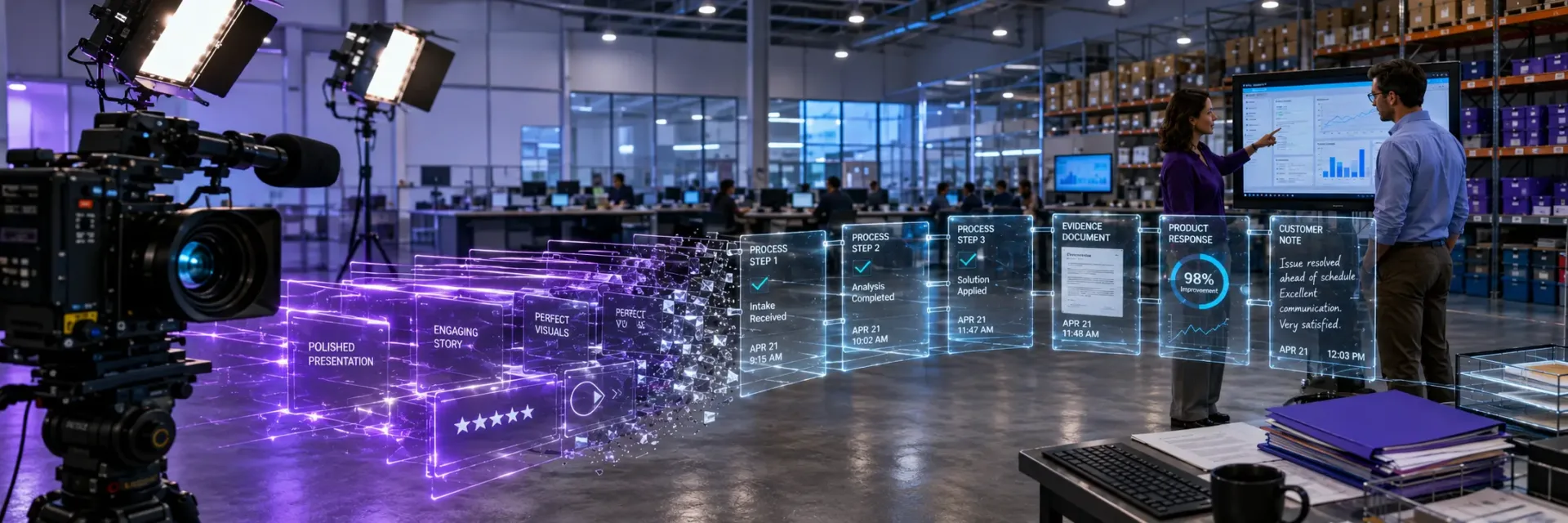
A trust-building video increases buyer confidence by making important claims observable, contextualized, and easier to verify.
Effective videos use demonstrations, testimonials, case studies, process footage, and explanations based on the buyer’s unanswered questions.
Credibility improves when evidence shows recognizable conditions, relevant proof, limitations, non-fit scenarios, and documented support for broader claims.
Human presence can clarify evidence, while behind-the-scenes footage can reveal how value is delivered.
AI-assisted video should distinguish recorded, edited, and generated elements when this affects interpretation.
Production polish should improve clarity, accessibility, and comprehension, but it cannot replace missing evidence, unsupported claims, weak buyer relevance, or promises the viewer cannot verify.
Key Takeaways
- A trust-building video earns confidence by making important claims observable, contextualized, and easier for buyers to verify.
- Demonstrations, testimonials, case studies, process footage, and explanations should be selected according to the buyer’s unanswered question, not production preference.
- Clear limitations, non-fit scenarios, dated evidence, and honest AI disclosure strengthen credibility by reducing misleading certainty.
- Production polish is valuable when it improves clarity and accessibility, but it cannot compensate for unsupported claims or missing proof.
A trust-building video should help buyers verify how a product, service, or process works.
But production quality can make a claim look credible without making it verifiable.
The common belief is that a polished presentation creates trust; the sharper test is whether a skeptical buyer can connect the message to something observable.

What a trust-building video must help buyers verify
Polish can improve sound, pacing, lighting, and focus.
It cannot prove that a promise holds in the buyer’s setting.
A perfect set, paid actors, sweeping claims, and invisible operation can create the opposite reaction from the one a brand wants.
The video may feel staged while the buyer’s main question remains unanswered.
That doubt often appears in practical questions:
- Does the product work outside the script?
- Does the result depend on ideal conditions?
- Is the company showing a real operation or only a convincing message?
Why polished claims can still create buyer doubt
The expensive gap is between looking credible and being easy to verify.
A trust-building video narrows that gap with something concrete to inspect: a real workflow, a visible product response, a customer explaining a specific change, or a clear view of what the service does and does not cover.
These details support evidence-backed claims without asking the viewer to treat the brand’s confidence as proof.
Therefore, production quality should support the evidence, not substitute for it.
A clean video can earn attention; relevant evidence helps turn that attention into buyer trust.
The difference between showing function and asserting function
Showing function lets the buyer observe an important part of the value.
Asserting function describes the value and asks the buyer to accept it without seeing enough of the operation.
The difference is easy to miss in video marketing.
A presenter can say that a platform reduces manual work.
A stronger video may show the task before use, the process in operation, and the resulting change.
The second approach gives the buyer a way to examine the claim.
A product label can describe what a machine does.
Its moving parts let you judge whether it performs that work in a believable way.
A video does not need to reveal every detail, but it should reveal the detail tied to the buyer’s main concern.
That changes the review question: “Which important claim can the buyer verify from what appears on screen?” is more useful than “Does this video look professional?”
A customer testimonial can show function when it names the situation, the action, and the observed change.
A case study can do the same when it connects the customer’s problem to the work performed.
Behind-the-scenes content can help when it reveals a real process that matters to the purchase decision.
But visibility alone is not enough.
A real demonstration that avoids the buyer’s concern may feel authentic yet remain commercially weak.
Therefore, the evidence must match the point of risk.
That is where format stops being the main decision.
A testimonial is not automatically stronger than a demonstration.
A polished explainer is not automatically weaker than behind-the-scenes content.
The useful question is whether the chosen format makes the relevant claim easier to inspect.
What skeptical buyers need to weigh
Skeptical buyers do not need every possible detail.
They need the right evidence for the confidence gap that could block action.
That gap may involve operating conditions, expected limits, implementation effort, customer fit, or the difference between a stated benefit and a visible result.
A trust-building video should make those conditions easier to weigh instead of burying them under broad reassurance.
Four review criteria keep the assessment grounded:
- Recognizable conditions: Can the buyer see where, when, or how the value appears?
- Relevant evidence: Does the video address the claim that matters to the purchase decision?
- Stated limits: Does it show where the product, service, or process may not fit?
- Specific confidence gap: Does it answer the doubt this buyer is likely to carry into the next step?
The third criterion often separates confidence from suspicion.
A video that states limits can feel more credible than one that presents universal success.
Clear boundaries give buyers a way to judge fit.
AI-assisted video adds another review point.
Efficient production can help a team create more versions, but speed does not remove the need for verifiability.
If the result relies on synthetic scenes, generic voices, or claims with no visible support, the format may add distance between the message and the buyer’s judgment.
The same standard applies across the buyer journey.
Early video may help a buyer understand the problem.
Later video may need to show operation, customer fit, or implementation detail.
The evidence should become more specific as the decision carries more risk.
So what should an executive look for first?
Find the claim most likely to delay action, then check whether the video lets the buyer examine it without relying on production polish.

How to choose evidence before choosing a video format
Trust-building video planning should begin with the evidence a buyer needs, not the format a team wants to produce.
But many teams still start with an explainer, testimonial, or polished brand film.
The common belief is that one strong format can carry every trust claim, yet the unanswered question should determine what the video shows.
Match the buyer’s question to the evidence available
A buyer’s question changes across the buyer journey.
Early on, the question may be, “What is this?”
Later, it may become, “Will this fit our situation?”
At the decision stage, the question is harder: “Can I trust this team to deliver what it says?”
Each question needs a different form of evidence.
Education can clarify a problem or explain a category.
A real demonstration can show observable operation.
Process footage can make delivery steps visible.
Case studies and customer testimonials can support claims about experience, outcomes, or working relationships.
But format alone does not answer the question.
An explainer may describe a service without showing how it works in practice.
A testimonial may sound positive without giving enough detail to assess the claim.
High production quality may improve attention while leaving buyer trust unchanged.
The useful planning move is to list the claims first, then test each one:
- What does the buyer need to understand?
- What does the buyer need to see?
- What does the buyer need to compare?
- What would make the claim easier to verify?
This is where many video briefs lose commercial value.
They name the asset before naming the doubt.
A trust-building video earns attention by reducing a specific unknown.
For an awareness audience, the evidence may need to make a problem clear.
For a consideration audience, it may need to show solution fit, process visibility, or operating logic.
For a decision-stage audience, it may need to make delivery, limitations, and accountability easier to judge.
Therefore, the same company may need several evidence types across one buyer journey.
A single brand video can create recognition, but it may not answer the later questions that shape a purchase decision.
Use demonstrations, testimonials, case studies, and explanations for different proof needs
Video Formats Matched To Buyer Proof Needs Table
| Video format | Best used when the buyer needs to | Evidence it can provide | Important limitation |
|---|---|---|---|
| Product, service, or process demonstration | Inspect operation | Visible features, use, workflow, or delivery steps | May be weak if it avoids the buyer’s main concern or uses ideal conditions only |
| Customer testimonial | Assess experience or working relationship | A customer’s situation, decision, and observed experience | Broad praise without specific context gives little to assess |
| Case study | Judge relevance and fit | The starting problem, work performed, result, and conditions | Should not imply that every buyer will receive the same outcome |
| Educational, FAQ, or explainer video | Understand meaning or resolve confusion | Definitions, tradeoffs, explanations, and objections | Explanation cannot replace evidence the buyer needs to observe |
| Process or behind-the-scenes footage | Understand how value is delivered | Preparation, sequencing, checks, handoffs, equipment, or constraints | Atmosphere alone is not process evidence |
Video formats are containers.
Evidence is the substance inside them.
A product demonstration can show features, use, or operation.
A service demonstration can show the work itself, such as a review process, customer interaction, or delivery workflow.
A process demonstration can make invisible steps easier to inspect.
These formats help when the buyer needs observable evidence rather than a verbal claim.
Customer testimonials serve a different purpose.
They can show how a customer experienced the problem, evaluated the option, or judged the working relationship.
Their value depends on relevant detail.
A broad statement of satisfaction gives buyers less to assess than a clear account of the situation, decision, and experience.
Case studies add structure around a customer situation.
They can connect the starting problem, the work performed, and the result discussed.
But a case study should not be used to imply that every buyer will get the same outcome.
Its stronger function is to help a prospect judge relevance and fit.
Educational videos, FAQ videos, and explainer videos work best when confusion blocks progress.
They can define terms, clarify tradeoffs, and answer objections.
They become weaker when explanation substitutes for evidence that the buyer needs to observe.
The common myth is simple: one polished format can build trust at every stage.
It cannot.
A buyer who needs to see operation will not get the same value from a brand story as from a real demonstration.
Ask what kind of doubt remains after the video ends.
If the doubt is about meaning, explain.
If it is about operation, demonstrate.
If it is about experience, use a relevant customer account.
If it is about delivery, show the process and name its limits.
The format should follow the unanswered question.
That rule also protects budget.
Teams can avoid adding polish where stronger evidence would do more work.
A concise process view may support buyer trust more than a larger production built around claims the viewer still cannot check.
Build credibility when customer testimonials do not exist
A lack of customer testimonials does not require a company to make unsupported claims.
It requires a different evidence plan.
Process footage can show how work is performed.
Prototypes can make a proposed experience concrete.
Pilots can show what is being tested, what is known, and what remains open.
Real workflows can reveal the people, steps, checks, and constraints behind a service.
These assets do not need to pretend that a new offering has a long track record.
Their strength comes from making the work inspectable.
That distinction matters.
Credibility can come from visible practice, clear boundaries, and honest limits before public case studies exist.
AI-assisted video can support production in some settings, but it does not create real evidence on its own.
It may help organize information, adapt explanations, or speed early drafts.
It cannot replace footage of an actual workflow, a named expert discussing a real process, or a customer account that has not been provided.
The same standard applies to prototypes and pilots.
Show what exists.
State what is being tested.
Avoid presenting an intended capability as a proven one.
Named limitations may feel less polished, but they give buyers a clearer basis for judgment.
This is the quiet advantage of restraint.
When testimonials are unavailable, the evidence plan can focus on questions the company can answer now:
- Can the team show the process?
- Can it demonstrate the current product or service?
- Can it explain what has been tested?
- Can it name the conditions where the offer may not fit?
- Can a buyer see who owns each step?
The answers shape the trust-building video.
They also expose gaps before those gaps reach sales conversations.
If the company cannot show how a claim is supported, the production brief should not hide that weakness with music, motion, or polished visuals.
A buyer does not need every uncertainty removed.
The buyer needs to see that uncertainty has been recognized and handled honestly.

What makes a real demonstration credible
A credible real demonstration gives buyers enough visible context to judge a claim for themselves.
But a clean video can still hide the conditions that make the result hard to assess, creating doubt that production polish cannot resolve.
The common belief is that realism means showing everything without structure, while buyers actually need a clear view of the operation, the setting, and the limits.
Show real operation in recognizable conditions
A buyer weighs a demonstration against their own operating reality.
Real people, real screens, real rooms, and real workflows give them reference points they can compare with their own needs.
That does not mean every frame needs to look rough.
It means the visible setting should carry useful information.
Show the interface the user will encounter, the steps the team must complete, and the environment in which the product, service, or process is expected to work.
A studio ideal may make the claim easy to watch.
A recognizable condition makes the claim easier to judge.
Therefore, the video supports buyer trust when the viewer can ask, “Would this still make sense in my setting?” and find enough detail to answer.
The setting is part of the evidence.
If the room, workflow, or screen looks disconnected from the intended buyer, the viewer must fill in the gaps.
Those gaps create doubt during the buyer journey.
A trust-building video reduces that mental work by making the relevant conditions visible.
For a service, that may mean showing how information moves through a real workflow.
For software, it may mean showing the actual user path rather than a sequence of abstract screens.
For a physical product, it may mean showing the product in the type of space and task where the buyer expects to use it.
Keep the demonstration clean without making it look staged
Production quality has a useful job: it should help the viewer see and hear the operation.
Clear audio, steady framing, readable screens, and purposeful cuts can remove distractions without changing the substance of the demonstration.
But production choices can cross a line.
Dramatic lighting, constant motion, selective edits, or a spotless setting may make the scene feel impressive while hiding the work needed to produce the result.
That creates a gap between presentation quality and evidence quality.
A clean demonstration improves visibility.
A staged demonstration manages perception.
The difference matters.
Ask what each production choice helps the buyer inspect.
If a close-up makes a process easier to follow, it adds clarity.
If a cut removes a difficult step without explaining the omission, it reduces verifiability.
If music carries the emotion while the claim remains vague, the video may be polished but still weak at decision support.
This is where many teams misread “authentic”.
Authenticity does not require poor sound or careless framing.
It requires production choices that preserve the viewer’s ability to assess what happened.
A demonstration can be calm, clear, and well produced while still showing the parts a buyer may question.
Show imperfect outcomes and relevant operating limits
A flawless result can be hard to weigh.
Without context, the viewer cannot tell whether the outcome reflects normal operation, ideal input, careful selection, or a moment that happened to work well.
Showing an exception does not weaken an evidence-backed claim by itself.
It can make the claim more precise.
State what changed, show how the process responded, and make clear where the result may depend on conditions outside the video.
This matters most where inputs vary.
A service may depend on client participation.
A workflow may depend on clean information.
A product may perform differently under different conditions.
The demonstration should make those dependencies visible rather than leave the buyer to discover them later.
The limitation is part of the decision.
Relevant limits help a buyer compare the promise with the risk.
They can reveal what the product does, what the team must do, and where another approach may be needed.
That is more useful than a perfect result with no operating frame.
A practical review asks three questions:
- What was the starting condition?
- What changed during the process?
- What would prevent the same result?
These questions turn a viewing experience into an assessment of fit.
But limits need proportion.
A video should not bury the main operation under warnings or edge cases.
It should show the conditions that could change the buyer’s decision.
That keeps the demonstration clean while giving the viewer enough context to judge the claim.
The result is a more durable form of buyer trust.
The viewer is not asked to accept perfection.
They are given enough detail to decide whether the performance is relevant, repeatable in their setting, and worth further review.

How evidence-backed claims and honest limitations build confidence
Evidence-backed claims show buyers which parts of a trust-building video they can verify and which depend on supporting context.
But footage alone cannot support every statement about results, reliability, adoption, savings, or customer experience.
The common belief is that stronger production quality makes broader claims more credible, yet confidence depends on the claim’s basis, scope, and limits.
Map each general claim to dated or documented evidence
A real demonstration can show what happened on screen.
It cannot, by itself, support every broader statement around that moment.
Claims about results, reliability, adoption, savings, or customer experience need evidence beyond the footage.
A simple review test helps: underline every claim that extends past what the viewer can directly observe.
Then connect each claim to a dated record, documented source, or other evidence a buyer can assess.
If no support exists, narrow the wording or remove the claim.
This does not require a crowded screen.
A source note, date, scope statement, or linked record may give the claim enough context to be judged.
The point is not to make the buyer research every sentence.
The point is to show that broad claims were reviewed before publication.
A claim without a source is like a label on a sealed box.
It tells the buyer what to expect, but gives no way to check what is inside.
The useful question is simple: what can the viewer verify, and what must the viewer take on trust?
That distinction shapes video review criteria.
A production team may approve a strong visual sequence, while a commercial reviewer asks whether the supporting claim has a clear date, scope, and basis.
Both reviews matter, but they address different risks.
Therefore, evidence review should happen before the final cut.
It protects buyer trust from claims that sound precise yet remain too broad to assess.
Use testimonials and case studies as contextual evidence
Customer testimonials and case studies can add useful context to a trust-building video.
Praise alone rarely tells a buyer whether the situation resembles their own.
A stronger customer story makes the starting problem clear.
It explains what changed, what process was used, and which result the customer is describing.
It should also give enough context to show where the result applies and where it may not.
The same standard applies to case studies.
A result without its conditions can create the wrong expectation.
A buyer may see the outcome but miss the starting point, scope, timing, or work required to reach it.
In review work, one practical test is to remove the positive adjectives and read the remaining story.
Is there still a problem, process, result, and context?
If the answer is no, the testimonial may create warmth without adding much evidence.
That is the quiet weakness of social proof.
A customer story becomes more useful when it helps a buyer compare conditions, not when it simply makes the company sound well liked.
This supports better commercial evaluation.
Buyers can ask whether the same type of problem, process, or outcome fits their own needs.
AI-assisted video adds another review concern.
It can help organize customer material or present a clear narrative, but it cannot supply missing context.
If a testimonial is vague, a smoother edit will not make it more verifiable.
Therefore, use customer testimonials and case studies to clarify fit.
Let the story show what happened, under which conditions, and what the buyer should not assume from it.
State what the offering does not do
A credible trust-building video names its limits.
It tells buyers where the offering fits, where it does not, and which conditions can change the outcome.
This may feel risky.
Some teams fear that exclusions will reduce interest.
But vague claims create a larger risk: they invite the wrong buyer to continue, then force sales or service teams to correct the impression later.
A clear limitation can be short.
The offering may not fit a certain use case, require a specific condition, or cover a particular need.
Naming that boundary gives the buyer a better basis for action.
It also helps separate a real demonstration from a staged promise.
If the video shows one successful path, the viewer should know whether that path represents the normal use case, a narrow condition, or a selected outcome.
Here is the business payoff: product-fit clarity can reduce wasted evaluation effort.
The right buyers get a sharper reason to continue, while poor-fit buyers get an earlier reason to pause.
That is not a loss of persuasion.
It is a gain in decision quality.
The same rule applies to evidence-backed claims.
If available evidence supports a limited statement, keep the statement limited.
Do not let production quality, confident narration, or a customer quote stretch the claim beyond its basis.

How human presence, process footage, and AI affect verifiability
Human presence, process footage, and AI-assisted video affect whether buyers can verify what a trust-building video shows.
But a sincere face, a busy worksite, or a polished synthetic voice can make weak evidence feel complete, while production quality can support attention without proving performance.
Many teams treat natural presentation as authenticity; the better test is whether viewers can identify what was shown, under which conditions, and what remains unshown before they trust the claim.
Use people to clarify evidence, not replace it
People can make a trust-building video easier to understand.
A staff member can explain a step, answer a likely concern, or point out a limit that polished copy might hide.
But facial expression, body language, and a candid tone do not verify performance on their own.
A confident speaker can describe a process without showing how it works.
A customer testimonial can express satisfaction without showing the conditions behind the result.
The useful question is not, “Does this person seem believable?” It is, “What can this person help me inspect?”
A strong presenter connects words to visible details.
They identify the stage being shown, explain what the viewer should notice, and separate direct observation from interpretation.
Therefore, human presence supports buyer trust when it improves the viewer’s ability to assess evidence.
The person adds meaning.
The footage carries the claim.
That distinction protects the video from confusing warmth with verification.
It also helps teams judge whether a testimonial supports a claim or simply delivers a positive impression.
Treat behind-the-scenes footage as process evidence
Behind-the-scenes content earns trust when it reveals how value is delivered.
Operational footage can show preparation, sequencing, quality checks, handoffs, equipment, or the points where variation may enter the process.
The footage does not need to expose every internal detail.
It needs to expose the details that affect the buyer’s judgment.
If a service depends on review, show where review happens.
If delivery depends on coordination, show the coordination.
If a result has limits, show the condition that creates the limit.
A useful review asks three things:
- What part of the process is visible?
- What condition does the footage help the buyer understand?
- Which claim still needs support outside the video?
This keeps behind-the-scenes content from becoming a staged tour.
A camera moving through a workspace may create atmosphere, but atmosphere is not process evidence.
The value appears when the viewer can connect an action to an outcome or a limitation.
Production quality still matters.
Clear sound, stable framing, and readable details reduce friction.
But polish should make evidence easier to inspect, not make missing evidence harder to notice.
Think of process footage as a window, not a backdrop.
A backdrop makes the setting look credible.
A window lets the buyer see how the work happens.
Therefore, the strongest behind-the-scenes video does more than humanize a company.
It gives the buyer a clearer view of delivery risk, which can affect conversion quality and trust in the wider set of claims.
Set authenticity and disclosure expectations for AI-assisted video
AI-assisted video can help teams edit, repurpose, caption, or adapt content for different buyer moments.
Those uses may improve access and consistency.
They can also weaken buyer trust if the viewer cannot tell what was recorded, changed, or generated.
The risk is not AI itself.
The risk is an unclear boundary between documented evidence and synthetic presentation.
A real demonstration that receives light editing asks for a different level of disclosure than a generated presenter describing a customer outcome.
A personalized video assembled from approved footage differs from a fabricated customer testimonial.
These distinctions affect how a viewer weighs the message.
A practical review should cover:
- Which parts show a real person, place, product, or process?
- Which parts were edited, enhanced, generated, or repurposed?
- Could the changes alter the viewer’s view of performance or authenticity?
- Does the viewer receive enough context to judge the claim fairly?
Disclosure should be plain.
It should explain the use of AI where that use could affect the viewer’s interpretation.
Hiding the change may protect a smooth viewing experience for a moment, but it can create doubt once the viewer notices an unnatural voice, altered scene, or impossible interaction.
That doubt spreads beyond the edited clip.
It can make buyers question the evidence-backed claims around it and weaken confidence in other video marketing materials.
The decision rule is direct: use people for context, process footage for inspection, and AI only with clear limits around what the viewer is being asked to trust.
Human presence can guide attention, and production quality can improve comprehension, but neither can repair evidence that the viewer cannot examine.
The next question is which video review criteria should determine whether that evidence is strong enough for a buyer to act.

When production polish is genuinely the right solution
A trust-building video needs production quality when buyers struggle to see, hear, or access evidence that is already available.
But cleaner images, stronger sound, and smoother editing cannot supply proof that the video does not contain.
The harder question is whether the asset needs a clearer presentation – or whether polish would only make a weak claim feel safer to accept.
Improve lighting, sound, editing, mobile viewing, and captions when clarity is failing
Production quality earns its place when the claim is sound but difficult to inspect.
Poor lighting can hide process details.
Weak sound can blur an explanation.
Slow editing can bury the moment that matters.
The fix should match the failure.
Improve lighting when buyers need to see a product, workspace, or process.
Improve sound when the explanation carries the claim.
Tighten editing when useful evidence gets lost between long pauses or repeated points.
Mobile viewing deserves the same attention.
A trust-building video may be watched on a small screen, without sound, or in a busy setting.
Captions, readable text, strong contrast, and clear framing help buyers access the evidence without changing its meaning.
A useful test is simple: can a buyer inspect the claim more easily after the edit?
If yes, the investment supports buyer trust.
If the edit mainly adds style, pace, or status signals, the trust problem may sit elsewhere.
Clarity improvements reduce friction in the buyer journey.
They help a sound claim survive the conditions in which people actually watch video, while leaving the evidence itself unchanged.
Do not use polish to conceal missing proof
Polish becomes risky when it creates confidence without increasing verifiability.
A controlled set, refined color grade, confident voiceover, or fast sequence can make a claim feel settled before the buyer has seen enough to judge it.
Visual refinement is not the problem by itself.
Its purpose is what matters.
Production should clarify what happened, who is speaking, what conditions apply, and which parts of the claim still need support.
Remove the music, motion graphics, and visual effects during review.
What remains?
If the claim loses most of its force, the video may be leaning on presentation instead of evidence.
The same test applies to AI-assisted video.
Synthetic scenes, voices, or edits may help explain an idea, but they should not imply that a real operation, customer outcome, or product behavior was directly observed when it was not.
The expensive mistake is easy to miss: a polished video can pass an internal approval review while leaving a buyer with fewer reasons to believe the claim.
Therefore, separate two tests during review.
First, can the audience follow and inspect the content?
Second, does the available evidence justify what the video says?
Strong clarity cannot compensate for weak support.
Choose written evidence when video cannot show the claim honestly
Video is a poor fit when the claim depends on details that cannot be seen or heard with enough context.
This often includes terms, policies, technical limits, pricing conditions, research methods, or a record of what changed over time.
In those cases, written evidence may give buyers a cleaner way to assess the claim.
A case study can show the starting point, method, limits, and result in a form that is easier to review.
A written customer testimonial can preserve exact language without forcing a performance on camera.
A process document can show steps that a short video would compress or omit.
The choice is not video versus trust.
It is the right format for the evidence.
Video can show a real demonstration, human presence, or visible process.
Written material can carry detail, conditions, source context, and careful distinctions with less risk of visual overstatement.
Ask one question before funding another production pass: what must the buyer verify, and which format lets them verify it with the least distortion?
If video makes the claim easier to misunderstand, stop polishing and change the format.
If the evidence is clear but difficult to see, hear, or access, improve production quality.

How to review a trust-building video before publication
A trust-building video needs a publication review based on what buyers can verify, weigh, and understand.
But production quality can pass an internal review while leaving buying questions unanswered.
The common belief is that a video is ready when it looks credible; the stronger test is whether a buyer can judge the claim, fit, and risk without filling gaps with assumptions.
Test whether the video shows recognizable operation
Start with the operating conditions.
Can the viewer see the product, service, or process working in a setting that matches the buyer’s decision?
A real demonstration needs more than motion on screen.
The footage should show enough context to make the action meaningful: what is being used, who is using it, what happens before and after, and which conditions may affect the result.
If the camera shows only a close-up or a staged success, the buyer may see activity without learning how the offering works.
Reviewers should compare the footage with the intended use case.
A software video may need to show the actual workflow rather than a sequence of ideal screens.
A service video may need to show the process, the people involved, or the point where a customer receives the work.
A product video may need visible scale, setup, or operating conditions.
The question is not whether the video looks real.
It is whether the viewer can recognize the operation well enough to assess it.
Test whether every general claim has supporting evidence
General claims need a second pass.
Words such as “faster”, “safer”, “simpler”, or “proven” reach beyond what a short clip may show.
For each claim, ask what supports it.
The support may appear in the footage, in a dated document, in customer testimonials, in a case study, or in another source the buyer can review.
If the evidence is absent, the claim should be narrowed, qualified, or removed.
A practical review can mark each statement as visible, documented, attributed, or unsupported.
That distinction prevents the script from borrowing credibility from nearby footage.
A scene may show a process taking place, but it may not prove a broad performance claim about every customer or use case.
This is where many videos lose buyer trust.
The footage earns confidence, then the voice-over asks the viewer to accept more than the evidence can carry.
Therefore, the publication decision should follow the strongest support available, not the strongest wording the team can write.
That protects conversion quality by keeping the promise within the buyer’s ability to verify.
Test whether limitations and non-fit scenarios are visible
A trust-building video should help a buyer decide when the offering is a poor fit.
That requires visible limits, not just positive outcomes.
Review the moments that could change the decision.
Does the process depend on a certain setting?
Does the product require a specific setup?
Does the service exclude a type of customer, task, or condition?
If those limits matter, the video should give the viewer a fair way to find them.
This does not mean turning the video into a list of warnings.
It means removing the false certainty created by a one-sided presentation.
A short note, clear caption, or direct statement may be enough to set the right boundary.
The standard is whether a reasonable buyer can weigh the offer without guessing at material risks.
What happens if the buyer discovers the limit only after purchase?
The cost may reach beyond one poor fit.
It can weaken confidence in the claim, the sales process, and the next buying decision.
The strongest trust signal is often a clear boundary: this works here, and it may not work there.
That boundary helps the right prospects move forward while reducing avoidable acquisition and retention risk.
Test whether production improves clarity without reducing verifiability
Production quality should make evidence easier to see, hear, and understand.
It should not make the evidence harder to inspect.
Check lighting, sound, editing, captions, mobile viewing, staging, and any AI-assisted video elements.
Clean audio can make a process understandable.
Captions can preserve meaning when sound is off.
Better lighting can reveal a detail that supports the claim.
Tighter editing can remove dead time without removing the conditions a buyer needs to judge.
But production choices can also hide useful context.
Fast cuts may skip the step where the result is produced.
Heavy staging may make ordinary operation look unusual.
Synthetic voices or generated scenes may blur what was recorded and what was created.
The review should ask whether each choice improves comprehension while preserving a clear line between observed evidence and presentation.
A simple decision rule helps: if a production choice makes the video clearer, keep it; if it makes the proof harder to check, change it.
The goal is not low production quality.
It is production quality that carries evidence without disguising its limits.

How to measure whether the video is building buyer confidence
Measuring a trust-building video starts with what buyers can verify, not what platforms can count.
But high views, long watch time, and clicks can leave the central buying doubt untouched.
The common belief is that strong performance proves trust; the better test is whether the video gives buyers enough evidence to make an informed decision.
Measure proof quality and buyer verifiability directly
Start with the evidence itself.
Can a buyer see how the product, service, or process works?
Are the operating conditions recognizable?
Does the video support its main claims with visible detail, a real demonstration, customer context, a case study, or another checkable source?
Review the video as a skeptical buyer would.
Mark each important claim and ask three questions:
- What can the viewer verify?
- What context makes the claim meaningful?
- What limitation could change the decision?
That review can expose gaps a polished cut hides.
A customer testimonial may sound sincere yet leave out the situation that shaped the result.
Behind-the-scenes content may show activity without showing the standard or process that matters.
An AI-assisted video may explain a benefit clearly while giving the buyer little direct evidence to inspect.
The strongest signal is not a feeling of credibility.
It is a clear path from claim to checkable support.
Use buyer-confidence feedback as another direct signal.
Ask reviewers what they still doubt, which claim feels supported, and what information they would need before taking the next step.
Their answers can show whether the video reduces uncertainty or simply makes the brand easier to remember.
Therefore, video review criteria should assess verifiability, claim support, context, limitations, and buyer response before production quality takes center stage.
That focus helps teams spend effort on evidence gaps that can affect trust, conversion quality, and retention.
Use engagement and conversion metrics as supporting signals only
Views show exposure.
Watch time shows sustained attention.
Completion rate shows how many viewers reached the end.
Click-through rate and conversion rate show response after the video appears.
Those signals matter.
But none can prove buyer trust on its own.
Engagement metrics show a reaction; they do not show whether the audience accepted the claim or found it verifiable.
A viewer may finish a video out of curiosity.
A click may reflect interest in pricing, comparison, or a promotional offer.
A conversion may happen with unresolved concerns that surface later in sales, onboarding, support, or retention.
The same caution applies to production quality.
Clear sound and visible detail can help buyers inspect evidence.
They do not turn an unsupported claim into an evidence-backed claim.
Read performance metrics beside the proof review.
If watch time rises while buyer questions remain unchanged, the video may be holding attention without building confidence.
If clicks rise but reviewers still question the conditions behind the claim, the next edit may need more context rather than stronger calls to action.
Review whether the video reduces the buyer’s specific confidence gap
Trust is not a general reaction.
It depends on what the buyer doubts, where they are in the buyer journey, and what decision they must make next.
A first-touch viewer may need to understand whether the offer is real.
A later-stage buyer may need to judge operating conditions, limitations, implementation risk, or fit.
The same trust-building video can help one audience and leave another unconvinced.
Start with the original confidence gap.
Was the buyer unsure that the process works?
Unsure that the result applies to their situation?
Unsure what happens after purchase?
The review should test the video against that exact question, not against a broad impression of quality.
One practical test is to compare buyer feedback before and after exposure.
Look for a sharper understanding of the claim, fewer repeated objections, or stronger recognition of what must be checked next.
Do not treat any one response as final proof.
Use the pattern to find what the video has clarified and what it has left open.
The most useful measurement question is simple: what doubt became smaller, and what doubt remains?

Related guidance for evidence-led video and visual marketing
A trust-building video should lead to the next evidence question in the buyer journey.
But broader video marketing support should not mean adding more content by default.
The strongest next asset is not always the most polished one; it is the one that helps buyers judge what remains uncertain.
Video and Visual Marketing
Video marketing works best when each asset has a clear job.
A real demonstration may help a buyer assess a process.
Behind-the-scenes content may make the work easier to inspect.
A customer testimonial may add experience from another point of view.
But format should follow the evidence, not replace it.
Review each asset for what buyers can see, hear, compare, or verify.
AI-assisted video can support speed and consistency, yet it still needs clear boundaries around what is real, edited, or generated.
The useful measure is simple: does the asset answer a buying question that another format leaves open?
Trust and Positioning
Trust and positioning meet at the claim a company can support.
A strong position tells buyers why the offer matters.
Evidence shows whether the company can support that position in practice.
Therefore, review the message and the proof together.
If a video claims speed, show the relevant process.
If it claims care, show the steps that express that care.
If it claims expertise, give buyers enough context to judge the work rather than relying on polished language.
Production quality can improve access to evidence.
It cannot create evidence that the video does not contain.
Proof-Led Social Media Content
Proof-led social media content extends the same standard beyond a primary video.
Short clips, customer testimonials, case studies, process footage, and visual posts can each support buyer trust when their claims remain specific and checkable.
But repeated claims do not become stronger through repetition alone.
The content should add a new view, detail, source, or real demonstration.
Use video review criteria across channels: identify the claim, inspect the evidence, note what remains uncertain, and decide whether the asset helps the buyer move forward.
The right next asset is therefore the one that closes the next evidence gap, not the one that produces the most activity.

Scientific context and sources
The sources below provide research-backed context for how evidence, credibility cues, information quality, product demonstration, and transparent presentation influence buyer confidence in video and digital communication.
- Information Verification and Perceived Credibility
“The Role of Site Features, User Attributes, and Information Verification Behaviors on the Perceived Credibility of Web-Based Information” – Andrew J. Flanagin & Miriam J. Metzger – New Media & Society (2007)
Examines how people assess message, website, and source credibility across different types of websites, including the role of site attributes, source familiarity, user characteristics, and information-verification behavior. The study supports the distinction between surface credibility cues and the deeper process of evaluating and verifying information before accepting it as trustworthy.
https://journals.sagepub.com/doi/10.1177/1461444807075015 - Source Credibility and Persuasion
“The Persuasiveness of Source Credibility: A Critical Review of Five Decades’ Evidence” – Chanthika Pornpitakpan – Journal of Applied Social Psychology (2004)
Reviews five decades of research on the persuasive effects of source credibility. The evidence generally supports greater persuasion from more credible sources, while also showing that the effect varies according to characteristics of the source, message, channel, receiver, and communication context. This provides a strong foundation for the article’s argument that a credible or confident presenter can support persuasion but cannot substitute for relevant evidence.
https://onlinelibrary.wiley.com/doi/10.1111/j.1559-1816.2004.tb02547.x - Trust Cues in Product Review Videos
“Stranger Danger? Cue-Based Trust in Online Consumer Product Review Videos” – Alexander Pfeuffer & Joe Phua – International Journal of Consumer Studies (2022)
Investigates which content cues increase trust in online consumer product-review videos. The research identifies cues including detailed product descriptions, balanced information, and product demonstrations as contributors to trust judgments. It supports the article’s emphasis on giving viewers specific, inspectable information rather than relying primarily on enthusiasm, presenter confidence, or production polish.
https://onlinelibrary.wiley.com/doi/10.1111/ijcs.12740 - Product Demonstrations and Perceived Information
“Impacts of Video Display on Purchase Intention for Digital and Home Appliance Products – Empirical Study from China” – Ruohong Hao, Bingjia Shao & Rong Ma – Future Internet (2019)
Examines how different forms of product video presentation influence purchase intention for digital and home-appliance products. The study links usage-scenario presentation with perceived information volume and shows how perceived information and perceived value contribute to purchase intention. It supports showing products in recognizable use situations where buyers can obtain more decision-relevant information rather than relying only on abstract benefit statements.
https://www.mdpi.com/1999-5903/11/11/224 - Transparency for Synthetic and AI-Assisted Content
“Reducing Risks Posed by Synthetic Content: An Overview of Technical Approaches to Digital Content Transparency” – Bilva Chandra, Jesse Dunietz, Kathleen Roberts, Yooyoung Lee, Peter Fontana & George Awad – National Institute of Standards and Technology, NIST AI 100-4 (2024)
Reviews technical approaches for increasing transparency around synthetic content, including provenance tracking, metadata, watermarking, labeling, authentication, and synthetic-content detection. NIST emphasizes that transparency can provide information about content origins and modifications but does not automatically guarantee trustworthiness. This provides an authoritative foundation for clearly distinguishing recorded, altered, and AI-generated material when those distinctions could affect how viewers interpret authenticity or evidence.
https://www.nist.gov/publications/reducing-risks-posed-synthetic-content-overview-technical-approaches-digital-content
Questions You Might Ponder
What is a trust-building video?
A trust-building video is a video that helps buyers verify how a product, service, or process works under recognizable conditions. Its purpose is not merely to look professional, but to reduce a specific confidence gap with demonstrations, customer context, process footage, documented claims, and clearly stated limitations.
Does video production quality increase buyer trust?
Production quality can increase trust when it improves visibility, sound, captions, pacing, and mobile access. However, polish does not prove performance. A trust-building video works best when production supports observable evidence instead of disguising missing proof with music, staging, dramatic editing, or confident narration.
What should a product demonstration video show?
A credible product demonstration video should show the product operating in conditions that resemble the buyer’s environment. Include the starting situation, key actions, visible response, relevant setup requirements, and meaningful limitations. Recognizable operation helps buyers judge fit more effectively than a feature list or polished product tour.
How do testimonials build trust in marketing videos?
Testimonials build trust when customers describe a specific problem, decision, process, and observed change. General praise provides social proof but limited evidence. A stronger testimonial explains the context and scope of the result, helping buyers compare the customer’s situation with their own instead of assuming identical outcomes.
Should AI-generated video be disclosed?
AI-generated or AI-altered video should be disclosed when it could affect how viewers interpret a person, product, process, result, or customer experience. Clear disclosure separates documented evidence from synthetic presentation. AI can improve editing and adaptation, but it should not imply that an unobserved event or outcome was real.