
What You’ll Learn
Social CTAs and readiness fail on engagement-heavy social posts when likes, comments and saves are mistaken for purchase intent. Engagement can show attention, but demand requires repeated problem recognition, trust and a clear next step that matches the buyer’s stage.
Key Takeaways
- High social media engagement rarely equals commercial demand; visible signals often conceal unreadiness to buy.
- Most engagement comes from non-buyers and outer circles, skewing perceptions of readiness.
- Earned trust through repeated, consistent visibility is crucial for moving silent observers toward real action.
- Premature or forceful CTAs trigger resistance; soft, audience-matched steps result in better conversion over time.
It’s easy to think a like, comment, or share signals commercial interest – but rarely is your audience actually ready to act.
But on most social channels, high engagement creates the illusion of demand.
The sharper truth: visible attention often conceals the fact that your audience isn’t even close to making a decision.

When engagement hides unreadiness
It’s easy to mistake surface interaction for market opportunity.
Yet the act of engaging – tapping a heart, writing a funny reply, joining a poll – costs almost nothing.
Sliding a finger or typing a clever comment doesn’t equal mental commitment or buying intent.
The core myth is that high engagement signals action is coming next.
Why attention isn’t buying intent
We’ve seen teams chasing the engagement metric as if more reactions will turn social media into a lead engine overnight.
But most of those signals are just noise – attention, not intent.
That disconnect creates a trap where teams push hard CTAs, expecting immediate action from an audience still browsing for entertainment or information.
Reasons Why Engagement Does Not Equal Buying Intent
- Engagement actions cost almost nothing (liking, commenting, sharing).
- Surface interaction doesn’t equal mental commitment or buying intent.
- High engagement often signals attention, not intent.
- Most social engagement comes from browsing for entertainment or information, not buying.
- Visible engagement can be noisy and circular without commercial value.
Imagine engagement as a crowd gathering outside your shop window.
They’re looking, chatting, sometimes taking photos.
But few have walked in, compared products, or weighed options.
That is the gap between social media engagement and genuine demand.
How do you tell the difference?
One diagnostic we use: ask if your “top” posts drive direct questions, private outreach, or signs of pain-point recognition.
If not, you’re seeing attention, not intent.
The dashboard might signal a spike, but the pipeline stays dry.
Audience behavior proves it.
A witty poll can get a thousand responses from users who would never buy.
An insight post garners applause from peers, competitors, or people outside your market.
The metric is up, but the account’s business value is stuck.
More activity makes the mirage harder to spot.
Therefore, the first task is learning to read between the signals – what looks like movement is often circular.
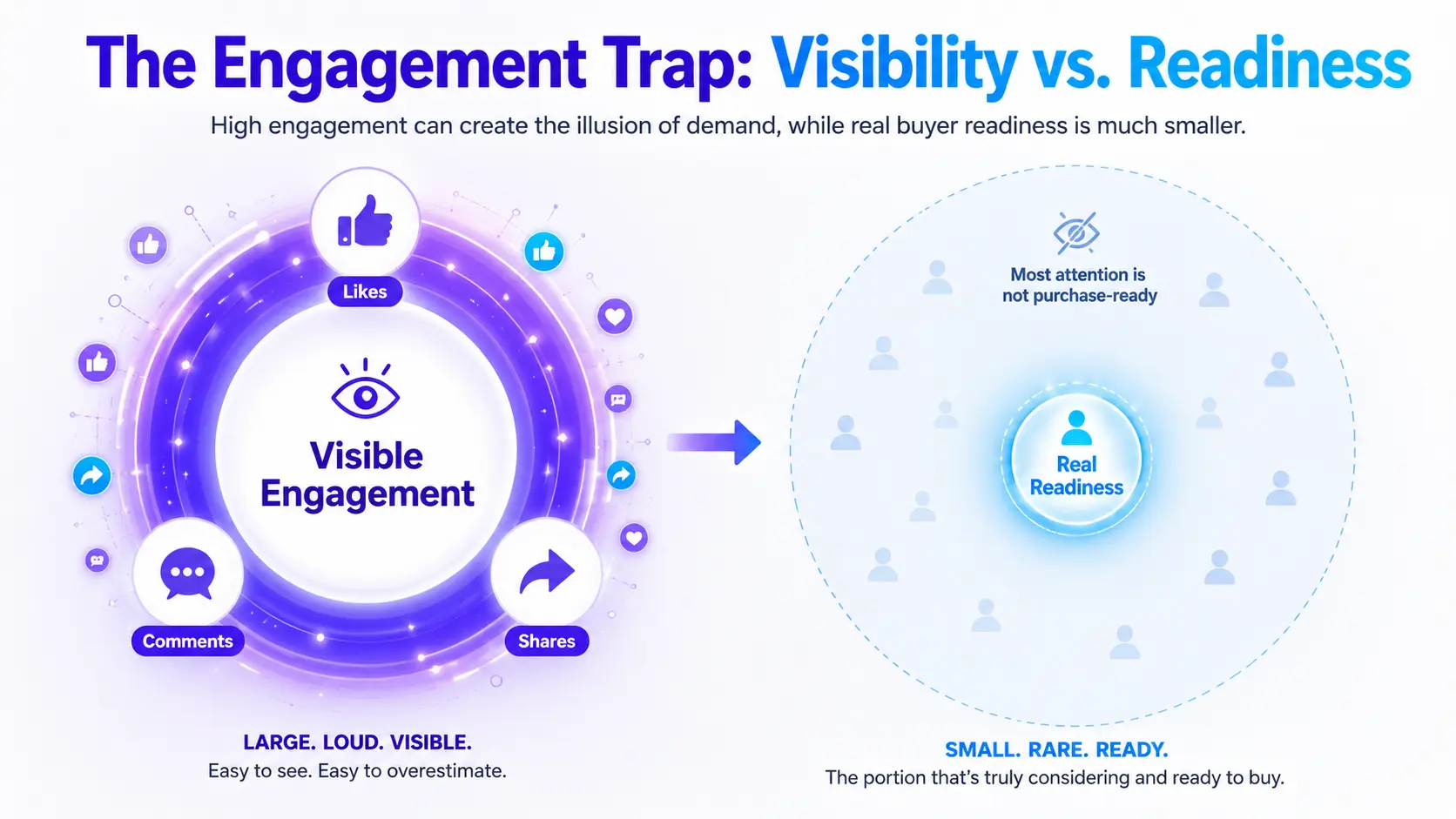
Who your audience really is
Most engagement-heavy audiences aren’t full of buyers.
That’s the dirty secret behind many viral posts – reactions usually come from an outer circle of allies, lurkers, and spectators.
We’ve mapped engagement on B2B campaigns and found the lion’s share comes from employees, industry watchers, or “social regulars” who interact by habit, not intent.
The people who quietly watch are rarely the ones who engage.
Lurkers – those who consume quietly – are the bigger commercial audience, yet they leave fewer obvious clues.
So the visible engagement skews your sense of readiness.
Who, then, is interacting?
Often: early-stage observers, curious peers, or people boosting their own visibility, not yours.
That’s why the highest performing posts in terms of likes or comments may have the lowest conversion.
Think of the noisy likes and shares as applause in a crowded room – it sounds good, but who’s clapping?
An early-stage audience will engage often but buy rarely.
The trap is building strategy around the loudest signals.
So the smart move: question every apparent signal.
The repeatable insight is simple – audience maturity isn’t measured by engagement, but by invisible readiness to act.
That distinction sets up the deeper problem – how do you nurture invisible trust so that readiness matures before you ever drop a CTA?
That wider diagnostic pattern is mapped in Social Media Marketing.

How visibility builds trust over time before action
Big spikes in social media engagement catch every marketer’s eye.
But what happens after the attention fades?
For most, applause doesn’t directly flip into leads.
The essential shift is quieter: trust – earned over time and largely invisible – forms before any audience member even considers taking action.
Repeated visibility as psychological permission
Many treat social media as a direct pipeline from visibility to conversion.
However, visibility functions more like showing up at the same networking event week after week: the first interaction rarely drives commitment, but repeated exposure normalizes your presence and credibility.
This steady flow gives the audience small signals that you’re both active and real – long before they ever engage with a CTA.
Yet, one persistent myth claims consistency only matters for the algorithm.
In practice, what changes is psychological: each quality exposure softens resistance.
The mind tracks familiarity and – over time – converts it into permission for deeper attention.
The surprise is this trust process runs quietly; most do not realize when the switch happens.
Have you noticed how prospects warm up after seeing your brand three, five, or even ten times – even if they never liked a post?
That pattern isn’t random.
We’ve watched as longtime lurkers surfaced suddenly ready for a commercial conversation, often referencing months-old posts.
Repetition signals reliability.
But social proof only compounds when the message stays coherent.
Scattershot posting erodes this effect.
Therefore, the win is not frequency, but repeated, expert proof in the same direction.
That recalibrates readiness, one silent exposure at a time.
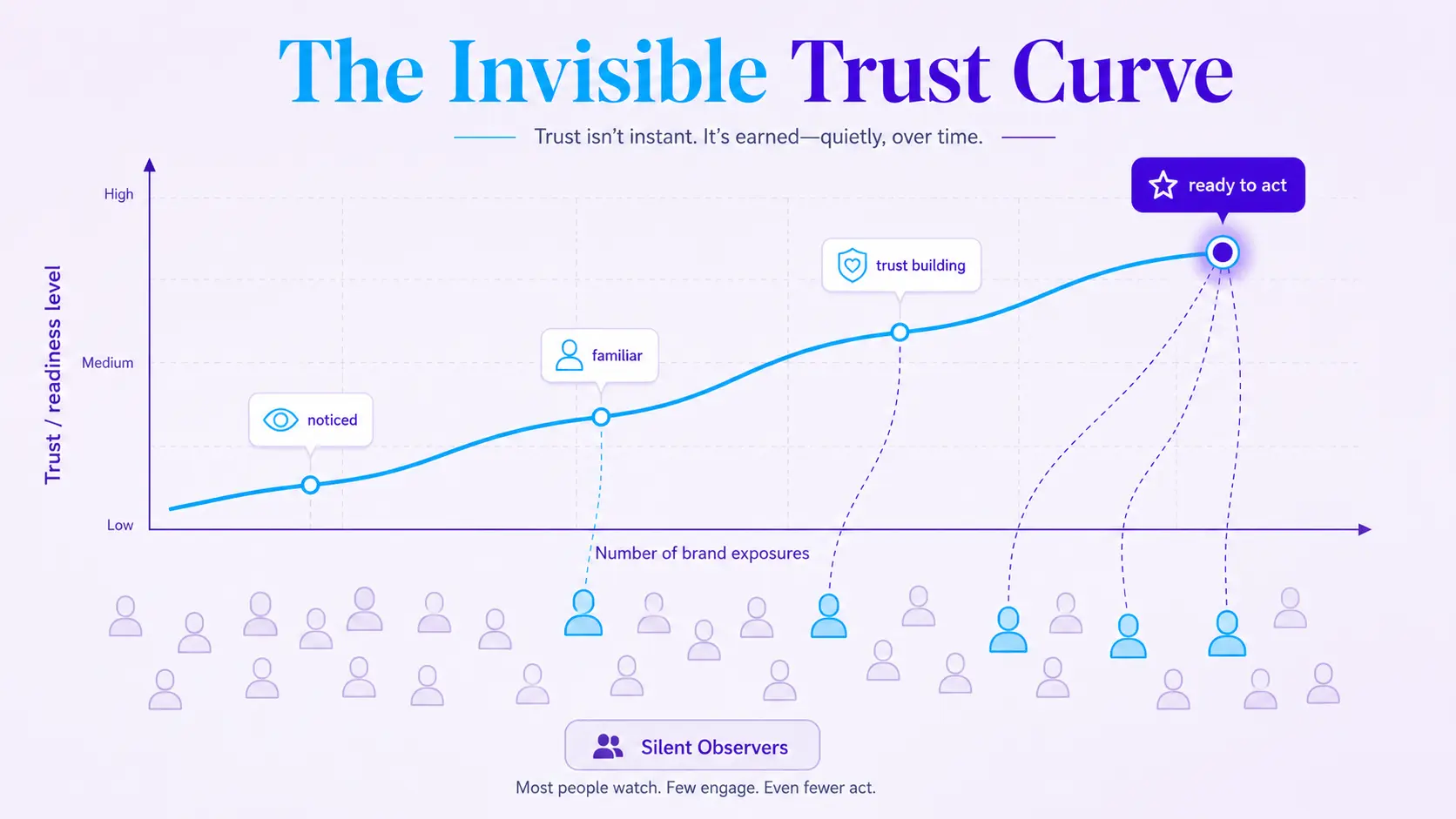
Silent observers over visible reactions
Engagement metrics spotlight the loudest part of the crowd.
However, B2B buying and high-stakes sales hinge on another layer – the silent majority watching without leaving a trace.
These are the lurkers: decision-makers who never comment or like, but track content across weeks and months before acting.
The commercial impact?
Their invisible attention becomes influence at the table when deals are discussed, introductions are made, or RFPs are shaped internally.
We’ve seen buying committees reference LinkedIn posts that had just two likes, yet those posts swayed a budget or a shortlist.
As one practical insight: the true signal of “social media readiness” is more often the quiet depth of return visits and direct messages, not the public spark of engagement.
So, how do you design for trust, not just attention?
The smarter path is to act as if your real audience is watching in silence – because, in many cases, they are.
The next implication?
Readiness rises long before it shows up in your notifications.
Therefore, conversion strategy must follow trust, not the surface-level flood of reactions.

Why premature CTAs backfire
A well-timed call to action can turn attention into revenue, but pressure applied too soon does the opposite.
Often, a surge in engagement creates a false sense of readiness – yet the decision to act is still distant for most of your audience.
Pressure before permission breeds resistance
Every marketer sees the pattern – content lands, likes and comments pile up, so the next logical step is to drop a CTA.
But when the audience’s true readiness doesn’t match the ask, the reaction isn’t action – it’s withdrawal.
This isn’t just a drop-off; it’s a signal that momentum can freeze when trust hasn’t caught up to persuasion.
Consequences of Premature CTAs
- Audience reaction is withdrawal instead of action.
- Momentum can freeze when trust hasn’t caught up with persuasion.
- Public engagement turns into private indifference.
- Premature asks lead to silent exits or ignored CTAs.
- Pressure before readiness increases opt-outs, unsubscribes, and disengagement.
We’ve seen teams pour resources into engagement, proud of viral reach, only to watch CTA clicks stall at a trickle.
Public applause becomes private indifference.
What looks like heat is often social insulation: when someone feels rushed before comfort, resistance isn’t vocal – it’s silent exits or ignored prompts.
Why does this happen?
The myth is that attention signals intent.
In practice, most signals on social media measure curiosity or surface validation – not readiness to buy.
The difference is sharp: social validation feels safe, public, and noncommittal; meaningful action, like requesting a demo or starting a conversation, feels risky until enough trust accumulates.
So why do many CTAs provoke unsubscribes or disengagement instead of conversions?
When permission hasn’t been earned, even a soft ask can feel like pressure.
It becomes easier to opt out, snooze, or disengage, rather than step forward.
That’s when resistance takes root – and it can take months to repair that breach.
Your best prospects aren’t just ignoring you – they’re testing whether you understand the tempo of real demand.
For B2B and high-consideration offers, social media engagement vs demand forms a gulf, not a bridge.
The difference between nudging and rushing is the hidden fault line.
Soft steps align with early-stage readiness
So, if a hard CTA falls flat, what’s left?
The answer: match every ask to audience maturity, not just visible activity.
Soft steps – micro-invitations that meet the audience where they stand – create forward motion without triggering resistance.
Instead of “Book a call now”, open with “Reply if you’ve seen this challenge too”.
Or, swap signup asks with prompts to share a perspective, vote in a poll, or download a low-barrier resource.
Each small action tests and grows readiness, without demanding a leap.
It’s like guiding someone across a river – not pushing them in, but giving them stepping stones.
Examples of Soft Call-to-Action Steps for Early-Stage Readiness
| Signal | Description | Indicative Audience Behavior |
| Repeat visibility | Same profiles consume or react repeatedly over time | Multiple appearances in view history indicate evolving interest |
| Comment depth | Quality and substance of comments referencing frameworks or questions | Detailed threads and debates signal actual consideration |
| Alignment over applause | Audience restates or personalizes your solution to their context | Comments like ‘I’m using this strategy’ or ‘This addresses my team’s pain’ show readiness |
We’ve watched skepticism fade when the offer is not a finish line, but a handrail.
The shift isn’t about making CTAs weaker; it’s about making them fit the step the buyer is mentally on.
Over time, these soft asks become drivers of deeper engagement, moving the audience beyond observation toward intent – on their terms.
That’s where most revenue is quietly built.
But the real unlock comes before the CTA: diagnosing the subtle signals of readiness that most brands miss entirely.
Which signals matter more than another spike in likes?
That’s the tension in the next section.

What to evaluate before adding a CTA
A spike in reactions looks like momentum you should harvest now.
But the most expensive mistake is asking for action before the ground is ready.
Before triggering any call to action, most brands never ask: what’s the hard evidence that this audience will move, not just watch?
Momentum is not the same as movement.
Signals of readiness beyond engagement
It’s common to treat comment tallies, shares, or follower counts as go-ahead signals.
But true readiness is usually quieter – and often invisible on first read.
The myth says: if people are talking, they’re ready to buy.
In reality, content often draws attention before intent, and intent before trust.
That’s where most social demand signals quietly fail.
So what changes when you look for decision signals, not just engagement?
Here’s where the hidden indicators start to surface:
- Repeat visibility: If the same profiles consume or react to your posts over a longer time, you’re seeing early audience maturity. One like is random. Ten appearances in your view history signals attention evolving toward a need.
- Comment depth: Instead of raw count, watch for comments that reference your frameworks, debate your core points, or ask method questions. Fast replies like “agree!” or emojis show you’re on the radar. Detailed threads reveal actual consideration.
- Alignment over applause: The strongest readiness isn’t in praise. It shows up when people restate your solution to their world (“I’m using this strategy”, or “This addresses my team’s pain exactly”). That is when engagement quietly shifts toward commercial readiness.
Numbers can’t replace pattern recognition here.
We’ve seen entire pipelines built from audiences who never liked a post, but repeatedly sent DMs referencing older content.
In one B2B campaign, the biggest buyer never commented publicly – but dissected a year’s worth of posts before reaching out.
Key Signals of Audience Readiness Beyond Engagement
| Soft Step Example | Purpose | Audience Impact |
| “Reply if you’ve seen this challenge too” | Invites minimal commitment interaction | Encourages dialogue without pressure |
| “Share a perspective” | Promotes peer interaction and sharing | Fosters low-barrier community involvement |
| “Vote in a poll” | Engages users with a simple action | Builds participation without commitment |
Think of latent readiness as water behind a dam – silent, building up, nothing visible until the structure gives way.
Engagement is the surface shimmer, but intent is the pressure you need to sense before opening the gate.
So the core filter becomes simple: does your next action reflect individual audience maturity, or just the noise of the crowd?
Most brands never spot the difference until results falter.
Once you spot it, every call to action becomes a test – of both timing and trust.
The next step: knowing how to diagnose that readiness in live campaigns, not just dashboards.

Scientific context and sources
The sources below provide foundational context for how decision-making, attention, and performance dynamics evolve under scaling and constraint conditions.
- Decision-making under uncertainty
Judgment under Uncertainty: Heuristics and Biases – Daniel Kahneman, Paul Slovic, Amos Tversky (Eds.) – Cambridge University Press
This book explains how people rely on heuristics and surface-level signals when judging uncertain situations, which helps ground why visible social media engagement can mislead teams about audience readiness and buying intent.
https://www.cambridge.org/core/books/judgment-under-uncertainty/6F9E814794E08EC43D426E480A4B412C - Online behavioral intent vs. action
Do Facebook Likes Lead to Shares or Sales? Exploring the Empirical Links between Social Media Content, Brand Equity, Purchase Intention, and Engagement – Constantinos K. Coursaris, Wietske van Osch, Brigitte A. Balogh – Hawaii International Conference on System Sciences
This paper directly examines the relationship between Facebook engagement signals, purchase intention, brand equity, and social media content, making it a stronger fit for explaining why likes and shares should not be treated as reliable buying-readiness signals.
https://dl.acm.org/doi/10.1109/HICSS.2016.444 - Building trust and invisible audiences
Quantifying the Invisible Audience in Social Networks – Michael S. Bernstein, Eytan Bakshy, Moira Burke, Brian Karrer – ACM CHI Conference on Human Factors in Computing Systems
This paper shows that online audiences are often larger and less visible than public reactions suggest, supporting the article’s point that silent observers can matter more commercially than the people who openly like, comment, or share.
https://dl.acm.org/doi/10.1145/2470654.2470658 - Psychological impact of repeated exposure
Exposure and Affect: Overview and Meta-Analysis of Research, 1968-1987 – Robert F. Bornstein – Psychological Bulletin
This meta-analysis synthesizes evidence on the mere exposure effect, showing how repeated exposure can shape preference and familiarity even when people do not consciously register each exposure. This supports the article’s point that trust and readiness often build quietly before action.
https://psycnet.apa.org/doi/10.1037/0033-2909.106.2.265 - Viral engagement and distorted audience perception
The “Majority Illusion” in Social Networks – Kristina Lerman, Xiaoran Yan, Xin-Zeng Wu – PLOS ONE
This paper explains how social network structure can make a behavior or signal appear more common than it really is, which supports the article’s argument that visible engagement can distort how marketers judge audience maturity and market demand.
https://journals.plos.org/plosone/article?id=10.1371/journal.pone.0147617
Questions You Might Ponder
Why doesn’t high social media engagement guarantee more business leads?
High engagement such as likes and comments often reflect fleeting attention, not genuine commercial intent. Most audiences engage for social validation or entertainment, meaning metrics can look strong while real buying interest remains weak.
What’s the risk of using hard calls to action with a social media audience?
Hard CTAs can backfire if trust and readiness haven’t been established. Pressuring audiences before they’re ready often leads to disengagement, unsubscribes, or indifference, making it harder to convert prospects later.
How can brands identify when their audience is actually ready to buy?
Brands should look beyond raw engagement stats and focus on deeper signals like repeat visits, in-depth comments, private messages, and mentions of specific needs. These behaviors indicate real intent, not just surface interaction.
Who actually makes up the highly engaged audience on social posts?
Most high engagement comes from outer circles – peers, industry watchers, employees, and habitual commenters. True buyers or decision-makers are often silent, monitoring quietly without public reactions.
What steps nurture genuine demand on social media versus chasing reactions?
Nurture trust through consistent, quality content and soft CTAs that match audience maturity. Focus on invisibly warming up lurkers and fostering permission over time instead of pushing for immediate conversions.