
What You’ll Learn
Proximity eligibility in local search is the geographic filter that determines whether a business is close enough to a searcher to appear in local results before ranking signals like reviews, relevance, or authority are considered.
It acts as a visibility gate: if the business is outside the searcher’s proximity radius, it may not appear in the Map Pack even with strong SEO.
This radius is not always a clean circle; it can shift by block, ZIP code, competitor density, search location, and algorithm changes.
Proximity eligibility defines where a business is allowed to compete, while trust and optimization matter only after that local visibility threshold is passed.
Key Takeaways
- Proximity eligibility in local search creates a hard, non-negotiable geographic filter where only businesses within a specific radius are visible, no matter their SEO strength.
- Changes in search visibility often reflect algorithmic updates or competitor movements, not internal business actions or quality signals.
- Actual local visibility zones are uneven and patchy, requiring geo-targeted testing to understand where your presence truly ends.
- Strategic focus should shift from trying to “stretch” proximity barriers to maximizing trust and performance within your eligible coverage area.
Most businesses never realize they’re invisible to local searchers who are just a mile further than an unspoken radius.
No matter your ratings, authority, or investment – if you’re outside this hidden perimeter, Google never shows you in the Map Pack.
This isn’t a demotion or penalty.
It’s a silent, binary filter: you exist or you don’t.

What Proximity Eligibility Means and Why It Matters
You can win every traditional SEO battle – content, citations, trust, reviews – and still not make it to the local results if the searcher is too far from your location.
The local eligibility filter acts like a velvet rope, quietly deciding who even gets to compete.
We’ve seen client listings that dominate right up to a street, then vanish from visibility just two blocks further.
Why?
The distance filter in local search acts as a non-negotiable barrier (sometimes called the fade‑out radius in local search visibility).
Why being outside the proximity radius means invisibility
A persistent myth says that more reviews or higher domain authority can “stretch” your local reach.
In truth, Google’s proximity gating on local visibility is uncompromising – if you’re outside the radius, even perfect relevance and trust don’t matter. Imagine shouting into a soundproof room: it doesn’t matter how persuasive you are if no one can hear you.
We’ve tracked hundreds of locations where presence evaporates sharply outside a set radius, even as competitors further away (but inside their own proximity bubbles) stay visible.
Executive takeaway: The map pack distance barrier is an eligibility checkpoint, not a quality contest.
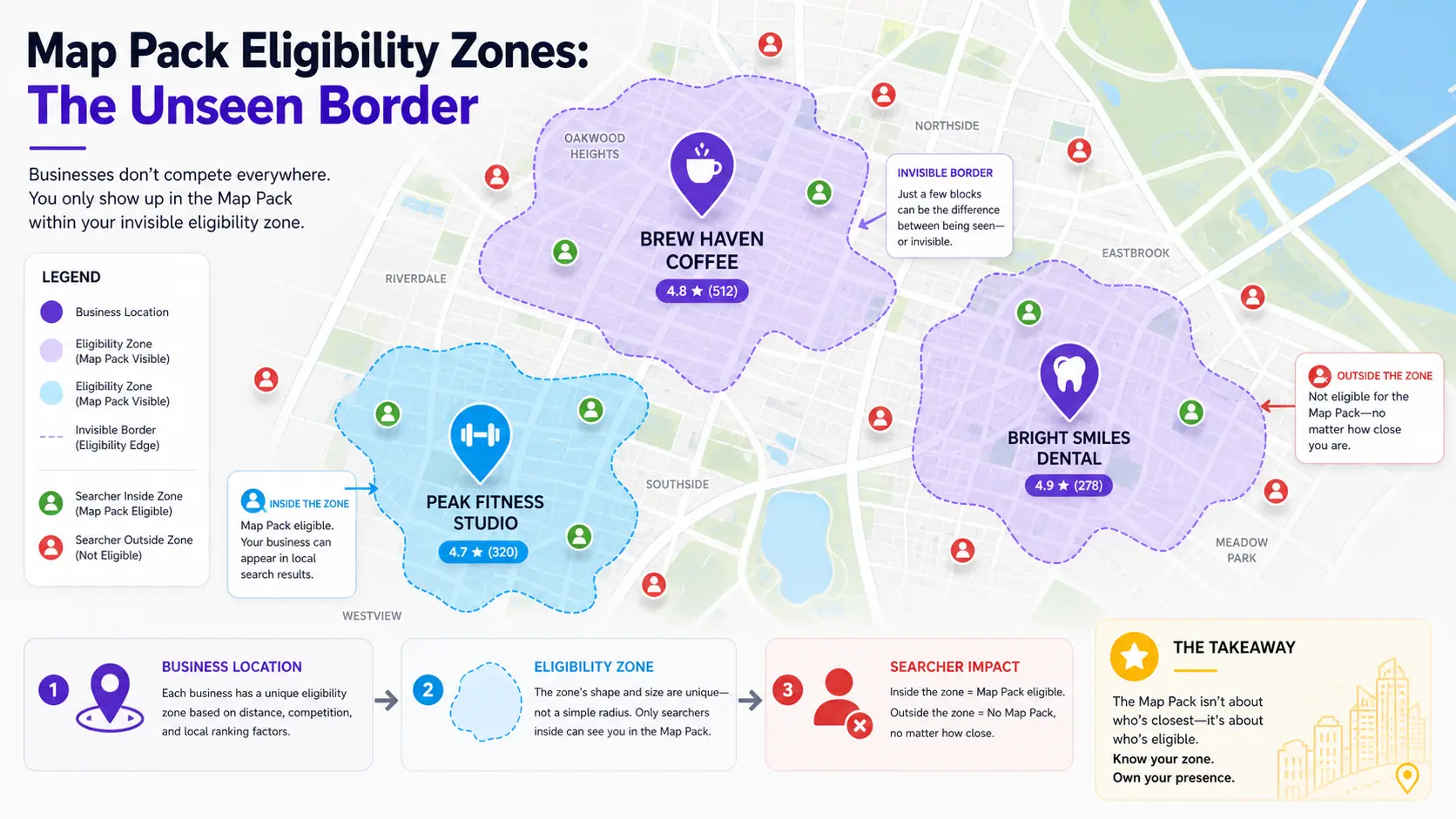
How uneven geography creates visibility gaps across your service area
Your visibility zones aren’t circles – they’re jagged, uneven, and full of blind spots.
A business on a city border may show up everywhere in one neighborhood but vanish without warning on the other side of a major street.
One client with six locations found all their clinics ranked “best in city” within a five-block core, only to fade to nonexistence half a mile west, with zero listing changes.
This isn’t random. It’s a pattern caused by geo‑constrained visibility in local SEO.
Factors like competitor density, irregular city layouts, and invisible eligibility filters create sharp divides.
Why not appear nearby in Google Maps even when you feel “local enough”?
Because the eligibility filter isn’t flexible – it’s a literal gate that doesn’t care about your definition of local.
Think of the proximity boundary as urban cell phone coverage: one step too far and your call drops, even if you’re standing right next to a customer just inside the range.
Service areas can appear robust.
Yet, they often bleed out in thin lines or entire pockets, unaffected by SEO effort.
For leaders, the insight is clear: If you don’t pass the proximity eligibility checkpoint, none of your other efforts count.
Focus first on where you’re already permitted to play.
If this seems restrictive, that’s intentional – understanding what you can’t influence is the key to focusing where you can.

What Causes Silent Drops in Proximity Visibility
Most executives assume visibility drops follow business changes, but some of the sharpest declines happen while nothing on your end has moved an inch.
The real culprit often hides in the way distance is recalculated behind the scenes – shifting like a tide you can’t see, let alone control.
One week, your map pack reach stretches comfortably; the next, it contracts, locking you out of zones you once dominated.
Why does this happen, and why does it feel impossible to diagnose on your dashboard?
Why visibility can vanish without any listing updates
Here’s the myth: “If our Google Business Profile hasn’t changed, visibility should hold steady”.
In practice, proximity filters can tighten overnight without warning or any notification.
We’ve seen clients with consistent reviews, traffic, and name recognition drop off the map – literally – after an unannounced local algorithm tweak or a subtle adjustment in the way Google defines the “local” area for searches.
Imagine a curtain silently lowering between your business and part of the city.
No alerts, no red flags, just sudden radio silence from prospects outside the new radius.
Clients often call frustrated – “Why did we disappear when nothing changed on our end?”
The unsettling answer: your reach is bounded not just by your efforts, but by ongoing recalibration of the rules that decide which businesses get shown to whom.
Algorithmic volatility – where proximity rules change with no notice – is the invisible trigger for silent drops in local search visibility.
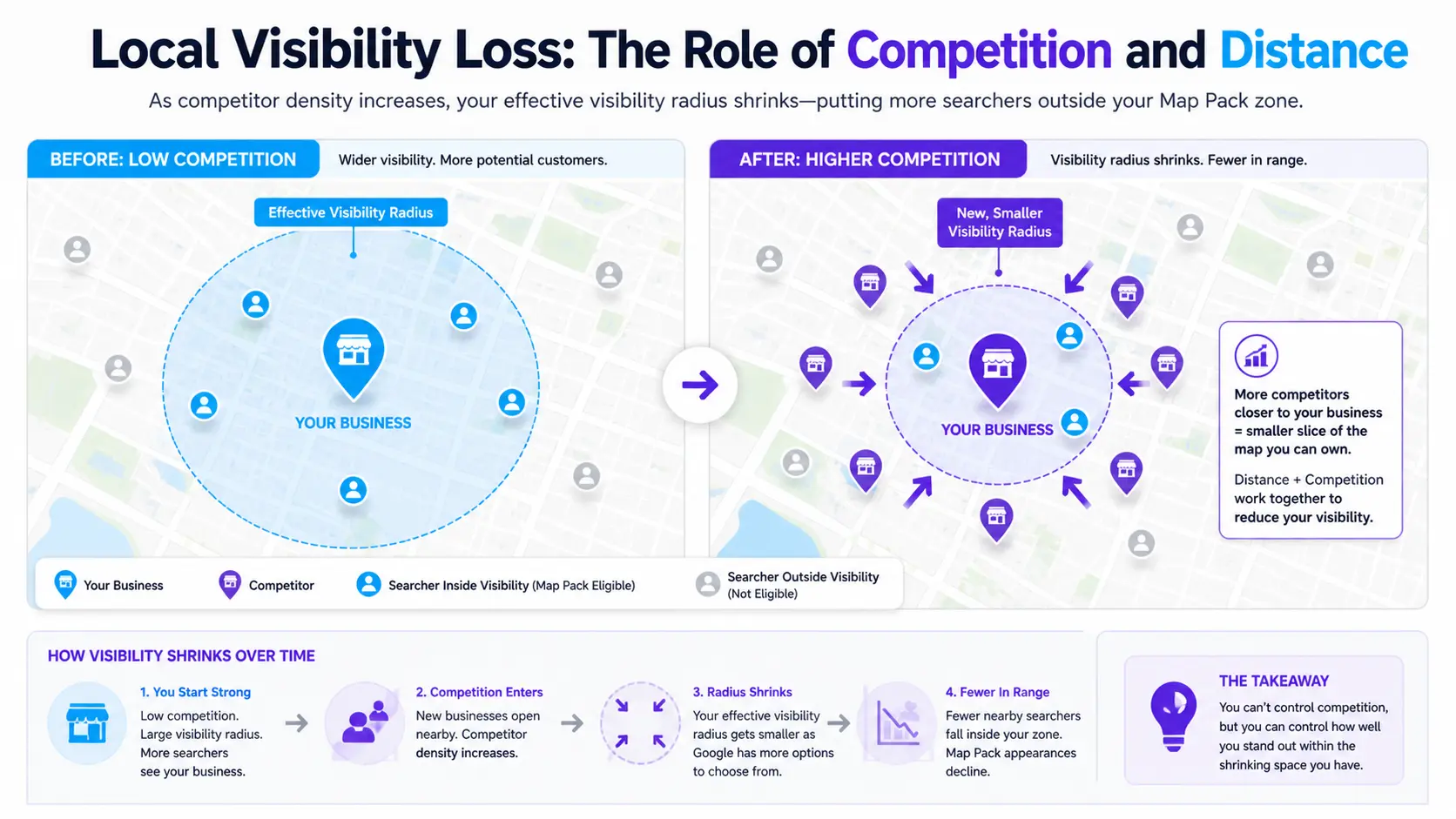
How competitive density shrinks your effective radius
Impact of Competitor Density on Local Visibility Radius
| Step | Action | Purpose | Tools/Methods |
| 1 | Identify key intersections or locations within service area | Cover diverse geographic zones for testing | Internal business knowledge, maps |
| 2 | Conduct searches from each point for the business listing | Determine presence or absence in Map Pack | VPNs, search engine location parameter tools |
| 3 | Record visibility results per location | Map out ‘visible’ vs ‘no-show’ areas | Spreadsheets, mapping software |
| 4 | Analyze geographic patterns and boundaries | Detect uneven or jagged cutoffs | GIS tools or visual maps |
What happens when multiple strong competitors open shop nearby?
The local visibility radius contracts – not always in a straight line, but in complex, uneven patterns.
We’ve observed a national chain lose half its local search footprint just because two mid-sized rivals moved in within a quarter mile.
Even businesses with spotless ratings and hundreds of reviews can watch their service area fade at the edges, not from their own missteps, but from the weight of new neighbors crowding the map.
Proximity gating works like a reverse spotlight: as competition intensifies, the beam gets narrower and more selective with each new entry.
Have you noticed high-performing locations pulling fewer leads from streets they covered just months ago?
That shrinking footprint is often an early signal of density-driven eligibility loss – a silent squeeze that rarely triggers obvious alarms.
The harsh reality: stability is an illusion when your boundary is set by invisible, ever-adjusting lines.
What feels secure this quarter can evaporate the next, even for strong brands.
When silent drops strike, don’t blame internal changes – look first to the shifting, crowd-sensitive shape of your proximity fence.

How to Evaluate Your Proximity‑Driven Visibility Boundaries
Most executives believe their local visibility extends predictably across their city, but the real map looks more like a patchwork quilt, with sharp visibility cutoffs that don’t follow your service intentions.
It’s easy to assume you’re “nearby” in Google Maps for everyone within a reasonable distance – until you test and discover your presence disappears just blocks from your door.
Wondering why you rank “nowhere” just minutes away?
The answer hides in how proximity eligibility fences your results long before SEO performance even counts.
How to measure visibility radius across locations
Checklist for Measuring Proximity-Driven Visibility Radius
| Competitor Density | Visibility Radius Impact | Effect on Business | Example Scenario |
| Low Density | Radius remains wide | Business covers broad area | Few competitors nearby; stable presence |
| Moderate Density | Radius narrows slightly | Edge coverage begins to fade | Several competitors within 0.5 miles |
| High Density | Radius contracts significantly | Major loss of visibility zones | Two mid-sized rivals open within quarter mile |
| Very High Density | Radius constricts sharply | Visibility limited to immediate vicinity | Multiple strong competitors cluster nearby |
The difference between a business that ranks across a metro area and one that only shows down the street often comes down to a single factor: where you check from.
Picture standing at a half-dozen key intersections throughout your service area and searching for your business – sometimes you’re a dominant presence; in other places, you’re invisible.
We’ve seen companies stunned when a five-minute drive is enough to drop them from page one to not found at all.
A practical hint: map pack results act like a focus ring.
The center is bright – your immediate vicinity lights up with your listing.
Edge just a short distance outward, though, and your business fades as if you’ve crossed a hard border.
One client’s visibility radius was less than two miles in one direction and nearly four in another, despite identical marketing strength.
The tool isn’t broken; it’s geo-constrained visibility at work.
If you want to diagnose your actual radius, try location-based searches using VPNs or search engine tools that let you set position.
Separate out which blocks or ZIP codes your business loses visibility in to build a true map of your eligibility.
If you want to know where Google’s “distance filter” draws the line, use live, point-based checks with different VPN locations or location parameters in the search URL.
Aggregate the visible/no-show spots; you’ll quickly see the local eligibility filter SERP in action. Each zipcode – or even block – can tell a different story.
The insight: Visibility in local search isn’t abstract. It’s a shape drawn physically on a map, not on your business plan.
What zone‑specific disparities reveal about proximity constraints
Here’s where most go wrong: seeing poor visibility in a district and assuming it’s a weak spot in their marketing mix.
In reality, uneven geography builds uneven visibility, and the fade‑out radius for local search isn’t always consistent or fair.
A location hemmed in by water or highways can experience a dramatically compressed radius, limiting reach with no fault or fix on your end.
The pattern we observe?
Businesses often dominate in a cluster of neighborhoods – then abruptly vanish as if cut by an invisible border.
That border isn’t a failure; it’s a symptom of proximity gating local visibility.
We’ve told clients: “Don’t blame your content or reviews for a blackout three miles away.
Blame the map pack distance barrier”.
It’s less a leak and more a glass wall separating reachable and unreachable zones.
If you’re seeing wide swings – visible here, gone next door – realize this is systemic, not personal.
That clarity can replace months of false diagnosis with a more confident view: your efforts haven’t failed, they’ve run into a geo-fence.
Proximity eligibility draws your real battle lines.
When you see where the wall is, you’re ready for the next move – not just more of the same.

When Proximity Limits Should Shift Your Strategic Focus
The trap is thinking you just need to stretch harder – more content, more reviews, bigger budgets – to force your way past the invisible wall.
Except sometimes, the harder you push, the less it moves.
Most leaders don’t realize proximity eligibility isn’t a lever – once you hit its edge, the engine stalls until you shift strategy entirely.
Geographic constraints aren’t always technical puzzles to solve, but gates that signal it’s time to build strength elsewhere.
When local eligibility constraints are unsolvable through proximity alone
You can diagnose and optimize until your reports glow, but if your business is physically outside the local eligibility filter, more proximity tricks won’t generate visibility.
We’ve seen service brands dominate visibility in their primary pocket, only to watch impressions drop to zero two streets over – regardless of trust signals, consistency, or spend.
This isn’t a measurement or execution gap.
It’s the rule of the geo-constrained visibility local SEO barrier: when the proximity filter says “out”, no downstream tactic overrules it.
To put it simply, proximity gating in local search is like a security door with no keypad – either you’re on the list for that radius, or you’re left standing outside, no matter how persuasive your credentials.
The urge to fix, expand, or patch local visibility from the outside-in is strong.
Yet the myth that more SEO effort can always overcome local eligibility is the fastest path to wasted resources.
The real skill is recognizing when the game has moved to a different arena entirely.
What business moves are possible once eligibility is unlocked
Once a business crosses the eligibility threshold – inside the map pack distance barrier and free of fade‑out radius local search visibility limitations – everything changes.
Now, trust and consistency come into play.
We’ve watched professional service franchises double their lead volume simply by shifting from proximity obsession to reputation acceleration across every eligible location.
Visibility can be a feast or famine situation: eligibility unlocks the door, but credibility walks you inside.
A word-for-word insight from the front lines: Eligibility sets the arena; trust wins the crowd.
When your spot on the map is secured, investments in ratings, reviews, and NAP consistency start moving the needle where proximity once blocked progress.
Are you still fighting the distance filter, or are you ready to compete on trust and experience?
Proximity gates are a signal, not a command – spot them, accept the limit, and channel your efforts where the payoff starts multiplying.

Scientific context and sources
The sources below provide foundational context for how decision-making, attention, and performance dynamics evolve under scaling and constraint conditions.
- Proximity Effects in Digital Information Access
The Geographies of the Internet – Matthew A. Zook – Annual Review of Information Science and Technology
Explores how digital information is unevenly distributed across space, showing that access, visibility, and representation are shaped by geographic factors, with certain regions systematically advantaged in search and information systems.
https://asistdl.onlinelibrary.wiley.com/doi/10.1002/aris.1440400109 - Algorithmic Filtering and Local Relevance
Towards a Study of Information Geographies – Mark Graham, Stefano De Sabbata – Oxford Internet Institute / research paper
Demonstrates that digital platforms apply geographic and structural filters, producing uneven visibility where some locations are overrepresented and others excluded regardless of content quality.
https://www.researchgate.net/publication/281059919_Towards_a_Study_of_Information_Geographies_ImMutable_Augmentations_and_a_Mapping_of_the_Geographies_of_Information - User Perceptions of Location Bias
Cyberspatial Proximity Metrics: Reconceptualizing Distance in the Digital World – Matthew Zook, Frederik Devriendt, Martin Dodge – Journal of Urban Technology
Shows that even in digital environments, perceived and functional distance still matters, with users interacting more with geographically proximate information despite global accessibility.
https://www.zook.info/2011_Zook_Devriendt_Dodge-Cyberspace%20Proximity%20Metrics_JUT.pdf - Geo-Constrained Digital Competition
The Geography of the Internet Industry: Venture Capital, Dot-coms, and Local Knowledge – Matthew A. Zook – Blackwell Publishing
Demonstrates that digital markets cluster geographically due to local knowledge, capital, and network effects, meaning competition and visibility are still shaped by location rather than purely global performance.
https://ndl.ethernet.edu.et/bitstream/123456789/44178/1/15.Matthew%20A.%20Zook.pdf - Decision Limits and Search Algorithms
Models of Bounded Rationality – Herbert A. Simon – MIT Press
Establishes that decision systems operate using rule-based simplifications and thresholds, meaning algorithms often rely on eligibility filters (e.g., proximity, category constraints) rather than evaluating all possible alternatives.
https://mitpress.mit.edu/9780262192057/models-of-bounded-rationality-volume-1/
Questions You Might Ponder
How does proximity eligibility in local search restrict which businesses appear in Google Maps?
Proximity eligibility in local search creates a strict radius around the searcher. Only businesses within this invisible boundary are shown in map results, regardless of their quality signals or relevance, making location the primary gatekeeper for visibility.
Why does my business vanish from search results just a few blocks away?
Local search uses a non-negotiable distance filter. If a user’s location crosses this eligibility boundary – even by a block – your business can abruptly disappear from results. The filter ignores trust, reviews, or domain strength once distance is too great.
Can improving SEO or getting more reviews extend my map pack visibility further?
No. Unlike other ranking factors, proximity eligibility is uncompromising. Regardless of SEO, reviews, or authority, your map pack visibility does not ‘stretch’ beyond Google’s fixed proximity barrier – more effort won’t alter this cutoff.
What causes sudden drops in local search visibility for my business without any changes on my end?
Algorithmic changes, competitor influx, or Google’s recalibration of local boundaries can reduce your eligible service area overnight. Even with consistent operations and reviews, proximity gating rules can shift, causing visibility to contract sharply and silently.
What’s the best way to measure my business’s true proximity-driven visibility area?
Use VPNs, location-specific search tools, or Google’s own location parameters to run searches from various points around your city. Mapping where you appear (or don’t) lets you visualize your real eligibility zones and optimize strategy accordingly.