
What You’ll Learn
Geo variance in local search visibility is the block-by-block change in whether a business appears in local results based on the searcher’s exact location, proximity thresholds, competitor density, and user engagement signals.
It means a business may rank well in a city, metro area, or one neighborhood, yet disappear a few streets away because local search applies micro-market filters before broader SEO strength matters.
Geo-variance is not always a listing problem; it can reflect proximity eligibility, neighborhood-level competition, or behavioral signals such as clicks, calls, directions, and listing interactions.
Accurate diagnosis requires testing visibility from multiple physical points, not relying on one city-wide ranking.
Key Takeaways
- Proximity is the primary gatekeeper in geo‑variance for local search visibility; even top-rated businesses may be excluded outside a narrow radius.
- Neighborhood-level ranking volatility is routine; metro or city rankings do not ensure micro-market presence and can mask invisible gaps.
- Behavioral factors, including clicks and calls, are critical tiebreakers that can override simple proximity, especially in high-density urban markets.
- Accurate diagnostics require mapping both spatial and engagement-driven patterns; identifying the true driver unlocks effective local SEO strategy.
Most companies believe local search is about reputation and relevance.
The unspoken reality: If you’re outside a searcher’s invisible distance threshold, your brand may as well not exist.
Proximity isn’t a tie-breaker – it’s the first filter, a hard cut-off that determines whether you’re even in the race.
Businesses often focus on reviews or categories, but the geographic eligibility logic almost always trumps those factors.
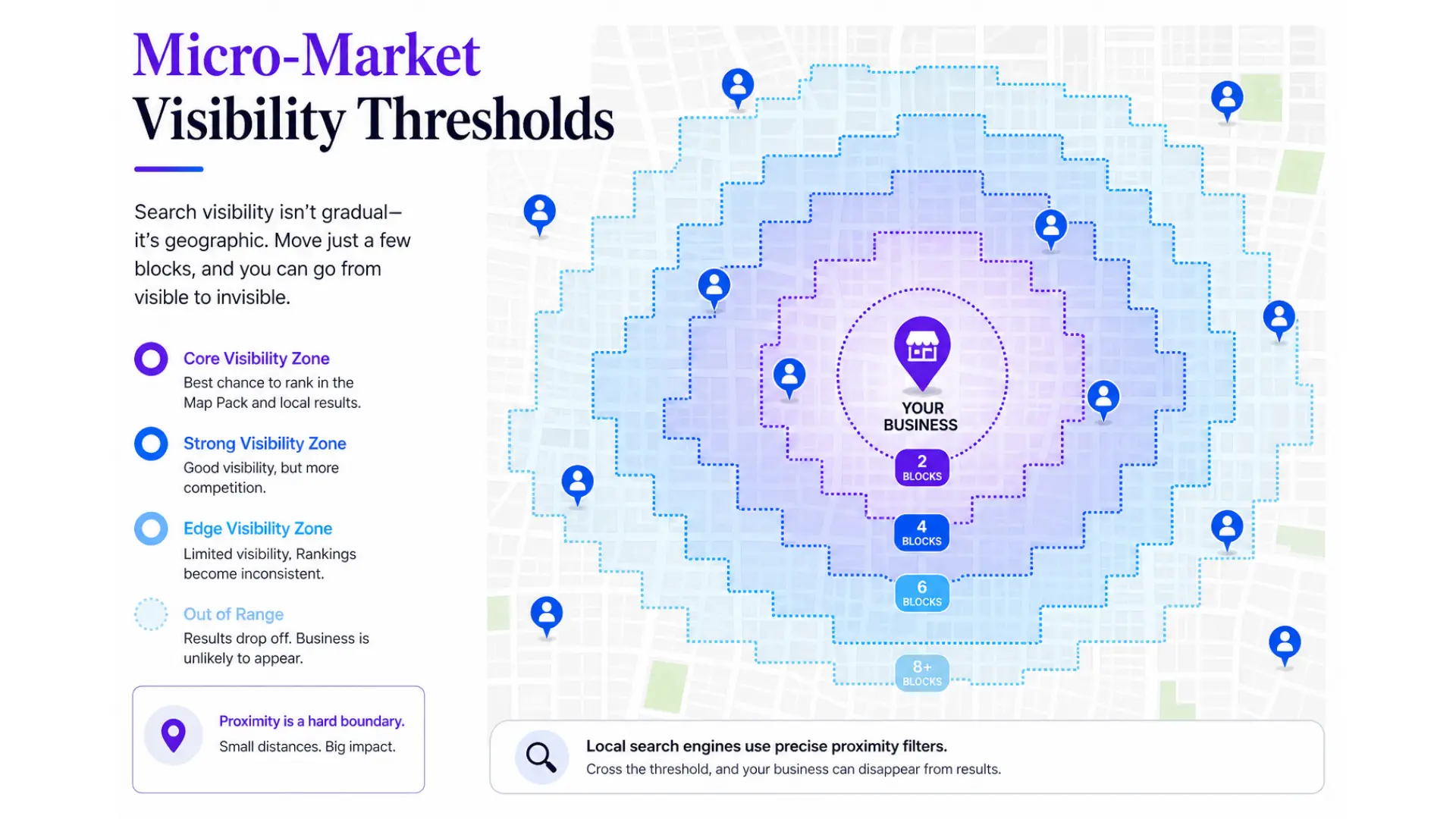
The difference between showing up and being filtered out can be as little as two blocks.

Why proximity acts as a literal gate to visibility
Picture a coffee shop ranking #2 for “coffee near me” from one street but completely vanishing two blocks over.
This isn’t bad luck – it’s baked into the literal ‘near me’ proximity gate of every local search.
In practice, Google’s local pack and map listings use strict micro-market boundaries to decide what’s “local” enough to display.
How micro‑market distance thresholds create inconsistent appearance
One executive client with 15 branded locations noticed a wild pattern: Some stores dominated in their census block but dropped off the map just a half-mile away, even as their competitors held steady.
The myth: broader area ranking equals universal presence.
The reality is much harsher – neighborhood-level ranking disparity is routine.
Visibility volatility by distance isn’t a bug; it’s core to the algorithm.
Is your business actually visible where your customers are, or only where you happen to be headquartered?
The answer often isn’t obvious until you look neighborhood by neighborhood – a micro‑market search visibility audit always surfaces surprises.
Quantifying proximity’s weight in ranking models
Relative Weight of Proximity vs Other Local Ranking Factors
| Symptom | Likely Cause | Typical Pattern |
| Visibility drops sharply beyond consistent radius | Geo-location proximity filter | Clean cutoff aligned with distance thresholds |
| Inconsistent visibility near searcher despite proximity | Listing or trust issue | Unpredictable drops even within close range |
| Competitors with weaker profiles visible farther away | Listing suppression or behavioral weighting | Competitor appears despite distance, client vanishes locally |
Proximity is the dominant factor. Fresh data from local pack studies shows being geographically closest accounts for over 50% of your initial visibility – outweighing reviews, keywords, or overall relevance combined.
A practical analogy: Think of proximity as the bouncer at a club.
No matter the quality of your “credentials” (reviews, keywords, business hours), if you’re not within the allowed radius, you’re not getting in.
In client audits, we’ve seen multi-location brands get filtered out simply because their location sits outside the searcher’s literal proximity fence – even when their reputation is flawless.
If you’re planning expansion or evaluating why high-performing locations drop off in search, remember: Proximity sets the ground rules before anything else matters.
The literal gate isn’t just a filter – it changes how you diagnose, prioritize, and ultimately grow hyperlocal presence.

Why visibility cliffs happen between broader and neighborhood contexts
What looks like market dominance in a city-wide search can evaporate within a quarter mile.
The neighborhood border you cross on foot is often a digital cliff edge in local SEO.
This is the classic “visibility cliffs city vs state search” – ranking volatility by metro is built in, not a glitch.
Most executives assume strong metro or state visibility secures neighborhood presence.
In reality, broad rankings can conceal steep drop-offs at the micro‑market level, creating phantom coverage that misleads growth teams.
State or metro visibility can mask hyperlocal invisibility
Picture this: your brand ranks for ‘best dentist in Dallas,’ but for ‘dentist near me’ just down the street, you vanish.
That’s the proximity constraint in local visibility – ‘city rank’ doesn’t equal micro-market eligibility.
The myth: City or metro-level rankings reflect granular coverage.
The daily reality: high placement at a regional scale doesn’t guarantee eligibility inside a smaller radius.
One client gained strong traction in metro-wide queries, but lost 70% of high-intent traffic because their location fell outside the hyperlocal filter baked into Google’s local pack.
It’s like owning a billboard on the highway that can’t be seen from the side streets – impressive reach, but half your local audience is functionally locked out.
Broad visibility is the floor, not the ceiling.
Meet the micro‑market threshold, or the map wipes you out.
City‑specific volatility in high‑value markets
Nowhere are these cliffs sharper than in high-value, saturated cities.
We’ve seen hospitality operators with dense, star-studded profiles lose nearly all local pack placements moving from city to neighborhood search within Manhattan.
Visibility volatility isn’t linear – drop-offs are sudden and dramatic, triggered by subtle shifts in searcher location, time of day, and even device settings.
There’s a pattern here: cities with dense clusters of “near me” queries and numerous competitors create a literal eligibility lottery at the block-by-block level.
A restaurant might appear at the top for New York City searches, but vanish from results the moment the filter zooms to “East Village”.
Why?
The ranking volatility is part geographic eligibility logic, part competition density.
If you’ve ever wondered why a revenue hotspot suddenly dries up, check not just where you rank, but whether you rank at all as the search radius closes in.
Visibility cliffs aren’t gradual – they’re abrupt. Recognizing and mapping these drop-offs is the first move toward reclaiming ground others don’t even see vanishing.

How behavioral significance can deepen or override proximity limits
Some businesses appear inside the local pack while their equally close competitors stay buried – and it’s almost never by accident.
If you think proximity alone explains those sudden shifts in neighborhood‑level rankings, watch what happens when users start clicking and calling: the map changes.
Engagement, not just geography, now steers visibility in the toughest micro‑markets.
Engagement metrics reshape local ranking after proximity gate
Clicks, calls, and direction requests aren’t just passive signals – they’re the currency of micro‑market search visibility.
Most teams overlook this: winning the proximity gate simply buys you a ticket.
The real ranking war starts when Google weighs how searchers interact with each candidate, measuring who actually earns attention, not just whose pin sits closest.
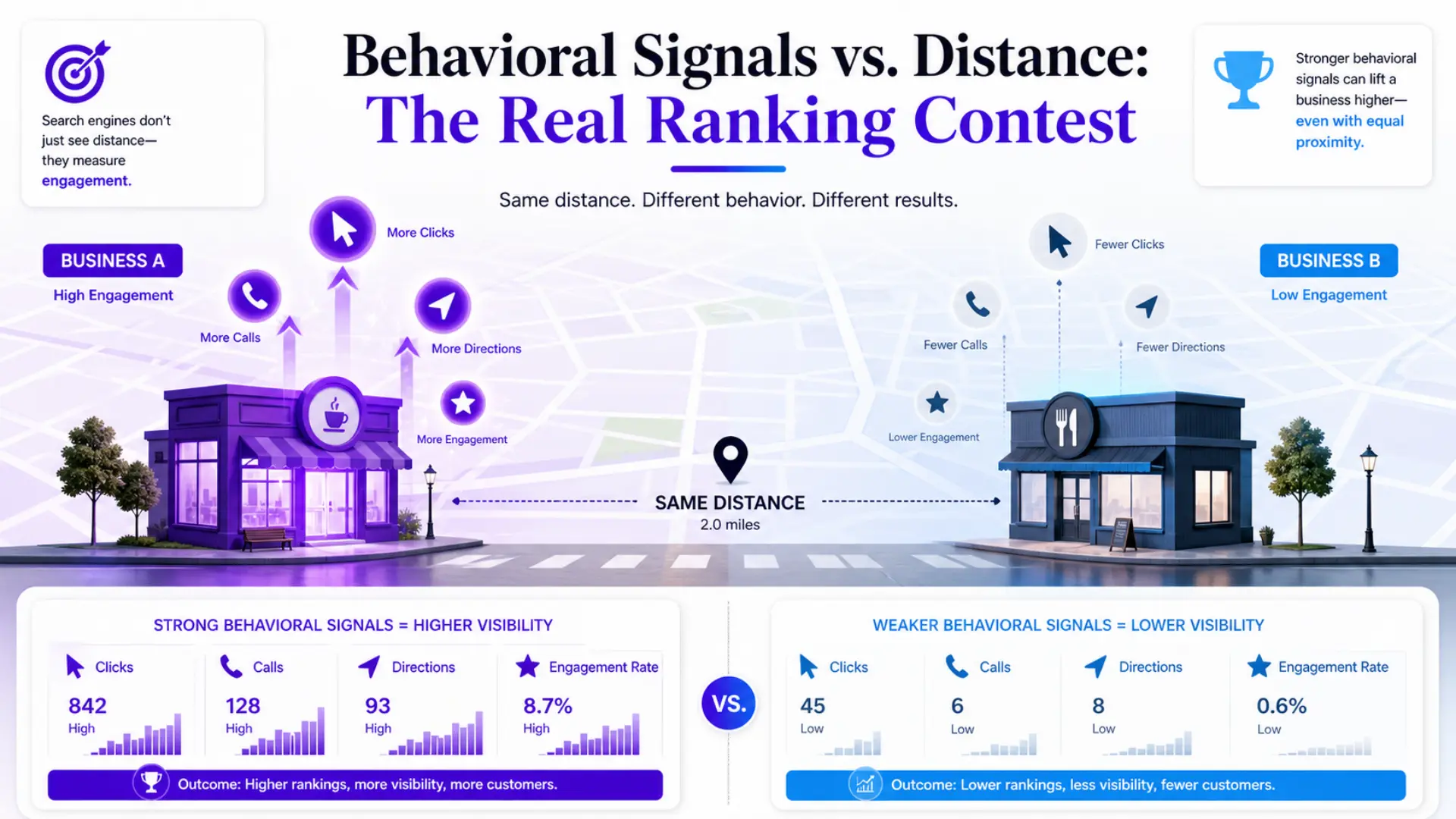
We’ve seen this pattern in high‑density neighborhoods: two stores, equal distance from the searcher, yet only one consistently tops local results.
The difference?
Volume and recency of real engagement – think: surges in phone taps after a weekday lunch rush, or a spike in driving directions on the weekend.
One location pulled ahead for weeks because its Google listing added a click‑to‑call offer, doubling its call volume practically overnight.
Think of micro‑market visibility as dynamic: each interaction you earn can shift your position almost in real time.
The pace and recency of engagement steadily reshapes the rankings – it’s not fixed real estate, but a moving contest.
Why does this matter for executives?
Because proximity is no longer the great equalizer once behavioral signals pour in.
It’s why a drop in engagement can knock a formerly dominant location off the first page, even if the address hasn’t changed.
Why two equidistant businesses perform differently
You might assume two shops located across the street should enjoy equal visibility, but actual results show persistent gaps.
The myth: location parity guarantees even footing.
The reality: Google interprets ongoing user interactions as votes of relative helpfulness for nearby options.
For example, when a client’s two clinics launched identical proximity campaigns, the one with richer review responses and faster reply times to direct inquiries consistently ranked higher – regardless of identical geo‑positions.
Another business found that adding real‑time Q&A to its listing created a burst in click‑through and direction requests, driving up its map position versus next‑door competitors.
In micro‑market search, behavior can outweigh blocks.
Two businesses separated by fifty feet may live worlds apart in digital visibility if one turns engagements into signals and the other goes silent.
If your location is showing up everywhere but getting cold engagement stats, don’t blame the pin – diagnose the relationship with your users first.
Growth comes to those who look past the map and tune their presence for every touch.
In micro‑market search visibility, behavioral nuance – not just being closest – can propel one site ahead of an equally located competitor.

Diagnostic implications for understanding uneven visibility patterns
You can solve the wrong problem for months if you don’t diagnose what’s really driving your local search gaps.
Two businesses with identical reviews and nearly identical locations can show up in different search packs – and it’s not always clear why at first glance.
Is your listing invisible because it’s simply outside the geo-fence, or is it quietly being held back for trust or behavioral reasons?
This is where most diagnostics veer off course: latching onto surface changes instead of isolating the actual bottleneck.
When to investigate geo‑location eligibility vs listing issues
Diagnostic Checklist: Geo-Location Eligibility vs Listing Issues
| Ranking Factor | Relative Influence (%) | Role in Ranking |
| Proximity | 50+ | Primary filter determining visibility eligibility |
| Reviews | 20-25 | Influences ranking within proximity-eligible businesses |
| Keywords/Relevance | 15-20 | Supports relevance but secondary to distance |
The difference between a distance filter and a trust problem is subtle – until you map the clues.
If your business is visible up close but drops cleanly beyond a certain radius, geo-variance in local search visibility is likely working as intended.
But if competitors with weaker profiles remain visible while your listing vanishes, you’re not up against the proximity constraint local visibility, but a deeper listing or trust stability issue.
From real client audits: We’ve seen cafes appearing in the top 3 for “coffee near me” within a four-block range, then vanish as soon as a searcher crosses the main boulevard – always at nearly the same distance.
The eligibility boundary is sharp, not gradual.
That’s not an optimization issue.
Compare that to a franchise location losing visibility even when searchers are standing next door, while nearly identical branches show up everywhere.
That’s not about neighborhoods – that’s about the location’s eligibility or a suppressed listing.
Ask yourself: Is the dropout tied to distance, or is it consistently unpredictable regardless of geography?
Simple analogy: Think of your eligibility like the coverage area of a streetlight.
The beam (your presence) falls off predictably – unless the bulb is damaged, and whole patches of sidewalk go dark for no visible reason.
Signals that suggest proximity vs behavioral constraints at play
Look for signature patterns: strong visibility when someone stands close, disappearance further away is classic proximity gating.
But, if rankings shift after repeated clicks and calls, behavioral engagement is moving the needle – micro-market search visibility shaped by action, not just location.
In one retail project, a client with multiple sites dominated city-level visibility but failed to show up a mile away, unless searchers interacted with their listing first.
That in itself is a clue: The location filter in the local pack isn’t the only test – behavioral signals push visibility further, sometimes overriding pure distance.
If performance flips based on engagement metrics (not just where the searcher stands), you likely have a case where the proximity wall is being bent – or broken – by behavioral weight.
True visibility volatility by distance reveals itself in the pattern, not the numbers.
If you’re consistently visible “here”, invisible “there”, distance is the switch.
If engagement flips the switch, look deeper.
Geo-variance in local search visibility isn’t just a quirk – it’s the first signal.
Most people misread this because rank checking is misleading.
Find the root cause, and diagnosis unlocks strategy.

Scientific context and sources
The sources below provide foundational context for how decision-making, attention, and performance dynamics evolve under scaling and constraint conditions.
- Geo-spatial Context in Information Retrieval
GeoSearcher: Location-Based Ranking of Search Engine Results – C. Watters, M. Shepherd – Journal of the American Society for Information Science and Technology
Introduces a ranking model that integrates geographic coordinates into search results, showing that distance and spatial relevance directly re-rank results, acting as a primary inclusion and ordering mechanism in location-sensitive queries.
https://ideas.repec.org/a/bla/jamist/v54y2003i2p140-151.html - Algorithmic Filtering and Urban Geography
Google Search in India: Unveiling the Geo-Personalized Web – P. Chatur et al. – ACM Digital Library (2024)
Provides empirical evidence that search engines apply geo-personalization filters, significantly altering ranking outputs depending on user location, confirming the existence of algorithmic geo-fencing and localized ranking behavior.
https://dl.acm.org/doi/10.1145/3632410.3632420 - Behavioral Decision-Making in Local Contexts
You Are How (and Where) You Search: Comparative Analysis of Web Search Behavior – A. Urman, et al. – Computational Communication Research / PMC
Shows that user behavior and engagement patterns vary by geographic context, influencing both what is shown and how users interact with results, reinforcing that location and behavior jointly shape visibility and outcomes.
https://pmc.ncbi.nlm.nih.gov/articles/PMC10155157/ - Effect of Engagement Signals in Ranking Algorithms
Case Study: The Impact of Location on Bias in Search Results – G. Gezici – arXiv
Demonstrates that search engines adjust ranking outputs based on location-dependent interaction patterns and bias signals, showing that engagement and geographic context together influence retrieval performance and ranking differences.
https://arxiv.org/abs/2206.11869
Questions You Might Ponder
What is geo‑variance in local search visibility and why does it matter?
Geo‑variance in local search visibility refers to the way business listings appear or disappear based on precise searcher location. This matters because even high-reputation businesses can vanish from results within a few blocks, impacting market reach and customer acquisition at the hyperlocal level.
Why do local search rankings change so quickly within short distances?
Local search rankings change due to strict proximity filters in search algorithms. These create micro-market boundaries, causing listings to drop off sharply as a searcher moves beyond a set radius, making visibility highly sensitive to location – even between neighboring streets.
How does user engagement impact local search ranking beyond proximity?
User engagement metrics – such as clicks, calls, and direction requests – influence which nearby businesses are favored in rankings. After meeting the proximity threshold, listings that earn more real-time interactions are boosted, meaning behavioral signals can shift results beyond pure location.
Why doesn’t strong city or state visibility guarantee neighborhood presence?
Visibility at the metro or state level often fails to reflect true neighborhood coverage because hyperlocal filters apply stricter distance criteria. A business may rank city-wide but be excluded from critical “near me” searches just blocks from its physical location due to these tighter boundaries.
How can businesses diagnose if low rankings are caused by proximity or listing issues?
To diagnose, map your visibility at various distances. If you vanish cleanly at a set radius, proximity limits are responsible. If you disappear unpredictably, regardless of distance, listing or trust issues may be the cause. Audit engagement data and Google My Business settings to identify the culprit.