
What You’ll Learn
Local visibility consistency failure is the loss or instability of local search visibility caused by inconsistent business identity signals across Google Business Profile, directories, schema, website data, internal links, and third-party sources.
It happens when search and AI systems see conflicting versions of a business name, address, phone number, category, suite number, hours, or structured data and can no longer form a stable entity match.
These mismatches may look minor to humans, but algorithms treat them as evidence of uncertainty.
The result can be map pack exclusion, voice search omission, ranking volatility, or silent visibility loss even when SEO, reviews, and the main website appear unchanged.
Key Takeaways
- Even minor data inconsistencies across local listings erode trust, causing invisibility in AI-powered local discovery.
- Search algorithms prioritize stable, repeatable NAP signals over rare, perfect details – pattern consistency is critical.
- Entity fragmentation arises from mismatched business identifiers, leading to silent exclusion from maps and recommendations.
- Background technical inconsistencies (schema, internal links) frequently drive sudden, unexplained local ranking drops.
A single misplaced suite number or inconsistent business name can erase your local presence – even if everything else is flawless.
Most executives expect minor mismatches to be treated as background noise; search algorithms do the opposite.
They interpret conflicting signals not as harmless mistakes, but as evidence that your entity can’t be trusted at scale.
This is not a margin-of-error world.

When Stable Identity Fails: Why Minor Inconsistencies Shut Down Local Visibility
We’ve seen businesses vanish from map packs and voice search overnight, not because of penalties, but because bots encountered three slightly different NAP entries in top directories.
The myth is that search tolerates local data “fuzziness”.
In reality, inconsistency cues unreliability and triggers silent exclusion.
Google isn’t cross-referencing your business details the way a local resident would – it’s building a probabilistic identity fingerprint.
If the prints don’t match, you’re invisible.
Why search treats conflicting details as a trust breakdown, not noise
Picture search systems as border agents, not librarians.
They’re designed to spot fragmentation as a risk, not a clerical oversight.
If your business appears with two phone variations or operates under slightly divergent addresses, it looks unstable.
Patterns, not intentions, lock in trust.
This silent filtering explains why two virtually identical businesses can have wildly different visibility – one trusted, one sidelined – based solely on consistency.
That broader visibility constraint is outlined in Local Search Visibility.
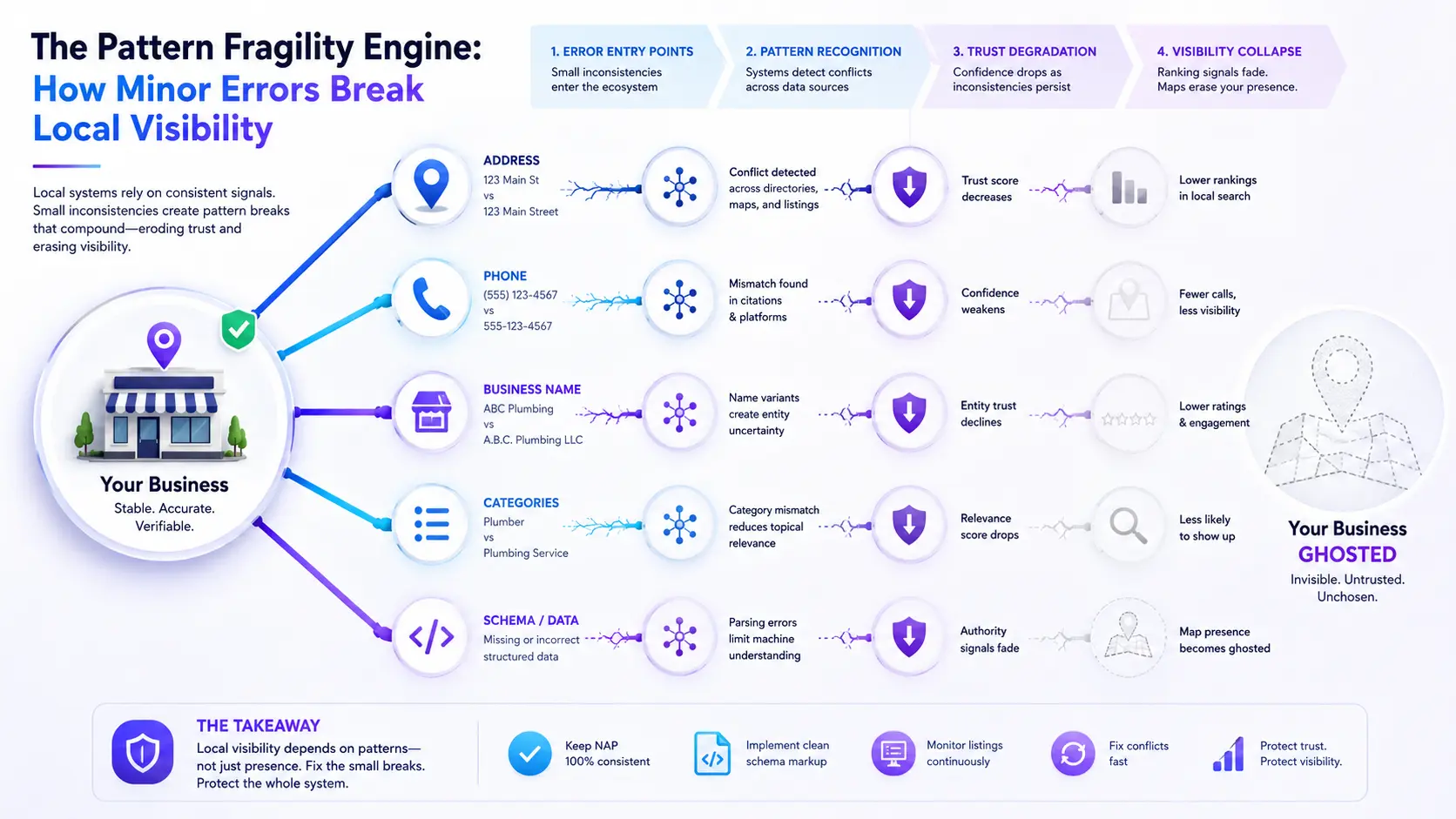
How AI-driven discovery systems exclude businesses with fragmented entity data
AI assistants and local discovery engines see fragmented data as a red flag, not a tolerable quirk.
When their models encounter mismatched details – an address here, a phone number there – they err on the side of exclusion.
It’s not punishment; it’s risk minimization.
We’ve worked with brands expecting incremental drops, only to find they’re simply missing from local recommendations after minor data syndicated mismatches.
The analogy here: think of an AI assistant like a bouncer with a razor-sharp memory.
Show three forms of ID with slight differences and you’ll be left outside, no matter how accurate most of your credentials are.
Pattern recognition is the trust gatekeeper – if the pattern breaks, so does your eligibility.
This behavior is amplified in voice search and map apps, where discovery relies on instant, unambiguous confidence in the entity presented.
Is your business being left out because of a competitor’s aggressive campaigns?
Or are you simply failing the “stability test” of modern AI filters?
What looks like a gentle traffic slide is often total omission, triggered by small, overlooked inconsistencies.
Don’t assume small mismatches are harmless.
For AI and search, they’re evidence of instability.
That’s why fragile consistency is the silent killer of local visibility.

Why Consistency Matters More Than Accuracy in Local Trust Systems
Most executives overestimate the value of an occasional, perfectly correct listing.
In reality, local trust algorithms reward relentless predictability.
A single error repaired in isolation barely moves the needle – but erratic details repeated just twice can break local visibility for weeks.
Why?
Because for machine-driven trust, pattern stability beats momentary accuracy every time.
Why predictability builds confidence faster than correct-but-rare signals
Imagine you’re handed ten IDs for the same person – nine match, one’s flawless but shows up once and never again.
Which would you trust?
Search platforms behave the same way: repeated details, even if not perfect, build confidence faster than sporadic flashes of accuracy.
Our own work shows that listings with near-identical data across ten sources outrank technically perfect but inconsistent profiles every time.
The myth: a single, manually-perfect citation will recover lost visibility.
In practice, algorithms look for steady, recognizable signals – a pattern more reassuring than a scattered handful of pristine details.
Even sophisticated teams get lost chasing corrective sprints when what matters is quiet repetition over time.
Predictability is the foundation of entity trust – systems don’t remember occasional accuracy, they remember consistent signals.
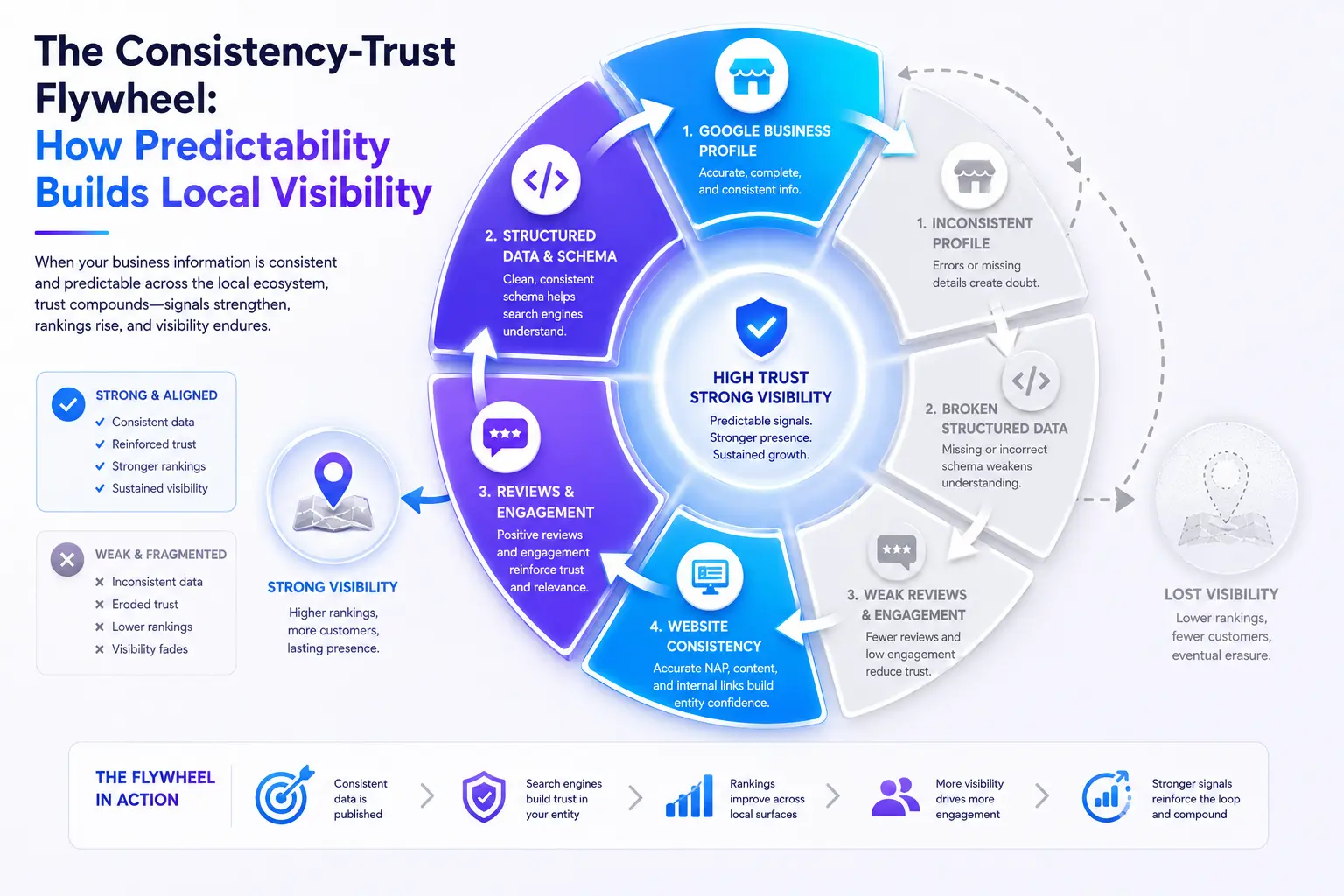
How inconsistency creates volatility even without branding or site changes
Here’s the mistake: assuming no visible rebrand or website overhaul means local presence is safe.
In fact, volatility from identity inconsistency operates beneath the surface.
Multiple times, we’ve seen site traffic drop overnight despite zero changes on the client’s end.
The culprit?
Subtle, rolling mismatches in business data – such as an extra hyphen on one aggregator or a slowly propagating street abbreviation – that AI-driven systems spot as instability.
One client watched their ranking evaporate with no warning, simply because a partner directory updated their phone number format.
No alert, no obvious break.
The analogy: it’s like trying to win a relay race when the baton keeps shifting weight mid-hand-off – one fumble, and you’re out, long before anyone notices why.
If your team sees a silent local visibility drop, don’t blame algorithm changes or lack of optimization.
Blame volatility from fractured patterns.
The cost?
Trust is not lost loudly – it just quietly leaves.
Consistency beats precision, every time.
That’s the quiet force driving trust in local systems, and the hidden threat behind sudden invisibility.

Fragmented Identity: How Disjointed Signals Trigger Local Visibility Erasure
It only takes a single mismatch – a wrong abbreviation, a swapped phone number, a stale suite reference – for local systems to start questioning if your business is even real.
The brutal reality?
Most visibility losses happen not from what you change but from fragmented signals you didn’t even notice.
Patterns get fractured in silence, and sooner than you think, your business starts vanishing from maps and recommendation lists without warning.
When inconsistent NAP or listing details break entity recognition
Local discovery systems aren’t hunting for pixel-perfect accuracy – but the moment your business name, address, or phone (NAP) spin out of sync, you trigger silent suspicion.
Unlike a human who shrugs off an old phone number or a typo, algorithms treat every inconsistency as a possible warning flag.
What’s worse: even a minor abbreviation (“St”. vs “Street”, “#204” versus “Suite 204”) can create what amounts to a second digital identity.
From a decade in agency work, we’ve seen businesses disappear without a trace in local listings after a well-meaning directory “update” added a hyphen or missed a unit.
Even small, atomized changes stack up – and algorithms panic when multiple partial matches fragment your entity into versions that don’t quite overlap.
One favorite client once wondered why calls dried up only in select cities.
After weeks in the trenches, we traced it to a mismatched listing on a niche aggregator using the outdated address format.
Fixing that single source snapped recognition back across dozens of other sites.
Imagine a chorus singing in harmony, then one voice slips off-key – the entire performance is suddenly suspect.
Does it matter if your main site and GMB are flawless?
Not if even one authoritative listing prefers the old address or phone.
The myth: as long as core sites are right, stray listings don’t matter.
The reality: every authoritative NAP source is a pattern piece, and gaps let trust bleed out invisibly.
Where the system can’t form a confident link, it creates a void – what you think is a minor error is actually the difference between being recognized and being ignored.
Why missing schematic or internal linking undermines technical clarity
Technical clarity isn’t just about having an up-to-date site or a filled-out Google profile.
Local systems, especially AI-driven ones, scan for schematic structure and reinforced links between your site, your GMB, and other citations.
Missing schema markup or broken internal links keep identity signals isolated, turning a business into a fractured story instead of a singular entity.
One vivid example: a regional chain updated its name on the website but left structured schema and internal references half-matched.
For months, main rankings held – then suddenly local placements collapsed in high-density ZIPs.
The piece missing?
There was no machine-readable connection tying updated brand data back to their listings.
Without a technical trail of breadcrumbs, discovery systems defaulted to safer, simpler matches – often their competitors.
It’s like putting up a new storefront but forgetting to tell the post office and delivery drivers; your business becomes invisible even with the sign in place.
The analogy: fractured signals work like overlapping but incomplete fingerprints – no system can build a confident match, so every search feels risky, and the business is quietly erased from the candidate pool.
Visibility erasure from fragmented identity isn’t loud.
It’s the slow fade where presence is replaced by silence – where consistency failure doesn’t just fracture rankings, it deletes you from the local story entirely.

Silent Volatility: Why Stability Fails Without Warning in Local Visibility
Most executives assume local visibility collapses only after dramatic changes – a website overhaul, a rebrand, or sudden negative reviews.
The reality is far more unnerving: local search systems can cut your presence without any visible event, and teams often don’t notice until it’s too late.
Why?
The answer usually sits in the silent background, where pattern recognition algorithms hunt for subtle inconsistencies and punish volatility even when all front-facing details seem untouched.
Why unchanged data can still lead to invisible presence shifts
Here’s the myth: if you haven’t changed your business data, your visibility should remain unaffected.
In practice, local search systems don’t just measure what’s new – they constantly reassess background signals for consistency across every source.
The trap isn’t in obvious mistakes, but in weak signals or minor timing mismatches: a phone number update on one aggregator that never syncs to a secondary directory, a GMB field that quietly reverts, or an old address left in the structured data deep in your site.
These silent inconsistencies often go unnoticed because – on the surface – nothing appears wrong.
In client audits, we repeatedly find brands blindsided by ranking drops even though they hadn’t touched a single public-facing element.
There wasn’t a penalty.
There wasn’t even a crawl issue.
But background entity signals (the ones you never see in a basic audit) started drifting out of phase, and the local system responded with exclusion.
Why does this happen?
Pattern recognition systems thrive on certainty.
The analogy: Think of a bank’s fraud model triggering a hold when transfers appear subtly out of sync – even if each transaction, viewed alone, makes sense.
Local search works similarly: it isn’t looking for a single red flag but for statistical harmony over time.
When that harmony flickers – even slightly – the trust gate tightens, and your listing fades while your dashboard tells you nothing.
This is why presence loss feels invisible.
The downturn isn’t dramatic; it arrives as a slow evaporation of impressions, a gradual squeeze in map rankings, until you’re simply not found.
How competitors appear more stable even when your SEO hasn’t weakened
Here’s the unsettling twist: your competitors can pass you in maps and local packs without doing anything extraordinary – just by maintaining steadier signals.
We’ve watched brands get outpaced not because their own SEO weakened, but because rivals avoided silent volatility.
It’s less an arms race, more like a contest of stability – a test of who delivers algorithmic comfort rather than technical brilliance.
Ask yourself: Why do two businesses, offering the same services from the same block, see one dominate while the other drops to local obscurity – even with identical reviews, similar content, and matching authority?
The answer is rarely found in what you’ve built or optimized, but in the invisible thread running through every data source and change log.
Stability, over time, tells systems which entity belongs and which gets quietly sidelined.
The blunt reality: Local visibility is eroded not by visible mistakes, but by the aggregate weight of background mismatches.
Reliable brands win simply by making fewer silent errors.
If volatility is your norm, even in small bursts, your local presence becomes a ghost – visible in memories and status dashboards, but not in real user searches.
Visibility loss rarely announces itself.
Instead, it chips away – silent, gradual, and almost always missed until the gap against competitors becomes undeniable.

What to Watch Next: How to Diagnose Where Your Entity Stability Is Breaking Down
Most visibility collapses don’t announce themselves – they leak through tiny cracks your team isn’t watching.
The irony: the data points sabotaging local trust are almost always hiding in plain sight.
If your map rankings shift and nobody can trace a root cause, you’re probably looking in the wrong direction.
Which data mismatch patterns disproportionately erode local trust
Key Data Mismatch Patterns That Undermine Local Trust
| Signal Gap | Description | Effect on Local Visibility |
| Missing schema markup | Lack of machine-readable structured data on website | Prevents consistent entity recognition and lowers trust |
| Broken internal location links | Disconnected or inconsistent linking between site pages and listings | Fragments identity signals, causing confusion for AI systems |
| Inconsistent cross-referenced identifiers | Conflicting data between Google Business Profile, website, and directories | Triggers AI exclusion due to inability to confirm entity integrity |
Not all inconsistencies are equal, but it’s tempting to treat every NAP issue like mere background noise.
In practice, a mismatched suite number or wrong business type listing can act like a failed fingerprint scan – small errors that flag your entity as unreliable to pattern-sensitive systems.
One client with 400+ citations watched traffic evaporate after an aggregator pushed a slightly different street abbreviation, instantly creating a ripple effect of conflicting references.
From experience, three mismatch types do the most damage: (1) partial business name swaps (Inc. vs LLC; brand vs operating name), (2) variable phone formats or area codes, and (3) location-specific details that don’t align across GMB, local listings, and the website footer.
The worst part?
Teams overlook these because each seems harmless or too minor to matter.
Ask: where do your published details disagree – even by one character?
That’s often where trust starts leaking.
It’s like running a relay with runners in slightly different uniforms.
One minor divergence and the entire team’s legitimacy comes into question.
Which signal gaps correlate most with AI-level exclusion
Signal Gaps Leading to AI-Level Exclusion in Local Search
| Mismatch Type | Example | Impact on Local Trust |
| Partial business name swaps | Inc. vs LLC; brand vs operating name | Creates fragmented identity and lowers algorithmic trust |
| Variable phone formats or area codes | Different formatting or outdated numbers | Signals instability and unreliable contact details |
| Location-specific detail mismatches | Suite number, street abbreviations differing across sources | Breaks entity recognition and triggers exclusion |
The signal gaps that push you into the void rarely look like dramatic errors – they’re cumulative, subtle, and distributed.
AI-driven discovery engines don’t just read your name and address – they hunt for reinforcing patterns.
The absence of confirming schema, broken internal location links, or missing entity connections between your website and external sources can trigger silent demotion.
We’ve seen businesses with perfectly optimized on-page SEO get excluded from AI-powered local assistants simply because their knowledge panel data lacked consistent cross-referenced identifiers – a gap invisible to most audits.
Consider: when was the last time your web schema, Google Business Profile, and major directories reflected the same entity signals in both visible and structured data fields?
If that question makes you pause, you already have your next audit path.
Silent local visibility drop isn’t a bug – it’s a pattern recognition trust gate slamming shut.
Stability problems show up first in these hidden mismatches, not just in rankings.
Find the friction before you chase fixes that miss the real break point.
When consistency breaks, identity fragments. That deeper pattern appears in Entity Fragmentation and AI Exclusion.

Scientific context and sources
The sources below provide foundational context for how decision-making, attention, and performance dynamics evolve under scaling and constraint conditions.
- Entity Resolution and Data Quality
An Overview of End-to-End Entity Resolution for Big Data – Christophides, V., Efthymiou, V., Palpanas, T., Papadakis, G., & Stefanidis, K. – ACM Computing Surveys
Explains algorithmic challenges behind identity matching and the risks of fragmented entity signals across large, distributed data ecosystems.
https://homepages.tuni.fi/konstantinos.stefanidis/docs/csur20.pdf - Pattern Recognition for Trust in Information Retrieval
Credibility in Information Retrieval – Ginsca, A. L., Popescu, A., Lupu, M., Coeur, A. L., & Bressan, M. – Foundations and Trends in Information Retrieval
Details how retrieval systems assess credibility, trust, quality, and reliability signals when ranking or filtering information.
https://www.nowpublishers.com/article/DownloadSummary/INR-046 - Impact of Data Consistency on Perceived Quality
Information Quality Benchmarks: Product and Service Performance – Kahn, B. K., Strong, D. M., & Wang, R. Y. – Communications of the ACM
Shows how accuracy, consistency, and quality expectations shape perceived reliability in information systems.
https://www.researchgate.net/publication/220422696_Information_Quality_Benchmarks_Product_and_Service_Performance - Decision-Making Under Incomplete and Contradictory Data
On Group Decision Making, Consensus Reaching, Voting and Voting Paradoxes under Fuzzy Preferences and a Fuzzy Majority: A Survey and some Perspectives – Kacprzyk, J., Zadrożny, S., Fedrizzi, M., & Nurmi, H. – Springer
A comprehensive treatment of how decision systems handle inconsistent, partial, or fuzzy preference inputs when forming decisions.
https://link.springer.com/chapter/10.1007/978-3-540-73723-0_14
Questions You Might Ponder
How do minor inconsistencies in business listings impact local visibility?
Even a small mismatch – such as an address abbreviation or phone number variation – can result in local search algorithms downgrading or excluding your business. Consistent NAP (name, address, phone) data is essential for building trust with AI-driven discovery systems, affecting whether your business appears in maps and recommendations.
Why does search prioritize consistency over occasional perfect accuracy?
Search systems value repeated, stable patterns rather than sporadic precision. Frequent matching details across directories reinforce your entity’s identity, while isolated perfect listings have minimal impact. Algorithms are optimized for stability over time, not rare flashes of accuracy, due to the need for reliability in scalable discovery.
What are entity fragmentation and its effects in local search?
Entity fragmentation occurs when business details diverge across directories, causing AI and search engines to view them as separate or unstable entities. This fragmentation lowers trust signals, often leading to businesses being excluded from local packs and AI recommendations, even if their main sites are correct.
How can invisible technical inconsistencies affect local rankings?
Technical gaps – like missing schema, broken internal links, or unsynced structured data – cause local discovery systems to miss key connections. This weakens entity recognition regardless of your visible site accuracy, leading to unexplained ranking drops or ‘silent’ disappearance from local search results.
What are early warning signs of local visibility consistency failure?
Gradual loss of impressions, reduced map rankings, and traffic drops without major website changes often signal underlying NAP mismatches or schema gaps. Regular audits of all listings, schema, and Google Business Profile alignment help detect early signs before significant visibility is lost due to unnoticed instability.