
What You’ll Learn
Entity fragmentation in local search is the breakdown of a business’s digital identity when search engines see multiple conflicting versions of the same entity across listings, directories, Google Business Profiles, phone numbers, addresses, names, hours, reviews, or location pages.
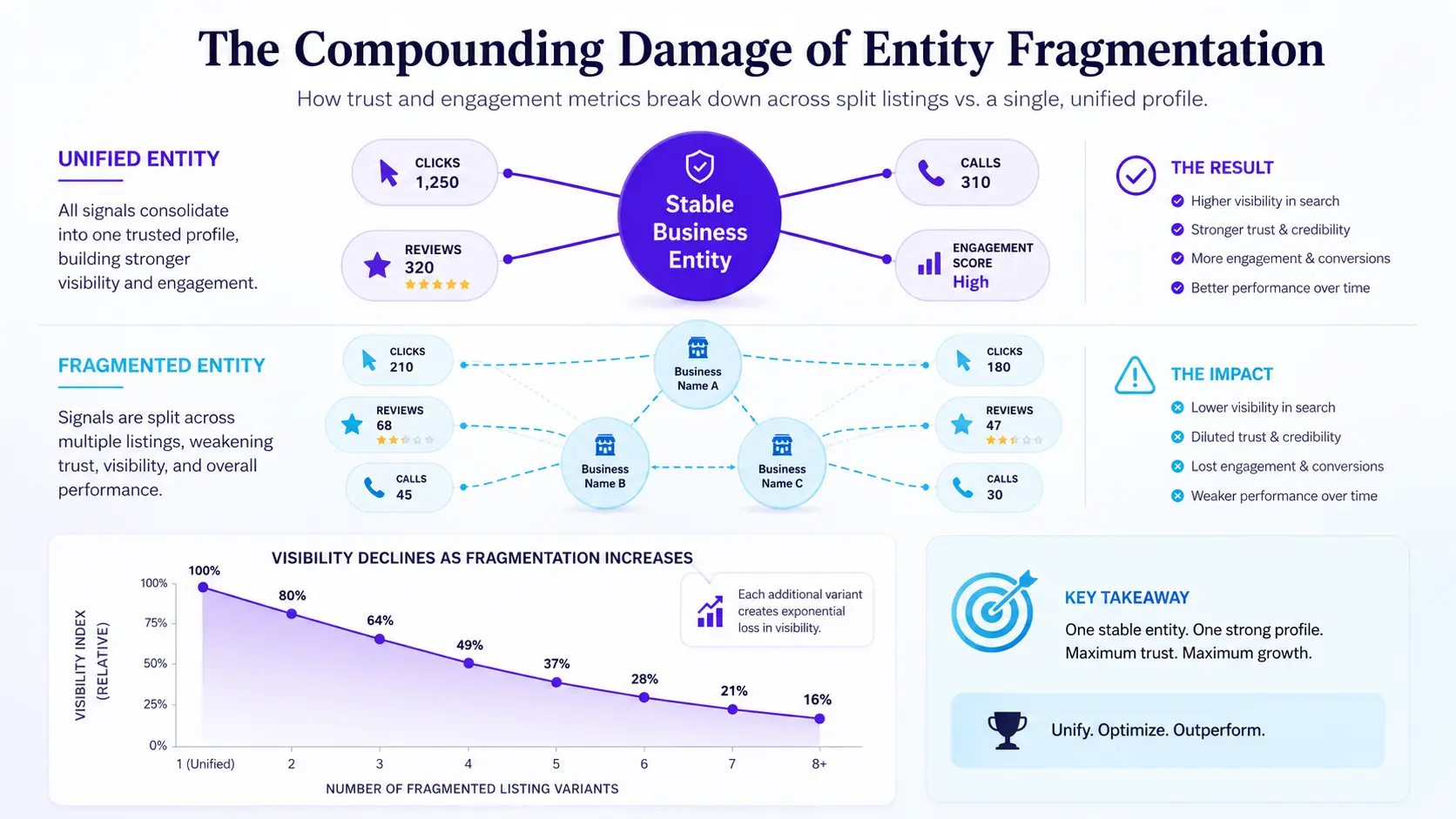
It weakens local trust because reviews, engagement, and business data become split across duplicate or inconsistent records instead of compounding around one clear entity.
When local systems cannot confidently decide which version is real, they may suppress visibility, reduce map eligibility, or create ranking volatility without showing a penalty.
Strong proximity, reviews, and SEO cannot fully compensate for fragmented identity signals.
Key Takeaways
- Entity fragmentation in local search causes algorithmic uncertainty, leading to suppressed visibility and reduced map eligibility – even with strong reviews or proximity.
- Splitting reviews and business data across multiple listings weakens trust signals, preventing the compounding effects needed for top rankings.
- Inconsistent or duplicate NAP data triggers automatic risk filters, quietly excluding affected listings from local results without explicit penalties.
- Multi-location expansion multiplies fragmentation risks; stability and centralization of entity data are now fundamental to local SEO success.
Most businesses think more listings mean more exposure.
In reality, those extra listings function like false passports – each one chips away at system trust until your entire local presence sits under suspicion.
Search engines don’t see “more” – they see “less clarity”, and nothing stalls visibility faster.
That broader logic appears in Local Search Visibility.

Why Multiple Listings Destroy Local Search Confidence
Imagine pouring five-star reviews into two different buckets.
Instead of overflowing with visible support, your credibility stays scattered and weak.
Search systems notice fractured engagement: reviews, clicks, and even clicks-to-call get split between profiles.
The net effect?
Each listing appears less established, even if your total engagement is high.
How split reviews and metrics fracture trust
One multi-location retailer watched supposed “review growth” deliver zero ranking improvement – because half their praise landed on an old, unofficial profile.
This is common: positive signals lose compounding effect when they’re dispersed across duplicates.
To a search platform, a business with 500 reviews on one stable entity is infinitely safer than three entities that barely reach 150 each.
Impact of Review Distribution on Local Search Trust
| Cause | Description | Impact on Local Search | Example |
| Autonomous Regional Listing Management | Teams localize details independently, modifying hours, descriptions, or contacts | Triggers search trust gate failure, causing visibility loss | 40-location healthcare chain with divergent local entries |
| Inconsistent Business Data | Conflicting phone numbers, addresses, or names across listings | Activates risk filters leading to silent suppression | Suite number typo causing listing to slip into visibility limbo |
Executives often assume “more reviews somewhere” is good.
It isn’t – dispersion is interpreted as instability.
Like spreading your team across uncoordinated projects, you end up with less impact everywhere.
Why would Google front a business whose support base looks uncertain, divided, or manufactured?
Why inconsistent business data triggers risk filters
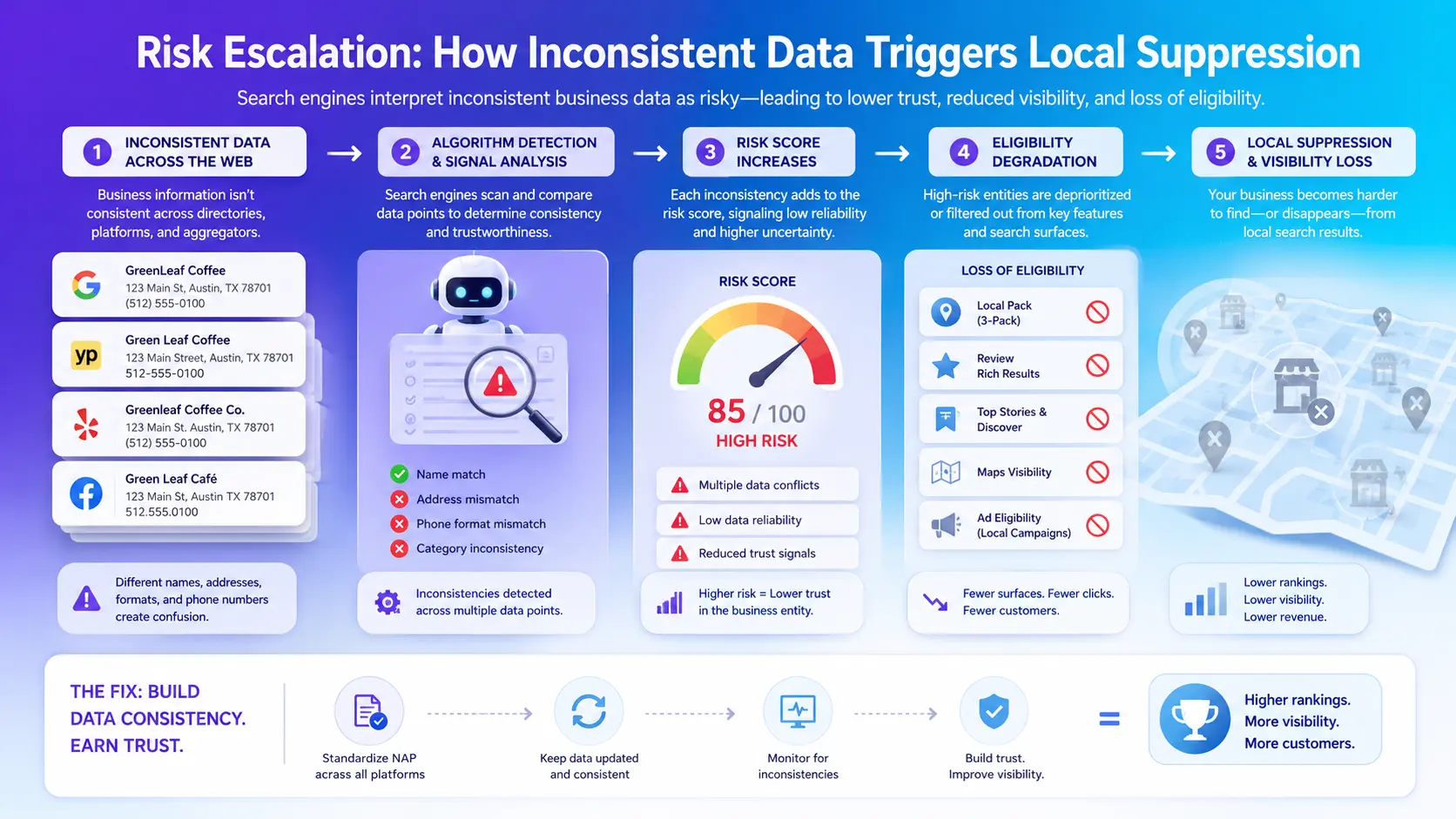
Duplicate phone numbers, conflicting addresses, or mismatched names don’t invite a slap on the wrist – they signpost eligibility doubts.
Local search engines are programmed to suppress, not warn or penalize, when forced to guess “which version is real?” Instead of racing you to the top, they sideline you in the name of user trust.
We’ve watched listings slip into visibility limbo for months after a simple suite number typo conflicted with a primary address.
Resolving the mismatch restored presence, almost overnight.
Systems don’t want a messy index – any sign that your business identity can’t be anchored triggers a risk filter, shrinking your eligibility instantly.
Here’s the truth: search trust isn’t granted, it’s accrued by showing stable, singular signals.
Every new variable – extra phone line, differing working hours, another business name – acts like digital static.
If the algorithm can’t reconcile your true identity, you get filtered out, not gently demoted.
Fragmentation is not a minor tech error.
It’s the silent trust killer that keeps competent businesses off the map, while less capable but more consistent competitors rise.
Identity clarity is currency – don’t dilute it across fractured listings.

How Visibility Collapses when Entity Clarity Breaks
Most brands miss the true cause of sudden drops in local search visibility: their listings weren’t penalized – they were quietly erased from eligibility, almost like being voted off the map with no warning.
Search engines don’t signal these shifts.
One day you’re visible; the next day you aren’t, and there’s no message explaining why you disappeared.
Silent suppression and unpredictable ranking shifts
If your team is looking for obvious errors, you’ll miss the real breakthrough.
Suppression often hits without notice: rankings nosedive, search impressions dry up, and lead volume falls off a cliff – while your listings look perfectly intact from the outside.
We’ve observed businesses lose half their map pack presence overnight, with nothing changed on their actual profiles.
Why?
Each mismatch, old listing, or rogue variant is a red flag – local systems treat conflicting signals as instability, triggering silent filtering rather than visible penalties.
It’s like running a retail store with two main doors, but only one is ever unlocked at a time – and nobody tells you when the other is bolted shut.
If a platform senses the business isn’t singular, it “suppresses” presence until the identity puzzle fits again.
The volatility shakes confidence at all levels – one client saw wild swings across cities even with a static marketing budget and zero changes on their end.
When eligibility toggles off, no amount of technical troubleshooting uncovers the cause if entity health isn’t questioned first.
Visibility gaps despite strong SEO performance
You can dominate organic rankings and still suffer map invisibility the minute entity fragmentation creeps in.
We’ve watched multi-location brands outpace competitors in classic SEO – flawless backlinks, deep content, robust technical signals – yet local listings drop off the radar when system confidence breaks.
“Why aren’t we showing for category terms?” is the recurring executive question, often asked just as their digital presence hits peak technical form.
This is the myth: SEO strength covers all bases.
But authority signals can’t override underlying eligibility logic.
Google and other engines shut the gate on businesses they can’t clearly define.
It’s not about authority – it’s about trust in the core identity.
Fragmented signals will always trump isolated strengths.
If your map presence feels unpredictable, entity instability – not competition or ranking factors – is usually the real culprit.
If your local visibility flips from strong to silent, check identity clarity before anything else.
A stable entity is the gatekeeper to predictable, durable rankings – and volatility is often the first and only warning.

How Fragmented Entity Signals Mimic Higher Risk Profiles
Most local systems judge business identity the same way a bank flags suspicious activity: the more versions they encounter, the higher the threat score – even before a human ever sees it.
Executives often believe a well-optimized listing will outweigh platform suspicion, but entity fragmentation in local search actually pushes your brand into the “handle with caution” category, outpacing competitors that may have weaker metrics but tighter identity control.
Conflicting versions appear unreliable to local systems
What looks like harmless duplicates to an operator is often read as instability by search engines.
One practitioner insight from managing a franchise brand: even subtle differences – like a phone number typo or a new appointment URL – can trip risk filters, suppressing all related listings without warning.
This isn’t a penalty in the sense of punishment; it’s an exclusion born from uncertainty.
Google’s algorithms are programmed to avoid promoting entities that feel unstable, since a single unreliable record can threaten the user experience at scale.
Picture a bouncer outside an exclusive club with a clipboard – if your business shows up with three names and three sets of credentials, you’re seen as a potential imposter, not a VIP.
Why should the system trust a profile that can’t prove who it is?
The key myth: that more NAP citations or listings mean extra trust.
In fact, fragmentation breeds doubt, and every mismatch signals a possible fake.
In local search, perceived reliability is stronger than raw volume.
Ask yourself: if search can’t decide which version is the real you, how many opportunities slip away before you even notice?
Most businesses only realize the cost of eligibility instability after months of lost impressions – and by then, the trail of inconsistent records can be long and deep.
Multi-location complexity amplifies fragmentation risk
Expanding across locations sounds like scaling success.
But brand-scale multiplies the risk of entity fragmentation, especially when autonomous teams manage listings.
Our experience with a 40-location healthcare chain revealed that letting regions “localize” details – down to tweaking business hours or adding unique descriptions – triggered search trust gate failure.
The result: reviews fragmentation, listings quietly shadowed, and visibility volatility in local search that defied correlation with traditional SEO.
Multi-location Fragmentation: Causes and Consequences
| Review Distribution Scenario | Total Reviews | Reviews per Listing | Perceived Trust by Search Engines |
| Single Stable Listing | 500 | 500 | High – Stable Entity with Consolidated Signals |
| Three Fragmented Listings | 500 | ~150 Each | Low – Signals Dispersed, Seen as Unstable |
The analogy: growing multi-location presence without centralized entity stability is like trying to harmonize an orchestra where each section plays to a slightly different score.
No matter how talented the musicians, dissonance drowns out the intended theme.
Visibility volatility isn’t a temporary blip – it’s a warning light.
With every divergent entry, the system reads higher risk, limiting exposure even as operational metrics improve.
Entity stability in maps is now fundamental: precision beats scale.
Clarity secures eligibility.
Fragmented local signals don’t just reduce your share – they remove you from the stage entirely, no matter how close, well-reviewed, or large your footprint becomes.

When Entity Confusion Matters More than Proximity or Reviews
You can outspend every local competitor, stack your reviews, and earn top proximity – yet still vanish from results if your entity identity falls apart.
Most operators assume their distance to the searcher or their five-star ratings guarantee relevance.
Reality is harsher: once systems spot a fragmented identity, those signals take a back seat.
Entity stability becomes the only gate that matters.
Why proximity fails to surface unstable entities
Imagine standing right next door to your customer but wearing three different uniforms.
Search algorithms react the same way: if identity data breaks, your physical closeness no longer counts.
We’ve seen businesses one block from a searcher, with perfect SEO and high intent, disappear from local packs simply because their NAP data conflicted in a couple listings.
Search systems treat confusion as a higher-order filter; the proximity boost only applies if the entity record is clear and resilient.
Here’s the overlooked reality – proximity is powerless if trust in your entity’s coherence is broken.
This is why duplicate listings and inconsistent details trigger silent exclusion, not just rank suppression.
The system is trained to ignore what it cannot interrogate with confidence.
Are you sure your proximity advantage isn’t being silently wasted?
Why better reviews can’t rescue a fragmented identity
Great reviews, spread across conflicting listings, routinely fail to move the gatekeepers, because fragmented praise cannot trigger eligibility confidence.
We’ve watched brands pour months into review generation, only to find their fragmented profiles dilute both volume and trust.
The myth that “great reviews always win” blinds teams to the real risk: reviews split across duplicate or unmatched listings get filtered out of the eligibility equation.
The system doesn’t aggregate good signals from fractured entities; instead, it sees unreliable intent capture.
Think of it like submitting references to a background check – if they’re all filed under different versions of your name, they count for nothing.
Are your review ratings feeding a single, stable identity – or leaking through cracks no customer can see?
Stability is the single most valuable asset in local search.
Clear identity is the switch that turns other signals on.
If you’re missing the map spotlight, look past proximity and positive reviews – fix entity clarity first.
That fragmentation almost always leads to conflicting signals, which is explored in Conflicting Entity Signals in Local Search.

Scientific context and sources
The sources below provide foundational context for how decision-making, attention, and performance dynamics evolve under scaling and constraint conditions.
- Trust and Search Systems
Entity Resolution: Theory, Practice & Open Challenges – Getoor, Lise; Machanavajjhala, Ashwin – Proceedings of the VLDB Endowment
Covers the theoretical and practical importance of entity disambiguation and stability across digital systems, underscoring why fragmented business records impact search and decision confidence.
https://vldb.org/pvldb/vol5/p2018_lisegetoor_vldb2012.pdf - Local Search and Eligibility
Tips to improve your local ranking on Google – Google Business Profile Help, Google Official Documentation
Presents Google’s official framework for how local search judges relevance, distance, and prominence when ranking businesses.
https://support.google.com/business/answer/7091?hl=en - Multi-source Data Integration Impact
Data Fusion – Bleiholder, Jörg; Naumann, Felix – ACM Computing Surveys
Discusses methods and implications of handling conflicting information in integrated data systems, applicable to listings and profile fragmentation in business search contexts.
https://dl.acm.org/doi/10.1145/1456650.1456651 - Social Proof Aggregation
Why Is the Crowd Divided? Attribution for Dispersion in Online Word of Mouth – He, Stephen X.; Bond, Samuel D. – Journal of Consumer Research
Academic analysis of how the fragmentation of reviews or ratings alters perceived trust and conversion likelihood for both automated and human evaluators.
https://www.scheller.gatech.edu/directory/research/marketing/bond/pdf/he_bond-jcr-2015.pdf - Behavioral Bias in Digital Trust Systems
Cyber Security and the Internet of Things: Vulnerabilities, Threats, Intruders and Attacks – Abomhara, Mahmoud; Køien, Geir M. – Journal of Cyber Security and Mobility
Explores how instability or inconsistency in digital identity, authentication, and trust management heightens risk in user-facing connected environments.
https://www.riverpublishers.com/journal/journal_articles/RP_Journal_2245-1439_414.pdf
Questions You Might Ponder
How does entity fragmentation affect local search rankings?
Entity fragmentation in local search confuses algorithms by creating conflicting or duplicate business records, making it harder for search engines to determine which listing is accurate. This reduces eligibility, suppresses rankings, and can cause reputable businesses to vanish from map packs despite strong reputation or proximity.
Can positive reviews outweigh the effects of fragmented business profiles?
No. Even a large number of positive reviews cannot compensate for the confusion caused by fragmented profiles. Search engines often disregard the total review value if praise is split across conflicting listings, recognizing only trust built through consolidated, stable entity signals.
Why do search engines penalize inconsistent business data?
Search engines suppress, rather than explicitly penalize, listings with inconsistent names, addresses, or phone numbers (NAP), interpreting them as signals of risk or potential fraud. This automatic exclusion protects users but can render even well-performing businesses invisible if discrepancies remain unresolved.
What is the main risk of managing multi-location businesses independently?
Decentralized management often leads to variations in critical business data and inconsistent profile details. This amplifies entity fragmentation risk, resulting in volatility or suppression of visibility across locations, regardless of strong SEO or review strategies at the individual level.
What should businesses do first when local rankings suddenly drop?
When local search visibility suddenly collapses, businesses should prioritize reviewing and correcting all entity identification signals – such as duplicate listings or mismatched NAP info – before troubleshooting content or technical SEO. Restoring entity clarity is key to regaining eligibility and stability in search results.