
What You’ll Learn
Conflicting local signals visibility is the loss, instability, or suppression of local search presence caused by inconsistent business identity data across listings, directories, aggregators, Google Business Profiles, landing pages, citations, or internal location assets.
It happens when search systems see mismatched names, addresses, phone numbers, business hours, categories, duplicate profiles, or stale upstream data and cannot confidently resolve one trusted entity.
In local search, this conflict can trigger silent exclusion before ranking begins, even when proximity, reviews, content, and SEO are strong.
Stable visibility depends on unified signals because local systems treat entity trust as an eligibility gate, not a ranking bonus.
Key Takeaways
- Conflicting local signals undermine search visibility by eroding algorithmic trust, leading to silent exclusion even with minor data inconsistencies.
- Visibility drops are often triggered by upstream sources or aggregators, not by direct changes or errors made internally.
- The “trust gate” functions as an eligibility filter: listings with inconsistent identity data are removed from local search, not merely demoted in ranking.
- Positive optimization factors cannot compensate for trust issues – only ironclad, unified identity data guarantees stable local visibility.
Most local search visibility drops don’t start with an obvious error – they start with confusion.
A single inconsistent address or mismatched business name can cause systems to treat your company like a stranger, not a known entity.
The gap between assumed control (“our data matches everywhere that matters”) and reality (“one rogue aggregator entry tanks our confidence overnight”) is where silent losses begin.
That broader trust constraint shows up across Local Search Visibility.

Why Inconsistent Identity Fragments Local Trust
Conflicting business details – think phone numbers that differ by a digit, old location addresses that persist in directories, or alternate business names – act like static in an identity signal.
We’ve seen businesses pour money into reviews and ads, only to find a stray NAP variant slashes their inclusion rate.
Why?
Modern local systems don’t default to “closest match”, they revert to uncertainty.
How Fragmented Details Disrupt Entity Recognition
Common Types of Fragmented Details and Their Impact on Local Entity Recognition
| Trust Factor | Effect if Met | Effect if Not Met |
| Accurate core business details (NAP consistency) | Listing considered eligible and shown | Listing becomes invisible, no partial credit |
| Citation volume and quality | No effect if trust threshold not met | Ignored until eligibility achieved |
| Reviews quantity and relevance | Helpful only after meeting trust threshold | No impact if entity confidence low |
| Optimized on-page relevance | Secondary strength that supports rankings post-eligibility | Does not substitute for trust |
| Upstream data consistency | Supports stable identity and visibility | Conflicting data causes immediate exclusion |
The mistake most teams make is assuming obvious listings (Google, Apple, Yelp) matter most.
In practice, secondary directories, old citations, or forgotten aggregators often carry enough weight to trigger confusion.
One hospitality brand we worked with had four active GMB pages for two locations – with three distinct phone numbers listed across various sources.
The result?
Algorithmic hesitation.
No system, machine or human, wants to recommend an entity it can’t consistently identify.
Imagine trying to verify a passport where the photo, address, and date of birth all mismatch slightly.
Would you trust that document to board an international flight?
Search systems apply almost identical logic: minor inconsistencies equal major risk.
Why the System Excludes Uncertain Entities Rather than Rank Them
Here’s the reality executives need to grasp: local algorithms aren’t calibrated for forgiveness.
Their default position is exclusion, not demotion.
When entity confidence drops due to data conflict, discovery drops to zero – not just one spot.
It’s tempting to blame competitors or shifting algorithms when rankings disappear.
In truth, silent exclusion is a risk-management function.
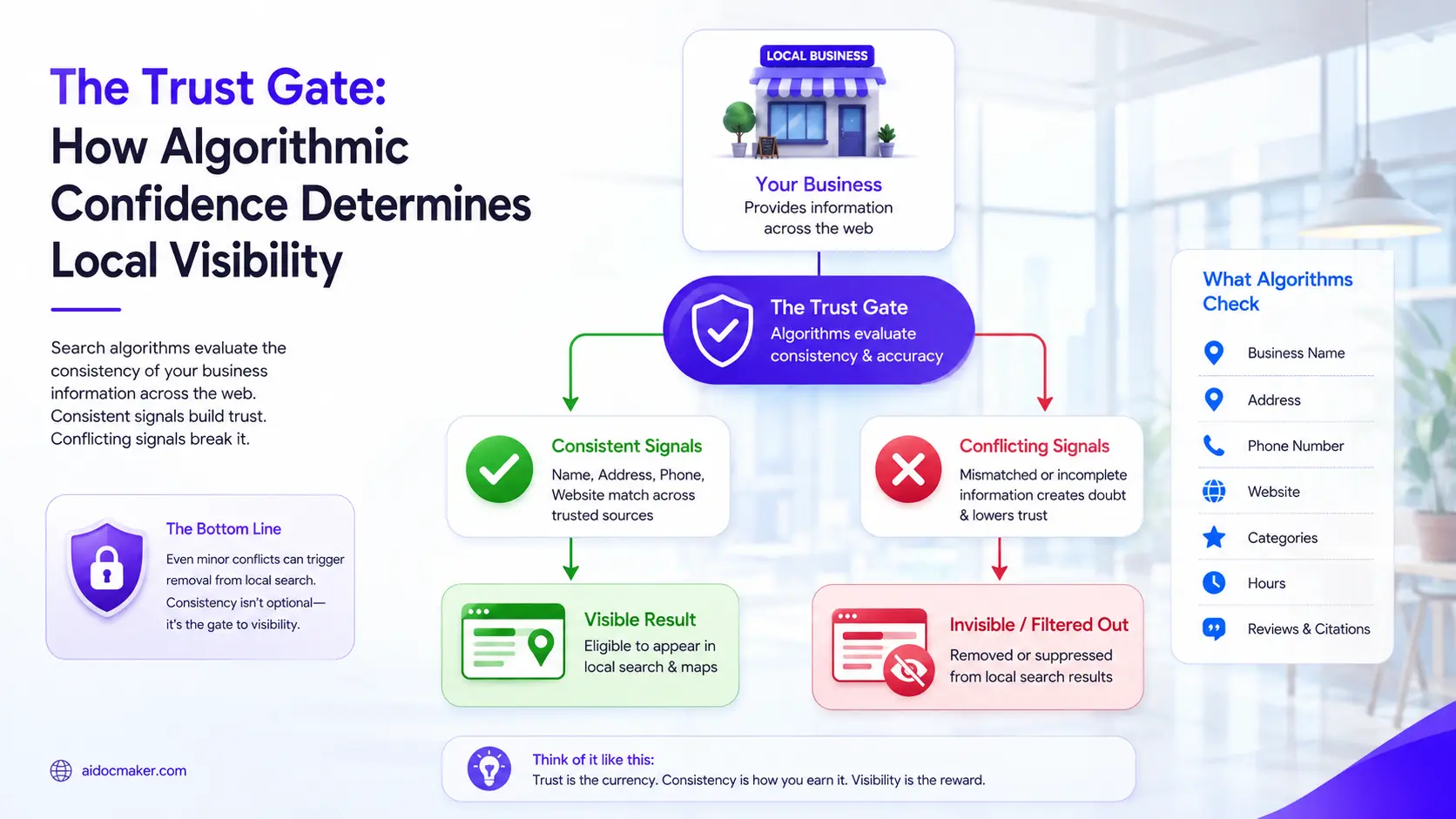
Search systems operate on a “trust gate” – when identity score falls below a set threshold, the business simply vanishes from eligible results.
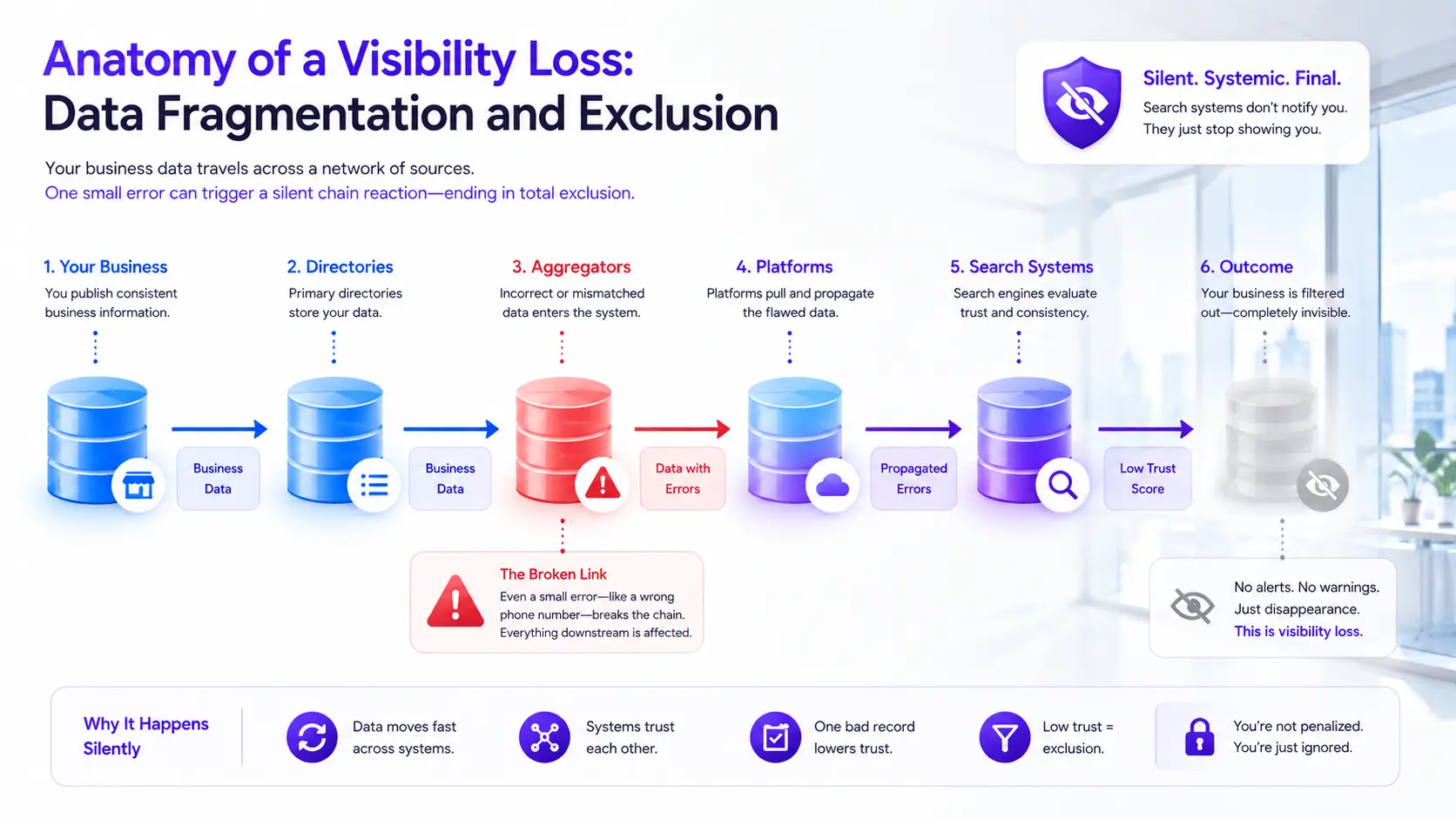
No warnings, no gradual downgrade, just silent omission.
This is why top-performing listings can drop without warning and with no visible change on your end.
What may look like volatility or glitch to the business is just a system declining to take a risk.
Executives who fixate on rankings miss the larger threat: the confidence test that quietly decides whether you appear at all.
Fragmented identity isn’t about minor sloppiness.
It’s a hard stop for inclusion.
If your entity feels invisible overnight, the system likely made a single, binary choice: not trustworthy enough to risk showing.

How Signal Conflict Leads to Volatile Presence
Spotting a rank drop is rarely your first warning.
More often, your business vanishes from local results before any analytics alert fires – while everything else appears stable.
This isn’t a glitch.
Silent disappearance is the system’s preferred shield against risk, long before it “punishes” you with a visible drop.
Silence before Drops: Silent Exclusions as Risk Management
It’s easy to assume visibility loss means you missed an optimization step or a competitor outperformed you.
But most volatility streaks start with silent exclusion – your listing simply stops showing, sometimes days or weeks before any ranking data changes.
That’s not a penalty; it’s a precaution.
One local franchise we advised lost map presence overnight, yet all public-facing data remained unchanged.
Diagnostics showed the first sign wasn’t a lower rank, but erratic impressions – then total silence.
Here, the local search system acted like a cautious auditor: faced with inconsistent signals, it quietly hit pause, removing the entity from candidate results rather than risking an incorrect display.
The myth that “consistent effort always prevents loss” falls apart in this context.
Even established brands can be filtered out without warning, not due to lack of optimization, but from behind-the-scenes confidence slips.
The system prioritizes certainty of identity over perfect optimization hygiene.
So why does this silence matter?
Think of it as the system’s safety latch.
When local search senses even moderate risk of confusion – an unusual aggregator feed, a conflicting business name upstream – it defaults to invisibility.
Silent exclusion always precedes a measurable drop.
Why Unaltered Assets still Lose Visibility
Here’s the paradox: even untouched listings can lose footing.
Volatility isn’t a direct response to changes you make; it’s often triggered by trust shocks elsewhere in the data ecosystem.
When two or more local signals don’t match, or a directory propagates outdated info, entity confidence wobbles.
The result?
Your local presence flickers – sometimes strong, sometimes missing – for days or even weeks.
We’ve watched high-performing locations go dark after an aggregator pushed stale phone numbers, even without a single front-end modification.
This volatility is a downstream effect: the system tries, fails, or gives up on resolving your identity, so it opts out.
It’s like a navigation app removing a destination from the route when it suspects the address may be wrong, even if it never tells the driver why.
If you’re left asking why positions swing wildly despite no visible change, recognize this insight: Unstable identity, not poor optimization, is usually the culprit behind local volatility.
Visibility volatility isn’t random – it’s the system quietly managing doubt.
If you want predictable presence, ironclad identity comes first.
The next step is understanding how eligibility gates shut out even high-quality businesses if their digital footprint leaves room for uncertainty.

Why Local Systems Treat Trust as a Gate, not a Reward
Most local marketers assume trust signals help you climb the rankings.
The reality: trust works like a velvet rope – miss it, and you’re not even allowed through the door.
No amount of optimization can substitute for this first checkpoint, and systems are programmed to filter aggressively when identity confidence drops.
Trust Thresholds and Eligible Candidate Filtering
Local System Trust Thresholds: Eligibility vs. Optimization Factors
| Fragmented Detail | Example | Impact on Entity Recognition |
| Phone number mismatch | Phone numbers differing by a single digit across listings | Triggers algorithmic hesitation and lowers confidence |
| Old location addresses | Persisting outdated addresses in directories | Creates conflicting signals leading to exclusion |
| Alternate business names | Different names listed for the same location | Confuses entity resolution systems |
| Multiple active listings | Four GMB pages for two locations with varying phone numbers | Causes system uncertainty and exclusion |
| Stale citations | Outdated info from aggregators or secondary directories | Introduces static disrupting identity signals |
Here’s the part that trips up savvy operators – having more citations, reviews, or optimized pages won’t matter if your core business details suggest uncertainty.
Local algorithms don’t grant partial credit for effort; they simply set a minimum trust bar.
Fail to reach it, and your listing becomes invisible, not merely deprioritized.
We’ve seen client locations with near-perfect review volumes and on-page relevance disappear, simply because one upstream data provider submitted a slightly different address.
It’s not that they were demoted – systems filtered them out as ineligible.
In local, trust is binary: you qualify, or you vanish.
Why does this feel so unforgiving?
Imagine a security checkpoint that bars anyone if their ID shows even one mysterious discrepancy.
Most executives expect local inclusion to be cumulative, but in reality, it’s conditional.
The myth: trust boosts your rankings.
The truth: trust is the price of admission.
Entity Confidence over Proximity or Review Strength
Ask yourself: if your location sits right in the searcher’s neighborhood and boasts glowing reviews, why might you still be excluded?
The hidden logic is entity confidence.
When systems detect instability in your signals – be it from conflicting NAP data or duplicate listings – they ignore even the strongest secondary factors like proximity or review strength.
One pattern stands out from client work: locations with excellent engagement metrics and local relevance, yet lost presence overnight after updates to a single aggregator.
The drop didn’t correlate to reputation or distance, but to shaken identity.
It’s like building the best possible credentials, only to be dismissed on a technicality.
If you remember anything, let it be this: in local search, no amount of secondary strength can compensate for shaky identity.
Trust isn’t a gold star – it’s the green light for entry.
Systems don’t dole out trust like a bonus.
They use it as a definitive gate.
Understanding this flips the script – and shifts your focus from chasing incremental strength to securing non-negotiable eligibility.

What Drives Exclusion without Visible Changes
It’s not always what you change – it’s what changes upstream, out of your line of sight.
Businesses often assume visibility loss comes from internal errors or moves they made directly.
The real surprise: your presence can vanish overnight even if your listings, reviews, and landing pages stay untouched.
So how is it possible to be shut out without ever pulling a lever?
The answer usually sits in the shadows, built from unseen data conflicts and silent logic traps.
Data Source Collisions and Aggregator Conflicts
Here’s a reality check: you don’t control the full picture of your local footprint.
Even if you perfect every asset, upstream data aggregators can inject errors with one syndication sweep.
We’ve managed cases where a client’s correct address propagated cleanly for months, only to disappear from maps after an aggregator reintroduced pre-merger legacy details.
The company’s dashboard looked fine – Google My Business unchanged, main directory listings untouched – yet inclusion failed.
Why?
Because local engines reconcile multiple feeds.
If just one “source of record” pushes conflicting data, the system can’t resolve which version to trust, so it quietly removes the entity from consideration.
Imagine building a puzzle with pieces from different boxes: even when one new piece arrives, the whole picture can break.
Many believe local exclusion is caused by an optimization miss; the real culprit is often a silent tug-of-war between conflicting upstream signals.
Internal Volatility from Multi-location Ambiguity
Duplicate or similar locations are like mirrors that distort the system’s sense of your business identity.
We’ve seen multi-location chains lose visibility entirely in target markets after expanding their local landing pages – no public-facing changes, no user complaints, but ranks suddenly vanish.
Why?
The internal entity resolution logic got tangled.
Two locations sharing near-identical names, addresses in adjacent zip codes, or re-used phone numbers trigger a confidence crisis.
The algorithm faces a riddle: which of these is the real option to surface?
Instead of risking a bad recommendation, it often responds by excluding both.
The myth is that more pages and more citations always help; reality is, too much similarity can create volatility and erode visibility overnight.
Think of it as static in a radio signal – two strong yet slightly mismatched broadcasts can cancel each other out, leaving nothing audible at all.
The lesson: even perfect external hygiene can’t prevent visibility loss if invisible sources introduce conflict or if internal assets blur together.
Losses you can’t trace are often losses you couldn’t see coming, and the fix starts upstream, not in the interface.
Uncertainty often ends in instability, which is explored further in Silent Local Visibility Failure.

Scientific context and sources
The sources below provide foundational context for how decision-making, attention, and performance dynamics evolve under scaling and constraint conditions.
- Information Consistency and Search Credibility
Entity Resolution and Information Quality in Databases – John R. Talburt – Morgan Kaufmann
This book explains how inconsistency in data fragments reduces system trust and impacts downstream information retrieval, matching the article’s focus on local identity disruption.
https://booksite.elsevier.com/samplechapters/9780123819727/01~Front_Matter.pdf - Algorithmic Risk Management and Data Fragments
Trustworthy Online Controlled Experiments: A Practical Guide to A/B Testing – Ron Kohavi, Diane Tang, Ya Xu – Cambridge University Press
Details how automated decision-making systems evaluate trust, violated assumptions, and confidence in data-driven decisions, supporting the article’s argument about silent omission.
https://www.cambridge.org/core/books/trustworthy-online-controlled-experiments/D97B26382EB0EB2DC2019A7A7B518F59 - Digital Identity and Recognition in Machine Systems
Big Data Integration – Xin Luna Dong, Divesh Srivastava – Springer
Analyzes fragmented data sources, record linkage, and data fusion in large-scale systems, emphasizing how inconsistent inputs erode confidence.
https://link.springer.com/book/10.1007/978-3-031-01853-4 - Attention, Cognitive Overload, and System Filtering
The Filter Bubble: What the Internet Is Hiding from You – Eli Pariser – Penguin Books
Describes how digital systems filter information and shape candidate visibility, echoing the theme of eligibility gates in local search.
https://www.penguinrandomhouse.com/books/309214/the-filter-bubble-by-eli-pariser/ - Official Documentation: Google’s Entity Ranking and Disambiguation
How Google Search organizes information – Google
Documents how Google crawls, indexes, processes signals, and organizes information for Search, paralleling the article’s technical explanations.
https://www.google.com/intl/en_us/search/howsearchworks/how-search-works/organizing-information/
Questions You Might Ponder
What are conflicting local signals in visibility, and why do they matter?
Conflicting local signals in visibility refer to inconsistencies in business name, address, or phone number across directories. These mismatches reduce algorithmic trust, leading systems to avoid showing your business in search, risking loss of visibility even without direct errors.
How quickly can inconsistent business details affect local search visibility?
Visibility can decline rapidly – sometimes overnight – if aggregators or directories introduce mismatched data. Algorithms respond instantly by withholding ineligible entries, meaning silent exclusion can happen before analytics or rankings reflect any issues.
A related decision is covered in Entity Fragmentation Undermines Local Search Visibility, which explains the adjacent issue in more detail.
Why do unchanged listings sometimes lose local visibility?
Listings may lose visibility even if untouched because search systems reconcile multiple data streams. An upstream aggregator updating data, or an external source injecting outdated details, triggers a drop in trust, resulting in vanishing presence despite no direct changes.
What is the ‘trust gate’ in local search algorithms?
The trust gate is a minimum confidence threshold used by search algorithms to decide business eligibility. If your entity’s signals fall below this bar, your business is filtered out entirely, regardless of efforts spent on optimization or review gathering.
Can positive reviews and proximity overcome conflicting local signals?
No: even with high review scores or prime location, systems exclude businesses with unstable identity data. Entity confidence overrides secondary ranking factors, making consistent identity the prerequisite for any local search presence.