
What You’ll Learn
Local search trust gate is the confidence threshold a business must pass before it can appear in Google Maps or the local pack, even when it is close to the searcher.
It is based on whether local systems can verify the business as real, active, consistent, and safe to recommend.
Signals include accurate NAP data, stable business identity, matching hours, correct categories, active reviews, operational proof, and consistent third-party listings.
If these signals are missing, fragmented, outdated, or contradictory, the business may be silently filtered out before ranking begins.
Proximity can place a business near the opportunity, but trust determines whether it is included.
Key Takeaways
- Proximity alone does not determine local search visibility; passing the local search trust gate requires strong, consistent, and verifiable business data.
- Inconsistencies in listings, even minor ones, can silently trigger exclusion from local packs due to insufficient system confidence in business legitimacy.
- Trust signals – stable business identity, matching data, and operational evidence – outweigh brand strength or SEO efforts in gaining visibility.
- Regular data audits and alignment across platforms are essential to clear the local search trust gate and sustain reliable local visibility.
If you believe being nearest to the searcher makes you visible in local packs, you’re missing the factor that actually decides who shows: trust – specifically, the system’s confidence in your business entity.
The difference between ranking high and becoming invisible isn’t always about who’s closest; it’s about who the system trusts not to burn it with bad recommendations.
We’ve watched plenty of service businesses a block from a customer disappear from maps completely, not because they moved, but because their trust signals lagged behind.
That wider filter is set by the constraints explained in Local Search Visibility.

Understanding the Local Search Trust Gate: What It Is and Why It Silences Nearby Businesses
It’s like having the best storefront on the main street but your name is missing from the city’s official directory – the system can’t risk pointing users to you without assurance you’re legit, current, and active.
The myth: proximity wins local search.
The reality: proximity is a filter, not a ticket.
Proximity puts you at the door, but only trust lets you in.
Why proximity alone fails to guarantee visibility
Seen up close, this trust gate explains why some listings – despite flawless SEO or hyperlocal keywords – vanish overnight.
Local algorithms are structured to minimize user risk, so the local search trust gate (sometimes called the local inclusion threshold or confidence threshold in local visibility) cuts out businesses with ambiguous, weak, or contested signals.
Ever wonder why a competitor with fewer reviews and weaker website pops up in the map, while your polished profile stays buried?
It’s often because the system has more confidence it actually exists and meets the local inclusion risk filter.
This principle repeats: without trustworthy signals, even perfect proximity doesn’t get you seen.
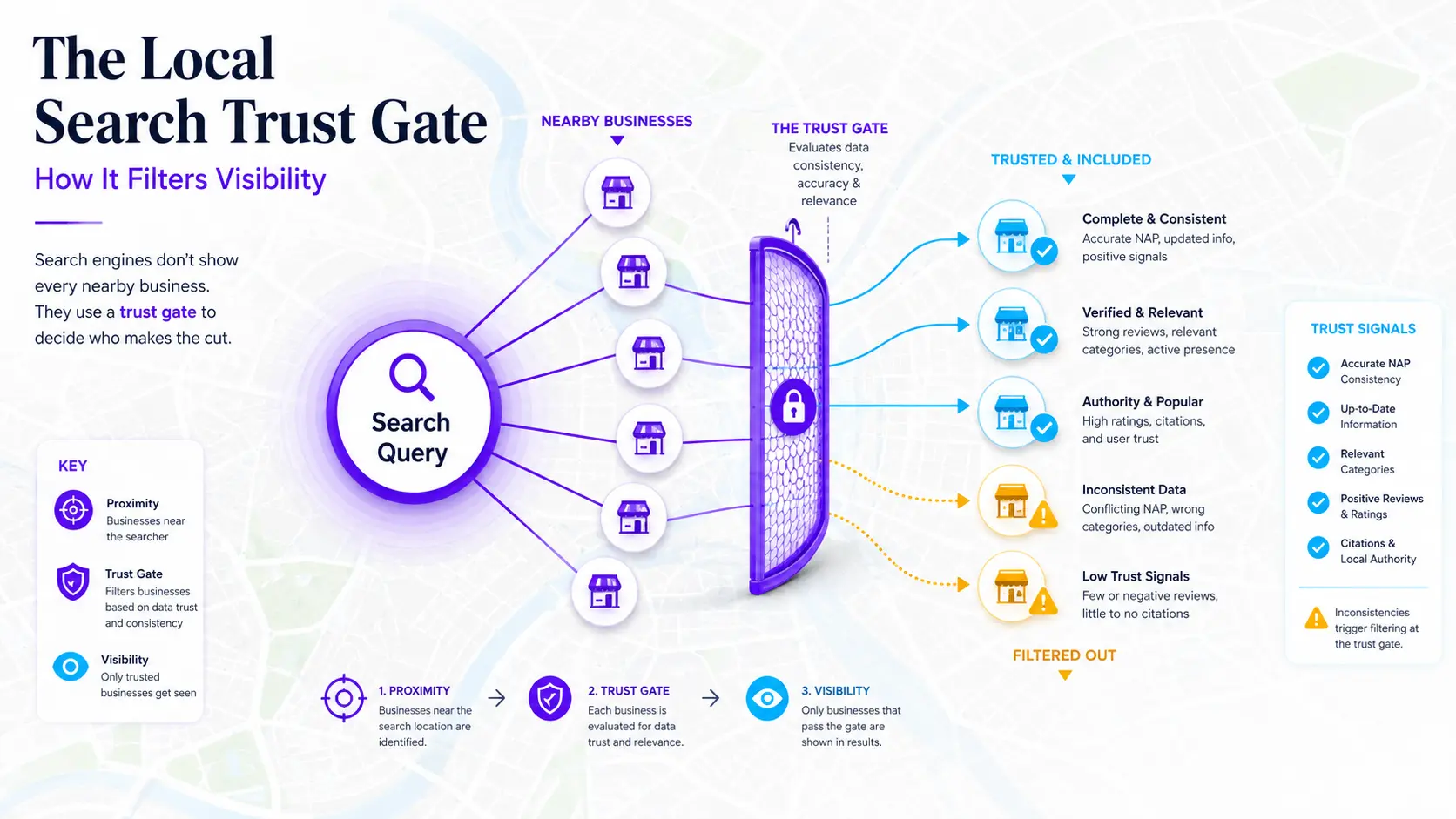
How uncertainty or inconsistency triggers invisible filtering
Common Data Inconsistencies Impacting Local Search Trust
| Assessment Area | Description | Why It Matters |
| Evidence Footprint Gaps | Identify missing essential signals like secondary categories or operational proof | Missing proof leads to silent exclusion |
| Cross-System Consistency | Check all listings, website, and profiles for matching info | Inconsistencies cause trust erosion and filtering |
| Business Identity Accuracy | Confirm name, address, phone, and ownership details are stable | Ensures entity stability and reliability |
| Operational Behavior | Verify active and consistent business hours and review activity | Supports ongoing confidence in presence |
| Third-Party Confirmations | Ensure presence and data alignment on partner platforms | Reinforces credibility and trust signals |
Most businesses that vanish from local maps never realize it wasn’t a penalty – it was invisible filtering triggered by uncertainty.
The system doesn’t warn you; it just quietly excludes what it can’t trust.
Even minor inconsistencies – an outdated phone number, mismatched hours, or sporadic business category changes – can lower the entity confidence in local search, leading to silent visibility drops local pack-wide.
We’ve seen chains lose their local presence in multiple cities after their listings data was syndicated incorrectly for just a week.
The map isn’t punishing them; it’s protecting itself from embarrassing misfires.
Imagine sensors on a self-driving car getting conflicting signals: the car hits the brakes rather than crash.
Local search works the same way – uncertainty is treated as risk.
Here’s the insight: systems don’t “fail” you; they simply subtract what doesn’t clear their trust bar.
Every inconsistent data point – whether a typo, duplicate, or conflicting listing across partner sources – piles on uncertainty until the system filters you out.
Ask yourself: when did you last audit the public signals about your location, business identity, or categories?
If the gates seem silent, that’s on purpose.
The only sign of a local inclusion threshold crossing is your absence.
Most never see it until competitors, often farther away, fill the space you thought you owned.
At its core: the trust gate isn’t about perfection, but reliable, aligned evidence.
Those who supply it get seen.
Those who don’t, don’t.
This is where proximity ends and the real contest for local visibility begins.
A related decision is covered in Silent Local Visibility Failure: Symptoms, Causes, and Diagnosis, which explains the adjacent issue in more detail.

Evaluating Your Business’s Confidence Score: What Affects the Inclusion Threshold
Most companies fixate on rankings and reviews, but here’s the blind spot: the true local search trust gate measures confidence in your business’s identity – before “visibility” is even an option.
Plenty of businesses have glowing reputations or a flood of positive content, yet remain invisible on maps because foundational signals are inconsistent or fragmented.
If you assume strong SEO is enough, you’re playing the wrong game.
Entity stability and consistent presence as reliability indicators
Businesses rarely realize how much minor data inconsistency chips away at system confidence.
We’ve seen single-location operators lose ground for months after changing their suite number, even when everything else stayed constant.
The myth: “As long as our contact details are mostly right across platforms, we’re safe”.
In practice, each variation – address tweaks, phone swaps, business hours that drift – erodes the perceived stability the system needs to verify you’re real and present.
Imagine sending a package that keeps changing destinations midway; eventually, the carrier stops trusting it’ll ever land.
If your digital footprint flickers between sources, local systems see risk, not reliability.
Confidence isn’t earned once – it’s maintained by relentless consistency.
Trust signals vs brand reputation: what local systems actually test
It’s easy to conflate brand strength with local trust, but search systems draw a sharp line.
We’ve watched regional brands with spotless reputations get filtered out, while newer, less-known competitors stubbornly appear in the local pack.
Why?
The algorithm doesn’t care how beloved you are – it tests for proof you exist, operate, and belong at a specific place and time.
Awards, PR, and happy customers won’t outweigh a missing category, mismatched location, or conflicting third-party listings.
Trust signals – verifiable, stable, mutually reinforcing data points – control who crosses the local inclusion threshold.
If you’re seeing competitors rank above you, even with weaker content or branding, don’t assume the system “favors” them.
More likely, their trust signals are simply more airtight, letting them slip past risk filters you’re still tripping.
At its core, local search inclusion is a confidence problem – not a popularity contest.
Stabilize your signal; pass the gate.

Spotting Silent Failures: Common Patterns That Signal Trust Gate Collapse
Most businesses blame lost local visibility on algorithm changes or a dip in reviews.
The reality: listings often vanish or fluctuate when the system’s trust in your business slips – frequently with no warning, no penalty message, and no surface-level explanation.
If your Google Maps profile disappears overnight, the cause is rarely a ranking tweak.
More often, it’s a silent verdict: the confidence threshold wasn’t met.
Listing volatility when confidence erodes
Picture two days: on Monday, your business appears #2 for local searches.
On Wednesday, it’s gone – no changes to content, budget, or campaigns.
Most assume glitch or sudden update.
From direct client experience, these swings almost always trace to trust signals degrading just below the inclusion line.
It’s not a “demotion;” it’s a risk filter – like a bouncer quietly closing the rope on borderline IDs.
If your business occupies this confidence gray zone, systems will flick the visibility switch on and off, unpredictably, as their belief in your identity wavers.
A real-world analogy: Imagine an airport security line.
Even if you’ve flown 100 times, if your identity paperwork looks off, you might pass in the morning and be held back by noon.
Local systems constantly re-validate: small data mismatches, outdated listings, or signals of instability quietly chip away at their willingness to show you, no matter your SEO investment.
Here’s the myth: Visibility drops are rarely punishment for bad SEO or reviews.
They’re the outcome of falling below the silent local inclusion threshold – the trust gate separating the reliably visible from the sometimes-missing.
Competitive visibility despite weaker SEO – what that signals about trust thresholds
Why does that competitor with fewer links and weaker website content show up consistently – while your better-optimized business flickers on and off?
The answer isn’t more “authority”.
It’s trust.
We’ve seen companies outperformed by smaller competitors simply because those rivals keep a stable, consistent identity footprint: matching business names, addresses, hours, and profile presence everywhere.
In one case, a newer entrant with no backlink strategy outlasted established players during an industry-wide local pack reshuffle.
Their secret?
Zero listing inconsistencies and frictionless system confidence – even with a less impressive
digital footprint.
The trust gate is binary: you’re above it, or you’re not.
Sub-threshold, even small instability can trigger instant exclusion, no matter how many generic SEO tactics you deploy.
Think of the trust gate as a silent alarm.
If a competitor’s listing is never interrupted, their operational consistency – rather than superior marketing – is likely the controlling factor.
In short: erratic local visibility is nearly always a sign your business sits just below the confidence threshold, not that you’ve been out-SEOed.
The pain of seeing less optimized businesses win is real – but it’s the trust gate, not traffic or authority, that’s enforcing these outcomes.
When visibility flickers or disappears, start by diagnosing trust.
If you only chase rankings, you’ll miss the gate keeping you out.

What to Assess Before Considering Optimization
Diagnostic Checklist for Passing the Local Search Trust Gate
| Inconsistency Type | Example | Effect on Trust/Visibility |
| Outdated phone number | Old contact still listed | Lowers entity confidence, triggers filtering |
| Mismatched hours | Different store hours across listings | Signals instability, reduces trust |
| Sporadic category changes | Switching business categories frequently | Creates ambiguity, causes exclusion |
| Duplicate listings | Multiple entries with conflicting info | Increases uncertainty, impacts visibility |
| Typos in critical info | Misspelled address or name | Decreases system confidence, risk of filtering |
What if the problem isn’t what you’re doing, but what’s not there to measure?
Most executives hunt for errors or blame campaigns when local visibility stalls.
But in reality, businesses often lose ground because the system never saw what it needed in the first place.
Optimization is pointless if invisible gaps quietly disqualify you before you even start.
Assess evidence footprint gaps – not what to fix, but what’s missing
Imagine showing up to an exclusive club with only half of your credentials.
You won’t get feedback – you just won’t get in.
Local search trust works the same way: insufficient or patchy evidence leaves you out with no warning.
We’ve reviewed dozens of listing audits where nothing seemed blatantly wrong, yet essential signal types – like secondary category clarity or operational proof – were missing entirely.
The error isn’t negative; it’s the absence of positive proof.
Pause before asking “how do we fix this?” Instead, consider: what types of evidence have you never offered, not just what’s technically present?
Experience shows most failures stem from unaddressed evidence gaps – think missing business hours in underserved platforms, lack of third-party confirmations, or even a dormant Google profile.
It’s not just listings or content; it’s the missing categories of signals that trigger the local inclusion threshold – or block it.
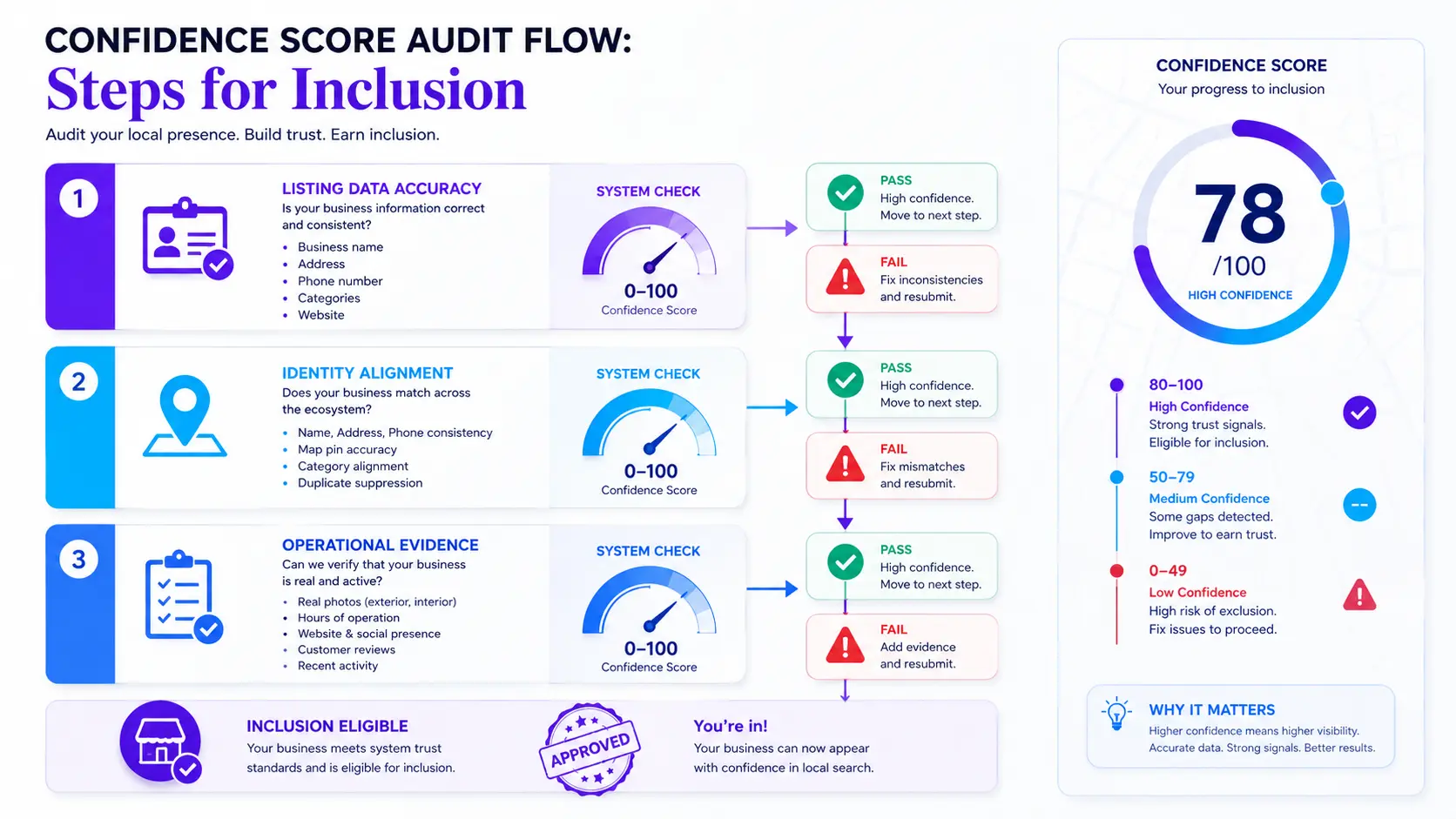
Align cross-system consistency: listings, identity, behavior
Picture local search confidence like a banking credit check.
A single mismatch between your declared income and your spending pattern triggers closer scrutiny – or immediate rejection.
Invisibility often isn’t the result of a one-off listing typo or a small review dip.
It’s the ripple effect from inconsistent signatures: variants in address, ownership names, or irregular hours that hint at fragmentation or instability.
In our audits, the most common silent barrier is misalignment between systems: your website’s hours don’t match Google, maps data doesn’t reflect recent moves, and review activity suggests inactivity.
If one major touchpoint starkly disagrees with the others, confidence plummets across the board.
Before attempting optimizations, confirm that every surface tells an identical story – identity, operation, and interaction.
Before acting, assess what’s absent – not just what’s incorrect.
The trust gate closes quietly, but a complete, coherent evidence trail is what lifts the silence.
Ready to see what your business actually looks like through the system’s eyes?
Confidence comes from evidence, not claims.
That distinction drives Evidence Checks: Proving Trustworthiness to Local Systems.

Scientific context and sources
The sources below provide foundational context for how decision-making, attention, and performance dynamics evolve under scaling and constraint conditions.
- Entity Consistency and Data Quality
Data Quality: The Accuracy Dimension – Jack E. Olson – Morgan Kaufmann
Addresses the significance of consistent data quality, exploring how discrepancies and mismatches undermine automated trust frameworks and user-facing visibility.
https://www.sciencedirect.com/book/9781558608917/data-quality - Algorithmic Risk and Decision Systems
Algorithmic Bias Detection and Mitigation: Best Practices and Policies to Reduce Consumer Harms – Nicol Turner Lee, Paul Resnick, Genie Barton – Brookings Institution
Examines how risk-based thresholds are set and enforced by decision algorithms, explaining invisible exclusion mechanisms in digital trust gates.
https://www.brookings.edu/articles/algorithmic-bias-detection-and-mitigation-best-practices-and-policies-to-reduce-consumer-harms/ - Search Engine Ranking Dynamics
The Impact of Search Result Diversification on Search Ranking Dynamics – Ricardo Baeza-Yates, Berthier Ribeiro-Neto – Foundations and Trends in Information Retrieval
Details how evolving ranking signals, contextual weighting, and relevance evaluation mechanisms influence visibility and ranking stability in search systems.
https://www.nowpublishers.com/article/Details/INR-019 - Digital Footprint Integrity
(Almost) All of Entity Resolution – Olivier Binette, Rebecca C. Steorts – arXiv
Analyzes how inconsistent and fragmented digital entity representations affect system confidence, matching accuracy, and downstream real-world applications, closely paralleling trust gate effects for businesses online.
https://arxiv.org/abs/2008.04443 - Local Search and Trust Systems
A Survey of Trust and Reputation Systems for Online Service Provision – Audun Jøsang, Roslan Ismail, Colin Boyd – Decision Support Systems
Surveys mechanisms by which online services build, verify, and maintain trust, with direct relevance to automated filtering and credibility assessment in digital marketplaces.
https://www.sciencedirect.com/science/article/abs/pii/S0167923605000849
Questions You Might Ponder
What is the local search trust gate and how does it affect business visibility?
The local search trust gate is an algorithmic filter that determines whether a business appears in local search results. It checks for consistent, verifiable data. Even if a business is nearby, lacking trustworthy signals or complete information may trigger exclusion – making location alone insufficient for visibility.
Why do some businesses disappear from local maps despite having strong SEO?
Local visibility depends on trust signals before SEO factors. When foundational data (such as address, hours, or business identity) is inconsistent or fragmented, the system may silently filter out the business, regardless of SEO quality or online reputation.
How do minor listing inconsistencies impact the local search trust gate?
Even small inconsistencies – like a mismatched phone number or outdated business hours – can erode the confidence threshold for local search algorithms. This uncertainty compels systems to filter out such listings to reduce risk, leading to sudden, unexplained invisibility.
Why might competitors with weaker SEO still appear in local packs?
If competitors maintain stable, consistent data across all platforms, they’re considered less risky by local search systems. As a result, they may clear the trust gate and gain visibility, even with weaker SEO, outperforming more optimized but inconsistent businesses.
How can a business assess and improve its chances of passing the local search trust gate?
To boost visibility, businesses should conduct regular audits across all digital platforms, ensuring identical, accurate information. Identifying and closing ‘evidence gaps’ – like incomplete categories or missing hours – restores trust signals and increases the likelihood of consistently passing the inclusion threshold.