
What You’ll Learn
Local search trust evidence inclusion is the process by which local search systems decide whether a business has enough verifiable external proof to appear in Maps or local results.
It depends on evidence beyond self-written website claims, including consistent NAP data, accurate categories, third-party listings, reviews, unlinked mentions, check-ins, clicks, and repeated customer behavior.
Proximity may place a business near the searcher, but inclusion requires proof that the business is real, active, locally relevant, and consistently represented across trusted sources.
When evidence is missing, outdated, fragmented, or unverifiable, local visibility can drop even if the website has strong SEO authority.
Key Takeaways
- Local search trust evidence inclusion depends on consistent, externally verifiable signals beyond self-written claims or SEO authority.
- Inconsistent business records or missing third-party validations frequently lead to silent local ranking losses, even if site content is fully optimized.
- Persistent reviews, behavioral proof, and congruent listings anchor local inclusion and protect against volatility from algorithm shifts.
- Brands with high global authority but weak local evidence risk unpredictable drops in visibility – durable inclusion requires ongoing off-site proof.
Most businesses assume that showing up on the map is as simple as being close to searchers.
That belief gets expensive fast.
In reality, local systems treat proximity as an entry condition, not a guarantee – like standing outside a club’s velvet rope while the bouncer checks your ID.
What actually unlocks inclusion isn’t location, but a documented trail of credibility that external sources can independently verify.
That wider pattern is outlined in Local Search Visibility.

When proximity isn’t enough: why evidence matters for local visibility
If marketing claims were enough, every coffee shop would be “the best in town”, and every new clinic would be “serving this community for decades”.
Local systems spot this bluff instantly; they’re engineered to treat self‑description as static noise.
The myth: That well‑crafted local landing pages or grandiose about-us sections build trust with search platforms or AI.
In practice, these self-written lines hold about as much influence as a resume without references – they’re not ignored, but they’re certainly not trusted.
Why self‑descriptive claims don’t reduce uncertainty
We’ve watched businesses invest in beautifully optimized local content, only to be absent from map packs while scrappier competitors with less-polished sites but robust third-party records dominate.
Systems don’t fail to read your proud claims – they just need corroboration.
Think of self-descriptions as a business’s own testimony at trial: persuasive if – but only if – the evidence backs it up.
Here’s the rub: The more a claim cannot be independently verified, the less weight it carries in a trust-driven search environment.
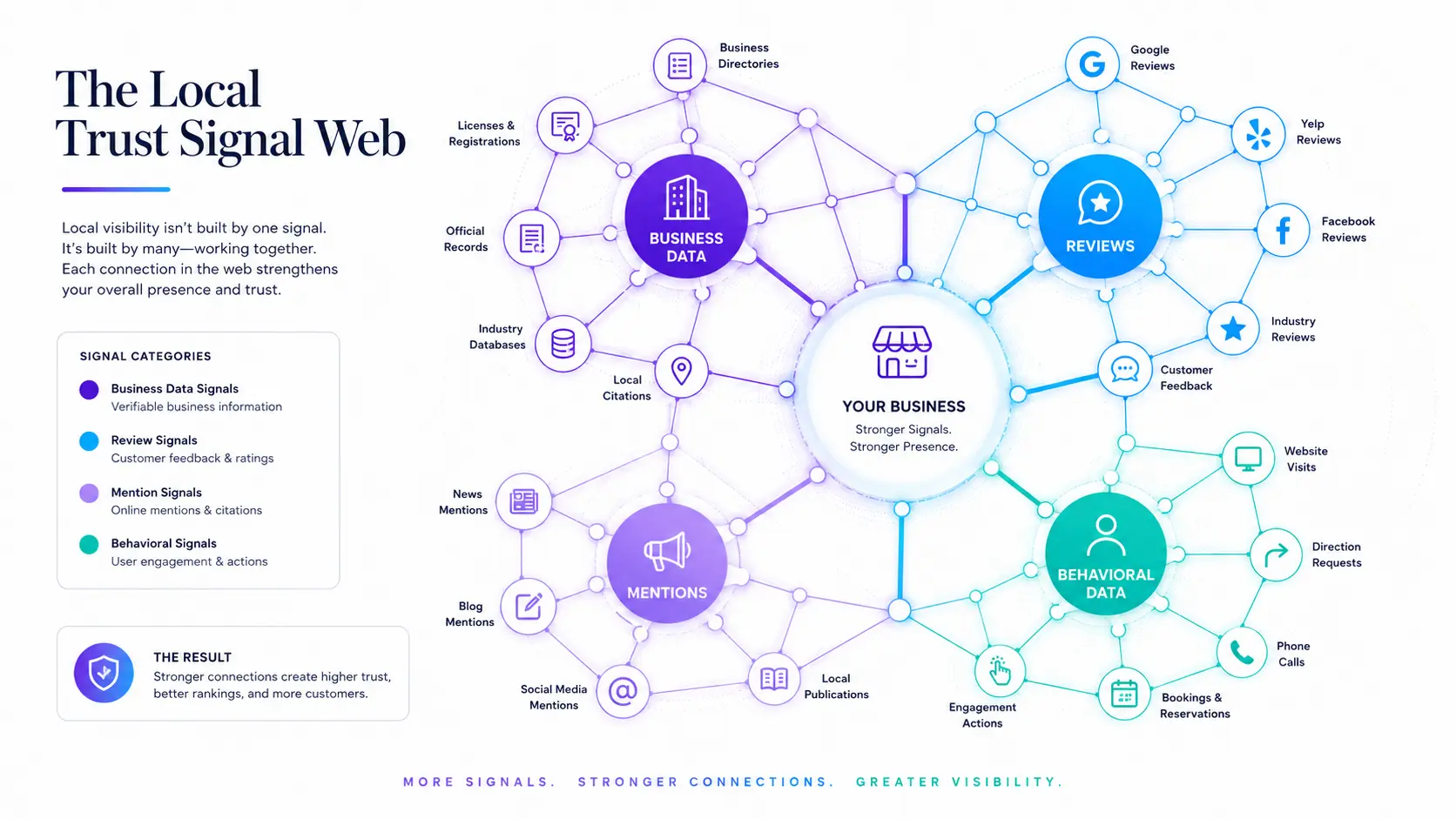
How evidence stabilizes visibility when site claims cannot
External evidence acts as the business’s reputation in public view – think updated directories, persistent mentions, and behavioral signals that show real activity.
It’s the difference between claiming “open late” on your homepage and showing up in third-party listings, review timelines, and real check-in data reflecting that reality.
Clients often ask why their site says everything correctly, but their listing still disappears.
It’s rarely a technical error – it’s almost always a missing pattern in the network of proof beyond their site.
Local systems scan for congruent footprints: does your operating info match across hundreds of sources?
Do real customers interact repeatedly over time?
In one case, a multi-location retailer improved their local visibility not by rewriting site copy but by systematically cleaning up third-party records and encouraging actual check-ins – the result: far less volatility, even when competitors spun up new landing pages.
Think of external evidence as a set of interlocking gears: if one slips, the whole machine can stall.
If every signal confirms and repeats your existence, your visibility becomes less sensitive to algorithmic shifts and more durable to competitive noise.
When in doubt, remember – local inclusion favors those who prove it, not those who just declare it.
Presence on the map starts at proximity, but reliable inclusion is earned by creating a web of evidence that no single claim – or clever headline – can substitute.

Trust gates in local search: what types of evidence matter
Types of Evidence That Influence Local Search Trust
| Aspect | Surface SEO Authority | Local Confidence (Evidence-Based Trust) |
| Definition | Website domain authority, backlinks, national SEO reputation | Consistent external records, reviews, behavioral signals confirming local presence |
| Key Signals | Content quality, trust flow, backlinks | NAP consistency, real-world customer interactions, third-party citations |
| Effect on Local Visibility | Limited influence; presence may not show in local map packs | Critical for map pack inclusion and stable local rankings |
| Typical Outcome | High domain authority but poor local visibility | Smaller or less polished sites with strong evidence rank better locally |
Most brands believe a strong website and proximity guarantee local search inclusion.
But visibility hinges on types of evidence most overlook – signals you can’t control just by updating your own pages.
The systems that sort local trust aren’t persuaded by your self-portrait; they’re searching for evidence from the outside world that you truly are who you say you are – and that others behave as if you’re worthy of inclusion.
Consistent business identity across external records
Here’s the catch: even a single mismatched address or stray business name on an obscure directory can quietly break the chain of trust.
We’ve seen local networks ignore otherwise prominent businesses simply because their core details – name, location, category – don’t match across every record.
Think of external records like passport control: one flagged discrepancy, and you’re held for further inspection or blocked entirely.
Entity consistency isn’t about perfection, but it is about alignment everywhere the digital network checks – major directories, niche industry sites, even secondary aggregators.
It’s not just what’s on your site; it’s how every third-party source speaks the same language about your business.
This is the silent gate.
You may think you’re visible, but if a bot or reviewer finds conflicting evidence, you can vanish.
Reviews, unlinked mentions, and behavioral proof as structural signals
A robust identity is necessary, but it isn’t enough if no one acts as though you exist locally.
Local systems use real-world signals – consistent review activity, persistent unlinked mentions, and patterns in user behavior – like anchors in a shifting current.
Unlike one-off boosts from a new listing or sudden link, these signals are persistent: once established, they create a rhythm local search ecosystems trust.
One local retailer we worked with had strong on-site content but little behavioral evidence – no reviews, no unrelated sites talking about them, sparse click data.
Result: months offline, invisible even as neighbors thrived.
Why?
Search engines don’t ask if you say you’re relevant.
They measure if people treat you as relevant – over time, through different channels, and in ways that can’t be easily faked.
If consistent third-party activity is air in the balloon, a lack of it slowly lets the air out, invisible until your listing sinks.
Surface authority can’t substitute for multi-channel evidence.
Only stable, persistent external signals open the trust gate – and keep it open.

Silent failure modes: what causes evidence‑based trust to fragment
Most teams don’t realize local search exclusion often happens with zero warning – and sometimes with no outward error at all.
Your business can look fully compliant, rank one week and disappear the next, all while internal dashboards show green lights.
The cause isn’t a penalty or a technical fault.
It’s invisible erosion: evidence fragmentation.
Fragmented listings and inconsistency eroding inclusion
Local inclusion isn’t held by a single thread – it’s a web of small but critical signals.
Imagine a spider’s web: snip just a few strands, and it sags or collapses altogether, even if most of the structure looks intact.
In our client work, mismatched address formats or inconsistent business names across citation sites were enough to quietly break trust gates.
No human review flagged the issue.
Instead, an AI system simply withheld inclusion until trust was restored.
The myth: one master record or a well-optimized GMB page guarantees stability.
But local systems cross-check data across dozens of sources.
A silent mismatch – especially one left unresolved across third-party directories – becomes a missing puzzle piece the algorithm can’t overlook.
That’s why brands with inconsistent listings sporadically drop in and out of local visibility, with no obvious cause.
Want predictability?
Consistency at the entity level isn’t optional.
It’s structural.
Volatility from unverifiable evidence and AI downgrades
What undermines trust faster than inconsistent data?
Signals that once existed but can no longer be verified.
Local systems use what I call “living evidence” – data that must stay current, observable, and externally referenced.
We’ve seen businesses lose entire citywide coverage overnight simply because an old citation source disappeared or AI began discounting a formerly reliable aggregator.
Here’s the executive dilemma: your team may fix one visible issue, only for silent downgrades to slingshot your visibility back to zero.
Two questions every decision-maker should ask: which sources can an AI currently verify, and which are at risk of vanishing next quarter?
Unlike surface technical errors, evidence-based trust failures don’t announce themselves – they flicker, then vanish.
If your local presence feels volatile or random, odds are silent gaps in evidence – not surface optimizations – are to blame.
For those focused on stability, clarity is simple: audit for silent fragmentation and plug evidence gaps before the next invisible failure strikes.

Comparing visibility risks: surface authority vs local confidence
Comparison of Surface Authority and Local Confidence in Local Search
| Type of Evidence | Description | Impact on Local Visibility |
| Consistent Business Identity | Uniform name, location, and category across all external records and directories | Prevents exclusion due to mismatched or inconsistent business details |
| Reviews | Consistent and persistent review activity over time | Signals real customer engagement and builds credibility |
| Unlinked Mentions | References to the business on external sites without direct links | Indicates genuine local recognition beyond owned and linked content |
| Behavioral Proof | User actions like check-ins, clicks, and repeated interactions | Demonstrates actual business activity and relevance to users |
Most decision-makers believe that a high-authority website guarantees strong local search visibility.
In practice, that’s rarely true – and the difference between global reputation and local inclusion is often invisible until it costs real business.
Why do brands with domain authority, trust flow, and impressive backlink profiles sometimes vanish from local packs while unknown competitors persist just blocks away?
When broad SEO authority doesn’t translate into local inclusion
Imagine you’re driving a car with a top-tier engine, but your tires are bald – the power never meets the pavement.
Broad SEO authority (think: robust content, PR hits, national links) often fails to deliver at the local level because local systems check a different set of signals first.
We’ve seen well-funded brands invest six figures ramping up their SEO footprint, only to realize that not a single GMB listing or map pack spot improved.
Why?
Local search trust evidence inclusion hinges on signals like entity consistency and external evidence signals – not just authoritative claims hosted on your own site.
Simply put, search engines ask: is this business *demonstrably* operating here, or just saying so online?
The myth that “authority flows everywhere equally” is persistent.
But local algorithms act like border guards – they don’t care where your passport was issued if you fail local verification.
One national client saw organic growth surge while their local presence flatlined, until off-site trust signals (business records, reviews, offline trust signals) were cleaned and synchronized.
If your local evidence crumbles, no amount of headline authority fills the gap.
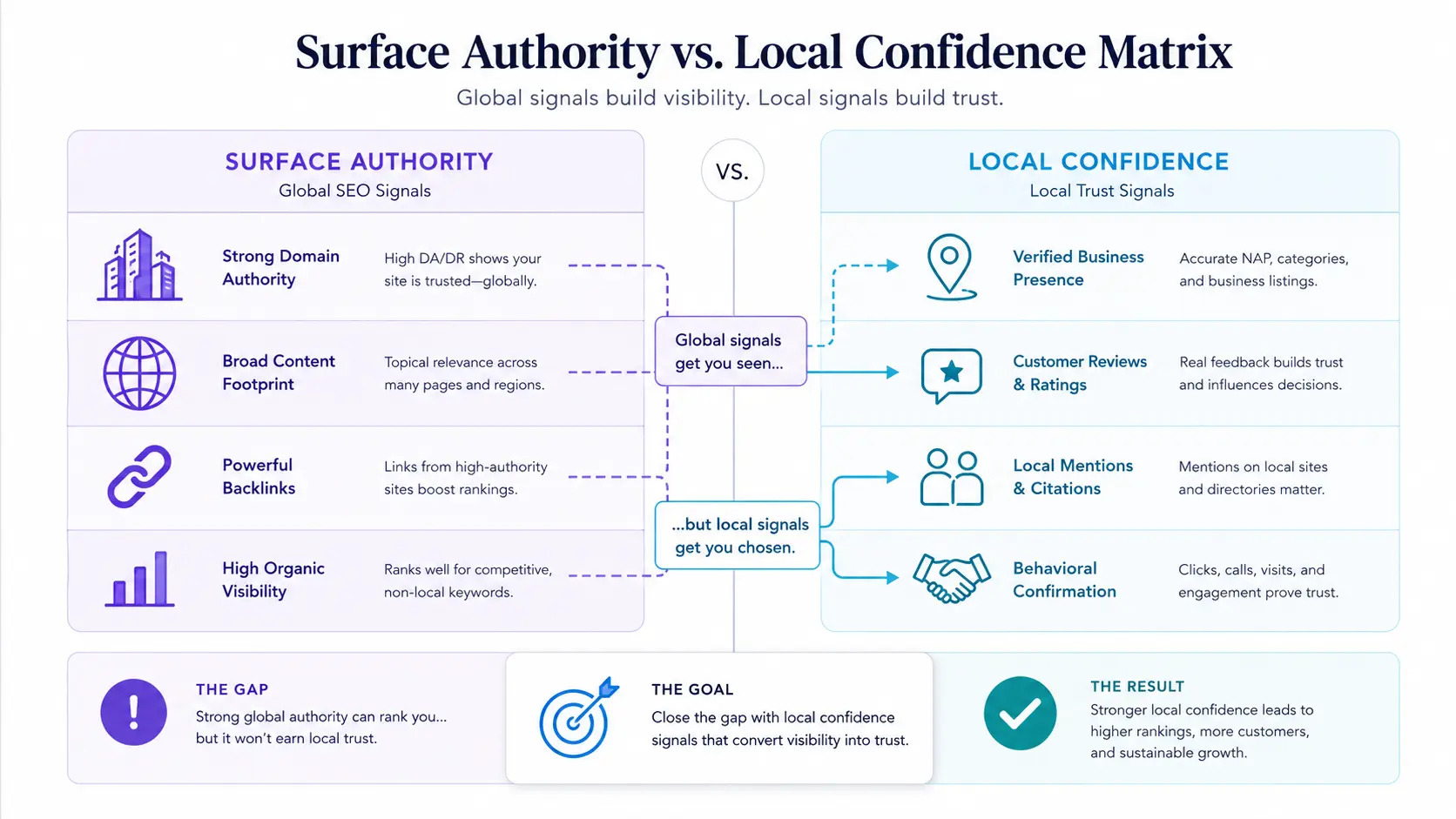
Why brands appear authoritative but vanish locally
“Why did our location drop off maps overnight?”
It’s a common executive question.
The answer usually lies in the gap between surface authority and local confidence.
We’ve worked with brands whose digital footprints outscale competitors by orders of magnitude – yet they watch their brick-and-mortar locations disappear from local search for days or weeks at a time.
Here’s the simple analogy: surface authority is a billboard visible for miles, but local inclusion is the lock on your office door.
Only local trust signals (consistent NAP, reviews, behavioral proof, unlinked mentions) grant access.
Strong branding builds recognition, but if evidence over self-description is missing, your presence is downgraded or removed in a heartbeat.
Ask yourself: if your map listing vanished today, would your offsite evidence prove you should reappear?
Local inclusion uncertainty is driven by evidence gaps, not SEO headline strength.
That explains why even market leaders face volatile local visibility after a rebrand, relocation, or entity inconsistency.
Surface authority is impressive, but only local confidence sustains visibility where business is won or lost.
The most resilient brands invest just as hard in evidence as they do in appearance – because local trust is earned, not claimed.
Reviews act as fast evidence for local trust.

Scientific context and sources
The sources below provide foundational context for how decision-making, attention, and performance dynamics evolve under scaling and constraint conditions.
- Decision-Making and Uncertainty in Digital Systems
Information Foraging – Peter Pirolli, Stuart Card – Psychological Review
Explores how users and systems evaluate the value and credibility of information under uncertainty, supporting the article’s focus on evidence over claims in local search.
https://psycnet.apa.org/doi/10.1037/0033-295X.106.4.643 - Mechanisms of Trust in Automated and Online Environments
Trust in Automation: Designing for Appropriate Reliance – John D. Lee, Katrina A. See – Human Factors
Analyzes how automated systems establish and require corroborated trust signals, paralleling local search algorithms’ preference for verifiable evidence.
https://journals.sagepub.com/doi/10.1518/hfes.46.1.50_30392 - Entity Resolution and Data Consistency in Information Networks
Entity Resolution: Theory, Practice & Open Challenges – Lise Getoor, Ashwin Machanavajjhala – Proceedings of the VLDB Endowment
Addresses the importance of consistent signals across distributed sources to maintain entity trust, directly reinforcing the article’s position on identity consistency for local inclusion.
https://dl.acm.org/doi/10.14778/2367502.2367564 - Consumer Behavior and Third-Party Validation
Third-party Organization Endorsement Impacts on Brand Trust – Chia-Lin Yuan, Chia-Hung Hsu – Industrial Marketing Management
Investigates how external validation impacts credibility and performance outcomes in marketplace visibility, supporting the critical role of reviews and mentions.
https://www.sciencedirect.com/science/article/abs/pii/S0019850119308156 - Effects of Data Fragmentation on Trust and Performance Indices
Common Data Quality Elements for Health Information Systems – H. Ghalavand et al. – BMC Medical Informatics and Decision Making
Examines how fragmented or outdated records silently erode trust and performance, consistent with the silent failure modes discussed.
https://pmc.ncbi.nlm.nih.gov/articles/PMC11367888/
Questions You Might Ponder
Why doesn’t a business’s proximity alone guarantee local search visibility?
Proximity is only the starting point for local inclusion. Modern local search algorithms require additional proof through external, verifiable evidence – like listings, reviews, and behavioral data – before granting map visibility. Relying on proximity alone misses critical trust-building steps.
What types of external evidence influence local search trust evidence inclusion?
The most influential external evidence includes consistent business details across third-party sites, recent customer reviews, unlinked mentions, and user behavior patterns. These signals anchor trust, ensure entity alignment, and validate real-world operations for search systems.
How can inconsistent listings affect local search trust evidence inclusion?
Even minor inconsistencies in business information such as mismatched addresses or names can break digital trust chains. Local algorithms treat these discrepancies as red flags, often pausing or removing listings until all evidence is verified and synchronized.
Why do authoritative websites sometimes fail in local search trust evidence inclusion?
Authority from backlinks and well-optimized content helps globally, but local search prioritizes evidence like review volume, local user activity, and business record alignment. Without this localized corroboration, broad SEO signals aren’t enough for inclusion.
What causes sudden drops in local visibility despite technical compliance?
Invisible trust erosion frequently results from outdated, missing, or unverifiable external evidence – even when internal metrics look fine. Silent fragmentation, such as vanishing third-party listings, quietly downgrades or removes map visibility without visible warnings.