
What You’ll Learn
Reviews as trust evidence in local search are customer-generated signals that help search engines and AI systems decide whether a business is credible, active, relevant, and safe to recommend in local results.
Reviews influence local inclusion through volume, recency, rating patterns, owner responses, detailed service language, and consistency across platforms.
Proximity may make a business eligible, but strong review evidence can determine whether it appears, ranks, or stays visible.
Fresh, specific reviews reduce uncertainty by showing real customer experience, while stale, sparse, generic, or unanswered reviews can weaken confidence and cause visibility loss. In local search, reviews act as proof, not just reputation.
Key Takeaways
- Proximity alone is not enough for local search inclusion; reviews as trust evidence in local search are now the primary filter for map visibility.
- Volume, recency, and narrative detail in reviews collectively build the confidence algorithms require to recommend your business locally.
- Review silence or unaddressed feedback erodes trust, leading to sudden loss of map presence, regardless of previous rankings or site changes.
- Industry competition and review activity levels determine whether trust signals or proximity carry more weight in local search results.
The biggest myth in local search is that being near the customer guarantees your spot on the map.
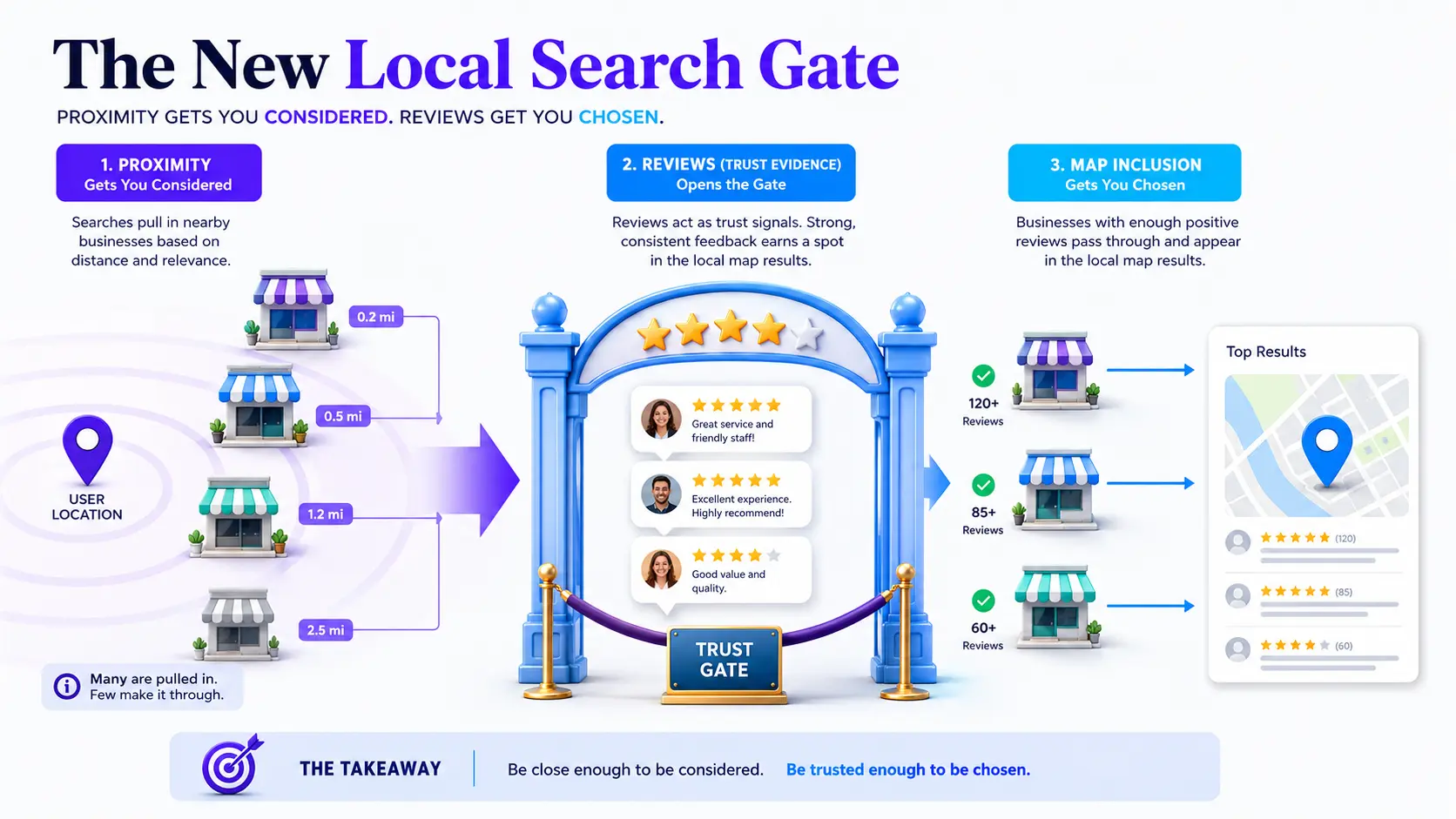
Most businesses don’t realize: proximity only gets you to the bouncer – it’s your reviews that open the door.
Being close makes your listing eligible, but the real filter kicks in when search engines ask: “Do others trust you enough for us to risk offering you to users?”

Why reviews act as the trust gate for local inclusion
For countless client audits, we’ve watched storefronts closest to a searcher sit hidden below map pack scroll – passed over because their review trail was sparse or stale, even as competitors with thicker review profiles took top billing from farther away.
Imagine proximity as your business physically waving from the crowd, but review evidence as the ID badge that lets you past the velvet rope.
Have you ever wondered why a competitor two blocks farther consistently outranks you?
It’s rarely random.
The trust required for inclusion is built through signals that reviews supply.
How visibility begins with proximity, but true inclusion needs review evidence
The open loop: Google’s algorithms don’t just “prefer” better-reviewed options – they rely on reviews to decide if you’re even worth showing at all.
The map isn’t a level playing field; it’s a confidence filter, and the rules changed as trust evidence became the new entry ticket.
That broader logic is mapped in Local Search Visibility.
Why volume, recency, and detail form the foundation of confidence
Key Review Factors Building Local Search Confidence
| Industry/Sector | Priority Factor | Typical Scenario |
| Healthcare & Beauty | Review Volume & Recency | Medical spas dominate despite being farther away |
| Legal, B2B, Rural | Proximity | Personal injury attorneys with few reviews outrank distant rivals |
It’s not the star rating alone that determines trust.
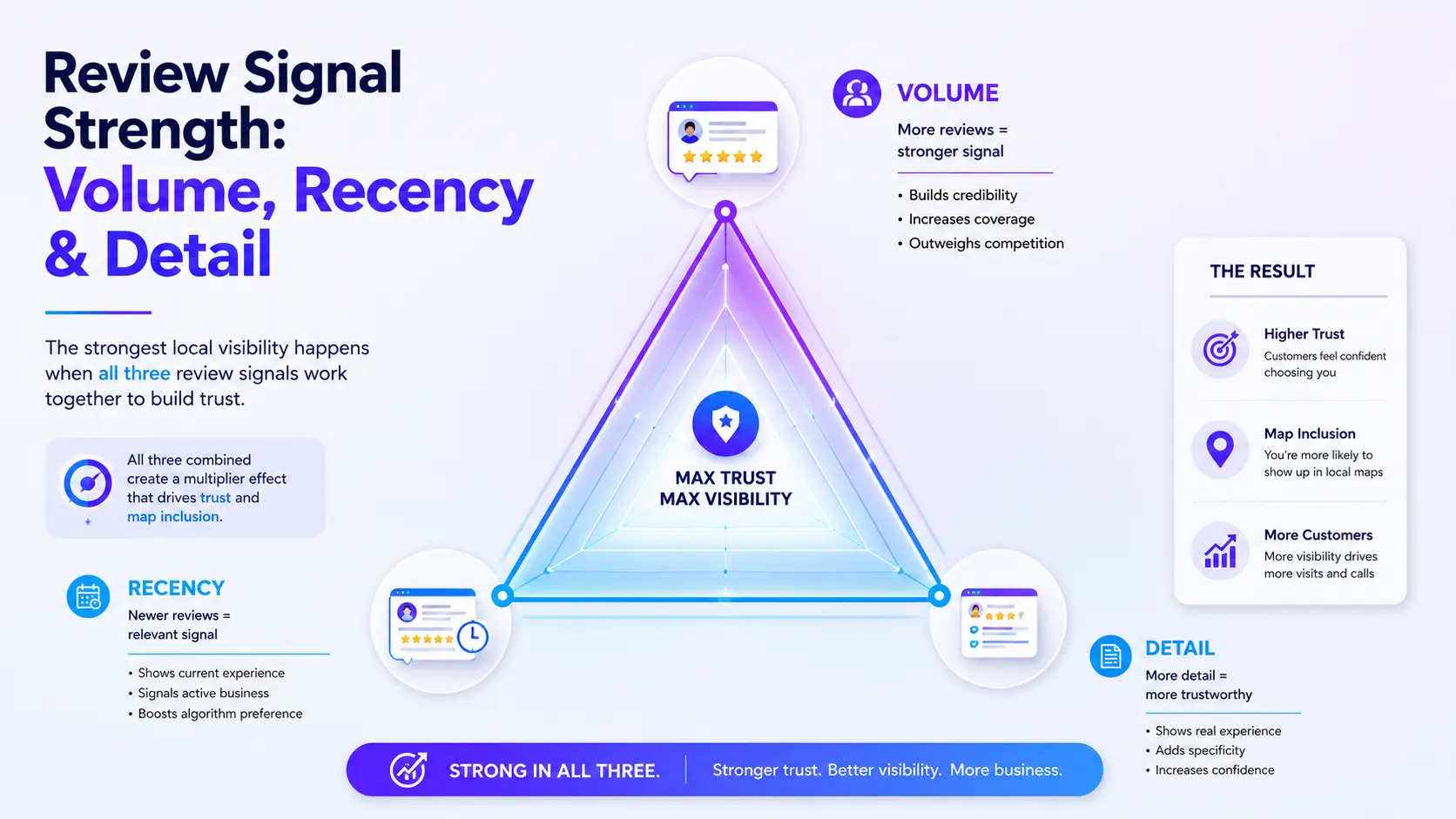
Inclusion confidence in local maps forms from a compound signal: enough reviews (volume), reviews from the last few months (recency), and content that shows real customer experiences (detail and relevance).
We watched a fitness chain leap to prominence after doubling fresh reviews within 90 days – outpacing older, higher-rated incumbents.
Another client plateaued in map exposure, despite glowing scores, until recent reviews started pouring in and candid feedback filled in missing service specifics.
Review recency acts like a freshness guarantee, while volume de-risks the occasional bad outlier.
Detailed narratives – “fast appointment”, “spotless equipment”, “open late on weekends” – function as micro-evidence AI uses to validate your offering against user intent.
Why?
Because silence, gaps, or generic praise are interpreted as risk or irrelevance.
Review strength works like daylight flooding a dark room: the more recent, plentiful, and specific your reviews, the easier it is for systems (and humans) to trust what you say about yourself.
When reviews as trust evidence are missing or weak, proximity fades and confidence evaporates.
Local inclusion isn’t granted by location alone – it’s earned, validated, and advanced by your review history.
What happens when review signals are weak or silent
Losing map visibility rarely comes with a warning, but there’s almost always a signal loss behind the scenes: silence in your reviews.
The most common mistakes we see aren’t massive blunders – they’re periods of inactivity, a few months without new reviews, or a pattern of late replies that quietly cost local inclusion.
What feels like a small pause in customer engagement can trigger a full trust reset by the systems that decide who stays visible.
Why sporadic or stale reviews erode inclusion even without site changes
Imagine a coffee shop that once buzzed with fresh feedback but now collects reviews as infrequently as holiday cards.
Local platforms don’t just notice – they treat those gaps as doubts about your relevance, no matter how consistent your services.
It’s tempting to think that a high average rating is a safety net, but when reviews trickle in or go stale, your trust score decays beneath the surface.
One pattern from our client reviews: businesses with six-month gaps in feedback fell out of local packs, even though their websites and offerings were untouched.
Search engines and AI-powered listings see silence as a negative trend, interpreting it as declining customer engagement or underlying issues.
If your competitors maintain steady review activity, your visibility drops off – sometimes overnight – without a single technical fault on your side.
Review activity isn’t just additive; its pace matters.
Not seeing recent or regular reviews feels, to the system, like a party where the music stopped but nobody told the guests.
A store with steady, living feedback stays in the map pack spotlight, while others quietly fade.
How unaddressed feedback undermines visibility in AI‑driven summaries
A common myth: only positive reviews matter.
In reality, leaving feedback – especially criticism – unanswered often does more harm than the negative comment itself.
Today’s AI-driven local results scan for unresolved complaints or unanswered questions, flagging them as risk factors.
In competitive markets, this silence looks like indifference.
We’ve seen businesses lose share in AI summary listings simply because unresolved reviews created ambiguity about their service stability.
Unaddressed feedback is like static on a phone call; the message gets garbled, and trust evaporates by default.
When search engines or AI products detect gaps in owner response, they struggle to present authoritative, current answers – especially for queries with “best” or “reliable” intent.
Ask yourself: if the only communication a customer sees is negative or old, would you expect a system engineered for safety and confidence to risk recommending you?
Leaving feedback unaddressed hands the narrative – and the ranking opportunity – to your competitors.
If review signals fade or go unaddressed, it’s not just traffic that disappears – it’s the system’s vote of confidence, lost in silence and static.
The next section explores how review detail and language reactivate trust and precision for stubborn inclusion gaps.

How review content shapes relevance beyond simple ratings
You can have a wall of five-star reviews and still miss the map pack.
The factor most leaders ignore?
It isn’t just “how many” or “how fresh” your reviews are – but what’s actually said inside them.
Many businesses assume a high rating does the heavy lifting.
In reality, systems now treat review language as the raw data powering local search matching.
The words matter as much as the stars.
Why keywords in reviews help systems understand your services
Think of reviews as your silent marketing team.
When a customer details, “fast same-day AC repair”, that phrase gives AI-driven local systems a true signal: your business solves the exact need someone might search for.
We’ve repeatedly seen companies with fewer total reviews outrank better-known rivals simply because their reviews reference core services directly – “root canal”, “child-friendly dentist”, or “pet boarding”, not just “great service”.
The real myth?
That generic praise helps boost you.
It doesn’t.
Local algorithms match customer language to searcher queries, treating every specific detail (“emergency furnace install”, “gluten-free pastries”, “Saturday appointments”) as a data point increasing your fit.
This is not just keyword stuffing, but organic semantic alignment.
The closer your review narratives mirror actual demand, the more often you appear for lucrative, intent-driven searches.
If you don’t influence the language customers use, your business becomes invisible for the queries that drive decisions.
We often see high-intent local calls increase when review content reflects unique service offerings, showing the impact of semantic relevance.
If your reviews only say “highly recommend”, you’re limiting your reach – no matter your rating.
Why AI engines rely on consistent review consensus across platforms
A single review silo won’t cut it anymore.
Increasingly, AI-powered search pulls data from all visible sources – Google, Yelp, Facebook, industry directories – and looks for consensus in both tone and specific language.
If your story is clear and repeated (“fast AC repair” everywhere), systems feel confident surfacing your listing.
But even a mismatch – a surge of “best brunch” on one platform, but “terrible service” on another – creates what we call trust friction: a signal that something isn’t right.
We’ve watched local clinics held back from top positions solely due to review disparities across sites, even when their Google ratings were strong.
Ask yourself: does your value proposition echo across every review channel, or does it fracture?
AI doesn’t award points for isolated wins.
It rewards unified trust, consistently evidenced in both keywords and sentiment.
Like tuning instruments in an orchestra, consensus across platforms raises your inclusion confidence in local maps.
Review content isn’t a side effect of happy customers – it’s the vocabulary that maps your business to buyers’ real-world needs.
The difference is immediate: companies that manage their review language and consistency dominate intent-rich local search while silent competitors fade out.

When review strength varies by industry or competitive context
Industry Impact on Review Weight vs Proximity
| Factor | Description | Impact Example |
| Volume | Having enough reviews to establish a pattern | Doubling fresh reviews helped a fitness chain leap in rankings |
| Recency | Reviews from the last few months ensuring freshness | Client stalled until new recent reviews arrived |
The difference between owning map visibility and being invisible isn’t just about reviews – it’s about who your competitors are and what sector you play in.
One client in aesthetics saw new patient flow surge after their Google review count tripled, even though their address was further away for most searches.
Yet we’ve seen estate law offices remain in the map pack with stale review profiles, simply because no one else in town has built meaningful trust signals.
So, how do you know when to prioritize review acquisition versus location advantage?
When review volume outweighs proximity – for healthcare or beauty
In sectors like healthcare and beauty, proximity sets the stage but review quantity and recency decide who gets top billing.
Patients seeking a dermatologist or parents comparing orthodontists – they click on the provider with 100+ recent, detailed reviews rather than the clinic closest to them.
We’ve watched medical spas five miles outside high-density zip codes dominate search results, reflecting how review activity accumulates trust regardless of location.
Why?
Trust accumulation outpaces location.
The system weighs a wall of current, descriptive reviews as stronger evidence that real people have real, recent experiences.
In the minds of both algorithms and customers, a two-mile detour is worth it to avoid risk.
Think of reviews as compounding interest: in segments where service outcome and personal comfort matter, each new, relevant review adds credibility that proximity alone can’t provide.
Is your volume and freshness beating the local norm, or are you hoping convenience will work against a wall of social proof?
When proximity still dominates – legal or low‑competition zones
Contrast that with legal, B2B, or rural markets, where system logic defaults to proximity.
We’ve seen personal injury attorneys with five reviews outrank better-rated, farther-off competitors simply because local density is so low.
Here, even a dated or sparse review profile won’t penalize you – unless a new entrant starts stacking positive reviews quickly.
The main risk is complacency: as soon as one firm breaks the silence with sustained review growth, the balance tips.
Are you in a market where all it takes is location, or is someone quietly turning reviews into a moat?
As competitive context and industry expectations shift, so does the true weight of your reviews.
What worked for you last year – or in a different vertical – may be the blind spot that lets a challenger outpace you now.
Low confidence often shows up as volatility, as explored in Silent Local Visibility Failure.

Scientific context and sources
The sources below provide foundational context for how decision-making, attention, and performance dynamics evolve under scaling and constraint conditions.
- Local Trust and Social Signals
Reviews, Reputation, and Revenue: The Case of Yelp.com – Luca, M. – Harvard Business School Working Paper
A key academic analysis of how user reviews influence perceived trust, market inclusion, and local consumer choices, directly backing the article’s argument.
https://www.hbs.edu/ris/Publication%20Files/12-016_a7e4a5a2-03f9-490d-b093-8f951238dba2.pdf - Algorithmic Filtering in Information Retrieval
The Small-World Phenomenon: An Algorithmic Perspective – Kleinberg, J. – Proceedings of the ACM Symposium on Theory of Computing
Explores how network signals function as filters in decentralized search settings – paralleling local search gatekeeping.
https://www.cs.cornell.edu/home/kleinber/swn.pdf - Behavioral Foundations of Online Reputation
Review on Computational Trust and Reputation Models – Sabater, J. & Sierra, C. – Artificial Intelligence Review
Analyzes how reputation and trust models shape digital confidence, mirroring local search algorithms’ reliance on review-based signals.
https://link.springer.com/article/10.1007/s10462-004-0041-5 - Cross-Platform Reputation Consistency
Tips to improve your local ranking on Google – Google Business Profile Help, Google Official Documentation
Clarifies how Google evaluates relevance, distance, prominence, reviews, and profile signals for local ranking eligibility.
https://support.google.com/business/answer/7091?hl=en - Semantic Review Content and Search Relevance
A semantic measure of online review helpfulness and the importance of message entropy – Fresneda, J. E. & Gefen, D. – Decision Support Systems
Illuminates how specific language in reviews enhances review helpfulness and content-based matching, providing empirical support for the article’s focus on review detail.
https://www.sciencedirect.com/science/article/pii/S0167923619301460
Questions You Might Ponder
Why do reviews matter more than proximity in local search rankings?
Reviews as trust evidence in local search provide dynamic proof that real customers engage with and recommend your business. While proximity puts you on the eligibility map, data-driven trust signals from reviews determine inclusion, making or breaking your visibility for users and search engines alike.
What type of reviews help my business rank higher in local results?
Recent, detailed, and high-volume reviews boost local search inclusion. Search engines prioritize review signals showing real, recent customer experiences that align with search intent over just star ratings or generic praise, rewarding narrative detail and frequency.
Can my business lose map visibility without negative reviews?
Yes – review silence or stagnation can trigger a trust reset, causing your business to disappear from map packs even without negative feedback. Search algorithms view inactivity or outdated reviews as a risk, reducing your inclusion confidence compared to competitors with ongoing review activity.
Does responding to negative reviews improve local search performance?
Absolutely. Timely, thoughtful responses to all feedback – especially criticism – demonstrate engagement and risk mitigation, raising trust signals for both users and search engines. Ignored negative reviews, in contrast, generate ambiguity and can lower your local ranking.
How does consistency across multiple review platforms affect ranking?
Local search systems evaluate cross-platform consensus in both sentiment and keyword themes. Broad alignment – such as repeated mention of services or quality – increases trust, while discrepancies or silent platforms reduce your signal strength and map inclusion probability.