
What You’ll Learn
Local search inclusion vs ranking is the difference between being eligible to appear in local results and competing for position after eligibility is granted.
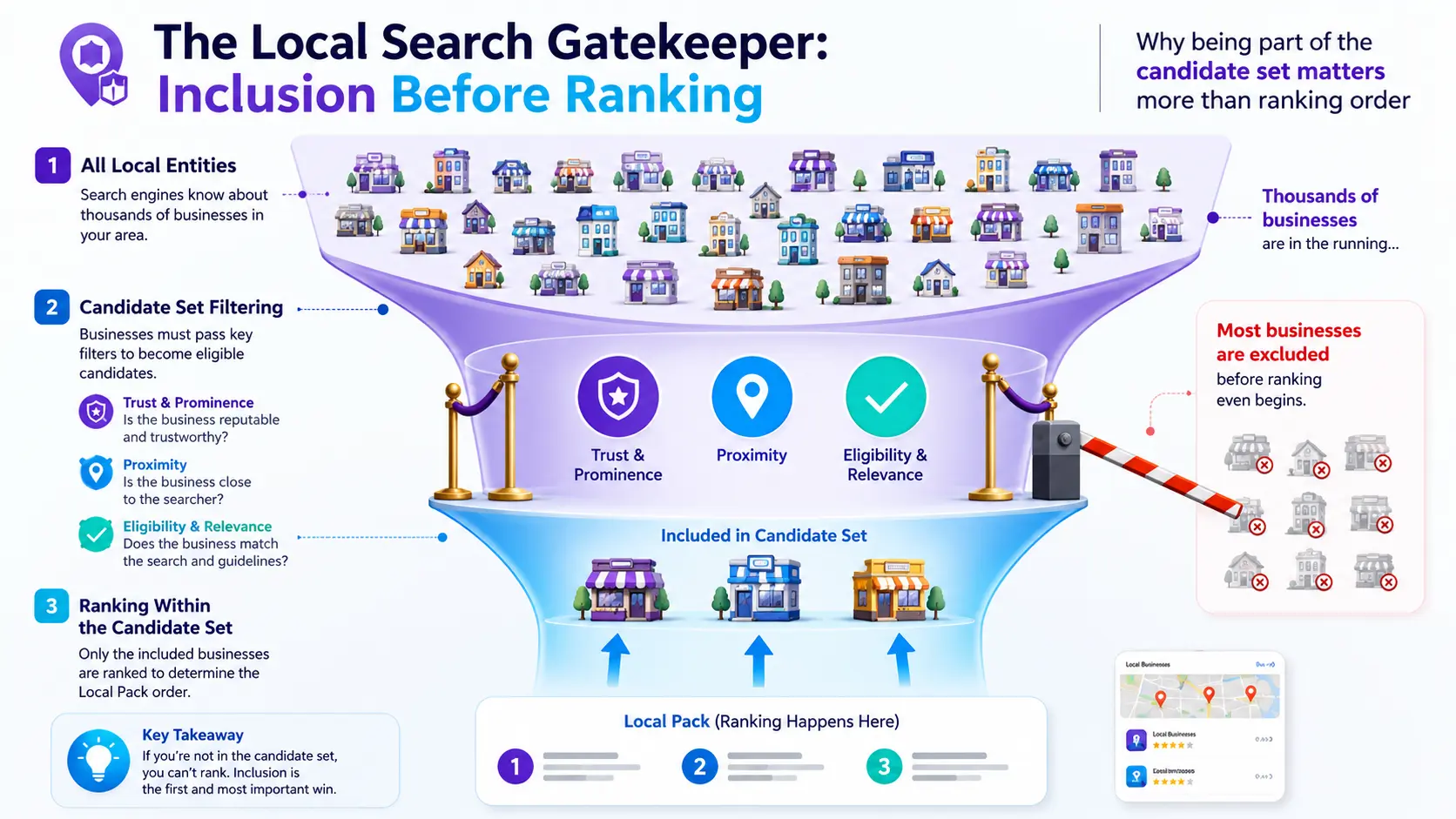
Inclusion comes first: Google must recognize a business as a valid local candidate based on proximity, verified entity data, NAP consistency, Google Business Profile accuracy, reviews, categories, and trust signals.
Ranking only matters after the business enters that candidate set.
A company can have strong organic SEO, links, and content authority but still be absent from the local pack if inclusion filters fail.
Diagnosing local visibility should therefore start by asking whether the business is being considered at all, not where it ranks.
Key Takeaways
- Local search inclusion is the precondition for ranking; eligibility must be met before Google considers your business for local pack results.
- High website authority and links do not guarantee local pack presence – proximity, entity accuracy, and trust signals are the true gatekeepers.
- Eligibility for local search is highly volatile and can be lost due to changes in reviews, directory data, or NAP inconsistencies, even if your site is unchanged.
- Diagnosing local search failures requires focusing on inclusion first; only those admitted to the candidate set can impact their ranking position.
Most companies obsess over local rankings – and miss that they might never even make the shortlist.
The harsh reality: unless Google recognizes your entity as eligible, no amount of SEO firepower will put you in front of local searchers.
Inclusion is the quiet gatekeeper of local visibility – the ranking only starts once you’re inside that club, and that door is locked shut for most brands.

Why being part of the candidate set matters more than ranking order
The first filter is simple but absolute: proximity and eligibility.
Think of the candidate set like the velvet rope at a high-demand club.
Only businesses within a certain geographic radius, with a verified identity and clear trust signals, even have a shot at being shown.
We’ve worked with multi-location brands recognized nationally but invisible in their own zip codes – because inconsistent entity details or missing review data silently locked them out.
How Google decides who can even appear
One myth still trips up enterprise teams: that local pack eligibility operates like organic SEO, where enough backlinks or content can force your way in.
Not here.
Google’s local inclusion logic scans for a matching business profile, reliable NAP consistency, and trust markers like steady reviews or updated information.
If any piece is off, your listing is filtered before ranking comes into play.
It’s less about ‘being the best’ and more about ‘being recognized as an option at all’.
How ranking only applies after approval
Ranking in the local pack feels urgent – but only after you’re “approved” for the search.
Being outside the candidate set makes your local SEO efforts irrelevant: no one can rank from the outside looking in.
We’ve seen businesses burn budget analyzing positions that, in reality, don’t even exist for them because Google never included their entity in the pool for those searches.
It’s like focusing on your running speed in a race you were never allowed to start.
The order in the pack only matters for those who survived eligibility filtering.
Ask yourself: are you fighting for position – or wondering why you’re not even on the field?
The difference is the gap between visibility and total invisibility.
What matters most for local visibility isn’t how high you rank, but whether you’re in the game at all.
Only once you make the cut does the question of ranking have any meaning.

Why traditional SEO authority doesn’t guarantee local pack inclusion
Most executives equate domain strength with local dominance – but Google’s local pack doesn’t care how many links you’ve earned if you miss a basic eligibility test.
You can outrank Fortune 500s in organic SERPs and still watch your business vanish from the map overnight. Why? Because local search inclusion vs ranking is more gatekeeper than ladder.
Let’s look at two fault lines that shatter the illusion of “SEO strength equals visibility”.
Why content authority fails when inclusion filters are unmet
A flawless content strategy cannot compensate for an invisible business profile fifty feet outside Google’s proximity boundaries. Imagine pouring concrete for a skyscraper, only to discover the plot is six inches over the property line and ineligible for development.
The same friction applies to local pack eligibility: entity consistency, proximity, and trust signals (from your Google Business Profile and third-party sources) set the walls before ranking even becomes possible.
We’ve seen SaaS brands with 10x more backlinks than their competitors get boxed out of the local search candidate set for missing one GBP category or hiding their office location.
Here’s the myth to break: organic SEO vs local pack is not a seamless handoff – authority only matters after inclusion logic gives you a ticket.
How silent volatility breaks inclusion without site changes
What disrupts eligibility can be nearly invisible.
Silent volatility – those sudden disappearances or erratic appearances – rarely trace back to your site or new content.
More often, the culprit is trust instability: missing reviews, a slightly different business name across directories, or a hidden suspension risk in Google’s trust systems.
One multi-location client lost two-thirds of their local impressions overnight after a directory update introduced minor address inconsistencies – despite zero changes to their web domain or site structure.
Ranking volatility gets attention.
But the deeper risk is silent exclusion, where even a perfect site sits in the dark if entity data signals, proximity boundaries, or trust markers aren’t in sync.
Think of your website authority as horsepower – it can’t drive you to the starting line if you’re blocked by a locked garage.
If your local visibility fluctuates while your organic rankings stay stable, eligibility – not authority – is likely the missing piece.
The real win comes from diagnosing and stabilizing those hidden local pack eligibility factors before obsessing over position shifts.

What causes eligibility to shrink or disappear unexpectedly
Your business can lose local search eligibility overnight – no site changes or rule-breaking required.
Eligibility is dynamic; two silent, system-level forces outside your organic performance often trigger unexplained invisibility.
Sudden disappearance is rarely about SEO decline – instead, it’s about the invisible candidate set boundary shifting.
When proximity limitations cap reach – even with high authority
Imagine a spotlight fixed to your business location; step just outside the beam, and you vanish from Google’s local candidate pool, no matter your SEO prowess.
We’ve seen multi-location brands with flawless authority confined to a few neighborhoods – because Google’s local search candidate set isn’t swayed by backlinks or stellar content when proximity fails.
Authority doesn’t travel: if your address sits outside the user’s intent radius, you’re out.
One client increased local pack impressions by 70% in a new district simply by opening a verified, physical location – after months of flatlining despite escalating every other signal.
Ask yourself: why does your visibility evaporate a block away – even when your competition’s sites are weaker?
Because for Google, proximity trumps muscle.
It’s not a bug; it’s a filter.
The analogy: authority is horsepower, but eligibility is the racetrack – without the right map, you never hit the gas.
How declining trust signals can exclude you behind the scenes
Eligibility isn’t just about where you are – it’s also about whether Google still trusts your entity enough to show you.
Your business could remain unchanged, but if reviews drop off, NAP (Name, Address, Phone) data fragments, or entity signals become inconsistent across sources, inclusion can quietly evaporate.
For one retailer, a sudden dip in new reviews (while competitors surged) triggered a two-month local invisibility streak – despite traffic and links still climbing.
Another saw their GBP entity drift out of the candidate set for a regulated term after a licensing directory went stale – Google rescans trust, and one missing piece can break the chain.
You never receive a warning.
Are you never shown because your authority dipped, or because the eligibility gate closed behind you?
The diagnostic difference means everything.
Here’s the insight: “Local visibility can disappear not because you lost ground, but because the field around you changed”.
When eligibility shrinks, the odds are you won’t see it until the phone stops ringing.
The smart move: monitor not just how you rank – but whether you’re even being considered.
That’s the difference between chasing phantom ranking fixes and solving the real problem.

How to distinguish inclusion failures from ranking issues
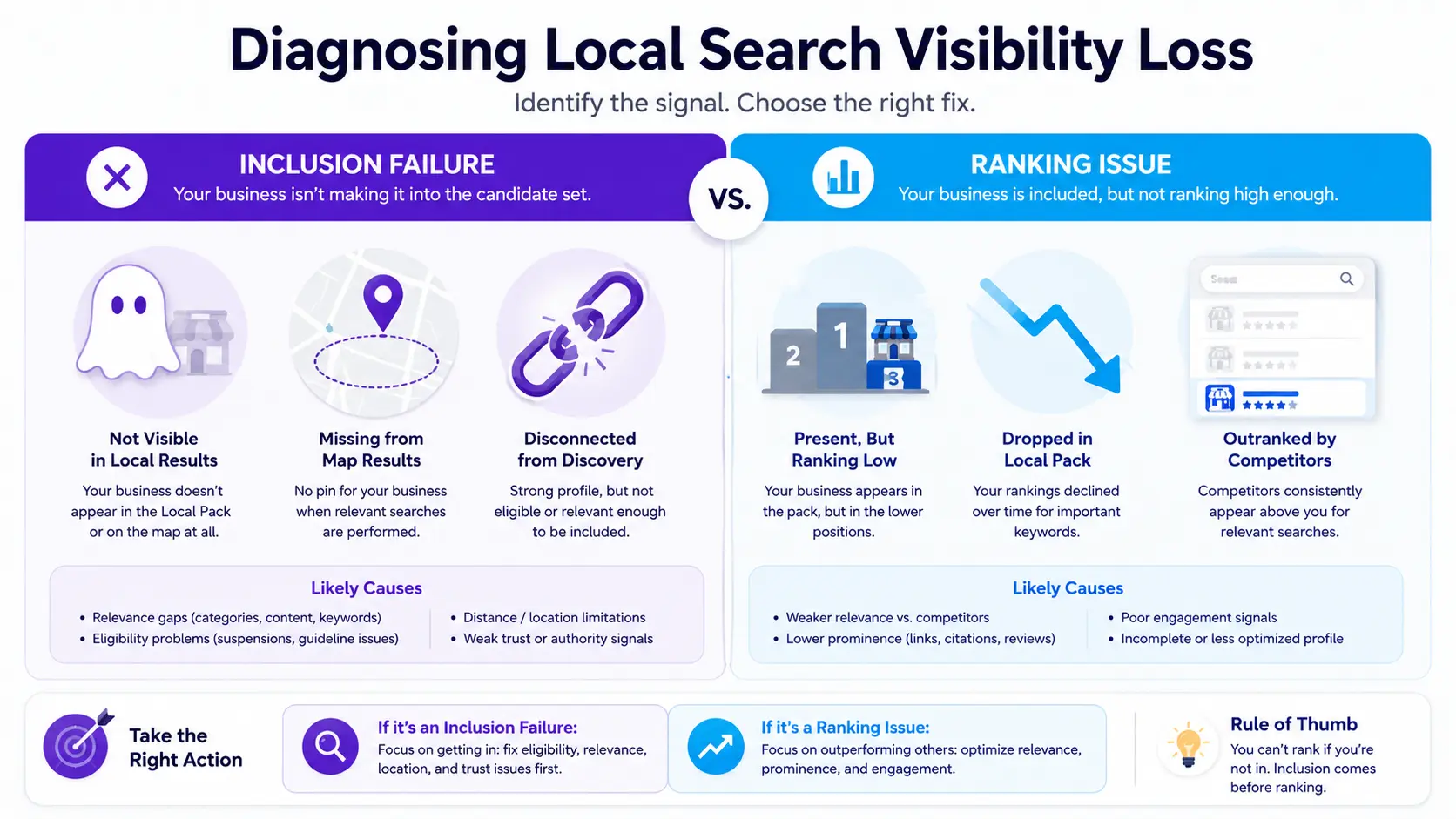
If your local search numbers flatline – zero map impressions, missing from the local pack, or strange on-again-off-again visibility – it’s rarely a ranking problem.
Most visibility issues masquerade as poor placement, but in reality, you weren’t even considered for the list.
This is the core local search blind spot: obsessing over ranking signals when the inclusion gate quietly locks you out.
Signs you’re never being considered vs ranked poorly
Diagnostic Differences: Inclusion Failure vs Ranking Weakness
| Failure Type | Recommended Diagnostic Tool | Diagnostic Focus |
| Inclusion Failure | Map-focused analytics (geo-grid scans) | Check candidate set presence across locations |
| Ranking Weakness | Traditional ranking tools / SEO analysis | Assess authority and optimization signals |
Imagine pouring resources into your organic SEO, only to find your business ghosted in key searches.
The giveaway?
You never show up, even for brand or niche queries in areas you know you should serve. It isn’t that you lost a rank – it’s that you’re missing from the candidate set altogether.
No impressions, even with aggressive reviews, local citations, or direct lookups.
With true ranking weakness, your business appears deep in the pack: low impressions, some horrid click-through rates, but not outright invisibility.
Inclusion failure feels different.
Your listing flickers on and off across devices, or vanishes outside a razor-thin proximity band – even when competitors display regularly.
We’ve seen sophisticated chains with flawless reputation skip entire ZIP codes, not due to authority, but because a conflicting address or review dip forced Google to doubt their legitimacy.
It’s the difference between playing a game from the bench versus never even being issued a uniform.
Are you getting no local pack impressions at all, or do you see a trickle – just never in the top three? That diagnostic split is everything.
Which next diagnostic asset to use based on the failure type
Diagnostic Tool Selection Based on Local Search Failure Type
| Aspect | Inclusion Failure (Not Considered) | Ranking Weakness (Poor Position) |
| Impressions | No impressions at all | Low impressions, visible in lower positions |
| Search Queries | Absent even for brand/niche queries | Present but ranked low |
If inclusion is the issue, traditional ranking tools mislead more than they help.
Instead, map-focused analytics – like geo-grid scans – reveal where your entity is a candidate and where it simply isn’t in play.
When patterns show you’re missing across all locations, that points to trust or entity consistency breakdowns.
If you appear, but never above the cutoff, then authority and optimization layers matter.
In practice, our highest-leverage move isn’t chasing one more link or tweaking another GBP field.
It’s diagnosing whether Google even recognizes you as eligible in each micro-market.
Only then can you apply the right fix, whether that means stabilizing trust signals or mapping proximity boundaries.
The most expensive mistake?
Solving for ranking when your inclusion gate is still closed.
Diagnose eligibility first – then optimize for rank.
That’s how you convert confusion into control.
Local search evaluates businesses as entities, not pages.

Scientific context and sources
The sources below provide foundational context for how decision-making, attention, and performance dynamics evolve under scaling and constraint conditions.
- Entity Recognition and Trust Signals
“Entity-Oriented Search” – Krisztian Balog – Foundations and Trends in Information Retrieval / Springer
Explains how modern search engines identify, classify, and rank entities using structured and unstructured data, directly relevant to how business entities are created, interpreted, and surfaced in local search systems.
https://link.springer.com/book/10.1007/978-3-319-93935-3 - Attention and Cognitive Bias in Results Display
“Driven to Distraction: Examining the Influence of Distractors on Search Behaviours, Performance and Experience” – Leif Azzopardi, David Maxwell, Martin Halvey, Claudia Hauff – ACM SIGIR CHIIR
Explores how distractions and competing stimuli alter search behavior, attention allocation, and decision quality, closely paralleling competition for visibility within constrained result sets such as local packs.
https://dl.acm.org/doi/10.1145/3576840.3578298 - Constraint-Based Eligibility and Filtering
“The Anatomy of a Large-Scale Hypertextual Web Search Engine” – Sergey Brin, Lawrence Page – Computer Networks and ISDN Systems
Describes foundational mechanisms of large-scale search indexing, candidate filtering, and ranking systems that later evolved into modern eligibility and ranking frameworks used in local search environments.
https://research.google/pubs/the-anatomy-of-a-large-scale-hypertextual-web-search-engine/ - Trust, Consistency, and Real-World Signaling
“Reputation Systems” – Paul Resnick, Richard Zeckhauser, Eric Friedman, Ko Kuwabara – Communications of the ACM
Provides a foundational framework for understanding how reputation signals, reviews, and trust indicators influence inclusion, credibility, and decision-making in platform-based systems.
https://dl.acm.org/doi/10.1145/355112.355122 - Behavioral Blind Spots in Performance Attribution
“Accurately Interpreting Clickthrough Data as Implicit Feedback” – Thorsten Joachims, Laura Granka, Bing Pan, Helene Hembrooke, Geri Gay – ACM SIGIR
Demonstrates that user behavior is heavily shaped by visibility and ranking position rather than intrinsic relevance alone, supporting the distinction between inclusion effects and underlying authority.
https://www.cs.cornell.edu/people/tj/publications/joachims_etal_05a.pdf
Questions You Might Ponder
What is the difference between local search inclusion and ranking in Google?
Local search inclusion is the process by which Google decides if a business is eligible to appear in local results, based on criteria like proximity and trust signals. Ranking only determines order among those included. If you’re not included, you can’t compete for rank.
How does proximity impact local search eligibility?
Proximity refers to how close a business is to the searcher’s location or intent. Google heavily restricts the candidate pool based on distance, so even highly authoritative websites are excluded from local packs if they fall outside these proximity boundaries.
Why can a business with strong SEO still be invisible in local search?
A business can outrank competitors organically but still miss out on local search because Google’s inclusion filters – like NAP consistency and trust signals – are not met. Local pack eligibility is decided before traditional ranking and authority play any role.
What causes sudden drops in local pack visibility without website changes?
Sudden invisibility in local search is usually due to eligibility barriers, not ranking shifts. Changes in reviews, trust signals, directory consistency, or entity accuracy can exclude a business behind the scenes, even if the site remains unchanged and SEO is strong.
How can you tell if your business isn’t even being considered for local rankings?
If your business never appears, even for niche or branded searches, with zero impressions or flickering visibility across areas, you’re likely not included in the candidate set. True ranking issues, in contrast, will show low but present listings further down the pack.