
What You’ll Learn
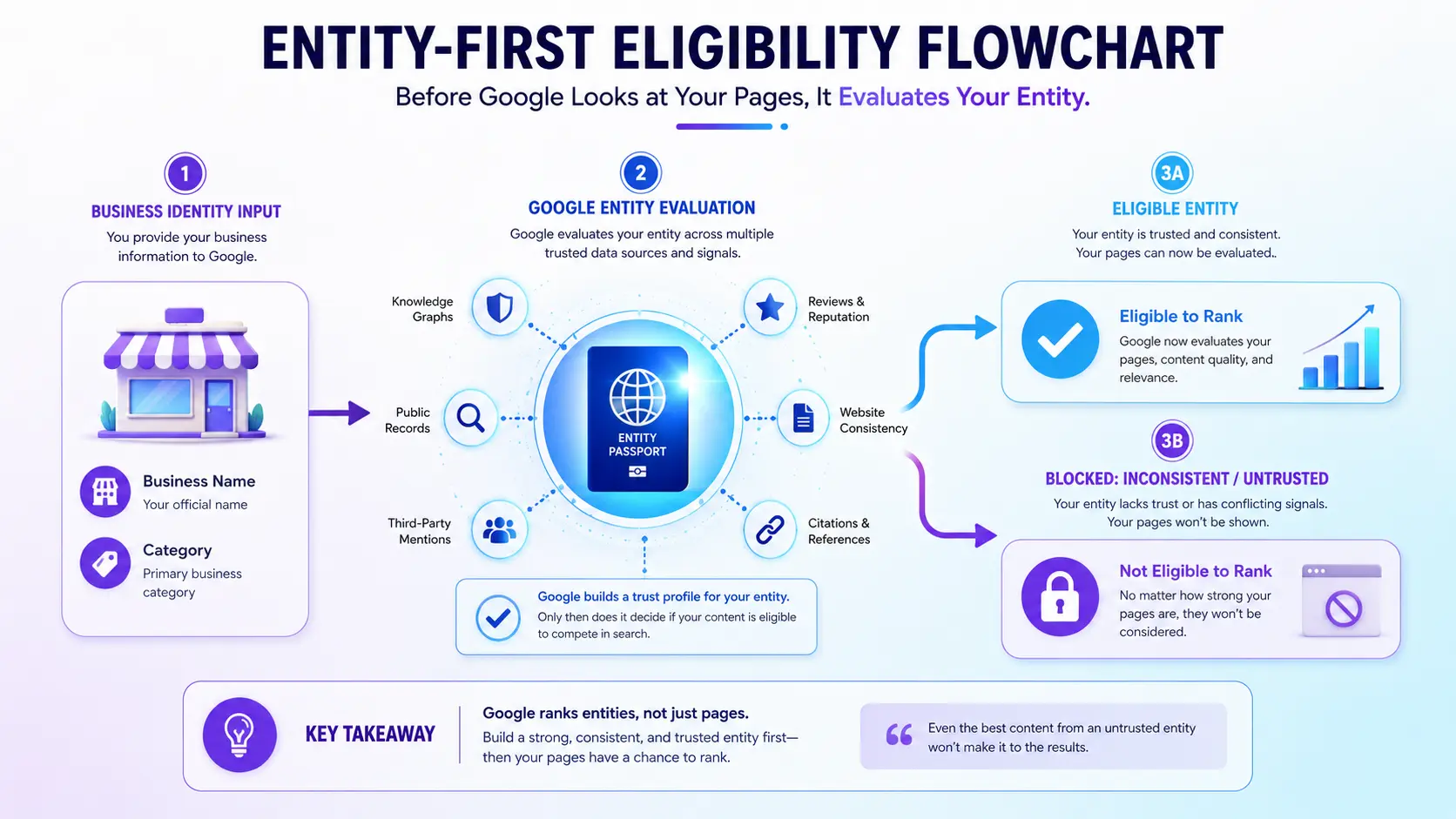
Local search entity evaluation is the process by which Google decides whether a business is a clear, trusted, and relevant local entity before it can appear in Maps or the local pack.
It evaluates signals such as business name, category, Google Business Profile data, NAP consistency, schema, directory listings, reviews, user engagement, navigation behavior, and real-world visit patterns.
This evaluation happens before traditional page ranking, so strong content or backlinks cannot compensate for unclear entity data.
When Google sees inconsistent categories, addresses, phone numbers, or weak behavioral proof, local visibility can shrink or disappear even if the website remains unchanged.
Key Takeaways
- Entity validation is the primary filter for local search eligibility, preceding all page authority signals.
- Business name, category selection, and data consistency define whether a business appears as a strong local entity to Google.
- Local map visibility depends more on behavioral signals (like visit history and engagement) than on legacy SEO tactics such as link building.
- Fragmented or inconsistent entity data quickly erodes Maps visibility, making unified online identity essential for sustained performance.
Most local businesses assume that better SEO or stronger link profiles mean higher placement in Maps.
In reality, Google refuses to even consider your site if it can’t first classify your business as a trusted, unambiguous entity – not just a page with authority.
The secret: local pack eligibility is an entity-first filter.
Page strength only matters if you pass the entity gate.
That broader model is outlined in Local Search Visibility.

What Makes Google Evaluate Entities Before Ranking Your Site
The difference between a visible listing and an invisible one often comes down to phrasing – not optimization.
Google dissects your business name and category to decide where your entity “begins and ends”.
Change a word in your name or shift your primary category, and you may redraw your entire eligibility map overnight.
How your business name and category define your entity boundary
Impact of Business Name and Category Changes on Entity Boundary and Local Visibility
| Inconsistency Type | Description | Example | Effect on Entity Trust and Visibility |
| Multiple NAP versions | Different name, address, or phone across directories and profiles | Law firm listed with varying phone numbers and addresses | Confuses Google’s entity model, causing visibility drop |
| Category mismatch | Google Business Profile category differs from site schema or directories | Fitness club vs gym vs personal training categories mixed | Suppresses local pack inclusion despite strong backlinks |
| Outdated or conflicting profiles | Old or incorrect listings that still appear online | Manufacturer pages with obsolete business info | Fractures digital identity, lowering entity confidence |
We’ve seen clients spend months chasing links and reviews, puzzled by flat local performance.
The problem?
Their business category was either too broad, too narrow, or inconsistent between profiles.
One retail client added “CBD” to their public name for branding – without considering how that single change would recalculate their entity boundary and instantly exclude them from common searches like “wellness store near me”.
This process is less like an SEO checklist, more like Google drawing fences around each business: step outside the defined fence, and your visibility collapses.
Picture your entity as a digital passport – your name and declared category are the biometric data.
If they don’t precisely match the search context, you never even reach the border.
Is your current category reflecting how customers actually search, or how you wish they did?
The myth: organic visibility equals local eligibility.
The reality: name and category often act as yes-no gatekeepers long before authority signals get weighed.
When entity classification blocks visibility despite strong SEO
What makes a business with dozens of #1 organic rankings nearly invisible in the local pack?
Entity misalignment.
If your signals don’t match the user’s intent taxonomy (think: “orthodontist” vs. “dental clinic”), Google simply never puts your entity up for consideration, no matter how strong your page authority.
We’ve worked with a fitness chain with stellar content and robust backlink profiles that couldn’t break into Maps for key service terms.
The issue wasn’t citations or on-page. Instead, their digital identity drifted: categories set in Google Business Profile didn’t match site schema, and directory listings scattered their brand across variations (“gym” vs. “fitness club” vs. “personal training”).
Google’s entity classifier hesitated, resulting in suppressed inclusion for high-value searches.
If page authority were the ultimate decider, consistency wouldn’t matter.
But even a category mismatch – down to a single word – can short-circuit eligibility.
Why?
Google’s model weighs entity understanding before page merit.
No consistent entity, no ranking evaluation.
Think of it as submitting a resume: If your name, title, and role don’t match the position, no one reads your qualifications.
“Entity relevance before ranking” is an insight executives should engrain.
For leaders focused only on traditional SEO, the punchline is simple: unless Google confidently resolves your local entity first, no amount of authority will get you ranked in Maps.
Move forward with a clear understanding – visibility begins with entity evaluation, not with links or content.

Why Behavioral Signals, Not Links, Expand Your Local Entity Influence
Most local marketers are stuck chasing backlinks, convinced that authority flows from citations and content volume.
But Google’s decision to trust – let alone broaden – your local entity depends on real-world signals it can measure, not just digital clout.
Here’s the twist: even a site with hundreds of links can sit invisible just one block outside its home address if people never genuinely engage, visit, or interact.
Why?
Because local entity boundaries don’t stretch by technical strength.
They expand only as Google believes your business is truly part of the local fabric.
Visit history and click radius: the unseen trust metrics
A myth that quietly torpedoes local growth: that a flood of generic SEO traffic equals geographic influence.
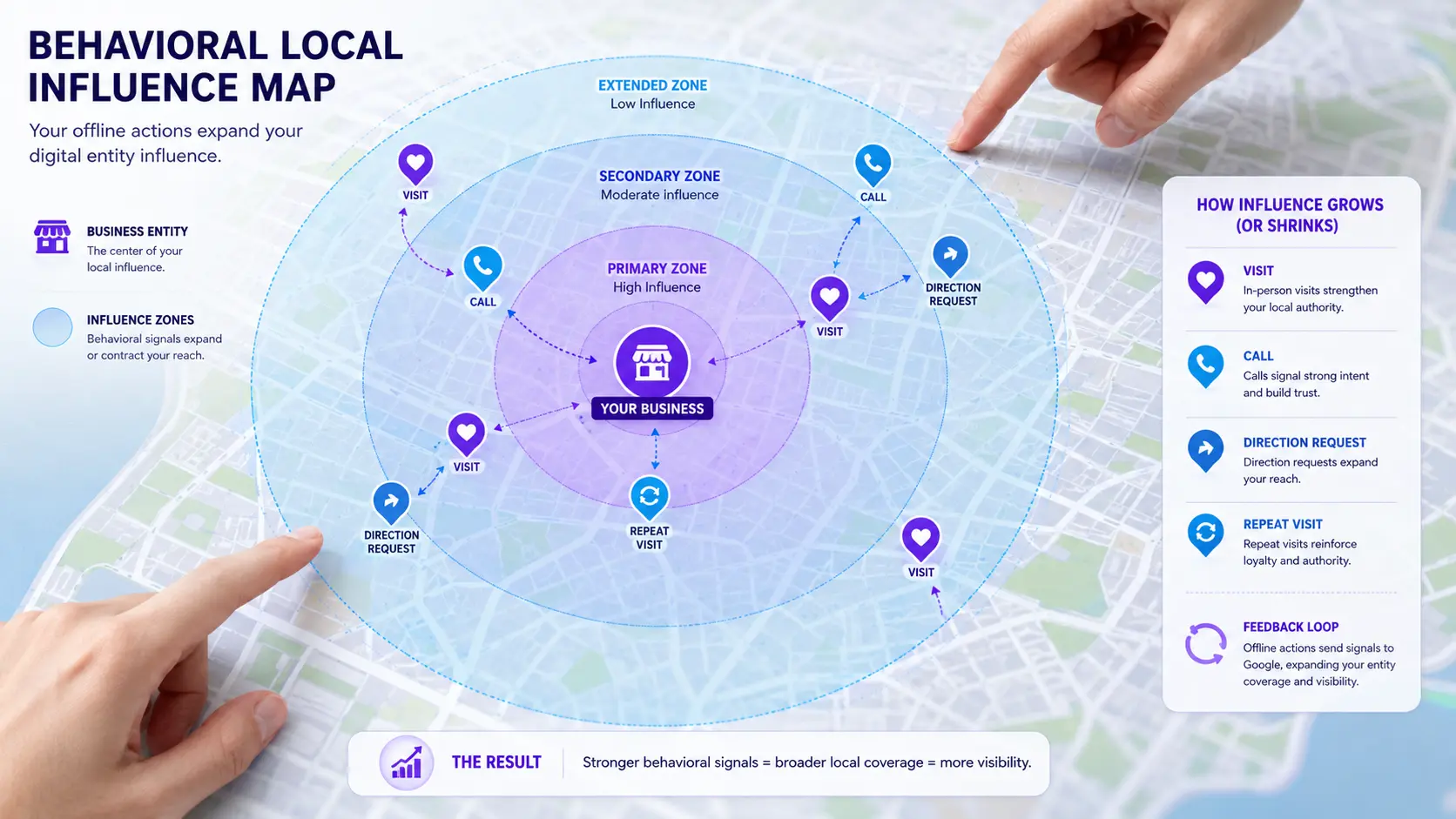
In practice, Google examines where users physically travel and how they digitally interact after searching your brand.
We’ve watched well-optimized locations stagnate in Maps despite clean citations – until in-person visits ticked up and organic click paths started radiating farther from their core neighborhoods.
‘Click radius’ is Google’s silent signal: if customers are willing to travel two, five, or even ten miles to reach you, and if those searches convert into real actions – visits, calls, or requests – your entity’s coverage area widens.
But that change isn’t broadcast in a ranking report. It’s invisible, unlocking eligibility rather than position.
Think of your local entity as a drop of ink: expansion happens not from the center out, but wherever the ink actually touches.
Are your digital and offline footprints reinforcing each other, or pooling in one tiny corner?
Nav‑boost and engagement depth as visibility stabilizers
Getting one wave of new attention doesn’t entrench local influence.
Google tracks how visitors behave: Do they use Maps to navigate to you again and again?
Do users linger, convert, or return via branded queries?
This pattern – what seasoned strategists call Nav-boost – signals to Google that your entity deserves persistent visibility to a wider audience.
In client campaigns, we found one repeated thread: spikes in search impressions meant almost nothing unless sustained behaviors followed.
Entities that attract a true cycle of intent – navigation, conversion, revisit – become anchors in their area.
Those that fail to earn depth become ghosts outside their immediate spot, regardless of authority. Ignore this behavioral validation, and you risk building on sand.
Influence in local search is never about the biggest pile of links – it’s about persistent, real-world proof that your entity matters where it claims to operate.
If your boundaries are shrinking or growth is stalling, the map isn’t wrong.
The story your visitors tell Google is.

How Inconsistent Entity Data Undermines Local Visibility
Common Entity Data Inconsistencies and Their Impact on Local Visibility
| Change Type | Example | Effect on Entity Boundary | Resulting Maps Visibility Impact |
| Change to Business Name | Added ‘CBD’ to retail store name | Redefines entity boundary stricter/exclusive | Excludes from common searches like ‘wellness store near me’ |
| Change to Primary Category | From ‘dental clinic’ to ‘orthodontist’ | Shifts entity intent taxonomy alignment | Blocks visibility for some user intents despite strong SEO |
| No Change | Consistent naming and category | Stable entity boundary aligned with search intent | Maintains or improves Maps eligibility |
You can have the strongest site in your category – but if Google sees five versions of your business across the web, your Maps presence can disappear with no warning and no recourse.
It’s not about penalties or rankings; it’s about a fractured identity causing search engines to lose confidence that any of those listings point to a real, unified entity.
Imagine investing heavily in SEO, yet still dropping from the local pack, not because of something you did, but because your own digital shadow splintered behind the scenes.
If this sounds obscure or rare, it isn’t: entity fragmentation is one of the quietest killers of local visibility.
Entity fragmentation across directories, profiles, and schema
A law firm’s Maps traffic plummets overnight – nothing changed on the site, but half a dozen mismatched name-address-phone (NAP) entries tangled across chamber listings, social profiles, and outdated manufacturer pages go undetected.
Each small inconsistency splinters your brand’s digital version, confusing Google’s entity model.
The search giant expects to triangulate one clear entity; mix categories, phone numbers, or address variants, and suddenly the algorithm struggles to resolve which version is real.
Building the local search puzzle with misfit pieces quietly erodes even the strongest online presence.
The analogy we use with clients: if you hand three different ID cards to a bank teller – one with your old address, another with a previous company, a third missing your middle name – they freeze your account, even if your credit is flawless.
Entity boundary local search works the same way; mismatched NAP and identifiers break the chain of trust that supports Maps visibility and local pack eligibility.
Do you know how many different “you” Google currently sees in its index?
Trust dilution when your entity appears under multiple versions
Recognition isn’t validation.
When your business appears under several slightly different versions across the local web, trust doesn’t multiply – it gets divided.
For multi-location retail and service brands, we’ve seen this show up as sudden drops in city-level presence, even though every location’s pages and authority metrics looked strong.
The unspoken problem: entity consistency local search signals broke down.
Google wants one real-world entity behind every local result; multiple versions erode the simple confidence required for inclusion.
This trust dilution plays out in abrupt ways: sudden drops from Maps, reduced impressions, or inability to trigger the local pack even after positive PR or reviews.
A single update to your address in one aggregator without matching changes elsewhere can lower your eligibility score well below competing entities with half your link profile but unified signals.
Why does Google care?
Because if its system can’t reconcile all the sources into a single, anchored identity, it can’t risk surfacing your business as the answer to query intent.
Here’s the insight worth repeating: authority isn’t what gets you in the door – consistency is.
Map visibility hinges on a single, uncontested version of your entity.
Every deviation lowers your odds of inclusion.
If your local presence is stalling despite obvious SEO progress, start by tracing where and how your digital identity has splintered.
Restoration comes from reunifying your entity footprint and restoring absolute confidence back to Google.

When Local Visibility Drops Without SEO Changes
Some businesses wake up to vanished Maps rankings, no drop in traffic, no loss of links – just sudden invisibility.
The usual culprits (penalties, technical mistakes, negative SEO) get ruled out fast, but that’s missing the point.
Most local search collapses aren’t triggered by anything you changed.
The invisible line?
Google’s sense of who you actually are – and whether you still belong inside the entity boundary for a given query.
Algorithmic eligibility shifts vs page updates
Here’s the myth: strong websites, existing citations, “business as usual” – these should guarantee stable local presence.
In practice, your site can sail on, while the entity boundary closes around you.
We’ve watched dental clinics hold top organic spots, only to drop from Maps when Google tightens its interpretation of business category or neighborhood bias, based entirely on off-page signals.
Most executives miss this because there’s no manual review – Google’s algorithmic eligibility can contract quietly, months after your last optimization.
Think of it like building access: you might have the right credentials, but if the security system quietly revokes your pass based on new policies, your door won’t open – no matter how many people vouch for you.
This reality isn’t rare.
Entity boundary shifts now drive more sudden drops in local inclusion than outright SEO setbacks.
Once the entity context changes (category, service radius, or prominence), your eligibility for the local pack can vanish even if your site’s strength and on-page content remain untouched.
Behavior volatility and its impact on inclusion consistency
Why does visibility remain fluid for some businesses, even when everything else seems stable?
Google’s systems don’t just check static data – they watch for ongoing behavioral proof that your entity still deserves its place.
Subtle shifts in searcher interaction or geographic click spread often precede drops or swings in Maps presence.
We’ve seen multi-location retailers lose city-wide visibility with no site changes, simply because seasonal foot traffic shifted or fewer users engaged with critical location cards.
Ask yourself: If engagement fell off a cliff tomorrow, would you know before the rankings told you?
Entity-driven local search is less about stacking up past achievements and more about living evidence – users showing up, clicking, asking for directions, confirming that you are who you claim to be.
The analogy is simple: imagine a venue that suddenly sees fewer guests – quiet rooms, empty chairs.
The event is still scheduled, the address unchanged, the signage gleaming.
But if no one shows up, the organizer pulls the plug silently.
Maps inclusion can disappear just as quietly, based on ebbing behavioral signals, with no obvious technical trigger.
Google doesn’t punish upkeep; it rewards momentum.
Local visibility depends on staying actively trusted – not resting on historical authority.
When rankings vanish, start with this: what silent change in entity confidence or user action might have quietly moved you outside the gate?
This is why content alone rarely moves Maps.

Scientific context and sources
The sources below provide foundational context for how decision-making, attention, and performance dynamics evolve under scaling and constraint conditions.
- Entity-based search and information retrieval
“Entity-Oriented Search” – Krisztian Balog – Springer
A comprehensive framework showing how entity understanding underpins search engine ranking systems, supporting the article’s focus on entity-first models in local search.
https://link.springer.com/book/10.1007/978-3-319-93935-3 - Trust and decision-making in digital environments
“Trust in Automation: Designing for Appropriate Reliance” – John D. Lee & Katrina A. See – Human Factors
Research into how systems measure and calibrate trust in automated decisions, mirroring Google’s requirement for consistent, reliable entities before granting local visibility.
https://journals.sagepub.com/doi/10.1518/hfes.46.1.50_30392 - Location-based behavioral signals
“Location-Based Services” – Jochen Schiller, Agnes Voisard – Morgan Kaufmann
Academic overview of how user location behaviors are tracked and influence service delivery, supporting the article’s coverage of visit patterns and engagement in local search eligibility.
https://www.sciencedirect.com/book/9781558609297/location-based-services - Data integration and entity resolution
“Entity Resolution and Information Quality” – John R. Talburt – Morgan Kaufmann
Analyzes the effects of inconsistent entity data, demonstrating how fragmented digital identities inhibit algorithmic confidence and search visibility.
https://www.sciencedirect.com/book/9780123819727/entity-resolution-and-information-quality - Behavioral science in local digital interaction
“Exploiting Location Information for Web Search” – Ji-Rong Wen, Na Wang, Ruihua Song, et al. – Computers in Human Behavior
Peer-reviewed research examining how user location behavior and contextual engagement signals influence search relevance and interaction outcomes in geographically-aware systems.
https://dl.acm.org/doi/10.1016/j.chb.2013.04.023
Questions You Might Ponder
What is local search entity evaluation, and why does it matter for Maps rankings?
Local search entity evaluation is Google’s process for determining if a business can be recognized as a distinct, trusted entity before it’s considered for local rankings. Without clear entity validation, even authoritative websites won’t appear in the Maps pack, prioritizing identity over pure SEO.
How do business name and category changes affect local search eligibility?
Changing your business name or category can instantly shift your defined entity boundaries. If changes don’t match user intent or consistent classification, Google may exclude your listing from search eligibility, regardless of existing site strength or link profile.
Can strong backlinks guarantee visibility in Google Maps?
Strong backlinks alone do not guarantee presence in Maps. If Google detects entity misalignment – such as mismatched categories or inconsistent business data – it may block local pack inclusion, showing that entity trust outweighs traditional SEO authority signals.
What user behaviors expand a local entity’s area of influence?
Google monitors visit history, click radius, and ongoing engagement patterns. If users consistently visit, engage, and return, these behavioral signals convince Google that your entity genuinely serves a wider area, expanding your Maps eligibility organically.
How does inconsistent business information harm local search?
Inconsistent business info across directories and profiles fractures your entity identity. Google’s system loses trust and may suppress your Maps inclusion, even if your main site is strong – emphasizing the need for unified, accurate entity data everywhere.