
What You’ll Learn
Content impact on local pack visibility is the limited and conditional role website content plays in Google Maps and local pack rankings.
Content can support organic relevance and help refine positioning, but it usually does not unlock local pack visibility by itself.
Before content matters, Google must first validate proximity, entity trust, review strength, Google Business Profile accuracy, and NAP consistency.
A business can publish strong service pages, blogs, and local landing pages yet remain invisible if it is too far from the searcher or if trust signals are weak.
Content helps most after the business is already eligible to appear in the local candidate set.
Key Takeaways
- Core map pack visibility is determined by entity trust, proximity, and data consistency, not the quantity or quality of website content.
- Content supports organic rankings, but only boosts local pack position after business eligibility signals are validated by Google.
- Review metrics (volume, recency, sentiment) and accurate business listings are the primary gatekeepers for local map inclusion.
- Doubling down on content without addressing trust and proximity will misallocate resources and may not resolve local visibility gaps.
Most teams assume that ramping up website content will automatically push them into Google’s local pack.
The reality is almost the opposite – no matter how much you publish, core map visibility gates are locked elsewhere.
This disconnect quietly drains resources and misleads entire roadmaps.
Why does this foundational belief fail in practice?
That wider system framing appears in Local Search Visibility.

Why local visibility doesn’t follow content improvements
You can dominate organic rankings for local terms and still watch your map presence stay flat.
The reason: Google’s local pack operates on a different rulebook.
It doesn’t matter how comprehensive your service pages or blog content become – if your entity isn’t trusted or close enough to the searcher, you don’t even make the candidate list.
It’s like bringing gourmet ingredients to a potluck you’re not invited to; quality or quantity won’t get you past the door.
Content supports organic relevance, but inclusion is gated by trust and proximity
Every fast-growing client wants to believe their site expansion unlocks new local map opportunities. But we’ve seen high-authority domains, publishing weekly, sit off the map simply because they’re outside the physical radius or lacking review velocity.
The myth: “Better content means better Maps rankings”.
The truth: Content relevance is a filter for organic listings, not map pack entry.
Relevance matters – after your trust and proximity signal make you eligible.
Organic authority matters only after entity eligibility is established
Eligibility – defined by trust and location – always precedes the impact of content.
Major brands often expand their content arsenal, yet if entity-level trust or local signals are missing, their map presence remains unchanged.
Content can only make a difference after these initial boundaries are cleared.
With one insurance client, site authority and topical depth soared, but local pack impressions remained unchanged across months.
Why?
Google’s system only prioritized their brand after verifying business info and consistent presence on key local directories.
Only when entity-level trust clicked in did content help nudge position – never before.
Are you pouring resources into “proving relevance” before your firm is even eligible?
Many do, missing the real gate. You must prioritize trust and verification first.
Content only amplifies your position after Google puts you in the game.
AI‑driven local answers amplify the visibility gap even with strong content
Here’s where the separation grows: Google’s new AI-based local modules pull answers and recommendations without depending on your site’s traditional content at all.
Even the strongest resource pages or blog rollouts can’t muscle into local inclusion if the core entity signals – or proximity – aren’t met.
The system leans on business attributes, reviews, and real-world presence.
We’ve watched clients double down on content after seeing no improvement in map rankings, only to find Google’s AI layering in more review-led or attribute-rich answers instead.
The analogy: you’re shouting louder while the system listens to a different frequency.
Is your site’s authority still relevant?
Yes – but only as a secondary input.
Content fuels organic visibility, but for Maps, entity eligibility is the first and highest gate.
Skip this, and you’ll keep missing the invite.
If you’re frustrated by stagnant local visibility despite your publishing calendar, you’re not alone – and you’re not broken.
The ceiling isn’t your content; it’s the eligibility walls around the map pack.
Next: cut through content myths and focus on what actually gates your entry.

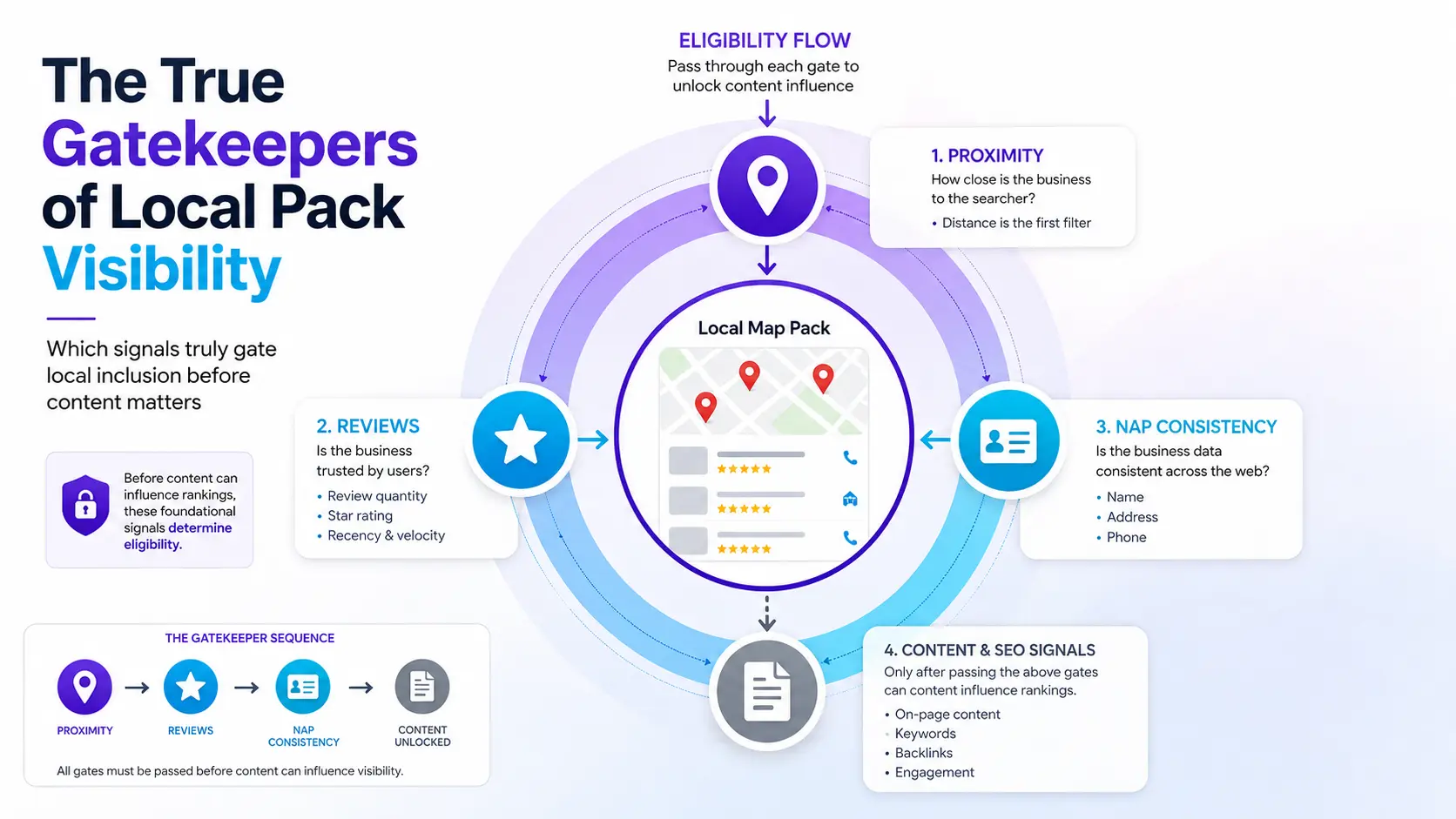
Which signals truly gate local inclusion before content matters
Key Local Inclusion Signals Gating Map Visibility
| Audit Area | What to Check | Why It Matters | Suggested Action |
| Proximity | Confirm business location is within target search radius | Google filters out too distant listings regardless of content | Verify address and service area accuracy |
| Review Profile | Review count, recency, and overall sentiment | Trust signals outweigh content in local pack eligibility | Implement strategies to increase fresh positive reviews |
| Entity Data Consistency | NAP consistency across GMB and local directories | Mismatched info causes invisibility despite strong content | Audit and correct Name, Address, Phone, GBP details |
Most teams pour resources into content and wonder why their brand barely flickers on Google Maps – then miss the real gatekeepers entirely.
It’s not the words on your site that open the door;
it’s a hidden scoring system that reshuffles the deck before a single paragraph registers.
Proximity remains the default filter even before trust signals
Picture this: you launch a hyperlocal landing page for every zip code in your region.
But Google still shows your listing only to people close to your street address.
The myth?
That content can stretch your reach.
In reality, if you’re too far from the searcher, you’re invisible – no matter how relevant your copy is.
We’ve seen multi-location chains lose map presence after relocating a single storefront by a mile, even while their content arsenal grew richer.
Physical distance isn’t just a bias – it’s the automatic first cut.
Why fight the map’s boundaries when they’re drawn in concrete, not HTML?
Review volume, recency and sentiment function as trust gates
Ever noticed a competitor with thinner content but twice the reviews dominating your local pack slot?
That’s not an outlier; it’s the norm.
Google’s trust gates are calibrated on volume and velocity – fresh, positive reviews are the keys.
We’ve witnessed well-known brands drop off the map entirely after a wave of negative sentiment or a flatline in review activity, even as they published guides and case studies.
Content may persuade readers, but reviews persuade the algorithm.
Ask yourself: are you competing in content or in trust?
Consistency in entity data (NAP, GBP profile accuracy) stabilizes trust eligibility
Sometimes, high-performing listings vanish from Maps with no warning – while their sites and content never change.
Silent drops almost always trace back to inconsistent NAP (Name, Address, Phone) data or mismatched Google Business Profiles.
We’ve rescued businesses from invisibility by correcting a single digit in their phone number or restoring a missing suite number, instantly restoring eligibility.
It’s like having the right password: a mismatch, and you’re locked out, regardless of your content authority.
Visibility gaps aren’t content failures – they’re filter failures.
Elevate trust, proximity, and consistency, or content will keep shouting from outside the door.

Why content-driven assumptions lead to misdiagnosis of visibility failures
Most teams double down on content the moment local visibility stalls – then wonder why nothing in Google Maps moves.
It feels rational: more content should equal more presence.
But the invisible wall isn’t built from weak pages; it’s built from the wrong assumptions about what Google needs to see before listings gain traction.
Strong content teams still miss Maps due to inclusion logic mismatch
You can invest years building out expert blogs, guides, and hyperlocal landing pages – yet watch competitors with thinner sites consistently outrank you in Maps.
We’ve seen multi-location brands pour resources into new content only to remain absent from the map pack.
The myth?
That rising organic strength automatically carries over into local inclusion.
It doesn’t.
Google’s eligibility logic splits early: if your entity – or service area – never clears the minimum trust and proximity requirements, your website authority is practically a backstage pass at a sold-out concert.
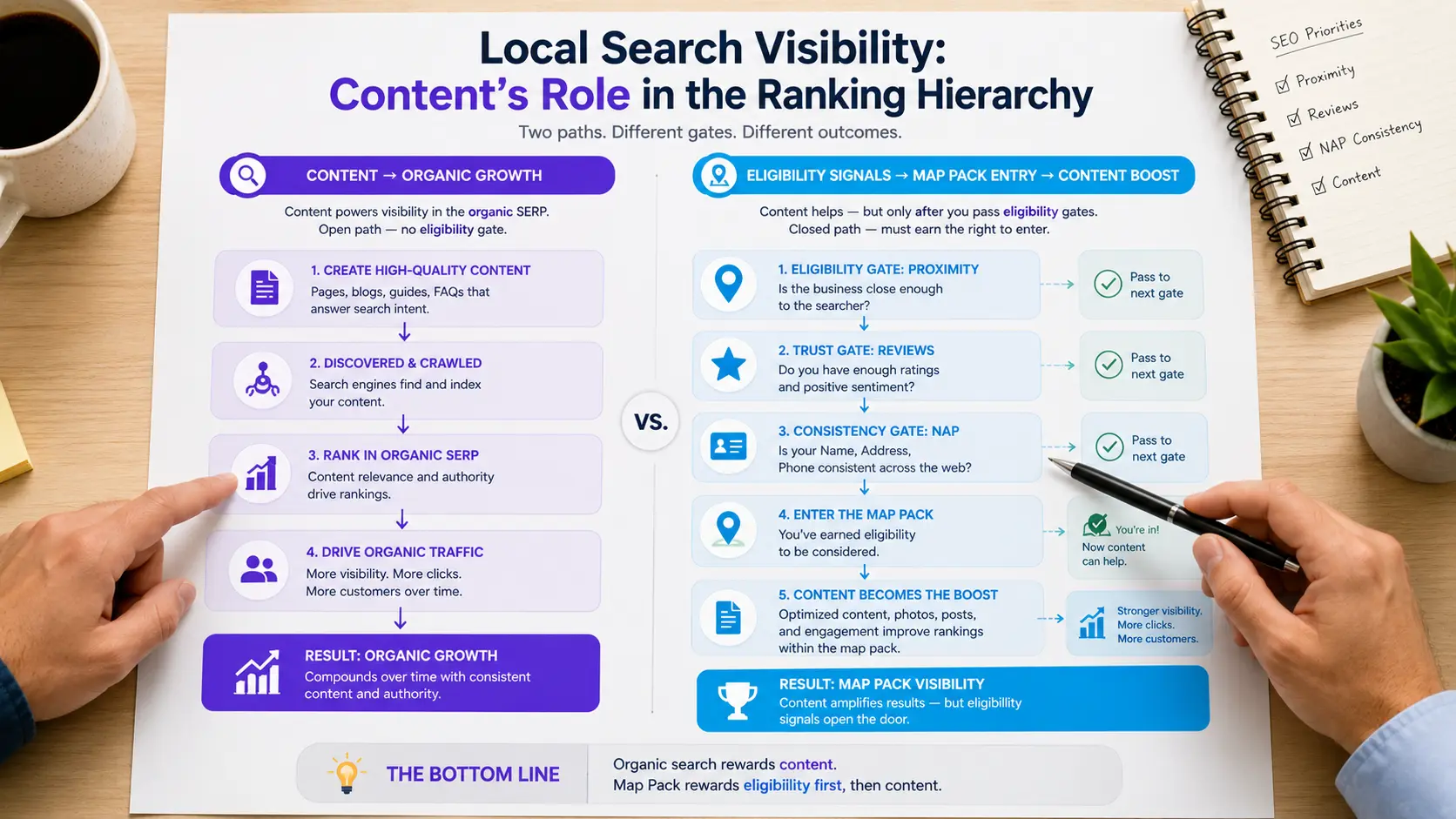
Local pack entry is a separate list, and content alone is never the ticket.
Ranking fluctuations often reflect personalization or AI shifts, not your copy
Leadership sees Maps rankings wobble and immediately calls for a content overhaul.
But many drops trace directly to Google’s shifting personalization logic, not anything your writers did or didn’t publish.
We recently saw a client’s map ranking for core terms swing from #2 to out of the pack in some geos overnight while their content, reviews, and NAP were unchanged – the culprit was a rollout of AI-powered proximity adjustments that moved the center of gravity for which businesses appeared.
Is your team addressing the algorithm’s real triggers, or just pushing more copy into the void?
Chasing content tweaks to solve visibility gaps shaped by AI distribution wastes resources and misreads the true levers at play.
Failure to diagnose entity-level trust gaps misdirects investments into content
The harsh truth: teams repeatedly treat content as life support for listings when the patient is missing vital signs elsewhere.
If entity trust – measured by consistent data, live citations, and authentic review volume – lags behind peers, Google keeps your business invisible regardless of your editorial investment. We’ve watched well-funded content initiatives burn six figures while location data inconsistencies quietly blocked every map pack opportunity.
Here’s the analogy: building more stories onto a house with a cracked foundation.
A page audit can feel productive, but unless you address trust signals and data integrity, the needle won’t budge.
Most local search failures happen because trust gaps are diagnosed as content gaps.
Teams that misdiagnose the problem don’t just waste money – they stall momentum.
The only way forward?
Diagnose inclusion barriers first, then let content support eligibility, not substitute for it.

What to evaluate next when content isn’t moving the needle
Local Pack Visibility Audit Checklist Before Content Investment
| Signal | Description | Impact on Local Pack Visibility | Supporting Example |
| Proximity | Physical distance between business location and searcher | Primary filter; too far means invisible regardless of content | Multi-location chains losing presence after relocating a single storefront by a mile |
| Review Volume, Recency, Sentiment | Quantity, freshness, and positivity of customer reviews | Critical trust gate; dominates algorithm over content depth | Competitor with thinner content but twice the reviews dominating local pack |
| Consistency in Entity Data (NAP, GBP accuracy) | Accurate and consistent Name, Address, Phone and Google Business Profile data | Stabilizes trust eligibility; mismatches cause sudden drops | Rescuing listings by correcting a single digit in phone number restored eligibility |
Assess inclusion signals before authorizing content investment
The simplest way to waste next year’s budget? Keep producing content after Google’s already decided you’re invisible on the map.
All the expertly crafted pages and high-converting copy in the world can’t override a weak signal on inclusion factors – yet most teams only discover this after flatlining in local search reports.
There’s a common myth executives cling to: that better content eventually tips the scales for map visibility.
In reality, Google’s filters still cut more than 80% of candidates before content relevance even gets a vote.
Over and over, we’ve seen high-traffic sites with stellar blogs locked out of the three-pack by a business around the corner with mediocre web content but ironclad eligibility signals.
Start by testing your proximity, review stack, and NAP consistency.
We’ve watched top-performing franchises lose their map ranking, not from thin content, but because a single address mismatch or an outdated GBP link triggered a trust drop.
If your reviews are stale or inconsistent with local competition, no keyword density will save you.
Ask: have we audited these inclusion signals, not just our latest blog series?
The process is less like writing your way onto a guest list and more like getting past security – if your paperwork isn’t in order, content is just background noise.
The real bottleneck is seldom on your website; it’s in the basics that decide eligibility long before relevance comes into play.
Map content doesn’t hurt – but don’t rely on it: redirect to trust and eligibility assessments
Content doesn’t sabotage your map inclusion, but treating it as your lead strategic lever for local visibility is like painting the walls when there’s no foundation.
One multi-location group we worked with spent months rewriting service pages, only to see competitors with half their domain strength lead the map results.
The reason?
Their citations were precise, their reviews were recent, and their business info never drifted.
Why does this break expectations?
Google Maps selects who’s visible based on entity trust and proximity, not topical depth.
Content matters – after you’ve proved you belong in the pool.
Until then, even Pulitzer-worthy copy gets filtered out of the map algorithm.
Are you investing in authority when what’s required is eligibility?
Don’t scrap your content plans, but reroute primary efforts into trust signals and eligibility checks.
The content – map pack connection is real, but conditional.
Until those conditions are met, every new post is, at best, a future asset.
Content moves the needle only after you clear the real gates.
Steer investment toward what actually earns your seat – then amplify with content once you’re truly in the running.
This leads to misaligned optimization effort.

Scientific context and sources
The sources below provide foundational context for how decision-making, attention, and performance dynamics evolve under scaling and constraint conditions.
- Search Engine Ranking Signals and Local Search
“Local Web Search Examined” – Dirk Ahlers – Emerald Publishing / Web Search Engine Research
Analyzes how geographic information retrieval, proximity, trust signals, and contextual ranking systems interact in local search visibility and local engine result generation.
https://www.emerald.com/books/edited-volume/13820/chapter/84606850/Chapter-3-Local-Web-Search-Examined - Proximity and Trust in Local Search Algorithms
“Personalized Local Internet in the Location-Based Mobile Web Search” – Dae-Young Choi – Decision Support Systems
Explores how user proximity, location-awareness, and behavioral relevance signals influence ranking and personalization in location-based search systems.
https://www.sciencedirect.com/science/article/abs/pii/S0167923605000710 - Entity-Based Search and Eligibility
“Entity-Oriented Search” – Krisztian Balog – Foundations and Trends in Information Retrieval
Summarizes the transition toward entity-first search systems and explains how entity trust, identity resolution, and structured data influence search visibility and eligibility.
https://www.nowpublishers.com/article/Details/INR-053 - The Effects of Consumer Reviews on Trust and Search Visibility
“Reputation Systems” – Paul Resnick, Richard Zeckhauser, Eric Friedman, Ko Kuwabara – Communications of the ACM
Provides a foundational framework explaining how reviews, reputation metrics, and trust signals influence credibility, inclusion, and visibility in digital platforms.
https://dl.acm.org/doi/10.1145/355112.355122 - Consistency of Business Information (NAP) in Search Engines
“Entity Resolution and Information Quality” – John R. Talburt – Morgan Kaufmann
Documents how inconsistent entity records and fragmented business identity data reduce confidence in algorithmic matching and visibility systems.
https://www.sciencedirect.com/book/9780123819727/entity-resolution-and-information-quality
Questions You Might Ponder
Why does stronger website content fail to improve local pack visibility?
Content boosts organic relevance but doesn’t override Google’s eligibility filters for the local pack, which prioritize business trust and proximity before content matters. Only after these gates are cleared can content influence rankings.
What signals does Google prioritize for local pack inclusion?
Google relies heavily on proximity to the searcher, consistent business data (NAP), and review quality and quantity. These factors gate eligibility, while content is primarily a filter for organic search, not Maps inclusion.
How do reviews impact my business’s placement in Google Maps?
Google values high review volume, recency, and positive sentiment as trust factors. Businesses without competitive review stacks rarely enter the map pack, regardless of content quality or frequency of site updates.
Can map pack visibility be fixed by publishing more localized landing pages?
Publishing more local pages won’t solve map visibility if your location, trust signals, or business information are weak. The local algorithm filters by proximity first, then trust, making new content insufficient by itself.
Why do competitors with less content outrank me in the map pack?
If competitors maintain stronger trust signals (reviews, accurate data, verified profiles) and are closer to search queries, they will outrank more content-rich sites. Map pack entry is based on eligibility, not abundance of content.