
What You’ll Learn
Organic vs local visibility gap is the difference between strong organic SEO performance and weak or missing visibility in Google Maps or the local pack.
It happens because organic search and local search use different inclusion systems.
A business can rank well in standard search results through content, links, and technical SEO, yet still be excluded from local results if proximity, entity eligibility, NAP consistency, Google Business Profile trust, or local data accuracy fail.
This gap often causes teams to optimize the website while the real problem sits in local inclusion.
Local visibility requires being recognized as a trusted nearby entity before organic authority can help.
Key Takeaways
- Organic SEO success does not guarantee inclusion in Google’s local Map Pack, which relies on distinct eligibility and trust systems.
- Small NAP inconsistencies, profile mismatches, or outdated listings can silently exclude a business from local visibility with no warning.
- AI-driven changes, like slot compression, can instantly reduce local exposure even while organic rankings hold steady.
- Optimizing for organic search when local eligibility is missing leads to wasted resources and missed growth opportunities.
Most teams chase organic rankings and assume the visibility will follow everywhere.
Here’s what shatters that assumption: you can own top spots in organic results and still be invisible in the local Map Pack – because you’re optimizing for a system that doesn’t even judge you.
That’s the organic vs local visibility gap hardly anyone talks about.

Why strong SEO performance can’t break through local inclusion boundaries
The real surprise?
The strongest site on paper can be blocked before the local algorithm even considers it.
We’ve seen agencies deliver authority, fresh content, pristine technical setups – all while their clients remain locked out of local search.
Your work isn’t wasted, but it’s pointed at the wrong gate.
The difference isn’t just technical – it’s architectural.
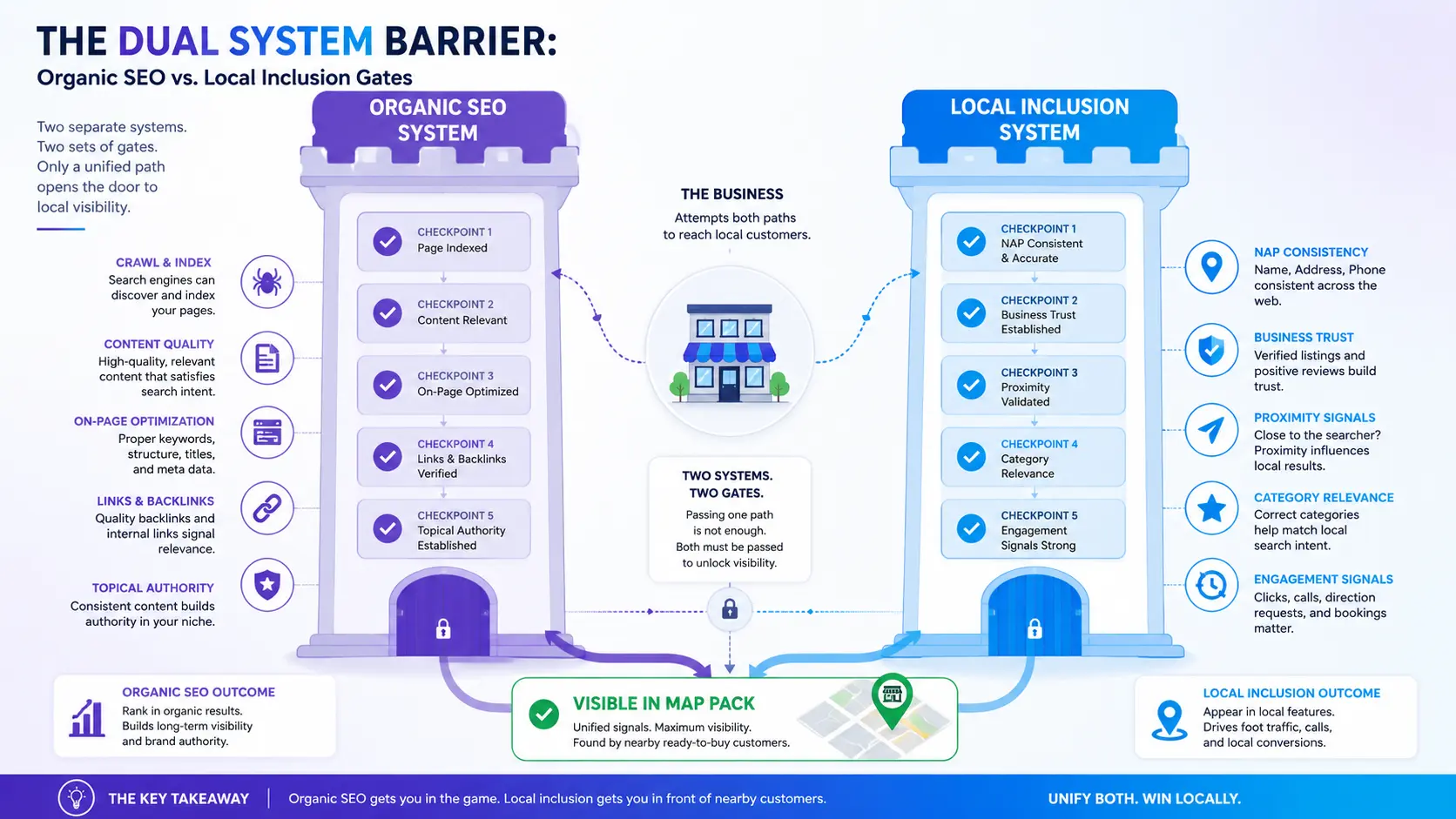
Google runs two overlapping yet distinct inclusion systems, each with its own rules, blacklists, and eligibility filters.
How inclusion gates decide who even appears in local search
Google Local Inclusion Gates
| Factor | Description | Effect on Local Search Visibility |
| Authority | Business credibility via SEO signals like citations, reviews, backlinks | Can increase ranking but is secondary to proximity |
| Proximity | Physical closeness of business to searcher | Primary driver; distant but authoritative businesses may be excluded |
| Geo Constraints | Search uses centroid mapping and radius limits | Creates physical barriers regardless of authority level |
Getting into the local pack is more like passing security at a high-clearance facility than winning a footrace.
- First, Google screens for entity eligibility – does your business even “count” locally, based on category, NAP (name, address, phone) consistency, and verified presence?
- Second, trust comes under the microscope: are you considered a real, active, and attested entity by both users and Google’s backend systems?
- Third, proximity acts as a silent border control – if you’re outside Google’s defined radius for a query, not even perfect site authority gets you in.
One client example: a law firm dominating organic for “personal injury lawyer” couldn’t break into the Map Pack for half the city because their move triggered an address mismatch across hidden business data sources.
The result?
They didn’t exist in the candidate pool. It’s not a penalty – it’s a silent refusal to even enter the race.
Think of it like airport security: no matter how early you arrive or how well you pack, if your ID doesn’t match their system, you’re not flying.
Some teams still believe they’re “losing to stronger SEO”. In reality, they’re not even getting judged in the right contest.
Here’s the line you’ll repeat: Winning at search means being eligible before being excellent.
Why being #1 organically doesn’t predict Map Pack eligibility
Landing the top organic spot gives zero guarantee of Map Pack inclusion – because the filters don’t sync.
Google’s local inclusion logic relies on entity trust, physical location, and recency of local signals, not just classic SEO prominence.
Your site can be the best answer, but if Google’s local index can’t vouch for your business’s real-world presence, you’re invisible above the fold.
One pattern we see: a business ranks first for broad keywords on desktop, yet disappears entirely on the same queries from a mobile device a few miles away.
What’s happening?
The local system redraws eligibility every query, often compressing pack slots or changing requirements based on AI-driven interpretations of user intent and proximity.
Volatility increases as Google experiments with which entities surface when and where, so organic rank doesn’t “flow through” to Maps.
Ask yourself – if you’re obsessing over every technical on-page tweak, but the Map Pack refused you weeks ago over a missing address update, which system are you actually optimizing for?
Most executive dashboards blur this distinction, making resource misallocation almost inevitable.
Brutal but useful analogy: optimizing for organic when you need local is like upgrading your car’s engine for a race you’re not invited to.
Until you’re on the right start line, horsepower is irrelevant.
If you want local visibility, don’t just build a better site.
Step back and ask: are we even in the pool Google’s local system is choosing from?
Only then does the rest of your SEO work translate into real-world visibility.

What hidden forces cause your local visibility to vanish without changes
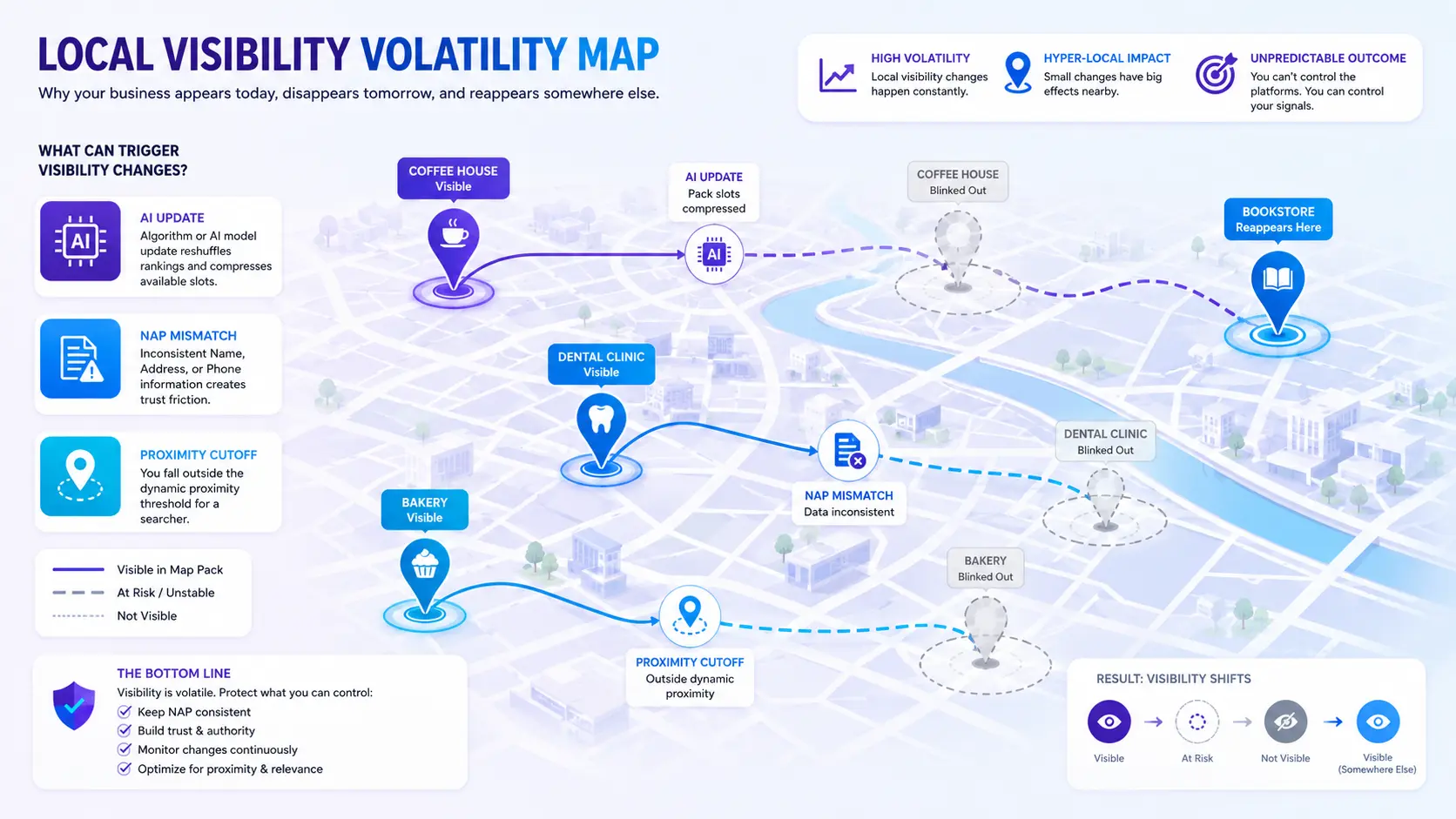
You can wake up one morning ranked exactly where you were – and discover your business is suddenly invisible on Google Maps.
No warnings, no technical errors, no failed campaigns.
The tools say you’re steady, but your phones go silent.
What happened?
Here’s the catch: visibility loss in local search rarely comes from your traditional SEO strategy.
It’s driven by algorithm shifts and system rewrites you can’t see, often triggered by forces with no direct connection to rankings, links, or even your website at all.
And when these hidden levers move, entire segments of local visibility vanish overnight – leaving authority sites out in the cold despite nothing looking “wrong” in your core SEO performance.
AI‑driven pack formats and slot compression shrinking visibility
Most companies still believe a #1 organic ranking is secure real estate.
These days, it’s more like renting a shop in a mall where the landlord keeps shrinking your store, then charging the same rent. AI-powered Map Packs and new display variants can compress the number of visible results from ten to three or even just one slot, all depending on format – and they now update as frequently as product recommendations on your favorite e-commerce site.
We’ve watched clients hold steady at the top of organic for months, only for their Map Pack presence to collapse after an AI update consolidated verticals.
Suddenly, fewer spots exist – but the competition hasn’t changed.
It’s like musical chairs where the chairs keep disappearing mid-game.
Is your brand trusted enough, local enough, and entity-authoritative enough to win one of those shrinking slots?
The myth: strong organic stability means predictable local exposure.
The reality: organic vs local visibility gap is wider than most expect, especially as AI-driven volatility and format changes compress who even gets seen.
Tracking blind spots that mislead executives into false confidence
Too many dashboards still operate like a rearview mirror – they show traffic and rankings but ignore the disappearing context (and audience) right outside your field of view.
Standard SEO tools can’t report on Maps inclusion, call triggers, or AI-induced slot losses.
You might be investing for growth, only to find you’re measuring the wrong battlefield entirely.
In practice, we’ve seen organizations bask in the glow of “steady” organic numbers while leads tanked.
The actual culprit?
Packs changed overnight, compressing their vertical and dropping their listing from the public map – while their reporting failed to register the real world result.
Why does visibility vanish when your metrics say you’re safe?
Because most systems miss the triggers that matter: pack volatility, AI slotting, and actual inclusion.
Here’s the simple analogy: it’s like reading your GPS speed but missing that the road itself has disappeared.
Reports can show smooth progress long after the path to customers is gone.
Most executives don’t realize: you’re not just fighting for rank – you’re battling invisible ceilings and shifting terrain.
The forces removing you from local view aren’t visible in rankings – they’re structural.
If leads or foot traffic suddenly drop with no clear technical event, suspect a change upstream in how Google surfaces (and limits) candidates.
Don’t trust your organic steadiness as a shield against local disappearance.

When inconsistencies and trust erosion silently exclude your listing
The harshest hits to local visibility rarely come from clear mistakes – they’re triggered by unseen cracks in trust.
A business can look flawless in SEO reports but still vanish overnight, never getting a warning.
The real threat is ambiguity: small inconsistencies that silently erode the foundation of inclusion, leaving teams blindsided despite stable performance.
How NAP divergence and profile incoherence erode perceived trust
It’s counterintuitive: you can have the best on-page SEO and still be ghosted by the local pack for one simple reason – your Name, Address, and Phone (NAP) data betrays even minor inconsistencies across the web.
We’ve seen businesses wiped from local results just because an old suite number lingered on a forgotten directory, or their business hours didn’t match between their Google Business Profile and their Facebook page.
The search system reads these micro-mismatches as a fractured identity, like a passport with two birthdates. It only takes one misaligned signal to cascade doubt through the system.
The myth: “Solid SEO equals solid inclusion everywhere”.
Reality is harsher – local inclusion isn’t a reward for technical effort. It’s an ongoing trust evaluation, where every profile, citation, and third-party source must echo the same, unambiguous entity story.
If the echoes sound off-key, the system simply withholds your listing.
Ask yourself: how many old directory profiles could be quietly poisoning your trust, outside your main domain’s control?
Here’s a repeatable truth: In local search, trust is binary.
Either your identity signals stack perfectly, or you’re left out of the Map Pack, no matter how authoritative your site.
Why listings vanish or fluctuate without any visible optimization updates
Executives often assume visibility is stable if nothing changes in the playbook.
But local algorithms work more like a bank’s fraud detection team – one odd signal, and the account goes under review.
We’ve watched local rankings sink overnight after a phone verifier updated a listing, simply because the new area code conflicted with the website contact page.
No penalty notice appears, traffic graphs stay flat, but call volume drops – fast.
Here’s what most miss: local systems are hypersensitive to “entity trust gates”.
If your accumulated trust crosses below a hidden threshold – sometimes triggered by external data corrections or review spam – your visibility can vanish without a single site edit. It’s like a light switch, not a dimmer.
Why did that listing disappear when your SEO ranks held?
Because the local engine saw enough ambiguity to cut off exposure, regardless of your optimization roadmap.
The analogy: Imagine a well-lit storefront suddenly dropping into shadow because the city changed the streetlight pattern, not because your sign dimmed.
The cause is external, but the impact is personal and punishing.
Relying on unstable trust signals leaves your business exposed to unpredictable drops, no matter how strong your SEO performance.
Long-term stability in local visibility depends entirely on uncompromising clarity and consistency across every listing and profile.

What risk does misaligned optimization create in geo‑constrained search systems
Marketing teams often double down on organic strategies, convinced every push will improve local results.
The risk?
All of that effort might never budge your local reach – no matter your organic success – if you’re working at the wrong layer.
Wasted effort chasing tactics that SEO can’t control
A common myth says boosting organic signals (links, citations, technical health) will naturally boost Map Pack visibility. In practice, these are separate layers with their own rules.
We’ve seen brands invest in massive content overhauls and watch their organic traffic climb, while Map Pack calls, clicks, and even appearances flatline.
There’s no alert. No “failure” flag. Budgets keep draining, but the local needle doesn’t move.
Here’s what we see repeatedly: campaigns optimized for “organic delight” rack up numbers that look impressive in dashboards, but local exposure doesn’t budge because the real gates – entity eligibility, business proximity, and trust signals – were ignored.
It’s like adding horsepower to a car but skipping the ignition key.
The engine purrs; you’re still parked.
If your reporting sheet celebrates higher rankings while leads dry up, you’re likely optimizing the wrong system.
The most expensive mistake with local is fighting the wrong battle with perfect form – and no possible win.
When proximity and centroids override authority in local exposure
Authority vs. Proximity Impact on Local Visibility
| Gate Stage | Purpose | Key Factors Considered |
| Entity Eligibility | Determines if business qualifies to appear locally | Category match, NAP consistency, verified presence |
| Trust Evaluation | Assesses if business is real and active | User signals, Google backend attestation |
| Proximity Check | Ensures business is within search radius | Physical location relative to query location |
Even the most authoritative brands can find themselves invisible just blocks away from the searcher.
The hard truth: in geo-constrained systems, proximity beats authority when it comes to the local pack.
We’ve worked with national chains convinced their brand equity would keep them dominant in every map result.
The reality?
Their locations often vanish from the packs the moment the searcher steps outside a narrow radius.
That’s not a ranking penalty – it’s a physical wall.
Local systems map the centroid of a search to nearby entities and lock out strong, but too-distant, listings.
Why does it work this way? Local inclusion systems favor what’s close, not just what’s credible.
You can own all the primary keywords, have pristine citations, a perfect review score – and still lose to a less authoritative competitor that’s just closer.
Imagine running a marathon perfectly, only to discover the finish line has moved three miles behind where you started.
Are you mistaking reach for visibility?
If so, every incremental investment in authority delivers less and less, while simple proximity wins the moment.
Resource waste isn’t the only risk – if your brand assumes that authority is king everywhere, you lower your odds of local dominance the moment geography comes into play.
Success in geo-constrained visibility starts with diagnosing where influence actually operates – then committing resources only to the systems that control local eligibility.

Scientific context and sources
The sources below provide foundational context for how decision-making, attention, and performance dynamics evolve under scaling and constraint conditions.
- Entity-Based Ranking in Local Search
Entity Retrieval – Krisztian Balog – Foundations and Trends in Information Retrieval
Explores how search engines model, retrieve, and rank entities rather than documents, providing a foundation for understanding entity-first ranking systems used in local search and map-based results.
https://www.nowpublishers.com/article/Details/INR-024 - Impact of Proximity and Credibility on Local Search
Local Web Search Examined – Dirk Ahlers – Emerald Publishing
A data-driven analysis of how geographic proximity, trust signals, and contextual relevance influence local search visibility and ranking outcomes.
https://www.emerald.com/books/edited-volume/13820/chapter/84606850/Chapter-3-Local-Web-Search-Examined - Trust, Identity, and Digital Business Representation
A Survey of Trust and Reputation Systems for Online Service Provision – Audun Jøsang, Roslan Ismail, Colin Boyd – Decision Support Systems
Explores how fragmented digital identities and inconsistent profile data undermine algorithmic trust, paralleling local search visibility gaps caused by weak entity confidence.
https://www.sciencedirect.com/science/article/abs/pii/S0167923605000849 - Attention Allocation in Conflicted Optimization Systems
Cognitive Load Theory and Instructional Design: Recent Developments – Fred Paas, Alexander Renkl, John Sweller – Educational Psychologist
Provides foundational context for how attention and optimization resources become misallocated in complex systems when structural distinctions are overlooked.
https://www.tandfonline.com/doi/abs/10.1207/S15326985EP3801_1
Questions You Might Ponder
Why can a business rank high organically but not in the local Map Pack?
Ranking high organically doesn’t guarantee Map Pack visibility because Google’s local algorithm uses separate filters, emphasizing proximity, NAP consistency, and trust signals over standard SEO factors. If a business fails eligibility checks, it won’t appear locally – even if it’s top in organic listings.
How does an address or NAP mismatch affect local search visibility?
A mismatch in Name, Address, or Phone (NAP) across directories, profiles, or Google Business can signal ambiguity or distrust to local algorithms, often excluding the business from local search results despite outstanding technical SEO performance.
What are AI-driven ‘slot compression’ effects in local search visibility?
AI-driven slot compression refers to Google reducing the number of visible spots in the Map Pack based on intent, device, or vertical consolidation. This change means even established businesses can be pushed out, leaving fewer chances for discovery in high-competition markets.
How do reporting blind spots cause false confidence in SEO teams?
Standard SEO dashboards focus on organic rankings and traffic, often missing Map Pack inclusion and hidden visibility drops caused by eligibility or algorithmic shifts. This data gap can mislead teams into thinking their local exposure is secure when it’s actually declining.
Why does optimizing only for authority/links fail in geo-constrained local systems?
In local search, Google prioritizes proximity and verified entity status over authority or link metrics. Even highly authoritative businesses can be invisible beyond a small geographic radius, so optimizing solely for traditional SEO authority fails to deliver local visibility.