What You’ll Learn
Delayed detection of local visibility loss is the lag between when a business starts disappearing from Google Maps or local search results and when the decline becomes visible in dashboards, calls, leads, or revenue.
It happens because local visibility often fades quietly through trust decay, NAP inconsistencies, proximity boundary shifts, category relevance changes, or silent exclusion before reporting tools show a clear drop.
Dashboards usually confirm past damage rather than warn in real time.
Early signs may appear as fewer calls, weaker inquiries, lower direction requests, reduced discovery in nearby areas, or demand decline without obvious SEO changes.
Detecting the delay requires comparing local pack presence, calls, messages, and historical demand patterns.
Key Takeaways
- Most local visibility losses begin invisibly, with gradual trust or proximity changes escaping dashboard detection until significant damage is done.
- Silent failures accumulate without triggering alerts, making dashboards a lagging – not leading – indicator of search exclusion.
- Downstream business symptoms, like fewer calls and weaker leads, signal visibility loss long before metrics confirm the issue.
- In competitive markets, delayed detection of local visibility loss results in missed, irreversible demand, elevating timely forensic analysis over reactive fixes.
Most executives assume that when their local search metrics dip, it’s a real-time alert – the problem started today.
In reality, your presence can shrink for weeks before those metrics even blink.
Why?
Most losses in local visibility move quietly, not dramatically, seeded by gradual shifts invisible to standard dashboards.

Why local visibility can vanish before dashboards notice it
Imagine being slowly ushered out of a room without noticing.
That’s how most businesses experience local visibility loss.
Exclusion from the map or listings nearly always begins with trust decay or subtle data mismatches – outdated hours, tiny discrepancies in name or address, or changes in category relevance.
But the system doesn’t flash a warning; it just starts filtering you, one query at a time.
By the time your team spots a demand drop or call decline, you’ve already been left out of thousands of searches.
How signal lag hides exclusion in plain sight
With clients, we’ve seen cases where a small trust signal – like a missing suite number or inconsistent opening hours – kicked off a slow reduction in impressions, but there wasn’t a single dashboard alert until conversion rates fell.
Local visibility silence is a real phenomenon: there’s no “lost trust” metric, only quieter phones and fewer in-person visits.
One client lost 15% of high-intent visibility before anyone noticed because proximity relevance changed after a competitor slightly shifted their location information.
You don’t see the map contract; you just find yourself invisible to new demand.
Think of local algorithms as a thermostat with a broken display: you only feel the chill once it’s already cold.
The system quietly omits you, query by query, while metrics look stable – until they don’t.
The lag isn’t accidental; it’s the byproduct of how trust and proximity filters adapt without human notification.
What’s the insight?
Visibility fades silently through omission, not catastrophic error.
That broader diagnostic perspective is outlined in Local Search Visibility.
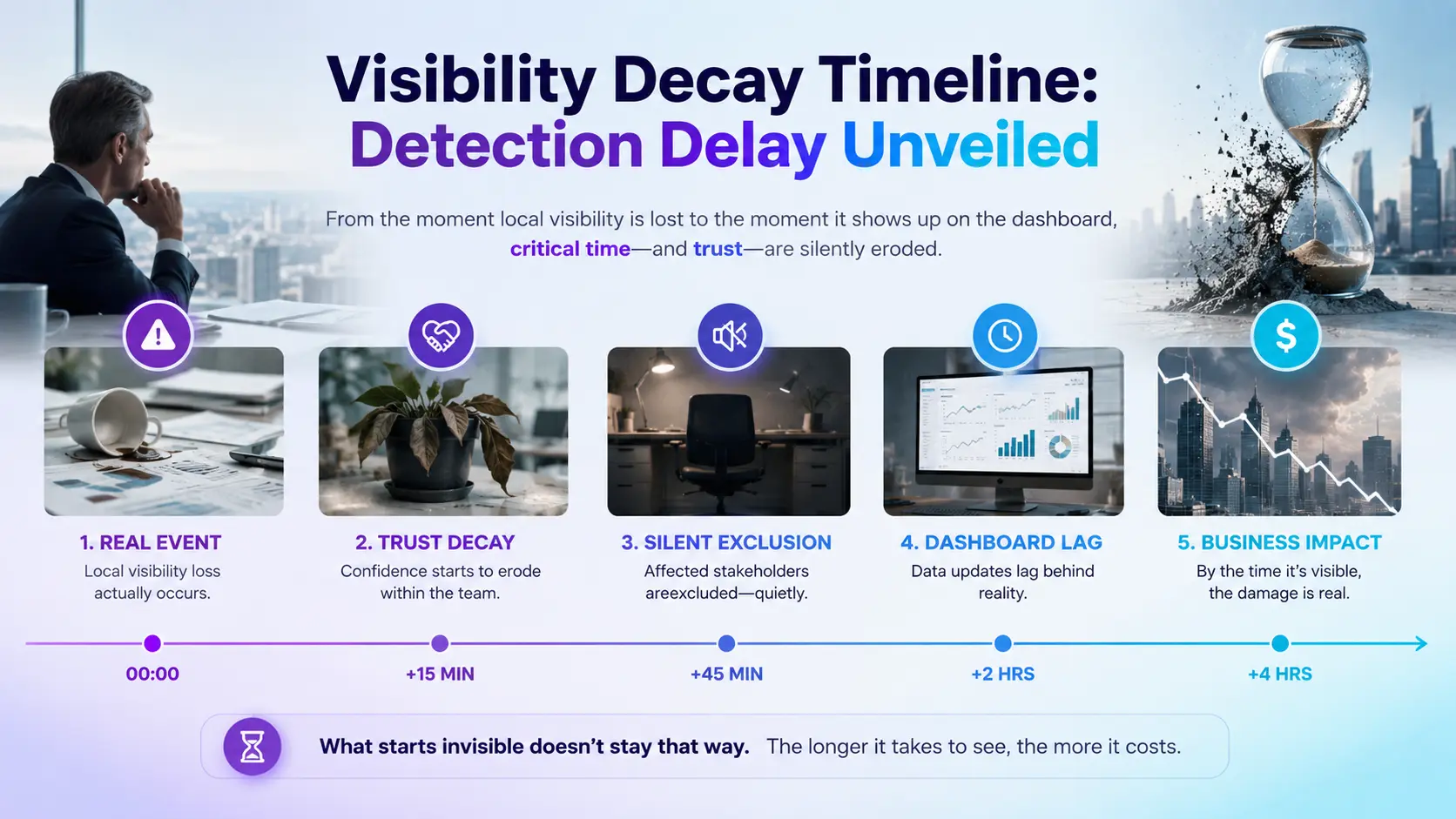
Why dashboards reflect the past, not current visibility
By the time your dashboard catches up, the real exclusion happened days or weeks prior.
The reason is simple: most reporting platforms aggregate data with a delay, smoothing out volatility but masking the first moments of trouble.
You’re not looking at a live feed – you’re looking through a rearview mirror.
We’ve watched execs fixate on daily impressions or click counts, only to realize those numbers measure historical inclusion.
The awareness gap in local SEO isn’t just blind spots in reporting; it’s structural signal lag.
When a client’s Google Maps entry dropped out of the “near me” pack, the reporting dashboard still showed healthy averages for another business week.
Cause and effect get misaligned – performance dropped only after the error compounded.
This is the quiet exclusion problem: if you wait for the graph to drop, you’re already behind.
Map visibility volatility rarely sends a push notification.
Is your dashboard measuring the present, or archiving yesterday’s omissions?
The lesson: dashboards confirm what you’ve already lost, not what you’re about to lose.
If you rely on current reporting, you’ll always detect demand drop after it’s become a business problem.
Early exclusion is invisible, dashboard data lags behind, and local visibility losses strike in silence.
The next sections break down how to spot the root causes and catch demand drops before they compound.

What real failure patterns cause silent drops in local reach
Comparison of Failure Patterns Causing Silent Local Visibility Drops
| Topic | Description | Consequences | Recommended Action |
| Cost of late realization | Missed opportunities in constrained demand periods go unrecovered. | Permanent loss of leads and revenue, competitors gain advantage. | Monitor early signs beyond dashboards; track demand patterns closely. |
| Next diagnostic steps | Forensic mapping of visibility drop vs. detection timing. | Identifies systemic delayed detection risks before fixes. | Track calls, messages, local pack presence vs. historical demand to find lag. |
You don’t lose local visibility through a dramatic plunge – it slips away through minor, almost invisible missteps.
Here’s the myth: most decision-makers expect a warning, a penalty, or at least a spike in alerts.
The truth?
Some of the deepest losses happen in silence, erasing you from results before any dashboard panic button goes off.
Why do so many executives only notice when leads already dried up?
Because the failure patterns that drive local visibility silence are engineered to be undetectable – until their impact is visible in lost demand.
Unseen shifts in trust or entity consistency
Sometimes a single detail – like a business address slightly out-of-sync between your Google Business Profile and a third-party aggregator – triggers a slow decay in trust.
No alert fires.
No audit flags the quiet exclusion.
In practice, we’ve watched local profiles gradually lose presence because someone added a stray comma, or the closing time shifted by fifteen minutes on one directory but not others.
That inconsistency, even when accidental, tells Google’s systems your business might not be what it claims.
Like a rope fraying one strand at a time, trust drops aren’t sudden – they accumulate, erasing your competitive position without visible drama.
There’s a strong analogy here: it’s like a financial institution quietly freezing part of your account – not enough to get noticed immediately, but enough that over time, you can’t withdraw as much as before.
What happened to your funds?
The problem is hidden until you try to act.
The same goes for local visibility: subtle trust failures increasingly restrict your capacity to appear when it matters, and you only see the result when demand has already dropped.
Have you ever wondered why dashboard numbers seem healthy until they suddenly aren’t?
That’s the trap: minor trust inconsistencies rarely trigger an alert, but they trigger real exclusion behind the scenes.
You think you’re in the map pack, but the reality is, you started leaving weeks ago.
Proximity’s dynamic boundary quietly shrinking reach
The radius where your business appears isn’t static.
We’ve seen locations lose 40% of their discovery coverage after an unannounced local update – even though their performance metrics looked stable for days.
Why?
Because proximity relevance – the invisible zone where Google believes you’re the best fit – can contract without warning.
It doesn’t announce that you’ve been quietly excluded from adjacent neighborhoods.
In fact, you might still rank well in your anchor location while becoming invisible to everyone just a mile away.
It’s similar to a streetlight on a timer: you stand beneath it, thinking you’re visible, but the light’s circle is shrinking minute by minute until half the street is in shadow.
Are you aware of when you slip into the darkness?
Most aren’t, because until the calls and foot traffic weaken, the risk stays hidden.
If your demand seems to drop “without reason”, look at how small boundary changes in proximity can cause abrupt demand gaps that dashboards won’t register in time.
This is the essence of signal lag local search: change usually happens at the edge, not the center.
The central issue: Silent failures let your reach shrink long before you spot a problem.
Visibility volatility is the norm, not the exception.
Next, let’s break down how these symptoms appear – and why recognizing them early is the only edge left.

How to assess if demand decline started before you noticed
Most teams see the demand drop after the damage is done – not as it’s happening.
The surprise?
Your primary warning signs rarely come from traffic charts or dashboard alerts.
They’re visible in quiet downstream symptoms, often misread or ignored, while exclusion has already taken hold upstream.
Downstream symptoms that signal silent exclusion
If your phones ring less, inquiries start to lag, or you stop appearing in non‑Maps discovery moments, it’s likely the system began filtering you out long before you noticed.
One business we advised saw a steady decline in inbound calls over eight weeks, yet their performance dashboards only reflected a minor dip in the last two.
Why?
Metrics chase visibility, but exclusion starts with subtler changes – entity trust, shrinking proximity bands, or data inconsistencies triggering silent removal from “near me” results.
The myth is that dashboards act as early warning systems.
In reality, they echo what you already missed.
Demand drops first, reporting lags behind.
If you only watch the numbers, you catch exclusion by its ripple effects – reduced direction requests, conversions coming in colder, or competitor names dominating branded queries.
The real problem: these symptoms feel disconnected, so teams look for tactical fixes instead of tracing the upstream exclusion event.
Think of it like seeing leaves falling before spotting the broken branch above.
You’re not seeing the initial fracture – just the aftereffects hitting the ground.
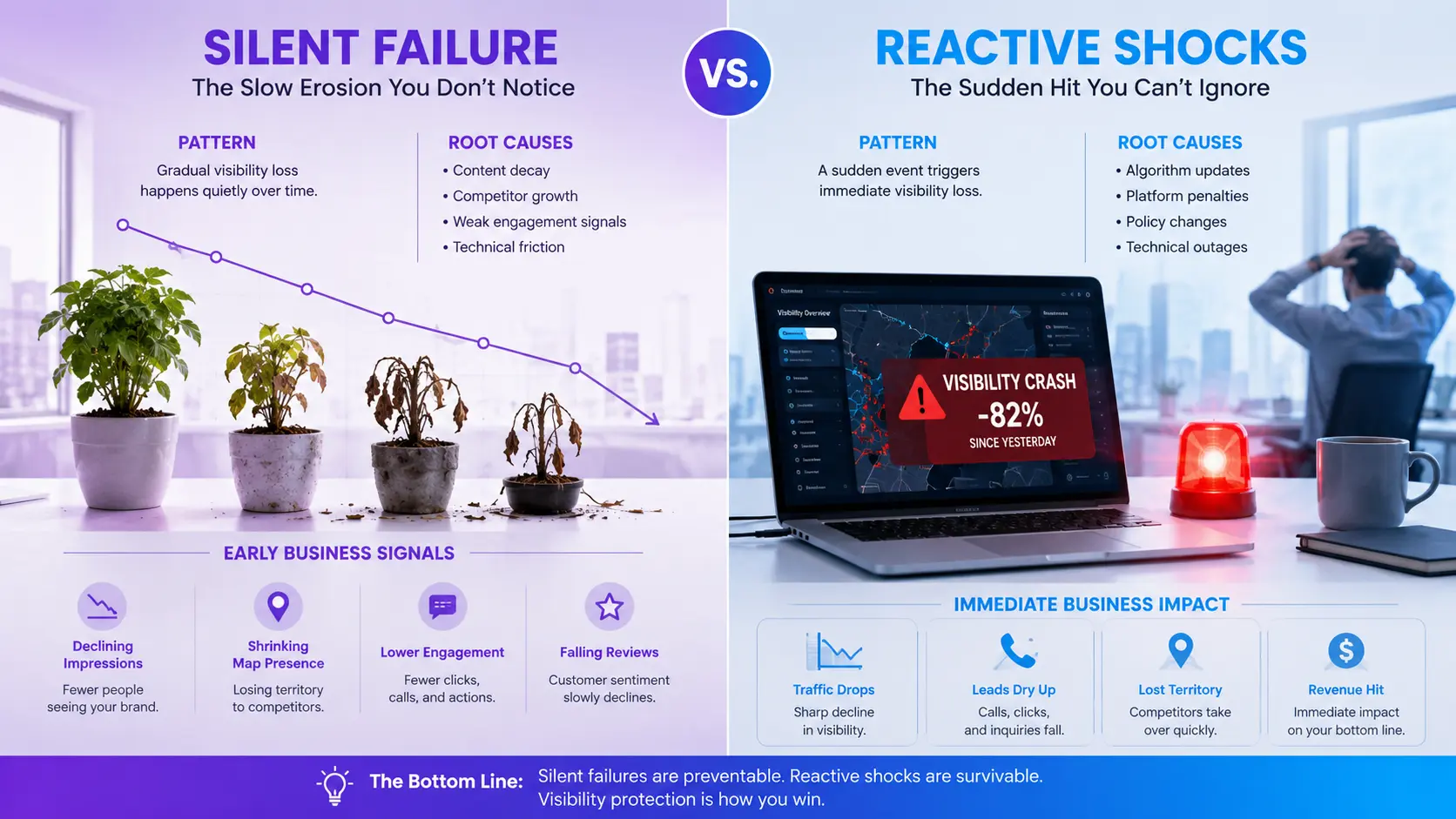
Distinguishing silent exclusion from reactive shocks
Not every metric drop comes from a loud event like an algorithm penalty.
The danger is misattribution: assuming an API bug, short-lived system crash, or “Google quirk” caused the loss, when it was really a slow, silent exclusion already underway.
We’ve diagnosed multiple instances where a business suspected a technical error, only to find gradual trust decay or minor profile inconsistencies quietly pushed them below the threshold for inclusion.
Ask: did the decline start before any obvious technical event?
Did conversion quality shift before traffic numbers did?
Silent exclusion creeps.
Reactive shocks hit hard but explain themselves – systemic filtering does not.
The awareness gap (“local visibility silence”) is that the system rarely tells you which club you’re leaving and when the door was closed.
If symptoms predate any “incident”, you’re not chasing a one-time glitch – you’re uncovering the signature pattern of delayed detection of local visibility loss.
In local search, seeing the true starting line of demand decline is the difference between catching a slip and suffering a slide.
Forward motion starts by recognizing not just what you missed, but how early the silence began.

When and why detection delay becomes a strategic risk
Detection Delay: Risks and Diagnostic Steps
| Failure Pattern | Description | Typical Indicators | Alert Visibility |
| Unseen shifts in trust or entity consistency | Minor mismatches or outdated business details that reduce system trust. | Data inconsistencies, missing suite numbers, slight address or hours changes. | No alerts; very subtle or none. |
| Proximity’s dynamic boundary shrinking reach | Invisible contraction of geographic relevance radius by local search algorithms. | Stable central metrics but reduced discovery beyond immediate area. | No alerts; changes go unnoticed initially. |
Most executives think the real threat to local visibility is obvious loss – a sudden ranking drop, a Google Maps wipeout, a penalty.
The reality is sharper: in tight local markets, even a few days of unnoticed disappearance can erase opportunities for good.
What looks like a small dip is often the aftershock of missing prospects who found someone else first.
Silence in your data isn’t safety; it’s a warning with the volume turned down.
The cost of late realization in constrained local demand environments
There’s a critical difference between missing a single visitor and missing the surge that actually matters – think of a fashion retailer losing exposure during prom season, or a medical practice going invisible during back-to-school rush.
In markets where demand is capped, you don’t just lose leads for a day.
That moment is gone forever, with direct revenue consequences.
One client in a competitive legal vertical lost local pack placement for just under a week – no dashboard alert, no spike in error messages.
The only sign: new consultations dipped sharply, yet core KPIs looked normal for days.
By the time their team realized, top competitors had already captured the week’s most valuable cases.
The analogy here: imagine your business like a parade float.
If you stall for even a block, the entire parade moves on.
You can’t make up the lost cheers afterward.
Recovery isn’t just a matter of regaining lost ground; it means facing a permanent gap in demand capture.
In geo-markets where every impression counts, dashboard lag isn’t just inconvenient – it’s a silent tax on growth.
If conversion rates look flat but new customer signups drift downward, ask: is your team chasing technical issues, or have you simply fallen out of the running without a sound?

Next diagnostic steps, not fixes
Don’t reach for quick optimizations.
The first move is forensic: map out the time lag between when visibility actually dropped and when your team became aware.
Track missed calls, message declines, and local pack appearances against historical demand patterns.
Establish where local visibility silence began – not when the data reflected it.
If the gap is more than a few days, you’re dealing with systemic delayed detection of local visibility loss, not just a glitch.
Look for evidence of signal lag local search and dashboard lag local visibility – pinpoint moments when your digital presence faded quietly in Google Maps or local packs before any metric ticked down.
Where the gap exists, risk sits in the shadow; that’s your new baseline for proactive local search defense.
Teams that succeed fastest are those who act before delayed detection of local visibility loss turns a slip into a slide.
The fastest teams don’t just monitor – they hunt for the quiet exclusion Google Maps will never announce.
That shift changes the entire risk profile.
Delay in detection always compounds.
Get good at spotting it, and you stop local momentum from slipping away before next week’s numbers even tell the story.
The first symptoms appear outside search tools in Signs of Local Visibility Loss.

Scientific context and sources
The sources below provide foundational context for how decision-making, attention, and performance dynamics evolve under scaling and constraint conditions.
- Information Lag and Organizational Response
Organizations – James G. March & Herbert A. Simon – Wiley
Covers how organizations perceive, process, and act on information, with classic models addressing lag effects between changes in the external environment and actionable awareness.
https://books.google.pl/books/about/Organizations.html?id=FbBJEAAAQBAJ - Trust and Local Search Ranking
Knowledge-Based Trust: Estimating the Trustworthiness of Web Sources – Xin Luna Dong, Evgeniy Gabrilovich et al. – Proceedings of the VLDB Endowment
Explores trust signals, consistency, and their impact on ranking in search environments, laying technical groundwork for sensitivity to profile discrepancies.
https://www.vldb.org/pvldb/vol8/p938-dong.pdf - Consequences of Delayed Feedback in Decision Systems
Delays Impair Learning and Can Drive Convergence to Inefficient Strategies – Hazhir Rahmandad & Michael Shayne Gary – Organization Science
Shows that delayed outcome feedback can impair learning, slow strategy correction, and push decision-makers toward inefficient choices that produce faster visible returns but worse long-term results.
https://pubsonline.informs.org/doi/10.1287/orsc.2020.1405 - Algorithmic Filtering and Visibility
The Relevance of Algorithms – Tarleton Gillespie – MIT Press
Analyzes how algorithmic filtering produces silent exclusion effects, relevant to understanding unannounced removals in discovery systems.
https://www.microsoft.com/en-us/research/wp-content/uploads/2014/01/Gillespie_2014_The-Relevance-of-Algorithms.pdf - Data Aggregation and Retrospective Bias in Dashboards
Task-Driven Evaluation of Aggregation in Time Series Visualization – Danielle Albers, Michael Correll & Michael Gleicher – ACM CHI
Studies how aggregation and visual presentation affect trend judgment, reinforcing the article’s point on dashboards as rear-view mirrors.
https://pmc.ncbi.nlm.nih.gov/articles/PMC4204486/
Questions You Might Ponder
Why does delayed detection of local visibility loss happen even with advanced dashboards?
Advanced dashboards typically aggregate and smooth data, masking subtle, slow-building changes. This delay means exclusion or trust issues go unnoticed until significant damage occurs, causing dashboards to reveal loss only after the event, not as it begins.
What are the most common silent triggers of local search visibility decline?
Silent triggers include minor inconsistencies in business details (name, address, hours), trust signal degradation, and shifting proximity boundaries. These often compound invisibly, quietly diminishing a business’s reach before any reporting tool issues a warning.
How does trust signal decay impact Google Maps rankings?
Google’s algorithms penalize inconsistent or unreliable information across directories, seeing minor trust failures as potential fraud. Decay in trust signals leads to gradual removal from high-priority search results, drastically impacting discoverability and conversion rates.
What symptoms indicate a visibility loss before dashboards do?
Early symptoms are less inbound calls, reduced foot traffic, colder leads, and domination by competitors in branded and ‘near me’ searches. Dashboard metrics typically reflect only historical averages, echoing loss after it’s already occurred.
Why is detection delay a major risk in competitive, capped-demand markets?
A late response means missing critical demand spikes that can never be recovered, as competitors capture lost opportunities. In constrained markets, even short lapses create lasting revenue impact, making timely detection critical to business health.