What You’ll Learn
Local search visibility failure symptoms are the early business signals that a company is losing actionable visibility in Google Maps or local search even when rankings, impressions, or SEO reports look stable.
These symptoms often appear first as fewer calls, weaker inquiries, lower bookings, reduced direction requests, fewer form fills, or a sudden gap between expected demand and actual customer actions.
They can be caused by silent eligibility filters, AI-powered local pack compression, entity data inconsistencies, outdated visual signals, ads, summaries, or zero-click layouts that reduce real attention.
The key symptom is not always a ranking drop, but demand disappearing while visibility metrics still look healthy.
Key Takeaways
- Stable local rankings can mask sudden drops in lead-generating demand, as algorithmic eligibility gates quietly exclude businesses from actionable audiences.
- AI-powered local results compress visible listing space, diverting actions to summaries or sponsored cards, causing calls and bookings to decline despite unchanged map pack positions.
- Aggregate impression and ranking metrics fail to detect silent local search visibility failure symptoms; direct action metrics reveal true demand shifts.
- Consistent entity data and up-to-date visual signals are critical, as trust or eligibility failures erode real business opportunities before any decline appears in ranking charts.
Most businesses trust their local rankings to predict lead flow – but a stable number in the pack can hide a cratering in real-world calls.
The result: executives stare at tracking dashboards that insist “all is well”, while actual demand quietly drains out the bottom.
Why?
Because ranking alone doesn’t guarantee your business is seen, chosen, or even eligible for a real shot at a customer.
That broader logic for local search visibility is outlined in Local Search Visibility.

When Calls Fall but Rankings Don’t: What’s Really Happening
Here’s the first myth: a visible map ranking equals actual opportunity.
It doesn’t.
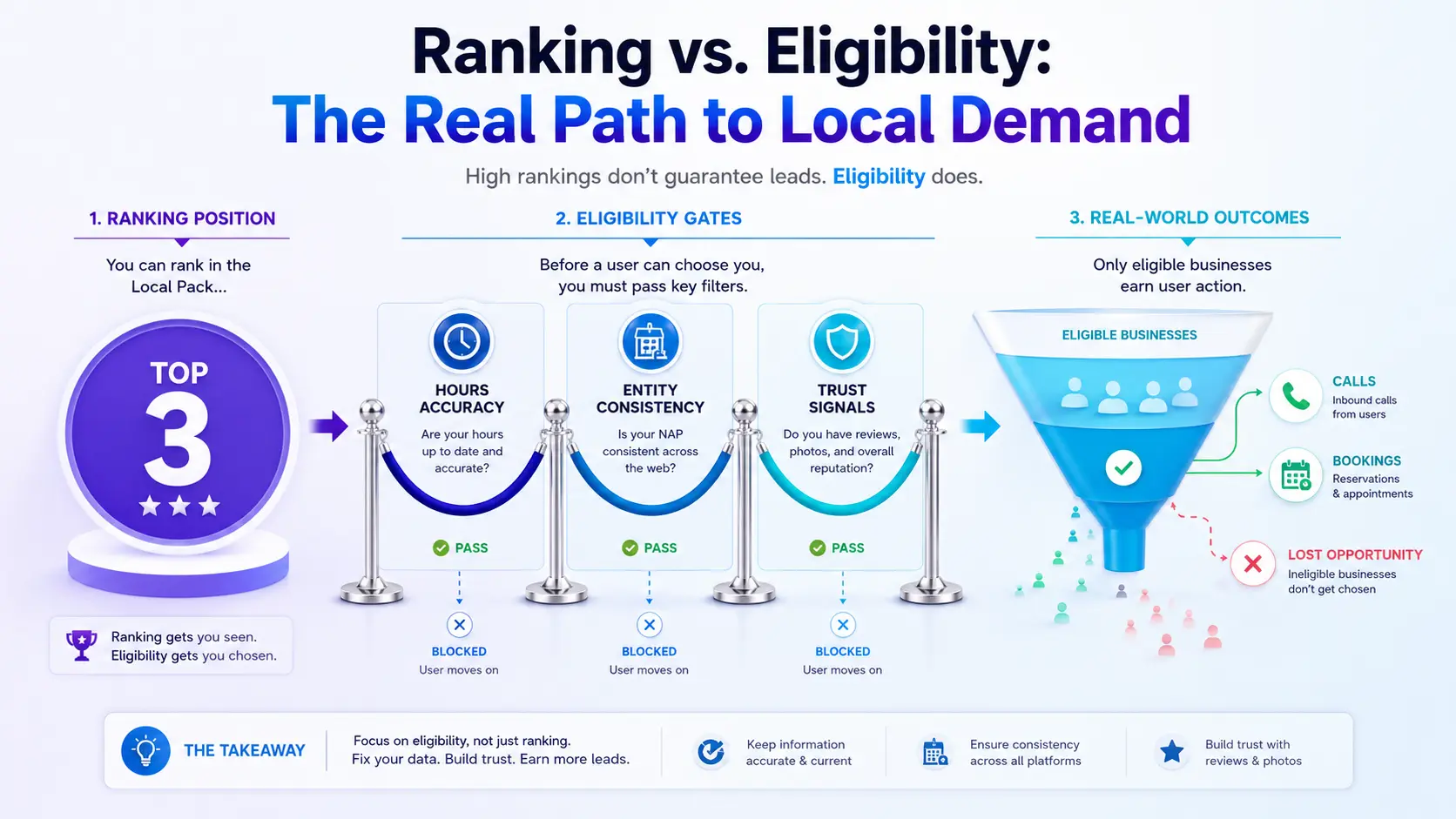
What most teams miss is that Google’s local algorithm uses more than pure rank – the eligibility gate swings open or shut before a searcher even notices your listing.
We’ve watched clients hold steady at “#3” in local packs, yet calls drop by half in two weeks.
Why?
Their entity was still ranked, but not actively surfaced for the majority of high-intent searches once eligibility signals slipped (think: hours, category tags, or just one competitor’s review hill-climb tipping them out of selection).
Why ranking position isn’t the same as eligibility for attention
Algorithms now change which listings become visible at the exact moment a user triggers a query – sometimes even reshuffling in real-time based on searcher behavior, device, or intent.
Ranking is like being third in line for a closed-door meeting: you look close, but you’re not actually invited in.
If eligibility criteria tighten – even slightly – your spot is passed over before the searcher ever sees you.
Comparison of Ranking Position vs Eligibility for Attention
| Factor | Description | Potential Issue | Impact on Visibility |
| NAP Consistency | Name, Address, Phone match across listings | Mismatches between citations or profiles | Listings excluded from certain queries/devices |
| Hours Accuracy | Business hours reflect actual open times | Outdated or incorrect hours listed | Listing excluded from ‘open now’ filtered searches |
| Profile Verification | Proper Google My Business verification status | Unverified or PIN issues | Listings fail eligibility gate silently |
| Category Tags | Appropriate primary and secondary categories | Missing or incorrect categories | Not shown for relevant keyword queries |
| Entity Data Consistency | Business details match official website and directories | Conflicting or incomplete data | Filtered out by eligibility algorithms |
Measuring only rank is like watching the score without seeing the rules of the game.
Eligibility silently filters you out before impressions are counted.
How AI-powered local packs compress visibility and mute conversions
AI-driven results now mean that less real estate is devoted to local business listings in the main visual pack.
You can hold a stable “top 3” organic rank, yet see your call volume crash as the new formats crowd out classic interaction paths.
In client audits throughout the past year, we’ve documented stable rankings but a sharp slide in actions – calls, bookings, directions – almost overnight, especially when Google features AI summaries, paid blocks, or dynamic FAQ answers above or around local packs.
Fewer customers even scroll to reach the listings, and those who do often see an AI-generated summary or the first visible option, compressing practical visibility further.
It’s like moving from a six-lane highway to a two-lane road overnight.
The same cars (rankings) are there, but the throughput (actual calls and engagements) plummets.
This compression hits hardest for those relying on historic position as their main success metric.
Silent demand signals – call logs and direct actions – are the indicators of real opportunity, far more than aggregate impressions.
The reality is simple: local search visibility failure symptoms rarely begin with a drop in rank.
They show up first in lost demand.
If you don’t spot the disconnect early, you won’t just lose leads – you’ll lose the story about why.

The Invisible Leak: Why Lead Drops Often Go Unnoticed
What undermines confidence is not always what changes the most in your reports.
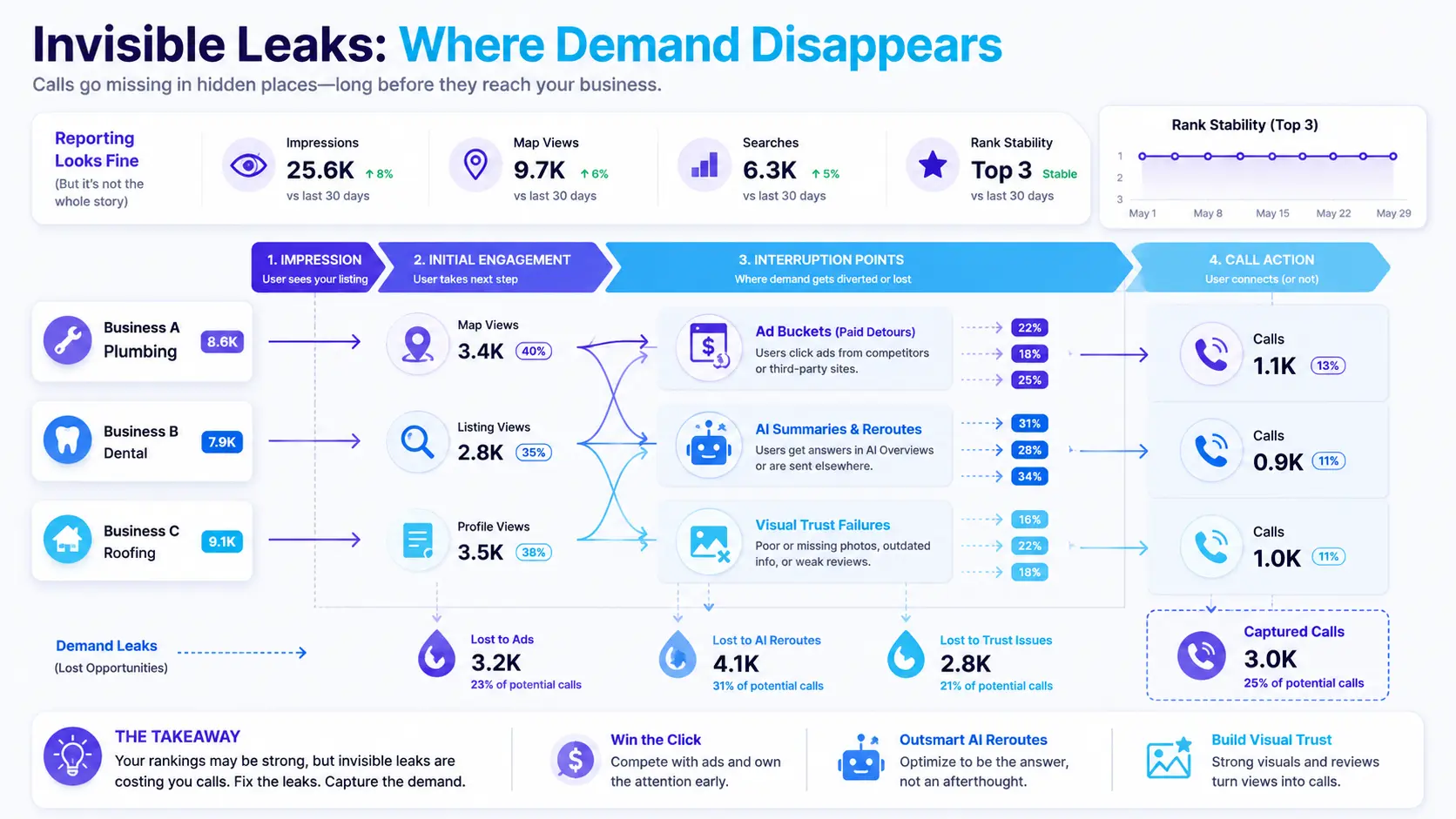
Measurement blind spots: impressions look healthy, but calls vanish
A steady stream of impressions can fool teams into believing local demand has not changed.
We’ve watched clients leave money on the table for months, thinking their listings remained effective, only to discover the real problem: their presence was visible, but not accessible where it counted.
Reports aggregate every fleeting glimpse of a business name, not whether that view actually triggered a call, tap, or real interest.
One hotel group staring at their metrics celebrated “rank stability”, even as direct bookings slid by 22%.
It felt impossible – until we uncovered that most “impressions” now happened on secondary tab views or outside actionable spots, invisible to prospective guests seeking a fast decision.
This is the difference between a storefront on a busy street and one with the door locked – walk-bys get counted, but no one comes in.
Most measurement dashboards are built for volume, not intent, which is why loss of actionable visibility rarely triggers alerts.
Did your business just get excluded from the carousel on a popular device?
Did an update push you off the call-ready segment?
Your numbers won’t flinch, but your phone will – silently.
The real symptom isn’t a reporting alert; it’s a Monday with phones that don’t ring as expected.
Myth: More impressions always mean more opportunity.
Reality: The right impression in the right context is what drives leads.
Without that, you’re reading tea leaves.
Attribution breakdown across AI, ads, and local summaries
Attribution used to be difficult.
Now, it’s fracturing.
AI-driven summaries, sponsored ad slots, and fast-evolving “zero-click” experiences reroute customers away from direct actions – without a trace in legacy analytics.
That favorite call-to-action button?
It might have sunk below the fold or been hidden behind new AI-generated business panels since last quarter.
We’ve seen medical practices suddenly “lose” lead calls, only to find out Google’s AI summary auto-answered patient questions and routed appointment prospects through alternative providers via nearby listings.
The practitioners thought demand was dropping – but in truth, it was their share of actionable attention that disappeared, masked by design shifts and summary cards.
Where do those missing calls go?
Sometimes, they’re absorbed by an ad; sometimes, AI offers a single business as the only “trusted” answer, demoting others to digital footnotes.
No alert flags this.
All you see is a silent local visibility drop, with stable rankings masking the rerouted demand.
Old attribution logic simply can’t follow the handoff between algorithms, ads, and summaries.
The clearest signal isn’t always in your dashboard.
It’s the gap you feel between what “should be happening” and what actually lands in the calendar or inbox.
That’s the real leak: silent, masked, and invisible to standard measurement.
Stable metrics can’t guarantee steady leads.
The real threat is not a drop in rankings – it’s a silent shift in demand signals executives never see coming.

What Undermines Demand Even When Visibility Seems Stable
The biggest threat isn’t losing your ranking, but not noticing silent exclusion behind stable metrics.
Most local businesses believe that as long as they hold their spot in the map pack, demand is safe.
But Google’s real gatekeepers work behind the curtain – shutting out brands before they even enter the customer’s field of view, with zero warning.
Demand drops can originate from hidden trust thresholds that never trigger alerts and are invisible in standard reports.
Call volumes can drop sharply despite unchanged ranking positions – because eligibility or data trust quietly shifted.
Eligibility gates and entity consistency as hidden trust thresholds
The algorithm doesn’t just reward location or proximity – it quietly enforces eligibility gates wired to signals you won’t notice in rank charts.
One missing address fragment, a PIN-verified profile out of sync with your official site, or a subtle mismatch in entity data can make a business invisible to segments of searchers.
For a multi-location service client, we noticed that Google’s silent eligibility algorithms filtered listings out of local packs for queries with minor keyword variations – without shifting the visible ranking in the standard tools.
This wasn’t a penalty, just an exclusion based on incomplete or inconsistent entity signals.
Key Eligibility Gates and Entity Consistency Factors Affecting Local Visibility
| Aspect | Ranking Position | Eligibility for Attention | Impact on Leads |
| Definition | Order in local pack based on Google algorithm | Criteria that determine if a listing is actually shown to the searcher | Ranking may be stable but eligibility affects if the user sees or interacts |
| Visibility | Visible in rank charts/tools | Determines actual surfacing in user queries | Only eligible listings generate real impressions and calls |
| Influencing Factors | Proximity, keywords, backlinks | Hours, category tags, reviews, entity consistency | Eligibility gates can block users even if rank stays stable |
| User Experience | Listing position in search results | Whether the listing is displayed or filtered out | Leads drop if eligibility signals slip despite rank stability |
| Analogy | Standing in line | Having the door open to enter | Rank is line position; eligibility is invitation to join |
Think of Google’s eligibility system as a velvet rope at a club: only those who check every box step inside, but outsiders never get told which form they missed.
Even a business consistently shown in the three-pack for one device or city might be quietly excluded for another, simply due to a stale directory citation or a missed update after a branding change.
The invisible gate isn’t a rank drop – it’s silent disqualification, leading to sudden demand dips executives rarely trace back to entity hygiene.
Why does this matter?
Because the biggest drops in call volume often start with something as small as an unclaimed citation or mismatched hours, not a drop in ranking position.
If rankings are the scoreboard, eligibility is the rulebook – and you don’t know you’ve broken it until revenue slips.
Visual trust erosion from stale or inconsistent signals
Stable local rankings cannot compensate for eroded visual trust.
We’ve seen locations with pristine ranking and impression graphs – but outdated storefront photos, low-quality logo uploads, or a profile image that no longer fits the brand.
The result: view counts look steady, yet calls and direction requests fade by double digits.
Trust is a visual shorthand – a storefront image last updated two years ago signals neglect to customers (and to Google’s AI summarization models).
In one client’s case, we swapped in recent exterior and staff photos across five listings.
The only change: call volume rebounded by 18% over eight weeks, with zero shift in average rank.
A stale visual presence acts like a dusty display window: people might walk by, but they don’t walk in.
Is your team measuring appearance as carefully as analytics?
If your visuals don’t look current, no line in your rankings dashboard will save your demand curve from sliding.
Presentation drives conversion before rank ever sees the lead.
What quietly drains demand isn’t always visible from a dashboard or a search result.
Hidden eligibility failures and visual trust risks can erode phone calls and lead flow with no obvious early signal – until the numbers turn, and by then, it’s already a recovery problem.
These symptoms often get misattributed, which is unpacked in more depth in Attribution Failures in Local Search.

Scientific context and sources
The sources below provide foundational context for how decision-making, attention, and performance dynamics evolve under scaling and constraint conditions.
- Search ranking, attention, and real-world decisions
Accurately Interpreting Clickthrough Data as Implicit Feedback – Joachims, Granka, Pan, Hembrooke, Gay – Proceedings of ACM SIGIR
Shows that clicks are informative but biased, and that higher-ranked results can receive more clicks because of trust bias, not only relevance.
https://www.cs.cornell.edu/people/tj/publications/joachims_etal_05a.pdf - Measurement bias and demand estimation
Performance Measurement and Control Systems for Implementing Strategy – Simons, Robert – Prentice Hall
Explores how measurement systems shape managerial attention and can distort how organizations interpret performance and demand signals.
https://www.hbs.edu/faculty/Pages/item.aspx?num=256 - Algorithmic filtering and silent exclusion
The Filter Bubble: What the Internet Is Hiding from You – Pariser, Eli – Penguin Books
Describes how personalization systems silently shape what users see and hide, creating invisible exclusion from information flows.
https://www.penguinrandomhouse.com/books/309214/the-filter-bubble-by-eli-pariser/ - Trust and visual information in decision science
What Makes Web Sites Credible? A Report on a Large Quantitative Study – Fogg, B.J. et al. – CHI Conference Proceedings
Large-scale study showing which website elements increase or reduce perceived credibility, including visual and design-related trust signals.
https://credibility.stanford.edu/pdf/p61-fogg.pdf - Attribution and measurement fragmentation in AI-powered environments
Attributing Conversions in a Multichannel Online Marketing Environment: An Empirical Model and a Field Experiment – Li, Hongshuang Alice & Kannan, P.K. – Journal of Marketing Research
Analyzes how multi-touch customer journeys create attribution gaps when aggregate metrics hide the true effect of different channels.
https://journals.sagepub.com/doi/10.1509/jmr.13.0050
Questions You Might Ponder
Why can local search visibility failure symptoms appear when rankings remain stable?
Local search visibility failure symptoms often appear with steady rankings because Google’s algorithms can quietly restrict a business’s eligibility for high-intent audiences. Ranking alone cannot capture hidden exclusion or decreased actionable impressions, resulting in call drops before rankings ever shift.
What are examples of silent eligibility gates in Google local search?
Silent eligibility gates include factors such as inconsistent address data, outdated hours, unverified profiles, or mismatched citations. These can cause Google to filter out a business from key search segments, reducing real-world lead flow despite unchanged rankings or healthy impression numbers.
How do AI-powered local results impact traditional lead attribution?
AI-powered search panels, summaries, and dynamic Q and A strips often intercept user actions before a business’s listing is even displayed. Leads may get routed to ads, summarized answers, or alternate providers, making it difficult to trace lost demand with traditional last-click attribution models.
Why is ‘stale visual trust’ a risk even with good ranking?
Stale or outdated visual elements, like old storefront or staff images, erode user trust and conversion rates, even if a business ranks prominently. Google’s AI and consumers both factor in freshness signals; a current, professional appearance is required to capitalize on every eligible impression.
What is the best way to detect local search visibility failure symptoms in real time?
To detect local search visibility failure symptoms early, businesses must monitor real actions – call volume, direction requests, and bookings – over aggregate impressions or ranking dashboards. Sharp drops in these direct demand signals almost always indicate a hidden eligibility or visibility shift.