
What You’ll Learn
Risk weighted PPC is paid media advertising where platforms limit delivery, approval, reach, and auction access based on regulatory or reputational risk, not only bid strength, demand, or ad quality.
It affects high-risk sectors such as healthcare, finance, gambling, addiction treatment, and other regulated categories where platforms apply stricter review, inventory filters, policy checks, and delivery caps.
In risk-weighted PPC, even compliant ads can face slower approvals, higher CPCs, sudden disapprovals, volatile impressions, or flat results despite larger budgets.
The main constraint is often platform risk tolerance, meaning PPC performance may fail because of upstream compliance filters rather than weak creative, targeting, or landing pages.
Key Takeaways
- Risk‑weighted PPC systems restrict delivery in regulated industries based on platform risk tolerance, not market demand or bid strength.
- Compliance and approval filters act as throughput bottlenecks, capping campaign reach and causing delays, unpredictability, and cost spikes.
- Most campaign failures in high-risk verticals stem from invisible platform constraints, not creative or funnel issues.
- Diagnosing upstream platform restrictions is vital; in persistent cases, reallocating budget to alternatives outperforms further PPC spend.
Most executives expect that strong demand automatically unlocks ad delivery.
In high‑risk categories, the opposite happens: the more attention your market attracts, the tighter the spigot closes.
The myth?
Platforms throttle ads not due to lack of interest, but because risk trumps opportunity when compliance is on the line.

How risk‑weighted PPC systems limit ad delivery – even when demand exists
Picture the PPC auction as an airport security checkpoint.
In regulated industries – finance, health, gambling – every “passenger” (your ad) faces extra inspection.
It’s not about who’s willing to pay the most, but who survives the compliance filter in paid media.
Platforms limit the supply of eligible impressions through pre‑screening, internal audits, and real‑time detection to avoid regulatory blowback or legal risk.
Why platforms impose delivery filters on sensitive sectors
With one fintech client, we watched inventory constraints strangle reach even as demand spiked.
Why?
The number of permissible ad slots in these sectors is capped, not by audience size, but by risk tolerance.
Sometimes, dozens of eligible advertisers compete for a handful of allowed placements – driving up cost and shrinking share.
Even before creative tests or bids are considered, the platform’s scrutiny of ad inventory sets the baseline: fewer impressions, heavier audits, and constant monitoring for new policy triggers.
Ask yourself: How many eyes never see your message, not because of your budget, but because the auction volume has been throttled upstream?
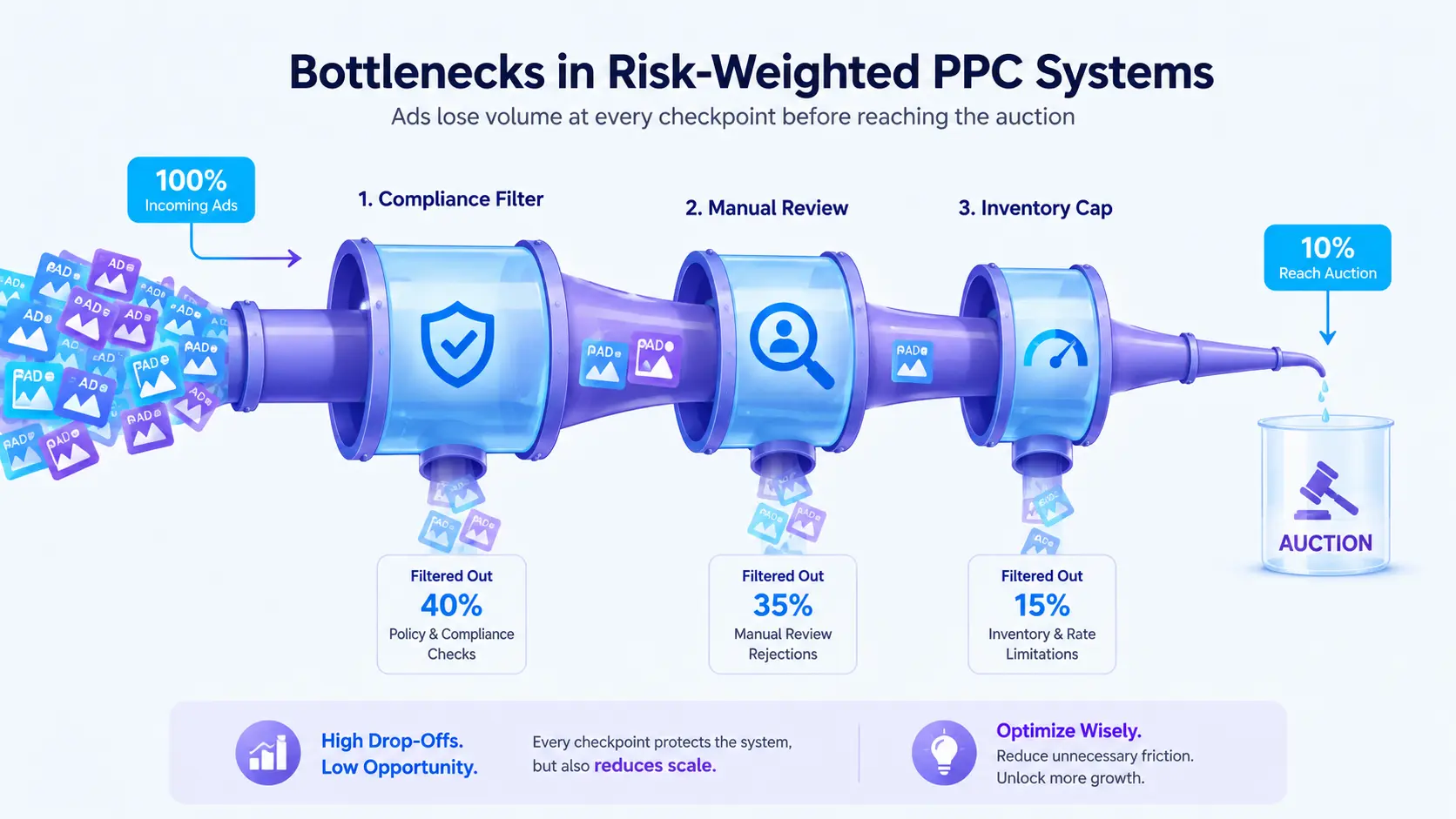
How approval constraints become system bottlenecks
Approval constraints in paid media are often the true bottleneck, not creative failure.
Most companies misdiagnose this as a copy issue, but review processes – whether automated or manual – impose delays, sudden rejections, and capped delivery even for previously approved ads.
Key Impacts of Approval Constraints in Risk-Weighted PPC
- Delays and stalling of campaigns for days or weeks
- Sudden ad rejections and unpredictable review outcomes
- Capped delivery despite strong creative and bids
- Higher scrutiny for larger budgets and lucrative targets
- Platform bottlenecks often mistaken for creative or funnel failure
We’ve seen campaigns stalled for weeks, not by spend, but by opaque review queues and unpredictable platform interpretations of compliance.
The bigger the budget or the more lucrative the target audience, the higher the scrutiny.
This is the paradox: in high‑risk PPC, budgets rarely get spent because system bottlenecks halt delivery long before the campaign exhausts its potential.
Imagine water flowing through a series of narrowing pipes.
Even if pressure (demand) increases, the smallest valve (approval constraint) sets the system’s limit.
Results are dictated by bottlenecks that exist entirely outside the marketer’s control.
Don’t mistake underdelivery for a tactical failure – often, it signals that risk‑weighted PPC systems are prioritizing platform safety over market opportunity.

Why compliant ads still face higher cost and volatility in high‑risk categories
Most teams believe that running a “compliant” campaign in a regulated industry guarantees a level playing field.
The reality: compliance is just the price of entry – platforms still throttle your campaigns through hidden risk calculations long after your ads pass review.
Demand and creative strength can’t solve for a system that stacks volatility on top of every bid.
How platform risk tolerance affects auction dynamics
Here’s what’s rarely discussed: platforms pre-emptively restrict the flow of ads in high-risk verticals, not because of overt violations, but because their risk models default to caution.
When we launched a campaign for a client in a tightly monitored sector, we noticed – despite flawless creative – average cost-per-click was 1.7-2x higher than in adjacent lower-risk categories.
Fewer brands make it through compliance, so inventory shrinks and platforms widen delivery gaps to avoid even perceived risk.
Fewer eligible bidders means less true auction – most placements go to the highest bidder by default, not because of superior relevance.
Impact of Platform Risk Tolerance on PPC Auction Dynamics
| Action | Purpose | Description |
| Evaluate approval & inventory filters | Identify bottlenecks | Check for pending reviews, long audit times, and disapprovals blocking delivery |
| Analyze campaign delivery diagnostics | Detect constraints | Review approval logs and delivery status for non-creative issues |
| Assess structural viability of PPC | Determine feasibility | Consider if platform restrictions consistently stall growth despite funnel health |
| Explore alternative channels | Mitigate risk | Shift budget to owned/earned media less affected by platform risk filters |
| Diagnose constraints before optimizing creative | Avoid wasted effort | Focus on platform-level issues instead of ad copy or bidding |
Think of it like a casino with only two active tables: your seat is expensive, time at the table unpredictable, and the house keeps shifting the odds based on what makes them most comfortable.
Does that sound like the efficient, open auction executives picture?
Not even close.
The myth is that compliance equals access.
In reality, “risk-weighted PPC” means platforms bias their auctions to protect themselves first, marketers last.
Ever seen a sudden spike in CPC or a slide in impressions without any change on your side?
It’s almost never your offer.
It’s that risk filters narrow auction supply as soon as a threshold is crossed, whether you know it or not.
When only a trickle of brands is approved, volatility spikes.
The next campaign over the line pays the penalty for everyone else’s risk.
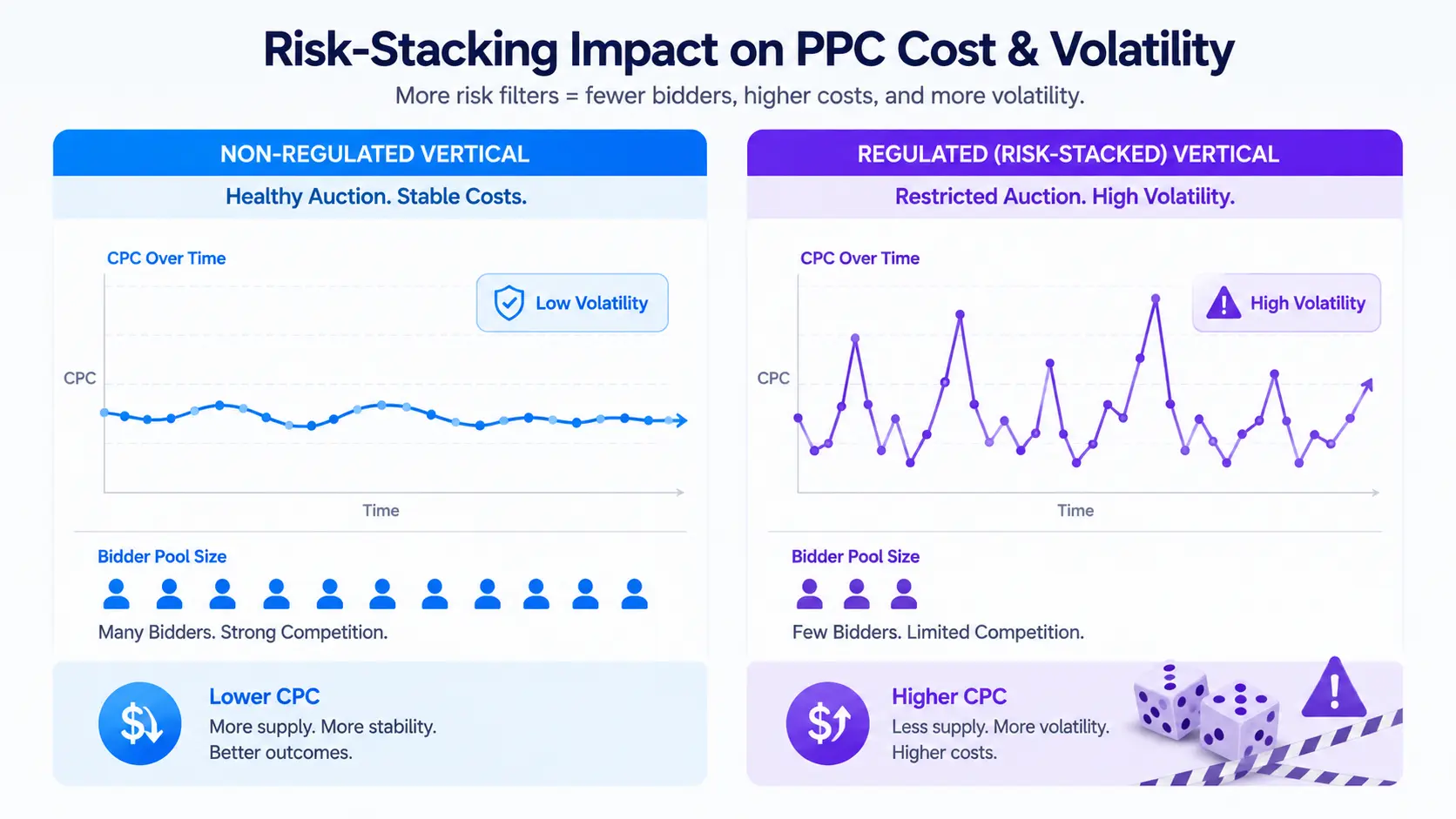
What causes sudden delivery collapses after policy shifts
Risk-weighted PPC isn’t just volatile – it’s brittle.
One algorithm tweak or policy update can erase half your eligible reach overnight.
We’ve seen this firsthand: a routine platform update reclassified a client’s core keyword set as “restricted”.
Approved ads vanished from rotation before anyone on the brand side received a notice.
Spend was ready, creative unchanged, but delivery slammed to zero.
The cause?
A single policy flag in the system, not a creative or conversion issue.
If a compliance filter flags even a hint of sector-wide risk, whole campaigns face a delivery cap – even when rules are meticulously followed.
No amount of creative testing or bid bumping will solve for the root issue.
It’s like driving a car that runs into invisible walls: you don’t see them coming, but you’ll feel the whiplash in your results. Pay extra attention to unexplained drops or spikes in cost.
For regulated verticals, these often signal a system-level clampdown, not a tactical misfire.
Compliance wins you a ticket; risk stacking and policy shifts decide if you even get to play.

What real failure patterns indicate systemic breakdown – not creative or funnel issues
Most paid campaigns in regulated sectors die slowly – not with an error message, but through symptoms that look like normal performance drift.
The catch: the root cause almost never lives in your creative or your funnel.
Instead, invisible constraint layers – deep in the ad platform – put a ceiling on what your budget can actually buy.
When spend grows but results don’t scale
Many executives whip the budget harder when volume plateaus, expecting more spend to spark more leads.
But in risk‑weighted PPC environments, extra dollars often get you zero extra reach.
One client in addiction treatment industry doubled daily ad spend for three weeks – result: no increase in impressions, clicks, or conversions.
The myth?
That flatlining growth is a sign your creative is weak or your funnel is leaking.
In truth, you’re trapped by compliance filters and inventory constraints, not messaging.
It’s like pressing the gas pedal in a car with the handbrake on.
You’ll burn fuel, hear noise, but never pick up speed.
Ask yourself: Is my campaign hitting invisible caps, or are we really out of market?
Symptoms of Delivery Caps in High-Risk PPC Campaigns
- Increased ad spend without corresponding rise in impressions
- Flat or declining clicks and conversions despite higher budget
- Performance plateau mistaken as creative weakness
- Invisible compliance filters limiting market reach
- Wasted budget with no impact on campaign velocity
These delivery caps in high-risk PPC can’t be bypassed by budget alone.
When CTR or volume drops abruptly without funnel change
Sudden drops in click-through rate – or sharp falls in lead numbers – nearly always trigger a scramble to rework ads or tweak landing pages.
But platform scrutiny and algorithmic policy shifts in regulated categories are notoriously volatile.
We’ve seen healthcare campaigns lose half their delivery overnight, with zero on-site changes.
The common mistake: blaming UX or creative, when in fact a new compliance filter, tighter auditing, or platform-wide policy tweak just wiped half your inventory.
Picture it like flying through clear air, only to hit turbulence: nothing you did as a pilot caused the shake – conditions changed above your head.
Why does this matter?
Because chasing creative fixes here is chasing shadows. The takeaway: in regulated sectors, real PPC breakdown starts at the system level, not in your ads.
The difference is conviction – stop blaming the funnel when the platform has moved the finish line.

What to look at next when PPC feels unstable under regulation
The real risk in regulated PPC isn’t just budget loss – it’s wasted energy on the wrong levers.
Teams often dive into creative tweaks or fresh bidding strategies, expecting a rebound, while the silent killer – a platform constraint – remains untouched and invisible.
Most campaigns in high‑risk categories don’t fail because of a bad message or weak audience fit; they collapse because delivery is throttled where you can’t see it.
So where should you look before your next move?
Diagnostic and Strategic Actions for Risk-Weighted PPC Challenges
| Aspect | Effect | Explanation |
| Compliance Approval Rate | Lower | Fewer brands pass review in high-risk sectors |
| Inventory Availability | Shrinks | Restricted eligible ad slots reduce overall impressions |
| Cost Per Click (CPC) | Increases (1.7-2x) | Reduced supply and higher competition for limited slots |
| Auction Competitiveness | Decreases | Fewer eligible bidders result in de facto highest bidder wins |
| Delivery Volatility | Increases | Sudden policy shifts and risk filters cause spikes and drops |
Evaluate platform approval and inventory filters first
Hidden constraint, not creative, is usually the silent assassin.
In practice, we’ve seen fully compliant, conversion-tested ads dead on arrival – not because of copy issues, but because the compliance filter in paid media flagged their vertical for new manual review, parking spend for days.
Teams wasted cycles rebuilding ads, never realizing the original creative was stuck in a queue instead of an auction.
As mentioned earlier, think of risk‑weighted PPC like airport security: it doesn’t matter how prepared or optimized you are if you keep getting detoured by another random checkpoint.
Before spending more or swapping creative, dig into the approval logs and delivery diagnostics.
Are there “pending” statuses, longer-than-normal reviews, or repeated disapprovals for minor issues?
If so, further investment won’t accelerate results – it’ll just get stuck in the same holding pattern.
Most executives ask “why isn’t my ad performing?” when the real question is “what constraint is blocking my ad from running?” Always interrogate the constraint layers first; even a minor compliance change can bring your delivery to a standstill overnight.
Consider whether PPC is structurally viable or needs alternative channels
There’s a point where you have to question whether risk‑weighted PPC is structurally compatible with your goals.
For some verticals, no fix – creative, bid, or landing page – can consistently overcome delivery caps and policy volatility.
We’ve advised clients in financial and medical sectors to pull back, not because their ads weren’t good, but because the platform scrutiny ads faced kept throttling scale regardless of effort.
If approval constraints and inventory limits consistently stall growth despite strong funnel metrics, paid media won’t become dependable by force of will.
What’s the alternative?
Some teams redirect budget toward owned assets or earned channels – building content engines or referral systems immune to sudden policy swings.
Like rerouting traffic when a highway is closed, sometimes the only way forward is a different road entirely.
When volatility becomes the norm and platform approval becomes a dice roll, it’s time to step back and ask: Is fighting the system worth it, or is there a smarter way to grow?
The next step isn’t another creative refresh – it’s diagnosing the constraint, and if needed, redirecting energy where it returns control.
That broader constraint logic plays out in Addiction Treatment PPC & Paid Media.

Scientific context and sources
The sources below describe the economic and marketing science foundations behind diminishing returns in advertising and marketing spend. They provide empirical and theoretical context for the mechanisms discussed above, including concave response curves, advertising elasticity, and the relationship between spend intensity and marginal performance.
- Platform Risk and Market Participation
Entry into Platform-Based Markets – Feng Zhu, Marco Iansiti – Strategic Management Journal
This peer-reviewed research examines how platform governance, entry barriers, and competitive controls influence market participation and strategic behavior, making it directly relevant to understanding platform-imposed risk constraints in PPC ecosystems.
https://onlinelibrary.wiley.com/doi/10.1002/smj.941 - Algorithmic Auditing and Policy Enforcement
Algorithmic Content Moderation: Technical and Political Challenges in the Automation of Platform Governance – Robert Gorwa, Reuben Binns, Christian Katzenbach – Big Data & Society
This peer-reviewed paper examines how platforms use automated systems to audit, classify, restrict, and enforce policy decisions at scale, directly relevant to campaign throttling, enforcement opacity, and sudden policy-driven delivery changes in advertising systems.
https://journals.sagepub.com/doi/10.1177/2053951719897945 - System Bottlenecks and Delivery Throttling
Fundamentals of Queueing Theory – Donald Gross, John F. Shortle, James M. Thompson, Carl M. Harris – Wiley
This foundational quantitative reference explains how constrained processing systems create throughput bottlenecks, delays, and resource contention, providing a rigorous framework analogous to approval queues, auction congestion, and delivery throttling in PPC systems.
https://onlinelibrary.wiley.com/doi/book/10.1002/9781119453765 - Regulatory Constraints and Digital Advertising
Regulation of and by Platforms – Tarleton Gillespie – New Media & Society / SAGE Handbook of Social Media
This academic work examines how platforms create and enforce governance rules that shape visibility, participation, and acceptable behavior, offering a strong conceptual parallel for understanding regulatory constraints and compliance enforcement in digital advertising ecosystems.
https://www.microsoft.com/en-us/research/wp-content/uploads/2016/12/Gillespie-Regulation-ofby-Platforms-PREPRINT.pdf - Performance Collapse under Constraint
The Tyranny of Metrics – Jerry Z. Muller – Princeton University Press
This academic book examines how metric-driven optimization systems can create unintended distortions, brittleness, and performance collapse when operational constraints or proxy goals dominate real outcomes, directly relevant to platform-controlled PPC performance breakdowns.
https://press.princeton.edu/books/hardcover/9780691174952/the-tyranny-of-metrics
Questions You Might Ponder
Why do risk‑weighted PPC systems limit ad delivery even when demand is high?
Risk‑weighted PPC systems limit ad delivery because ad platforms prioritize compliance and risk mitigation over opportunity, capping ad inventory not by demand but by regulatory and reputational risk tolerance, regardless of how much market interest exists.
What causes sudden spikes in CPC and volatility in regulated PPC campaigns?
Sudden CPC spikes and volatility often stem from platform risk models narrowing auction supply due to policy changes, compliance flags, or sector reclassification, not from creative or bidding issues. This makes approved campaigns pay premium rates and experience unstable delivery.
How can I tell if my paid campaign in a regulated sector is being throttled by the platform?
Key signs of throttling include flat or declining impressions and conversions despite increased budget, sudden ad review delays, or unpredictable rejections. If spend rises but results stagnate, invisible compliance filters and inventory limits are likely active.
What should marketing teams evaluate first when PPC performance drops in high-risk industries?
Before changing creative or bids, teams should analyze platform approval logs, delivery diagnostics, and compliance status. Delays, repeated disapprovals, or long review queues often reveal bottlenecks upstream of ad creative or funnel strategy.
When is it time to switch from PPC to alternative channels in regulated verticals?
If campaign growth consistently stalls and volatility is triggered by compliance constraints and inventory caps – not messaging or bidding – shifting budget to content marketing, SEO, or referral programs may deliver more reliable results than risk‑weighted PPC.