
What You’ll Learn
PPC intent mismatch is the gap between what a paid click appears to signal and what the visitor is actually ready to do after clicking.
PPC often captures interest, curiosity, or research behavior, not immediate buying intent.
Intent mismatch happens when ads, keywords, audiences, offers, landing pages, follow-up, or sales handoffs treat awareness-stage visitors like decision-ready buyers.
This creates high click volume but weak lead quality, low opportunity rates, stalled sales conversations, and wasted spend.
It becomes worse when broad match, algorithmic expansion, or poorly aligned funnels increase traffic without preserving intent clarity.
Strong PPC performance requires matching message, offer, and next step to the buyer’s real readiness stage.
Key Takeaways
- PPC clicks signal interest but rarely indicate immediate buying intent, necessitating intent-stage segmentation for profitable lead generation.
- Most lead quality issues stem from post-click misalignment – when follow-up, funnel, or messaging fails to match initial ad intent.
- Algorithms and keyword expansion can drive volume but worsen PPC intent mismatch, requiring strict controls to preserve lead value.
- High-performing teams escalate fixes downstream – reviewing tracking, funnel, and operations – once ad-level improvements plateau.
Most executives assume a click signals a ready buyer.
In reality, that single tap is often nothing but fleeting curiosity – one finger on the mouse, but no hand raised to buy.
If you’ve ever seen thousands of clicks turn into a handful of real conversations, you’ve already lived this gap: PPC intent mismatch isn’t a bug, it’s baked into how paid media works.
The broader logic of buying decisions under constraints is explored in PPC & Paid Media.

How PPC Captures Interest, Not Decisions
Picture your search traffic as a spectrum, not a funnel.
On one end, your visitors are information-hunting: researching broadly, comparing, sometimes just browsing.
On the other, a few are urgent and primed to act.
Think of it like airport travelers: everyone heads to the gates, but only a fraction are ready to board your plane.
Understanding the intent readiness spectrum in paid media
Here’s the myth – every click reflects the same value.
It doesn’t.
We’ve seen B2B clients spend six figures on hyper-targeted campaigns only to find that most leads stalled in evaluation, never crossing into sales discussion.
That’s not just an attribution flaw; it’s a misread of intent readiness.
Those who click are rarely on the same page as those who convert.
Why does this matter?
Because segmenting your offers by intent stage is not optional if you want profitable acquisition.
The difference between research and purchase intent is the difference between window shoppers and actual buyers.
If you treat them the same, your lead quality in PPC will always disappoint – and your cost per acquisition spikes for the wrong reasons.
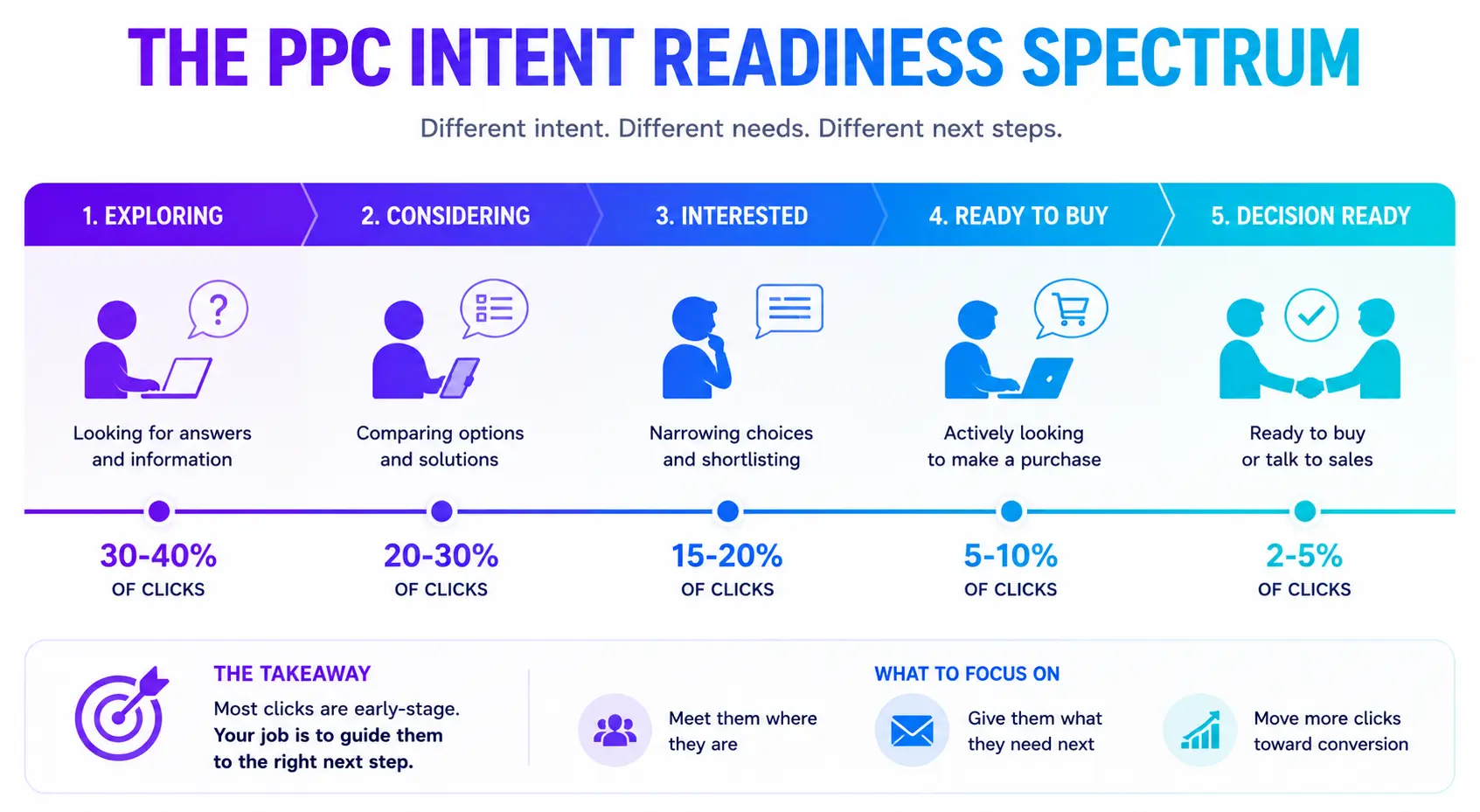
Why keyword matches don’t guarantee decision-level engagement
A keyword match feels like evidence, but it’s often camouflage.
People Google “best agency” as often for curiosity as for contracts.
Our team once audited an account where 70% of conversions came from mid-funnel queries – meaning most were just looking, not buying.
Here’s the problem: Search engines reward clicks, not commitment.
Keyword targeting catches a wide net, but doesn’t filter for those with actual purchase intent.
Ask yourself: How many of your “qualified” leads are simply interested in a report, demo, or quick answer?
How often does a high match rate mask a low show-up rate?
Think of your PPC as a magnet – it attracts metal, but not all metal is gold.
Focusing on message match without understanding post-click intent mismatch leaves you optimizing for curiosity instead of conversions.
The strongest metric isn’t the click, but what happens after.
That’s the insight marketers skip: Most PPC campaigns perform as designed – the problem is what they’re actually designed to capture.
This is a classic example of post-click intent mismatch, where surface engagement conceals readiness gaps.
Clicks measure interest, not decisions.
Grade your pipeline accordingly – and remember, the gap between click intent and sales readiness is where profit leaks out fastest.

What PPC Controls – and Where Responsibilities Shift
Most teams throw more budget or creative at campaigns that underperform.
The real problem?
PPC only shapes the start of the journey – then its influence vanishes, fast.
Many executives keep pulling levers in the ad account, chasing lift that can’t be found there.
That’s not just wasted effort; it can misdiagnose where performance breaks down.
Where PPC influence ends and funnel or sales begins
Treat PPC like a turnstile: it can count who enters, but it doesn’t direct where they go inside.
We’ve seen global SaaS teams invest six figures refining ad copy on the assumption that a lead drop means bad targeting.
After reviewing their journey, it was clear – ads brought in qualified curiosity, but handoff to sales buried real prospects in a generic drip.
The myth is that perfect campaigns guarantee sales-ready leads.
In practice, ad platforms deliver intent signals, not signed contracts.
Ask this: are you optimizing ad spend after users leave your controlled environment, or isolating the true handoff point?
The system boundary sits at the moment a prospect lands post-click – everything after involves website experience, lead nurturing, sales process, or operations.
One insight from client reviews: The biggest ROI gain usually happens when teams escalate from ‘campaign tweaks’ to ‘funnel diagnostics’ the minute patterns emerge downstream (like high-quality clicks but sagging conversions).
Don’t keep sanding the wrong end of the board.
When tracking or messaging breakdowns mask performance issues
Warning Signs of Tracking or Messaging Breakdowns
- Sharp, unexpected conversion metric drops
- No improvement despite bid or creative changes
- Tracking pixels or analytics code failures
- Landing page messaging inconsistent with ads
- Post-click confusion causing low engagement
A sharp conversion drop isn’t always an ad problem – it’s often a tracking, attribution, or messaging miss hiding the real leak.
We’ve surfaced cases where ‘conversion’ metrics tanked overnight, and the knee-jerk response was to slash bids.
The culprit?
One pixel breaking or a landing page headline rewriting the meaning of the offer.
No bid strategy can fix invisible reporting or post-click confusion.
The question isn’t, “Are my ads bad?” but “Where in the system did outcomes diverge from intent?” Executives who distinguish pipeline friction from platform underperformance move faster to solutions.
Here’s the analogy: imagine a GPS that plots your path flawlessly until you hit a roadblock nobody mapped.
Staring at the app won’t clear the street – your focus has to shift to what’s beyond the screen.
Every high-performing PPC program learns this boundary: ad optimization delivers interest; conversion demands system clarity.
When campaign data says ‘stall,’ that’s when responsibility must move downstream – fast.

Why Timing and Intent Misalignment Derails Lead Quality
The cost of poor lead quality in PPC is rarely about ad failure – it’s the direct result of mismatched timing and intent.
Executives assume that clicks equal decision-ready leads, but the gap between when buyers are curious and when they’re ready to commit is where most of the profit leaks away.
That disconnect – known as PPC intent mismatch – means strong campaigns still deliver weak pipeline when expectation and readiness don’t align.
The cost of using awareness-level traffic for decision-driven offers
Pushing a hard decision on a visitor still gathering information is like dropping a proposal ring on the first date – predictable outcome, wasted effort.
We see this disconnect play out in campaigns that report strong inbound numbers but result in sales teams chasing ghosts.
One SaaS client spent six figures driving demo signups – conversion spiked, but close rates flatlined.
Why?
The majority arrived looking for pricing or feature lists, not ready to buy.
Every dollar spent attracting awareness-stage clicks fuels a false-positive pipeline, hiding opportunity cost beneath the surface.
Consider the numbers: A campaign converts at 8%, but only 1% of leads become opportunities.
The remaining 7%?
Window shoppers, clearly marked by short session durations and zero engagement with downstream sales materials.
That’s not just wasted budget – it clogs your sales process, distracting teams from true buyers.
What’s invisible is often the most expensive.
How many follow-up calls are lost on “leads” who bounced before reading your offer?
How platform broadening effects dilute intent clarity
The platforms promise more volume – just widen targeting, add similar audiences, or trust the algorithm.
But volume without intent is a leaky faucet: consistent flow, no pressure.
Algorithms aren’t optimizing for sales readiness, but for proxies like similar keywords or audience lookalikes.
The further the net is cast, the further you drift from intent.
We’ve watched performance drop when platforms expand match types or loosen audience parameters.
One B2B fintech campaign doubled its traffic using auto-broadening features – yet lead quality fell off a cliff.
Session recordings revealed visitors didn’t match ICP, nor did their queries signal urgency.
Instead of “RFP for enterprise solution”, platforms delivered swarms of “how does fintech work” clicks.
Intent clarity is a diminishing asset the broader you go.
The critical question: Is algorithmic expansion fueling growth, or just creating more data to sift through for the same handful of workable leads?
Getting lead quality right starts with respecting timing and intent – otherwise, you pay premium rates to fill your funnel with pre-decision noise, not pipeline.
The fastest way to improve lead quality isn’t one more tweak to PPC – it’s closing the gap between what buyers want right now and what you ask them to do next.

When to Stop Blaming PPC and Reroute the Problem
Most PPC failures aren’t digital ad failures – they’re handoff failures hiding in plain sight.
Chasing every dip in lead quality through platform tweaks is like tuning your car’s radio when the engine won’t start.
If your campaigns drive high click volume but conversions stagnate, it’s rarely a bidding issue.
The unseen gap is where intent, message, and funnel meet – and break.
Patterns that signal funnel or handoff failure, not PPC
Symptoms Indicating Funnel/Handoff Failure vs PPC Issues
| Symptom | Description | Likely Cause | Recommended Action |
| High bounce rates on post-click pages | Users leave quickly after clicking ads | Funnel or landing page problem | Audit landing page and user experience |
| Sudden form drop-offs | Users abandon lead forms before submitting | Form issues or poor incentive | Review form usability and messaging |
| Sharp drop in sales after strong lead influx | Sales numbers fall despite many leads | Handoff or sales process breakdown | Coordinate sales and marketing alignment |
| Callers citing wrong offer or misunderstanding value | Miscommunication in messaging after lead capture | Broken messaging continuity | Align messaging across funnel and sales |
| Hidden form formatting bugs | Technical issues reducing conversions unnoticed | Technical/tracking errors | Fix bugs and verify tracking |
If your qualified lead count tanks even as click-through rates and cost per click improve, the problem isn’t always in the campaign.
We see it most when sales complain about “weak” leads and marketing stays stuck swapping keywords.
High bounce rates on post-click pages, sudden form drop-offs, or sharp drop in sales after what looked like a strong lead influx – these are classic signs.
One client’s PPC channel delivered volume, but a hidden form formatting bug cut conversion by 40% overnight.
No ad would fix that.
Another pattern: callers citing the wrong offer or misunderstanding your value prop entirely – almost always rooted in mismatched handoffs or broken messaging continuity, not in platform targeting.
How often are leads passed into sales without proper scoring, or follow-up workflows left idle?
We’ve watched pipeline reports glow green while pipeline velocity crawls – a disconnect that ad tweaks can’t solve.
The strongest indicator: quality metrics diverge downstream, while top-of-funnel looks healthy.
That’s not a PPC intent mismatch – that’s a system break after the click.
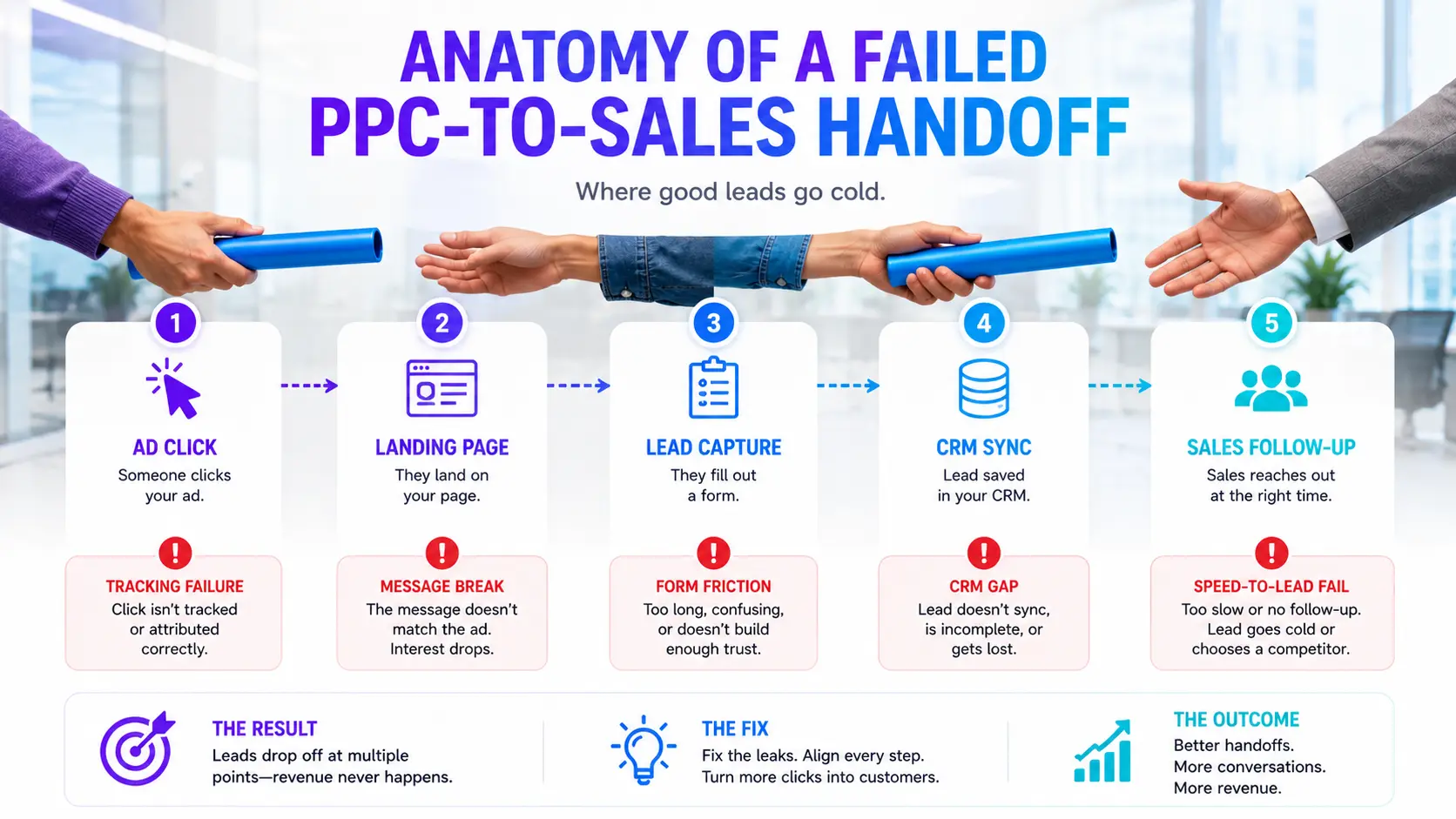
Decision-stage checkpoints for escalating to operational teams
Checkpoints to Escalate PPC Issues to Operations
- Consistent PPC metrics fail to generate revenue or qualified pipeline
- Persistent CRM data syncing issues
- Sales cycle bottlenecks at initial contact points
- Attribution anomalies like phantom conversions
- Leads do not translate into pipeline velocity
What’s the moment to escalate?
If you’ve optimized targeting, tightened copy, improved landing speed, and leads still disappoint, it’s time to involve operational or CRO teams.
The checkpoint is simple: when consistent, valid PPC metrics don’t translate to revenue or qualified pipeline, move downstream.
Even when intent exists, expectations define lead quality.
A prospect may click with genuine interest, but if messaging, offer framing, or the handoff creates a mismatch between what they expected and what they encounter next, lead quality deteriorates before sales even engages.
Unresolved CRM data syncing?
Hand it to ops.
Sales cycles clogging at the first call?
Funnel review.
Attribution anomalies, like “phantom” conversions that never reach fulfillment – analytics audit needed.
One insight we share with every executive: think of your PPC program as an airport gate.
If passengers keep boarding the wrong flight, the problem isn’t with the runway.
Fixing the gate process – or the signposting after security – often matters more than adjusting flight schedules.
What you escalate and when is the difference between scaling and stalling.
The bottom line: don’t let PPC serve as a scapegoat for conversion leaks.
Spot the signals, pass the baton, and accelerate real fixes where they count.

Scientific context and sources
The sources below describe the economic and marketing science foundations behind diminishing returns in advertising and marketing spend. They provide empirical and theoretical context for the mechanisms discussed above, including concave response curves, advertising elasticity, and the relationship between spend intensity and marginal performance.
- Decision-Making Under Uncertainty
Judgment under Uncertainty: Heuristics and Biases – Daniel Kahneman, Paul Slovic, Amos Tversky – Cambridge University Press
This academic book is a foundational work on how human decision-making systematically departs from rational models, making it highly relevant to understanding mismatches between observed user behavior and inferred intent in digital marketing.
https://www.cambridge.org/core/books/judgment-under-uncertainty/6F9E814794E08EC43D426E480A4B412C - Attribution and Channel Performance
The Path to Purchase and Attribution Modeling: Introduction to Special Section – P.K. Kannan, Liye Ma
International Journal of Research in Marketing
Summarizes the complexity of attribution across multiple digital touchpoints, showing why PPC performance can be misread when channel contribution is oversimplified.
https://www.sciencedirect.com/science/article/abs/pii/S0167811616300817 - B2B Buying and Intent Signals
A General Model for Understanding Organizational Buying Behavior – Frederick E. Webster Jr., Yoram Wind – Journal of Marketing
Explains how organizational purchasing decisions involve multiple stakeholders with differing intent, making simplistic interpretations of clicks or form fills as purchase readiness unreliable.
https://journals.sagepub.com/doi/10.1177/002224297203600204 - Impact of Ad Placement and Timing on Outcomes
An Empirical Analysis of Search Engine Advertising: Sponsored Search in Electronic Markets – Anindya Ghose, Sha Yang – Management Science
Examines how ad position, competitive dynamics, and user behavior affect paid search performance, supporting analysis of intent mismatch and conversion variability in PPC environments.
https://papers.ssrn.com/sol3/papers.cfm?abstract_id=1022467 - Signal Detection, Noise, and Marketing Funnel Drop-off
Signal Detection Theory and ROC Analysis in Psychology and Diagnostics: Collected Papers – John A. Swets – Lawrence Erlbaum Associates
Provides the foundational framework for distinguishing true signal from noise in decision systems, conceptually useful for understanding unqualified traffic, false positives, and funnel interpretation errors in marketing analytics.
https://www.taylorfrancis.com/books/mono/10.4324/9781315806167/signal-detection-theory-roc-analysis-psychology-diagnostics-john-swets
Questions You Might Ponder
What causes PPC intent mismatch and how does it impact lead quality?
PPC intent mismatch occurs when users click on ads for information but are not ready to purchase. This results in lots of traffic but few true leads, increasing acquisition costs and straining sales teams who must sift through non-decision-ready prospects.
How can marketers align PPC campaigns with different stages of buyer intent?
By segmenting offers and messaging according to research, consideration, and decision stages, marketers can create tailored post-click experiences. This ensures that calls to action and follow-up match readiness – boosting conversion rates and improving lead quality.
Why do high click-through rates not guarantee sales-ready leads?
High CTRs indicate curiosity, not purchase intent. Many users investigate products or services, but only a small segment is ready to buy. Relying solely on CTR overstates pipeline health, leading to inefficient spend and missed optimization opportunities downstream.
What signals indicate a breakdown after the PPC click, rather than in the campaign itself?
Sharp drops in conversions with stable PPC metrics, high post-click bounce rates, CRM syncing problems, and inconsistent landing page messaging signal a post-click breakdown. These issues highlight where pipeline friction, not ad design, is leaking value.
How does platform-driven audience expansion affect PPC intent clarity?
Algorithmic broadening (wider targeting, lookalikes) brings volume but dilutes lead quality. As audience definitions loosen, more unqualified users click through, obscuring true buying intent and forcing sales to sort through excess low-probability leads.