
What You’ll Learn
Good PPC lead definition is the shared standard a business uses to decide whether a paid media lead has real value beyond a click, form fill, or low cost per lead.
A good PPC lead is not absolute; it depends on intent, fit, readiness, timing, sales capacity, validation quality, and the outcome each team is measured against.
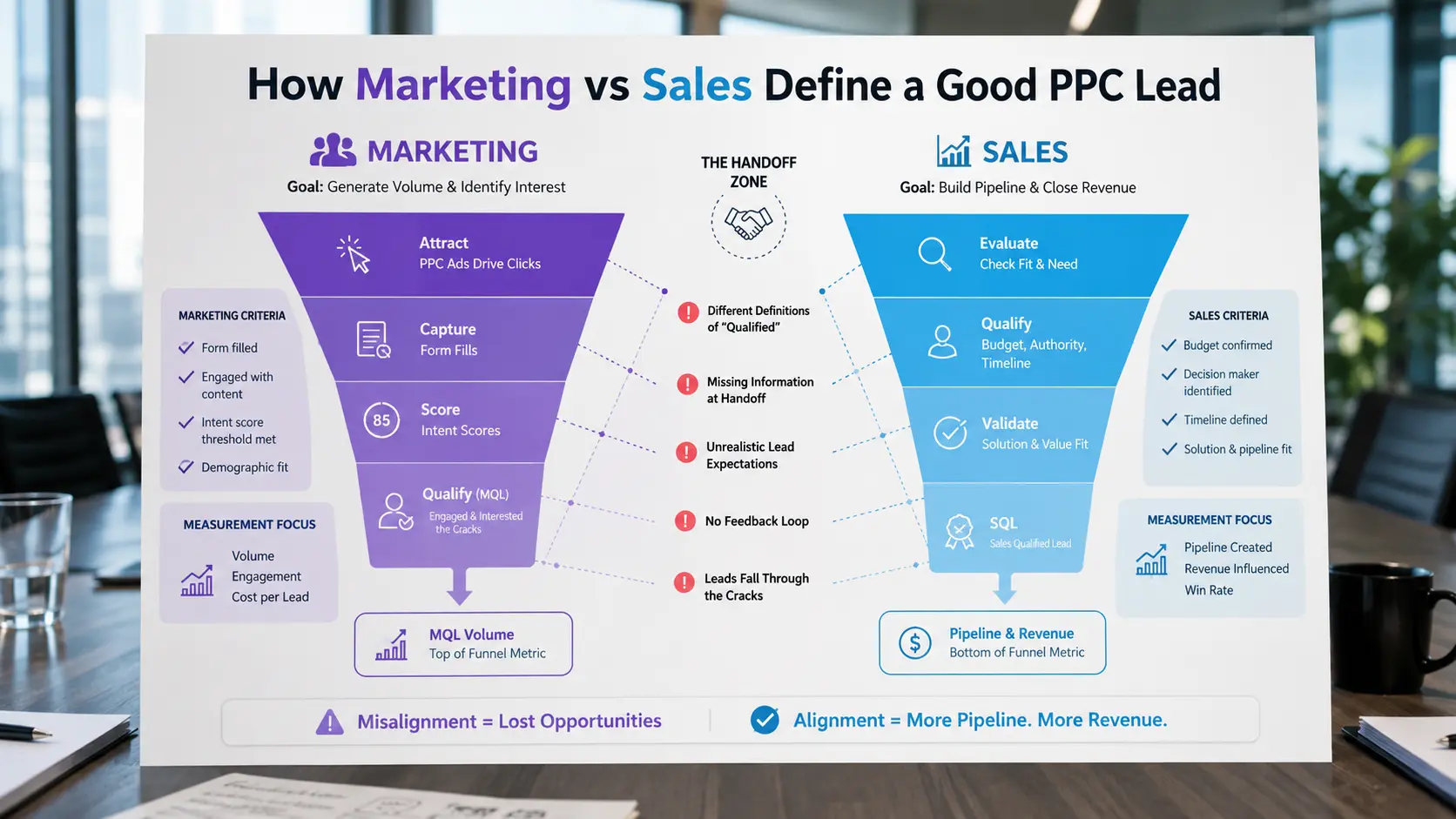
Marketing may define “good” as a captured intent signal, while sales defines it as a contact with budget, authority, need, timeline, and a realistic chance to convert.
A strong definition aligns PPC targeting, offer, qualification, handoff, and revenue feedback so lead quality is judged by downstream value, not volume alone.
Key Takeaways
- The definition of a good PPC lead is context-dependent, shaped by whose outcomes are measured – marketing or sales.
- Timing and capacity constraints play a pivotal role in how lead quality is perceived and acted upon by organizations.
- Focusing only on metrics like cost per lead can mask underlying pipeline issues and lead to operational inefficiencies.
- True improvement in lead quality comes from redefining criteria and aligning definitions across teams, not just changing ad tactics.
Most PPC teams celebrate when the leads start pouring in, but ask sales what’s “good” and you’ll get a very different answer – sometimes outright laughter.
It’s not dysfunction, it’s the direct result of two departments chasing different outcomes with the same word.
The definition of a good PPC lead is less about absolutes than whose goals get measured.
That broader logic appears in PPC & Paid Media.

What does a ‘good PPC lead’ even mean – and why it varies by role
Marketers point to filled forms, webinar signups, or high-scoring intent signals as proof of victory.
For them, a lead’s value lives above the funnel: did someone click?
Did the channel deliver intent?
In two recent client workshops, marketing leads described “good” as high volume plus completion of a contact action – ambitious and data-driven, but often divorced from pipeline reality.
How marketing and sales define ‘good’ differently
Sales, meanwhile, cares about readiness.
“Good” means qualified budget, authority, genuine timeline, and a live pain – what closes, not what clicks.
They see marketing’s version of “good” almost like a half-baked cake: promising at the top, unfit for consumption at the bottom.
This collision isn’t petty – it’s baked into how each team gets judged.
Comparison of Marketing vs Sales Definitions of a Good PPC Lead
| Factor | Effect on Lead Quality | Example from Article |
| Follow-up Speed | Delays reduce conversion odds and retroactively decrease lead value | Missed deals due to 60+ minute follow-up lag |
| Sales Capacity | Overload leads to neglect, downgrading, or ignoring extra leads | Leads labeled ‘good’ shrank on Mondays due to weekend backlog |
| Volume vs Capacity Balance | Mismatch creates shifting standards for what counts as ‘good’ | PPC produces 20 leads but sales can handle 10 a day |
Here’s the myth: Converting intent signals directly into sales outcomes skips the fact that these roles don’t just want different things – they’re operating under different systems entirely.
A marketer optimizes for signals of interest, a salesperson for proof of need.
So what happens when intent capture and close-ability don’t overlap?
Chaos, handoffs fumbled, and finger-pointing over why sales “rejects” leads by default.
A useful analogy: Defining a “good” PPC lead is like defining an “ideal” job applicant.
HR may filter for resumes that check every skill box, but the hiring manager only interviews the few candidates who actually fit the team’s needs and show up ready.
Both think they’re describing quality, but they’re spotlighting different lists.
Which leads to the insight we see at every growth-stage client: A “good lead” in PPC isn’t a standard; it’s a byproduct of which department owns the finish line.
Why timing and follow‑up capacity shift lead quality
Factors Impacting Lead Quality Beyond Intent
| Aspect | Marketing Definition | Sales Definition |
| Focus | High volume, completion of contact actions, intent signals | Readiness: qualified budget, authority, timeline, live pain point |
| Measurement | Clicks, form fills, webinar signups, intent scores | Proof of need, deal closure likelihood |
| Outcome | Above funnel engagement | Pipeline conversion and closed deals |
Even the rare lead who’s both interested and qualified can sour fast if timing slips.
We’ve watched companies burn six-figure budgets only to miss deals because the follow-up engine lagged by sixty minutes.
Speed doesn’t just increase conversion odds; it retroactively decides whether that lead ever had value in the first place.
Capacity constraints add new subjectivity to lead quality.
If sales has headcount to handle ten hot inquiries a day, and PPC drops twenty, the extra ten may get neglected, downgraded, or written off entirely.
In one SaaS client, “good” magically shrank on Mondays simply because salespeople were buried by weekend leads – volume alone shifted the standard.
So, is the lead actually “bad”, or did it become less valuable when timing and attention bottlenecked?
Does the channel deserve blame, or is the system defining “quality” to fit gaps in resourcing?
Treat lead quality less like a pass/fail grade, more like a moving target defined by internal bandwidth and responsiveness.
What’s golden to a hyper-responsive inside sales team might go straight to the recycle bin at a company stuck in triage mode.
“Good PPC lead” isn’t objective reality – it’s a mirror for your own handoff, speed, and what each role is truly resourced to pursue.
If you want better lead quality, first interrogate whose yardstick you’re using.

When a lead looks bad but clicked intentionally: intent versus outcome mismatch
The gap between leads that look perfect in platform reports and those that flop on sales calls isn’t about click intent – it’s about the invisible boundaries between capturing interest and closing a deal.
PPC excels at generating intent, but guaranteeing outcomes?
That’s where the handoff to the rest of the business, not the ad engine, makes all the difference.
Clicks don’t equal commitment – what platforms control and what they don’t
Picture this: a campaign drives hundreds of clicks with near-perfect targeting, yet sales sees more tire-kickers than buyers.
The core misunderstanding is simple – ad platforms specialize in generating interest, not decisions.
They can put your offer in front of the right eyes but can’t force genuine commitment.
We’ve seen clients burn thousands optimizing toward higher CTRs and form fills, believing measurable engagement equals actual demand.
It doesn’t.
It’s like inviting prospects to a showroom and celebrating every footstep, when real value comes from who actually buys.
These boundaries matter because PPC’s job ends at capturing a signal – not at qualifying, nurturing, or closing.
Is your team tracking what you control, or blaming ads for what happens after the click?
When low‑intent or invalid traffic wastes good lead definition
Now, add another layer: not every click signals high intent.
Some are accidental.
Others arrive from bots, affiliates, or confused visitors looking for something else entirely.
We’ve audited accounts where up to 35% of ‘leads’ failed even basic validation – wrong verticals, fake emails, or zero follow-up potential.
Suddenly, what looked like “good PPC leads” pollutes the pipeline downstream.
The analogy: treating every ticket at a seminar as a future client, knowing half may just want the refreshments.
How meaningful is your lead metric if weak clicks outweigh genuine prospects?
One grounded insight: high-volume campaigns almost always surface this waste unless exclusion and filtering are aggressive.
Don’t let system boundaries mask the truth – sometimes the ‘good’ lead problem begins before your sales team ever picks up the phone.
This context is central to any good PPC lead definition discussion.
The core idea: PPC can make intent measurable, but outcome remains stubbornly out of reach.
Before doubting your lead sources, question what the data actually reflects – and whether your definition of “good” stops at the click or tracks all the way to revenue.

When ‘cheap leads’ collapse downstream business value
Most leadership teams feel good watching cost per lead drop – until revenue stalls or sales complaints spike.
The real shock is this: “Cheap leads” can quietly bleed the pipeline dry, even as dashboards glow green.
CPL obsessions often distract from what actually moves profit downstream.
Why lower cost per lead may hide lower real value
Here’s a myth that’s deadly for growth: lower CPL always means higher efficiency.
Reality stings – platforms reward volume and surface-level conversions, but don’t check if those leads close.
We’ve watched B2B services firms cut CPL in half only to see opportunity values crater; the pipeline swelled with contacts nobody could reach or qualify.
Metrics disconnect further when outbound sales waste time on “leads” generated by bots, incentives, or misaligned keywords.
Think of it like filling a tank with low-octane fuel: The gauge reads full, but performance sputters.
How many campaigns show a healthy CPL while sales teams quietly reclassify most of those leads as unworkable?
How much revenue never materializes because “success” was defined by a finance-friendly metric, not real business outcomes?
Lowering CPL without enforcing rigorous qualification is false efficiency – and often masks the steep downstream cost of cleaning, chasing, and retiring bad leads.
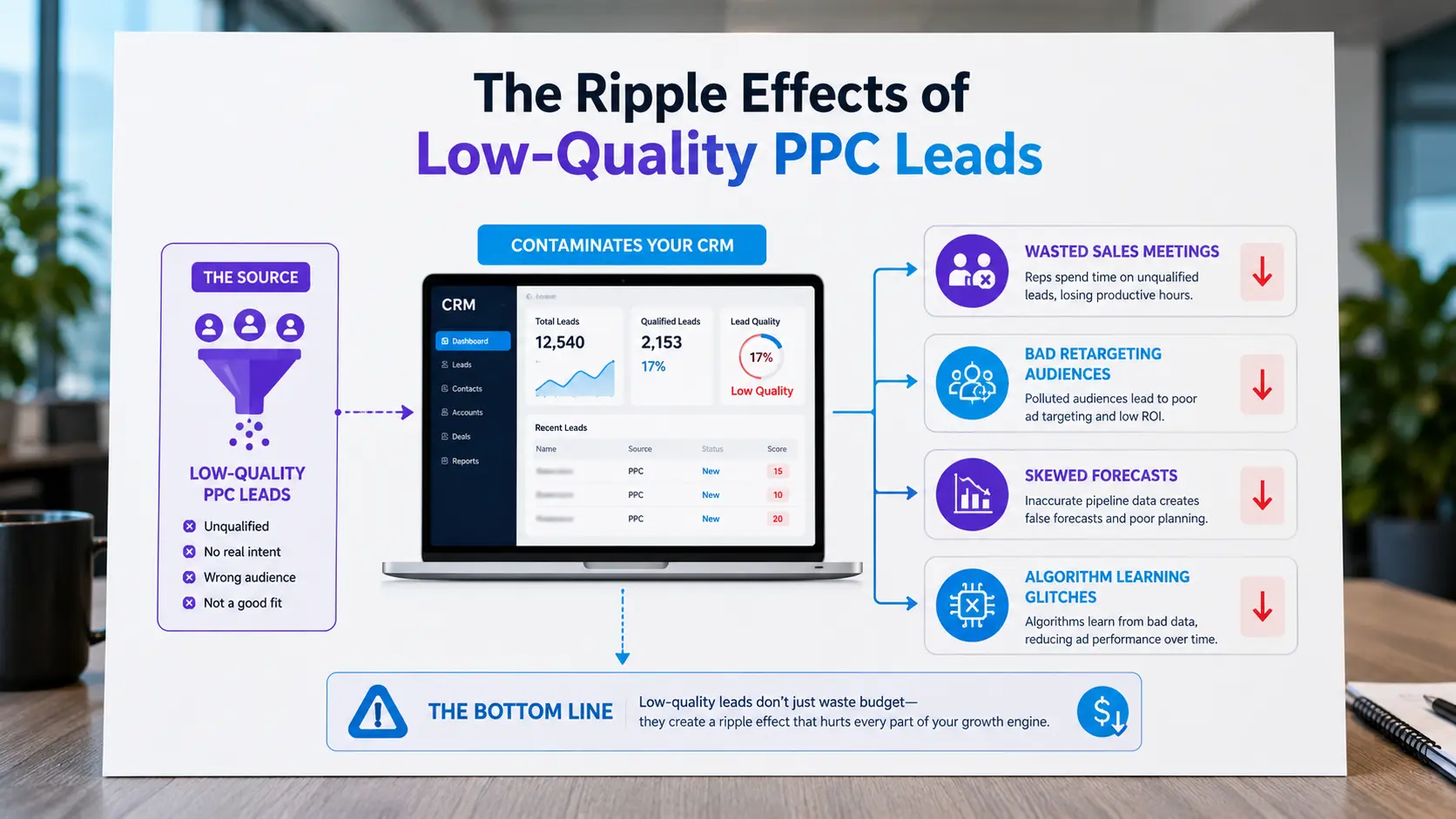
How poor leads pollute CRM, audience models, and optimization logic
Bad leads don’t just disappear – they contaminate everything downstream.
When low-quality PPC traffic floods your CRM, the consequences ripple far past lost sales.
Scenarios we see: account execs waste cycles chasing tire-kickers, audience lists fatten up with junk data, and algorithms “learn” from all the wrong signals.
It’s not just a clean data problem; operational drag creeps into forecasts, budget plans, and every touchpoint that relies on audience insights.
Is your CRM segment full of ghosts nobody responded to?
Are nurtures and retargeting spending real money on contacts that never had potential?
The issue isn’t a conversion rate tweak; it’s that definitions have failed systemically.
As one client put it, “Our best model chased bad apples for six months before we noticed”.
Efficiency at the top can mean dysfunction at the bottom.
A cheap lead that can’t move is a liability, not an asset.
What looks like a cost win at the ad platform often becomes a silent tax on the entire revenue engine.
The true value of a lead comes out only after it survives every step – from first click to actual customer.

How to spot a definition mismatch before blaming PPC
Blaming the ad channel when lead quality drops almost always misses the mark – the real culprit is usually the definition of ‘good.’ If marketing and sales rate the same contact worlds apart, the issue isn’t weak traffic, it’s misaligned scoreboards – sometimes sharpened by urgent handoff gaps rather than campaign misfires.
Listening to sales: what rejection language reveals
Common Sales Rejection Phrases Indicating Definition Gaps
- “Not a real opportunity”
- “Wasting our time”
- “Marketing sent us tire-kickers”
- “Leads never have authority”
- “The brief was for something else”
A string of phrases – “not a real opportunity”, “wasting our time”, or “marketing sent us tire-kickers” – isn’t just venting.
It’s an X-ray into system boundaries.
We see this in client rooms every quarter: marketing reports record lead volume spikes, but sales pipelines droop, and complaints rise.
Listening for pattern language exposes whether sales is rejecting leads due to incomplete fit, impossible timelines, or gaps only the sales process reveals.
If sales says “marketing leads never have authority” or “the brief was for something else”, they’re flagging where expectation and handoff fail, not merely weak traffic.
The myth is that sales rejection means bad PPC; in reality, it often points to where your definition needs tightening.
What if your qualified lead checklist is built for one stage of the buyer’s journey, but sales requires something entirely different?
When defining ‘good’ should lead you to a deeper capability, not a bid change
Key Considerations for Aligning ‘Good PPC Lead’ Definition
- Do marketing and sales agree on which traits signal a sales-ready prospect?
- Has the definition evolved with capacity and product mix changes?
- Is there an active feedback loop to sharpen quality criteria?
- Are persistent rejection patterns signaling process or ownership issues?
- Is lead quality treated as a moving target by role and timing?
We’ve watched smart teams throw budget at bid policies or ad copy, missing that the “good PPC lead definition” was drafted in a vacuum.
Picture a relay race where the handoff zone keeps shifting.
Is it any wonder the baton drops?
Your PPC team captures intent, but quality drops if there’s no feedback loop to sharpen criteria on what matters at conversion.
Instead of rewriting ads, ask: Do marketing and sales agree on which traits signal a sales-ready prospect?
Did that agreement evolve as your capacity and product mix changed?
When you spot persistent rejection patterns, that’s not a signal to flip creative or spend – it’s a cue to interrogate capability, process, and ownership.
Sometimes, real lift comes from realigning how you define “good”, not simply chasing more leads.
When you treat lead quality as a moving target defined by role and timing – not as a fixed output of your PPC channel – you gain both clarity and leverage for building the next growth layer.
Even a well-defined lead fails if handoff breaks.
That handoff-centric failure pattern is mapped further in PPC Handoff Mechanics.

Scientific context and sources
The sources below describe the economic and marketing science foundations behind diminishing returns in advertising and marketing spend. They provide empirical and theoretical context for the mechanisms discussed above, including concave response curves, advertising elasticity, and the relationship between spend intensity and marginal performance.
- Organizational Goal Alignment
Goal Setting and Task Performance: 1969-1980 – Edwin A. Locke, Lise M. Saari, Karyll N. Shaw, Gary P. Latham – Psychological Bulletin
Discusses how differing goals, performance definitions, and incentive structures shape organizational behavior, making it highly relevant to conflicts between departments such as marketing and sales over what constitutes success.
https://psycnet.apa.org/record/1981-27276-001 - Pipeline Performance in B2B Lead Acquisition
Strategic and Operational Alignment of Sales-Marketing Interfaces: Dual Paths Within an Integrated Marketing Communication Framework – Amol Malshe, Douglas E. Hughes, Michael Le Bon
Industrial Marketing Management
Examines how strategic and operational alignment between sales and marketing affects execution quality, pipeline effectiveness, and commercial performance in B2B environments, making it directly relevant to lead quality interpretation and pipeline conversion outcomes.
https://www.sciencedirect.com/science/article/abs/pii/S0019850117303991 - Impact of Speed on Conversion Rates
The Short Life of Online Sales Leads – James B. Oldroyd, Kristina McElheran, David Elkington – Harvard Business Review
Presents empirical evidence showing that response speed materially affects lead qualification and conversion rates, demonstrating that lead quality is partly operational, not purely acquisition-driven.
https://hbr.org/2011/03/the-short-life-of-online-sales-leads - Data Quality and Downstream Effects
The Influence of Quality of Big Data Marketing Analytics on Marketing Capabilities and Firm Performance – Matti Juhani Haverila, Kai Christian Haverila
Marketing Intelligence & Planning
Analyzes how data quality and analytics quality affect marketing decision-making, capability development, and downstream business performance, directly supporting the argument that poor upstream data degrades later commercial outcomes.
https://www.emerald.com/mip/article-abstract/42/2/346/1223996/The-influence-of-quality-of-big-data-marketing?redirectedFrom=fulltext - Behavioral Economics and Commitment Gaps
Nudge: Improving Decisions About Health, Wealth, and Happiness – Richard H. Thaler, Cass R. Sunstein – Yale University Press
Analyzes the gap between stated intent and actual committed behavior, helping explain why observable PPC engagement signals do not necessarily translate into meaningful business outcomes.
https://books.google.pl/books?id=dSJQn8egXvUC&printsec=frontcover&hl=pl&source=gbs_ge_summary_r&cad=0#v=onepage&q&f=false
Questions You Might Ponder
What factors make a ‘good PPC lead definition’ differ across marketing and sales?
A good PPC lead definition varies because marketing values form fills and top-funnel intent, while sales prioritizes readiness to buy, authority, and deal potential. The definition shifts based on department goals, causing friction and necessitating continual alignment for true lead quality.
How does timing impact the value of PPC leads?
A PPC lead’s value can quickly decline if follow-up is delayed. Studies show that response speed directly increases conversion chances, making timing critical for retaining lead quality after capture, not just during initial click or form submission.
Why does a low cost per lead sometimes harm pipeline revenue?
Focusing solely on lowering cost per lead frequently results in low-quality contacts that rarely convert. This false efficiency causes wasted sales resources, inconsistent pipeline forecasts, and pollutes CRM systems with unworkable leads instead of boosting business outcomes.
How can companies detect misalignment in their PPC lead definition?
Consistent language from sales – like ‘not a real opportunity’ or ‘tire-kickers’ – signals a mismatch in lead definitions. When persistent sales complaints emerge, it often indicates that criteria for lead quality require updating rather than changes in campaign spend.
What happens when PPC traffic includes invalid or low-intent leads?
Poorly filtered PPC campaigns often generate bot traffic, unqualified users, or accidental clicks. These inflate lead volumes but degrade actual deal generation, contaminating data models and wasting downstream resources on contacts who never had potential to close.